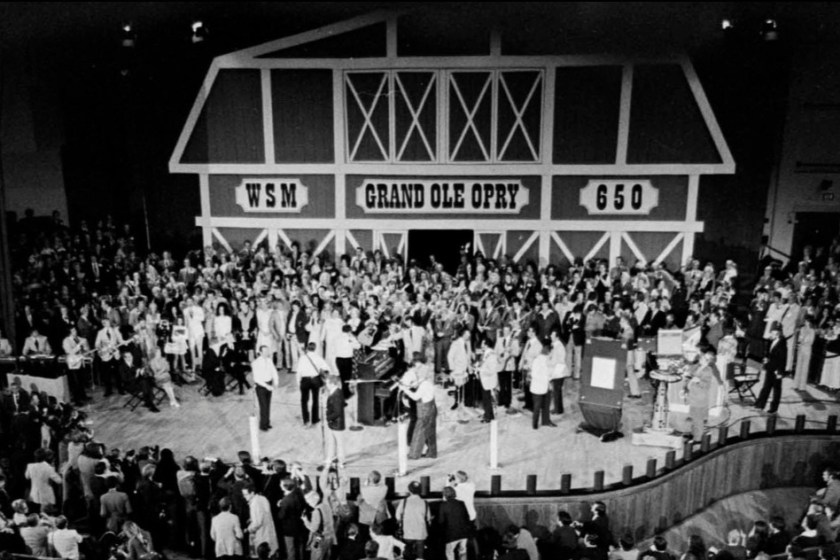
The Grand Ole Opry turns 100 years old this month.

The story is one of legend.
On November 28, 1925—100 years ago next Friday—station manager George D. Hay sits a white-bearded man before one of Nashville radio station WSM’s newfangled carbon microphones to let him play a few old-time fiddle tunes. WSM was owned by the National Life Insurance Company and the call letters stood for “We Shield Millions.”
The old man begins to play, and what happens next is magical.
“The switchboard lights up and telegrams pour in. The old man, Uncle Jimmy Thompson, plays for an hour, and across the country listeners scramble for the earphones to their old crystal radio sets. Hay gets an idea: why not have a regular weekly show of this sort of stuff? Soon he is besieged by pickers and fiddlers of every variety: ‘We soon had a good-natured riot on our hands,’ he recalled.”
From that single session, the Grand Ole Opry was born.

A Good Natured Riot: The Birth of the Grand Ole Opry (1999) by Charles K. Wolfe is a highly readable yet thoroughly documented account of the early years of The Grand Ole Opry. George D. Hay’s account of the birth of the Opry on that memorable November night is fairly accurate, but Wolfe contends that the actual story is even more dramatic and in more complicated ways. As one reviewer at the time of its publication noted, what makes Wolfe’s book so compelling “is that it shows the intersection of the birth of the Opry with so many other important, and often overlooked, cultural moments.” In doing so, Wolfe examines the background and lives of the key performers on the early Opry to an audience that has largely forgotten Uncle Jimmy Thompson, Dr. Humphrey Bates, Uncle Dave Macon, DeFord Bailey, along with the radio fiddlers and hoedown bands of the era. It is a masterful work that I reread in honor of the Opry’s anniversary and because of my personal ties to Charles Wolfe.
The Opry comes along at the dawn of radio, and several of the unique features of the pioneering stations are included in Wolfe’s account. The clarity of the airwaves in those days allowed WSM, on only 1,000 watts, to broadcast nearly coast-to-coast. Hays’ decision to present a program of what was then called “old time music” was in itself controversial, especially in the station’s home town. In the early decades of the 20th century, just after the infamous Scopes Trial in Dayton, Tennessee, the city of Nashville worked to assert its high-brow aura, branding itself “The Athens of the South.” Old time music seemed lowbrow, yet its popularity pushed the format forward. It is largely due to the Opry’s location there that Nashville is known today as the home of country music.

It may surprise many to know that the Opry was, in its early days, one of the few venues that featured both black and white musicians. “The folk roots of the early Opry’s music was nowhere more clearly demonstrated,” writes Wolfe, “than in the career of DeFord Bailey.” That black musicians fell out of country music is an aspect of the transition from old time to country, and one that Wolfe handles sensitively. One of Bailey’s most famous songs was the Pan American Blues, where he mimicked the sound of a passing train on his harmonica.
Another chapter features the story of Uncle Dave Macon, “with his chin whiskers, gold teeth, and open-backed Gibson banjo” who was the first real star of the Grand Ole Opry in addition to being one of the most colorful personalities in the history of the music. Known as “The Dixie Dewdrop,” Uncle Dave’s music is considered an important bridge between 19th-century American folk and vaudeville music and the phonograph and radio-based music of the early 20th-century, as Wolfe aptly documents. There are a few videos taken late in Uncle Dave’s career. My favorite is the following clip from the Grand Ole Opry Movie, with Uncle Dave and his son Dorris playing Take Me Back to My Old Carolina Home.
This book has personal memories for me.
When I was a young undergraduate student at Middle Tennessee in the late 1970s, there were two English professors who influenced my life in ways that I’m still only understanding. One was Ralph Hyde, who was serving as editor of the Tennessee Folklore Society Bulletin. Ralph published the first articles of mine in a professional journal or magazine, introduced me to the rich cultural traditions of the mid-South, and gave me my first bottle of moonshine. I still think all three are significant in shaping my life.
The other was Charles Wolfe, who taught English, succeeded Ralph as the editor of the TFS Bulletin, and—most importantly—brought scholarship and love to old time and bluegrass music. Charles was an avid collector, writer, and recorder of music from the mid-South, and I was lucky enough to be with him on occasions when he was recording or interviewing some of the area’s old-time musicians.
Charles and I were both featured as “talking heads” in a Nashville Public Television production entitled The Ryman: Mother Church of Country Music. Charles is one of the country music experts while I speak about the preservation issues along with other Nashville preservationists. And the story of the saving of the Ryman is worth noting.
Shortly before the Opry was moved from downtown Nashville’s Ryman Auditorium to the newly built Opry House in 1974 and plans were announced to raze the old building, John Hartford released Tear Down the Grand Ole Opry, a scathing commentary on the commercialization of country music.
“Right across from the wax museum |They used to line up around the block | From east Tennessee and back down home they came | All of a sudden there’s nothing to do where there once was an awful lot | Broad Street will never be the same.”
Hartford sings nostalgically on his legendary Aereo-Plain album. “Aereo-Plain,” as one reviewer noted, “is a song cycle which celebrates the rise and fall of the old time music subculture. Ironically, Hartford’s coda to bluegrass was premature, as ‘Aereo-Plain’ found a hip young audience. As a result, bluegrass began to morph into newgrass and progressive variations” that still continue to thrive today . . .
. . . as seen in bluegrass star Billy Strings’ appearance live at the Opry singing about drugs. Hartford, in the 70s, was also singing about the illicit drugs of the day, an update from songs about moonshine, I suppose.
Charles Wolfe was an institution, but he also had a great sense of humor. In the compilation The Bluegrass Reader, Charles had a wonderful article full of in-jokes entitled The Early Days of Bluegrass, Vol. 117 (Fiction). Here’s just one of my favorite tunes on this fictional album, which Charles notes (very tongue-in-cheek) as “peripheral influences on the development of bluegrass”
The Big Mouth Sacred Singers, “No Potholes in Heaven” (Backhoe 5440-B)
“This was apparently a family group headed by a self-styled preacher named Tyler Tyree, who was the founder of a sect called the Church of the Speckled Bird, which venerated wrens. They were fond of singing out of round-note songbooks in shape-note style, giving their music a striking diatonic effect. Their special significance to bluegrass stems from the fact that they moved to Rosine, Kentucky, in 1929; a few short weeks later young Bill Monroe left Rosine. So did several other people.”
The Bluegrass Situation has a long and informative feature on the Opry’s 100th anniversary and some of the current activities scheduled for this week and beyond, which I also commend for those wanting to go down a rabbit hole.
Happy Birthday, Grand Ole Opry!
More to come . . .
DJB
 MORE TO COME...
Pingback: Observations from . . . November 2025 | MORE TO COME...
Pingback: From the bookshelf: November 2025 | MORE TO COME...
Pingback: The year in books: 2025 | MORE TO COME...