
“People who know death is near are dealing with the loss of everyone they hold dear. Not one but everyone. Dying is itself an experience of grief writ large. Yet the antidote to the loss of life is more life.”
In a powerful memoir-as-meditation Natalie Goldberg tells her story of a cancer diagnosis that forever changes the way she looks at life. And death. Her diagnosis brings new perceptions, such as in noticing subtle differences when friends come to visit.
“Yes, they had more energy, more mobility than I did. They were still busy in the world with the routines…But there was something much more subtle, something I don’t often catch until after they left: They don’t know they will die.”
In 2015 my friend Henry Farrington was diagnosed with Amyotrophic Lateral Sclerosis (ALS), often called Lou Gehrig’s disease after the baseball player who was diagnosed with it. Henry’s doctors estimated he had 3-5 years to live. Eternity was at his door. That’s true for all of us, but so often—assuming death is a “long distance call that will come in our eighties or nineties”—we push it out of our mind. Henry passed away on November 2nd of this year, more than beating the odds.
Friends and family gathered last Saturday to celebrate and give thanks for Henry’s life. Two of my mentors were part of the service. Their thoughtful remarks helped all of us see why Henry’s was a life worth celebrating.
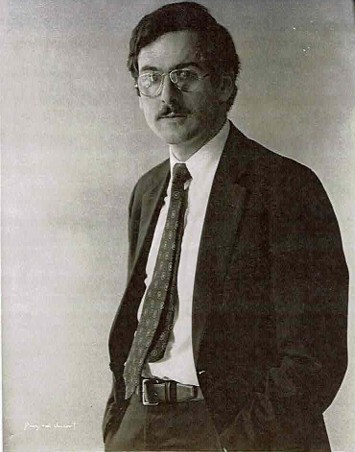
Finding a path to set one foot in front of another, continuing to live even when the physical act of walking is impossible, was a theme those who spoke returned to again and again. A lifelong friend who first met Henry at South Kent School in Connecticut spoke of their time there and of Henry’s Army service during the Vietnam war. We heard about Henry’s career as a financial advisor and about his active volunteer work at St. Alban’s Parish, serving among other duties as an usher, which is where I first got to know him. Henry was also a member of the board of the Workers of St. Alban’s (WSA), which oversees our Opportunity Shop and administers a grant program, funded by the sales of the shop, that supports the work of a number of not-for-profit organizations in the DMV.
But that’s just the outline of his 78 years on earth. What so many wanted to discuss was the content of his character.
George Farr spoke of that character, beginning with the simple act of Henry’s welcoming George to the WSA board.
“It turned out that Henry was already a member of the Board and, as I entered the room to attend my first meeting, there he was, already seated at the table. He turned, saw me, and smiled. And then, pulling out the chair beside him, gestured for me to sit next to him.
I was grateful for this welcome. But—in retrospect—I came to realize that this simple, apparently spontaneous gesture was deeply characteristic of Henry: the outward expression of a person who always seemed conscious of what might make things easier or better for others and of how he could help them in whatever way—small or large—that was appropriate to the occasion.”
George also mentioned a trait which I came to see in my interactions with Henry: He was never afraid to ask a question. “Often this would be the difficult question, the question that needed to be asked, or that might be hard to ask, or that others might be reluctant to ask. But it moved the discussion to a more enlightened place.”
Henry enjoyed nonfiction which I discovered when he became a regular reader of this newsletter. When I would stop by his house in Georgetown, or correspond by email, or talk over the phone, Henry always had questions. He was insatiably curious about life and those around him. He would ask about a book I was reading, what I knew about the candidates for the vestry, about last week’s sermon, or about the current state of politics.
“Over the course of these conversations, it became clear that Henry was a man of strong, firmly formed opinions,” [George said of similar encounters] “but he was also open and generous in listening to an opinion that differed from his own. Henry was impatient with anyone who wasn’t a straight-shooter, who was “evasive” when confronted with a hard truth . . . He was curious and reflective. He had a wry, quizzical sense of humor and he enjoyed telling jokes.
As the years went on, I was frequently astonished, after a telephone conversation with Henry. And not just because he dramatically exceeded the medical expectations of his doctors. But because it seemed that, as his physical capacities were slowly and steadily deteriorating, there was, concurrently, an increase, a kind of efflorescence, of intellectual energy—an energy that was manifested in a desire to learn new things and to understand “more” about life, past and present.”
Frank Wade, the long-time and now retired rector at St. Alban’s Parish, gave the homily. As with all of Frank’s sermons it was short, eloquent in its style and simplicity, hit just the right theme and tone, and had a turn of phrase that stays in your mind for weeks . . . if not a lifetime . . . afterwards.
Frank, of course, spoke of hope, as one does at funerals. “People like us at times like this,” Frank reminded those in the pews, “have discovered that hopeful ground to be solid and the way steep but sure.” But he took that thought and brought a perspective that has rarely left me since hearing these words at Henry’s service. And as is his custom, Frank told us through a story.
“Many years ago a clergyman I knew was conducting a funeral for a child deep in the Appalachian Mountains. He assured the grieving mother of the promises of our faith just as we have done here. She replied, ‘Yes I know and believe those things but it is the miss of him.’
The miss of him. How do we deal with ‘the miss of him,’ the morning noon and night of him that seems so removed from the great promises of belief and hope? It is a hard question that must be faced by all who grieve.
Fortunately we have a wonderful example of how to live with loss and grief. I refer to Henry Farrington himself. We keenly feel his loss and absence. But take a moment and be aware that people like Henry who know death is near are dealing with the loss of everyone they hold dear. Not one but everyone. Dying is itself an experience of grief writ large.
How did Henry handle his grief? Frank spoke to his wife Toni and others who knew Henry well.
“The words they used to describe him are the words we would do well to have in mind as we deal with ‘the miss of him.’ As Henry faced his own death and the grief that went with it those who knew him best used these words to describe him: sense of humor…remained positive…accepted… grateful for all the help…close to family…kept reading and learning…maintained an interest in a broad range of topics…extraordinary patience… faith…courage…energy… grace.
One of Henry Farrington’s parting gifts to us is a tutorial in how to deal with ‘the miss of him.’ He showed us that the antidote to the loss of life is more life, embracing life to the fullest. It is an incredible gift that will serve us all well in the days to come.”
Natalie Goldberg ends her meditation on this question by turning to a painting by Pierre Bonnard, who “silently grieves” about the emotional absence of human fulfillment through the medium of paint. The last piece he painted, a week before his death in 1947, was Almond Tree in Blossom. It is full of light.
“When Japanese Zen masters approach death, they write a poem to reveal their mind at the final moment. In this final painting, Bonnard does something similar, displays his lightening heart. Before the great question—How is it to live with eternity at your door?—Bonnard answers: In full bloom.”
Henry’s daughter Alex remembered that her father liked to smoke cigars. As a way of remembering that part of his life, Alex placed a cigar on the top of the urn holding Henry’s ashes, and it was buried with him in the columbarium beside the church.

Rest in peace, Henry Farrington. You showed us how to live life—even in the face of death—to the fullest. And I know you’ll enjoy that cigar.
More to come . . .
DJB
Image of almond blossoms by Beverly Buckley from Pixabay
 MORE TO COME...
Thank you for this and Merry Christmas!
Thank you, Jane, for being such a faithful reader. I’m glad you liked it. Candice joins me in sending along best wishes for a Happy Christmas! All the best, DJB
Good Afternoon!
I read them all.
I think of you often and can’t imagine the pain, considering your past career.
I know you ‘keep the faith.’ 🙏🏻
Pingback: Readers choice: The best of the 2025 MTC newsletter | MORE TO COME...
Pingback: Observations from . . . December 2025 | MORE TO COME...