Imagine if we stopped spending so much time online and focused more of our time on making life better: New thoughts that build on those made in my September post entitled “Disengage with your misery machine.”
Two posts that arrived the morning after the Super Bowl brought me up short. Both were written by writers I admire and follow. Both were not really takes on the game but instead used this ubiquitous American “holiday” as a starting point to push us to question what’s really important. One was written by a sociologist and writer. The other was from a sportswriter.
I DID NOT WATCH THE SUPER BOWL
The first that showed up was Robyn Ryle‘s post I did not watch the Super Bowl. Careful readers will recognize Robyn as the author of Sex of the Midwest: A Novel in Stories, one of my favorite books of 2025. Just the title of Robyn’s most recent post caught me off guard because I’ve written for years that I don’t watch the Super Bowl. But for some inexplicable reason I watched it this year. (And no, I’m not blaming Candice for the fact that she wanted to put together a Super Bowl spread . . . I’m really not. I am responsible for my own actions.) Andrew cares even less than Candice about football but he wanted to watch the Bad Bunny halftime show. I’m glad he was there to act as my cultural references translator. (God, getting old is tough.)
But I digress. Robyn’s post wasn’t so much about the Super Bowl as it was the fact that she’s done with being a person on the internet. She begins by pointing out that she just doesn’t care anymore.
“I didn’t want to see people critiquing the commercials or the music or winding it all up into this never-ending narrative about the state of our current world. I’m exhausted by it all. Really, I’m so, so f**king exhausted. I’m over it. I just do not care anymore.”
Then she notes that it isn’t that she really doesn’t care, it is just that she wants to care about different things.
“Not the Super Bowl. Not what happens on social media. Not the creator economy.
I do still read some good and useful things on the internet, among them this series from Adam Mastroianni at Experimental History about underrated ways to change the world. These are the kinds of things I want to care about. Quiet, simple, underrated ways to make the world a better place. Note that most but not all of these take place someplace that is not online.”
Robyn’s piece was still buzzing around my brain when the second post popped up.
THE UBIQUITY (AND WONDER) OF HOT TAKES
Joe Posnanski, a self-described “writer of sports and other nonsense” and author of one of my all-time favorite books, The Baseball 100, took a different route to raise similar points as Robyn in his post The Ubiquity (and Wonder) of Hot Takes.
“That was the best Super Bowl Halftime Show ever, better even than Prince’s Halftime Show, which I was in the stadium to see. I didn’t even know Bad Bunny’s songs, but it didn’t matter because the vibe was so joyful, so thrilling, there was an actual wedding in it, there were so many fun guest appearances (Ronald Acuña Jr.!), and there was so much love for community and family and all the Americas, North and South. It warmed my heart.
Unless you think it was actually a political statement, and Super Bowl Halftime Shows should be in English, and I’m too brainwashed to understand that.
Let’s fight about it.”
Joe provides six similar examples to let us know that he “hates hot takes.”
“Hot takes break us apart over things that don’t matter at all. Do I really care if the Super Bowl was a dog or a classic? Nope. Do I actually have strong feelings about how anyone else should feel about the Bad Bunny halftime show? Nope. Do I stay awake at night thinking about celebrities promoting gambling? Nope. Do I feel strongly that people should agree with me about my half-baked thoughts on Lindsey Vonn or our nationwide obsession with PEDs? Not really.
But once we go down those roads—once we start fighting—screaming enters, anger enters, bitterness enters, ego enters, pride enters. And suddenly we find ourselves on opposite sides of things, and find ourselves wondering how we grew so far apart.
It would be nice to be on the same side more often.”
As I said in the earlier post, when it comes to algorithmic manipulation we do not have to be passive victims. We each have the power to do what our phones—a device historian of American political rhetoric Jennifer Mercieca calls a misery machine—won’t do on their own: lead us to hopeful news. Good news. We have the ability to choose differently.
Robyn and Joe both pushed me to think about the things I read on the internet, why I read those things, and what other things I could be focused on instead to make this a better world. It strikes me as a much more enriching and productive way to spend a Sunday . . . or a life . . . rather than watching the Super Bowl and getting upset about the halftime show or what others think about the halftime show.
More to come . . .
DJB
P.S.: In a similar vein you might also be interested in 2020’s Connect and Care and in 2024’s Step away from the exhausting digital chatter.
P.P.S.: Those who know me would not be surprised that I really enjoyed this post-Super Bowl editorial cartoon:
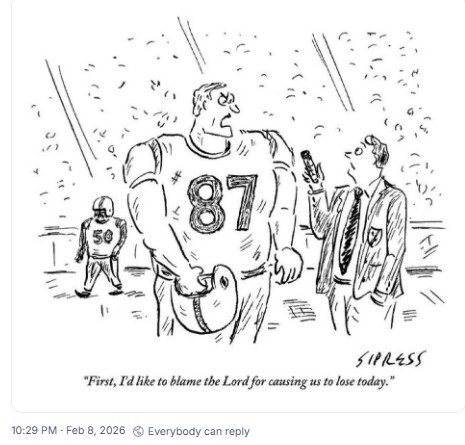
Photo by Annie Spratt on Unsplash
 MORE TO COME...
Pingback: Observations from . . . February 2026 | MORE TO COME...