
There is beauty and joy in the everyday, even in getting older. Billy Collins helps us see and appreciate it.
(NOTE: If you are reading this post via email, click on the title to see the online version, so you can read the entire poems included here.)
My wife and I were visiting friends in the Shenandoah Valley last fall. In the course of a conversation I was struggling to remember something that was just on the tip of my tongue . . . except that it wasn’t.
In the moment I reverted to one of my new favorite fallback lines when my personal research librarian is struggling to pull up the right file:
“Candice and I like to say that between the two of us we have one memory.”
Our wise friend Oakley immediately walked me over to the refrigerator to read this poem which had a prominent place on that ubiquitous family photo wall:
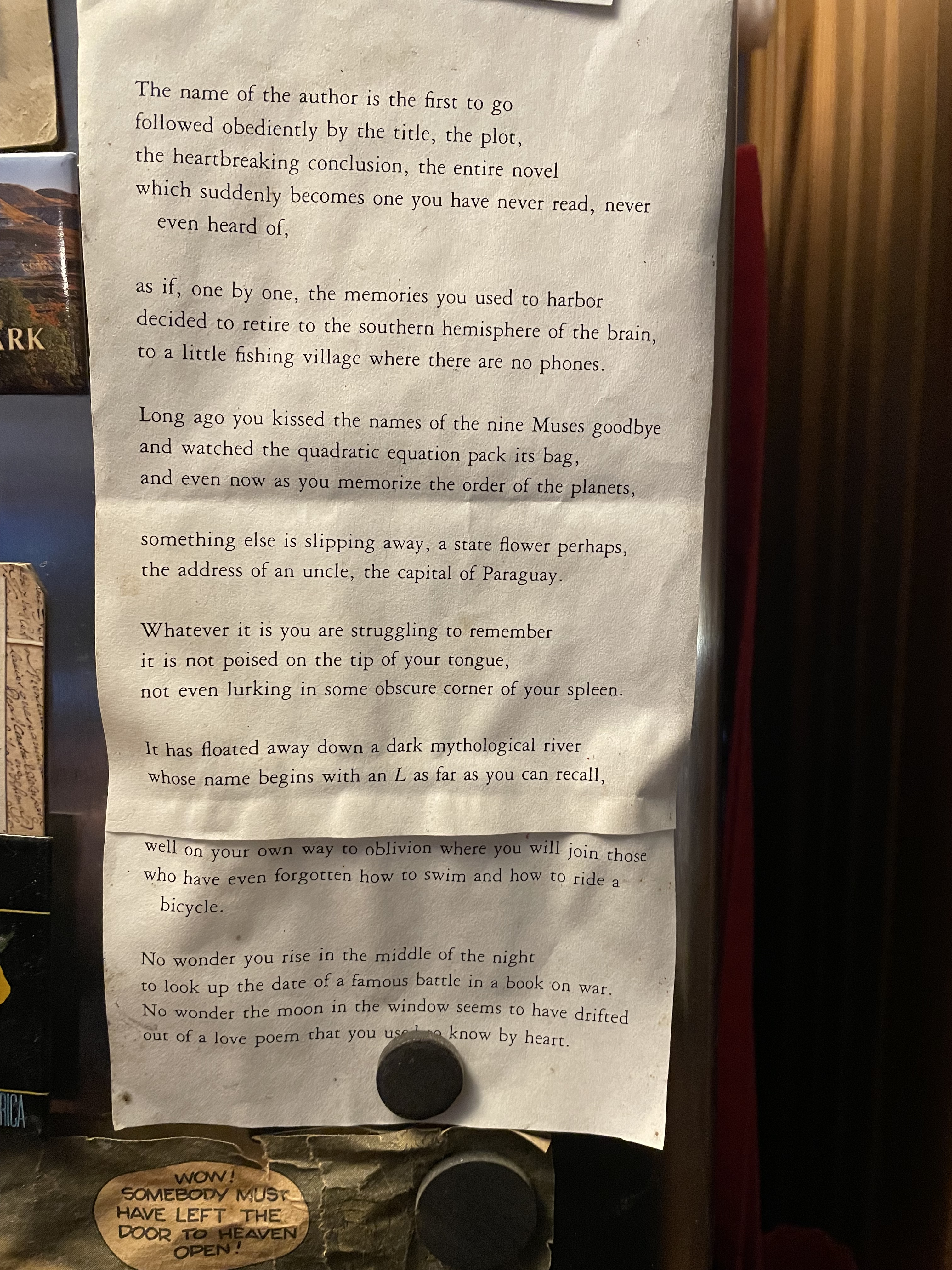
It was Forgetfulness, one of the most famous poems by the former U.S. Poet Laureate Billy Collins. That first line is especially memorable: “The name of the author is the first to go . . . “
We all have our aversions to aging. It is almost a religious belief in this country that aging and its effects will happen far in the future. Social scientist Arthur Brooks recounts that when asked what “being old” means,
“. . . the most popular response among Americans was ‘turning eighty-five.’ In other words, the average American (who lives to seventy-nine) dies six years before entering old age.”
I have a friend who swears he will rage against old age all the way to the grave. For some that is what keeps them going. Being influenced by my mother’s love for peace and harmony—familial and otherwise—I’ve never been very good at rage. At the times in my professional life when I succumbed to raising my voice or, heaven forbid, pounding on the table, I regretted it almost immediately. So raging against the fates doesn’t work especially well for me.
One thing I haven’t regretted as I age is selecting books on a whim based on a recommendation or something as simple as seeing a poem on the front of a refrigerator.
Which is how I came to read a recent collection of poems by Billy Collins, picked up while in Books, Inc. in Alameda, California.

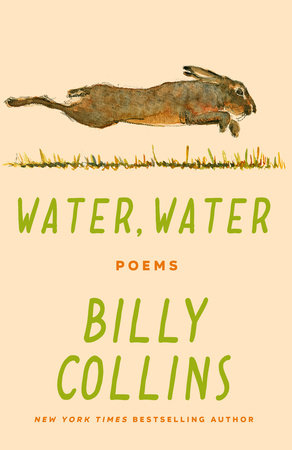
Water, Water: Poems (2024) by Billy Collins is a collection of 60 new poems that looks at life with his typical informality and attention to the commonplace and all that’s around us. The topics Collins considers are serious—being counted, getting older, connecting with others—but he addresses them in a lighthearted way that asks us see the humor and occasional absurdity in life. There is beauty in the everyday, even in getting older, and Collins helps us see and appreciate it. And he’ll write about the everyday parts of life we encounter as we stroll down the street, sit down to a bowl of cereal, watch a cat drink from a swimming pool, turn our attention to the nurse in a doctor’s waiting room. There is a reason Collins is one of America’s favorite poets.
And yes, some of the poems in this recent collection actually do deal with water, such as this delightful one that puts a different take on the old creation story.
Adam Names the Fish
Genesis 2:20
Exhausted,
after coming up with giraffe,
buffalo, and butterfly,
then ocelot and kangaroo
he begs the sky for a breather.
But there is nothing
but the silence
of the low clouds,
then a trace of wind,
the tweet of a wren,
the moo of a cow,
two of the many
he is most proud of
for their simplicity
and the hint of onomatopoeia.
Cow. Wren.
He likes snake and canary too.
But the silence says
he has more work to do.
So, with nary an Eve to impress,
he takes the deepest breath
known to man,
and, holding it, dives in.
Collins can write about being happy that he still has 400 pages left to read in Lonesome Dove and yet choosing not to take the book with him should his house burst into flames. Perhaps it was just where he was meant to stop reading. He marvels at being introduced for a talk by an astronaut, who is orbiting the earth at that very moment and who takes the time to read a poem from space by Emily Dickenson. He recognizes, as he grows old, that his plumber won’t really care that he once heard Percy Sledge live.
Collins finds the joy in everday life.
Ode to Joy
Friedrich Schiller called Joy the spark of divinity,
but she visits me on a regular basis,
and it doesn’t take much for her to appear—
the salt next to the pepper by the stove,
the garbage man ascending his station
on the back of the moving garbage truck,
or I’m just eating a banana
in the car and listening to Buddy Guy.
In other words, she seems down to earth,
like a girl getting off a bus with a suitcase
and no one’s there to meet her.
It’s a little after 4 in the afternoon,
one of the first warm days of spring.
She sits on her suitcase to wait
and slides on her sunglasses.
How do I know she’s listening to the birds?
He also encounters a little absurdity.
First Typewriter
The old Royal Aristocrat
I got for Christmas long ago
came with its own plastic cover,
so every night at bedtime
I would place the typewriter-shaped
cover over the typewriter
and another cover over the parrot.
Only then, could the three
of us get to sleep.
Then came the night
when I placed the typewriter-
shaped cover over the parrot
and was kept awake for hours
by the sound of her typing
what would turn out to be
the opening lines of Our Town
instead of the more customary Hamlet
by the more traditional roomful of blind monkeys.
Collins, who published this new collection at age 84, seems to have found a way to age gracefully. That ability to still be productive and useful in both known and as-yet-unknown ways has certainly become part of my journey. And, frankly, it is tough in these troubled times. The writer Anne Lamott had a recent piece that spoke to the “mixed grill” of life. Things would be much easier, she writes,
“. . . if I could implement life as a silverware drawer—the myriads things for which I am grateful would go in the knife drawer, the horrible scary things in the space for big forks, and so on.
But it doesn’t work this way. Things are all swirled together. . . . I have a grandson living here who is about to start applying to colleges. The FBI has seized the 2020 election ballots in Fulton County, Georgia. Paper whites are beginning to bloom here.”
Even as we age, perhaps especially as we age when we don’t handle multi-tasking with the same dexterity that we did in our 20s and 30s, the mixed up nature of life can lead to rage and despair. But there is also joy in things big and small. And perhaps, like Collins, we can find that joy even when facing death.
A Change of Heart
I once expressed the wish for a tomb
topped by a white marble angel,
her head buried in her folded wing,
but now, I’d rather you
just copy out that little poem by Ryota,
fold it into quarters,
then slip it into my shirt pocket
before I am incinerated in a chamber.
It’s the one where he used to think
that death came only to others,
but now in his ultimate hour,
he realizes that this happiness is also his.
Being patient with ourselves, and with each other, may be the hardest work we do. Finding joy in the everyday helps.
More to come . . .
DJB
NOTE: The poet referenced in the last Collins poem is Ōshima Ryōta (1718-1787), a prominent Japanese haiku poet of the Edo period. Illustration of brain from Getty Images via Unsplash.
 MORE TO COME...
Thank you, David. New poems from the poet with the most unlikely first name are always welcomed but especially on Ash Wednesday. His, ‘My Number’, humbles what remains of me being ready for last things
“ …Did you have any trouble with the directions? I will ask, as I start talking my way out of this.”
Thanks for this, Bob. I wasn’t familiar with “My Number” but found it especially moving, as you suggest, here on Ash Wednesday. From dust to dust . . .
Pingback: Observations from . . . February 2026 | MORE TO COME...
Pingback: From the bookshelf: February 2026 | MORE TO COME...