Eric Foner’s new book of essays from the last 30 years helps us understand that “the past is the key of the present and the mirror of the future.”
Historians and history are very much a part of today’s news. There is a war on history that has about as much to do with history as the “occupation” of Washington or Minneapolis has to do with crime. A new book of essays written by one of our country’s most distinguished historians arrives into this moment like a bracing breath of fresh air.
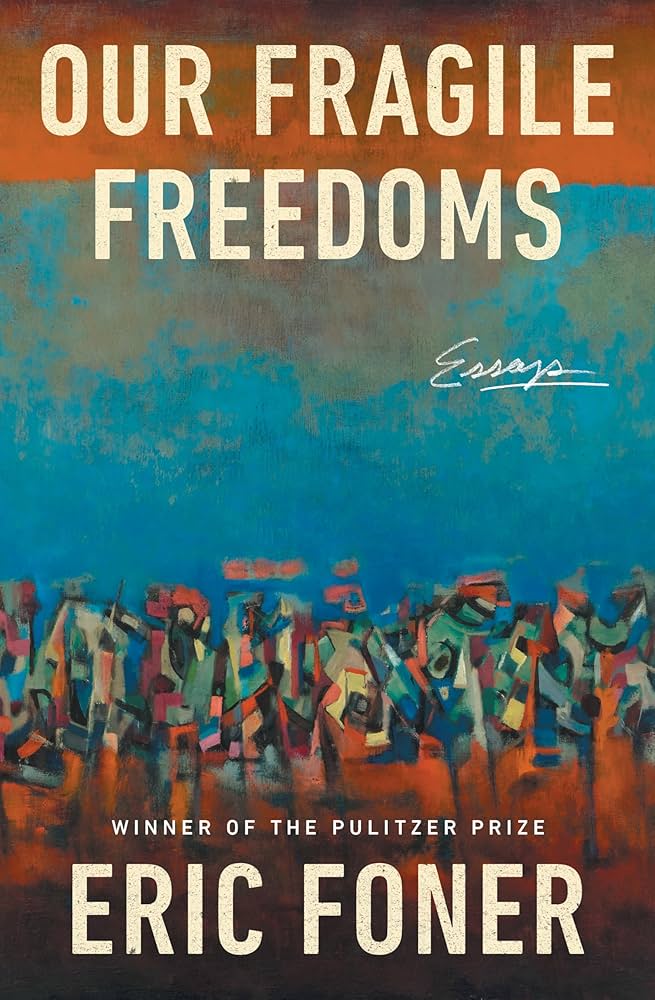
Our Fragile Freedoms: Essays (2025) by Eric Foner makes it clear that while there is no single “correct” way to study history, we must engage seriously with that past if we are to unlock and confront some of the most difficult challenges we face today. In a little under 60 essays, Foner looks at history through the lens of his own groundbreaking work around the Civil War and Reconstruction as well as from the perspective of a wide range of professional historians working in the field. The latter comes primarily from book reviews that provide the reader with context and new insights. Foner views the horrors of slavery and the violent return to white rule that came at the end of Reconstruction with his eyes wide open. Many of the essays and reviews seek to move us past the “consensus” of the Jim Crow era that the “Negro Rule” of Reconstruction was corrupt and ineffective while praising the white “redeemers” who used violence to stop Blacks from voting, holding office and owning property. It is a consensus that has been repudiated by professional historians but that is still a widely-held belief by large portions of the American public. And while Foner’s work builds on his own time in academia as well as dozens of other historians from the academy, his clear and cogent writing is easily accessible to a much wider mass audience. He is writing now to help us address the question of whether America can ever escape the legacy of slavery without a much more honest examination of the past.
In a theme-setting introduction, Foner reminds his readers to avoid reading history as a linear narrative of progress. And just to prove the point, he begins with two powerful essays—both book reviews—about how little we still know and understand the slave trade and slavery in this country. A review of Robin Blackburn’s The American Crucible: Slavery, Emancipation and Human Rights tells us that among the book’s many virtues is the fact that it moves slavery from the periphery to the center of any account of western ascendancy. “Between 1500 and 1820, African slaves constituted about 80 percent of those who crossed the Atlantic from east to west.” Slave plantations, more than any other institution, “underpinned the extraordinary expansion of western power and the region’s prosperity in relation to the rest of the world.” Even after emancipation, Americans refused to grapple with the impact of slavery on the nation, a refusal that continues to this day.
Foner’s review of Marcus Rediker’s book The Slave Ship: A Human History reminds readers about history’s greatest forced migration. Over the course of four hundred years “eleven million Africans were transported involuntarily to the New World. About three million more perished onboard the ships or in the process of capture and enslavement in Africa.” To forget that scale of human trafficking—and the complicity it required—thwarts our ability to address the long tail of the aftermath.
When he turns to the section on Civil War and Reconstruction, Foner begins with a review of historian Drew Gilpin Faust’s book This Republic of Suffering, an insightful work that looks at how death on a massive scale changed the life of the nation. Foner writes that Faust’s task is to strip from war any lingering romanticism, nobility, or social purpose. In another essay, published in 2011 in The Nation, Foner reminds readers that the Civil War changed the nature of warfare, created an empowered nation-state, vindicated the idea of free labor, and destroyed the modern world’s greatest slave society. Each of these outcomes, as from all great historical events, carried with them ambiguous, even contradictory, consequences. We are grappling with those today.
In that same essay, Foner identifies the gap that exists between historical scholarship and popular understanding of history.
“In April 1961, when Charleston, South Carolina, marked the anniversary of the firing on Fort Sumter, the city was bedecked with Confederate flags and the commemorations made no mention of slavery. Fifty years later, in April 2011, the city fathers and National Park Service sponsored a gathering that included reflections on slavery’s role in the war and on post-slavery race relations. As in 1961, a band played ‘Dixie,’ but now it was accompanied by ‘The Battle Hymn of the Republic,’ recognition that a majority of South Carolina’s population (the slaves) sided with the Union, not the Confederacy. But the event attracted far smaller crowds than the first time around.”
In other insightful essays and reviews, Foner moves through Jim Crow America, the Gilded Age, and our struggles in the late twentieth and early twenty-first century to move past the legacy of slavery that has always been, as President U.S. Grant told German Emperor Bismarck, “a stain on our Union.” I was fascinated by the final section on historians and myth, where Foner reviews the work of such pathbreakers as W.E.B. Du Bois, C. Vann Woodward, and Richard Hofstadter. A final, bracing essay looks at historians and the role of myth in American life. In pushing back against the view that Americans need new myths, Foner argues that the role of the historian today “is not so much to devise new myths as to piece together a candid appraisal, no matter how alarming, of the fraught moment in which we live.”
Foner has won the Bancroft Prize, the Lincoln Prize, and the Pulitzer. His most famous book is Reconstruction: America’s Unfinished Revolution, 1863–1877 published in 1988. It set the standard for modern histories of Reconstruction. One of his most important, from my point of view, is The Second Founding: How the Civil War and Reconstruction Remade the Constitution which brought together a lifetime of scholarship around this most contentious era in our nation’s history. And in spite of its look at a period some 150 years in the past, it is work with great resonance for this day, this political climate, and the major questions of how we will advance as a nation.
Foner makes the point that “the past is the key of the present and the mirror of the future” as he opens Our Fragile Freedoms.
“The pieces reproduced here also remind us of the current crisis of American democracy, reflected in intense political polarization, the weaponizing of base prejudice, and refusal to accept the outcomes of elections. This situation is not unprecedented. American democracy has always been a terrain of conflict. Our politics have always included those who believe that too many people, or people of the ‘wrong’ kind, are voting and taking part in public debate. Various forms of violence—war, assassination, mob actions, political repression, the brutality intrinsic to slavery—have played more of a role in our history than is often recognized. I vividly recall watching televised images of the Capitol riot as it unfolded on January 6, 2021, and hearing a commentator declare that ‘nothing like this’ has happened before in the United States. ‘That’s wrong,’ I remarked to no one in particular. ‘What about the Battle of Liberty Place or the Colfax Massacre—violent uprisings a century and a half ago that sought to oust democratically elected state and local governments in Reconstruction Louisiana—or the 1898 coup d’etat in Wilmington, North Carolina, that marked the end of biracial government in that state?”
History, Foner writes, was visible at that riot. It remains visible today. We forget it, ignore it, or sanitize it at our peril.
More to come . . .
DJB
Photo by Roma Kaiukua on Unsplash
 MORE TO COME...
Pingback: From the bookshelf: March 2026 | MORE TO COME...
Pingback: Observations from . . . March 2026 | MORE TO COME...