
At the conclusion of a fantastic World Baseball Classic (congratulations Venezuela) and the beginning of what promises to be another lost regular season wandering in the wilderness for my Washington Nationals, I go through my regular spring training routine of reading about the game.
Bill “Spaceman” Lee—the effective 1970s reliever for the Boston Red Sox and the Montreal Expos whose “natural sinkerball is dwarfed in baseball memory by his natural inability to utter a dull sentence”—once told the Los Angeles Times that “Baseball is the belly-button of our society. Straighten out baseball, you’ll straighten out the rest of the world.”
That quote is the epigraph of the conclusion to a work that I found largely frustrating in part because of the writer’s insistence on continually re-plowing soil she had already tilled and in part because I simply disagree—based on first-hand experience—with her take on changes to speed up the game. It isn’t the fault of the author, but I was also reminded of what the scourge of gambling has done to the game since the book was written in 2018.
This slim volume illustrates the challenges of the Yale University Press series “Why X Matters.” This is the fifth I’ve read from this series. In the hands of the right author these short works illuminate and expand our horizons. When the author’s point-of-view gets in the way of the subject, however, they can become personal polemics that frustrate all but the true believers.
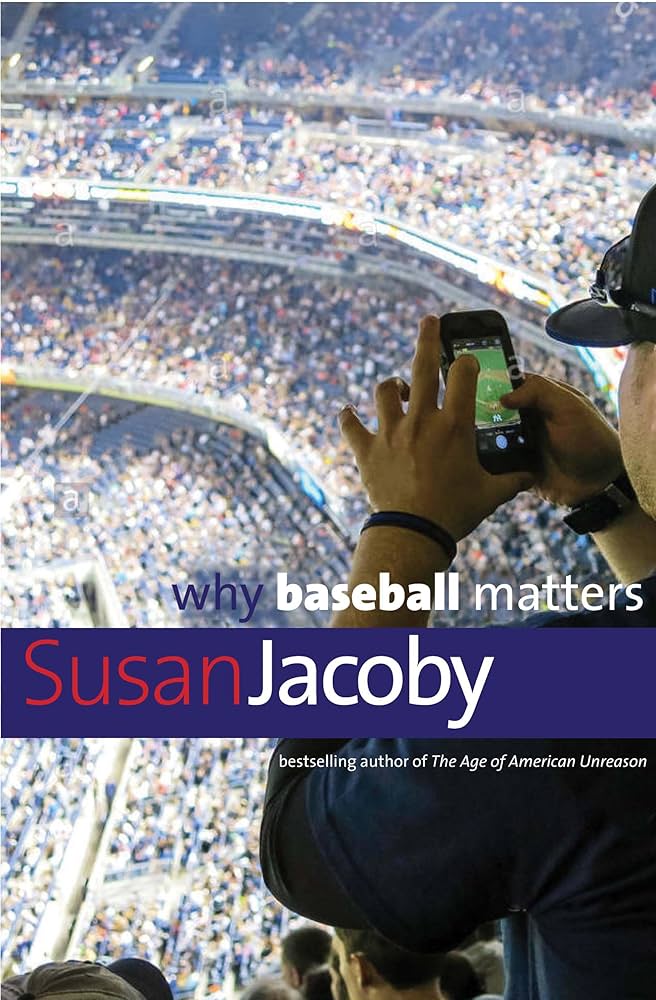
Why Baseball Matters (2018) by Susan Jacoby is the author’s personal story about how she came to love the game while watching it on television in her grandfather’s bar, a no-holds-barred defense against changes to the integrity of the game, and a worried meditation on how the game can survive in our age of short attention spans and social media takes that do not support baseball’s natural rhythms. Reading this work some eight years after it was published—a time when the sport made significant changes (largely positive) to move the speed of the games back to their historic and natural pace while also succumbing to big-time gambling that threatens to wreck all professional sports—provides us with a perspective against which to evaluate Jacoby’s work.
It isn’t until the conclusion, when she moves beyond baseball’s vulnerabilities (some repeated again and again) that she answers the key question in the title. Baseball matters, she decides, because it provides genuine nourishment rather than junk food. It demands attention in an attention-free era. It matters because the same game can essentially be played on a small town sandlot by young fans learning about loss (the best fail two out of three times), teamwork, and love . . . just as you can in a big league park. It matters because it “has repeatedly demonstrated the ability to reinvent itself in times of immense social change.” Baseball matters because it still lends itself, Jacoby asserts, to a unique conflation of the game itself with American virtue.
“The emotions baseball is capable of evoking are part of its special currency, but it is a currency that can easily be devalued if used in an exclusionary, aggressive fashion.”
Jacoby spends a great deal of time worried about the proposed rules (at the time) to speed up the game. What she never really addresses, however, is how much the modern game has dramatically slowed down, adding almost an hour on average to the historic pace, as we waited for batters to play with their batting gloves (I’m looking at you Bryce Harper), pitchers to throw over to first countless times, and everyone to take “lollygagging” to new extremes. I saw my first major league game in 1963 in Wrigley Field. Bob Gibson and the St. Louis Cardinals beat the Chicago Cubs 4-1 in a brisk two hours and four minutes. The game needed to be reset, and the pitch clock, the rules on throwing over to first, and other changes have been—to my mind—very successful.
Jacoby also addresses the problem of gambling and baseball, and it is here that she’s spot on. She notes, as I have as well, that any time baseball has become involved with gambling, however indirect, it doesn’t turn out well. My first inclination is to say that I’m not a fan of the automated balls-and-strikes change because we’re doing it to provide precision to gamblers when they bet big sums. But . . . then I watch a game like the World Baseball Classic between the US and the Dominican Republic and see an umpire make two terrible third strike calls late in the game—one to Juan Soto who has the best eye for the strike zone I’ve ever seen—and I think perhaps its time. Here’s how Joe Posnanski described the umpire’s performance.
“Yes, home plate umpire Corey Blaser rang up Soto on a pitch that wasn’t even close to a strike, and while this wasn’t what made the game unsatisfying—as most of you know, a worse call was yet to come—it really struck me wrong. I couldn’t even believe how much that call ticked me off. . . .
. . . the humanity of umpiring has already been taken out of the game . . . except for ball-strike calls. And with the Automated Ball Strike challenge system coming in 2026, that last bit of humanity will begin to disappear.
Is that something worth mourning?
Well, it’s not if, in the eighth inning of a tight and exciting one-run game between the United States and the Dominican Republic, Corey Blaser thinks he knows the strike zone better than Juan Freaking Soto.”
The thing is, the most egregious call came in the next inning and it ended the game when Blaser rang up Geraldo Perdomo after a breathtaking eight-pitch at-bat on a pitch that was so far below the strike zone even a blind man could see it.
Joe said that a few people wrote that “Sunday’s game was basically one long advertisement for the ABS Challenge System.” I have to agree.
Each year during spring training I pick a baseball book to read. Over the years I’ve amassed quite a collection.
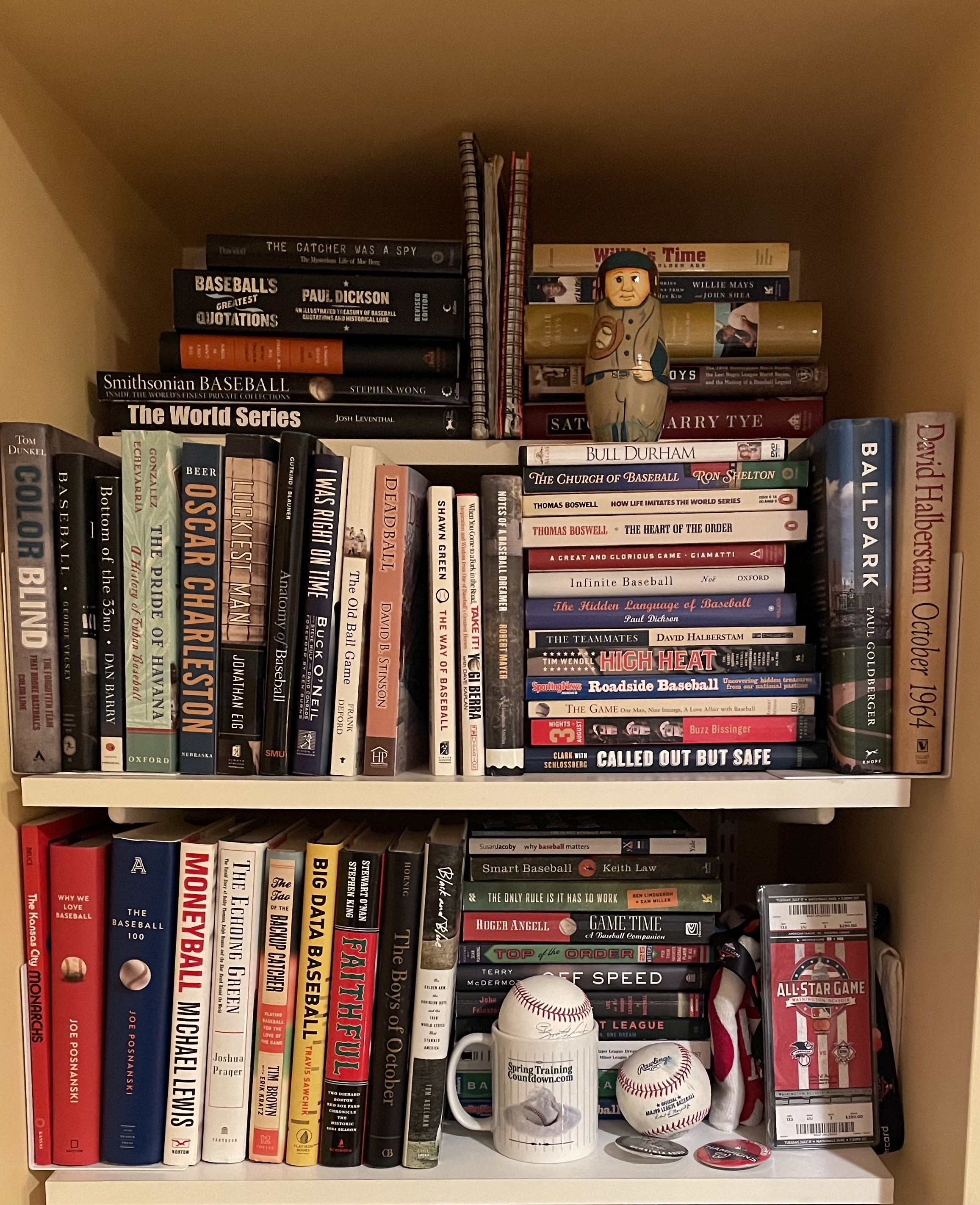
As you can tell, as I was finishing this book I took in the closing games of the 2026 WBC. And that wonderful experience—from the raucous fans of the Latin American teams to the tight drama on the faces of the Japanese and American players to the unexpected delight of Italy’s rise through the ranks—suggested that Jacoby’s worry about baseball’s communicability in international settings was misplaced. I’ll enter the regular season with hope, but knowing that my Nationals still don’t seem to have a plan, or an ownership group, to lead them beyond a basic AAA-level team. Oh well.
The bottom line is that Why Baseball Matters is a mixed bag. But to return to the Spaceman, I’ll let Jacoby explain why he’s so right to bring the belly-button into baseball.
“Calling baseball America’s belly-button—that primal remnant of everyone’s first medium of nourishment and entry into the world—is exactly right, just as reverential descriptions of the game as a metaphor for and evidence of American exceptionalism and goodness are exactly wrong . . . Baseball matters because it provides genuine nourishment rather than junk food . . . [and] we cannot afford to lose a game that demands our attention to provide its nourishment.”
Play ball!
More to come . . .
DJB
NOTE: For other MTC reviews of books in this Yale University Press series “Why X Matters” see my takes on:
I have also read, but did not post a review at the time of Why Preservation Matters.
Top image of Nats stadium in happier days: Game three of the 2019 World Series
 MORE TO COME...