
Five books. Every month. A variety of topics from different genres. Here is the list from March 2026.
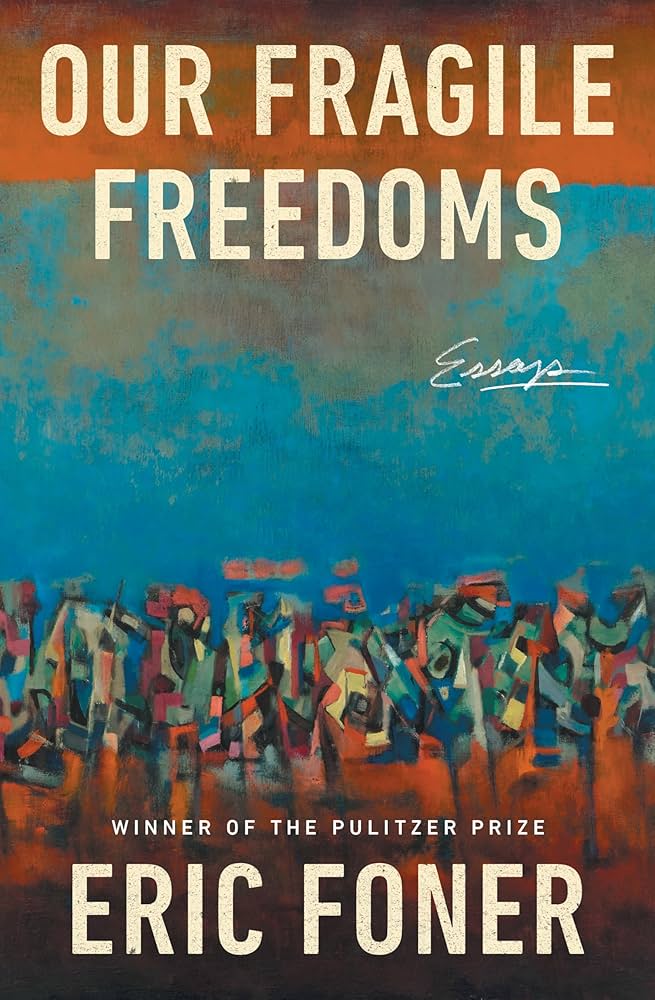
Our Fragile Freedoms: Essays (2025) by Eric Foner makes it clear in a little under 60 essays that while there is no single “correct” way to study history, we must engage seriously with the past if we are to unlock and confront some of the most difficult challenges we face today. Foner looks at history through the lens of his own groundbreaking work around the Civil War and Reconstruction as well as from the perspective of a wide range of professional historians working in the field. The latter comes primarily from book reviews that provide the reader with context and new insights. Foner views the horrors of slavery and the violent return to white rule that came at the end of Reconstruction with his eyes wide open. Many of the essays and reviews seek to move us past the “consensus” of the Jim Crow era that the “Negro Rule” of Reconstruction was corrupt and ineffective while praising the white “redeemers” who used violence to stop Blacks from voting, holding office and owning property. It is a consensus that has been repudiated by professional historians but that is still a widely-held belief by large portions of the American public. In clear and cogent writing easily accessible to a wider mass audience, Foner works to help us address the question of whether America can ever escape the legacy of slavery without a more honest examination of the past.
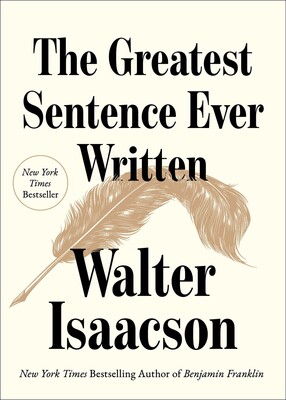
The Greatest Sentence Ever Written (2025) by Walter Isaacson examines the narrative of America through the lens of the second sentence in the Declaration of Independence. In 67 short pages Isaacson makes it clear that while we think of Thomas Jefferson as the author of one of the world’s most famous documents, he really just wrote the first draft which was then edited and changed multiple times. The drafting committee, including Benjamin Franklin and John Adams, made substantial alterations, including to the first phrase, which Jefferson penned as “We hold these truths to be sacred . . . .” It was Franklin who crossed out “sacred” and inserted “self-evident.” From there Isaacson takes us through what the men (and they were all men) were thinking and the cultural and intellectual influences that swirled around them. These truths became the “creed that bound a diverse group of pilgrims and immigrants into one nation.” The Declaration of Independence, as written in 1776 and then reinforced “four score and seven years” later at Gettysburg by Abraham Lincoln, defined both our common ground and our aspirations. It is in the exploration of what constitutes that common ground and how we continue to hold on to it in perilous times where Isaacson makes his case: We must seek those truths once again if we are to survive as a democracy.
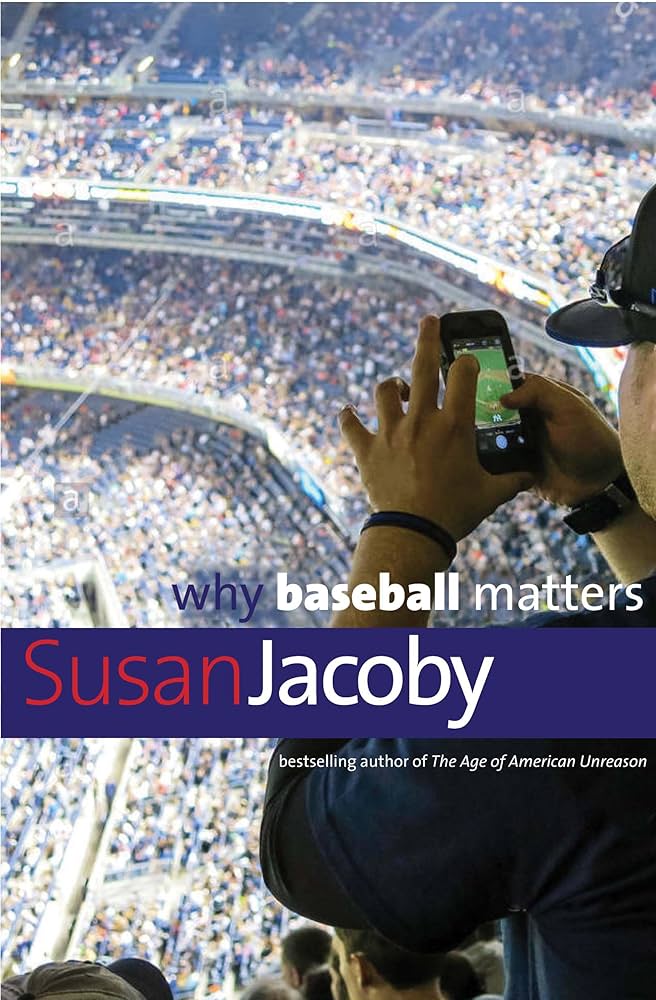
Why Baseball Matters (2018) by Susan Jacoby is the author’s personal story about how she came to love the game while watching it on television in her grandfather’s bar, a no-holds-barred defense against changes to the integrity of the game, and a worried meditation on how the game can survive in our age of short attention spans. Reading this work some eight years after it was published—a time when the sport made significant changes (largely positive) to move the speed of the games back to their historic and natural pace while also succumbing to big-time gambling that threatens to wreck all professional sports—provides us with a perspective against which to evaluate Jacoby’s work. She only answers the key question in the title at the end. Baseball matters, she decides, because it provides genuine nourishment rather than junk food. It demands attention in an attention-free era. It matters because the same game can essentially be played on a small town sandlot by young fans learning about loss (the best fail two out of three times), teamwork, and love . . . just as you can in a big league park. It matters because it “has repeatedly demonstrated the ability to reinvent itself in times of immense social change.” Baseball matters because it still lends itself, Jacoby asserts, to a unique conflation of the game itself with American virtue.
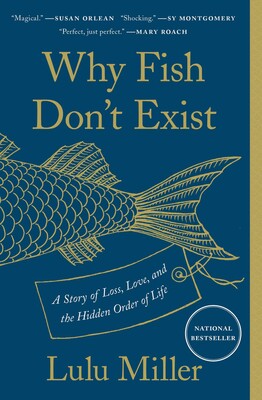
Why Fish Don’t Exist: A Story of Loss, Love, and the Hidden Order of Life (2020) by Lulu Miller is part biography, part memoir, and part scientific thriller. Miller began this work studying David Starr Jordan—a taxonomist, a man who would be credited with discovering nearly a fifth of the fish known to humans in his day, and the president first of Indiana University and then Stanford. Even though the universe seemed to conspire against his work—his specimen collections were demolished three times by natural disasters—Miller was initially taken with how he fought back against the chaos. Her life was falling apart at the time, it wasn’t clear why any one person mattered in the greater scheme of things, and she thought Jordan may have found a way to carry on in the face of multiple disasters which would have destroyed lesser individuals. But as she dug deeper she discovered a darker, more troubling story. As president Jordan worked to cover up the poisoning of university founder Jane Stanford at the time she was preparing to have him removed. After he was forced out at Stanford Jordan remained active in the scientific community of the day, enthusiastically embracing eugenics, the discredited movement of the late 19th and early 20th century broadly defined as the use of selective breeding to improve the human race. Miller comes to the realization in this sometimes dark but ultimately uplifting book that from “the perspective of the stars or infinity or some eugenics dream of perfection” one life doesn’t seem to matter. But this is just one of infinite perspectives. Although Charles Darwin was often misunderstood, it is his creed that human beings . . . and all living creatures . . . in tangible, concrete ways matter to this planet.

Above Ground: Poems (2023) by Clint Smith explores the emotional terrain of fatherhood in works that are touching, light-hearted, gripping, loving, insightful, disturbing, and delightful. In other words, they are just like being a parent. Smith is a gifted writer who looks deeply at lineage and the history surrounding being black in America. He is also discovering the world anew through the eyes of a child, with the curiosity and joy that often comes when one encounters life for the first time. As the publisher notes, Above Ground “wrestles with how we hold wonder and despair in the same hands, how we carry intimate moments of joy and a collective sense of mourning in the same body.” I had a range of emotions reading the collection: delight, laughter, and recognition of life with children, certainly. But also sadness at the world our children—and especially children of color, LGBTQ+ individuals, and children of immigrants—inhabit today. Smith has captured the joys and sorrows of life through vibrant poems that look at the everyday occurrences of parenting.
WHAT’S ON THE NIGHTSTAND FOR APRIL (Subject to change at the whims of the reader)
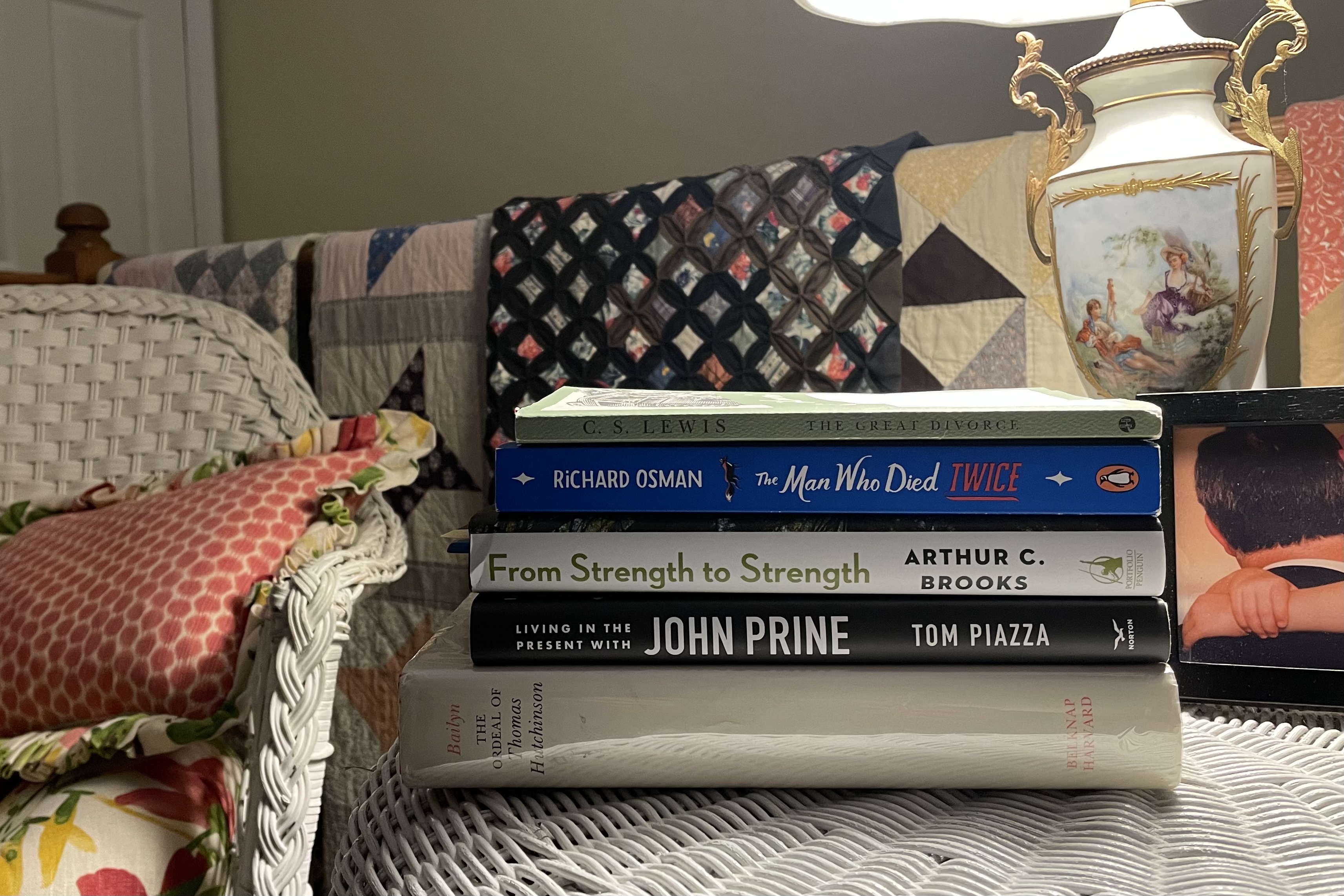
- The Ordeal of Thomas Hutchinson by Bernard Bailyn
- From Strength to Strength: Finding Success, Happiness, and Deep Purpose in the Second Half of Life by Arthur C. Brooks
- The Great Divorce by C.S. Lewis
- The Man Who Died Twice by Richard Osman
- Living in the Present with John Prine by Tom Piazza
Keep reading!
More to come . . .
DJB
NOTE: Click to see the books I read in February of 2026 and to see the books I read in 2025.
Photo of Boy Reading by Ben White on Unsplash
 MORE TO COME...