
Arthur C. Brooks looks at how to face, and perhaps even thrive, in the midst of the inevitable.
In recent years I’ve taken to reading works in a variety of genres that cover a wide range of topics. But I recently noticed that I have stopped reading in an area that was once a staple of my literary diet: self-help books.
There’s a formulaic feel to these works that began to feel repetitive. Plus, in my experience they tend to take a few good ideas and then generate enough words and anecdotes so that one has to slog through 250 pages for what should have been a good New Yorker article or a Ted Talk.
When one of my book groups chose to read a work that promised to serve as a guide to “transforming the life changes we fear into a source of strength” I was skeptical. But book clubs are about tackling works that perhaps you wouldn’t choose to read on your own, so I jumped in.
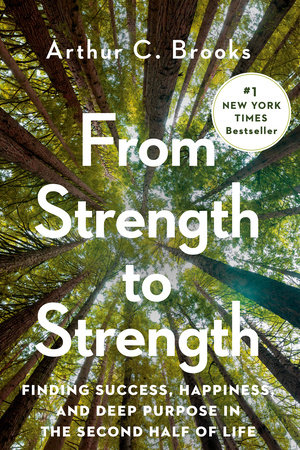
From Strength to Strength: Finding Success, Happiness, and Deep Purpose in The Second Half of Life (2022) by Arthur C. Brooks begins with the premise that too many of us believe that the more successful we are the less susceptible we become to the sense of professional and social irrelevance that often accompanies aging. But Brooks asserts that our belief in our ongoing relevance simply isn’t true. Aging, and decline, are inevitable. For many successful adults, facing this fact is painful. A social scientist and “one of the world’s leading authorities on human happiness,” Brooks chronicles his own journey, beginning at age 50 at the height of his career, to see if he could transform his future from disappointment to an opportunity for progress in new and unexpected ways. Depending on your perspective and personal experience, he either succeeded or simply finally found wisdom about the world as it works that many intuitively know or find through family, experience, or faith without having to read a self-help book.
Brooks is a good writer who raises intriguing points. Early on he notes that too many of us don’t recognize how early decline actually begins in our professional and personal lives. Surveys have shown that Americans believe “being old” means that you are “turning eighty-five.” In other words, the average American (who lives to be seventy-nine) dies six years before entering old age. But if we are being honest with ourselves we know that our memory begins to slip in our 50s, our physical plant begins to need repairs at about the same age, and things we once did with some ease—such as multi-tasking—become difficult if not impossible.
Over the course of 200+ pages, Brooks works through ways to move from one strength (the striving self) to another (such as the teaching/mentoring self). He asks his readers to ponder their death. Then he goes into a bit of real self-help mumbo jumbo when he travels to India to meet with a Hindu guru he’s been following for years. I found one of the more useful chapters to be his exhortation to make your weakness your strength. I agree that we really only connect with others through our weaknesses. More importantly, in telling Stephen Colbert’s story of “how he learned to love the thing that I most wish had not happened”—in Colbert’s instance when his father and two brothers died in a plane crash when he was ten—he addresses a fundamental truth of how life is really lived. In an interview Anderson Cooper asked Colbert to clarify that statement and his response is very instructive.
“It’s a gift to exist, and with existence comes suffering. I don’t want it to have happened . . . but if you are grateful for your life . . . then you have to be grateful for all of it. You can’t pick and choose what you’re grateful for.”
Brooks ends by discussing the fact that the transitions he went through and those traveled by other successful, striving individuals are liminal in nature. We look up and the path forward is no longer straightforward. He has suggestions for “good liminality” (a phrase I instinctively hated) that in many ways boil down to learning a new set of life skills. After some theology (he was president of the right-leaning American Enterprise Institute for a while, so the trad-Catholic approach fits), Brooks encourages his readers to put their love not on things but on people and, ultimately, the divine.
Some of our book club members found the perspective in From Strength to Strength persuasive. I told the group that I had learned many of these lessons a long time ago from my father. When it came to career and then retirement, my father taught us not to be defined by our jobs. He was proud of his career as a TVA engineer, yet he retired in his early 60s and easily moved on. Tom Brown enjoyed life. Every day was a new day.
I have been thinking more about liminal spaces in recent years, and I think we can all embrace the liminality in life. Poet and songwriter Carrie Newcomer talks about living in the in-between times.
“Most of the time I’m living in that vibrating and shifting center point between all that was and all that’s to come. I’m trying to pay attention, to drink in what is so right and good and true in this moment in time. Peace of heart and mind, peace on earth, peace within and between us, comes in small moments of beauty, waves of goodness in the here and now that wash in and out like the tides.”
With a poet’s voice (as opposed to a social scientist’s), she writes that the key to navigating foggy or dark places may be to find what is still visible and beautiful close in. A willingness to light one candle and then another and another and another—to take one tentative step in the right direction, watch for things that clarify or point the way, grateful for the goodness seen and unseen, while we walk forward using all available light.
Looking for the goodness and love knowing that the path forward will not always be clear. That strikes me as a more realistic way to live our lives as we move through the liminality that is life.
More to come . . .
DJB
Forest from a worms view by Kazuend on Unsplash
 MORE TO COME...