Tom Piazza creates an intimate portrait of one of the most beloved singers and songwriters of our times.
When America lost one of its greatest songwriters to Covid-19 in April of 2020, I wrote that his grieving fans would have to be content with what is, by any definition, an amazing body of work.
Live performances and recordings over a five-decade career will always form the heart of what we remember about John Prine. But as the artist’s widow Fiona writes in the foreword, a new book by a talented author, musician, and storyteller “is now a valuable, and unique, part of the legacy of our beloved John.”
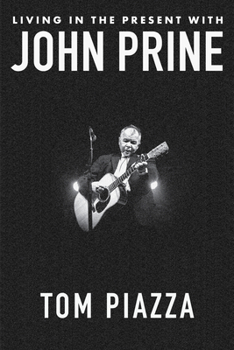
Living in the Present with John Prine (2025) by Tom Piazza was to be Prine’s memoir. But after the songwriter’s untimely death it became an intimate and personal narrative of the artist’s last few years. In a series of road trips, late night jam sessions, meals enjoyed in John’s favorite diners, and interviews, Piazza succeeds in capturing Prine’s unique voice. As fans we have heard this voice most frequently in his unforgettable songs. The joy of this new work is that we now experience John’s take on life in his everyday speech and off-hand remarks.
Piazza notes that Prine’s mind worked allusively, making connections through images and rhythms. John always lived in the present. “The moment was what mattered. He also had a strong sense of the finitude of it all,” which perhaps explains why he valued the present so much. “Part of that sense of the present was the fact that in any relationship, sooner or later, one of you would be saying goodbye.” In the end, Piazza has written a beautiful and personal work about friendship, love, and loss.
The book is not a biography although Prine does talk about his early years growing up in Maywood, Illinois, and visiting his parents’ families in western Kentucky. His origin story could come from a classic Prine song but Piazza only briefly mentions it here. John was a postman who wrote during his breaks. On a dare from friends (and under the influence of a few beers) he stepped up to an open mic and sang Sam Stone, Hello in There, and Paradise, three songs, any one of which most songwriters would have given their left arm to have written. A young Roger Ebert wrote his first music review of Prine performing in 1970 at the Fifth Peg in Chicago. In that review, he noted that “He starts slow. But after a song or two, even the drunks in the room begin to listen to his lyrics. And then he has you.” Kris Kristofferson stopped by to hear him play one night after the bar had closed. Prine pulled out his guitar, played seven songs, and Kristofferson asked him to play all seven again. Then he helped him get his first record deal and wrote the liner notes for his first album, where he memorably noted that Prine was “Twenty-four years old and writes like he’s two-hundred and twenty.”
Piazza joins the story in 2018, when Prine is an established and beloved figure in American life. With an opportunity to write an article for the Oxford American, Piazza and Prine begin to hang out, find mutual loves and connections, sing songs, and become friends. Over the next two years they see each other at various points on the map and add rich textures and compelling stories to their relationship. Prine, who had always said he never wanted to write a memoir, surprises Piazza by asking him to collaborate with him on writing one. They begin that task in February of 2020 with two days of interviews. Another session is planned for two weeks later but has to be postponed. Six weeks after that, on April 7, 2020, John died of complications from Covid-19. It has taken Piazza five years to come to the place where he could write this work.
“I told you I know how to waste a day,” Prine tells Piazza after a road trip to Sarasota in his ’77 Coupe de Ville where they buy shoes, reminisce about John’s first meeting with Bob Dylan, and eat the Granny Smith apple tart with an extra scoop of vanilla ice cream that John orders at lunch. That vibe runs throughout the book. So many of Prine’s songs are about connections—especially missed connections. “There is a yearning and a degree of melancholy inside all the wryness and brilliance of the lyrics.” Prine focuses on living in the present because he doesn’t want to miss those interactions with people he encounters, people he loves.
The book is full of little gems that capture a life well lived.
John tells about his seventeen-year-old Mexican girl friend. He was twelve at the time but somehow he “got the cojones to call her up and ask her for a date and she accepted!” He loved the whole family. “Her mother was five-foot-nuthin’ and had tortilla dust all over her.”
Then there is this story from early in his career.
“I did a big talk show in the seventies in Dublin, which was like the fifties anywhere else. The people wore cardigans—they looked like Mister Rogers. It was my first time playing Dublin. The show was on every night, like The Tonight Show. The other guests on the show were Brendan Behan’s mother, a defrocked bishop, and Freddy the Organ Grinder, with his monkey. Off the streets of Dublin! And I sang ‘Sam Stone.’ Brendan Behan’s mother and the bishop drank a whole bottle of port and got soused in the green room while I sang ‘Jesus Christ died for nothing I suppose,’ to all the Catholics in Ireland . . .”
John convinces the legendary Sam Phillips to come out of retirement to produce his album Pink Cadillac. His record company hated it. Robert Palmer, in the New York Times, wrote the album’s only positive review. “Rolling Stone said it sounded like the drunks were recording on shoeboxes.”
There are countless stories about John and Cowboy Jack Clement, another legend in the Nashville music business. “Cowboy’s business was fun . . . If we’re not having fun, we’re not doing our jobs.”
I could go on and on.
Jason Wilber, John’s lead guitarist for twenty-four years, said,
“He was unflappable; he didn’t get ruffled for no reason. I feel like one of the things I learned from him is you have all these opportunities to just be nice.”
John’s older brother Dave put it best. “If John Prine’s songs don’t get to you, you are dead. Or you have been lobotomized! Or you’re just not paying any attention.”
The music critic Jayson Greene wrote a 2018 profile in Pitchfork that put John’s appeal this way.
“Prine grew up in the Midwest, and his songs are full of very white, Middle-American sounding folks, people with names like Donald and Lydia and Loretta and Davy who drive trucks and serve in the Marines. But he doesn’t fetishize the lives of those he grew up around, or blow them up into gaudy myth like Springsteen. The people in his songs are never allegories for his own thoughts; they are just people, living with their own complications, and Prine takes pains to get them just right. In his songs, life is one long exercise in ambivalence, and the only honest point of view is a squint.”
John Prine was all about the details of life in a world that was cruel at times, but also where love shows through. And those details often focused on the everyday . . . until he spun them around through his quirky sensibility to see the wonder around us.
Tom Piazza has written a heartfelt portrait that is full of those loving, quirky and wonder-filled details of life. Fans of Prine—and we are legion—should be grateful.
More to come . . .
DJB
NOTE #1: If you want to see Prine performing in these later years, I recommend you find the time to watch one of the best: an intimate concert from 2019 on The Strombo Show. Gordon Lightfoot, who is one of John’s songwriting heroes, sits in the front row enjoying it as much as anyone, and you can watch him sing along with the familiar chorus of Far From Me: “Ain’t it funny how an old broken bottle / looks just like a diamond ring.” John also does a bit of mouth music in the song Crazy Bone and then says, “Please don’t mistake that for scat singing, that’s my shaving song in the morning. Somewhere between Popeye and Fred Flintstone.”
Classic.
NOTE #2: As fate would have it, three weeks before John’s death I happened to write about Prine and his music—before the world learned he was suffering from the symptoms of Covid-19—in a piece entitled The timeliness and timelessness of John Prine. It just seemed to be a good time to recall the work of the man who wrote the classic line, “To believe in this living is just a hard way to go.”
I didn’t realize how timely that post would be.
For other MTC posts about Prine’s music and legacy see:
- Remembering John Prine (April 2020)
- Paradise lost (October 2020)
NOTE #3: For another take, see also Gabe Meline’s Six Short Stories About John Prine
 MORE TO COME...