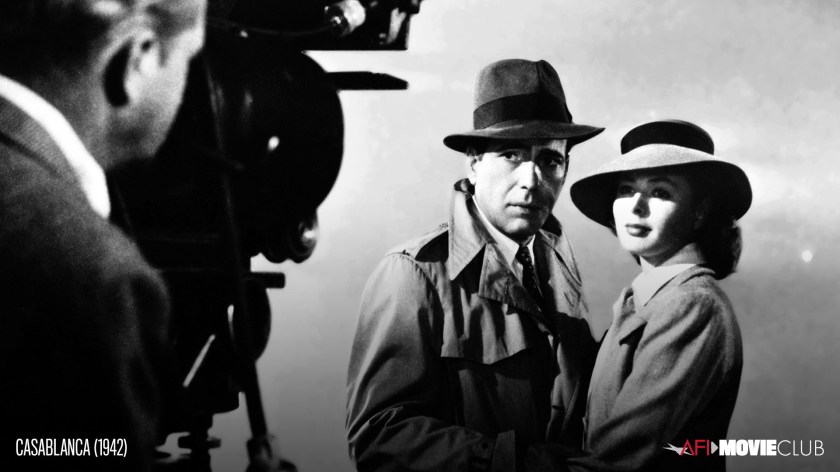
“Maybe there are better films than Casablanca, but there are probably none better loved.”
While preparing for an upcoming lecture on the ways that popular culture has influenced our views of history, I began delving into one of the best known and beloved movies of the last 100 years.
- The American Film Institute (AFI) listed it as #2 on the original list of America’s greatest movies (Citizen Kane was #1).
- It’s also ranked #1 among cinema’s love stories and has six quotes named among the most iconic of all time . . . leaving out, amazingly, my favorite from the film. *
- The song “As Time Goes By” sung by Dooley Wilson ranks #2 on the list of top 100 songs of American cinema, topped only by “Over the Rainbow.”
- Humphrey Bogart’s character Rick Blaine was ranked #4 on AFI’s list of the greatest screen heroes—and Bogart himself was named the #1 screen legend of all time on AFI’s 100 YEARS…100 STARS!
Film critic Roger Ebert made the astute observation: “When asked what is the greatest movie of all time, I say Citizen Kane. When asked what is the movie you like the best, I say Casablanca.”
Thankfully for the sake of my lecture . . . and for movie lovers everywhere . . . there’s a delightful book that helped flesh out my research with anecdotes and information that even longtime fans will find irresistible.
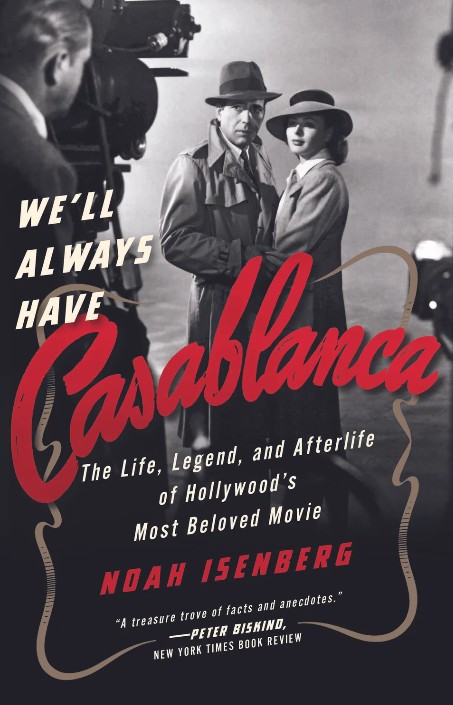
We’ll Always Have Casablanca: The Life, Legend, and Afterlife of Hollywood’s Most Beloved Movie (2017) by Noah Isenberg is a rich account of this most beloved movie’s origins as an unproduced stage play, its production as America’s involvement in World War II was beginning, its release just weeks after Allied troops landed in Morocco, and its long afterlife as a touchstone for our better angels. Isenberg, a noted film historian, conducts extensive archival research coupled with interviews of filmmakers, film critics, family members of the cast and crew, and diehard fans. The result is a deep yet swiftly moving, comprehensive yet tender account of the movie that millions around the world continue to watch and love. Senator Elizabeth Warren might have phrased it best in a New Year’s message written in 2016: “Each time I watch it, Casablanca gives me hope.”
In seven chapters titled from famous lines in the movie, Isenberg reveals the myths and realities behind Casablanca’s production. Chapter 1—Everybody Comes to Rick’s—sets the stage with extensive background on the writers of a modest, unproduced, three act stage play written in 1940 by English teacher Murray Burnett and his long-time writing partner Joan Alison. The origins of the story came from Burnett’s 1938 trip to Europe, as a relatively innocent and unsophisticated traveler, who saw firsthand the transformation of the continent by the Nazis. That summer he experienced the Nuremberg Laws, learned of the so-called refugee trail from Marseilles to Morocco, smuggled contraband from Jewish relatives out of Austria, and visited a smoky nightclub on the outskirts of Nice where a black pianist, a “crooner” from Chicago, was working the crowd playing jazz standards.
“Taking in the scene, Burnett purportedly turned to his wife and said on the spot, ‘What a setting for a play!’ Thus was the idea for Casablanca born.”
In what began a string of fortuitous timings associated with the film, the script showed up on the desk of Warner Brothers executives just days after the bombing of Pearl Harbor on December 7, 1941. By New Year’s Eve the script was beginning a long series of rewrites by a variety of screenwriters, and the studio sent around an internal memo announcing, “The story that we recently purchased entitled Everybody Comes to Rick’s will hereafter be known as Casablanca.”
Controversial casting decisions are also part of Isenberg’s story (in a chapter entitled Usual Suspects) where we learn that studio publicists issued a red herring of a publicity announcement that Ronald Reagan would star in Casablanca. (Perish the thought!) Bogart was the natural choice, although the female lead’s nationality and character would need to be changed before a twenty-seven year old Ingrid Bergman becomes Ilsa Lund. Bogart would later say that his status as a sex symbol went sky-high after the movie although he didn’t change all that much. “Bergman looked at him with an amorous gaze and, presto, he had sex appeal.”
Arthur “Dooley” Wilson memorably plays the black piano player and Rick Blaine’s confidant Sam in Casablanca. Wilson did his own singing but as he didn’t know how to play the piano that part was dubbed in by a staff musician. His fully-formed and sympathetic character, highly unusual during the Jim Crow era, was heralded as ground-breaking in the Black press of the day. One reviewer noted that “no picture has given as much sympathetic treatment and prominence to a Negro character as occurs in this story of war intrigue in North Africa.” A review in the New York Amsterdam News, one of the nation’s few black-owned newspapers, was titled “Wilson’s Role in Casablanca Tops for Hollywood” with a subhead that said it all: “Stars in Pic with Bogart: Warner Brothers Shows That It Can Be Done.”
Two of the more interesting storylines in the book relate to the battles with Production Code and war information censors and the central role refugees from Hitler’s Europe played in the movie’s creation.
The Production (or Hayes) Code was a 1930s creation to ensure that no picture was produced which would “lower the moral standards of those who watch it.” Sex—and especially adultery—was one of the Hayes Office’s “favorite whipping posts” which ensured that Rick and Ilsa romance in Paris had to be consummated only after Ilsa assures Rick that she believes that her husband, Victor Laszlo, is dead. Once Laszlo (played memorably by Austrian-born actor Paul Henreid) returns that same set of rules set the stage for the ending. The overseeing eye of the Office of War Information (OWI) added to the mix. While Rick may say early in the film that he “sticks his neck out for no one,” we find in the course of the story that he worked against the fascists in the Spanish Civil War and Ilsa reminds him of why he needs to leave Paris before the Nazi’s arrive. “Richard, they’ll find out your record. It won’t be safe for you here.”
Personally, I found the backstory about the extensive and complex role of refugees to be fascinating, especially when contrasting history with today’s challenges. If you think about it Casablanca may be a love story, but it is also at its heart a story about the travails of immigrants and the many dangers faced by refugees. Isenberg provides multiple storylines for those interested in that part of the subplot.
The casting is where one sees this most clearly.
“Nearly all of the seventy-five actors and actresses cast in Casablanca were immigrants. Among the fourteen who earned a screen credit, only three were born in the United States: Humphrey Bogart, Dooley Wilson, and Joy Page, Jack Warner’s stepdaughter, who plays the Bulgarian refugee Annina Brandel. At the studio, Stage S, where Rick’s Cafe was assembled, was known as International House.”
The American-born bit actor who played Abdul the doorman at Rick’s noticed:
“. . . streams of tears flowing from the eyes of his fellow actors—most prominently Madeleine Lebeau, who plays Rick’s on-again-off-again paramour Yvonne—during the singing of the Marseillaise. ‘I suddenly realized,’ he recalled many years later, ‘that they were all real refugees.”
In a good example of how popular culture’s depiction of history doesn’t always match what actually happened, Isenberg notes that while the story of refugees in centered in Casablanca, it was still glossed over in certain ways.
“. . .to tell the story on the Hollywood screen in 1942, these refugees would have to be stripped of any obvious ethnic or religious affiliations. They would simply have to be ‘refugees” congregating at Rick’s Cafe, all of them, in the shared predicament—not specific to any one group as the film has it—of waiting to secure a prized exit visa.”
André Aciman, author of Out of Egypt, observes,
“All these Jews are on screen and yet they cannot address it explicitly. It’s all over the screen, but not in the movie.”
That Jews were fleeing the Nazis and trying to leave Europe wasn’t a hidden secret at the time. Six million Jews were eventually killed in Hitler’s concentration camps. Yet the movies at the time could not, or would not, be that specific for fear of upsetting the Americans who flocked to theatres in that era. It is another part of our past that deserves deeper reflection.
Just like the movie, there is so much to love about this book. I’ve only touched the surface. But let me give the last word to scriptwriter Nora Ephron (When Harry Met Sally) who, months before her death, wrote a short Valentine piece for The Daily Beast in which she listed her all-time favorite love stories,
“. . . including Frank Capra’s It Happened One Night (1934) and Bill Wilder’s The Apartment (1960). Naturally Casablanca ranks high up on her list, but unlike the other wordier entries, her commentary on the film is limited to just two short, revealing lines: ‘How many times can you see it? Never enough.'”
That’s a historical perspective I can agree with.
More to come . . .
DJB
*The six quotes in the top 100 are:
- No. 5: “Here’s looking at you, kid” spoken by Rick (Bogart) to Ilsa (Bergman)
- No. 20: “Louis, I think this is the beginning of a beautiful friendship”
- No. 28: “Play it, Sam. Play ‘As Time Goes By,’” (often misquoted as “Play it again, Sam”
- No. 32: “Round up the usual suspects”
- No. 43: “We’ll always have Paris”
- No. 67: “Of all the gin joints in all the towns in all the world, she walks into mine”


David — what a great trip down memory lane! And the book sounds fascinating.
But you didn’t say what your favorite quote from Casablanca is — only that it was not among the six that made the top 100 list. So what is it? Curious minds want to know. . .
Sandy ________________________________
“I’m shocked, shocked to find gambling going on in this place. Your winnings sir. Thank you.”
There was a link inserted to the clip. Sorry it wasn’t clear!
Ah yes, I missed the hyperlink. But a sharp-eyed friend to whom I forwarded this posting found it even before I could pass along your comment. ________________________________
Pingback: Medinas, mosques, masterpieces . . . Morocco (Part 2) | MORE TO COME...
Pingback: Observations from . . . May 2026 | MORE TO COME...
Pingback: From the bookshelf: May 2026 | MORE TO COME...