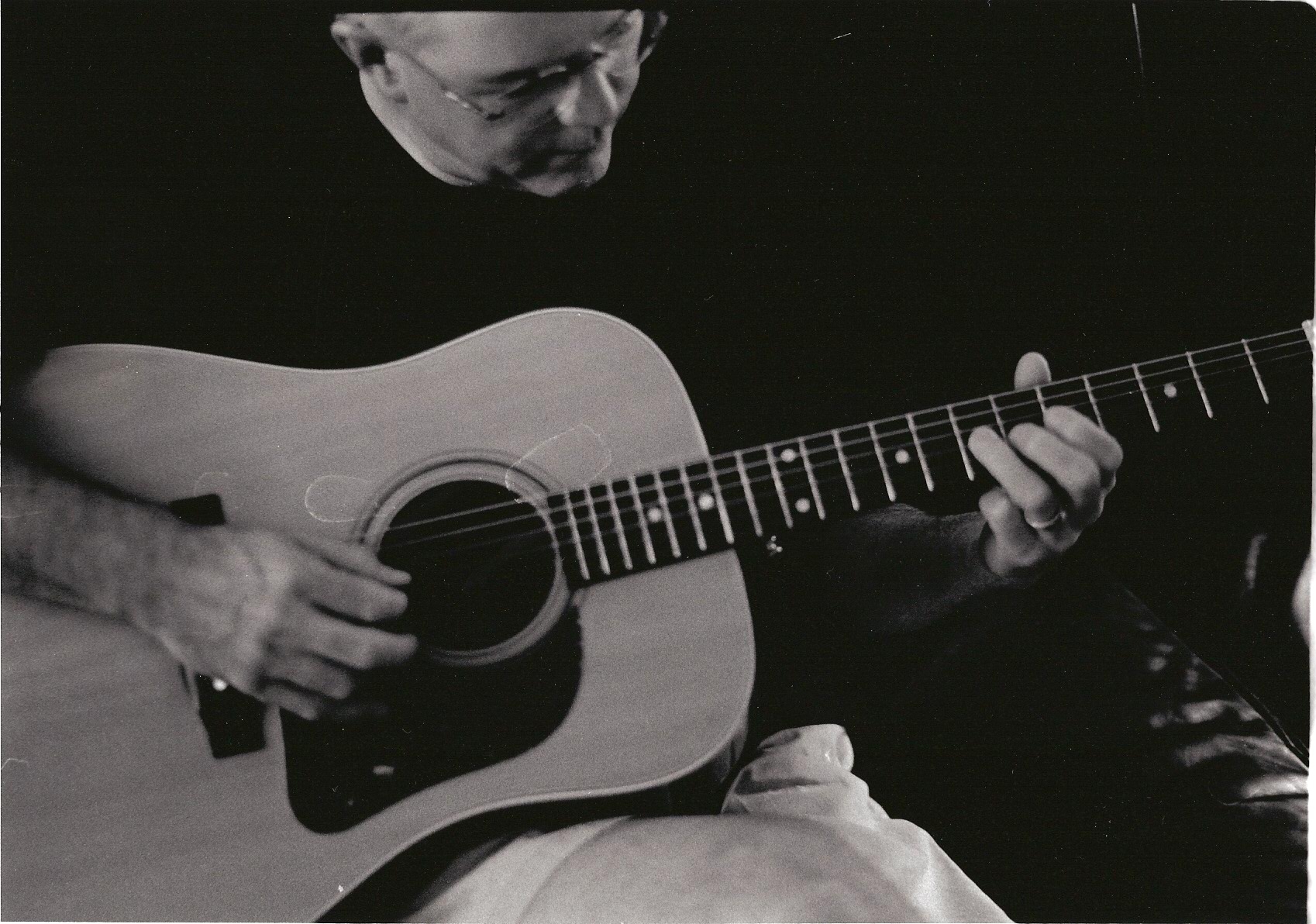
Playing music with friends over Thanksgiving has pushed me to reorder my schedule to find even more time to play. And – no surprise here – I’ve loved it. I’m reacquainting myself with some of the playing of Norman Blake (check out the Nashville Blues video below of Norman and the Rising Fawn String Ensemble) and other musicians I admire.
In the delightful book Practicing, author and musician Glenn Kurtz says,
For me, sitting down to play has very little to do with discipline. “It isn’t just education and discipline that makes one so devoted to work…it is simple joy. It is one’s natural sense of well-being, to which nothing else can compare.” Love of music brings me to the practice room.
I am finding that joy in playing again and it is a wonderful feeling.
So I’m off to play a bit now, and then tomorrow evening I’ll be at the Celtic Christmas concert of the Institute of Musical Traditions for some great acoustic guitar by Al Petteway and Robin Bullock. If you’re in the Washington, DC area stop by and support live music.
I awoke early this morning and came downstairs while everyone is still asleep. It is St. Nicholas Day, and I had to smile at the sight of two rather large teenage shoes — one from each child — sitting expectantly on the landing. The memories came rushing back.
We’re not German and I didn’t grow up celebrating St. Nicholas Day, but Candice loves a good holiday — especially one associated with a saint that could help counterbalance the commercialization of Christmas. So soon after the twins arrived we decided we’d celebrate St. Nicholas Day and it became a tradition.
The gifts are similar year to year. Candice always finds the gold coin chocolates. The gifts are modest. This year they include something for Claire’s hair and a “Bush countdown calendar” for our progressive teenage son. With St. Nicholas Day, the twins birthday, and Christmas all coming within a three week period, we have to be prudent on the gift buying front.
That’s what I like most about our St. Nicholas Day celebrations: the simple nature of the children’s expectations and the gratitude for small things. Each year there’s a wonder as to what St. Nicholas will bring. There’s a thankfulness for tradition – that we simply remembered to celebrate.
But of course Andrew and Claire aren’t children anymore. Last night at a holiday party, someone commented on the picture of the two of them in our recent A Year in Photos post. They look like young adults, and — in fact — that’s what they are. They live very busy lives and could just as easily have skipped right over St. Nicholas Day.
But the conversation before we all fell into bed last evening was about the safety of having St. Nicholas putting out chocolate while Lilly roamed the house during the night. How very far we’ve come, yet how near and dear they remain. Perhaps Madeleine L’Engle – the author of Andrew’s favorite book A Wrinkle in Time– was right. Perhaps we are always every age we’ve ever been. So when we’re 53 years old, we’re still 4 and we’re still 12 and we still love a childhood tradition.
I’m not sure what has been my favorite holiday, but I think Thanksgiving has now taken over the top rung on the ladder. I think it may be the fact that big business hasn’t yet figured out a way to commercialize it. Or perhaps it is the fact that food plays a big role. I like the focus on the act of being thankful for all we have in a country that’s been abundantly blessed. Then again, maybe it is just that we’ve figured out how to get together with people we really enjoy and have a very relaxing time. Whatever the reason, it is my new favorite holiday.
Candice and I have always enjoyed Thanksgiving. For many years we traveled over the mountain from Staunton to a wonderful inn, Prospect Hill, for a bountiful Thanksgiving dinner. It was especially meaningful to us because we honeymooned at Prospect Hill while we were very poor graduate students. Little did we realize that just a year after our wedding we’d move to Virginia and be an hour away.
With the coming of twins it became more difficult to pack up and go to a great restaurant/inn that was 2+ hours away for Thanksgiving (even though we gave it a try one year). That’s when our wonderful friends Margaret and Oakley invited us to join their extended “family” for Thanksgiving in Staunton…and we made the first steps to Thanksgiving becoming my new favorite. Random thoughts on why I have come to enjoy Thanksgiving:
I love the slow pace of a Thanksgiving meal. You talk, eat, drink, play a little music, eat some more, drink some more wine – and all of a sudden it is 11 p.m. The pace gives you time to digest (and I’m talking about more than just food).
The friends we share with Margaret and Oakley are neat people. And, of course, Margaret and Oakley are the neatest of all! They moved from the Mount Pleasant neighborhood in DC to Staunton a number of years ago, and have this great urban/rural/Minnesota/Dylan/gourmet/ natural foods/spiritual vibe that’s great to share. I’m sure you see all of that in the picture.
When we go back to Staunton, it is like we never left. We can begin conversations that began 15 years ago and that are ongoing.
One of the great things about community is that people accept each other EVEN though they know all the faults. One of mine is that I hear better music in my head than what comes out when I play. But guess what? The good musicians in our group still let me play and have a good time, even when I can’t remember the lyrics or get the chords right. That’s cool.
We love the small town of Staunton, where we lived for 15 years. It is always great to spend 4 hours wandering through the downtown to visit new shops and run into old friends. We did a lot of both this past weekend. This year it was even better because there’s this terrific new bass shop in town, called Fretwell Bass. When I walked into a store with 25 or so upright basses for sale, I thought I’d died and gone to heaven. My dream of playing an upright bass just came into focus!
Staunton’s restaurant scene is also improving. On Friday Margaret and Oakley joined us for dinner at the Staunton Grocery, a wonderful restaurant where we enjoyed the food and company. Candice and Margaret – the former catering partners – sat opposite the picture window looking into the kitchen and kept up a running commentary on the dishes as they were prepared and served. How can you beat two nights in a row of great food, wine, and conversation?
So Thanksgiving is now my new favorite holiday. During our music making on Thursday evening, I was reminded of the great Stephen Foster song Slumber My Darling. Our friend Constance has a beautiful voice which mesmerized us all as she sang this tune. Since I was playing guitar at the time and not filming the performance, I’ve instead posted this wonderful video of Alison Krauss. And while Constance didn’t quite have the backup band of Edgar Meyer, Mark O’Connor, and Yo Yo Ma that Alison enjoys, I’ll remember this highlight from Thanksgiving 2008.
On Thanksgiving morning, Candice and I visited our neighborhood Episcopal Church in Silver Spring. We went to give thanks for all we have, but we also went to this particular church because we knew that one of the DC-area’s best hammered dulcimer players – Karen Ashbrook – was providing the music.
Over the course of the next hour, Karen played six beautiful tunes. Of special note was the haunting O Savior Thee – a Scottish Christmas carol – which made for a wonderful time of reflection following the readings and sermon.
The small Gothic church was acoustically alive, providing a nice setting for Karen’s music. It was a wonderful start to our Thanksgiving Day.
Check out Karen and her husband Paul Oorts on this video of Irish tunes.
This Thanksgiving I’ve posted some photos from the past 12 months as a reminder of the many things for which we are thankful. Scroll over the top of the photo for a description. Click on the photo for a full-screen view.
Happy Thanksgiving.
More to come…
DJB
Enjoy!
More to come…
DJB
Image: Candice and Margaret Pearson cook Thanksgiving dinner
All of David Grier’s guitar skills were on display tonight at the Monday evening concert of the Institute of Musical Tradition in Rockville. Greir opened with a spirited version of Durham’s Bull, an old fiddle tune (and afterwards opined that all fiddle tunes are described as “old”), and then put on a two-hour tour de force of flatpicked guitar and bad jokes.
It is a tall order to keep an audience’s interest with two hours of solo flatpicked guitar, but Grier made it look easy. With equal measures original tunes and flatpicking chestnuts – with the occasional popular tune such as Yesterday thrown in as well – Grier showed why he’s one of the best flatpickers on the planet.
This was an evening of highlights: the beautiful intro for Red Haired Boy, the original waltz High Atop Princess Cove, and the Stephen Foster tune Angeline the Baker among them. One of Grier’s best recorded efforts is the Bill Monroe tune Old Ebenezer Scrooge, which he worked as a duet with bassist Todd Phillips on the Grammy award winning True Life Blues: The Songs of Bill Monroe. Tonight he played it as a powerful solo piece which fared much better than the “stupid fast” (Grier’s description) version of the other Monroe tune Roanoke that ended the show.
However, any complaints are nitpicking, and the numerous guitarists in the audience were there for a different type of picking. Suffice it to say that Grier satisfied.
In poking around on You Tube, I found the following video that features a young Grier with other winners of the International Bluegrass Music Association (IBMA) instrumentalists of the year awards. Enjoy Shenandoah Breakdown by Grier (displaying a fun use of time on his guitar break) with Sam Bush on mandolin, Jerry Douglas on dobro, Stuart Duncan on fiddle, Tom Adams on banjo, and the late Roy Huskey, Jr. on bass.
The Sunday New York Times included a story on “Slow Blogging.” I had never heard of the term (although I am aware of the slow food movement), but I found myself agreeing with the rejection of immediacy, the thought of blogging as meditation, and the precept that not all things worth reading are written quickly.
This approach is a deliberate smack at the popular group blogs like Huffington Post, the Daily Beast, Valleywag and boing-bong, which can crank out as many as 50 items a day. On those sites, readers flood in and advertisers sign on. Spin and snark abound. Earnest descriptions of the first frost of the season are nowhere to be found.
In between the slow bloggers and the rapid-fire ones, there is a vast middle, hundreds of thousands of writers who are not trying to attract advertising or buzz but do want to reach like-minded colleagues and friends. These people have been the bedrock of the genre since its start, yet recently there has been a sea change in their output: They are increasingly turning to slow blogging, in practice if not in name.
The blogger profiled in the Times story is Barbara Ganley, and she has a lovely post in response to her new-found fame. As is my habit, I searched through her blog and found several wonderful pieces, including this reflective piece on the morning after the election. If you like thoughtful writing, Vermont, beautiful photographs and more, you may want to explore bgblogging as well.
As regular readers know, More to Come…is quirky and certainly isn’t tied to either the news cycle or my professional life. Perhaps Ms Ganley and other slow bloggers have given me a context for what I’ve called my therapy. That gives me something to ponder.
There are few things in life I like better than the sound of an acoustic guitar. So I’m looking forward to two upcoming concerts in the Washington, DC area by three terrific players.
On Monday night, one of the best guitar flatpickers on the planet will be playing at the Institute of Musical Traditions series at Saint Mark’s Presbyterian Church in Rockville. David Grier is well-known to flatpicking aficionados and along with a busy session schedule handles the guitar duties in the supergroup Psychograss. Watch the video below of Grier and Wyatt Rice – younger brother of guitar superstar Tony Rice – and you’ll see why we flatpicker wanna-be’s will be in attendance on Monday, flatpicks clutched in our right hand taking in every lick.
For those of you who prefer your acoustic guitar fingerstyle (which I also love), you only have to wait two weeks to December 8th for the IMT concert featuring Al Petteway, Amy White, and Robin Bullock. Petteway and Bullock both have inventive minds and beautiful tones. Their holiday-flavored concert, which features the silver-throated White on a variety of instruments, is always a favorite. Make your plans now.
I bought some new strings today in anticipation of the playing to come after I’m inspired by these terrific musicians. Join me in supporting live music and your local music store!
In yet another of my posts on very interesting web sites found while searching the Internet, I bring you today The Edge of the American West. This is a site that contains writings by historians and philosophers, leading the site to suggest that “History is Philosophy teaching by examples. ”
The interests of these men and women run the gamut, if recent posts are any example. They do a regular This Day in History type of post, one of the most recent being about the day that Richard Nixon declared he wasn’t a crook. To give you a sense of the politics here, the post is entitled “Yes You Are. And Also a Liar.”There are posts on camel metaphors (having to do with choosing cabinet members), and the day in 1972 when the Dow Jones Industrial Average first closed above 1,000. (We may be headed back there!)
But I knew this was a website worth checking when I read Aw, that could have been MY head. Here the writer tells the story of how he “taught the future professional wrestler – and now Heavyweight Ultimate Fighting Champion – Brock Lesnar.” It is a very funny post, where the writer notes that he, “was less than impressed with Lesnar’s academic potential; his essay on Kant’s anthropology of race was likely not his finest work.”
After noting that Lesnar had wrestled in college, the writer goes on to say that:
Lesnar parlayed his amateur glory into a three-year run with World Wrestling Entertainment, during which time he evidently vaulted to the top of his profession, wrestling the likes of Hulk Hogan and The Rock on his way to becoming the youngest WWE champion in history. As I understand it, he was known for such moves as the “spinebuster,” the “scoop powerslam,” the “rear naked choke,” and something mysteriously known as “repeated turnbuckle thrusts.” His signature line, Wikipedia tells me, was “Here comes the pain!” — a phrase that I suppose I could have utilized whenever returning Mr. Lesnar’s written work.
You just can’t make this stuff up. Check out The Edge of the American West. You’ll probably find more than a few things of interest.
With two sophomores in Pre-Calculus, Spanish, Honors Chemistry, and the like, there’s not much I can do to help with homework these days. So when Claire asked me to come over to her chair tonight to look over a review sheet, I went with some trepidation. She must have seen my fear, so she added, “It is for history.”
Whew. That I can handle.
Her note sheet had some smudges, obscuring some of the answers. So she asked “Why did President Lincoln fire McClellan?”
“The first or second time?” My response surprised her, but she re-read the question and realized it was referring to the second time. So I said, “because he refused to attack Lee’s retreating army after Antietam.” She looked at her sheet, figured out the missing words around the smudge, and decided I was right. One for the old man.
“How did President Lincoln describe General McClellan?” Claire asked. “That’s easy,” I replied, “Lincoln said McClellan, ‘had a bad case of the slows.'”
Now I had her! “How did you know that?!” she exclaimed. I smiled. It isn’t often I get to bask in the glow of admiration from my teenagers’ when it comes to questions of homework.
Finally! All those years of devouring Civil War histories paid off in the self-satisfied feeling you get when you come across as something less than clueless to your teenagers. You’ll never know when you have to pull a quote about “The Little Napoleon” out of the air. So study up!