While I’m away, I want to take this Saturday Soundtrack opportunity to encourage you to visit the online site of a writer I follow and admire: The Musical Box: Musings on music by Walter Tunis. Once or twice a week Tunis will feature an interview with a musician or review a live show in the Lexington, Kentucky region and he never fails to bring both joy and deep knowledge of the field to his work.
A recent post entitled A few minutes with Sam Bush and Jerry Douglas is a great example. I’ve followed their careers for decades and have seen both of them live numerous times, but his interview was as fresh as the first time I was exposed to their amazing talents.
Here’s how Tunis begins this post:
“It was a dark and stormy night…
Seriously, it was. Outside the Martin Marietta Center for the Performing Arts in Raleigh, Hurricane Helene was beginning to make her devastating presence felt. While her full wrath went West of the city, the North Carolina capitol region was still hammered by rain, wind and unavoidable unease.
Inside, the Center, though, the mood was considerably lighter. There, two members of the Bluegrass Hall of Fame stood onstage. One, Sam Bush, had just inducted the other, Jerry Douglas. It was fitting as Bush himself entered the Hall of Fame last year. But what made this ceremony seem so, well, obvious was the fact the two artists have spent the last five decades redefining the string music vocabulary that has long been the DNA of bluegrass and applying it to all kinds of multi-genre settings. Some were rooted in tradition, others explored wildly progressive terrain. The cool aspect to all this, though, is how many of these half-century adventures the two have explored together – with Douglas on dobro and Bush on mandolin and fiddle – as bandmates onstage or as studio players on the same recording sessions.”
These two string-music giants then swap stories and memories that reminds me of why I subscribe to The Musical Box.
Do yourself a favor. Listen to Sam and Jerry play Bob Dylan’s Girl from the North Country and then mosey over and read the piece by Walter Tunis. There’s nary a false note to be found.
More to come . . .
DJB
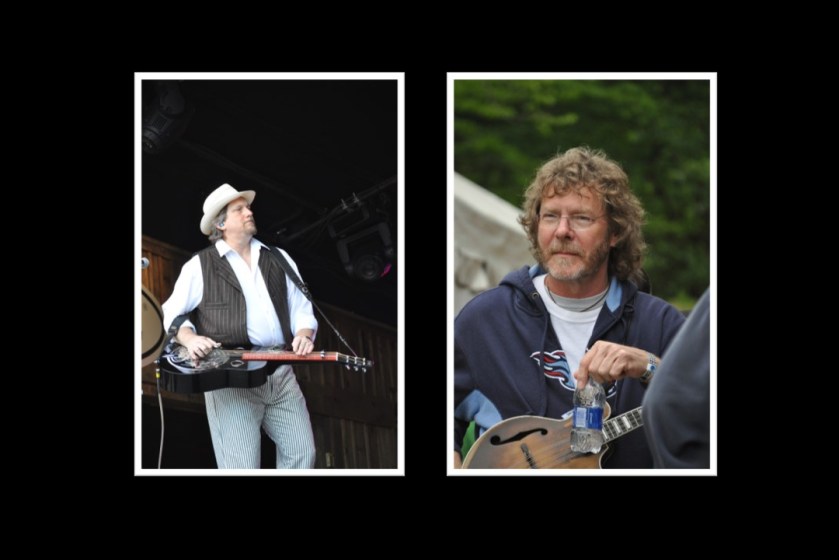
Photos of Jerry Douglas (left) and Sam Bush (right) taken at Merlefest by DJB
Traveling to Europe seemed an appropriate time to read about wine. Thankfully, I found a book where the author writes in her introduction that “wine is the place where history, science, and civilization meet.” I knew then I’d found a thoughtful, engaging, and educated guide.
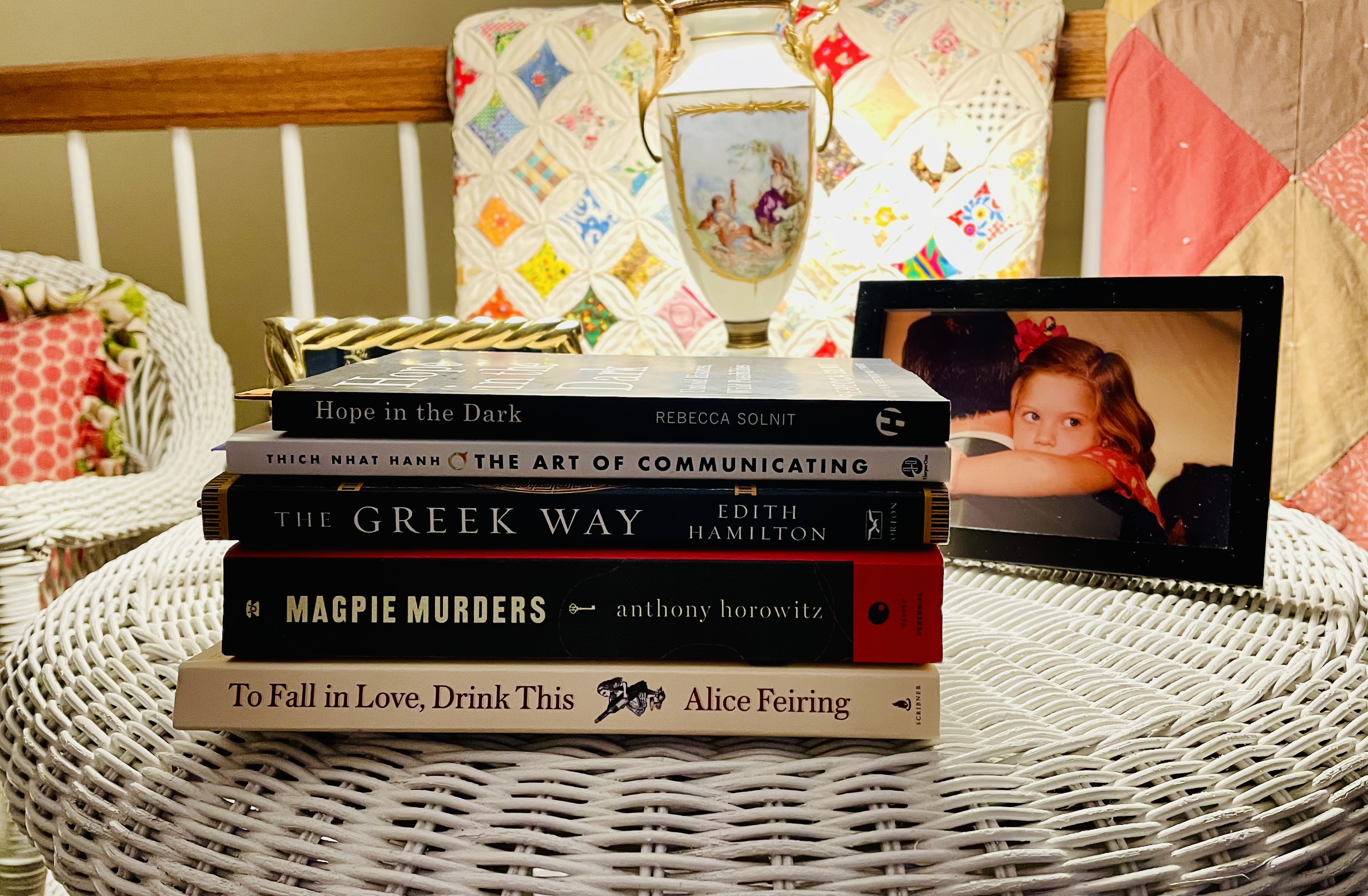
To Fall in Love, Drink This: A Wine Writer’s Memoir (2022) by Alice Feiring is a self-described “love letter to wine and a lifelong coming of age story.” Feiring believes that the best wine writing is about life, and in a series of eleven personal essays she explores her own life’s story while sharing her love of natural wine. She doesn’t want to be seen as a wine critic, but instead wants readers to share her fascination for wine’s spiritual underpinnings.
Feiring tells the story of Georgian soldiers who, when attacked by Turks, “went into battle with a vine clipping near their breast; should they die on the field, a grapevine would take root through their heart. Even if that story was nothing more than local mythology,” she continues, “the love behind the myth begs for attention.” She is captivated by the fact that virtually every culture has a relationship with wine. Her writings about this captivation, as well as the desire to find meaning in the metaphor that is wine, results in a book that is as delightful as good bottles with good friends around a bountiful table.
Throughout To Fall in Love, the reader travels with Feiring through childhood memories of her beloved grandfather who mixes stories in Yiddish and English and teaches her how to drink schnapps. We see teenage misadventures, such as the time she barely escapes the clutches of a serial killer who befriends her in a bookstore where she is sent while her father meets up with his mistress. Feiring shares stories of a long-term boyfriend who was Catholic and didn’t drink due to being raised by an alcoholic father, and how they finally broke up because they were “just different species.” The reader visits German concentration camps in Poland, where Sarah, the cousin of Feiring’s mother, escaped the Nazis with her family. We read about her first wine writing assignment and pandemic loneliness. In each essay Feiring provides us with a wine suggestion. These “are not here because they are the best or my preferred wines but because they move me and are integral to the story line.”
Feiring drinks as she eats: “organic, with very little processing.” Thus we learn about wines that are “at least seriously sustainable viticulture” with no added ingredients or “big machines.” She says that while some might call them natural, “these days I just call them real.”
And that’s also how she writes: simple at one level but complex in other ways, and always real. Each essay has its own particular taste, if you will, but each is satisfying. Feiring has an “uncommon palette” in food and wine, and that comes across in this delightful memoir. As one reviewer suggested, finish every drop.
I was a rising sixth grader when our family moved to Murfreesboro. Like many a new student dropped into an existing and well-functioning school community, I struggled with certain subjects and relationships. My classmates had all trained under the “new math” of the 1960s, which had yet to make its way to Capshaw Elementary, my former school in Cookeville. To quote the famous idiom we use when something is incomprehensible, “it was all Greek to me.”
Ironically, my sixth grade teacher, Mrs. Adkerson, helped save me from a life of academic failure with something that turned that idiom on its head. Mrs. Adkerson, you see, had a love of Greek mythology. As she enthusiastically taught both real and mythical tales from ancient Greece, I learned that the past could come alive in the hands of a skilled storyteller. As she admonished us not to snicker when we saw naked statues of young Greek men and women, she opened up possibilities for new ways to see and appreciate beauty, art, and the wider world. As she spoke about the cities and towns of ancient Greece, I came to learn the importance of place.
I suspect—even without proof—that a young Martha Adkerson had come under the influence of Edith Hamilton. She would not be alone among Americans of the mid-twentieth century.
The Greek Way (originally published 1930, reprinted in 2017) by Edith Hamilton is a well-known survey of Greek literature and art that is definitely a product of its time. “Probably no other single person has had such an impact in shaping the perceptions of classical literature and mythology in the United States for almost a century” writes Emily Wilson in The Nation. Hamilton was a powerhouse of her age, with influences that still exist. There is much to admire in this slim work, but also much is required to place this book and Hamilton’s worldview into its proper context.
In her preface, Hamilton lets the reader know where she stands on the crucial role of ancient Greece in the world today. Writing between the two World Wars, Hamilton rightly sees a world that is “storm driven.” In such situations, she suggests, “we need to know all the strong fortresses of the spirit which men have built through the ages.”
No place was a stronger fortress in Hamilton’s mind than ancient Greece.
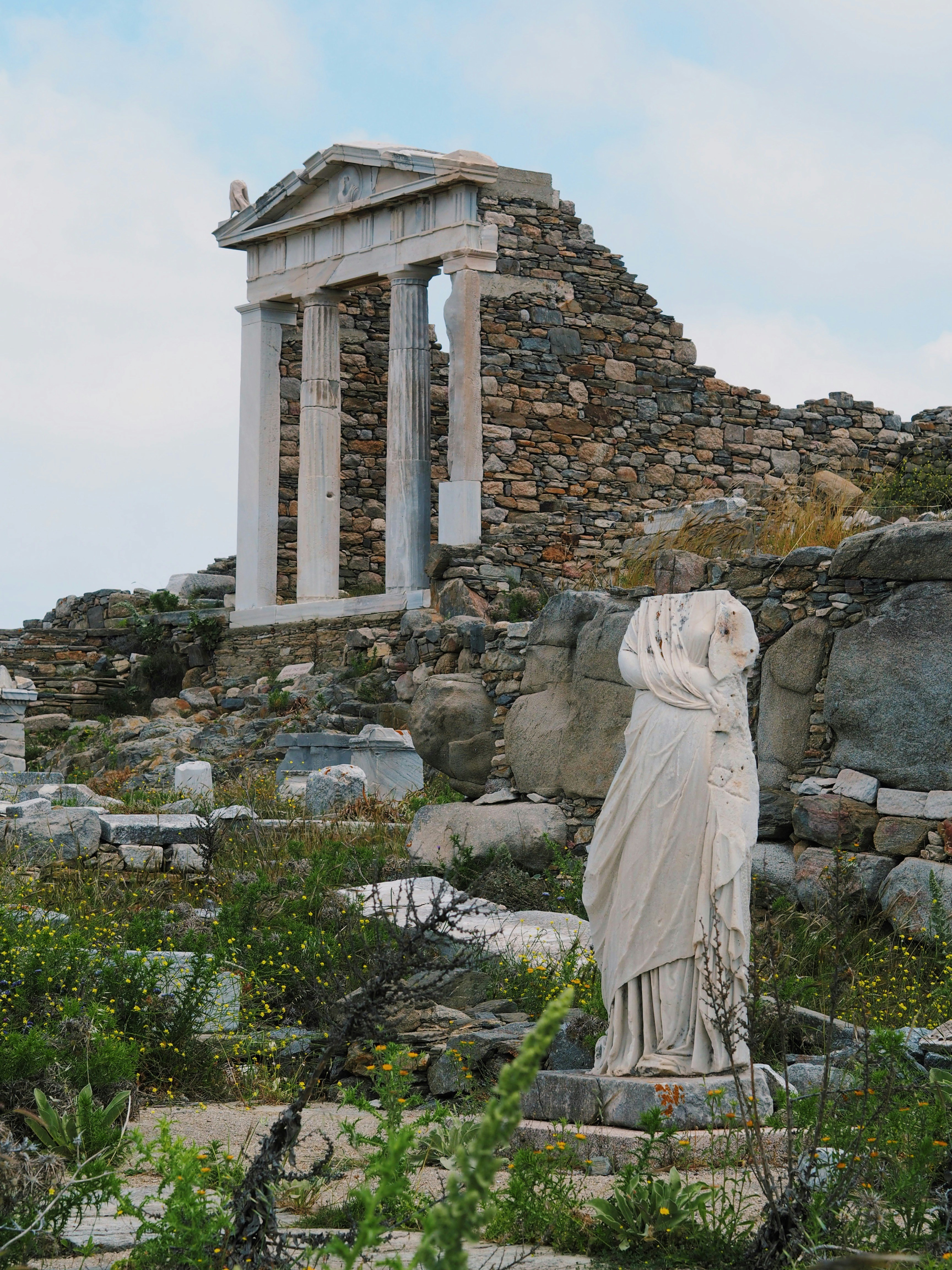
The ruins of Delos (from Unsplash)
Her first chapter is a comparison of East and West, and she describes the Greeks as “the first Westerners.” Although ancient, they belong in the modern world. “That which distinguishes the modern world from the ancient, and that which divides the West from the East, is the supremacy of mind in the affairs of man.”
Hamilton insisted on the superiority of the (Western, implicitly white) Greeks over the “ignorant,” “subjugated,” and “wretched” peoples of “the East.”
“Later, without any particular knowledge of ancient Egyptian or Asian civilizations . . . Hamilton blithely dismissed them as containing ‘human beings…who are only partially developed,’ lacking the complete unity of ‘mind and spirit’ that was present only in ancient Greece until its reappearance, at last, in America.”
Emily Wilson
Hamilton argues that the Greeks were the first people in the world to play, and they did so on a great scale. “To rejoice in life, to find the world beautiful and delightful to live in, was a mark of the Greek spirit.” It is, Hamilton argues, different than everything that had come before. It is a blending of mind and spirit, body and soul, and it sets out the path for the Western civilization that was to follow. In chapters on poets, artists, and historians, Hamilton tells a tale where even a novice like me can see the flaws. “Reviewers at the time of her first book’s publication (such as Percy Hutchison in The New York Times) observed that Hamilton’s stark distinction between ‘East’ and ‘West’ was, historically, complete nonsense.”
Yet Hamilton wrote with a style and spirit that captured the imagination. I suspect that’s what brought Martha Adkerson into the fold, and it still has adherents today.
But context matters.
Wilson, who has recently translated both The Iliad and The Odyssey to great acclaim, is Department Chair and Professor of Classical Studies at the University of Pennsylvania. She has been named a Fellow of the American Academy in Rome in Renaissance & Early Modern scholarship, a MacArthur Fellow, and a Guggenheim Fellow. Her essay on Hamilton helps explain how this retired Latin schoolteacher with “limited formal education and almost no scholarly credentials,” come to be “one of the most influential ‘classicists’ of the 20th century.” First of all, Wilson asserts, Hamilton “maintains a constant aura of authority on the page,” especially as she includes little snippets of ancient texts into her summaries and discussions. This is clear to anyone today reading The Greek Way. Hamilton is a good writer, so her loose, evocative translations provided without sources, encourages the reader “to take them as a matter of faith, not research.”
The second great reason for Hamilton’s grip on the American reading public is that she remakes ancient Greece in the image of an idealized United States—a world of glorious individualism and democratic freedom for all (or, if not exactly all, at least for everyone who matters). She relies heavily on vague, more or less unprovable grand claims about ‘spirit’: ‘To rejoice in life, to find the world beautiful and delightful to live in,’ she writes in one of many such passages, ‘was a mark of the Greek spirit which distinguished it from all that had gone before.’ Hamilton created an image of ancient Greece that was alien enough to sound romantic, but also familiar to a readership of white Americans eager to imagine themselves as the proud inhabitants of a land of freedom and superiority.”
Hamilton’s work came at an inauspicious time, as the world around Western civilization appeared to be crumbling. After World War I, Wilson notes, colleges and universities began to offer classes on ancient texts studied in translation. These studies were considered prerequisites for understanding “contemporary issues in Europe and the United States—regions that were now often lumped together under the term ‘the West.'” Classes were devised to showcase the “‘unique features of the western world,’ a world that apparently had begun in ancient Greece and that had now reached its apex in the American present.”
The goal of connecting US citizens to a long, largely fabricated notion of ‘Western civilization’ seemed increasingly urgent in the aftermath of a war that had torn the nations of Europe apart. The fantasy of a common ‘Western’ heritage shared by white Europeans and North Americans appeared as a prophylactic against future wars, at least between those who could qualify as ‘Westerners.’ But it also did something else. By excluding the numerous surviving ancient texts and cultural artifacts from the rest of the world, these new courses on ‘Western civilization’ suggested that premodern ‘civilization’ was the exclusive property of the ‘West’—enabling a kind of mythical/historical justification for continued domination of those peoples deemed to have come from outside this exclusive group, whether it was Black and Asian Americans in the United States or the millions still living under imperial and colonial rule in Asia and Africa.”
Wilson writes, and I strongly agree, that “we could do worse than take some lessons from Hamilton,” despite her many flaws. She engaged the reading public “not by actual knowledge or credentials, but by the unfeigned enthusiasm and devotion with which she told and retold the story of her love for her own imagined, idealized version of antiquity.” Storytelling, just like context, is so very important. Storytelling first captured me as an impressionable sixth grader. Context has helped me think about what’s important as I leave to visit the islands of ancient Greece.
I’m grateful for both.
More to come . . .
DJB
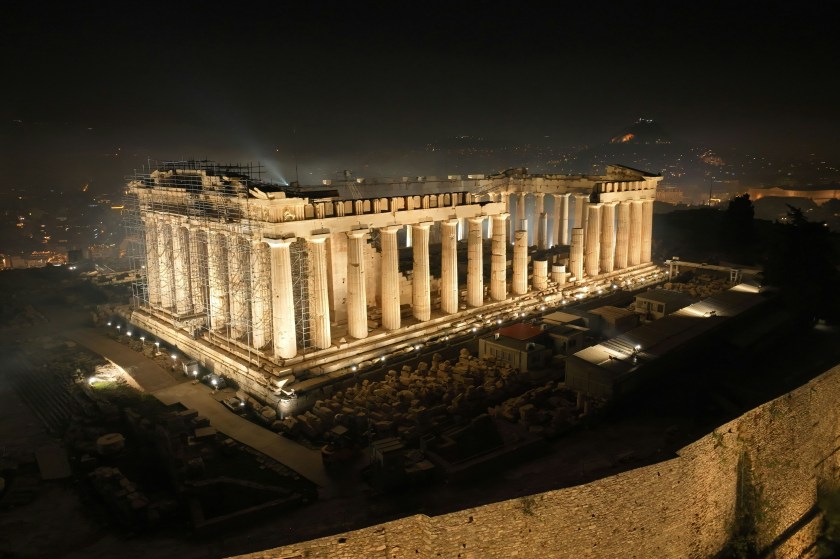
Photo of the Parthenon by Getty Images from Unsplash
Last Sunday we took in the Takoma Park Street Festival, sponsored by Main Street Takoma. * It was a glorious fall day, perfect weather to sample food, check out crafts and other offerings, and listen to some good music.
Fausto (r) and Dan (l) at 2024 Takoma Park Street Festival
We spent most of our visit listening to the terrific acoustic music of Fausto and Dan at the Gazebo Stage. I believe Fausto’s full name is Fausto Boaza, but the introductions were a little on the informal side. In any event, Fausto is an excellent acoustic blues guitarist playing on a classic Gibson guitar in the familiar alternating bass fingerpicked style of so many of the great blues players. He also threw in some A-style mandolin on the side. Dan Hovey, currently the guitarist with The Nighthawks, was the other part of the duo, playing rhythm and lead on a beautiful Huss & Dalton guitar and some nice slide on a Weissenborn lap guitar.
Next up was the duo’s treatment of an old Delmore Brothers tune, Blue Railroad Train. It has been covered by lots of musicians, but to my ears Fausto and Dan drew a lot from the classic Doc Watson version.
I couldn’t find any video of Fausto and Dan playing together, but Dan Hovey has some nice acoustic tunes up, including the Blues for Epi, played on his Weissenborn.
Takoma Park Street Festival (Credit: C.SAM KITTNER via Main Street Takoma)
And since we were in the hometown of the great acoustic guitarist John Fahey, let’s end with this version of Dan Hovey playing the Fahey classic The Red Pony. “I’m playing a 1945 Gibson J45,” Hovey notes. “Only a Gibson is Good Enough!”
Nothing beats some good acoustic music on a beautiful fall day.
Enjoy.
More to come . . .
DJB
* Takoma Park, MD is one of 33 designated Maryland Main Streets as designated by the State of Maryland in 2004. The Main Street Program is a preservation-based, downtown revitalization approach supported by the National Trust for Historic Preservation and run by Main Street America, a subsidiary of the National Trust. Full disclosure: I am a trustee emeritus of Main Street America and a former employee of NTHP.
Photo of Takoma Park Street Festival (credit: C. Sam Kittner via Main Street Takoma)
One of the reasons I habitually read historian Heather Cox Richardson’s Letters from an American early each morning is that she provides context, an important ingredient so often missing from the work of today’s political journalists. So many of us have been frustrated with the media “centering itself as the main story in a presidential campaign where the fate of democracy is in the balance.” Noah Berlatsky wrote earlier this week that this centering is “self-indicting” while illustrating all the ways in which the press has failed in the Trump era. Richardson would agree (in fact she linked to the Berlatsky essay), but she also provides the history about how media fails are nothing new, and what other generations have done when facing similar challenges.
In the October 10th edition of her newsletter, HCR noted that The Atlantic had endorsed Vice President Kamala Harris for president. “This is only the fifth time since its founding in 1857 that The Atlantic has endorsed a presidential candidate,” she wrote. The first time it did so was in 1860, when the magazine endorsed Abramham Lincoln.
But then Richardson goes on to provide some much-needed context.
“The Atlantic’s endorsement of Harris echoes its earlier endorsement of Lincoln, not only in its thorough dislike of Trump as ‘one of the most personally malignant and politically dangerous candidates in American history’—an echo of its 1860 warning that this election ‘is a turning-point in our history’—but because both endorsements show a new press challenging an older system.”
Why does that older system need challenging? Richardson explains.
“In a piece today, Matt Gertz of the media watchdog Media Matters reports that five major newspapers—the Los Angeles Times, the New York Times, USA Today, the Wall Street Journal, and the Washington Post—produced nearly four times as many articles about Democratic candidate Hillary Clinton’s email server in 2016 in the week after then–FBI director James Comey announced new developments in the story than they did about the unsealing of a new filing in Trump’s federal criminal indictment for alleged crimes related to the January 6 insurrection earlier this month.
‘None of the papers ran even half as many Trump indictment stories as they did on Clinton’s server,’ Gertz wrote. ‘Indeed, every paper ran more front-page stories that mentioned Clinton’s server [than] they did total stories that referenced Trump’s indictment. The former president continues to benefit from news outlets grading him on a massive curve,’ Gertz wrote, ‘resulting in relatively muted coverage for his nakedly authoritarian, unfathomably racist, and allegedly criminal behavior.’”
Many smart people in today’s new media are showing up every day to make it clear how much the corporate media is failing our country. Here are just three that surfaced in the last 24 hours:
In the past, “when the media has appeared to become captive to established interests, new media have begun to give a voice to the opposition,” Richardson writes. The New York Times and Washington Post are both captive to a status quo that supports their billionaire owners. Kamala Harris is focused on winning the election in 2024, not appeasing the owners of the Times and the Post. She is seeking to turn out new voters and she does that by reaching them in the venues where they receive news. “Harris has recognized that media shift by focusing her media appearances on podcasts like Call Her Daddy, radio shows like Howard Stern’s, and television shows like The Late Show with Stephen Colbert and The View. Based on averages, those shows reached 25 million or more people. These are not people who read the editorial pages of the New York Times.
Berlatsky is spot on with the ending to his essay. “Harris doesn’t have any obligation to help the mainstream media hand the election to Trump again. On the contrary, she has a responsibility to find better ways to talk to the American people about the threat we face.”
Each month my goal is to read a minimum of five books on a variety of topics from different genres. Here are the books I read in September 2024. If you click on the title, you’ll go to the longer post on MORE TO COME. Enjoy.
The Rediscovery of America: Native Peoples and the Unmaking of U.S. History (2023) by Ned Blackhawk opens with the provocative question, “How can a nation founded on the homelands of dispossessed Indigenous peoples be the world’s most exemplary democracy?” Winner of the 2023 National Book Award for Nonfiction, Blackhawk’s important new work seeks to reimagine our history “outside the tropes of discovery.” If history “provides the common soil for a nation’s growth,” he asks his readers to consider a new approach where “Indians no longer remain absent or appear as hostile or passive objects awaiting discovery and domination.” Blackhawk wants the reader—and ultimately the nation—to recognize the centrality of Native Americans to our history and ongoing story as we appreciate the true extent of Indigenous power and agency. A significant piece of new scholarship.
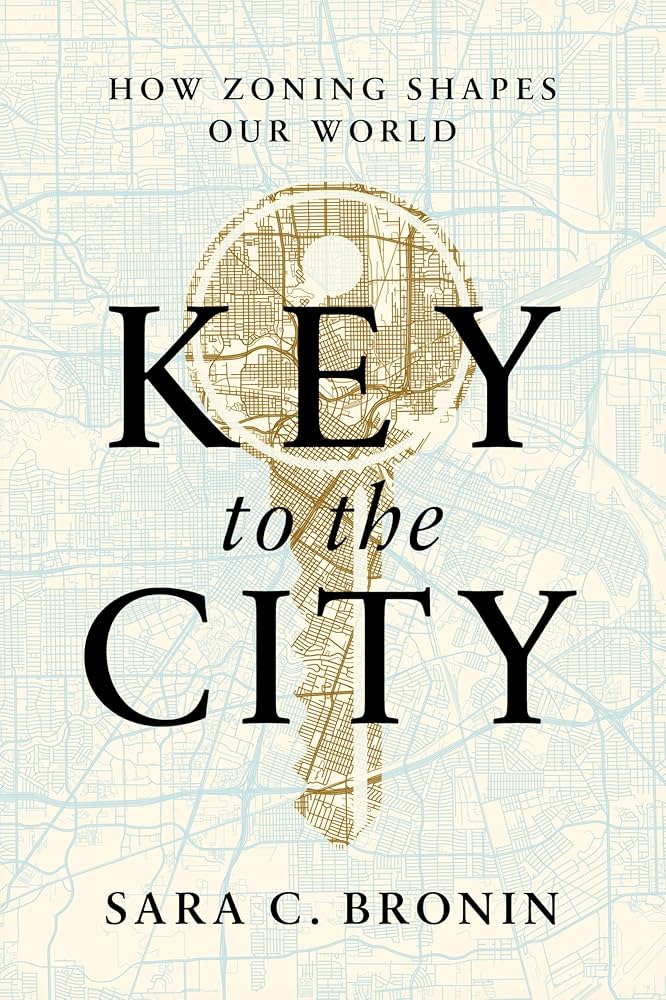
Key to the City: How Zoning Shapes Our World (2024) by Sara C. Bronin is an illuminating survey of the omnipresent tool driving the development of most American communities. An architect, attorney, policymaker, and professor who writes in an accessible and approachable style, Bronin shows the real-life consequences of codes that maintain racial segregation, build inequality, prioritize cars over people, and force us into choices that harm our health, our civic life, and the world in which we live. Changing our existing zoning policy is not easy. The new code that results from change is not a panacea. Yet in this ultimately optimistic work, Bronin makes a compelling case for what reformed and reimagined zoning codes can achieve. Read my most recent author Q&A as I have a conversation with Sara about the future of zoning in America.
Supreme Inequality: The Supreme Court’s Fifty-Year Battle for a More Unjust America (2020) by Adam Cohen is a devastating and damning argument against today’s Supreme Court and the Republican party’s fifty-year plan to circumvent the Constitution, overturn the gains of the New Deal and Civil Rights eras, and cement inequality into American law and life. Cohen surveys Supreme Court rulings on a variety of topics to expose how little the Court does to protect the rights of the poor and disadvantaged. Since the Nixon era “the Court has, with striking regularity, sided with the rich and powerful against the poor and weak, in virtually every area of the law.” I returned to this book after investigative reporters for the New York Times uncovered the cynical moves of Chief Justice Roberts to give former president Trump everything he wanted and more, at the expense of our democracy.
The Mystery of the Blue Train (1928) by Agatha Christie finds famed detective Hercule Poirot, now semi-retired, on the luxurious Blue Train running from London to the Riviera. Another passenger, the pampered millionaire’s daughter Ruth Kettering, is murdered en route and her expensive jewels are missing. Kettering is one half of an unhappy couple, each having an affair and each on the train, although they are unaware of that fact upon departure. A cast of eccentric characters are also included in this work which, while perhaps not in the top tier of Christie novels, is nonetheless worth the ride.
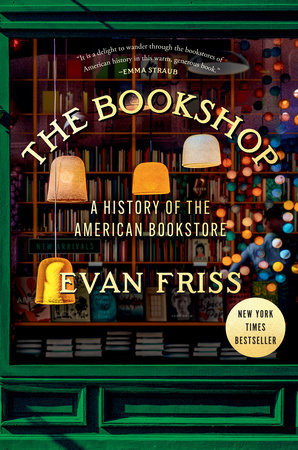
The Bookshop: A History of the American Bookstore (2024) by Evan Friss is an eye-opening and charming tour of bookshops through the years and across the country—places often owned by individuals who believe in the profound power of literature, creativity, and the freedom of expression. Benjamin Franklin was there at the founding of the country’s love affair with bookshops. Thomas Paine’s Common Sense—encouraged by Franklin and the first best-seller in America—kickstarted the revolution as well as the growth of bookshops across the colonies. Friss moves on to highlight a variety of shops and booksellers, taking us all the way to Ann Patchett’s Parnassus bookshop in Nashville, the face of today’s renaissance of independent bookstores. This is a deeply researched yet highly personal consideration of the enduring power of places devoted to the buying and selling of books.
What’s on the nightstand for October (subject to change at the whims of the reader)
This is my take on postseason baseball. But before we get there, I want to make one little detour.
Ummm . . . did you hear that the Vanderbilt Commodores football team stunned Alabama with a 40-35 win—Vanderbilt’s first win in program history against the AP No. 1 college football team. Fans stormed the field and tore down a goal post before parading it down Broadway, through downtown Nashville (that part begins at about the 1:45 minute mark). The fans ultimately reached the Cumberland River, where they tossed the goal post into the water.
Somewhere, Tom Brown is smiling. My father was a proud graduate of Vanderbilt University and a lifelong Vanderbilt sports fan (which can be difficult in the Southeastern Conference).
Proud Vanderbilt graduate
Oh, and he hated the University of Alabama and its football team because they beat Vanderbilt by a score of 71-0 in 1945. The year before Alabama filled out its team with 17-year-olds and young men who were too injured to serve in WWII, but not—presumably—to play football. (At least that’s the story that’s come down through our family.) By the time 1945 rolled around they had a year’s experience on everyone else and went 10-0.
So this win was for Daddy and the many long-suffering Commodore fans.
Now to the regularly scheduled programming.
You may have heard that our Washington Nationals did not make the postseason MLB playoffs. Not. Even. Close.
The Nats had to win two-out-of-three from the Phillies in the last series of the year to get even with last year’s 71-91 record. Somehow the grand plan that Mike Rizzo and the Lerners have promised fans since the last glory days of the 2019 World Championship is slow to unfold.
Very slow.
Yep, the season kind of unraveled for the Washington Nationals. Again.
With the exception of one observation that begins with the hometown nine, I want to focus today on the teams that actually made the playoffs. The favorites and the Cinderellas. We’re now through the best-of-three wild card round (more on that in a minute), and into the best-of-five division series. So here are some random observations from where I sit. beginning with a non-postseason rant.
What the hell did baseball expect
With 8 games left in the season, the Nationals sent all-star shortstop C.J. Abrams to the minor leagues. The team said the surprise demotion was not “performance based.” And while Mike Rizzo and Dave Martinez are not talking, the consensus is that the fact that Abrams was out at a Chicago casino until 8 a.m. before a day game (one in which he went 0-3) was the straw that broke the camel’s back. Many commentators have slammed the Nationals for an excessive punishment.
I’m with the Nationals management on this one. Abrams is a good young player (not a great one), but he’s often inattentive, especially on the basepaths. Frankly, it isn’t clear his head is in the game at all times. Breaking curfew so seriously is also about letting down your teammates.
But I’m mostly furious with Major League Baseball. What did they expect to happen when they sold their souls to gambling. Pete Rose—who died this past week—is the object lesson here. Young, competitive players with tons of money are going to gamble. Some, like Rose, will gamble on baseball. And baseball sees nothing wrong with taking $1.1 billion from the gambling industry while sending down a rising star who was out . . . wait for it . . . gambling.
“This industry is self-defeatist. So are similar industries that make as much money as possible from casinos and don’t care about the absence of integrity, including how it wobbles in Abrams’ mind. A month doesn’t pass without another miserable story, whether it involves baseball and NFL scandals, or Jontay Porter discharged from the NBA for life, or an interpreter stealing almost $17 million from Shohei Ohtani—the greatest player in sports—and impersonating him at the bank about 24 times, which remains shocking as he made 19,000 wagers in 26 months.
All it took, after seeing gambling ads in his daily sights and watching ESPN with its betting spotlight, was Abrams to spend too much off-time in a parlor. He could have been bombed on alcohol at 8 a.m. and not served baseball with more unscrupulous behavior. A young star was gambling, and while players can hang inside a casino, it suggests he didn’t know when to stop. What’s next for Abrams, a baseball wager?
As sports demands bets, players bet.”
Duh!? What the hell did baseball expect? I’m sick of all the in-your-face gambling ads all the time when I watch sports or attend a game. What a slippery slope we’re on.
Change the schedule
These short three-game and five-game playoff series do a disservice to the best teams. Baseball is about the long season and how to manage its many ups and downs. There’s a reason the top leader in the dugout is a manager and not a coach. I like Joe Posnanski’s suggestion: go back to the one-game wild card matchup, and then make all the others best of seven. The better teams are likely to rise to the top.
I know how those Milwaukee fans feel
I watched game 3 of the Mets/Brewers series and could feel the excitement in Milwaukee. The Brewers were two outs away from taking the wild card series, the fans were going crazy, and then Pete Alonzo blasted a home run to put the Mets ahead in a game they would soon win. The air just went out of the entire stadium.
I’ve been there. Twice.
The first was not the final game of the series, but it still hurt. I was in the stands in 2014 when rookie manager Matt Williams walked to the mound in the top of the 9th. There stood Jordan Zimmermann, just one out away from completing two of the most amazing back-to-back games with a potential win in Game 2 of the 2014 National League Division Series following his no-hitter to end the season. Only Williams never gives him the chance. Williams pulls Zimm from the game and puts in . . . yes . . . Drew Storen (more on him in a minute), who quickly gave up two hits and one run and the Nats went on to lose the game in an excruciating 18 innings.
I would refer Milwaukee fans to another baseball fan with a way for words, who said it best:
“It breaks your heart. It is designed to break your heart. The game begins in the spring, when everything else begins again, and it blossoms in the summer, filling the afternoons and evenings, and then as soon as the chill rains come, it stops and leaves you to face the fall alone.“
Everywhere I look I see Nats . . . okay, former Nats
A number of teams still in the playoffs are populated by former Nationals. Recent Nats (i.e., post-2019 players) include Lane Thomas with the Guardians and Jesse Winkler with the Mets. Of course the hated Philadelphia Phillies start each game with three former Nationals at the top of the lineup. I have no problem with how Kyle Schwarber, and Trea Turner ended up with the team. But then there’s Bryce Harper, who left the Nationals when they were on the cusp of winning a World Series all for a few extra million dollars.
Oh, and the Nationals won the World Series in 2019. Bryce still doesn’t have a ring. That’s fine with me.
Money, money, money
Can I just say up front that I hate turning batting helmets into billboards. For money (see gambling rant above), baseball has sold the rights to Strauss so that they can plaster their logo on every team’s helmet. It overwhelms the team logo.
I’m clearly not the only one, as this piece from Yahoo Sports suggests.
“Playoff baseball riles up fan bases from coast to coast with questionable strike zones and infuriating manager decisions. Yet nothing has brought out the anger quite like MLB’s batting helmet decal sponsorship with Strauss.
Three weeks ago, MLB announced that it agreed to a four-year partnership with the German workwear company, not only making it the league’s “official workwear partner” but also choosing it as the first brand to take advantage of a 2022 CBA carveout that lets the league sell helmet sponsorships in the postseason. Strauss will also be the helmet sponsor for the minor leagues starting in 2025.”
Baseball isn’t soccer. We’ve already seen commercial patches on the uniforms, however, so this feels inevitable in a sport that puts the fan experience way down the list of priorities. The only patch I’ve seen so far that I like is the #24 worn by the Mets in memory of the late Willie Mays.
Trains not planes
During the ALDS, Bob Costas made the observation that three of the four pairings featured teams that were only a short train ride away. He went on to opine that it would be great for the teams to travel by train to get to the other town for the next game.
Come on New York/Philly. Detroit/Cleveland. Los Angeles/San Diego. Travel between games the civilized way.
So who will win?
I would love to see the Tigers or Royals go all the way, but that’s probably the kiss of death. The Padres and Guardians would be fun. I’m not crazy about the Mets, Yankees, and Dodgers, but I don’t have a visceral hatred of those teams. I do not want to see the Phillies win it all (which means they probably will). I don’t really have a favorite. In the end, I’m just hoping to see some great games.
Songwriter, singer, and actor Kris Kristofferson died at age 88 on September 28th at his home in Maui. His father was a major general in the Air Force who always saw his son as having a military career. Naturally, the son ultimately rebelled and decided that he was a writer—the occupation listed on his passport.
More than one observer has suggested, “If you look up Renaissance man in any dictionary, you’ll likely find his image.” Kristofferson was gifted in so many ways. Those gifts, however, did not extend to his vocal abilities, which the New York Times accurately described as “pitch indifferent.”
In his younger days Kristofferson was an athlete (once making Sports Illustrated‘s “Faces in the Crowd” as a college football and rugby star) and a high-achieving student. In another life he could have had a long career as an academician after graduating . . .
. . . with honors with a degree in literature from Pomona College in Claremont, Calif., in 1958. * He also had prizewinning entries in a collegiate short-story contest sponsored by The Atlantic magazine before being awarded a Rhodes scholarship to study English literature at Oxford.
After graduation from Oxford he served his country as an Army officer, Ranger, and a helicopter pilot, finally turning down an academic appointment to teach at West Point so that he could move to Nashville and write songs.
Kristofferson had a short-lived romantic association with Janis Joplin and then was the husband of singer Rita Coolidge, with whom he won a GRAMMY award, for much of the 1970s. As an actor he won a Golden Globe award starring opposite Barbara Streisand in A Star is Born. He famously joined other outlaw singers and songwriters including Waylon Jennings, Willie Nelson and Johnny Cash as a member of The Highwaymen.
This only touches the surface.
Yes, he was a Renaissance man, but Kristofferson’s legacy will be in his songs. Music critic Walter Tunis wrote an appreciation earlier this week at The Musical Box that speaks to their importance.
“[T}he stories and inhabiting characters that populated Kristofferson’s first four albums were the stuff of legend. Each of them—1970’s Kristofferson, 1971’s The Silver Tongued Devil and I, and two 1972 entries, Border Lord and Jesus Was a Capricorn—are essential documents of classic American songwriting—folkish in detail, country (sometimes) in sentiments and worldly to an extent that moral imperfection, insecurities and, at times, affirmations rued the day.”
Tunis also tells the story of how Kristofferson helped launch the career of another unique and gifted songwriter, John Prine. In a Chicago bar around 2 a.m., Kristofferson had Prine sing him seven songs, bought him a beer, and had him sing those seven songs again. Soon afterwards Prine was opening for Kris in New York City and the rest is history.
Rolling Stone has an insightful piece on 20 essential Kristofferson songs that I recommend. Most were recorded by other artists, and he had a special affinity for music that worked for Johnny Cash. None was better than Sunday Morning Coming Down, “his perfectly told tale in which one man’s weekend hangover becomes an existential meditation of human loneliness,” with that memorable opening couplet:
“Well, I woke up Sunday morning | With no way to hold my head that didn’t hurt
And the beer I had for breakfast wasn’t bad | So I had one more for dessert.”
Rolling Stone describes Me and Bobby McGee this way:
“Kristofferson didn’t usually write on assignment, but when he received a call from Monument Records founder Fred Foster—who suggested a song title based off a secretary he knew—Kristofferson wanted to impress him. ‘I avoided him for three or four months because there were only thoughts running through my head,’ he said in 1973. ‘I was driving back to New Orleans one night, the windshield wipers were going, and it started falling together.’ Inspired by the Fellini film La Strada (Italian for ‘the road’), Kristofferson crafted a country stomper about two drifters. It became Janis Joplin’s only Number One hit, which Kristofferson only heard after her death in 1970. ‘Afterwards, I walked all over L.A., just in tears,’ he later recalled. ‘I couldn’t listen to the song without really breaking up.’”
Help Me Make It Through the Night is “a masterwork ballad of longing.” The song was “recorded by everyone from Elvis Presley and Jerry Lee Lewis to Tina Turner and, most famously, Sammi Smith.” My favorite is this duet version from 1972 with Rita Coolidge.
In 2017 I wrote a post on MORE TO COME about the wonderful little two-verse gem Here Comes That Rainbow Again. ** The description from Rolling Stone is spot-on:
“Inspired by a scene in John Steinbeck’s The Grapes of Wrath, this early Eighties Kristofferson waltz would later be called one of the greatest songs in modern history by none other than Johnny Cash . . . In just two verses, Kristofferson encapsulates humankind’s capacity for both meanness and, ultimately, kindness . . . ‘It’s a brother helping a brother,’ Kristoferson said. ‘Steinbeck had so much compassion.’”
In the intro to this video, Kristofferson says, “I kind of wrote it with John Steinbeck . . . only he was dead at the time.”
For my 60th birthday, I wrote a post entitled 60 Lessons From 60 Years. Lesson #24 began with “Fear isn’t a solid foundation for any healthy relationship.” So, for lesson #25, I wrote:
“Speaking of fear, Kris Kristofferson hit the nail on the head about hatred of things we don’t understand in Jesus Was a Capricorn. Truer words than ‘Reckon we’d just nail him up if he came down again’ were never spoken. Thanks to Darrell Scott for resurrecting this song (pun intended) on his wonderful Modern Hymns CD.”
The title tune from 2009’s Closer to the Bone, Tunis writes, was “an unusual song for Kristofferson—simple, almost whimsical but still telling of an artist in the autumnal phase of a storied career. In short, it’s very Prine-like.”
Heading for the highway, rolling like a river Soaring like an eagle, skippin’ like a stone Comin’ from the heartbeat, nothin’ but the truth now Everything is sweeter, closer to the bone
Lovin’ Her Was Easier (Than Anything I’ll Ever Do Again was written in 1971 and became Kristofferson’s first charting single.
“The song—with its perfect meter and devastating use of simile (‘dreamin’ was as easy as believin’ it was never gonna end’)—became a case study in Kristofferson’s unmatched craft as a songwriter.”
Kristofferson was also a fighter for justice. As the Times noted,
“The ’80s and ’90s saw his music take an activist turn, with lyrics championing social justice and human rights. ‘What About Me,’ a song from his 1986 album, ‘Repossessed,’ spoke out against right-wing military aggression in Central America.
There have been a number of excellent articles written in the wake of his passing, such as the New York Times obituary and the Tunis appreciation mention above. In the sports pages of the Washington Post, Sally Jenkins had a remembrance entitled “Before he was everything else, Kris Kristofferson was an athlete” that is well worth your time.
Ethan Hawke also had a 2009 interview with Kristofferson for Rolling Stone that is, unfortunately, behind a paywall. But here’s an illuminating excerpt that describes a confrontation between Kristofferson and Toby Keith, whom Hawke refers to as the Star.
“’Happy birthday,’ the Star said to Willie, breezing by us. As he passed Kristofferson in one long, confident stride, out of the corner of his mouth came ‘None of that lefty s#*t out there tonight, Kris.’
‘What the f*#k did you just say to me?’ Kris growled, stepping forward.
‘Oh, no,’ groaned Willie under his breath. ‘Don’t get Kris all riled up.’
‘You heard me,’ the Star said, walking away in the darkness.
‘Don’t turn your back to me, boy,’ Kristofferson shouted, not giving a s#*t that basically the entire music industry seemed to be flanking him.
The Star turned around: ‘I don’t want any problems, Kris—I just want you to tone it down.’
‘You ever worn your country’s uniform?’ Kris asked rhetorically.
‘What?’
‘Don’t ‘What?’ me, boy! You heard the question. You just don’t like the answer.’ He paused just long enough to get a full chest of air. ‘I asked, ‘Have you ever served your country?’ The answer is, no, you have not. Have you ever killed another man? Huh? Have you ever taken another man’s life and then cashed the check your country gave you for doing it? No, you have not. So shut the f#*k up!’ I could feel his body pulsing with anger next to me. ‘You don’t know what the hell you are talking about!’
Ray Charles stood motionless. Willie Nelson looked at me and shrugged mischievously like a kid in the back of the classroom.
Kristofferson took a deep inhale and leaned against the wall, still vibrating with adrenaline. He looked over at Willie as if to say, ‘Don’t say a word.’”
Kristofferson told Hawke in that interview that, “What is even more difficult than failure is when you are perceived as a ‘success’ and you are failing.” Jenkins ended her column with this paragraph that follows on Kristofferson’s statement.
“If there is a simple, central example to be taken from the life of Kristofferson, there it is. How many of us mistake perception for success? How often do we flail with our arms and never really put our weight behind the punch? In the timeless work of Kristofferson, you feel every blow.”
Perhaps John Frankensteiner did the best job of summing up Kristofferson’s life.
“Probably the coolest man who ever lived. Rhodes Scholar, boxer, soldier, helicopter pilot, actor, singer/songwriter, seemingly effortlessly great at everything he tried, loved and respected by everyone he came into contact with, the gold standard of just being a dude.”
Rest in peace, Kris Kristofferson.
More to come . . .
DJB
*Our daughter is a 2015 graduate of Pomona College. It’s a great school.
**Kristofferson’s death has had that post trending all week long.
“The most enduring feature of U.S. history is the presence of Native Americans, yet most histories focus on Europeans and their descendants,” writes the publisher of a new work seeking to change that paradigm. This long practice of ignoring Indigenous history is changing, “with a new generation of scholars insisting that any full American history address the struggle, survival, and resurgence of American Indian nations. Indigenous history is essential to understanding the evolution of modern America.”
The Rediscovery of America: Native Peoples and the Unmaking of U.S. History (2023) by Ned Blackhawk opens with the provocative question, “How can a nation founded on the homelands of dispossessed Indigenous peoples be the world’s most exemplary democracy?” Winner of the 2023 National Book Award for Nonfiction, Blackhawk’s important new work seeks to reimagine our history “outside the tropes of discovery.” If history “provides the common soil for a nation’s growth,” he asks his readers to consider a new approach where “Indians no longer remain absent or appear as hostile or passive objects awaiting discovery and domination.” Instead of a New World that conveys a sense of “wonder and possibilities made manifest by discovery,” Blackhawk wants the reader—and ultimately the nation—to recognize the centrality of Native Americans to our history and ongoing story as we appreciate the true extent of Indigenous power and agency. “American Indians were central to every century of U.S. historical development,” Blackhawk asserts in this significant piece of scholarship to change our perceptions by altering our perspectives.
Blackhawk, the Howard R. Lamar Professor of History at Yale, insists that “Indigenous dispossession facilitated the growth of white male democracy and African American slavery” to, as one reviewer phrased it, “constitute America’s historical trifecta of flaws.” The United States under Blackhawk’s probing eye was built to serve and expand a settler society by limiting full citizenship to white men. It “helped them start new farms on lands taken from Indians; and protected their property rights, including their possession of enslaved people.”
This is not an easy work to digest, and truth be told I have been reading this on-and-off for the better part of the year. Early in his book, Blackhawk’s writing about the three centuries after Columbus sometimes lacks sharpness. There is important information here to be sure, as when he describes the struggle for the interior of the American continent in the first half of the 18th century. But Blackhawk really hits his stride in shaping this narrative when he moves into the Indigenous origins of the American Revolution.
Instead of placing political activity against taxation in 1760s Boston at the forefront of the origins of the Revolution, Blackhawk wants us to look instead at the violence of the French and Indian War, a conflict which never really ended as settler colonists used violence without the consent of British officials to begin to take possession of Native lands. “Interior land concerns as well as the crown’s conciliatory relations with Indians upset settlers just as much if not more than policies of taxation.”
While not all early colonial leaders saw Natives as impairments to manifest destiny, Blackhawk shows how Indian hating—an ideology that holds Native peoples as inferior to whites and therefore “rightfully subject to indiscriminate violence”—became the foundation of an emerging political culture where “negotiations were best conducted between armed parties.” He makes the case that the push to drive Native Americans from their lands came to frame both the Declaration of Independence and the U.S. Constitution.
“The United States was founded upon the ideal of universal equality: ‘All men are created equal.’ The Constitutional Convention, Haitian Revolution, and Louisiana Purchase [from France, but made up primarily of Native lands] transformed and restricted that concept, creating forms of social and legal exclusion.”
In this 445-page book, Blackhawk moves through different events from American history to make his point. The building of the Erie Canal, for instance, would forever change the political economy of the Native Inland Sea, as the region became forever connected to the Eastern seaboard. In its first decade alone, more than $100 million in goods circulated via the canal. This change in the economy led the federal government to change the way it handled treaties with Native nations, constantly reneging on promises and changing the terms of agreement. “The influence of tribes upon the federal government’s development,” notes Blackhawk, “is overlooked.”
Detail from a modern totem pole in Ketchikan
Blackhawk notes that “like the Declaration of Independence, the Monroe Doctrine also became a declaration of war against America’s Indigenous nations, whose long-standing ability to ally with European powers became further inhibited.” He includes a perceptive look at Russian activity in Alaska and the Pacific Northwest as well as the growth of Spanish missions in California and the Southwest, which devastated the Indigenous population, overextended an already weakened empire, and led to the expansion of the American republic. “In California, more than in any other region, settlers used informal and state-sanctioned violence to shatter Native worlds and legitimate their own.” This continued through the Civil War, where Blackhawk shows that to focus solely on “a conflict between North and South is to miss this settler revolution and its transformative violence. Viewing the era as a conflict defined by ‘slavery’ versus ‘freedom’ also erases multiple campaigns of dispossession, removal and even genocide.” To claim that the abolition of slavery “appears” as the evolution of American freedom obscures “a more complex and less celebratory past.”
Courtyard in Sky City, one of four Native American communities that make up Acoma Pueblo in north central New Mexico. Acoma people have lived in the high, rocky area for more than 2,000 years, making Acoma the oldest continuously occupied place in the United States. (Photo by Carol Highsmith)
Church at Acoma Pueblo (photo by Claire Brown)
With similar insights, Blackhawk moves the reader through the period of taking children and treaty lands, Native activism, the myth of Indian disappearance, and Native American sovereignty in the Cold War era.
“Drawing on prodigious scholarship conducted over decades, Ned Blackhawk centers Indigenous people across a sweep of 500 years of United States history, reimagining and retelling familiar historical episodes from a new point of departure. In the process, Blackhawk ‘rediscovers’ America, guiding his readers to a novel understanding of our nation’s past and, hopefully, our collective future. This is an enlightening, transformative, and enduring work.”
More to come . . .
DJB
Navajo Eula M. Atene holds three-month-old Leon Clark on a ridge in the Arizona portion of Monument Valley. Photo from the Carol M. Highsmith Archive, Library of Congress, Prints and Photographs Division.
Historical and common-sense approaches to building safe, vibrant, and delightful communities are actually prohibited in many American cities and towns. Outmoded policies—a great number of which have not been seriously reconsidered in decades—are a key barrier. For the average citizen they are invisible or impenetrable. Nevertheless, far too many of us must navigate life based on their out-of-date dictates and unspoken biases.
These policies are our communities’ zoning codes. The good news is that citizens and local leaders can reform these codes and reimagine the places where we live.
Key to the City: How Zoning Shapes Our World (2024) by Sara C. Bronin is an illuminating survey of the omnipresent tool driving the development of most American communities. An architect, attorney, policymaker, and professor who writes in an accessible and approachable style, Bronin shows the real-life consequences of codes that maintain racial segregation, build inequality, prioritize cars over people, and force us into choices that harm our health, our civic life, and the world in which we live. Changing our existing zoning policy is not easy. The new code that results from change is not a panacea. Yet in this ultimately optimistic work, Bronin makes a compelling case for what reformed and reimagined zoning codes can achieve.
With real-life examples coming from her own experience leading the overhaul of Hartford’s zoning code along with conversations with civic leaders while traveling around the country, Bronin examines how zoning can help create delightful and meaningful places that foster vibrant economies and provide households with the essentials they need to thrive.
I was delighted when Sara agreed to chat with me about her new book, which comes out today.
DJB:Sara, zoning has a long history leading to issues such as discrimination and segregation. Yet you are bullish about the use of zoning as a positive tool to address some of the most important concerns we’re facing today. What drives your optimism?
Sara C. Bronin
SCB: Since the dawn of civilization, humans have developed rules to organize their built environments. Zoning is just a modern incarnation of that impulse. So I guess my starting point is that some form of land use regulation is inevitable—and that zoning is what we’ve got to work with. Why not make it the best it can be?
The fundamental optimism about people’s willingness to change is why I’m a professor. And it’s why I wrote this book. I really believe if more people understand zoning, and all it can do for good, more people will be compelled to make it better.
In “Key to the City” you describe Hartford’s efforts to completely rewrite a zoning code that was originally implemented in the 1950s. Why was it important to throw out the old and write a completely new code?
Like many American cities, Hartford had inherited a zoning code that spoke to the priorities of another era. When I became chair of the city’s planning and zoning commission and really pored over the code, I was surprised at how much it seemed geared toward making the city more like the suburbs. It made downtown development very difficult—subjecting every building to an arbitrary and time-consuming “special permit” process. The result was predictable; instead of new buildings, downtown was covered in vacant parking lots. The old code zoned large parts of the city for manufacturing—perhaps in the vain hope that industry would roar back. And it prioritized the car, allowing uses like drive-throughs and gas stations along the city’s most historic avenues, while forcing property owners to build parking they didn’t need or want.
The new code changed all of that, ushering in changes that legalized dense, mixed-use, walkable neighborhoods. Over time, the zoning code should enable the city to develop the way it did for its first three hundred years—and yes, Hartford (founded in ~1635) was over three hundred years old when it first adopted zoning. More cities should interrogate their codes and fix them so cities can become cities again.
You make the case that zoning can be used to create communities that foster vibrant economies. What key lessons did you learn from studying such efforts in Chicago, Nashville, and Austin?
First and foremost, zoning has to be flexible to respond to changing conditions. One of the main reasons we’re in the mess we’re in—with so much bad zoning all across the country—is that we adopted zoning codes and then never updated them. Zoning codes aren’t sacred documents. We have to keep reviewing and revising them to be sure they’re helping us meet contemporary needs. The book highlights how codes in Chicago and Nashville have just enough flexibility to facilitate creativity and nightlife. In Austin’s case, the zoning might need to be tweaked to ensure the city’s main entertainment strip (Sixth Street) is fun for everyone… including neighbors. But in all three cities, zoning reforms have been an active conversation in recent years. And ongoing public dialogue about how zoning can and should shape the future of a place is critically important.
There are state policies which are critical in driving development decisions. Why is it important for those seeking to build more equitable communities to possess what you call a “bird’s-eye view” in dealing with our zoning codes?
Before I answer this question, I want to be sure your readers understand something important: that state legislatures are the ones with the authority to regulate land use. But, around a hundred years ago, all fifty states decided to delegate this power to local governments. In state zoning enabling acts, legislators told localities just how they could go about exercising their delegated zoning authority. In the book, I argue that local officials should harness zoning to improve street design, food security, and water management. They can do so because the powers that state legislatures give local governments to zone are pretty vast, and do, as you say, enable communities to advance a broad range of policy goals through zoning. Some local governments are taking full advantage of this—promoting urban agriculture, for example, or identifying the types of landscaping that might save on water use. Most, though, are less active. I hope more local communities start to see zoning as a tool that can advance sound transportation, food, and environmental policy.
Finally, Sara, you grew up in Houston which famously does not have a zoning code, and you make frequent references to the specific experiences of family members, including your parents, grandparents, uncle, and sister. How do these life experiences help your readers understand the personal nature of zoning on all manner of Americans, and what lessons are you working to share with your children and others of the next generation?
As a kid, of course I’d never heard of zoning—and, as far as I know, my family members didn’t think about it for a minute. But zoning affects all of us, whether we know it or not. In the book, I briefly mention my research project, the National Zoning Atlas, an online, public map that seeks to standardize information about zoning across the country. We’ve analyzed about a sixth of the country, and in Texas alone, we’ve uncovered 400 communities without zoning—over 2,200 nationally, so far. But even if you live in one of those places, the ways other communities zone have downstream effects. We’re all interconnected. And that’s why we have to collectively work to ensure that zoning, where adopted, works for all of us.





















 MORE TO COME...