All posts filed under: Historic Preservation

Let’s stop celebrating a past that never existed. Instead, let’s understand and honor the one that did.

I first stood at Jamestown as a history-enthralled 11-year-old. The picture of the 17th century ruin of the church tower, abutted to the 1907 Memorial Church, is seared in my mind. I also remember the water lapping at the nearby shore, serving as a reminder that the people at Jamestown had the most tenuous of toeholds on this continent in those early years. While I didn’t know it at the time, the narratives of life in early 17th century Virginia — told by the guides, the plaques that lined the walls of the 1907 church, and the books I devoured — were incomplete and sometimes egregiously false. White Christian Europeans were the focus. If they were mentioned at all, Native Americans, along with the enslaved African Americans who began arriving against their will at Jamestown in 1619, were small, dependent actors; impediments, if you will, to the greater story of the colonists and settlers and the shaping of what it meant to be an “American.” Those Europeans were not home. They were the outsiders. Yet …

Rest in Peace, John Lewis

America just lost one of its most clear-eyed, moral leaders. John Lewis — civil rights hero on the front lines from lunch-counter desegregation in Nashville to Freedom Rides through a hostile South, the last remaining speaker from the August 1963 March on Washington, U.S. Congressman for 34 years, an activist to the end, and conscience for a nation — passed away Friday night after a six-month battle with pancreatic cancer. Representative Lewis was a hero to many because in this age of nonstop blathering nonsense, he spoke plainly about the hope for an America that — as Langston Hughes wrote — is the America that the dreamers dreamed. And he not only spoke, but he walked the talk, most famously when his skull was cracked more than fifty years ago while trying to walk across an Alabama bridge working for justice.  There are many wonderful tributes to John Lewis pouring in. I recommend the statement of President Obama, who — when given a ticket to his history-making inauguration as the nation’s first Black American president …

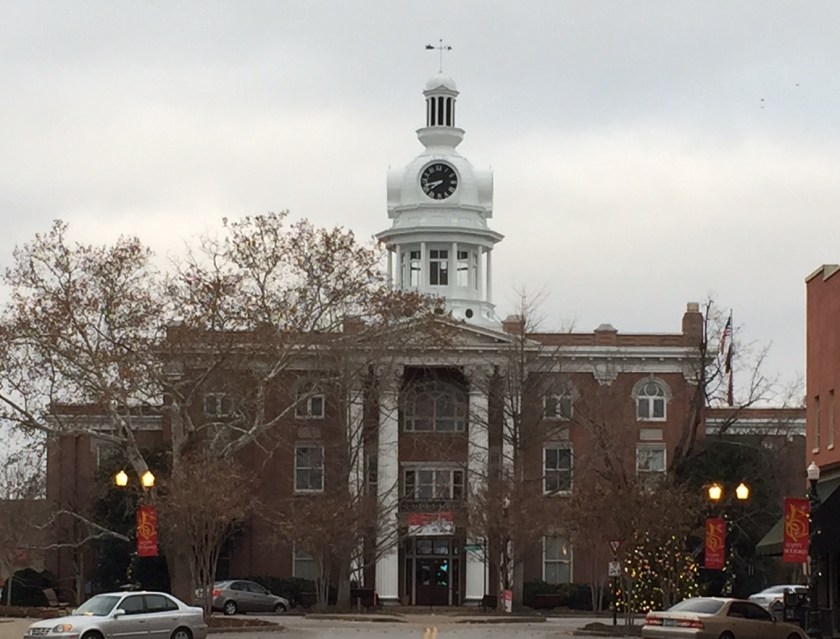
Rutherford County Courthouse

Places and perspectives

Are you afraid? It was an era when those protesting for civil rights had moved from nonviolent techniques to more confrontational stances, and the nightly news carried stories and photos of clashes in cities across the country between the police and protesters. The tribal nature of our communities was coming into focus for everyone to see. While we lived on Main Street, our neighborhood was mixed both economically and racially. And here I was, playing pickup basketball on a local court, when a player on the opposing team asked me that question. He wanted me to acknowledge that I was the only person scuffling around on the asphalt, shooting at hoops with torn nets and battered backboards, who was not African American. The question insinuated that I should feel out of place and uncomfortable and was followed by another: Don’t you feel scared? Playing on the local courts as a young teenager with whatever group of neighborhood kids came along was just what I did. “No,” I replied. I knew most of these guys, and …

Grant

Hope, redemption, and U.S. Grant

Last evening the History Channel began a three-part mini-series entitled Grant. The series* is based on the Ron Chernow magnificent biography of the same name. I decided to repost my 2018 review of Chernow’s work here to provide readers with some background along with encouragement to watch the mini-series. I was thinking of the themes of hope and redemption and how much impact they can have on our lives as I’ve been reading Ron Chernow’s new biography of Ulysses S. Grant.  Chernow is one of the few historians who, through deep scholarship and powerful writing, can drive the country toward a full reappraisal of a historical figure’s life and impact.  David McCullough’s works on Truman and John Adams come immediately to mind as examples of this type of national reassessment, but Chernow has also worked his magic in the past with Alexander Hamilton and George Washington. He does so again with this biography of Grant. The historical stereotype of U.S. Grant — especially if you grew up in the South — is of a failed …

Remembering the uncounted

Today we pause to honor and mourn the military personnel who have given the last full measure of devotion for our country. As we fight a worldwide pandemic on this particular Memorial Day, we would do well to recognize the global identities of those American service men and women we honor. Let us remember the more than 57,000 Filipino soldiers who died fighting as members of the U.S. Army from 1941-1945. We should add our gratitude for the 23 members of the Army’s 65th Infantry Regiment, a segregated Hispanic unit made up primarily of Puerto Ricans, who were killed in World War II while participating in the battles of Naples-Fogis, Rome-Arno, central Europe and Rhineland. And we should never forget the more than 600 soldiers who died while serving in the 442nd Regimental Combat Team — the most decorated unit for its size in U.S. military history and almost entirely composed of second-generation American soldiers of Japanese ancestry (Nisei) — fighting valiantly in Europe against the Axis powers although many had families confined to internment …

American Patriots

Today — May 8, 2020 — is the 75th anniversary of Victory in Europe (or V-E) Day, when the allies accepted the unconditional surrender of Nazi Germany. World War II was a time when the countries of the world came together to combat bigotry, racism, fascism and hatred. I had a father, uncles, and aunts who volunteered to serve, one of whom was at Normandy on D-Day. Many men and women made the ultimate sacrifice in those years. Yet all went to war because of what happened when xenophobia and demagoguery supplanted real leadership. Last month we passed the 155th anniversary of the surrender of Robert E. Lee and the Confederate Army on April 9, 1865. The victory, while complete on the battlefield, was not capable of eradicating 250 years of racism. So we all soldier on for a better, more just world. Abraham Lincoln said it best when he spoke of the reasons for the Civil War — and our unfinished task as Americans — at the dedication of the Union cemetery at Gettysburg: …

COVID-19 Claims the Life of the Last Surviving Monuments Woman

Motoko Fujishiro Huthwaite had — by any account — an amazing life. Born in Boston on August 24, 1927 to Japanese citizens, her father was a prominent dentist and professor at Harvard. As noted on the Monuments Men Foundation website: “The family was befriended by Langdon Warner, the legendary scholar of Asian art and future Monuments Man in Japan following the end of World War II. The Fujishiro household became the center of the Japanese community in Cambridge, Massachusetts. Japanese students, professors, and scholars from the many universities surrounding Boston would flock to parties expertly hosted by Motoko’s mother.” She and her mother and brother were forced to relocate to Japan following the attack on Pearl Harbor, however, while her father was arrested for espionage and put into an internment camp. He later returned to Tokyo a broken man. Motoko survived the war and became one of 27 women who worked for the Arts and Monuments Commission — popularly known as the Monuments Men. After the war, she reinstated her United States citizenship, lived in …

Belonging

During this pandemic, many of us are feeling vulnerable. Some may be wondering if or where we belong in a world that has dramatically changed. Brené Brown says that our belonging to each other can’t be lost, but it can be forgotten. She came to understand the simple yet profound answer to the question of the difference between fitting in and belonging out of a conversation with a group of middle school students. “Fitting in is when you want to be a part of something” they explained. “Belonging is when others want you.” With my background, Brené Brown’s thoughts on vulnerability and belonging led me to think about history, storytelling, and our use of selective memory to keep others out of our narrative, to ensure they don’t belong. If we confront our feelings during this pandemic, we may come to realize the ways that we have made others feel vulnerable in the past, perhaps by omitting or erasing their stories as if they don’t belong. History isn’t what happened. It is a story about what happened. …