Just say it
My one piece of advice to colleagues, friends, and family is pretty simple: Say “Thank you.” Say it early and often.
Thoughts on my Gap Year, Encore Career, and Whatever Comes Next
My one piece of advice to colleagues, friends, and family is pretty simple: Say “Thank you.” Say it early and often.

The February 10th newsletter of Chapter 16, a website celebrating Tennessee literature, was titled Paying Attention. Editor Maria Browning writes that, to her mind, February is “the most fickle month of the year in Tennessee,” with shifts between the stirrings of spring and days of snow (or, worse, ice). She continues, “Wardrobe challenges notwithstanding, this is a wonderful time to pay attention to the ever-dynamic natural world.” Her suggestion for some inspiration led me to read “Eleven Ways of Smelling a Tree” by Sewanee writer David George Haskell. As Browning notes, the piece at Emergence Magazine is a collaborative effort, with musician Katherine Lehman and art by Studio Airport. I’ve recommended Haskell’s The Forest Unseen in the past as a delightful book written by a scientist with the soul of a poet. “Eleven Ways of Smelling a Tree” has the same observational mix and magic. Haskell opens his piece with an ode to the American Basswood. “Harlem, New York CityVintage: 1908 We crack the windows on summer’s first warm days. I taste diesel smoke, acid and oily. The fumes rise …

The top ten reader favorites from the first 1,000 posts on More to Come.
On New Year’s Day, I finally saw the delightful movie, A Beautiful Day in the Neighborhood, starring Tom Hanks as the beloved children’s television star Fred Rogers. I waited until the last day this critically acclaimed film was showing at our local theatre because we wanted to go as an entire family and needed to align multiple schedules in our short window of opportunity over the holidays. Like millions of Americans, Mister Rogers’ Neighborhood was a part of our children’s childhood, and it just seemed right to sit down together to take it in as if watching around the television set. There is much to like about this film, from the cast to the skillful direction of Marielle Heller, from the smart screenplay to the transitional shifts taking place between the toy set and the real life scenes of Rogers and journalist Lloyd Vogel (played expertly by Matthew Rhys). Vogel is, as one reviewer notes, “a magazine writer who actually may be the one person on the planet who doesn’t love Mr. Rogers.” Rhys’ character is based …

It is time, once again, when I first look back over the past twelve months and then think ahead to where I want to go in the year to come. This annual review is one small part of a larger practice to have an honest conversation with myself in the hopes that I’ll then be able to have real conversations with the larger world. During 2019, I’ve thought a great deal about place, privilege, and—given the tenor of the times—paths forward individually as well as collectively. Why place? My career has been focused on older and historic places, what those places can tell us, and how they can nurture us (or not) into the future. Although I took a gap year from full-time work in 2019, I didn’t stop thinking about my life’s work. Knowing that emotions flow through place, in my writing over this year I’ve focused more on the buildings and landscapes in our cities and towns that, while coming from my professional life, also have deep personal meaning for me. Why privilege? …

I’ve long been a fan of the pithy proverb that contains truth in 20 words or less.

Regret and grief are very real. But there are ways to address the disconnect between our suffering and the hope and joy of the season.

A student asks, “Do you think I could be a writer?” The writer responds, “Well, do you like sentences?”
We all have our phobias and fears. For much of my life, that personal horror was stage fright. I’m surprised when people tell me they have never experienced the sensation of walking to a podium or settling in with their musical instrument and, suddenly, being gripped by a paralyzing fear. That dread just came naturally to me. Stage fright—or performance anxiety, as it is also known—is a condition that affects many people who have to talk for a living or want to perform for others. I’ve experienced it in both speaking publicly—say, for television interviews—and in playing music in any space other than my living room. If you don’t address your fears, the feeling saps your confidence and energy in ways that seem to make poor performance a self-fulfilling prophecy. With work and experience, I overcame at least a part of my anxiety through the years and came to enjoy public speaking and conversation. A little bit of online research will turn up 21.5 million results (I Googled it) around ways to combat stage fright. …
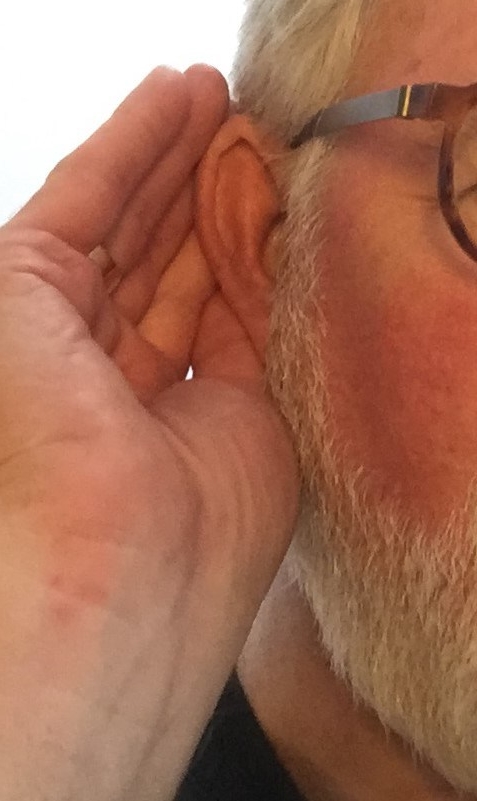
Old habits can be very hard to break. Case in point: my difficulty in breaking out of the mold of being a stereotypical male. I’m reminded of this far too often and in many different ways. However, one of the more consistent occurrences involves listening. Or, to be more accurate, not listening. The stereotype is that men are encouraged, and even trained, to be the center of attention. It is a stereotype, in this case, because it is usually true. Studies show that boys are called on more in school, that boys grow up to become men who talk more in meetings, and that we interrupt women more than we interrupt men. Most of the time I fall into this pattern of interruption because I’m not thinking. But a few times I do it knowingly and with the best of intentions. That was the case earlier this year when I found myself talking over a friend to “help her” explain something that I thought might be difficult to articulate. Not because she isn’t a smart, …

