All posts tagged: Monday Musings

Nats Rainbow

Cynicism vs. hope

Cynics.  We’ve all encountered them.  They make pronouncements with great certainty and take pride in not appearing foolish. Those who disagree with them are instantly branded, in the eyes of the cynic, as naïve. Thankfully, there are ways to combat cynicism. Over the holidays I finished reading author Rebecca Solnit’s most recent book, Call Them by Their True Names:  American Crises (and Essays).  Solnit includes an essay—Naive Cynicism—that flips the idea of cynicism and naivete on its head. “Naïve cynics shoot down possibilities, including the possibility of exploring the full complexity of any situation. They take aim at the less cynical, so that cynicism becomes a defensive posture and an avoidance of dissent. They recruit through brutality. If you set purity and perfection as your goals, you have an almost foolproof system according to which everything will necessarily fall short. . . . Cynics are often disappointed idealists and upholders of unrealistic standards.  They are uncomfortable with victories, because victories are almost always temporary, incomplete, and compromised.” Change and progress require hard work, and cynics …

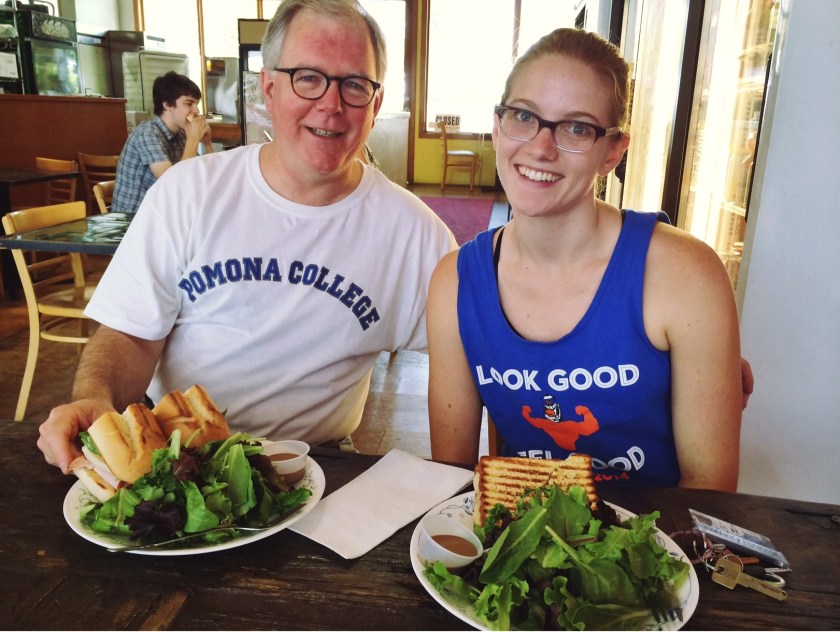
Lunch in Claremont with Claire

Connections

When I was a freshman in college, I waited tables at a local restaurant and bar in Nashville. Waiting tables is hard and humbling work, which I highly recommend.  Once you’ve experienced it you’ll forever be mindful of 1) how you treat wait staff, and 2) how to tip properly.  When I was leaving at the end of the school year, the manager, Bill, and his sister Ruth invited me over for a drink.  At the end of the night, Ruth gave me a hug and said, “Have a good life!”  This was the pre-Facebook/email/Instagram days, and she meant it as a heartfelt farewell to someone she’d probably never see again.  I stuck that sentiment in the back of my mind. But to paraphrase folksinger Arlo Guthrie halfway through the 17-minute-long Alice’s Restaurant, this isn’t a post about waiting tables. This is a blog post about the emotional and intellectual value of personal connections. One of our staff members had her final day at the National Trust coincide with the last day of our 2018 …

I could be wrong, but…

Last month the Harvard Business Review had a fascinating article about how we can become more open-minded.*  In this time of major disruption we need more leaders and citizens who are willing to consider other viewpoints and be intellectually flexible.  The article’s author, Shane Snow, noted that Benjamin Franklin had a way of both preparing himself and his listener to being open-minded.  Whenever Franklin was about to make an argument, he would open with something along the lines of, “I could be wrong, but…” Snow notes that “saying this put people at ease and helped them to take disagreements less personally. But it also helped (Franklin) to psychologically prime himself to be open to new ideas.” In today’s hyper-partisan environment, I find the need to push myself to consider other options, to consider that “I could be wrong, but…” as I make statements of (what seem to me to be) fact. Snow notes that in 2016, researchers—building off the concept of “intellectual humility” from religion—outlined four ways to assess open-mindedness: Having respect for other viewpoints …

Be thankful every day

Why do we often wait until an individual or team completes a major project to offer thanks?  Last week’s PastForward 2018 national preservation conference in San Francisco certainly falls in the successful major project category in my work, and I do want to thank our core team of Susan, Farin, Rhonda, Colleen, Alison, Nicky, Lizzy, Diana, Michelle, Reagan, Sandi and Priya.  They helped lead us through an inspiring week. I’ve often thought we shouldn’t wait for a holiday such as the one we are celebrating this week in the U.S. or only at the end of a project like PastForward to recognize others.  A few years ago I became intentional about saying “thank you” to someone every day.  It is one of the smartest things I ever did as I get so much more out of life since I began that practice.  If for no other reason, it reminds me how much I depend on the kindness of others. I believe there is a distinction between gratefulness and thankfulness.  If we are fully aware, fully …

Measure What We Value

We measure a great deal in the modern office environment, and the nonprofit world is no different.  Finding the right measurement to capture what is truly important, however, takes time and thought.  Profit for a business is easy to track, but in the mission-driven world of nonprofits the right outcomes can be hard to quantify. I was thinking of this while wrapping up James Williams’ Stand Out of Our Light:  Freedom and Resistance in the Attention Economy.  In looking for ways to set boundaries for attention-grabbing technology, Williams turns to measurement as one key.  He begins by noting, that “Our goal in advancing measurement should be to measure what we value, rather than valuing what we already measure.” How do we, both as individuals and as staff members of a large organization, do this work?  How do we measure what we value?  Williams has a suggestion on the organizational or corporate scale:  measure the mission.  If we “operationalize in metrics the company’s mission statement or purpose for existing, which is something nearly every company has …

Extraordinary People Hidden in Plain Sight

Last week was difficult.  The horrific shooting on Saturday at the Tree of Life synagogue in Pittsburgh shook many of us to the core. Coming at the end of a week of attempts at mass political assassinations, it called into question assumptions about our nation’s values. As a historian I know that anti-Semitism and bigotry are as old as our country, in fact as old as recorded history. Thankfully, stories of courageous response to bigotry are just as old, yet often not as well known. The Overlooked Obituary project of the New York Times is designed to recognize extraordinary people overlooked by the editors of the paper in their day. People like Rose Zar, the remarkable mother of my National Trust colleague Howard Zar. Rose Zar’s overlooked obituary appeared in the Times on the anniversary of her death in the Jewish lunar calendar.  That happened to fall during this past week, bringing a story of hope and determination amidst a flood of bad news. When she was 19 and living in the ghetto in Piotrkow, …