All posts tagged: Monday Musings

Surviving in a golden age of sycophancy

Who knew, but apparently we are living in a golden age of sycophancy.  Flattery.  Brown-nosing.  By whatever name it goes by, we’re talking about sucking up. Over a 40-year career, I’ve had a number of bosses.  On the exceptional-to-bad continuum, I’ve seen both ends, and a lot in between.  But I’ve been fortunate in that only one regularly sought out flattery from those who worked in the organization. Most good managers and senior executives see through obsequious behavior.  Colleagues see someone excessively playing up to a manager and roll their eyes (if they are charitable) or share their thoughts with others around the water cooler (if they are less than charitable). There’s a better way:  learn how to manage up. As I have suggested to my team at work, building a strong, professional relationship with your manager has nothing to do with sycophancy.  It has everything to do with doing your job and being the type of valued colleague who understands and supports a wider vision beyond one functional area or program. Communication that assumes …

Cooper-Molera Garden

To learn something new (about old places), bring in new partners with different perspectives

At the National Trust for Historic Places, where I work, we believe that historic sites are fundamentally places of intersection. When we allow them to share their stories, historic sites are dynamic spaces where past, present, and future meet in a variety of ways.  One very important way they intersect is with community. About ten days ago, I visited Cooper-Molera, one of our National Trust historic sites where delight and enjoyment are at the heart of our community intersections.  Cooper-Molera is a two and one-half acre property in the heart of downtown Monterey, California’s historic commercial district. There we are implementing a new model that combines commercial uses and interpretation in creative ways.  We will have a bakery, restaurant, and event center in adaptively used historic buildings operating in collaboration with museum uses in one of the adobe residences to reinvigorate the site, sustain it financially and engage audiences that might never visit a historic site or house museum. Those are the people we should all want to meet at this intersection. We call this …

Multitasking (or another word for “not paying attention”)

How well do you think you can multitask?  Let’s take a little test.  Click on this one-minute You Tube video and see how well you do.  You will need your sound, so in an open office environment either use headphones or turn the volume down a notch or two. If all of you are like the 30 colleagues I joined last week in a retreat, no one will ace the test.  That’s because it is impossible to give your full attention to two things simultaneously.  (Don’t confuse this with my recent note about keeping two opposing ideas in your mind.  Very different concepts.) The retreat leader used this as the kick-off to the day’s discussion, and added a confession:  she often finds herself multitasking in meetings.  As recently as the Friday before the retreat, she was on a call with individuals from around the country.  She was also using the time to check email.  She confessed that more than once, she looked up and thought, “I don’t have a clue what was just said.”  In …

Communication

“The single biggest problem in communication is the illusion that it has taken place.” This observation was included in a recent online post about the history of jargon, and it got my attention.  I’ve been writing and reading a boat-load of reports, letters, and proposals in the past few weeks, and I know how easy it is to make the mistake of thinking that communication has “taken place.”  I’ve made the mistake myself recently, on more than one occasion. “Excessive use of jargon can weigh down our communication and can be taxing to listeners. It may make it more difficult for others to grasp the full meaning behind our message. Worst of all, using jargon can be distancing. It may make some listeners feel excluded because they may not understand all the jargon and buzzwords being used—especially if it comes on thick and fast.” So what, according to the author, tops the current list of bothersome business buzzwords?  Synergy.  Low-hanging fruit.  Thinking outside the box.  This summer I bought a card featuring the famous New …

Accepting Life as It Presents Itself…And Doing Goodness Anyway

Anytime we face natural disasters such as we’ve seen with the landfall of Hurricane Harvey, our first thoughts—and the work of the first responders—are rightly focused on protecting those in harm’s way.  Those of us at the National Trust are thankful that our colleagues in Texas and Louisiana are safe, and we continue to keep the millions affected in those states foremost in our minds.  Knowing that many want to help, I want to share some good counsel for effective disaster giving, if you are so inclined.  No matter the amount donated, the underlying message is to diversify disaster giving. Give to more than one charity. Just like any other investment, spread your funding to more than one organization, with different goals for each. Give to recovery as well as relief: remember the long recovery phase that comes after a disaster. The urgent relief phase often gets the bulk of attention and funding, but don’t forget about recovery, which is often far longer, harder and more expensive.  Recovery done well also requires different kinds of …

Emotions Flow Through Places – Thoughts After Charlottesville

Last week I referenced Dr. Mindy Fullilove’s book Root Shock with a story that spoke to how emotions flow through places.  I wrote before the events in Charlottesville—and the reactions to that weekend—brought place, memory, and emotion to the forefront of our national conversation. Stephanie Meek’s statement on Confederate memorials and the confronting of difficult history speaks to how emotions that arise from place are not always built upon strong, positive memories.  Of course, Dr. Fullilove understands this all too well.  Root Shock is focused on the difficult history of urban renewal, something seen in Charlottesville’s destruction of the African-American community of Vinegar Hill in the 1960s.  At the Trust, as Stephanie notes, “we believe that historic preservation requires taking our history seriously. We have an obligation to confront the complex and difficult chapters of our past, and to recognize the many ways that our understanding, and characterization, of our shared American story continues to shape our present and future.”  That is especially true of our Civil War history, and the fact that many of …

Ebbets Field

Emotions flow through places

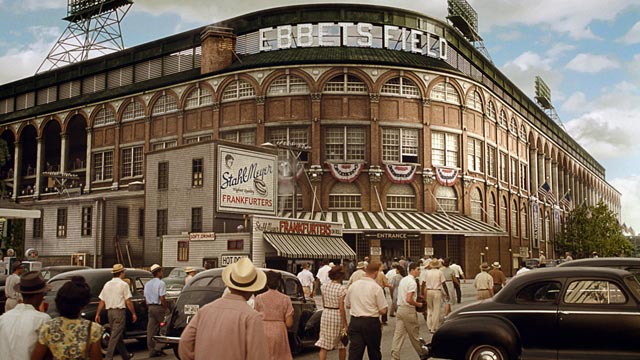
It will surprise no one that I read a couple of baseball books and watched several games while on vacation.  But it may surprise you to know that the best piece of writing I read which included baseball as its subject came from the opening pages of psychiatrist Mindy Fullilove’s 2004 book Root Shock:  How Tearing Up City Neighborhoods Hurts America, and What We Can Do About It.  She begins chapter one with several powerful paragraphs.  I’m going to quote extensively from those two pages. “Every once in a while, in a particular location and at a particular time, people spin the wheel of routine, and they make magic.  One such location was Ebbets Field in the heart of Brooklyn, where, through World War I, the Roaring Twenties, the Great Depression, World War II, and the postwar struggles for equality in America, hard-working people enjoyed baseball.  That small, unpredictable, and intimate ballpark was a gallery for characters to strut their stuff, and the characters in the stands took as much advantage of the opportunity as …

Perfection is a stick with which to beat the possible

A poem by Kilian McDonnell for a midsummer Monday. Perfection, Perfection I have had it with perfection. / I have packed my bags, I am out of here. / Gone. As certain as rain / will make you wet, perfection will do you / in. It droppeth not as dew / upon the summer grass to give liberty and green / joy. Perfection straineth out / the quality of mercy, withers rapture at its / birth. Before the battle is half begun, cold probity thinks / it can’t be won, concedes the / war. I’ve handed in my notice, given back my keys, signed my severance check, I / quit. Hints I could have taken: Even the perfect chiseled form of / Michelangelo’s radiant David / squints, the Venus de Milo / has no arms, the Liberty Bell is / cracked. We’ve all known grumpy perfectionists “who hold that anything less than total victory is failure, a premise that makes it easy to give up at the start or to disparage the victories that are …