All posts tagged: Rebecca Solnit

My 2018 year-end reading list

As 2018 draws to a close, I’m sharing this list of the books I read over the past twelve months.  Since returning from sabbatical early in 2016, I committed to reading more, and to seek out a wider range of works beyond my normal histories and biographies. Here are the treasures I found on my reading shelf this past year. Lincoln in the Bardo by George Saunders. I began the year with a work of fiction. In this at times perplexing yet ultimately satisfying novel, Saunders builds off the fact that in February 1862, just a year into the Civil War, President Abraham Lincoln’s 11-year-old son Willie dies of typhoid fever. It is known from contemporary accounts that the President went several evenings to stay in the crypt with his son’s body in Georgetown’s Oak Hill Cemetery. Saunders takes that bit of knowledge and turns it into a rich story populated with dozens of spirits who reside in the Bardo, which is the Tibetan Buddhist name for a transition period between death and rebirth. Tears …

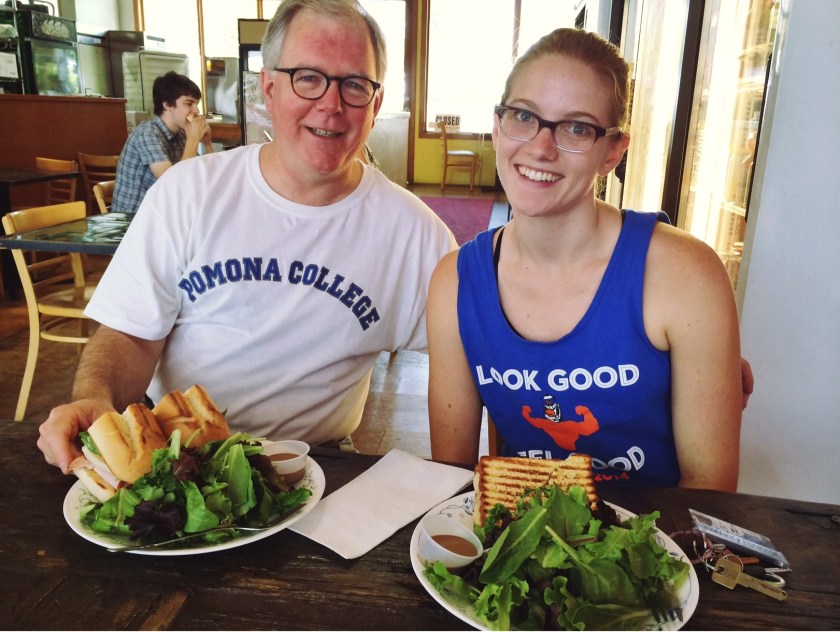
Lunch in Claremont with Claire

Connections

When I was a freshman in college, I waited tables at a local restaurant and bar in Nashville. Waiting tables is hard and humbling work, which I highly recommend.  Once you’ve experienced it you’ll forever be mindful of 1) how you treat wait staff, and 2) how to tip properly.  When I was leaving at the end of the school year, the manager, Bill, and his sister Ruth invited me over for a drink.  At the end of the night, Ruth gave me a hug and said, “Have a good life!”  This was the pre-Facebook/email/Instagram days, and she meant it as a heartfelt farewell to someone she’d probably never see again.  I stuck that sentiment in the back of my mind. But to paraphrase folksinger Arlo Guthrie halfway through the 17-minute-long Alice’s Restaurant, this isn’t a post about waiting tables. This is a blog post about the emotional and intellectual value of personal connections. One of our staff members had her final day at the National Trust coincide with the last day of our 2018 …

How Do We Know What We Know?

In recent weeks, a friend acquired a book by Rebecca Solnit, an author I admire.  I immediately offered to read it at the same time, in order to discuss it together.  Having read the book several years before, why return to this one when I had so many unread books in piles around the house? The answer comes in understanding how we know what we know.  That’s been on my mind recently as I’ve thought about topics as wide ranging as cultural norms, untold histories, political divisiveness, and generational perspectives. Just how do we—as humans—shape our personal world view? In rereading Solnit’s book, I came to the material at a very different time in my life and that of our country. I had vaguely remembered parts of the book from my first reading, but frankly there were whole sections that seemingly had escaped my notice or understanding the first time through.  But I also realized how much more of the book aligned with my current “model” of how the world works. And I don’t think …

Trinity Church Labyrinth

Sometimes the only way is the long one

During a 2013 vacation where each family member chose an activity close-to-home for us to share, my wife’s selection was a day at a local retreat center.*  Upon arrival, I was pleased to see that the center had created a labyrinth in the woods.  Labyrinths have come to have a special place in my heart.  A dear friend of our family who died in his early 20s was memorialized with a labyrinth designed for people of all physical abilities.  Andrew had spent the majority of his life in a wheelchair, but that never constrained his spirit. Back at the retreat center, “walking the labyrinth” became my activity for the morning. I was reminded of this recently while re-reading Rebecca Solnit’s wonderful book Wanderlust:  A History of Walking.  An early chapter is titled “Labyrinths and Cadillacs: Walking Into the Land of the Symbolic.” (I told you it was a wonderful book!)  Solnit, who describes herself as “having been raised as nothing in particular by a lapsed Catholic and a nonpracticing Jew,” found herself walking the labyrinth …

Celebrating International Women’s Day

I made a resolution in 2016 to return and read Rebecca Solnit’s Men Explain Things to Me once or twice a year, just to keep that clear voice and perspective front of mind.  International Women’s Day seemed to be a special moment this year to act on that resolution. I took time today during my lunch break to read, once again, of the silencing that occurs when men talk over women.  As Solnit phrases it, “Being told that, categorically, he knows what he’s talking about and she doesn’t, however minor a part of any given conversation, perpetuates the ugliness of this world and holds back its light.”  We are living in an age when our civic discourse shows just how serious the impacts of this silencing can be.  Solnit ends the postscript to the original essay by noting, “Having the right to show up and speak are basic to survival, to dignity, and to liberty.” I think about this dynamic a great deal.  When I’m learning from and celebrating the accomplishments of women, I am …

Perfection is a stick with which to beat the possible

A poem by Kilian McDonnell for a midsummer Monday. Perfection, Perfection I have had it with perfection. / I have packed my bags, I am out of here. / Gone. As certain as rain / will make you wet, perfection will do you / in. It droppeth not as dew / upon the summer grass to give liberty and green / joy. Perfection straineth out / the quality of mercy, withers rapture at its / birth. Before the battle is half begun, cold probity thinks / it can’t be won, concedes the / war. I’ve handed in my notice, given back my keys, signed my severance check, I / quit. Hints I could have taken: Even the perfect chiseled form of / Michelangelo’s radiant David / squints, the Venus de Milo / has no arms, the Liberty Bell is / cracked. We’ve all known grumpy perfectionists “who hold that anything less than total victory is failure, a premise that makes it easy to give up at the start or to disparage the victories that are …

Hope demands things that despair does not

In her essay “False Hope and Easy Despair,” historian and author Rebecca Solnit speaks to how hope requires action. “Hope” she quotes author Ernst Bloch, “is in love with success rather than failure.” That seems obvious, but Solnit drives home her point by noting that failure and marginalization are safe. Despair has many causes and varieties.  Denying one’s power and possibility allows us to “shake off” our sense of obligation. We can make our point too easily when the point becomes “the demonstration of one’s own virtue rather than the realization of results.” On the other hand, “Hopefulness is risky, since it is after all a form of trust, trust in the unknown and the possible, even in discontinuity.  To be hopeful is to take on a different persona, one that risks disappointment, betrayal…” I have spent recent weeks studying strategic plans, business models, trends in nonprofit organizations, and other materials that look backward to history to make sense of what’s ahead. They begin by looking backward because, as I’ve said earlier, hope is grounded …

SE Utah Cliff Dwellings

Places teach us, if we let them

I have just finished reading two books about the American West that were written in 1987 and 1994. As I finished the second one on a rainy Sunday afternoon I thought, “I hope I age as well.”  The older of the two—which I actually read second—was the first book cited by the author of the 1994 work in her “Sources” chapter.  Both are written by women I greatly admire as writers and thinkers. So enough of the cat and mouse games. Rebecca Solnit‘s Savage Dreams:  A Journey Into the Hidden Wars of the American West, was republished in a 20th anniversary edition in 2014, with a new preface by the author. I’ve been on something of a Solnit kick lately, as she is one of the most thoughtful of writers exploring a wide variety of issues across the American landscape. This early work is often hailed as a foundational work of environmental thinking.  However, I saw this more as a book about place and unacknowledged history, and the title of the post comes from her …

The Blessing of Silence, Part II

A few weeks ago I wrote about the blessing of silence, meaning “quietude” as opposed to the “silencing of voices.” Rebecca Solnit, in her most recent collection of essays entitled The Mother of All Questions, notes that silence is crucially different from quietude.  The latter speaks to the absence of noise – which is sought – while the former speaks to the absence of voice, which is too often imposed. Little did I know that the Friday before my last post on this topic, the Harvard Business Review had published an article entitled, “The Busier You Are, the More You Need Quiet Time.”  My colleague Barb Gibson sent along the HBR article which began with a quote from writer Ta-Nehisi Coates who argued that serious thinkers and writers should get off Twitter, in a call to “get beyond the noise.”  It isn’t just writers who suggest that periods of silence are valuable.  Medical researchers have found that “taking time for silence restores the nervous system, helps sustain energy, and conditions our mind to be more …