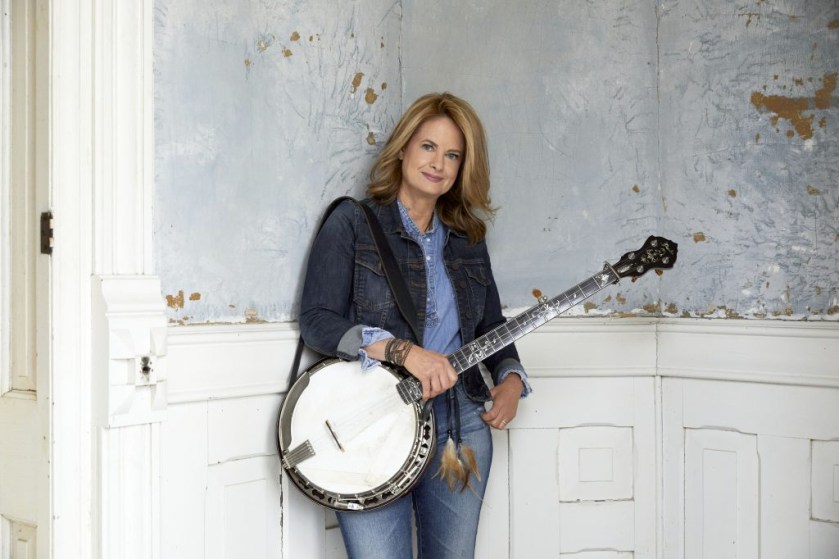
Alison Brown has never been one to back down from a challenge. The progressive banjo player only came at music professionally after completing her undergraduate studies at Harvard, receiving a MBA from UCLA, and pursuing a career in investment banking. “But she missed the bluegrass music she’d grown up playing in Southern California so much that when Alison Krauss called looking for a banjo player, she made the decision to give up her Wall Street career to pursue music.” She formed her own group, The Alison Brown Quartet, in 1993.
As I’ve written before on More to Come, Alison is also the co-founder and CEO of the Compass Records Group, an internationally recognized roots music label which Billboard Magazine has called “one of the greatest independent labels of the last decade.” Compass Records Group oversees a catalog of nearly 1,000 releases across multiple label imprints, including Red House Records, Green Linnet and Mulligan Records.”
Alison’s new album On Banjo shows the range of her musical skill and interests. In this new work she includes “forays into bluegrass, Brazilian choro music, classical and swing era jazz with collaborators including musician/actor/author Steve Martin, virtuoso mandolinist Sierra Hull, Israeli clarinetist Anat Cohen, multicultural chamber group Kronos Quartet, classical guitarist Sharon Isbin, and fiddle stalwart Stuart Duncan.”
Foggy Morning Breaking is one of the more traditional tunes on the new album, with Brown and Steve Martin sharing banjo duties, along with support by Nashville session fiddler extraordinaire Stuart Duncan, mandolin phenom Sierra Hull, Punch Brothers guitarist Chris Eldridge, and long-time acoustic bass master Todd Phillips. If you go to the end of the video, Brown and Martin talk about how they shared co-writing duties for this piece, which she also discusses in a recent interview with The Bluegrass Situation:
The way “Foggy Mountain Breaking,” came about is I wrote the A section. It was during the pandemic. I asked Steve, “Do you wanna write a B part?” He sent me a perfect B section 24 hours later. We figured out a bridge together. It’s named after a lyric in a John Hartford song and is obviously a riff on “Foggy Mountain Breakdown.”
People who follow bluegrass and Americana music know of Martin’s long-time interest in, and musical ability on, the five-string banjo. Others may be surprised to learn that he’s the originator of the Steve Martin Banjo Prize and highly respected among professional musicians. As Brown says in that BGS interview:
Steve’s a great banjo player with a really beautiful touch and a delicate, sweet tone. He loves playing in double C tuning. Banjo players usually tune to a G, but you can drop the fourth string to a C and tune the second [string] up to a C. It’s an old tuning that clawhammer guys use a lot.
Sierra Hull — who has been featured multiple times in More to Come — also joins Brown’s On Banjo project in a duet setting. After noting that Hull’s fingers “dance over the fingerboards,” Brown talks about the tune Sweet Sixteenths:
It required her to play every fret on the first string of the mandolin and she did it flawlessly. She said she’d never had a chance to work on such complicated music with another woman. So it’s a really special thing. It’s always a delight to play with Sierra, but to do a duet with her was like chocolate and more chocolate.
(UPDATE: And now featuring the official video instead of just the audio. Check out the marvelous little run that begins around the 2:25 mark.)
And while it isn’t on the On Banjo album, I just love The First Ladies of Bluegrass rendition of Brown’s piece Girl’s Breakdown. The superband quintet includes in addition to Brown — the first woman to win the International Bluegrass Music Association (IBMA) Banjo Player of the Year award — Hull, the first and only woman to ever win the IBMA Mandolin Player of the Year award; Missy Raines, the first and only female musician to win the IBMA Bass Player of the Year award; Becky Buller, the first and only woman to ever win the IBMA Fiddler of the Year prize; and Molly Tuttle, the first and only female to ever take home the IBMA Guitar Player of the Year honor.
Brown is out to reclaim the history of the banjo and to recognize and support the disenfranchised people who once played the instrument. As she notes, the banjo was first found on Southern plantations. “Then white people appropriated that music in minstrel shows, performing in blackface.” As Brown notes, “It’s deep in terms of what it says about our history and America’s original sin.”

It went from being a Black instrument to being a white lady’s instrument. The Black voice of the instrument and the female voice of the instrument were both disenfranchised. There are gorgeous old photos of women in the 1890s holding banjos, and there were female banjo orchestras. I’m excited to see that re-emerging.
As you can hear on the tune Porches, Brown isn’t afraid to take the music in new directions. Here she performs on low banjo with the Kronos Quartet: David Harrington (violin), John Sherba (violin), Hank Dutt (viola), and Sunny Yang (cello). The string arrangement is by Chris Walters.
It is said that “Alison Brown doesn’t play the banjo. Alison Brown plays music on the banjo.
Enjoy!
More to come…
DJB
Photos of Alison Brown (credit: AlisonBrown.com and Compass Records)
 MORE TO COME...
Pingback: Observations from . . . June 2023 | MORE TO COME...
Pingback: The Saturday Soundtrack 2023 top ten | MORE TO COME...
Pingback: These cats are good! | MORE TO COME...