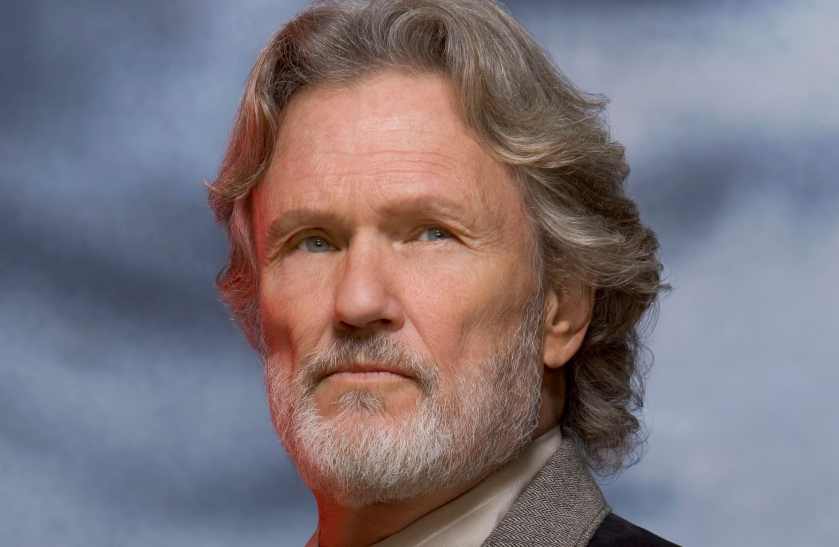
Songwriter, singer, and actor Kris Kristofferson died at age 88 on September 28th at his home in Maui. His father was a major general in the Air Force who always saw his son as having a military career. Naturally, the son ultimately rebelled and decided that he was a writer—the occupation listed on his passport.
More than one observer has suggested, “If you look up Renaissance man in any dictionary, you’ll likely find his image.” Kristofferson was gifted in so many ways. Those gifts, however, did not extend to his vocal abilities, which the New York Times accurately described as “pitch indifferent.”
In his younger days Kristofferson was an athlete (once making Sports Illustrated‘s “Faces in the Crowd” as a college football and rugby star) and a high-achieving student. In another life he could have had a long career as an academician after graduating . . .
. . . with honors with a degree in literature from Pomona College in Claremont, Calif., in 1958. * He also had prizewinning entries in a collegiate short-story contest sponsored by The Atlantic magazine before being awarded a Rhodes scholarship to study English literature at Oxford.
After graduation from Oxford he served his country as an Army officer, Ranger, and a helicopter pilot, finally turning down an academic appointment to teach at West Point so that he could move to Nashville and write songs.
Kristofferson had a short-lived romantic association with Janis Joplin and then was the husband of singer Rita Coolidge, with whom he won a GRAMMY award, for much of the 1970s. As an actor he won a Golden Globe award starring opposite Barbara Streisand in A Star is Born. He famously joined other outlaw singers and songwriters including Waylon Jennings, Willie Nelson and Johnny Cash as a member of The Highwaymen.
This only touches the surface.
Yes, he was a Renaissance man, but Kristofferson’s legacy will be in his songs. Music critic Walter Tunis wrote an appreciation earlier this week at The Musical Box that speaks to their importance.
“[T}he stories and inhabiting characters that populated Kristofferson’s first four albums were the stuff of legend. Each of them—1970’s Kristofferson, 1971’s The Silver Tongued Devil and I, and two 1972 entries, Border Lord and Jesus Was a Capricorn—are essential documents of classic American songwriting—folkish in detail, country (sometimes) in sentiments and worldly to an extent that moral imperfection, insecurities and, at times, affirmations rued the day.”
Tunis also tells the story of how Kristofferson helped launch the career of another unique and gifted songwriter, John Prine. In a Chicago bar around 2 a.m., Kristofferson had Prine sing him seven songs, bought him a beer, and had him sing those seven songs again. Soon afterwards Prine was opening for Kris in New York City and the rest is history.
Rolling Stone has an insightful piece on 20 essential Kristofferson songs that I recommend. Most were recorded by other artists, and he had a special affinity for music that worked for Johnny Cash. None was better than Sunday Morning Coming Down, “his perfectly told tale in which one man’s weekend hangover becomes an existential meditation of human loneliness,” with that memorable opening couplet:
“Well, I woke up Sunday morning | With no way to hold my head that didn’t hurt
And the beer I had for breakfast wasn’t bad | So I had one more for dessert.”
Rolling Stone describes Me and Bobby McGee this way:
“Kristofferson didn’t usually write on assignment, but when he received a call from Monument Records founder Fred Foster—who suggested a song title based off a secretary he knew—Kristofferson wanted to impress him. ‘I avoided him for three or four months because there were only thoughts running through my head,’ he said in 1973. ‘I was driving back to New Orleans one night, the windshield wipers were going, and it started falling together.’ Inspired by the Fellini film La Strada (Italian for ‘the road’), Kristofferson crafted a country stomper about two drifters. It became Janis Joplin’s only Number One hit, which Kristofferson only heard after her death in 1970. ‘Afterwards, I walked all over L.A., just in tears,’ he later recalled. ‘I couldn’t listen to the song without really breaking up.’”
Help Me Make It Through the Night is “a masterwork ballad of longing.” The song was “recorded by everyone from Elvis Presley and Jerry Lee Lewis to Tina Turner and, most famously, Sammi Smith.” My favorite is this duet version from 1972 with Rita Coolidge.
In 2017 I wrote a post on MORE TO COME about the wonderful little two-verse gem Here Comes That Rainbow Again. ** The description from Rolling Stone is spot-on:
“Inspired by a scene in John Steinbeck’s The Grapes of Wrath, this early Eighties Kristofferson waltz would later be called one of the greatest songs in modern history by none other than Johnny Cash . . . In just two verses, Kristofferson encapsulates humankind’s capacity for both meanness and, ultimately, kindness . . . ‘It’s a brother helping a brother,’ Kristoferson said. ‘Steinbeck had so much compassion.’”
In the intro to this video, Kristofferson says, “I kind of wrote it with John Steinbeck . . . only he was dead at the time.”
For my 60th birthday, I wrote a post entitled 60 Lessons From 60 Years. Lesson #24 began with “Fear isn’t a solid foundation for any healthy relationship.” So, for lesson #25, I wrote:
“Speaking of fear, Kris Kristofferson hit the nail on the head about hatred of things we don’t understand in Jesus Was a Capricorn. Truer words than ‘Reckon we’d just nail him up if he came down again’ were never spoken. Thanks to Darrell Scott for resurrecting this song (pun intended) on his wonderful Modern Hymns CD.”
The title tune from 2009’s Closer to the Bone, Tunis writes, was “an unusual song for Kristofferson—simple, almost whimsical but still telling of an artist in the autumnal phase of a storied career. In short, it’s very Prine-like.”
Heading for the highway, rolling like a river
Soaring like an eagle, skippin’ like a stone
Comin’ from the heartbeat, nothin’ but the truth now
Everything is sweeter, closer to the bone
Lovin’ Her Was Easier (Than Anything I’ll Ever Do Again was written in 1971 and became Kristofferson’s first charting single.
“The song—with its perfect meter and devastating use of simile (‘dreamin’ was as easy as believin’ it was never gonna end’)—became a case study in Kristofferson’s unmatched craft as a songwriter.”
Kristofferson was also a fighter for justice. As the Times noted,
“The ’80s and ’90s saw his music take an activist turn, with lyrics championing social justice and human rights. ‘What About Me,’ a song from his 1986 album, ‘Repossessed,’ spoke out against right-wing military aggression in Central America.
There have been a number of excellent articles written in the wake of his passing, such as the New York Times obituary and the Tunis appreciation mention above. In the sports pages of the Washington Post, Sally Jenkins had a remembrance entitled “Before he was everything else, Kris Kristofferson was an athlete” that is well worth your time.
Ethan Hawke also had a 2009 interview with Kristofferson for Rolling Stone that is, unfortunately, behind a paywall. But here’s an illuminating excerpt that describes a confrontation between Kristofferson and Toby Keith, whom Hawke refers to as the Star.
“’Happy birthday,’ the Star said to Willie, breezing by us. As he passed Kristofferson in one long, confident stride, out of the corner of his mouth came ‘None of that lefty s#*t out there tonight, Kris.’
‘What the f*#k did you just say to me?’ Kris growled, stepping forward.
‘Oh, no,’ groaned Willie under his breath. ‘Don’t get Kris all riled up.’
‘You heard me,’ the Star said, walking away in the darkness.
‘Don’t turn your back to me, boy,’ Kristofferson shouted, not giving a s#*t that basically the entire music industry seemed to be flanking him.
The Star turned around: ‘I don’t want any problems, Kris—I just want you to tone it down.’
‘You ever worn your country’s uniform?’ Kris asked rhetorically.
‘What?’
‘Don’t ‘What?’ me, boy! You heard the question. You just don’t like the answer.’ He paused just long enough to get a full chest of air. ‘I asked, ‘Have you ever served your country?’ The answer is, no, you have not. Have you ever killed another man? Huh? Have you ever taken another man’s life and then cashed the check your country gave you for doing it? No, you have not. So shut the f#*k up!’ I could feel his body pulsing with anger next to me. ‘You don’t know what the hell you are talking about!’
Ray Charles stood motionless. Willie Nelson looked at me and shrugged mischievously like a kid in the back of the classroom.
Kristofferson took a deep inhale and leaned against the wall, still vibrating with adrenaline. He looked over at Willie as if to say, ‘Don’t say a word.’”
Kristofferson told Hawke in that interview that, “What is even more difficult than failure is when you are perceived as a ‘success’ and you are failing.” Jenkins ended her column with this paragraph that follows on Kristofferson’s statement.
“If there is a simple, central example to be taken from the life of Kristofferson, there it is. How many of us mistake perception for success? How often do we flail with our arms and never really put our weight behind the punch? In the timeless work of Kristofferson, you feel every blow.”
Perhaps John Frankensteiner did the best job of summing up Kristofferson’s life.
“Probably the coolest man who ever lived. Rhodes Scholar, boxer, soldier, helicopter pilot, actor, singer/songwriter, seemingly effortlessly great at everything he tried, loved and respected by everyone he came into contact with, the gold standard of just being a dude.”
Rest in peace, Kris Kristofferson.
More to come . . .
DJB
*Our daughter is a 2015 graduate of Pomona College. It’s a great school.
**Kristofferson’s death has had that post trending all week long.
 MORE TO COME...
they don’t make ‘em like that, anymore..
Thanks,
Jane
Amen to that, Jane. Thanks. DJB
Pingback: Here comes that rainbow again | MORE TO COME...
thank you so much for this, David, about a man I knew too little about until his passing, but can now look back along my live, newly fortunate enough to have him by my side. The quotes and links are extraordinary, and your knowing, compassionate passion for the man is a wonderful gift you’ve shared.
Thanks, Alice. So glad you liked it. DJB
Pingback: Observations from . . . October 2024 | MORE TO COME...
Pingback: The best of the MTC newsletter: 2024 | MORE TO COME...
Pingback: 70 lessons from 70 years | MORE TO COME...