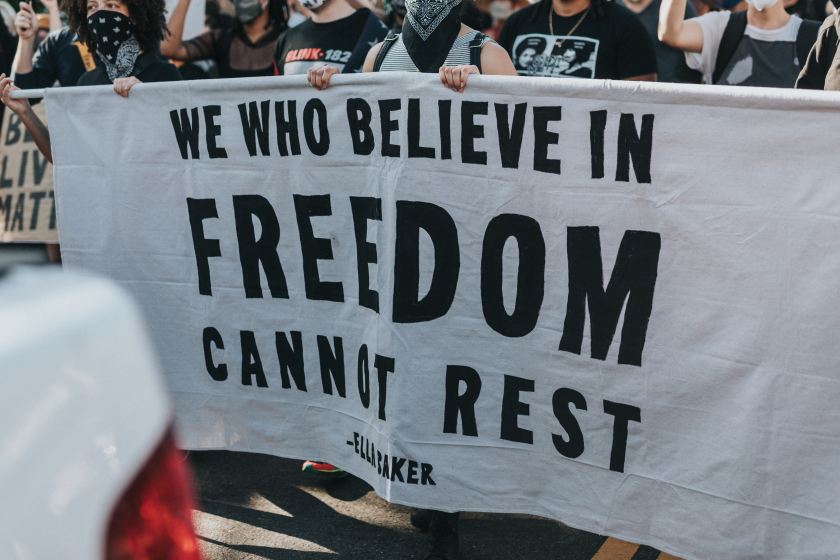
Music of hope and freedom for the Martin Luther King, Jr. weekend.
Music has often been at the heart of American freedom movements but it was an especially powerful part of the the push for civil rights in the 1950s and 60s. To honor the legacy of the Rev. Dr. Martin Luther King, Jr., I turned to Black Music Sunday, a weekly series curated by professor/activist Denise Oliver-Velez that highlights all things Black music. With almost 300 stories covering performers, genres, history, and more—each featuring its own vibrant soundtrack—it is a treasure trove of musical history.
A LASTING MESSAGE OF CHANGE
One of the anthems of the 1960s that continues to resonate today is Bob Dylan’s iconic The Times They Are A-Changin’, and Oliver-Velez highlights the tune in a post in her series. Wikipedia suggests that the universality of the song’s lyrics’ give it a lasting message of change. While some have said its time has passed, others—myself included—disagree.
“In 1985, [Dylan] told Cameron Crowe, ‘This was definitely a song with a purpose. It was influenced of course by the Irish and Scottish ballads …’Come All Ye Bold Highway Men’, ‘Come All Ye Tender Hearted Maidens’. I wanted to write a big song, with short concise verses that piled up on each other in a hypnotic way. The civil rights movement and the folk music movement were pretty close for a while and allied together at that time.'”
The great Nina Simone recorded a slow, deliberate version that seems to squeeze every bit of sadness and anger out of the song. One commentator has noted that the slow and deliberate pace of the performance intensifies the sense of drama. “Every note and word is delivered with clear intention, making the musical experience even more immersive and emotionally engaging.”
“Critic Andy Gill points out [via Wikipedia] that the song’s lyrics echo lines from the Book of Ecclesiastes, which Pete Seeger adapted to create his anthem “Turn, Turn, Turn!”. The climactic line about the first later being last, likewise, is a direct scriptural reference to Mark 10:31: ‘But many that are first shall be last, and the last first.'”
Blues artist Keb’ Mo’—who plays in nearby Tysons, VA in February—put his distinctive and soulful musical touch to the tune . . .
. . . as did jazz pianist Herbie Hancock, whose cover was released as part of The Imagine Project in 2010 with vocals from Ireland’s Lisa Hannigan and instrumental assistance by The Chieftains.
OTHERS WHO SHARED THE MUSIC OF FREEDOM
To expand this weekend’s offerings, let’s also remember a few other icons of the musical soundtrack of freedom, beginning with Sweet Honey in the Rock. When a musical group carries the torch for justice and love over decades, it goes without saying that they have seen and persevered through life challenges that would have stopped the less hopeful and determined along the way.
Through her Daily Kos series Oliver-Velez introduced me and many others to the Resistance Revival Chorus, a collective of more than 60 women, and non-binary singers, who join together to breathe joy and song into the resistance, and to uplift and center women’s voices.”
Oliver-Valez writes,
“I’m sure you can agree with the women of the RCC when they sing that Everybody Deserves to Be Free. Deva Mahal, (who happens to be the daughter of blues icon Taj Mahal) takes the lead.”
Of course, it doesn’t get any more iconic than Mavis Staples. Mavis was, of course, a member of The Staple Singers with her siblings Yvonne, Cleotha, and Pervis, and their father, “Pops” Staples. The group’s music was key to the soundtrack of the civil rights movement of the 1950s and 60s, and Mavis has been carrying the torch ever since.
And let’s tie one icon with another. First Mavis and Aretha Franklin brings together two of the greatest and most powerful Soul and Rhythm & Blues voices not just of their generation, but of all time, to sing the gospel tune Oh Happy Day. Gospel has always been a key part of the freedom movement’s soundtrack. And for fun, check out the interplay between these two amazing talents at about the 1:50 segment and then again at 4:00. Good gawd!
And we’ll end with Aretha’s live version of Amazing Grace. This is from Amazing Grace, the movie of Aretha Franklin’s 1972 recording of the gospel album of the same name. It is—like the lady herself—a national treasure. I can only describe the film as a 90-minute church service.
Hallelujah!
Remember the legacy of Dr. King this weekend and throughout the year as we continue our fight for democracy.

More to come . . .
DJB
Check out these other MTC posts on music for the MLK Weekend:
- Music of perseverance. Music of hope. Music for the MLK Weekend.
- I’m on my way: Music for the MLK weekend
- Feels like freedom
Ella Baker Quote photo by Nathan Dumlao on Unsplash
 MORE TO COME...
Pingback: Observations from . . . January 2026 | MORE TO COME...