Links to stories from a few writers I follow who have important things to say.
As we approach the Ides of March, I thought I’d share a group of stories from writers I follow. I hope you’ll find something of interest among this eclectic mix.
THE DISLOCATION OF JOY

I have written on multiple occasions about betting on sports, and how this will not end well. A mentor who is both an astute observer of life and an insightful writer added a comment to a 2021 post about the scourge of gambling in baseball. It made me stop and think.
“What truly disturbs me about sports betting is the dislocation of joy. The joy is supposed to be in watching the game. Monetizing it, as you point out, changes the focus — as if there could be no simple pleasures which are not really about cash.“
So I was pleased to see McKay Coppins piece in The Atlantic entitled Sucker: My Year as a Degenerate Gambler. It is a brilliant piece that shows, first, that two of the worst people in American life—Chris Christie, who brought a lawsuit to overturn the ban on gambling, and Samuel Alito, the justice who authored the Supreme Court decision in his favor—helped bring this scourge to the 21st century.
“G. K. Chesterton once wrote about two people who encounter a fence erected across a road. One of them demands that it be torn down; the wiser of the two responds that they should find out why it was put there in the first place before deciding on a course of action. . . .
[But] no one involved—not Alito; nor the five justices who joined him; nor the legislators in 36 states who would legalize sports betting for their constituents; nor the league commissioners, who would rush into partnerships with online sportsbooks—seemed acquainted with Chesterton’s fence.
Practically overnight, we took an ancient vice—long regarded as soul-rotting and civilizationally ruinous—put it on everyone’s phone, and made it as normal and frictionless as checking the weather. What could possibly go wrong?”
In this soul baring and thoughtful article, Coppins describes how he went down various gambling rabbit holes, including acquiring a loss of confidence in the games themselves.
“Sports leagues, of course, are not the first American institutions to suffer a crisis of authority in the 21st century. (See also: Wall Street, Congress, the military, the police, the press, etc.) But the recent decline of trust in sports is, to an extraordinary degree, self-inflicted and avoidable. By embracing gambling so completely—normalizing it, celebrating it, reaping massive profits from it—the leagues have all but ensured that many fans will see it as baked into the game itself . . . To watch sports in 2026 is to become, almost inevitably, a kind of conspiracy theorist.”
Coppins ends by showing how he took actions as a result of his gambling addiction that would have been unthinkable just a year ago. He notes that in 1907, a Unitarian minister, writing in The Atlantic, warned against “speculation.” “The long and costly experience of mankind bears uniform testimony against gambling,” Charles F. Dole wrote. “It is a dangerous or unsocial form of excitement; it hurts character, demoralizes industry, breeds quarrels, tempts men to self-destruction.”
Of course, he notes, not every consensus of the past is worth clinging to.
“But as a society, we are making an enormously risky bet: that we can reap the rewards of a runaway gambling industry without paying any price; that the litany of social ills long associated with this vice—addiction and impoverishment, isolation and abuse, cheating and chasing and corrosive idleness—can, this time, be kept in check; that, unlike every civilization that came before us, we can beat the house.
What are the odds that we’re right?”
MONUMENTS UP, MONUMENTS DOWN
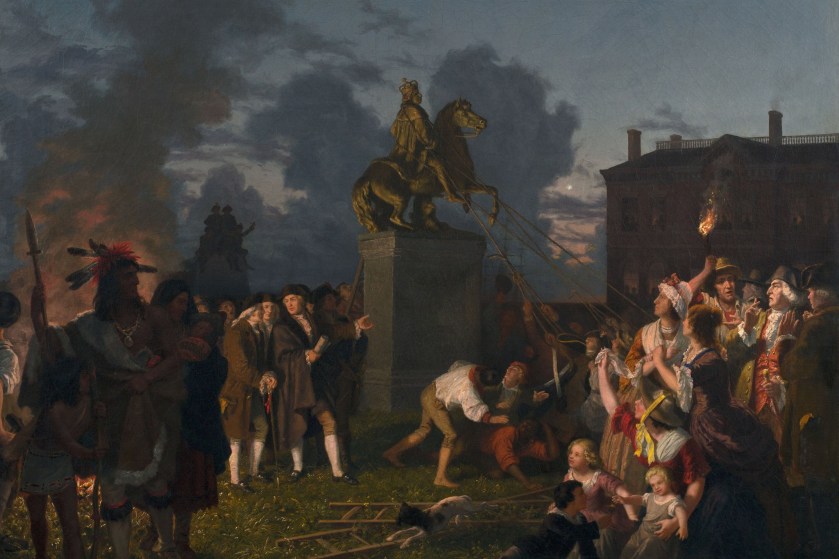
In February the History News Network/Bunk newsletter Continuum focused on the controversies over monuments that are not new and that seemingly never end. When I lecture on tours around the world, visiting countries such as Germany, Italy, and Belgium that are also grappling with what their monuments say in the present day, I’ll remind my listeners that Americans took down their first monument 250 years ago, just days after the passage of the Declaration of Independence. After the document was read in New York City, a crowd rushed to pull down a nearby statue of King George III.
Memorialization has been an often-discussed topic in Continuum and its predecessor newsletters, beginning in 2017 (remember that the Charlottesville protests were about the removal of a statue of Robert E. Lee), and again three years later, in the aftermath of the George Floyd murder. With the potential looming for more changes to the capital’s monumental landscape, the editors dedicated an edition of Continuum to the history of American monuments, and the people they have commemorated. Among the stories linked to in this fascinating newsletter is one entitled Monument Wars.
“The 2015 massacre of nine churchgoers by a white supremacist in Charleston touched off a wave of soul-searching about Confederate monuments around the country. Since then, dozens of towns and cities have decided to remove the statues in their communities. This exhibit explores discussions about what we choose to memorialize—and why.”
A MUSICAL INTERLUDE
Thanks to William Shakespeare the first thing that comes to mind around March 15th is to “Beware the Ides of March.” But for those of a certain age, you may also remember the rock band The Ides of March because of their one big hit Vehicle. Apparently they are still together, now six decades later, writing new music and playing shows. Here’s a little trip down memory lane.
LABELS CONFER JUDGEMENTS AND JUDGEMENTS MARK THE END OF THINKING

Trygve Hammer is a Marine veteran running for Congress as a Democrat in North Dakota. In a newsletter post entitled Fan Mail he shares his response to a resident of his state who asks why, as a former Marine, he’s not running as a Republican. Hammer’s reply is full of useful and thoughtful answers to questions such as this.
“Thank you for writing and for acknowledging my service. You’re right—I am a Marine. I deployed to Iraq in 2003 as an infantry officer with Kilo Company, 3rd Battalion, 23rd Marines. Before that, I was a helicopter pilot and forward air controller. Before that, I was enlisted in the Navy and then went to the U.S. Naval Academy.
You ask why I’m running as a Democrat in a ‘RED’ state. Here’s the thing: I’m not much for labels because they can confer judgments, and judgments mark the end of thinking. If we limit our options to ideas that come from boxes labeled ‘Conservative ideas’ or ‘Progressive ideas’ or ‘Government solutions’ or ‘Free-market solutions,’ our thinking is stunted from the beginning. So, I don’t believe in a red North Dakota or blue Minnesota. I believe North Dakota is full of people who work hard, pay their bills, and want a government that does the same. They are kind and generous by default. The folks I grew up with and the ones I worked alongside on oil rigs and on freight trains and in classrooms didn’t sort themselves by party or ideology before deciding whether to lend a hand.”
Hammer’s whole letter is worth your time, if for no other reason than it will make you think.
WHEN BOOK REVIEWS AREN’T NEWS

Jeff Bezos, who began to make his gazillion dollars by selling books, just killed off the book review section of The Washington Post. Adam Kirsch, writing in The Atlantic, wrote The Literary Ecosystem Is Dying in response.
“In a sense, the decline of book reviews, like the decline of newspapers themselves, is a story about disaggregation. Newspapers used to bundle several functions together in a way that made them both useful and profitable. A daily chunk of newsprint told you about world and local events, but also about stock prices, movie showings, potential romantic partners, and where to buy washing machines on sale. When the internet made finding that information easy and free, many people decided against paying for just the news part of the newspaper. . . .
Similarly, book reviews used to play a number of roles in the literary ecosystem. . . . But as with the newspaper, the whole was more than the sum of its parts. The most important thing that a daily book critic or a weekly book supplement does is bring a literary community into being—the kind of community that exists when people who don’t know one another are all thinking about the same thing at the same time.”
A SECOND MUSICAL INTERLUDE
Listening to The Ides of March took me down a bit of a rabbit hole with rock/jazz bands from the late 60s and early 70s. One of my favorites was Blood Sweat & Tears. Their arrangement of the Billie Holiday classic God Bless the Child still stands the test of time.
ASK THE 100 YEAR OLD QUESTION
John Sarvay, on his Notes on the Margin Substack, remembers Bill Martin, Richmond’s best friend. Bill died on December 28, 2025, after a tragic accident in downtown Richmond, Virginia. As the director of the Valentine Museum, dedicated to telling Richmond’s story, “Bill was eyes wide open about the stories that the museum could, and needed to, tell.”
Sarvay ends with five ways to channel your inner Bill Martin. This was first on that list:
“Ask the 100-Year Question—Even When It Slows the Meeting. Bill didn’t ask what could be done this quarter; he asked what story would matter after we’re gone. The Practice: In your life, in your work, introduce one question that reframes time entirely.”
YET ANOTHER MUSICAL INTERLUDE
A young and talented acoustic guitarist played most afternoons in the ship’s lounge on our recent trip to Seychelles and Madagascar. One day he launched into the familiar opening bars of Windy and Warm, the John Loudermilk classic, and I was immediately taken back to the place where I first heard the tune: Nashville’s Exit/In coming from the hands of the inimitable Doc Watson.
BREAKING EXPECTATIONS OF WHO IS RIGHT
Richard Rohr had a recent meditation entitled An Imperfect Messenger of how the very familiar story of Jonah breaks all the expectations of who is right and then remakes those expectations in favor of grace.
“Jonah thought he had the exclusive cachet of truth and thus could despise those to whom he was preaching. He wanted them to be wrong so that he could be right, yet in his anger at Nineveh and the Assyrian Empire, he failed to appreciate God’s desire to offer forgiveness and grace even to Jonah’s enemies. In fact, he even resented their joining his ‘belief club.’ He struggled mightily to accept the new ‘political’ arrangement.”
NOT ALL ORIGIN STORIES NEED TO BE SERIOUS

And finally, a little fun to wrap up this grab bag from The Bluegrass Situation.
“What happens when bluegrass, heavy metal, and American roots legend collide? Welcome to ‘The Devil Went Down to Deep Gap,’ a wild, animated reimagining of the Charlie Daniels Band classic—and a high-octane Doc Watson tribute like you’ve never seen or heard before. Featuring blistering acoustic and electric guitar duels from Bryan Sutton and GRAMMY nominee Billy Strings, plus an all-star cast including Sam Bush, T. Michael Coleman, Jerry Roe, and Hall of Famer Del McCoury as the Devil himself . . . The story imagines the ‘legend we never knew’: how Arthel Watson became Doc Watson after beating the Devil in a genre-bending showdown that shifts from pure flatpicking to screaming metal solos. Paired with stunning hand-drawn animation by Pat Bradley, the video brings the surreal duel to life—from metal mayhem to heartfelt harmonies and a joyful roll call of Doc’s most beloved tunes . . . this is more than a cover—it’s a gospel-tinged celebration of roots music, rebellion, and tradition.”
More to come . . .
DJB
Removal of Statue of King George III in NYC by Johannes Adam Simon Oertel from Wikimedia
 MORE TO COME...
Thank you, David. Always a hopeful chord to resolve the dissonance. Father Brown would be pleased!
Thanks, Bob. I’m back from my travels and will follow up about lunch.
Really interesting thoughts on sports gambling, that it monetizes joy and basically alienates fans from the sports. Also, how depressing.
Are you watching the World Baseball Classic? I think the Dominicans might win it all this year.
Robyn
Thanks, Robyn. Yes, when my friend wrote about monetizing joy instead of focusing the joy on the game it really hit home with me.
I haven’t seen much of the WBC because I’ve just returned from the Indian Ocean and the recovery has been brutal. But I did watch Canada and the US last night and have Sunday’s game with the DR on my calendar. Just looking at their lineup takes your breath away. Of course, never count out the Japanese!
Pingback: Observations from . . . March 2026 | MORE TO COME...