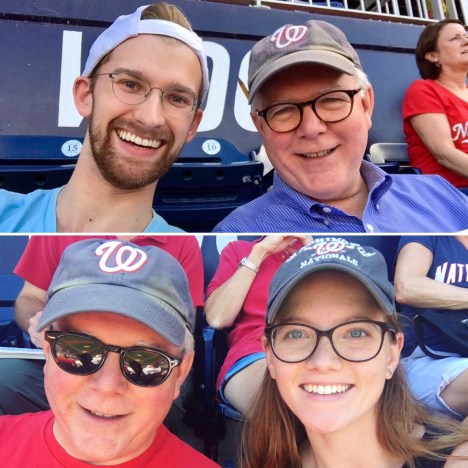
You may have heard that my team – the Washington Nationals – lost last Friday, a loss which ended their season. You may be surprised to know that while disappointed, I can live with that outcome. After 50+ years of watching sports, I find that low expectations are the key to happiness.
In my mind, baseball – with its timeless, cyclical rhythms and its “symbolic and literal journey ‘home’” – contains values and appeal that overshadow mere winning and losing and match the values and appeal we espouse in discussing why old places matter. What touches many in both fields is a sense of the familiar, the building upon the past while adding new meaning today, and a reality that recognizes difficult as well as celebratory history.
A. Bartlett Giamatti – PhD professor in comparative literature, president of Yale University, commissioner of baseball, and a lifelong fan of the Boston Red Sox until his untimely death in 1989 – understood both accomplishment and loss. In A Great and Glorious Game, Giamatti said of baseball,
“It breaks your heart. It is designed to break your heart. The game begins in the spring, when everything else begins again, and it blossoms in the summer, filling the afternoons and evenings, and then as soon as the chill rains come, it stops and leaves you to face the fall alone.”
The team that defeated my Nats – the Dodgers – had fans during their years of futility in Brooklyn that actually coined the famous cry “Wait ‘til next year.” That resilience – the desire to get up off the mat and try again even in the face of the game’s challenges – is what makes baseball so intriguing for so many. For a game where successful batters fail 7 times out of 10 and even the best teams lose at least 60 games every season, baseball cultivates a sense of humor and makes self-deprecation a survival tool. As New York Mets manager Casey Stengel said to his barber during the team’s hapless early years, “Don’t cut my throat. I may want to do that myself later.”
Saving Jewelers Row in Philadelphia
Historic Deerfield, on a beautiful fall day
The stories of the places we love – like the games we love – can help us understand what it means to be fully alive and living in community. Let’s embrace those stories – both celebratory and difficult – and work to hear, understand, and honor the full diversity of the ever-evolving American story. Oh, and as for the Nats, “Wait ‘til next year!”
Have a good week.
More to come…
DJB
Image: Nats win NLDS Game #2, only to lose the series.
I came into this season and this series with the same low expectations. So 2016 wasn’t as gut-wrenching as 2012. And since Dusty didn’t make any obvious mistakes (expect for keeping Danny in the lineup), it wasn’t as infuriating as 2014 (when Matt went brain dead).
Still, the Nats should have won this series. Even with season-ending injuries to Stras and Ramos. Even playing a shortstop in center field. Even with Bryce having the worst follow-up season of any MVP in history. They still had this series won…until they didn’t.
At critical times – and especially in the last three innings last evening – their big guns didn’t come through. They didn’t score enough runs to give Max any cushion on a night he was pitching well. They didn’t…
Writer Maria Popova speaks of our need “to connect countless dots, to cross-pollinate ideas from a wealth of disciplines, and to combine and recombine these pieces and build new ideas” if we seek to be creative and truly want to contribute to the world.
To reach this level of creativity and understanding of our beliefs, it is important that we be open to change. After noting that we should allow ourselves the “uncomfortable luxury” of changing our minds, Popova writes:
“We live in a culture where one of the greatest social disgraces is not having an opinion, so we often form our ‘opinions’ based on superficial impressions or the borrowed ideas of others, without investing the time and thought that cultivating true conviction necessitates. We then go around asserting these donned opinions and clinging to them as anchors to our own reality. It’s enormously disorienting to simply say, “I don’t know.” But it’s infinitely more rewarding to understand than to be right — even if that means changing your mind about a topic, an ideology, or, above all, yourself.”
Here’s to taking the time to be truly informed and — when the situation calls for it — to change our minds. Have a good week.
More to come…
DJB
Image by DJB: Anglesey Abbey Garden, Cambridge, England
I’m live blogging game 1 of the National League Division Series between the Washington Nationals and (Claire’s) Los Angeles Dodgers.
8:29 p.m. – And Murphy works a walk. And we have yet another pitching change. We’re now 3 hours in and only in the 7th. Playoff baseball takes soooo…. long.
8:33 p.m. – Harold gets it wrong…again. Just after saying that Murphy won’t run, he does. Bummer though – Murphy is thrown out. And no, Tom, the aggressiveness didn’t blow up on Dusty. It just didn’t work out this time.
8:39 p.m. – “Official payment partner” of the NFL. What the devil is a “payment partner?” I guess for Visa, it sounds better than “blood sucking, high hidden interest rate, debt machine.”
8:42 p.m. – Jayson still has a little bit of speed. Great catch! And we’re on to the bottom of the 8th. Let’s get a couple of runs, Nats!
8:50 p.m. – No one is complaining about the Dodger closer coming in during the 8th inning to get 5 outs, but in typical FOX fashion the announcers act like it is a YUUGE deal. It isn’t.
8:53 p.m. – Clint shoots the ball down the left field line for a two-out double. Okay, Chris Heisey, let’s get that R.I.S.P. in.
8:58 p.m. – Heisey swings at ball 4 and then watches strike 3. Oh well…top of the order up in the 9th, and maybe the closer will tire.
9:01 p.m. – Dusty calls on Melancon. He’s not getting the Showalter treatment for leaving his closer in the pen. Strikes out the first two batters he faces.
9:09 p.m. – And Melancon – as he sometimes will – gets into a jam. But, as is usually the case, then he gets out of it. On to the bottom of the 9th with the top of the order. Let’s get that win, Nats!
9:17 p.m. – That was a wicked pitch to Turner. Only two outs left to play with.
9:20 p.m. – Harp…go the other way. He doesn’t, and now we’re down to our last out and FOX is reading the credits.
9:24 p.m. – Classic Werth battle….But Jansen finally gets him and Dodgers get it done 4-3. Bullpen came through for both teams, but Max’s initial hole was just a little too big.
Candice with her “Half Smoke All the Way” at Nats Park earlier this season.
I’m live blogging game 1 of the National League Division Series between the Washington Nationals and (Claire’s) Los Angeles Dodgers.
Top of the 6th. Taking a bit of a break to eat my hot dogs. Thank you, Candice and Andrew for joining me in the man cave for dinner!
7:53 p.m. – And we’re through 6th, as Max leaves a runner stranded on 3rd. At 90 pitches. Does Dusty pinch hit for him in the bottom of the inning? (Depends on the situation, I assume.)
7:55 p.m. – My God. Who would take Eliquis after all the bleeding, bleeding, bleeding warnings in their ad?!
7:58 p.m. – And both starters are now gone. Difo in to pinch hit for Max. Not great, but kept ’em in the game.
8:01 p.m. – Turner walks. Let’s see if he can turn it into a double. And the call to the bullpen comes. Now for the sloooooow part of the game.
8:05 p.m. – And it takes one batter for Puig to show off and almost screw up a fly out from Harper. End of 6, still 4-3 Dodgers.
8:18 p.m. – A little too quiet at Nats Park tonight. Need some noise to energize the team.
8:19 p.m. – Time to stretch….and the forced patriotism of “God Bless America.” Of course, Andrew knows Ben Patterson, the tall tenor on the left of the Army Chorus quartet!
Time for a new thread.
Player introductions for Game 1 (photo credit: Tom Cassidy)
I’m live blogging game 1 of the National League Division Series between the Washington Nationals and (Claire’s) Los Angeles Dodgers.
My God…are we really going to have to look at Donald Trump ads throughout this series? Yes, Hillary is coming after your guns! Spare me.
Bottom of the 3rd.
6:38 p.m. – BRYCE! Double! Good start for Harper.
6:42 p.m. – Werth grinds out a walk. Kershaw over 50 pitches with one out in the 3rd. If you can’t beat him, wear him out. Nice double steal. Gets two R.I.S.P.
6:49 p.m. – ANTHONY! N-A-T-S, Nats, Nats, Nats, Woo! X2. That man can hit. 4-2 Dodgers and Kershaw is up to 60 pitches in the 3rd. Get in that bullpen.
6:51 p.m. – Zimmerman is 2-2! Keep the line moving.
6:55 p.m. – And I have the same question I had at 6:14 p.m…why is Espinosa still playing? The guy is the ultimate rally killer. Seldom makes contact. Jeez.
7:00 p.m. – I want to say that I’ve always loved Dusty. No matter what happens this year (and I have low expectations), he’s been great for the Nats and for Washington. He’s just having fun.
7:02 p.m. – 1-2-3 4th inning by Max. Let’s keep pilling up the pitches on Kershaw and chipping away at that lead.
7:07 p.m. – Pedro Severino! Lead-off double. Let Max (the RBI machine) hit!
7:10 p.m. – Scherzer does the job! Trea Turner has to get that R.I.S.P. in! Especially since they are playing back in the infield.
7:12 p.m. – And we’re back within 1! Sac fly Turner. Nicely done all the way around. 4-3 Dodgers in the bottom of the 3rd, with Harper coming up.
7:14 p.m. – Okay, ump. Harper will let you know when it is a strike. Don’t expand that zone for Kershaw.
7:15 p.m. – And we’re at the end of 4. Candice is fixing the hot dogs! What could be better for a ballgame?!
7:21 p.m. – Where is the producer in this game? Please tell Harold to stop talking! He’s taking over the Tim McCarver chair.
7:22 p.m. – Seven straight set down, and we are through 4 1/2. Keep up the pressure, Nats. 4-3 Dodgers going to the bottom of the 5th.
7:26 p.m. – Jayson gets it going in the 5th with a 2-strike single. Fear the beard.
7:30 p.m. – Kershaw is pushing 100 pitches. This has to be his last inning. And Anthony just comes through again. What did I say…a hitting machine!
7:31 p.m. – Zim seems to be getting his stroke back. Just missed a HR here. But…the rally killer is coming up. Come on Danny…prove me wrong!
7:38 p.m. – But he doesn’t. What’s that question again?
I’m live blogging game 1 of the National League Division Series between the Washington Nationals and (Claire’s) Los Angeles Dodgers.
Top of the second…
5:59 p.m. – Max is stalking!
6:03 p.m. – 10 pitches…that’s the way to bounce back, Max!
6:06 p.m. – These announcers on FOX never shut up. Leave a little “space” in the conversation, guys.
6:07 p.m. – And I’ll say it for F.P. “There goes the no hitter.” What’s a little 3-week layoff. Nothing for Murphy!
6:09 p.m. – Less than 10 minutes after talking about what a key Harper is for the Nationals, Harold Reynolds says Rendon and Zimmerman are the keys tonight. How many keys can one game have?
6:12 p.m. – Okay…let’s wear out Kershaw and get him to throw a lot of pitches. We’re going to be over 30 by the end of the second…assuming it takes Danny at least three to strike out. Prove me wrong, K-Street.
6:14 p.m. – But he doesn’t. Why, oh why, is Espinosa still playing?
6:15 p.m. – The Dodgers just found out that Severino is a lot faster than Ramos!
6:17 p.m. – We’re only in the second, and I’m already sick of Harold’s voice. Where are Bob and F.P. when you need them!
6:27 p.m. – Harold “doesn’t want to harp on a point”…and then proceeds to harp on it for another 30-45 seconds.
6:28 p.m. – Well, Max isn’t exactly shutting them down. 2-0 Dodgers. Harold seems to think that Max is missing Wilson. Hmmm… Thankfully, Kershaw doesn’t look like he’s totally invincible tonight.
6:31 p.m. – Damn. 2-run homer. 4-0 Dodgers. Ouch. Not sure Kershaw is that invincible.
6:33 p.m. – Okay, let’s get some of this back. We’ll start a new thread.
Okay. I’ve been much too serious in recent posts here on More to Come… So, to remedy that problem, let’s live blog Game 1 of the National League Division Series between our Washington Nationals and (Claire’s) Los Angeles Dodgers!
Go Nats!
I’ll be at tomorrow’s game in person, so it seemed appropriate to carry on a running conversation with readers online, just as if I were at the ballpark.
I’ll post several times during the game.
Thank God I missed 99% of FOX Sports 1 pre-game. The basket of deplorables on that show (Pete Rose! A-Rod!) is just too much to bear. But so FOX.
5:39 p.m. – First pitch strike from Max! And we quickly have a strikeout!
5:41 p.m. – Well giving up that home run to Corey Seager didn’t take long. (Only player who can give Trea Turner a run for his money on the “looks like he is 12 years old” scale.) Maybe Max got it out of his system early. The gopher ball has been his problem all year long. Don’t give up too many more, Max…we are facing Kershaw tonight.
5:45 p.m. – Nice double play to get out of any further trouble. On to the bottom of the first.
5:48 p.m. – Interesting…Harper is batting second in the order tonight. Maybe it will get him going.
5:50 p.m. – First battle of the rookies goes to Seager.
5:52 p.m. – For those wondering about which Clayton Kershaw might show up, take a look at this blog post from a regular Nats blogger that is generally worrisome for Nats fans.
5:56 p.m. – Well, it wasn’t efficient, but it was effective. Kershaw strikes out the side. I’ll wrap up this post and go on to #2 in the thread.
George, Tom, Abe, Teddy, Bill, and Cal…your Washington Nationals “Racing Presidents”
Tabula Plena: Forms of Urban Preservation, Edited by Bryony Roberts
A 2011 terrorist bombing in the national government quarter of Oslo damaged two central modernist buildings and set the Norwegian government on a path of demolition and replacement that raised questions of national remembrance, security, preservation, and democratic consensus. That incident provides the context for a new and expansive work about preservation, urbanism, and architecture edited by architectural designer and scholar Bryony Roberts, the 2016 Rome Prize winner in Historic Preservation.
Tabula Plena: Forms of Urban Preservation takes its title from a contrast to the familiar architectural and planning term, tabula rasa, the clean slate—a site that is cleared and thus provides the freedom for design without constraints. Preservationists in the United States know this situation all too well, from the urban renewal battles of the 1950s and 60s to today’s call for clearing urban blocks to allow new high-rise buildings that will provide more “density” in our rapidly growing cities.
Roberts and students from the Oslo School of Architecture and Design (AHO), working in collaboration with a team of students from the Columbia University Graduate School of Architecture, Planning and Preservation (GSAPP), prepared design and planning options for the damaged quarter that rejected the government’s call for demolition and instead offered strategies for combining the historic buildings with new construction. Tabula Plena grew out of that project and is composed of a series of essays, interviews, and case studies from a range of thoughtful contributors who offer guidance and perspectives for modifying and transforming contemporary urban sites with existing structures.
In the process a new vision for preservation is revealed. While the examples are largely European, the lessons for preservationists, architects, and urbanists around the globe are timely. Many of the perspectives align with ongoing discussions about preservation’s future here in the United States. Roberts’ helpful introduction notes how much we can—and should—change our perspective about the roles of various professions involved in the future of cities. She notes that:
“Collaborations among architects, preservationists, and urban planners have the potential to shift conceptions of both design authorship and architectural form. Processes of alteration and reuse necessarily challenge the concept of signature authorship. They prompt architects to work in response to previous architects’ decisions, as well as in collaboration with preservationists, planners, structural engineers, and community interests. Such collaborations also pull preservationists away from positions of seeming objectivity into roles with more explicit authorship, as they make choices about what to preserve and how to frame it for contemporary audiences. As a result, architects and preservationists both participate in a different form of design.”
The 20 essays and interviews in the book speak to the 21st-century challenges and opportunities of working with existing places in new ways. Eduardo Rojas, a visiting lecturer at the University of Pennsylvania who has worked around the globe in urban development, calls for new governance practices to encourage reuse and for flexible regulations to adjust the level of conservation of buildings and public spaces. Daniel M. Abramson, associate professor of art history and director of architectural studies at Tufts University, also touches on the need to treat the past flexibly, not reverentially, in his essay about obsolescence. Elizabeth Timme, co-founder and co-executive director of LA-Más, contributes a fascinating piece on cultural bias among designers and planners addressing community input and needs, as observed during her firm’s engagement in the Frogtown neighborhood of Los Angeles.
One of the more compelling arguments for a new path forward is that of AHO’s Erik Langdalen, author of an essay entitled “Utopia and Conservation.” Langdalen examines the utopian characteristics of conservation—as opposed to the typical perceptions of our work as conservative and retrospective—and makes the case that urban conservation is as much about the future as the past and is “undisputedly a creative act.”
A pedagogy roundtable between Roberts, Langdalen, Director of the GSAPP Historic Preservation Program Jorge Otero-Pailos, and Thordis Arrhenius of Linköping University is the capstone of Tabula Plena and returns to many of the topics covered throughout the work, including creativity. When Otero-Pailos mentions the need to talk about creativity within a preservation program, Arrhenius responds that:
“What is interesting about preservation is that it takes something existing and turns that into a gift. Something that is undervalued is given value. So it’s not just that preservationists deal with objects out there that are historically significant. Often they also identify things and turn them into historical, significant things.”
Bryony Roberts has led us into a useful and necessary conversation around the future of both preservation and architectural design. In his essay, “Nine Points Towards an Expanded Notion of Architectural Work,” Arrhenius sums up the opportunities available to us, asserting that, “The confrontation of established preservation methods with techniques of change and alteration offers methods to rethink the notions of permanence within preservation and to reframe the obsession with the new in architecture.” It is a conversation well worth the effort.
(Note: This book review originally appeared on the Preservation Forum blog of the National Trust for Historic Preservation.)
Growing up Baptist, I was schooled by my father of the dangers of having the government involved in religious life. A New Deal Democrat and a staunch supporter of the separation of church and state, Daddy was a proud “Roger Williams” Baptist. So when Andrew attended Brown University in Providence, Candice and I made sure to stop at the Roger Williams National Memorial – administered by the National Park Service – where I picked up a copy of John Barry‘s Roger Williams and The Creation of the American Souland sent it to my father.
We talked about both works before Daddy passed away, and I wrote a piece on this blog last year about how old places can help us understand the battles for religious freedom. When I brought both books home from his library earlier this year, I made the decision I wanted to read them back-to-back.
Roger Williams and the Creation of the American Soul by John M. Barry
I began with Barry’s 2012 study of Williams, one of the least understood of the founders of colonial America. The first portion of the book focuses on the religious turmoil in England, which shaped Williams as well as the Puritans who traveled to America for religious freedom. But as Barry makes clear, the religious freedom envisioned by the Puritans only included those who worshiped according to their dictates. Williams’ growing understanding of the need for liberty of conscience and the separation of church and state came about due to his close involvement with some of the leading post-Reformationist thinkers and leaders in England, as well as his first-hand observations from colonial America.
Barry’s book is full of surprises for those who have not studied this period of history in-depth. I had always assumed that Williams was a devout Baptist once he moved to what became Rhode Island, but Barry notes that he moved among religious groups and could more accurately be described as a seeker. Williams’ engagement with the Native Americans he found in the colonies was well ahead of his time (by several centuries), and led one reviewer to lament that Barry had not covered more of that story. The intrigue between Boston, Salem, Plymouth, Providence, and London – with Williams often in the center of controversy – is well documented by Barry, a talented writer who usually focuses on 20th century topics. (I especially enjoyed his Rising Tide about the great Mississippi flood of 1927.)
Barry’s Afterword sums up the remarkable man who was Roger Williams:
“Roger Williams was not a man out of time. He belonged to the seventeenth century, and to Puritans in that century. Yet he was also one of the most remarkable men of his century.
With absolute faith in the Bible, with absolute faith in his own interpretation of it, he nonetheless believed it “monstrous” to compel another person to believe what he or anyone else believed, or to compel conformity to his or anyone else’s belief. His enemies called him a “firebrand.”…They feared being challenged, and having their word, under challenge, disintegrate. They feared the chaos of freedom, and they feared the loneliness of it.
Williams embraced all that. Freedom, he believed, was worth it, worth his life and worth far more than his life…For of all the remarkable things he said, the most remarkable was this: ‘Having bought Truth deare, we must not sell it cheape, nor the least graine of it for the whole World, no not for the saving of Soules, through our owne most precious.’
For he knew that to believe in freedom and liberty required faith in the freedom of thought, of conscience. And that was soul liberty.”
One Nation Under God by Kevin M. Kruse
I have often thought of the troubles we encounter in America when we try to compel others to believe as we do. Kevin Kruse’s One Nation Under God: How Corporate American Invented Christian America, is a recent piece of scholarship that looks into the obliteration of the separation of church and state – at, surprisingly, the hands of anti-New Deal corporate CEOs.
This is another book full of surprises, and although not as well received as Barry’s book, that may be due to the more controversial subject matter. Having lived through the culture and school prayer wars of the 1960s up until today, I was certainly aware of how the so-called “Christian right” worked to wrap itself in God and country. What was more of a revelation was the support for this work stretching back to the 1930s from a broad group of corporate executives out to wreck Franklin Roosevelt’s New Deal reforms. Eisenhower’s role in the shift in American public opinion towards a more public religion, was also something of a revelation.
Neither work is perfect, but both are worth reading, especially in light of the ongoing battles in 2016 over the nature of religious liberty and the separation of church and state. I suspect if he were alive and active today, Roger Williams would be able to discern the charlatans among our midst, and the perils we face in limiting the rights of those not like us.
The First Baptist Church, Providence, RI
More to come…
DJB
Image: The First Baptist Church in America, in Providence, RI — where religious liberty and the separation of church and state was born (photo by DJB)