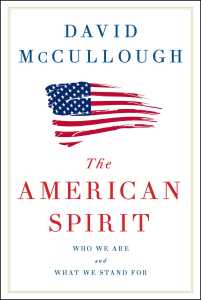
The July 4th weekend turned out to be the perfect time to read historian David McCullough’s newest book The American Spirit: Who We Are and What We Stand For. This compilation of 15 speeches spanning the years 1989 through 2016 brought renewed appreciation for the wisdom of the elder statesman of America’s historians (and honorary trustee of the National Trust for Historic Preservation). The fact that it includes McCullough’s October 20, 2001, speech at the National Trust conference in Providence, Rhode Island—the most memorable of several David McCullough speeches I’ve been privileged to hear in person—is an added bonus.
David McCullough’s “The American Spirit”
Some would note that optimism is in short supply in today’s world. That was certainly the case just six weeks after 9/11. Yet in 2001, McCullough used the setting of the First Baptist Church in Providence — one of the nation’s most historic houses of worship — and the scholarship from his recently published biography of John Adams to make the case for “the importance of history as an aid to navigation in such troubled, uncertain times,” as he says in this book’s introduction.
He spoke then to the importance of authentic places in helping to make a “physical, tactile contact with distant human beings. To “feel their mortality.” To “feel a common bond” with all humanity.
“We think we live in difficult uncertain times (McCullough said in 2001 in Providence). We think we have worries. We think our leaders face difficult decisions. But so it has nearly always been….It is said that everything has changed. But everything has not changed….We have resources beyond imagining, and the greatest of these is our brainpower….And we have a further, all-important, inexhaustible source of strength. And that source of strength is our story, our history, who we are, how we got to be where we are, and all we have been through, what we have achieved.”
Speaking in 1994 at Union College, McCullough touched on this same theme when he said,
“I think what most of us want—as most people everywhere want more than anything—is to be useful. This and to feel we belong to something larger than ourselves. What is needed now…is a common understanding of what that larger something can be. What we Americans need above all is leadership to define the national ambition….Beware the purists, the doctrinaires. It has been by the empirical method largely, by way of trial and error, that we have come so far. America itself is an experiment and we must bear that always in mind.”
This is a good time to remember the power of history. The power of story. And it is an especially good time to work to ensure that the story of who we are and all that we have been through to reach our achievements as people and as a nation is not lost in the uncertainty of the present.
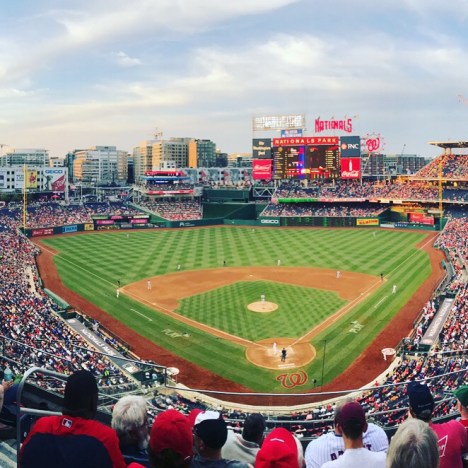
I was at Nationals Stadium on Wednesday evening with a co-worker. Beautiful evening. Low humidity. Stephen Strasburg on the mound for the home team. Nats are playing the world champion Chicago Cubs.
And 10,000 seats are empty.
Nats vs. Cubs on a beautiful night at the ballpark
What the heck is going on? I certainly asked that question. But today’s Washington Post had the full story.
The Nats and Lerners—according to writer Barry Svrluga—were price gouging, in hopes of making an easy buck at the expense of long-suffering Washington sports fans. Plain and simple.
“Nationals officials clearly saw the four-game Cubs series as an opportunity to draw large crowds at high prices. Last year, when Chicago played a Monday-Wednesday series at Nationals Park in mid-June, the crowds were 37,187, 41,955 and 42,000 — and the environment was perhaps the best of the regular season.
This year, the four Cubs games were listed in the preseason pricing structure as “Diamond” games, the highest of four tiers of pricing the Nationals offer. The only other Diamond game on the schedule was Opening Day. Even the annual Fourth of July game, this year against the Mets, is a step down.
That means there were higher prices across the board for the Cubs series. The July 5 game against the Mets, for instance, is in the “Regular” tier of pricing — the lowest. The most expensive seat is $370. A dugout box seat is $90. The cheapest advance-purchase ticket is $12.
But for the Cubs games, the increases were significant. For Thursday’s series finale, the high-end Delta Sky360 Club seat runs $450. The dugout box seats are $140 apiece. And the right-field terrace seat — that cheap ticket that is the price of the movie less than a week from now — is $35.”
What is it about real estate developers that makes them think that all of life is a deal and they can make people pay unreasonable prices just to line the developers pockets? The Lerners need to put some of their billions into hiring a decent closer.
A modest proposal for the Nats: until the team wins multiple playoff series and gets to the World Series under this ownership team, the “Diamond” level pricing should go the way of the Edsel.
This is a time of year when many of us have either completed school terms or have celebrated the accomplishments of children or other friends/family members at commencement ceremonies. Scholar and author Warren Bennis was thinking about this time of transition when he wrote the following in his landmark book On Becoming a Leader:
If I were restricted to three words in any commencement speech, they would be: Ideas, Relationships, and Adventure. Ideas are the basis for change, for re-invention, for, yes, intellectual capital. Relationships have to do with outstanding people working in harmony and openness, where everyone feels empowered, where all members feel included and at the center of things, where they feel competent and significant. And Adventure has to do with risk, with a bias towards action, with curiosity and courage.
A scene from the Brown University graduation of 2015…you can guess who the guy is in the middle with the sunglasses and big smile.
The challenge for organizations and their leaders is, as Bennis states it, to “create the social architecture where ideas, relationships, and adventure can flourish.” That isn’t easy, especially in light of challenges facing us today, but those who “choose to succeed must have the strength to persist in the face of setbacks, even failures.”
It is my belief that building the type of social architecture to ensure that ideas, relationships, and adventure can flourish is a collaborative effort that never ends. Each of us plays an important role. How we model behavior from our own perspectives and positions is as important as written statements of organizational or personal values. When it comes to the organization where I work, I’m glad to be traveling that path with a group of talented and committed colleagues who are eager to continue that work together. It is the only way we’ll succeed.
Dad Hat from Rook Coffee (photo credit: Rook Coffee)
Life on the road can become a blur. I began writing this from the Molly Pitcher Inn’s dining room which overlooks the Navesink River in Red Bank, New Jersey. Candice and I have come here to celebrate the 40th wedding anniversary of her cousin Mary Beth and husband Greg. It is the second time we find ourselves in Red Bank in three weeks, as we were here earlier in the month to celebrate with family and friends the life of Candice’s aunt and godmother, and Mary Beth’s mother, who passed away at age 90.
June is perhaps a bit more than typical in terms of travel (16 out of the first 24 days spent on the road), but only at the margins. Good thing that I enjoy it. In June alone I’ve not only visited Red Bank twice, but I’ve also been to Madison, Wisconsin (one of prettiest small college cities in America…in the summer); Athens and Atlanta, Georgia (my God, they never stop building highways); Philadelphia, Pennsylvania (a gem of a city with much to recommend it and work to be done); and Hampton, Virginia (home of Fort Monroe, Freedom’s Fortress). And there’s still a week to go before we hit the 4th of July weekend!
I’ve thought so many times of writing a blog post on this or that subject, only to drop the idea as I rush to a meeting or another airport. So this “Observations from…” post will be very short (dare I say Twitter-like”) comments on several things swirling around my travel-addled mind.
Rook Rocks—The waitress at the Molly Pitcher on Friday morning commented on my big cup of Rook Coffee. I told her I just had to try any independent coffee shop with the guts to locate next to a Starbucks, as is the case with Rook in downtown Red Bank’s wonderful Main Street. She replied, “Oh, you’re not from around here. In these parts, Rook so out-performs Starbucks. After a few sips, I knew why.
Independent Coffee Shops (and bookstores) are holding their own—I’ve come to seek out those independent coffee shops no matter where I go. When in Madison, stop by Colectivo Coffee on the Square. Their baristas rival Rook in their friendliness (and they have that Midwestern Nice vibe going for them). Jittery Joe’s is a tasty find in Athens. And on that rare occasion when I’ve been in DC, I took the time to stop by my favorite bookstore, Politics and Prose, where Candice and I enjoyed a late-night coffee recently at The Den after stocking up at the store’s member sale.
Everyone (and every thing) needs refurbishing now and then—I have stayed in just about every type of hotel imaginable this month. Most have been great. A couple have been a bit long in the tooth. Just like people, hotels need the occasional refurbishment every now and again. Let’s begin with those electrical outlets. (I’m looking at you, Molly Pitcher Inn!)
If I keep up this level of travel, I’m going to have to break down and get the MLB network—In June I’ve been to the ballpark once (but have a second game next week to see the World Champion Cubs and our Nats) and have only caught about five games on television. While I have enjoyed catching up with some other teams, I miss seeing my Nats on a regular basis. And I really like our announcers—Bob and F.P.—after sampling home team announcers in other cities. Truth be told, however, I don’t miss the heartburn that goes with the all-too-frequent Nats bullpen meltdown. Come on, Rizzo, please go find a closer. Thank God for yesterday’s laugh-fest blowout against the Reds! And I want to have a renaissance like Ryan Zimmerman!
I have to drive HOW FAR to go see the Braves—Even though I don’t need to visit the new Atlanta Braves stadium to add another one to my bucket list, I gave serious consideration to taking in a game one evening while I was in town. Then I Googled the distance from my mid-town hotel. Then I drove a bit in Atlanta. Then I watched the game from the comfort of my hotel room. What a dumb way to build a broad base of support for a sport that’s already seen as too old and white…build a new stadium way out in the northern suburbs to make sure that the city’s African-American fan base (real and potential) can’t get there. Jeez.
If I bite my tongue any more, part of it will fall off—I try to keep politics out of my blog. For now. But with so many things happening to endanger our American experiment in democracy, I may have to throw caution to the wind. I’ve traveled in both red and blue states this month and I’ve spoken with people from across the political divide. We need to face some hard facts as a nation.
Celebrate family and friends—Candice and I were talking today about all the interactions with family and friends we’ve experienced in recent months. Funerals. Weddings. Wedding Anniversaries (our own and others). Birthdays. Celebrations of Mothers and Fathers. Dinner parties. Picnics on our saint’s day at church. We’ve traveled for as many of these as we’ve celebrated at home in Washington. When family isn’t nearby, you lose something by not making the effort to see them on a regular basis. And friends expand the family circle. We are blessed on both counts.
Drinking whiskey at Jack Rose on Father’s Day with Andrew
Is anything better than bourbon and baseball for Father’s Day—That’s a trick question. Nope. Well, yes there is. It would have been even better if Claire had been here in D.C. with us. Andrew and Candice took me to Jack Rose Dining Saloon for a Father’s Day feast and some mighty fine bourbon last Sunday. (Largest bourbon selection in the Western Hemisphere!) Claire and Andrew are buying me a Nats jacket in anticipation of those October playoff games. What could be finer? (Another trick question.) Woo hoo!
Even in very busy and often challenging times, it is important to remember the wonder of travel, the joy of seeing new places, the lifetime pleasures of staying connected with family, the unexpected moments of delight that come from an expanded circle of friends, and the satisfaction of seeing (and being) people living their passion.
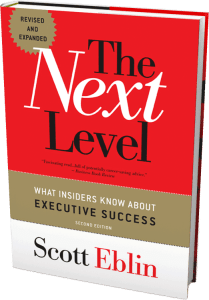
In his book The Next Level, Scott Eblin warns against being too myopic, which can lead to silos in organizations or businesses. We all understand our organization or business, but often only from one seat or perspective. I bring this up because of a conversation I had last week with one of our senior staff leaders in my organization, the National Trust. We were discussing ways in which we could help individuals on our team who become too closely identified with one program, their work in one city or region, or expertise in saving one type of historic resource. It reminded me of my own experience.
Several years ago I was working with an executive coach. After receiving 360 degree feedback on my work, she asked to see my resume, which listed my various preservation jobs since I entered the field. Once she reviewed the resume, my coach had me undertake what I thought at the time was an unusual task. I was to rewrite my vita without using the words “historic preservation” or without the name of any of the agencies or organizations where I had worked. In other words, she wanted me to take a fresh perspective as to who I was and my capabilities at the professional level. That led me to think about my eight-year stint as executive director of the Preservation Alliance of Virginia, for instance, in terms of skills and accomplishments without relying on the jargon of my profession. No “I led an effort to enact Virginia’s historic preservation tax credit” for this exercise. Instead I had to talk about coordination of a network of supporters, communication of key concepts to the media, collaboration with partners to reach new audiences outside my professional field, and providing effective testimony before legislative committees.
It was an eye-opening experience. I had become so identified in my own mind with my preservation career, that I simply never put much thought into how the skills required to do my job translated into a broader world of possibilities. This exercise, along with several others she had me do, forced me to look at my career, skills, and life with a new perspective.
When one becomes myopic, you don’t step back to think about the type of skills you may bring to other work where you could be a valuable team member. Similarly, you don’t think of areas where you may want to seek training to broaden your expertise. Let me encourage you, as you think about your work and what you bring to making a difference in this world, that you think bigger and try a fresh perspective every now and then. I suspect you will be surprised at what you find.
One of the items that is a perennial in our staff satisfaction survey is the comment “we have too many meetings.” Many organizations face the same feedback. A recent article I read on productivity suggested we should avoid meetings at all costs, quoting the billionaire Mark Cuban as saying that one should “never take meetings unless someone is writing a check.” That’s easy for him to say. He pays people to have the meetings to get to the check-writing part of the deal.
Meetings for a dispersed organization with a value of collaboration are inevitable and necessary. Useful meetings are, unfortunately, not inevitable. I had a colleague tell me of an experience where someone blocked out two hours on her online calendar with a meeting request, then showed up at the appointed time without an agenda or even an understanding of why they had called the meeting. No one was sure if the right people were in the room. The participants ended up stumbling around until the crux of the matter at hand was identified, which was then dispatched in less than 30 minutes. I told this individual that anyone in our division has my permission to refuse to accept open-ended meeting requests for long blocks of time that do not have a clear agenda or purpose.
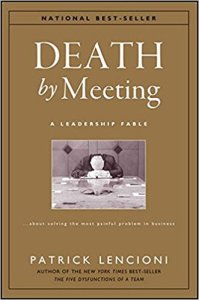
Death by Meeting
Patrick Lencioni’s book Death by Meetingssuggests a different way. Lencioni says we have to
“…fundamentally rethink much of the way we perceive and manage meetings. That means we cannot keep hating them. And we must abandon our search for technological solutions that will somehow free us from having to sit down face-to-face. And we have to…accept the fact that bad meetings start with the attitudes and approaches of the people who lead and take part in them.”
In this work, Lencioni notes that the “single biggest structural problem facing leaders of meetings is the tendency to throw every type of issue that needs to be discussed into one meeting” instead of clearly distinguishing between various purposes, formats, and timings. While the format won’t work all the time, he suggests we think about check-ins, tactical decision-making, strategic planning, and periodic review as different types of meetings with different timeframes, different participants, and different venues.
I am not a big fan of George Will, but he does have a good line about why baseball is preferable to football, and that is because the latter “combines the two worst things about America: violence punctuated by committee meetings.” If we focus, we can do something to make the meetings in our lives much more useful.
When I write I often fall in love with my own asides. (Aside: a remark that is not directly related to the main topic of discussion.) I believe that what I want to say is so fascinating that it doesn’t matter if it fits the topic. Nope, I’m going to interject it simply because I can.
I’ve just read a book that may—if not cure me—get me to think more deeply before heading down some rabbit hole.
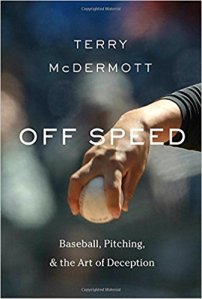
Terry McDermott’s Off Speed: Baseball, Pitching, and the Art of Deceptioncomes close to being a wonderful book. Using the framework of Felix Hernandez’s 2012 perfect game, Seattle Mariners fan McDermott takes the reader through a nine-inning/chapter history of pitching, pitches, and—naturally, given the subject—deception. Hernandez is one of the best in the game and a terrific subject for this fan’s dive into the deep end of baseball.
McDermott is a life-long lover of baseball, having been reared in the rural Midwest in “Field of Dreams” country. And that is where the trouble begins. McDermott finds his upbringing fascinating, and he drops in stories, footnotes, phrases (parenthetical and otherwise), and all matter of stuff that simply distracts from what could have been a terrific little baseball book.
Let’s take those footnotes denoted with an asterisk and placed at the bottom of the page that McDermott overuses throughout the book. He can’t even get past the second page of the preface without a long footnote about obscure Mariners relief pitcher Bobby Ayala and a call with his daughter. These footnotes occur so frequently that you feel compelled to read them, yet when you finish, 9 times out of 10 you have the thought “this book could have used a better editor.” And the use of a different pitch for each of the 9 chapters “almost” works…until you get to chapter 5 and the knuckleball—which Felix Hernandez doesn’t throw. That gives McDermott almost an entire chapter to chase down different stories, some of which are interesting and others of which are trite.
Which is all too bad. When I read in that same preface that reliever Brandon League “is a pitcher with a great arm, two great pitches, and apparently no brain” I thought I had latched onto a book both interesting and fun. And for the most part it is. The story of Hernandez’s perfect game, told inning-by-inning and almost pitch-by-pitch, is fascinating. McDermott does a good job of describing pitches, and for those who want to know the difference between a four-seam fastball, a two-seam fastball, a slider, and a cutter, this book provides that information in different ways that are almost all illuminating.
McDermott is a gifted writer, but he let’s his love get in the way of tighter editing. I’ll still recommend Off Speed, but—with apologies to William Shakespeare—beware the asides of summer.
Last evening I spoke in Athens, Georgia, on the occasion of the 50th anniversary of the Athens-Clarke Heritage Foundation. The topic was the future of preservation, and I took segments from remarks given by my colleague Tom Mayes at the recent EDRA conference on Why Old Places Matter and combined it with the basic elements of our recently released Preservation for People: A Vision for the Future.
The first key concept from the vision is that a people-centered preservation movement hears, understands, and honors the full diversity of the ever-evolving American story.
I built on this concept by noting that,
“The recognition of our stories and the capacity to see yourself and others in the American narrative has a profound effect on our sense of identity. A few years when the National Trust conference was held in Nashville, Congressman John Lewis challenged us to believe in the idea that ‘my house is your house. My story is your story. The history of my people is the history of all Americans not just African Americans.’”
The Well-Tempered City by Jonathan F.P. Rose
I followed that with a quote from The Well-Tempered City, by Jonathan Rose, the visionary developer, urbanist, and former NTHP trustee. In that work he notes that cities emerge from the interdependence of related parts. He says, “compassion is essential for a city to have a healthy balance between individual and collective well-being.”
It is my belief that hearing, understanding, and honoring the full diversity of America’s story helps provide “the connective tissue between the me and the we, and leads us to care for something larger than ourselves.”
After my remarks, a member of the Foundation’s board came to speak with me. Linda Davis is a civic and business leader in Athens, a member of the local school board, and African American. She told me that the vision is right in line with what she has been supporting in Athens in her five years on the ACHF board. She said, “I am not invisible” and this future is “exactly what I hope for preservation.” Her comment was straightforward, yet poignant.
Americans have conveniently forgotten most of the people whose lives are part of our layered history. At this time of deep division in our national life, I believe—more than ever—that we each have to do whatever we can to hear, understand, and honor the stories of those who might have been forgotten in the past. We have to make sure they are not invisible.
Every Saturday morning we’re in town, my wife and I do two things without fail: we buy our weekly groceries at the local farmers market, and then we spend an hour at the French pastry shop Tout de Sweet drinking coffee, eating scones, and talking. I call it my Candice time, and it is the one extended period during the week we have to focus on the week ahead and—more importantly—on bigger issues that are on our minds. When it comes to Saturday mornings, empty nesting has its privileges.*
This past Saturday as we discussed the impact of stress on our lives, Candice asked me what was on mind. I realized (with her help) that I had begun to focus on things I couldn’t control. Reflecting later on that conversation took me back to a book I first read in the early 1990s, Stephen R. Covey’s classic The Seven Habits of Highly Effective People. “Be Proactive” is the very first habit, and early in the book Covey notes that we each have a wide range of concerns—“our health, our children, problems at work, the national debt, nuclear war.” He suggests we separate those from things in which we have no particular mental or emotional involvement by creating a “Circle of Concern.”
“As we look at those things within our Circle of Concern, it becomes apparent that there are some things over which we have no real control and others that we can do something about. We could identify those concerns in the latter group by circumscribing them within a smaller Circle of Influence. By determining which of these two circles is the focus of most of our time and energy, we can discover much about the degree of our proactivity. Proactive people focus their efforts in the Circle of Influence. They work on things they can do something about.”
Covey writes that those who focus on things they can influence radiate positive energy, causing their Circle of Influence to increase. Reactive people, however, focus on things they cannot control or influence with results that include blaming and accusing attitudes, reactive language, and increased feelings of victimization.
There are so many things that concern us on a daily basis, and it differs for everyone. I realized that the first thing I could influence was where my focus was trained. It was helpful advice more than 20 years ago, and I’m glad it came up again during this week’s Candice time.
Have a good week.
More to come…
DJB
* I realize that with Andrew living at home while he builds experience and saves money for conservatory we aren’t “technically” empty nesters. But having a 24-year-old who manages his own schedule and helps out with all types of chores around the house is even better than empty nesting…and we don’t have any more early Saturday morning swim team meets!
Image: Circle of Concern and Circle of Influence (credit: Centre for Confidence and Wellbeing)
I have just finished reading two books about the American West that were written in 1987 and 1994. As I finished the second one on a rainy Sunday afternoon I thought, “I hope I age as well.” The older of the two—which I actually read second—was the first book cited by the author of the 1994 work in her “Sources” chapter. Both are written by women I greatly admire as writers and thinkers.
So enough of the cat and mouse games.
Savage Dreams by Rebecca Solnit
Rebecca Solnit‘s Savage Dreams: A Journey Into the Hidden Wars of the American West, was republished in a 20th anniversary edition in 2014, with a new preface by the author. I’ve been on something of a Solnit kick lately, as she is one of the most thoughtful of writers exploring a wide variety of issues across the American landscape. This early work is often hailed as a foundational work of environmental thinking. However, I saw this more as a book about place and unacknowledged history, and the title of the post comes from her 20th anniversary preface.
At the end of Savage Dreams, Solnit lists her sources and calls out Patricia Nelson Limerick‘s The Legacy of Conquest: The Unbroken Past of the American West for special inspiration.I have come to know Patty Limerick a bit from recent work we’ve undertaken together, and this book has been on my bookshelf since the early 2000s, when I first heard her speak in Denver. She is unquestionably one of the leading scholars of Western history.
What I found enlightening about both works was the timeliness of the issues they discuss some 25-30 years later. Immigration, the dominance of the military-industrial complex, the “owning” of the historical narrative, the complex layers of history that are the reality underneath our myth making of exceptionalism and manifest destiny—all are as present and divisive today as they were as the 1980s turned into the 1990s.
I could delve into so much in these two works, but will be content with a synopsis of each and some quotes that may lead you to want to explore them on your own. Solnit and Limerick are easy-to-read writers who take a different path in getting to their conclusions. Solnit’s work here is more of a meandering conversation that, amazingly, arrives at its destination at the end of each chapter and feels very satisfying. Limerick did not rely on original research in her ground-breaking work, but pulled together strains in New Western study with a style that is easily accessible.
Solnit’s work is actually two books, although they do connect in surprising ways:
“In 1851, a war began in what would become Yosemite National Park, a war against the indigenous inhabitants. A century later–in 1951–and a hundred and fifty miles away, another war began when the U.S. government started setting off nuclear bombs at the Nevada Test Site. It was called a nuclear testing program, but functioned as a war against the land and people of the Great Basin.”
In her preface to the 20th anniversary edition, Solnit notes that she was writing as a period of “making visible, of rewriting history” was underway. She is in the parking lots at Yosemite ten years after her book was written and noticed that the signs had changed, with a “massive reimagining of native America” as the old language of discovery was mostly gone, and the idea of virgin wilderness was seen as outdated.
Right from the beginning Solnit notes that “it’s important to remember that this was not inevitable change but was the work of scholars and tribal spokespeople, activists, and storytellers.” That is so important in today’s charged political environment, where thoughtful scholarship is often under attack. As she notes, “the people consigned to the past have emerged as our best hope for the future.”
I found this most compelling in the Yosemite story (not to downplay the importance and terrible nature of the test site history). But as we think about hearing, understanding, and honoring all stories in historic places, I was especially taken by the stories of eradication of the Native American people and story at Yosemite right from the beginning of its conquest by white Americans. As one small example out of many, the kind of plants growing in Yosemite Valley in the 1850s was largely the work of its original inhabitants. So when “Bunnell, Olmstead, and their peers rode into the valley and wondered at it for its resemblance to an English landscape garden, it resembled such a garden because it was one.” Since Yosemite is often considered an American Eden and a touchstone for wilderness, it is surprising (to many) to find that it was an “artifact of generations of human care.”
Legacy of Conquest by Patricia Nelson Limerick
Solnit’s is an activist’s book, which is “about how understanding history and making it are not really very different” to quote one reviewer. Limerick’s activism is of a different sort. She seeks to take the story of the “settling” of the American West as “a series of quaint, violent, and romantic adventures—most with happy endings—and a process that came to an end with the ‘closing’ of the frontier in the 1890s” and turn that on its head. The west is not a process, but a place. It is a place where competition, profit, loss, uneven business cycles and—always—conquests are what ground its history.
Limerick’s book is also divided into two sections. First, “The Conquerors” followed by “The Conquerors Meet Their Match.” In today’s fight over immigration rights, the antagonists on each side could do much worse than read Limerick’s chapter entitled “America the Borderland.” Limerick notes that this antagonism has been with us from the beginning of our country.
“…some New England Puritans brooded over the presence of Spanish Catholics far to the south; the ‘New World’ seemed less than pure if the papists had a more sizable empire than the Puritans. Two centuries later, Anglo-Americans moving into the borderlands encountered long-term Hispanic residents. Much modified by the environment, time, and contact with native populations, northern and southern Europe met in odd circumstances and conflicts between them, unresolved since the Reformation, surfaced again.”
One of the more difficult parts of our past to square with the American myth is the treatment of Mormons. Today’s hatred of “the other” has—it appears—deep historical roots. Limerick dives in here as well, to make the point that just when the reader thinks race is a key factor in dividing people in the West, we come face to face with the Haun’s Mill Massacre. As she says, this attack by a Missouri militia on a poorly defended settlement, where seventeen were killed and fifteen wounded, “restores one to a realistic confusion.” All of the victims of this 1838 massacre were white—and Mormon. She examines the prejudices behind the 1857 Mormon War, which is extraordinary in that the U.S. Army was deployed against a church primarily composed of U.S. citizens.
There is so much here I could explore, but suffice it to say that both Rebecca Solnit and Patty Limerick have written books that are as timely today as they were some 25-30 years ago. That’s a remarkable place for writers to find themselves. In these challenging times in which we live in 2017, we do well to remember Limerick’s point that we need to think as anthropologists, because “humans live in a world in which mental reality does not have to submit to narrow tests of accuracy.”
Recommended!
More to come… DJB
Image: Cliff Dwellings in the Bears Ears area of Southeast Utah, where centuries-old conflicts over the West are still present today (by DJB)