Latest Posts

Observations from the Road: The “There are Worse Places to Spend a Blizzard (Day 2)” Edition

Central Park

Central Park after the Blizzard of 2016

After 27 inches of snow fell in Central Park over Friday evening and Saturday, Sunday dawned bright, clear…and cold!  So after being fortified by breakfast, I decided to wander out to see how New York City was faring as a follow-up to yesterday’s There are Worse Places to Spend a Blizzard

First, a check of 5th Avenue at 54th Street.  When I was at that intersection last evening, it looked like this:

5th Avenue in NYC during the blizzard 01 23 16

5th Avenue at 54th Street shortly after 8 p.m. on Saturday, January 23rd

While the hustle and bustle in the roadways hasn’t picked up, there are many more people out walking through this part of the city by mid-day on Sunday.

5th Avenue

5th Avenue at 54th Street after the blizzard on Sunday morning

It was great to be out with the “crowds” (using that term loosely).  I saw dog walkers…and (small) dogs wearing booties.  I saw people gawking at the Trump Tower.  I saw men (mostly) doing the hard work of shoveling snow (with the main culprit in bad sidewalk maintenance being the luxury store Bergdorf Goodman.) I stopped by and saw the handiwork of old friends George Taylor and John Boody – Opus 27 – built by Taylor and Boody Organbuilders in Staunton, Virginia, for St. Thomas 5th Avenue in 1996.

Opus 27 Taylor & Boody Organbuilders

Taylor and Boody Organbuilders Opus 27 at St. Thomas Episcopal Church, 5th Avenue (photo credit: Taylor & Boody Organbuilders)

I also worked my way up to Central Park to see those 27 inches.  New Yorkers – being New Yorkers – were out in force.  The bicycle tours were doing a brisk business. Snow angels were being made. Selfies were the preferred photo of the day. And there was an outbreak of manners, as people waited turns to walk through small breaks in the snow and help older walkers navigate icy patches.  It was a great day to be out.

Plaza Hotel

The Plaza Hotel on Central Park South

Central Park looking east

Central Park looking east

Central Park looking west

Central Park looking west

Tomorrow I’ll have to navigate getting back to Washington.  Today, it is time to enjoy the snow.

More to come…

DJB

Observations from the Road: The “There are Worse Places to Spend a Blizzard” Edition

5th Avenue in NYC during the blizzard 01 23 16

5th Avenue at 54th Street in New York City at 8:30 on a Saturday evening

I came to New York City this weekend knowing full well that some of the meetings I had scheduled could be changed or cancelled due to the snow.  But the predictions were off significantly, and the blizzard that blanketed Washington came right up the eastern seaboard to New York.

However, our team made the best of it, and we were fortunate to have two of our members here from New Orleans.  So they just did what they always do in the face of natural disasters, and we ended up having a great “hurricane party” in their apartment about a block from our hotel.

What a wonderful way to spend a blizzard in New York City.

More to come…

DJB


The world, explained in ten maps

I’ve been sick much of the past week, with rest the best prescription.  As I’ve rested, I’ve read.  And read.  And read some more.

I should get sick more often.

Prisoners of Geography by Tim Marshall

Prisoners of Geography: Ten Maps that Explain Everything About the World is a book I bought for my father for Christmas.  But in leafing through it at Politics & Prose, it piqued my interest, so I picked up a second copy for myself.  I’m glad I did.

Author Tim Marshall is a long-time British foreign affairs journalist.  In this easy-to-read yet thought-provoking book, Marshall writes “The landscape imprisons their leaders (of all nations, big and small), giving them fewer choices and less room to maneuver than you might think.”

This is a geopolitical book, which looks at the ways in which international affairs can be understood through geographical factors.  For my friends in the Foreign Service or at the World Bank, this is no doubt old hat.  But I don’t read much in either geopolitical theory or international affairs, and so I found this a useful introduction to the field.

Marshall’s chapters look at ten different regions.  Each examines the geopolitics of the past (how the nations were formed), current issues, and potential future conflicts.  It is a fascinating book – part travelogue, part history, part current events (up to mid-summer of 2015), and all engaging.

Odessa, Ukraine

Marshall begins with Russia, followed by chapters on China and the United States.  He is breezy, but to the point.  (As in, Putin “may well go to bed each night, say his prayers, and ask God:  ‘Why didn’t you put some mountains in Ukraine.'”)  I’ve traveled a bit around the Black Sea, and so have visited many of the places that give Putin – and thus the rest of the world as well – heartache.  Marshall explains why China is so bent on becoming a major naval power.  And with the United States, Marshall notes that we have

Location, location, location.  If you won the lottery, and were looking to buy a country to live in, the first one the real estate agent would show you would be the United States of America….

It’s in a wonderful neighborhood, the views are marvelous, and there are some terrific water features, the transport links are excellent, and the neighbors?  The neighbors are great, no trouble at all.

I was obviously on firm ground (no pun intended) in this chapter, but less well versed when reading about Africa – beginning with the third or fourth paragraph where Marshall notes that “the world’s idea of African geography is flawed.  Few people realize just how big it is. This is because most of us use the standard Mercator world map.  This, as other maps, depicts a sphere on a flat surface and thus distorts shape.”  One attempt to show the correct land mass is the Gall-Peters projection:

Mercator Projection (Old) and Gall-Peters Projection (New) of the World (from FriendlyAtheist.patheos.com)

Suffice it to say that Africa is large!

The chapter on the Middle East filled in some holes in my understanding, although I’ve read a good bit about the region in the past decade.  One of the most fascinating chapters was the last, on the Arctic.

This was a terrific book, from start to finish.  The only disappointment – surprisingly – was the maps.  (Imagine that!)  They are not terribly clear or illuminating, and I could have used more of the zoomed-in versions that cropped up occasionally in a discussion of a particular portion of the region.  I could imagine this book would be great in an interactive e-book format.  In any event, it is highly recommended.

Now my wish is that every Republican presidential candidate would have to read this book and be given a test before we let them back on a debate stage.

There I go again…must be the sickness returning.

More to come…

DJB

The power of identity

I’ve been reading two important books in recent weeks. Both have challenged some of my deeply held assumptions.  Both books and their authors have received extensive coverage in the media. And while I didn’t originally plan for this post to come out on the Rev. Martin Luther King, Jr. weekend, perhaps it is only fitting that I spend this time on America’s racial history as we honor one whose life work was spent on correcting injustice.

One book was not written with a white audience in mind, while the other is clearly intended to open the eyes of the those who see the civil rights movement as a three-day event:  “On Day 1, Rosa Parks didn’t give up her seat on the bus. On Day 2, [the Rev. Martin Luther King Jr.] led a march on Washington. And on the third day, we signed all of these laws.”  Both books – in their own ways – have affirmed for me that the work I can do to help build a more complete American identify can be a small but important step in helping to heal the racial divide that tears at our country.

The topic of racism and our response in this country is one I’ve been wrestling with in this blog almost since it began. Last year was especially difficult in this regard, given the shootings of nine innocent parishioners at Mother Emanuel in Charleston, and the response.  I came to these two books from a rather progressive (especially for the South) family background, where I had always tried to follow the rules of respect and trust.  I’m not sure that’s enough.

Between the World and Me
Between the World and Me by Ta-Nehisi Coates

Ta-Nehisi Coates’ Between the World and Me is rightfully being hailed as a worthy successor to the intellectual legacy of James Baldwin.  Written as a letter to his adolescent son, Between the World and Me grapples – in straightforward, stark, and beautifully written prose – with what it means to be black in a country that built its history and power in part on the difference between being white and black.

While Coates has been quoted as saying this is not a book written for white audiences, I think it speaks in a special way to those of us who did not grow up as people of color.  Journalist and lawyer Sally Kohn has suggested the following reason it is important for white audiences:

That Between the World and Me was explicitly not written for white people (like me) is exactly why we should read it. Because part of the ideology of white supremacy and racial hierarchy is the idea that everything white is better, and that people of color should learn from how white people dress and work and raise their kids and write. Want to subvert that subtle, implicit bias? Tweeting #BlackLivesMatter is good, but expanding your intellectual as well as actual interpersonal relationships is even better. And especially if you live in a very white part of America, a book is a great place to start.

I don’t live in a “very white” part of America (our block has multiple families of color who share life together in our urban neighborhood), but this spoke to me.  Much of Coates story is difficult to absorb in one reading, which is why I’ll probably return to it.  But this is an important voice, and I’m glad my children pushed me to read this book.

Just Mercy
Just Mercy by Bryan Stevenson

Bryan Stevenson’s work is easier to understand, if not easier to accept.  I was privileged to hear a recent talk by  Stevenson at the National Trust for Historic Preservation’s 2015 PastForward conference which helped me put both these works in a context, as he framed this struggle as the “power of identity.”

Stevenson is the founder of the Equal Justice Initiative, a nonprofit that provides legal representation to indigent defendants and prisoners who have been denied fair and just treatment in the legal system.  EJI…

“…litigates on behalf of condemned prisoners, juvenile offenders, people wrongly convicted or charged with violent crimes, poor people denied effective representation, and others whose trials are marked by racial bias or prosecutorial misconduct. EJI works with communities that have been marginalized by poverty and discouraged by unequal treatment.

Just Mercy is Stevenson’s 2014 book that tells of this work, framed around the wrongful conviction of death-row inmate Walter McMillan, and the years-long effort to get the criminal justice system to right an obvious wrong.  It is a harrowing story, and not all of the people represented by EJI make it off of death row alive.  Stevenson’s struggle has been compared to Paul Farmer’s work in Haiti.  Tracy Kidder, who wrote the magnificent Mountains Upon Mountains about Farmer’s efforts to cure infectious diseases in the most poverty-stricken reaches of the planet, has this to say about Stevenson:

Our American criminal justice system has become an instrument of evil.  Bryan Stevenson has labored long and hard, and with great skill and temperate passion, to set things right.  Words such as important and compelling may have lost their force through overuse, but reading this book will restore their meaning, along with one’s hopes for humanity.

When Stevenson spoke last fall at the PastForward conference, he tied EJI’s work to that we do as preservationists.  He framed his talk as the power of identity, and called on us to speak to a more complete American identity.  Speaking truthfully about who we are as a people, “requires engagement that we have not yet made”  because there is a narrative of racial difference that we have not confronted.

Besides the power of identity, he spoke of power in memorialization, noting that “we preserve the things that matter.”  If we are to have a more complete American identity, we need a new way of thinking about what we preserve and what we tell.  Stevenson and EJI just released a report entitled Lynching in America: Confronting the Legacy of Racial Terror in which the Institute documents 3959 racial terror lynchings of African-Americans in Alabama, Arkansas, Florida, Georgia, Kentucky, Louisiana, Mississippi, North Carolina, South Carolina, Tennessee, Texas, and Virginia between 1877 and 1950.  The reports summary (linked above) should be read by all who care about truth and reconciliation in an area where we need to talk about race and racial justice.

This work is necessary, asserts Stevenson, not to punish, but to get to a “better freedom.”

Stevenson ended his talk at the PastForward conference with a call to change the landscape of American iconography, as it tells a false story.  He also ended with three points (two of which he makes in every one of his speeches).  Stevenson said that he believes,

  • We are more than the worst thing we’ve ever done.
  • That the opposite of poverty is not wealth, but justice.
  • And that we cannot judge how we are doing with landmark preservation if we just look at the sites of the wealthy, privileged and powerful.  You judge the character of a society by the places that it saves – especially the places that tell the story of the poor, the formerly enslaved, and the condemned.

There are important steps being taken at a time that this country is working through (not always successfully) its history of racial discrimination.  Martin Luther King, Jr. weekend is as good a time as any to take their work seriously.

More to come…

DJB

Image by Gerd Altmann from Pixabay

Observations from Home (The It Is Still the Christmas Season Edition)

Brown Family Photo by John Thorne 12 20 15

The Browns on December 20th – Andrew and Claire’s 23rd birthday (photo by John Thorne)

If it is the Christmas season, it means that the Browns are likely to have a new family photo taken by our friend John Thorne.

(Blog interruption:  For those who may be wondering about the use of Christmas language after New Year’s Day, just think of the 12 Days of Christmas.  That’s how we celebrate at the Brown home.)

I’ve written before about the fact that we wouldn’t have family photos if not for John.  Thankfully, he showed up at church on December 20th and asked if we would like a family picture.  All four of us were there, and it was also Andrew and Claire’s 23rd birthday.  A perfect day to capture the family for 2015!

John used two settings, with two different cameras.  At the top you see us in the church yard, while the photo below shows the Washington National Cathedral in the background.

Browns at the Cathedral

Andrew, Candice, Claire and DJB on December 20, 2015 (Photo by John Thorne)

What a wonderful gift for the Christmas season.  Thank you John!

Speaking of getting the family together:  I’ve been hinting over the past couple of months that I’d like to round out my “family” of Racing Presidents’ bobbleheads…and my wonderful wife heard me.  Bill Taft was under the tree this year, and today he took his position on my desk with the “Mount Rushmore 4” and Calvin Coolidge.

Racing Presidents

George, Tom, Abe, Teddy, Bill, and Cal…your Washington Nationals “Racing Presidents”

I’ll have to admit that collecting racing president bobbleheads is a great deal less expensive than G.A.S. (aka Guitar Acquisition Syndrome).

Now, if you don’t know what the racing presidents do, here’s a little sample…from the last race of 2015.

And remember…only 44 days until pitchers and catchers report!  (Thank you Spring Training Countdown!)

Here’s hoping you found what you wanted under your tree this holiday season!

Happy New Year!

More to come…

DJB
 

Farewell 2015, Hello 2016

Sunday Brunch

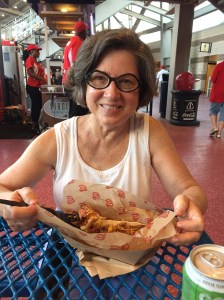
A family celebration at Le Chat Noir’s Sunday Brunch before Claire heads to LA

Once again, the New Year puts me in a reflective and optimistic mood.

As in the past, I’m taking to More to Come… to reflect on the year just past, account for my resolutions, and look ahead to 2016.

2015 was the year that both our children graduated from college, my father turned 90-years-old, and Candice and I had blessings too numerous to count.

While our family has been blessed on many fronts, the same isn’t true for so many of our fellow citizens of the world.  The news we hear on a daily basis seems overwhelming in the nature and scope of the issues we face as a planet.  As an example, my recent reading (the subject of an upcoming post) has focused on our country’s seeming inability to come to grips with our terrible history of racial divide and hatred. But I could just as easily be reading on  income inequality, climate change, fake news, our increasingly broken political system, increases in poverty, or other similar challenges we face in this country and across the world.

Of course, if I really wanted to go negative, I could always take the Dave Barry approach.  And I haven’t even mentioned the elephant in the Republican primary…

On the other hand, there is much to be thankful for this year.  More Americans have health insurance – as of this writing nearly 90 percent – which is about as close to universal coverage as we have seen in a long while.  And thanks to a supreme court ruling in June – where “Ideology came face to face with reality, and reality prevailed” – they can keep that coverage.  We have had years of slow but solid job growth after facing down the Great Recession.  As I wrote at the end of June, now both my children can marry the person they want, no matter where they live in America, thanks to the supreme court ruling on marriage equality.  And it seems – although it occurs in fits and starts – that we are beginning to have the conversation on race that we should have been having for the past four centuries.

But I try to focus on more personal and family items in this year-end review, so I’ll step aside from all those major issues and look in the mirror.  In my 2013 year-end post, I outlined seven rules for the next third of my life. For two years now I’ve looked at them on my computer wallpaper as I’ve logged on in the morning. Colleagues have seen them and made comments. The family has been supportive. So…how did I do this year?  Let’s reflect:

1.  Exercise six days a week for the rest of your life. 2015 has seen improvement on this front. Since early October I’ve exercised essentially every day of the week.  Just as importantly, I’ve been getting more sleep on a regular basis. I still have a way to go, but I’m feeling as if I have begun to settle into the pattern I hoped for when I set this rule.  Year-end report:  Last year I was 10 pounds heavier at year-end than at the beginning of the year.  As 2015 ends, I weigh ten pounds less than my heaviest weight of the year.  Progress!

2.  Listen more than you talk.  In feedback from the person who would know best, I’ve regressed some in this area. It is always a challenge when I find myself in a place of some authority (either at work or home) not to grab the bully pulpit.  Year-end report:  Check myself regularly to ensure that I’m truly listening before trying to put forward my perspective. 

3.  Spend less than you make.  Well, I didn’t buy any new guitars this year!  Seriously, this is an area where I do okay, but I feel the need – as my retirement years loom on the horizon – to adjust some of my expectations in order to live with much less regular income in the not-too-distant future.  Year-end report:  Okay, but I can improve…and would probably benefit from a longer-term plan.

4.  Quit eating crap!  Eat less of everything else.  Thanks to the support of Candice, Andrew, and Claire, I continue to make progress here.  I still eat the occasional serving of french fries at lunch, but I generally make the wise choice. I just had my year-end physical, and while I need to work to ensure that I maintain a normal blood sugar level, I had a pretty-good check-up, all things considered.  Year-end report:  Doing well, but should focus on learning more about the details of a healthy diet.

5.  Play music.  As seems to be the case recently, this rule comes and goes.  When we were in Staunton over Thanksgiving with our friends the Pearsons, Oakley brought together some friends and local musicians for a night of excellent music-making.  The next morning my fingers hurt, but it was a good kind of hurt.  I’ve now played a great deal over the holidays.  When this happens, the world just seems a better place.  Year-end report:  I just need to remember that I can never play too much music.

6.  Connect and commit.  We made real progress in gathering people together this year on a regular basis – be it in our Foyers group at St. Albans, brunch with friends, or meals around our dining room table to get to know couples in a deeper way.  Just as with rule #3, this is important to think about in the years to come.  Year-end report:  Keep up the good work…and do more good work.

7.  Don’t be a Grumpy Old Man.  Enjoy life! I think I had some issues here in 2015.  Turning 60 had a more profound effect on me that I liked to admit. Things started aching that had never ached before (and not just from the ambulance encounter).  Like every baby boomer, I think I’m about 7-10 years younger than my actual age.  My issues with rule #2 seem to come into play here.  When I hear comments about 1975, my first reaction is always “Well, that’s not so far in the past,” before I quickly do the math and realize that it was 40 years ago.  I have a pretty wonderful life, all things considered, and I want to enjoy it.  Year-end report:  Slipped on this one, but ready to shake it off.

2016 holds a great deal of promise, as I’ll have my first sabbatical in a 38-year career. Candice and I are looking forward to six weeks away (with two more later in the year) without a focus on the day-to-day of work and home. Andrew is now singing professionally every weekend, and is thinking through his next steps in terms of work and education.  Claire feels that her year of service through the Episcopal Service Corps was a great choice to help her determine her next steps.

I’ll end this with the same paragraph I used last year:

…feel free to call me when I come up short.  Also, feel free to take one or more of these goals for your own and modify them as you wish. I’ll keep you posted…but let’s hope you start seeing more pictures of a smiling, slimmer DJB playing more music! Better yet, let’s hope you are with me, enjoying the food, music, wine, and company.

Happy New Year!

More to come…

DJB

Favorite roots music albums of 2015

Muscle Shoals Recordings
The SteelDrivers: Muscle Shoals Recordings

I’m not going to pretend that this is a “best of” list for roots music in 2015.  With so many things thrown on my plate this year, I  haven’t had the time to sample as widely as I would like.  (Come to think of it, the last time I felt comfortable enough to publish a “best of list” was 2013!) But I’m very comfortable with a favorites list that just says, “Hey, I like these and I hope you will too.”

So with that caveat, let’s see what’s made the cut.

The Steeldrivers:  The Muscle Shoals Recordings – I’ve loved this Nashville-based bluegrass band for years, even as they have moved through personnel changes that included their lead singer and main songwriter.  (More on that later.)  The Muscle Shoals Recordings is really the first album where Gary Nichols stepped out on his own as the lead voice for The Steeldrivers – no longer in Chris Stapelton’s shadow.

Singer-songwriter Peter Cooper describes it this way:

Right there, at two minutes and ten seconds into the first song, “Long Way Down.” The part where Gary Nichols sings, “Girl, we both know where your soul is bound.” Only he bleeds it as much as he sings it. He sounds murderous, maniacal. Her soul is bound for nothing skyward, for nothing heavenly. And he’s fine with that.

Richard Bailey’s banjo plays funky, little Kentucky-goes-to-Memphis rolls. Tammy Rogers’ fiddle soars. Brent Truitt’s mandolin chops time, and Mike Fleming’s bass pounds the downbeat. And all that is righteous and right-on. Elevated, even. But Nichols—he lets loose something the opposite of righteousness. It’s a howl, full of hurt and anger and life. Starts on the highest E note that 99.9% of male singers can hit, then ascends into a sweet falsetto, and then opens up like the gates of Hell, into a reeling screech.

‘That made me dizzy for a second,’ Nichols says, remembering the moment he sang the line. ‘Really, I almost passed out. There are certain lines in SteelDrivers songs that require a little bit of Wilson Pickett.’”

As you can see, The Steeldrivers aren’t your normal bluegrass band.  While the instruments are bluegrass staples — played by some of Nashville’s best players — there is no “high lonesome” sound here.

Besides “Long Way Down,” there are other fine offerings on The Muscle Shoals Recordings.  “Drinkin’ Alone” fits in the catalog of great Steeldriver drinking songs.  “Here She Goes” is a heartfelt song about divorce.  “California Chainsaw” allows the band to show off their considerable instrumental chops.

This is a fine project, through and through.  Give it a listen.

Watkins Family Hour
Watkins Family Hour

Watkins Family HourSean and Sarah Watkins are well-known as the brother and sister founding members of Nickel Creek with mandolin phenom Chris Thile.  They are less well-known for their monthly show in Los Angles where they invite friends to join them in a wide-ranging exploration of American music. A friend who has seen that show calls it magical.

For those of us who can’t get to LA on a regular basis, the Watkins have given us the next best thing, with the release of 2015’s Watkins Family Hour. 

All the songs on the album are covers, and the incredible musicians play them at the high level you’d expect.  But that description really doesn’t do this project justice.  Everyone showcases their talent in ways both expected and surprising.

In the latter category, check out Sara Watkins’ vocal on Hop High.  You won’t hear anything like that vocal range on a Nickel Creek album. The range of musical styles includes country (“Where I Ought to Be”), folk (“Early Morning Rain”), New Orleans-style blues (“Prescription for the Blues”) and more.  Recommended.

Sara Watkins
Sara Watkins at Red Wing Roots Festival 2015

Happy Prisoner
Happy Prisoner: The Bluegrass Sessions by Robert Earl Keen

Happy Prisoner:  The Bluegrass Sessions by Robert Earl Keen.  If this was a “best of” list for 2015, I probably wouldn’t include this set of 15 bluegrass standards by Texas singer-songwriter Robert Earl Keen.  But there’s enough on this valentine to the music that fits Keen’s free-wheeling style and sensibilities to ensure that it can easily make a “favorites” list.

The album begins with one of my favorite Flatt and Scruggs tunes, the silly “Hot Corn, Cold Corn.”  The duets with Lyle Lovett and Natalie Maines – especially “Wayfaring Stranger” – are terrific.  In addition to his regular band, Keen brings in banjo-picker extraordinaire Danny Barnes and fiddler Sara Watkins to fill out the sound.  When Keen sings “99 Years for One Dark Day,” his boozy voice is a perfect fit for the tune.

This is a heartfelt romp through some of the greats of the bluegrass repertoire, and I always get a lift when one of the tunes comes up on the playlist.  What more can you hope for in a favorites list.

Robert Earl Keen, July 10, 2015
Robert Earl Keen performs at Red Wing III

Bela Fleck and Abigail Washburn

Bela Fleck and Abigail Washburn – I realize that this album was released in the fall of 2014, but I didn’t buy it until earlier this year…and it is my blog so I can list any thing I want!

This is a wonderful album from two musicians who have taken the banjo down wildly divergent paths.  Fleck, known for his incredibly complex jazz-influenced improvisational flights, connects on so many levels with his wife and musical partner Washburn, who is best known for her beautiful, simple playing and singing that draws from folk and world music traditions.

The reworking of the traditional “Railroad” (as in, “I’ve been working on…”) opens the project on a high note which continues all the way through to “Bye Bye Baby Blues.”  There are so many gems here, that I could just go down the set list.  “What’cha Gonna Do,” “Pretty Polly,” “And Am I Born to Die,” and “Banjo Banjo” are personal favorites.

Bela Fleck
Bela Fleck, performing at Merlefest, 2012

There are so many good online videos of Bela and Abigail playing together that it was hard to choose just one.  (I especially hated to drop the version of “Banjo Pickin’ Girl” they did to support public transportation in Nashville.) But their “Shotgun Blues” demonstrates the percussive and melodic tones that come from these two banjo masters.  Enjoy!

Pokey LaFarge - Something in the Water
Pokey LaFarge – Something in the Water

Pokey LaFarge – Something in the Water – For something completely different, I encourage you to give Pokey LaFarge a listen.  This is his Rounder Records debut, although he’s been touring and recording for a decade.  LaFarge is a witty and gifted songwriter, and his live shows are infectious.

This 2015 project expands on his previous work and includes not only his regular combo, but members of various groups including NRBQ, the Fat Babies, the Modern Sounds, and the Western Elstons.  But as he notes on his website, the sound remains “Midwestern.”

The Midwest is at the heart of this record,” LaFarge asserts.  “The people playing on these songs are from Wisconsin and Illinois and Chicago and St. Louis, and there’s a certain attitude that comes across in the songs and the way that they’re performed.  I’m born and raised in the Midwest, and my family’s been here for generations.  This is where I’m from and how I think, and that’s reflected in the music I make. 

The title track gets the joint jumping, about his girl “who does her makeup and hair, to cook fried chicken in her underwear.”  “Wanna Be Your Man” has a New Orleans ragtime feel, while “Underground” has a distinctive Pokey perspective on the end of the world.  The whole thing wraps up with the infectious “Knockin’ the Dust Off The Rust Belt Tonight.”

Pokey LaFarge at Red Wing 07 11 14
Pokey LaFarge at Red Wing II

Makes me want to drive to St. Louis for his New Year’s Eve Show!

And now…a bonus selection!

Chris Stapleton - Traveller
Chris Stapleton – Traveller

Chris Stapleton –  Traveller – I’m not sure how an album that was named Country Music Album of the Year counts as roots music these days…but when that record is from one of the best pure country voices to come along in years singing incredible music, it just does.  Trust me.

Stapleton was the founding lead singer and primary songwriter for The SteelDrivers from 2008-2010, adding a new take on bluegrass that has helped reinvigorate the genre.  He also spent the past few years writing hits for country stars all over Nashville.  Finally, he went into historic Studio A (God, am I glad we were able to help the community save that place!) and recorded his “debut” album.  Which promptly won him awards as Best Male Vocalist and New Artist of the Year, in addition to the CMA Album of the Year award.

Every song on here is terrific.  If you want a sample, go to You Tube, type in Stapleton’s name, and spend the evening listening to him sing.  To my mind, the album’s best song is “Fire Away.”  Just listen to that voice and guitar.  Oh my…

I hope you found something new to explore and enjoy.  Here’s to a musical 2016.

More to come…

DJB

Observations from the road: (The family, friends, community edition)

This is a tale of family gathering to grieve in the best way possible – by telling stories.  It is a tale of being part of a community. It includes guitars.  (Always guitars.) And it includes a haircut in a mini-United Nations.

Hang with me.  I’ll try to be brief.

The Wednesday before Thanksgiving, I received a call early in the morning from my sister Debbie.  She called to tell me that our brother-in-law Raouf – husband of my younger sister Carol – had passed away suddenly as a result of a heart attack.  Their two boys had come home from college the day before and the family had shared a meal together on Tuesday night.   By mid-day Wednesday, their lives had changed forever.

My older brother Steve and I spoke.  We were not able to get to the funeral, but quickly agreed to find a mutual time to travel to Tennessee to see Carol and the rest of the family. Our father – he of the recent 90th birthday – had just moved into an independent living facility.  We wanted to see him as well.

Which led to this weekend.  I flew into Nashville on Friday, and then – after some work on Music Row – I picked up Steve at the airport.  (The Music Row visit included the first guitar connection…but I’ll get to that later.)

I had written my father to tell him we were coming, and I said, “Let’s bust you out of that place and go to City Cafe” – the local meat and three place on East Main Street where they know “Mr. Tom.”  While the food at his new home is very good, he misses the freedom to go to his local haunts whenever he wishes.

Daddy, Carol, and DJB
My father and sister Carol, in my Dad’s new apartment

This is where the first community part kicks in.  All of my brothers and sisters (except for Debbie, who was practicing Christmas choral music) converged on City Cafe with my dad in tow. The staff was happy to see us.  (Our waitress went and got a Christmas card for him.) We saw the pianist from Daddy’s church and her husband.  Others stopped by to say hello. We scarfed down our fried catfish (I know, I was only there for one set of meals!) and began to tell family stories.

After stopping by Dad’s house and then dropping him off at his new digs, we headed home – for a nap! But all my brothers and sisters and the spouses in town came over to Debbie’s house for a family meeting (blessedly short) and a meal (a much longer and enjoyable experience).

Joe's Taylor T5
Joe with his new Taylor T5

Joe had brought along his new Taylor T5 electric-acoustic guitar for the evening…my second chance over the weekend to play a bit.  While I used the old flatpick on Joe’s guitar, on Friday afternoon I had the chance to fingerpick on a beautiful 1920s Martin O-style.  It is a great day when you can play While Roving On a Winter’s Night in a room in the Studio A building that has housed Nashville’s music royalty.  I have a wonderful job!

But I digress. Saturday night was all about sharing stories, laughing, and filling in gaps in our memories.  We had an extended riff on Cedar Lake Camp – where Steve, Joe, and I spent portions of our summers.  All three of us were members of the “Polar Bear Club” (where you went for a dip in the mountain lake at 6 a.m.). My other memory of camp?  Well, you had to know the books of the Bible to get into the mess hall.  As I told the family, you certainly didn’t want to get stuck in line around the minor prophets!  (Does Zechariah come before or after Zephaniah?)  I always tried to get there early for the Pentateuch, as I could always remember Genesis, Exodus, Leviticus, Numbers, and Deuteronomy!  We laughed…and agreed to keep some tales to ourselves.  And then we captured it all in the photo at the top of the post.

Family and community are so important, and I was reminded of that again today.  After flying home, I walked up to Raphael’s for a haircut.  I’ve been going to this neighborhood barber shop for years.  But this time, the owner – Tamara Kalandadze – wanted to know if I had “seen the news?”  Huh?  Then she handed me a John Kelly’s Washington column from Thanksgiving Day’s Washington Post.  With Tamara’s picture staring out at me.

Tamara at Raphaels photo credit John Kelly of Washington Post
Tamara at Raphael’s Barber Shop in Silver Spring (photo credit:  John Kelly of the Washington Post)

I love it!  Now the entire city knows what a great place this is.  I’ve often said this is a mini-United Nations, and John Kelly used the exact same phrase.

The shop is in the Metropolitan Building in downtown Silver Spring. The building turned 50 this year. So did Raphael’s. It’s an original tenant.

Raphael’s has weathered the neighborhood’s ups and downs. It’s booming now. A sign in the window announces that Raphael’s is hiring. Tamara needs two more barbers to fill all seven chairs.

The staff is a mini-United Nations.

“There are five languages spoken here,” Tamara says before reeling them off: Farsi, Arabic, Georgian, Russian, Vietnamese.

Oh, and English, of course. That’s what the barbers — Ebrahim and Sonny (Iran), Jalal (Iraq), Anna (Vietnam), Tamara (Georgia) — speak to one another.

The TV is tuned to a news channel. A voice rises above the snip of scissors and the blare of hair dryers: An announcer is saying, “You can see him dragging bodies behind a truck in Syria . . .”

I ask Tamara if the staff gets along. Even the guys from Iran and Iraq?

“People get along,” Tamara says. “It’s politicians who don’t get along.”

That’s a classic Tamara line.  And it is so true.

Instead of blocking immigration, let’s put together more neighborhood barber shops with wonderful people from all parts of the world. Let’s worry less about where those minor prophets fall in line.  And let’s get together and tell more stories. That’s how community works.

More to come…

DJB

Image: DJB (at left) with his brothers and sisters: Debbie, Steve, Carol, and Joe

A Republic, If You Can Keep It

The QuartetWhen asked, following the Constitutional Convention, what kind of government had been created, Benjamin Franklin made a now famous reply.  “A republic, if you can keep it.”

Those words have been on my mind a great deal in recent weeks.  I wonder why?

Could it be the calls from those who want us to seal the borders, shut off all immigration into the U.S., and deport 11 million individuals?  Could it be presidential candidates saying – when a decision is made that recognizes that we are a secular nation and not based on religious law – that we have “criminalized Christianity?” Could it be the calls to register Muslims and to reopen the internment camps of WWII?  When I hear these speeches, I’m reminded of the late great Molly Ivins’ quip about Patrick Buchanan’s famously combative “culture wars” speech at the 1992 Republican National Convention:  It probably sounded better in the original German.

But that’s not why I sat down to write.

I’ve read three books over the past couple of months that all bring a different perspective to my thinking about the future of our republic and our political system of governance.  They are very different works, and all three have flaws.  But in the end all were worth reading.

I began a couple of months ago with the most recently published of the three:  The Quartet: Orchestrating the Second American Revolution, 1783-1789 by historian Joseph J. Ellis.  Winner of the Pulitzer Prize, Ellis writes in a beautiful and highly readable style. There is much to learn from the interactions of George Washington, James Madison, Alexander Hamilton, and John Jay leading up to and during the Constitutional Convention. This is also the type of “famous man” history that misses so much going on around it.  Those flaws are called out in the New York Times review in the link above and in other commentary found on-line.

From my perspective, there are two passages which capture what is good and useful about this work.  Ellis’ observation that the most important part of the Constitution is the framework to support discussion – and ultimately – lawmaking, is among the most powerful insights to come from the historian’s work.

In the long run – and this was probably Madison’s most creative insight – the multiple ambiguities embedded in the Constitution made it an inherently “living” document.  For it was designed not to offer clear answers on the sovereignty question (or, for that matter, to the scope of executive or judicial authority) but instead to provide a political arena in which arguments about these contested issues could continue in a deliberative fashion.  The Constitution was intended less to resolve arguments than to make argument itself the solution.  For judicial devotees of “originalism” or “original intent,” this should be a disarming insight, since it made the Constitution the foundation for an ever-shifting political dialogue that, like history itself, was an argument without end.  Madison’s “original intention” was to make all “original intentions” infinitely negotiable in the future.

Writing near the end of the book, Ellis returns to this theme:

It has endured not because it embodies timeless truths that the founders fathomed as tongues of fire danced over their head, but because it manages to combine the two time-bound truths of its own time: namely, that any legitimate government must rest on a popular foundation, and that popular majorities cannot be trusted to act responsibly, a paradox that has aged remarkable well.

American NationsOne theory as to why we – as a country – are so good at arguments around immigration, civil rights and civil liberties, the role of religion in government, and so much more is put forward by Colin Woodard in American Nations: A History of the Eleven Rival Regional Cultures of North America. In this 2011 work, Woodard – an author and journalist – explores how different sections of North American were settled by different cultures that exist to this day.  I read this work immediately after The Quartet, and if Ellis is focused on the famous man theory of history, Woodard delves into the cultural cores of eleven different regions of the country, which he labels nations.

Woodard outlines his thesis of our fractured country and explains why “American values” vary sharply from one region to another

…how an idea like “freedom” as understood by an East Texan or Idahoan can be the polar opposite of what it means to a New Englander or San Franciscan.  

There isn’t and never has been one America…but rather several Americas. The original North American colonies were settled by people from distinct regions of the British Islands, and from France, the Netherlands,and Spain, each with unique religious, political, and ethnographic characteristics. Some championed individualism, others utopian social reform. Some believed themselves guided by divine purpose, others freedom of conscience and inquiry. Some embraced an Anglo-Saxon Protestant identity, others ethnic and religious pluralism. Some valued equality and democratic participation, others deference to a traditional aristocratic order. All of them continue to uphold their respective ideals today, with results that can be seen on the composition of the U.S. Congress or the county-by-county election maps of most any competitive presidential election of the past two centuries.

This is a very interesting thesis, and Woodard makes a compelling case. Having grown up in the South, I have seen much of the cultural distinctions he calls out for that nation.  However, I have also seen major shifts in how parts of those regions behave politically over time – sometimes for the good, sometimes not. Woodard tends to gloss over movements of people between the regions and the impact that has on those areas.  In the end, he never makes his case in a way that takes me from “yes, this is plausible” to convinced that these regional differences outweigh other factors that have shaped who we are as the United States.

David McCullough has talked about the way we are a nation founded on ideals and not on a common ethnicity, language, or culture.  One particularly in-depth reviewer of American Nations put it this way:

Say whatever you want about how the United States operates in practice, the idea of the United States is a beautiful thing.  The idea of the United States is that anybody – anybody – can be an American.  We don’t care about your skin color, your religion, your accent, your beliefs, or where you’re from.  To be an American, all you have to do is agree to abide by our laws and our Constitution, agree to respect the principles of representative democracy, and recognize those special “carve outs” for individual rights that may not be trampled on by the majority:  freedom of speech, freedom of worship, freedom of consciousness, equality before the law, etc.

The idea of America functions almost as a national, secular religion (if that isn’t too blatant a contradiction in terms), and I’ve long believed that it provides the necessary glue, the commonality that we all need, to hold us together as a people.  As much as I complain and cavil about my country and the things done in its name, like everyone else I know I’ve never stopped being proud of the ideas for which it stands.  And the unifying nature of those ideals, to which we all consciously pledge our allegiance, vastly outweighs the more instinctive cultural differences found in the United States.

The question we are facing today is whether the strains of nativism, aristocratic rule, the Know-Nothing movement, and domestic terrorism as primarily seen through our treatment of African-Americans  – which have always run through our politics and history – are, in our new world of instant communications and the highly partisan 24/7 news cycle, threatening to take us places we’ve always stopped short of visiting in our past.

Healing the Heart of DemocracyWhich leads me to the third book in this exploration of our political life today: Parker J. Palmer’s Healing the Heart of Democracy. I read a review of this 2011 book early in the year, and decided to add it to my list of works on politics and our future as a country.

This is a very personal book, and I won’t attempt to delve into Palmer’s personal journey.  It is important to note that he writes this from a “season of heartbreak” – both personal and political.  From the prelude:

The politics of our time is the “politics of the brokenhearted” – an expression that will not be found in the analytical vocabulary of political science or in the strategic rhetoric of political organizing.  Instead, it is an expression from the language of human wholeness. . . .  If we cannot talk about politics in the language of the heart – if we cannot be publicly heartbroken, for example, that the wealthiest nation on earth is unable to summon the political will to end childhood hunger at home – how can we create a politics worthy of the human spirit, one that has a chance to serve the common good?

The prelude is as good a place as any to capture the essence of Palmer’s book.

It is well known and widely bemoaned that we have neglected our physical infrastructure – the roads, water supplies, and power grids on which our daily lives depend.  Even more dangerous is our neglect of democracy’s infrastructure, and yet it is barely noticed and rarely discussed.  The heart’s dynamics and the ways in which they are shaped lack the drama and the “visuals” to make the evening news, and restoring them is slow and daunting work.  Now is the time to notice, and now is the time for the restoration to begin.

For those of us who want to see democracy survive and thrive – and we are legion – the heart is where everything begins:  that grounded place in each of us where we can overcome fear, rediscover that we are members of one another, and embrace the conflicts that threaten democracy as openings to new life for us and for our nation.

Ellis and Palmer have written hopeful books about our future as a nation, while my reading of Woodard is that he feels we face irreconcilable differences that could lead to dissolution. I am not as hopeful at the moment as Palmer, but historian that I am, I know we have faced difficult challenges as a people in our past. Our nation was not forged from a natural unity, but found a unity in spite of differences.  We fought one declared Civil War to begin to address the enslavement of African-Americans (which – as Bryan Stevenson has eloquently put it – then simply evolved into other forms of slavery).  We fought an undeclared Civil War to take over western lands from our native peoples. We went through a Gilded Age of great income inequality and the suffering that resulted, and we appear determined to repeat the sins of that era today.  We have incarcerated immigrants and others who don’t fit our preconceived notion of an American.  We have allowed corporations to take over our government and wrest power away from the people.

But so many of our parents, and their parents, and their parents before them have also fought for our idea of America.  I have to believe that the spirit to fight for that idea remains and – like Ellis – I believe that if we see our Constitution as the framework for having those arguments – instead of a piece of literal scripture with the answer for every issue – we can continue to thrive.

And finally, we need to focus in this work on e pluribus unum as opposed to the official U.S. motto that corporate America gave us when they invented Christian America in the era of the 1930s to the 1950s to push back against New Deal reforms:  In God We Trust.  But that’s another post.

More to come…

DJB

Sunday Brunch

Our year in photos – 2015

As we enter this season of Thanksgiving, I continue my tradition of posting family photographs from the past year on More to Come… This was certainly a year in which we had much for which to be thankful – and to celebrate

2015 was – to put it mildly – a year of transition in so many ways.

The year began with Andrew and Claire halfway through their senior year in college.  I was busy with work at the National Trust for Historic Preservation, while Candice was keeping everything together from headquarters.

In January, I was fortunate to be able to join colleagues in Nashville for work to help save the unique heritage of Music Row.  As I say on the website designed for capturing Music Row’s stories:

“Music Row is the very definition of a National Treasure. The sounds created here have echoed throughout the country for decades, earning it an unparalleled place in America’s cultural life.” 

Studio A Press Conference with Ben Folds - Photo Credit Rick Smith
(Photo Credit: Rick Smith)
Studio A Press Conference, photo credit Nathan Morgan, Nashville Business Journal
(Photo credit: Nathan Morgan – Nashville Business Journal)

In a wonderful kick-off to our work in Nashville, I joined musician Ben Folds at historic Studio A to announce our designation of Music Row as one of our National Treasure campaigns.  The next month I was with Secretary of the Interior Sally Jewell in Chicago at President Obama’s announcement of Pullman as the country’s newest National Monument.  I get to meet some very smart and talented people as part of my job!

Secretary Jewell with DJB
Secretary of the Interior Sally Jewell with DJB at the community celebration in Pullman

Candice and I were able to get away for family travel, and we especially enjoyed our final Pomona Parents Weekend in February in sunny Southern California.  It was bittersweet, in that we knew that we’d no longer have a great excuse to fly from the snow and cold of Washington to Claremont in February, so we could walk around in our shorts and polo shirts, grab a coffee and slider at Some Crust Bakery, and see Claire and all her talented friends at college.

Swimming Coach JP Gowdy with Claire
Swimming Coach Jean-Paul Gowdy with Claire following a Family Weekend practice

Then life threw us a bit of a curve.  Three hours before turning 60 years old, I was hit by an ambulance.  You read that right.  Needless to say, it made for a different type of celebration for my 60th, but the story – now that all is passed – gets better with each telling.

60th Birthday celebration
Celebrating my 60th birthday, along with my fractured shoulder and new sling

Andrew’s March was eventful…but in a better way.  Perhaps as a reward for enduring the New England winter of 2015, he traveled to Cuba with the Brown University Chorus over Spring Break.  Andrew loved the architecture, the music, the chance to use his Spanish extensively, and – most of all – the weather!

In Cuba
Andrew in Cuba
Andrew and Fred in Cuba
Andrew with Fred Jodry – director of the Brown University Chorus – wearing clothes in Cuba that would have led to immediate frostbite had they been in Providence at the time.

Candice also traveled in the spring, as the Hollywood Gang – friends from grade school in Hollywood, Florida – took in the sites around Atlanta.  This has become a much-anticipated weekend for Candice and her friends.

Hollywood Gang
Hollywood Gang in Atlanta

May was all graduations all the time.  We began on the west coast with Claire’s graduation from Pomona College.  It was a wonderful weekend, and of course I wrote about it and photographed it – all from the perspective of the proud father.  It was delightful to be together with the families of Claire’s wonderful classmates.

Graduation Lei
Andrew helps Claire with her graduation lei
Claire at Pomona
Our Pomona Class of 2015 Graduate
The Browns at Pomona
The Happy Family
Swim team cheers
The swim team cheers for the graduates
Sophomore and Senior Suitemates
Claire’s suitemates from her Sophomore and Senior Years – Susan (Sr), Ali (So/Sr), Jackie (So/Sr), and Kyra (So)
Parents celebrate
The parents celebrate graduation!
At Union on Yale
Celebrating the graduate at Union on Yale – Claire’s favorite Claremont restaurant

One week later, we all gathered in Providence to do it all again – this time in celebration of Andrew’s graduation from Brown University.  As an equal opportunity proud father, I covered it all from start to finish.  As I have told many people since then, the last half of May was among the happiest times of my life.  I was so proud of these two and all they have accomplished…and they’re just getting started!

Andrew and Claire
Andrew and Claire at the Big Dance
A D Phi Seniors
Andrew and his fellow seniors from the Alpha Delta Phi Society in the procession to Saturday’s Baccalaureate Service
Alex and Andrew
Alex Warstadt and Andrew, the two graduating singers from the Madrigals
Andrew waves from the procession
The happy graduate!
Andrew and Dietrich
Andrew with Professor Dietrich Neumann, Director of the Urban Studies Program at Brown University
Brown Celebration at the Salted Slate
Celebrating Andrew’s graduation at The Salted Slate, one of our favorite Providence restaurants

The celebrations continued in early July, as we flew to Tennessee to celebrate my father’s 90th birthday.  Brothers, sisters, in-laws, cousins, and all sorts of friends gathered to honor Tom Brown and his wonderful life.  My father is such a down-to-earth yet holy man.  It was wonderful to see the love that came pouring out for him from so many different people and places.

Celebrating Tom's 90th
Claire, Candice, Tom, DJB, and Andrew celebrating Tom’s 90th birthday
The DC and Chicago cousins
Claire and Andrew with their Chicago cousins Zoe and Kelsey
With Brittney
Andrew and Claire with cousin Brittney
Pool time
In the pool with the cousins
Candice with Joseph
Candice and Joseph rest by the pool
TB and his children
Tom Brown with his children (clockwise from upper left) Joe, Steve, Debbie, David, and Carol on July 5, 2015 – his 90th birthday
Tom Brown and Family
Tom Brown (yes, the one with the suspenders) with all his family members to celebrate his 90th birthday

In July, Candice and I were also able to get away for a weekend in the Shenandoah Valley for roots music and time with our friends Margaret and Oakley Pearson at the Red Wing Roots Music Festival.

At Red Wing III
Margaret, Candice, DJB, and Oakley at Red Wing III
Watkins, Jarosz, and O'Donovan
Sara Watkins, Sarah Jarosz, and Aoife O’Donovan at Red Wing Roots Music Festival on July 11, 2015

A work-related trip took David to Southeast Utah, and some of the country’s most evocative landscapes.

DJB in Cedar Mesa
Hiking in Southeast Utah

Claire took off for her new adventure in Los Angeles in early August (see the picture at the top of the post), and so we had Andrew to ourselves here in DC for the month.  We decided to go all-in on Restaurant Week, and what a treat that turned out to be.  We also squeezed in a dinner of the Ambulance Survivor’s Club with our good friends Nancy Williams, Steve Cambell, and Sarabeth Watson.

MXDC
Andrew gets ready to dig into the seabass at MXDC
At Fig and Olive
DJB, Candice, and Andrew wrap up DC Restaurant Week at Fig & Olive
Nancy and DJB
Nancy and DJB – the charter members of the Ambulance Survivor’s Club – toast our good health at Jackie’s Restaurant in Silver Spring

Work on the international front took Candice and me for a wonderful week in Cambridge at King’s College, followed by a family weekend in London.  It was a treat that we’ll long remember.

Candice in the rose gardens
Candice in the Rose Gardens at Anglesey Abbey
King's College Courtyard
King’s College Courtyard, Cambridge
FoodFilosophy
Candice at a small London cafe during a day spent rambling, exploring, and connecting

2015 was a tough season to be a Nats fan…so much so that Claire defected as soon as she hit the west coast this summer!  Nonetheless, bad baseball is better than no baseball, and I did pick up a couple of new bobbleheads – including the most recent addition to the racing presidents.  (I have a request for a Bill Taft in to my family as a stocking stuffer this Christmas!)  As you can see, Claire has adjusted well to her work on the west coast, but Candice and I went out in October to check on her anyway!

Claire at a Dodgers Game
Claire goes over to the dark side – at a Dodgers game with Caroline and Graycie
Jubliee Consortium
Claire with other interns from the Jubilee Consortium in LA
Claire in LA
Enjoying life in LA
Silent Cal
Calvin Coolidge joins the Racing Presidents in 2015
Claire, Candice, DJB at the Getty Villa
With Claire at the Getty Villa

In early November, Candice and her friends from the Weavings group traveled to Binghamton, New York, to celebrate the installation of one of their members – Elizabeth Ewing – as the new rector of Christ Episcopal Church.  It was a joyous celebration!

Ewing Installation
The Weavings Group celebrates the installation of Elizabeth Ewing as rector of Christ Church, Binghamton

As we enter the holiday season, we have so many blessings to be thankful for.  From all of us – Candice, Andrew, Claire, and DJB – we wish all our family and friends a wonderful Thanksgiving and a blessed Advent.

Pastishe
A celebration at Pastishe in Providence fit for a year of celebrations and transitions

More to come…

DJB

Image: A family celebration at Le Chat Noir’s Sunday Brunch before Claire heads to LA