A reminder from The First Baptist Church, Providence, RI
We are hearing a great deal these days about religious freedom. Much of it comes from individuals who appear – from their comments – to know little of our country’s history. For the past three days, I’ve been immersed in a state where all Americans would be well advised to come for a class on Religious Freedom 101.
One of the truly misunderstood stories in American history is that of Rhode Island and the establishment of religious freedom. My father – that lonely breed of Southern Christian liberal – has spent the past decade or more writing letters to the editor that remind his fellow church-goers of the importance of the separation of church and state. For my part, I’ve been in Providence and Newport this week, and took the time to visit two of the landmarks of the nation’s move to ensure that all had religious freedom, including the right not to worship.
Friday, I was in Newport for a series of meetings that began at Touro Synagogue, a National Historic Landmark and an affiliate site of the National Trust for Historic Preservation. Standing as a landmark to religious freedom for all Americans, Touro Synagogue, dedicated in 1763, is the oldest synagogue building in the United States. As described on the National Trust website:
A structure of exquisite beauty and design, steeped in history and ideals, the synagogue is considered one of the ten most architecturally distinguished buildings of 18th century America and the most historically significant Jewish building in the United States.
The congregation was founded in 1658 by the descendants of Jewish families who had fled the Inquisitions in Spain and Portugal and who themselves left the Caribbean seeking the greater religious tolerance that Rhode Island offered.
Touro Synagogue, Newport, RI (Photo: National Trust for Historic Preservation)
By the time those families came to Rhode Island, the “lively experiment” that was Rhode Island was already underway. An exhibit in the Ambassador John L. Loeb, Jr. Visitor’s Center (and captured on the website) explains it best:
Rhode Island’s experience was a catalyst to the development of these values (that the acceptance of the separation of church and state was a uniquely American value). Under the terms of its founding Charter, Rhode Island stood alone among the colonies in its desire to “hold forth a lively experiment, that a most flourishing civil State may stand and best be maintained, with a full liberty of religious concernments.”
Roger Williams and his followers were convinced that religion was a matter of conscience between an individual and his God, not the government. The founding documents for Providence, Rhode Island indicate a clear division between the public, civil realm and the private world of belief:
We, whose names are here under, desirous to inhabit in the town of Providence, do promise to subject ourselves, in active or passive obedience, to all such orders or agreements as shall be made for public good of the body in an orderly way, by the major assent of the present inhabitants, masters of families, incorporated together into a town-fellowship, and such others whom they shall admit unto them, only in civil things.
“Only in civil things.” This phrase, assumed to be from the pen of Roger Williams himself, establishes the principal of religious liberty that was to become the First Amendment to the U.S. Constitution. In the Rhode Island Colony, only matters of civil interest were to be considered by the town-fellowship. Matters of theology, doctrine, and religious practice were to be considered apart from the realm of civic discourse and within the confines of the individual consciousness or “soul-thought.”
The Charter of the Rhode Island Colony, negotiated in 1663 by Newport founder John Clark on behalf of the Rhode Island colonists from King Charles II of England, clearly demonstrates that religious freedom was the prime reason for the colony’s existence. Rhode Island’s Charter, which served as state constitution until 1842, includes this unique provision:
No person within the said Colony, at any time hereafter, shall be any wise molested, punished, disquieted, or called in question, for any differences in opinion, in matters of religion, who does not actually disturb the peace of our said Colony ; but that all and every person and persons may, from time to time, and at all times hereafter, freely and fully have and enjoy his own and their judgments and consciences, in matters of religious concernments, throughout the tract of land heretofore mentioned, they behaving themselves peaceably and quietly and not using this liberty to licentiousness and profaneness, nor to the civil injury or outward disturbance of others.
Touro’s unique place in American history came about in 1790, when in response to a letter from the congregation, President George Washington eloquently defined the new nation’s standard for religious freedom and civil liberties. He declared that America would…“give to bigotry no sanction, to persecution no assistance.”
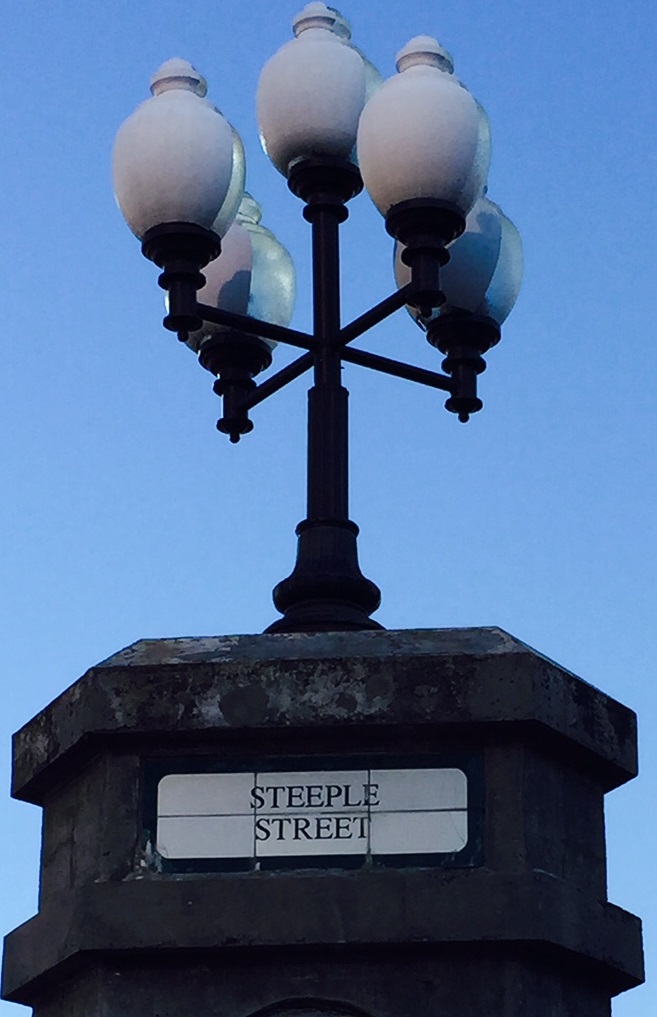
Providence – where I spent the rest of the trip – is a city that celebrates its religious history. Few communities carry off having a “Steeple Street” with the history that Providence does. (It is even obvious in the city’s name!)
Steeple Street, Providence
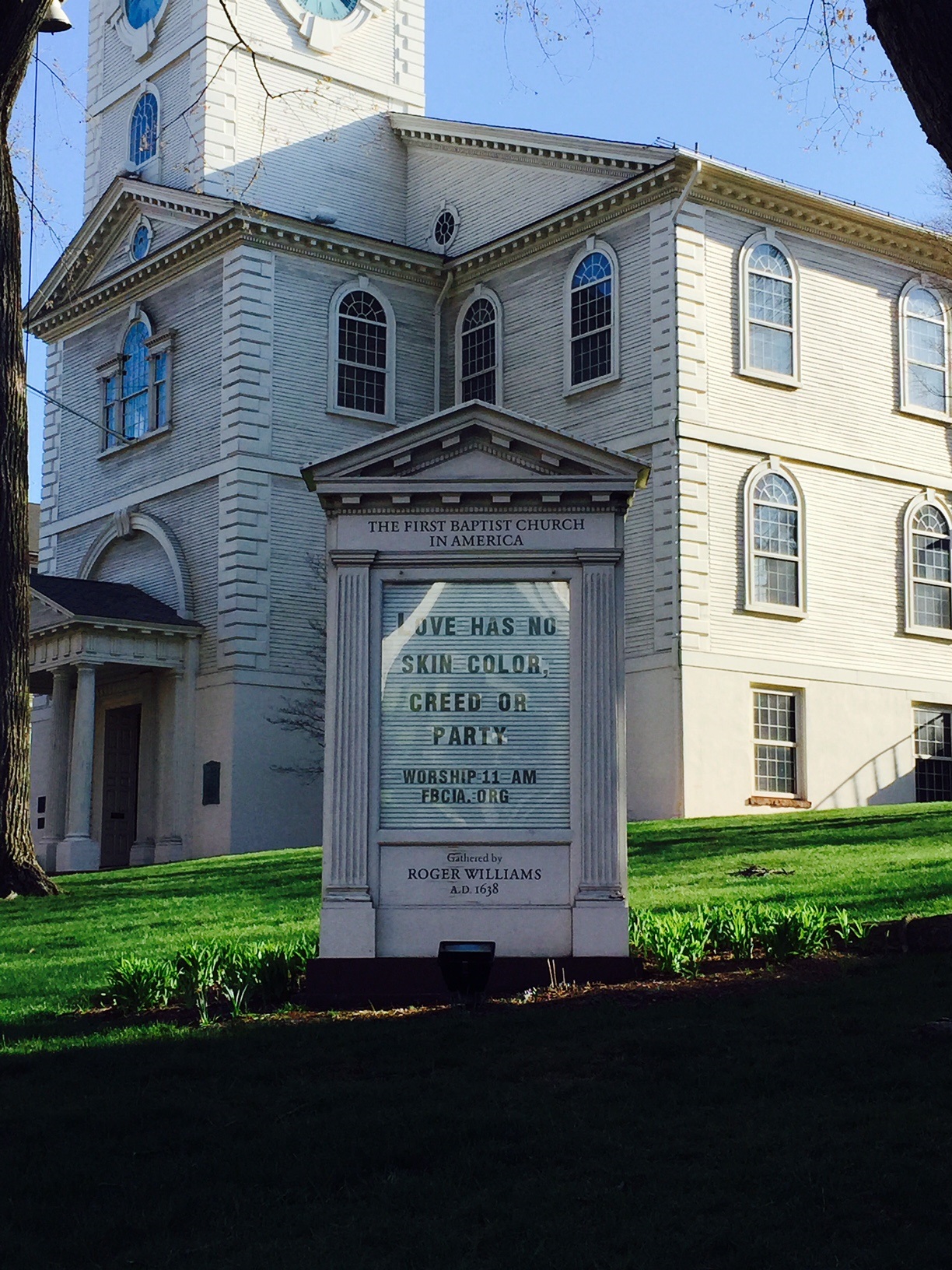
The most important of those houses of worship, from a historical standpoint, is The First Baptist Church, Providence.
The First Baptist Church, Providence, RI
Note that I didn’t write “the First Baptist Church in Providence.” No, this is THE FIRST Baptist Church IN AMERICA.
Historical Marker on The First Baptist Church, Providence,
Coupled with the Roger Williams National Memorial, managed by the National Park Service, The First Baptist Church tells an important story that is as fresh as today’s headlines. I’ve given a couple of speeches recently that focus on the relevance of historic places today. Here’s what I said in the most recent one:
When we change our focus (in preservation, from buildings) to people, we become serious about relevance. In many of the places we save, and in the way we approach their conservation, we often talk about the “period of significance.” But at the National Trust we are turning that on its head, and asking, “What if the period of significance is now?”
At President Lincoln’s Cottage, where Abraham Lincoln conceived the Emancipation Proclamation, understanding that “the period of significance is now” leads us to use of the site as the springboard for exhibits, lectures, and projects that address human trafficking in the 21st century. Slavery, unfortunately, didn’t end in 1865.
Old places can be eloquent in helping us think about how the lessons of the past inform us about today’s issues…whether those issues be human trafficking (Lincoln’s Cottage), immigration (The Lower East Side Tenement Museum), labor relations and income inequality (Pullman), or religious liberty (Touro Synagogue and The First Baptist Church).
Visit a historic site, and connect the past with today’s big issues.
First, there are lots of changing seasons. Playoffs are just starting in hockey and basketball. (Do you know that WWII wasn’t as long as the NBA playoffs?) Baseball is in its first week. Golf begins to come back onto the radar screen. And those folks who think football is the only game get all excited about…the draft. (Please. Get a life, people.)
This afternoon, I watched about all the golf I will take in on television over the course of the year – the last nine holes of the Masters. It takes me about an hour of CBS coverage of the Masters to remind myself why I think golf is so damn pretentious and full of itself. The hushed tones, the endless references to history, the endless paeans to Phil (I make millions of dollars, but I still complain about having to pay taxes) Mickelson. (The guy actually wears logos of a bank and an auditing firm. That should tell you something about this “game.”) Give me a break.
After the impressive win by Jordan Spieth at the Masters, I quickly switched over to ESPN’s Baseball Tonight. In spite of the 455th installment of Yankees vs. Red Sox on the world-wide leader in sports, it was quickly apparent why baseball vs. golf = no contest. You have real characters in baseball, even among the announcers. (Love Kruk’s sling…I feel like a kindred spirit. Kruk once said, “I’m not an athlete, I’m a baseball player.” Priceless.) Big Papi and kids – these guys are having fun. The Nats win their second of the year, with Zim flashing some leather, despite having a team batting average well below the Mendoza Line. The Royals are mad because despite being in the World Series last year, many folks have said they won’t make the playoffs. Plus, a fun report on a Red Sox bar in the heart of New York City. You don’t get this stuff in golf.
So bring it on. Even if we do have the Yankees and Red Sox again tonight, golf doesn’t stand a chance.
This week we lost the third member of the Aereoplane Band when “The Flatpickin’ Dobro Man” Tut Taylor passed away at age 91.
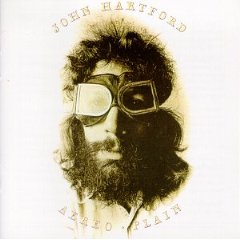
Taylor, along with the late Vassar Clements, Norman Blake, and Randy Scruggs made up the Aereoplane Band that helped the late John Hartford record his ground-breaking album Aereo-Plain – which I once highlighted as my favorite album of all time. (And yes, the name of the album is spelled differently from the title cut. Hey, it was the 70s.) I heard Tut play with Hartford’s band (Earl Scruggs opened for Hartford, if you can believe that) about 40 years ago, and I most recently heard him at MerleFest, where he was a mainstay.
Much has been written about Taylor’s unique style of playing the Dobro with a flatpick, as opposed to the finger picks used by every well-known Dobro player from Uncle Josh Graves to Jerry Douglas. Tut Taylor was unique, and his bluesy style fit well with the fiddling of Vassar Clements and the stellar guitar work of Norman Blake. This group has been rightly credited with starting the “newgrass” movement in Nashville, and has also been compared to a jazz quartet because of the interplay between the musicians. They were also the strangest looking group of musicians you were likely to see in the 1970s. Tut and Vassar looked like the country boys they were, while Hartford and Blake were wearing long hair before long hair was fashionable in Nashville.
Hartford’s hippie look on the seminal Aereo-Plain album that launched an acoustic music movement
Norman Blake, Vassar Clements, John Hartford, and Tut Taylor
As I wrote on my earlier post, for so many people who played acoustic music, Aereo-Plain gave them permission to try new things. Sam Bush has described it as a seminal recording for the newgrass movement. Hartford simply showed how to mix a hip, youthful sensitivity with a love for bluegrass music. Tut Taylor was an unlikely accomplice in that work.
Taylor did more than just play on two of country music’s most influential albums of the 20th century. He founded GTR Guitars, which is now known as Gruhn Guitars, and he also opened the Old Time Pickin’ Parlor on Second Avenue in Nashville, where I spent many a night in my college years.
But Tut will be most remembered for his help in changing the musical landscape. Take a listen to Vamp in the Middle from Aereo-Plain. At about the 30 second mark, Taylor starts adding in some delicious little fills that propel this tune forward. Great stuff.
Last weekend, as college basketball teams were playing to reach the Final Four, I found myself in a strange position: leading my office “friendly” pool after three of the four teams had been decided. I had Kentucky and Wisconsin. I even picked Michigan State to make it. I never win March Madness pools or similar challenges, I don’t play fantasy anything, and I don’t bet. (Andrew’s godfather – John Lane – says it best: “I have the same chance of winning the lottery whether I buy a ticket or not!)
But here I was, getting giddy at the prospect of leading our pool going into the final four games.
And then my head lost out to my heart.
I so wanted Gonzaga to get into the final weekend. I so did not want to see another Duke team in the Final Four – even if I thought they had the best chance to beat hated Kentucky. So I went with my heart…and got bumped from the top perch.
However, I was still close…until the first game of the semi-finals, when I still could have come out okay with a Michigan State win. The Spartans, however, were thoroughly thrashed by Duke. Another “heart” beaten by “head” game. But the heart had one more chance.
And the heart WON! My main desire of this March Madness tournament was to see Kentucky lose. I hate the one-and-done culture. And don’t get me started about John (“I didn’t know anything about those violations”) Calipari. I had picked Wisconsin to make the final, and with a glorious and fierce last 7 minutes, the Badgers pulled it out in a classic.
So, I have one more chance, although our current office pool leader (who happens to do all my finance work) also has Wisconsin to win it all, so I don’t have a chance to come out on top. That’s okay. If I won, I might be tempted to actually throw some money into a pool the next time around, and you know, I have the same chance of winning…
In any event, good-bye basketball. (I don’t watch the NBA. Any sport that allows a team to take a time-out and advance the ball to the front court has decided that rules don’t matter. That would be like allowing a football team to move the ball past the 50-yard line whenever they wanted to in the last two minutes of the game.)
Hello baseball!!
Opening day is tomorrow. Nats vs. Mets at Nationals Park. Max Scherzer on the mound. (Unfortunately, I will be on the road traveling, but I’ll try to catch a bit of the game.)
And to whet your appetite, check out this cool article in today’s New York Times about how long it will take to break various records in baseball. The numbers suggest the single-season home run record could be broken again in as little as 49 years. Batting average? We’ll all have to wait 250+ years for that to happen!
All in all a great read about some wonderful baseball history.
(Photo Credit: The Adventures of Sarah and Derrick)
There are few advantages to having a cracked bone in your shoulder…but there is at least one: I can be a total couch potato during the weekend of the college basketball tournament championships.
Yes, I know that college basketball has lost its soul. Yes, I despise the one-and-done culture that Kentucky has mastered so well, and for that I “hate” John Calapari almost as much as I hate Christian Laettner. (I don’t really hate either one, but you have to admit it is a great film title to kick off this season’s 30 for 30 on ESPN.)
But given all of that, I still enjoy the game. Especially this weekend and next weekend, before the elite big boys take over. On these two weekends, you can see teams that no one expects to go anywhere, suddenly get hot and destroy the best laid plans of the big boys. You can see Albany hit its only three-pointer of the game to beat Stony Brook for a one-point win, in today’s first game. My alma mater, Middle Tennessee, will play University Alabama-Birmingham later today. No college elites there.
And even elite teams can be underdogs on this weekend. UNC’s win over Virginia last evening – like Notre Dame’s over Duke – were both exciting games where the “underdog” won.
There are all sorts of key questions to be decided over this weekend. Can Harvard beat Yale in a game that never should have happened, except that Yale blew its chance to get in the Big Dance last weekend? Which part of the Atlantic coastline does Notre Dame’s home state of Indiana touch? Since when is Xavier and Cincinnati, Ohio located in the east? What will be Dick Vitale’s biggest outrage at the end of Selection Sunday? How many times will Clark Kellogg call someone “The Big Fella?” Will we spend more time debating the number one seedings than we do as a country in debating to go to war? (Okay, maybe that last one isn’t really fun.)
Next up, the SEC. Only question here is can any team in the conference get within 20 points of Kentucky by the end of the game. (Answer: N0.) I’ll probably drop Kentucky vs. Auburn to switch over and watch a bit of the MEAC Championship between Hampton and Delaware State. I’d also check out the Atlantic 10 championship between VCU and Davidson…if I had a television package that carried it. And since Purdue is now giving Wisconsin a run for its money, I’ll pay attention to the Big Ten semifinal. (Motto for the 14-team conference: “Don’t confuse us with institutions of higher learning that teach math.”) I’ll go in and out of a number of games all the way through the UNC vs. Notre Dame ACC final that no one saw coming.
So bring it on…and maybe after five tonight I’ll have a little libation to go along with my wayward ways.
Oh, and by the way. John Feinstein has the best idea of how to get rid of the one-and-done: use the baseball model.
The baseball rule: Any player graduating from high school is eligible for the draft. Once he finds out where he’s drafted and what kind of money he can make to turn pro, he then decides whether to turn pro or go to college. None of this blind guessing. One of the reasons so many underclassmen put their names into the basketball draft each year is because they have agents telling them, “Don’t listen to your coach, don’t listen to any committee, I know general managers and you’ll go in the lottery. Or in the first round.”
Are they often lying? Of course they are. They can’t make any money off players who are still in college.
Remember, everyone selected in the first round of the NBA draft is guaranteed a contract. Second round and free agency? Nothing. So, if a player is drafted in the first round and the money’s guaranteed, he will probably want to sign. If not, he might want to go to college.
In baseball, if you go that route, you can’t go back in the draft for three years. That means you have to make some effort to go to class and to make academic progress. It means if you leave school after three years there’s a reasonable chance you might come back and graduate. It means that your coach isn’t recruiting your replacement before you play a single game. It means you don’t have to face the ‘are you going or not going?’ questions until your junior year. It means you might actually get to experience college. And it takes the predatory agents out of the process for two years.
Pretty simple. For the sake of the college game, let’s do it.
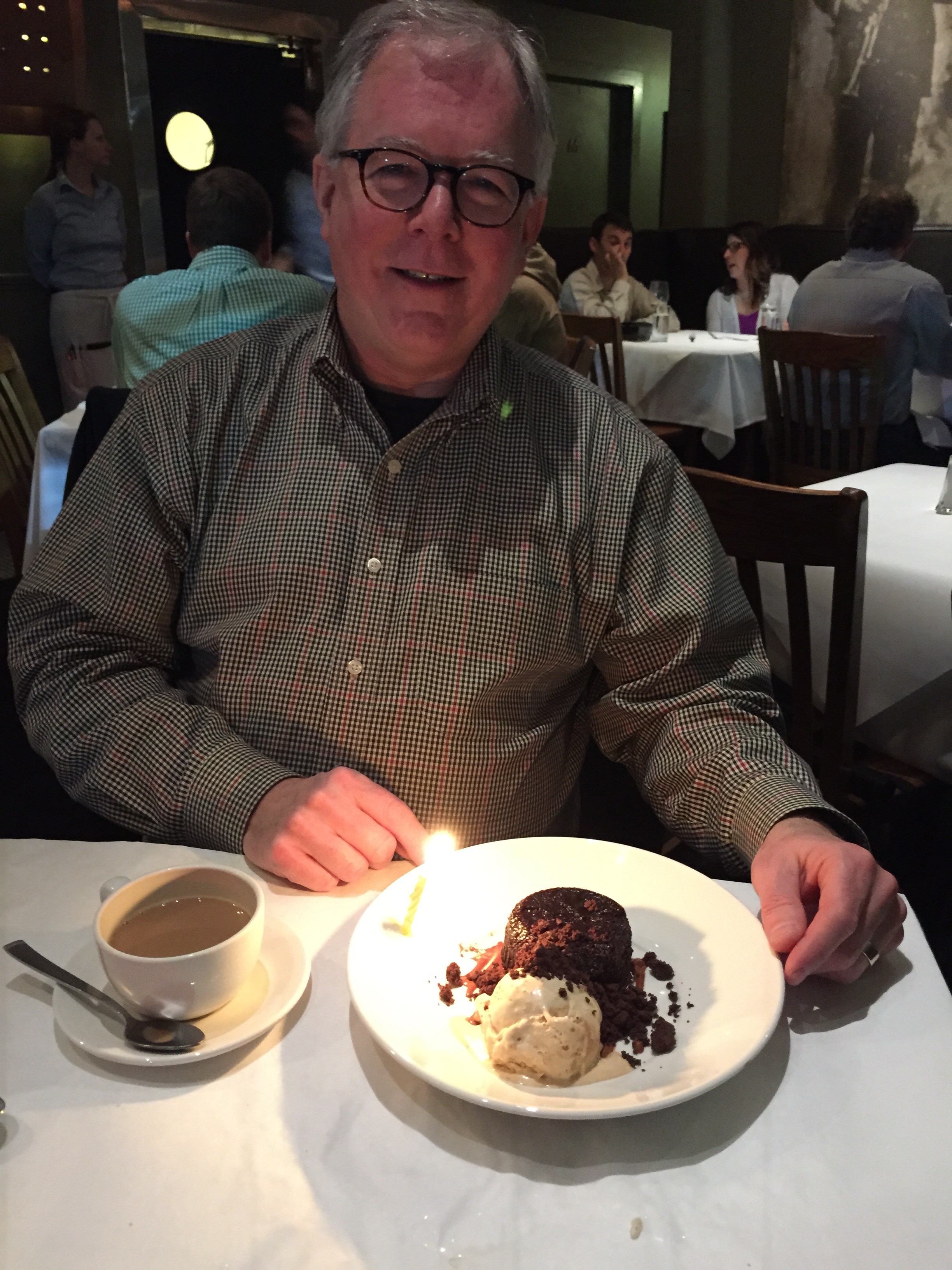
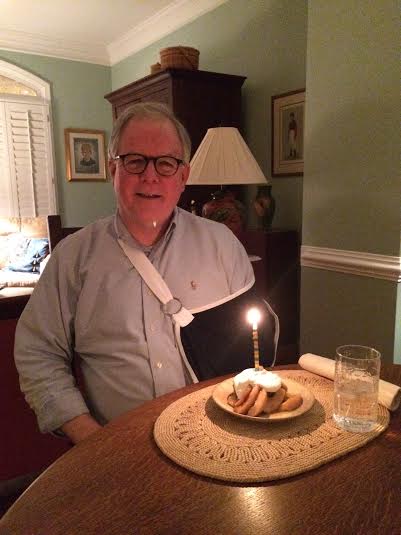
An early 60th birthday celebration at Herbsaint in New Orleans.
Earlier this week, two colleagues and I were “stranded” in New Orleans because of multiple flight cancellations back to DC. Monday evening they surprised me by taking me out for an early birthday dinner at a wonderful restaurant called Herbsaint – which just happens to be where the husband of the former executive assistant who made a cameo in my 60 Lessons From 60 Years (Lesson #18) now works.
One of those colleagues just sent the following message:
I was struck by the juxtaposition of the two images…of David’s celebrations. I think the takeaway is that you should always go ahead and have the deep fried lamb neck, dirty rice with sausage, fantastic pinot, and decadent dessert when you have the opportunity. You never know what comes next!
Celebrating my 60th birthday, along with my fractured shoulder and new sling
My blog is not one of those that has thousands of followers and elicits nasty comments…or many comments at all. 100 views is an excellent day. Most of my readers are family and friends, and the comments I do receive tend to come to me on email or on Candice’s Facebook page (since I went off Facebook more than two years ago).
So I was overwhelmed by the response to my last post, 60 Lessons From 60 Years. As of March 5th (a snowy day with offices and schools closed), I only had three “official” comments on the blog. But I have received well over 100 via those other channels and more than 500 views. I wanted to ensure the comments did not get lost in cyberspace and – more importantly – I wanted to share some of them with you.
But first, to understand the context, it helps to know a bit of the back-story:
Some people will do anything to avoid going to work on their birthday. My excuse? I was hit by an ambulance while helping a friend who had fallen on the ice. Yep, you read that right.
We made the local news. (A colleagues’ husband had seen it on one of those small screens they now have in cabs, so she wrote, “You’re famous in cabs!”) A friend (Nancy) who was staying with us went out to dinner with a client, and she slipped and fell on the road behind our house when she returned. An angel of a neighbor found her and called us. We went out to help Nancy, and as she couldn’t get up we called 911. I was kneeling behind her as she sat where she had fallen, to keep her upright and to keep her alert. The ambulance arrived and couldn’t stop on the ice as it headed towards us. We couldn’t get out-of-the-way. I was hit first – my left shoulder against the front of the ambulance – and was tossed into a snow bank. Then the ambulance struck Nancy and pushed her down our hill. I could quickly tell I was okay except for shoulder pain but Nancy was obviously in a worse condition. They took her to the trauma unit at a local hospital and I was taken to ER at nearby Holy Cross.
To cut to the chase, I now have a fractured Humerus in my left shoulder. Nancy has some broken bones. According to our doctors at the moment, neither of us will require surgery. I have to keep my left arm immobile in a sling, which you see at the top of the post. Candice and I are so relieved that Nancy’s prognosis is positive at this point. Mutual friends were so good to Nancy, allowing Candice to focus on my injuries, but Candice did get to visit Nancy in the hospital on Wednesday before Thursday’s snow storm hit.
As a result, many of the comments are from friends and colleagues who found out about our little adventure. And don’t worry about all the typing required for this long post. I am becoming a master of the cut and paste.
I wanted others to see the thoughtfulness, love, and wisdom that came through in responses from friends. I thought you, dear readers, would like to see which lessons resonated. Feel free to add further comments in the “Leave a comment” section below.
We’ll begin with a colleague who consults for us:
Three new things I just added to the hopefully more than 50 I’ve amassed in my 50 years: 1. You really are your dad, you lucky devil. 2. I am not one of those few who understand baseball, but I’d best attend more and try harder for something that merits this much praise from you. 3. I like and admire you even more than I thought. Which was a lot.
Thank you for sharing. Happy Birthday!
The picture of my grandparents – that was tied to Lesson #23 to “Make yourself useful, as well as ornamental” – was a big favorite. Here’s a sampling of those comments:
I came over to get another gander at the ears to see if they align with what was in the picture but all I can say is here’s to hoping I can one day read your reflections when you hit 90! Happy birthday!
Hope you’re having a Happy Birthday, ambulances aside! This was fun to read through—thanks for sharing. Gosh, you’re grandparents wedding photograph is wonderful—they are such a gorgeous and handsome couple! 29 cracked me up, and 45 is the bomb, as some say. And many more, including still having your dad with you. I hope I get as lucky.
Love them all, but especially #29, 35, and the photo of your grandparents.
The pastor who led the church where I was raised wrote to say:
In many ways you are your Father’s son.
Many commentators called out their favorite lessons:
Absolutely, completely beautiful. I’m fond of, and moved by, many of them. This morning’s favorite is #45.
Happy Birthday, David. Your lessons have (mostly) all resonated with me – especially on first read Nos. 13 and 37.
Thank you for sharing your blog with us, that was a gift, even if it had to reach me via your not so great news. I hope you are comfy and warm in your hospital and plan to take it very easy these next days. I shared your blog with my husband, we both greatly enjoyed it and live by many of your numbers -14 and 15 and more. We appreciate advice. A friend of my husband who is in the special forces in the UK, (my husband is a former British army officer at Sandhurst) told him once: you won’t succeed if you have to make all your own mistakes, you have to learn from other people’s mistakes. The same lesson can be applied about many things in life. Thank you for your wonderful blog, and I guess I need to give baseball another chance. Take it easy and Happy Birthday.
Such a delightful read – and full of sage advice I needed to hear after a long day! Also so excited to see I made a cameo. 🙂 (Editor’s Note: See Rule #18.) So great seeing you this past weekend. Happy birthday, David!
Thanks for including me on this – what a great read! I think it’s funny you mention “becoming your father” – I sometimes fear that though I look just like my dad, in personality I’m becoming my mother! 54 and 55 both resonated with me too. I seem to find that life often has something better in store for me than I could have thought up myself. Hope you’re recuperating well. Everyone keeps stopping by and passing along their good thoughts!
Happy Birthday David! Hope the shoulder is better. I heard. Can’t wait to read this and best of all listen to some of this music. My eye did catch your mention of…. The Bitter Southerner. (Editor’s Note: See #28) It is my #1 self treat after a nice long run. Makes me smile to have something in common with you even if you are 60 YEARS OLD. To Your Day!
I’m so glad to hear you are ok and that your humor remains intact. I was glad to follow this link and read your 60 lessons. It was a great read. Re: #17 – I would say Amtrak is the very best place to think and write. Icing on the cake for me would be the train from NYC to Albany, Hudson River side. #40 made me cry. I especially like #59. In the time I’ve been here, you’ve always been the one to thank me for things or say good job. I’ve mentioned it to many people how important those gestures are, just how far they go….but never thanked you directly. Thank you for taking the time to do that. Hope you feel better soon. Happy birthday!
I also received some suggestions for new lessons to add to the list:
From the ripe old age of 61, I agree with most of your observations. I would also add, “Do something that challenges you every day. It won’t hurt.” I am working on a retirement plan that would allow me to be a “senior nomad,” although I’ll have to change it to something like “Still Crazy Nomad.” I think that’s what I want to be when I grow up, since being Janis Joplin seems out of the question. Sorry to hear about your run-in with an ambulance. A classic “life is what happens to you when you’re busy making other plans.” Have a happy birthday in spite of it.
Happy birthday. Enjoyed your 60 vignettes, and now on your birthday, you’ve learned another: bad things happen to good people – and good may come of that.
• Birthday prediction: I think there’s an Gibson Advanced Jumbo in tobacco sunburst in your future …
• Lesson #61: You can never have too many guitars …
• Don’t forget the 12-step program I’ve been advocating: Step 1: submit to a higher power (i.e., the Guitar Gods) …
P.S. Don’t even think about it … just reach for the credit card and everything will be just fine…
Carl’s next acquisition…a Gibson sunburst Jumbo
Then, of course, the ambulance accident generated a great deal of commentary.
You are rocking the sling my friend! Take it easy…
Can’t want to see what you come up with for 65.
So sorry David. One helluva way to ring in your birthday. I’m so over this snow and ice. I bet you are too.
Heard you’re the subject of the news story I read last night about an ambulance striking the folks it was coming to help. Glad to hear you’ll be OK, but such an unfortunate (and painful!) thing to happen. I hope you feel better soon – and that you get to spend your recovery time watching spring training games from less-icy places!
I understand that you’ve injured your arm in the cause of helping a friend. I am sorry for your troubles and wish you a speedy, easy recovery. I will say, on the other hand, that your accident led me to read your blog post, “60 Lessons from 60 Years.” There’s a lot of love in your writing as well as good humor, wisdom, and links to fine music. Thanks for sharing the lessons you’ve learned.
Inconceivable! (one of the better lines from the Princess Bride) First of all, Happy Birthday!, but secondly stay inside, drink warm cocoa with a little schnapps for the pain and recover! Hope at least the drugs are good.
What a terrific milestone, David! I hope you have a wonderful, grateful, celebratory – and ambulance-free – birthday. (I hear cake can help …)
I am so sorry to hear about your accident and the injuries you and your guest sustained. Hope that you both heal soon and get back to 100%. I can’t imagine how shocked and helpless you must have felt as that ambulance was bearing down on you. Amazing that, so soon afterwards, you are able to reflect on it with such calm. Again, glad that you are on the road to recovery. Thank you too, for sharing your insights on life, love, and family on your blog.
I truly enjoyed your blog entry and savored the lessons therein. Had it not been for Rob visiting here yesterday…I would have written you with birthday greetings and a question about Glacier. However, Rob shared the news of Tuesday evening and the accident. Now this email has turned from Happy Birthday to Get Well Soon. One never knows what is around the corner. Some advice on the breaking of bones—Almost 4 years ago, I broke my leg. The things I learned—1) Listen to the doctor and stay ahead of the pain. Even if you don’t like medication, a healing bone is very painful; 2) Ice! 3)Let people do for you—at least at first; 4) Don’t write emails while taking the pain meds. You think you make sense between naps, but you don’t; 5) Take the time you need—easier said than done, but it will make a difference in the recovery and 6) Do the physical therapy and then some. It makes a tremendous difference! I hope that you and your houseguest will be on the mend shortly. Please know you will be in my thoughts and prayers. And may the year bring you much joy, preservation victories, baseball, music and family!
Finally, I received a long email from a friend, Ed. I met Ed and his wife Ruth on a National Trust tour of the Black Sea. They were representing Andover. We bonded over many things, but especially baseball. His son works for the Red Sox, and I have had the pleasure of visiting Ed and Ruth in their house outside Boston. We keep planning a trip to Nationals Stadium. They are both so very thoughtful, and I thought I’d end this post with excerpts from Ed’s reflections. Enjoy.
Just spent a fascinating evening with your 60 for 60, and Happy Birthday!
Delighted many times over…All 60 had something for me. Can’t think of them all now, but: Staunton [wasn’t Wilson born there?]. Old buildings which several generations have struggled to keep standing. Small towns. Your western travels. Your twins, beloved. [We have identicals as 6-year-old granddaughters in Lexington MA]. The Bitter Southerner’s reassuring message. Your thinking on church, on Southern Baptists, on the Christian Right, who get in their own way. And too much more to remember at the moment.
We differ on a few points, but I appreciate your perspective which would say, Vive la difference!
1. Belichick is far from perfect, but I’ve met him, as a fellow Andover alum. He loved Andover. He was charming, and he has a good side. A mutual friend heard from a guy that Bill once stopped along a highway to help this poor anonymous soul change his tire in a pouring rain. At the end, the guy said, hey, aren’t you . . . ? And Bill said, Please don’t say any more–to me or anyone else. You wouldda done the same thing for me. And he drove off. Kinda like Dean Smith. Maybe great coaches`figure out, sooner than the rest of us, not to be proud of doing the right thing, but just doing it.
The NFL is my guilty pleasure, and I feel like taking a shower after getting its evils splashed on me. But I must confess that it seemed right that Richard Sherman needed to learn more about Kipling’s point that victory and defeat are Two Great Imposters – and he did so with a grace that he had not shown me before. Ditto Pete Carroll, who had left USC just before his misdeeds there came crashing down on the folks he left behind. I was pleasantly surprised that Coach Carroll bravely took the blame for that play call. And Marshawn Lynch said he wasn’t surprised not to get the ball, because “football is a team game.” Not bad for a guy who hasn’t shown a lot of respect in other moments. As your 90-year-old Dad, and your beautiful Grandmother and daughter would doubtless agree, humans are complex and should not be written off.
2. Blue-grass, Blue Highways hymns, and mandolins, have not been to my taste. But I admire them more now, after seeing your appreciation for them.
The three best YouTubes of music I saw this year I will share with you, hoping to add to your eclectic appreciation.
A. So many surprises in this first one: As college kids in 1963-4, we skipped right over this song, to get to “Fun Fun Fun” or “Little Deuce Coop.” Brian Wilson, for a while a hopeless self-absorbed mess, wrote this relatively obscure tune–but not the equally beautiful lyrics–when he was barely 21. His cousin and Hawthorne, CA, neighbor–Mike Love–widely known as a jerk in most circumstances, this time created the words, that make the discerning tear up. And who knew that Mike Love of all people would admit his mistake, in trying to change Willie Nelson’s delivery?
But greatest of all, savor Brian Wilson’s facial expressions at about 4:49. It’s as if this astounding songwriter and harmonist is the RCA dog, listening to his master’s voice on the phonograph. HE tears up–not as a demi-god, but as a human being. All these guys, Willie included, are just regular people, creating some pretty good art, and shaking hands over it. If there is a God, She would smile here. Life can be beautiful, in the South, in the West.
(Editor’s note: Ed sent along a bonus Beach Boys video)
B. Tammy Wynette and some promoter named Billy Sherrill wrote this song in 15 minutes. We’ve all heard it, but few of us knew what real-life marital and bodily pain Wynette lived through–like Brian Wilson. Her voice haunts:
I’m gonna tell Ruth, and you can tell Candice, that even our selective hearing lets this song come through, loud and clear. [Wynette’s last recording session, before an early death, was singing Brian Wilson’s “In My Room,” which he wrote c. 1961 after yet another beating from his Dad. You can find a different YouTube showing Brian and Tammy together, recording, just weeks before she died. They moved each other, two screwed-up lives intersecting, like ships in the night.]
C. The U.S. Library of Congress selected this 1964 T.A.M.I. Show for preservation in the National Film Registry. The Rolling Stones later said that following James Brown at the end of this show was the biggest mistake they ever made in their careers–and yet they too performed memorably. [Didn’t get what they wanted, but maybe what they needed?] Check out this portion of James Brown’s 20-minute set:
Best to you, and now your remarkable family, Ed Q.
Candice came out when the Beach Boys tune was playing, as she was a big fan during high school. I had seen the James Brown clip before, and remain amazed. You gotta love friends who quote Kipling, Bill Belichick, Brian Wilson, Tammy Wynette, and the Godfather of Soul all in the same message. To each and every one of you who reached out with your love, concerns, thoughts, stories, and humor, my deepest and sincere thanks.
With much love and affection, and with More to Come…
DJB
Image: Celebrating my 60th birthday, along with my fractured shoulder and new sling
6. Good things can come from bad situations, if you’ll stop wallowing in your sorrow and seek out the good.
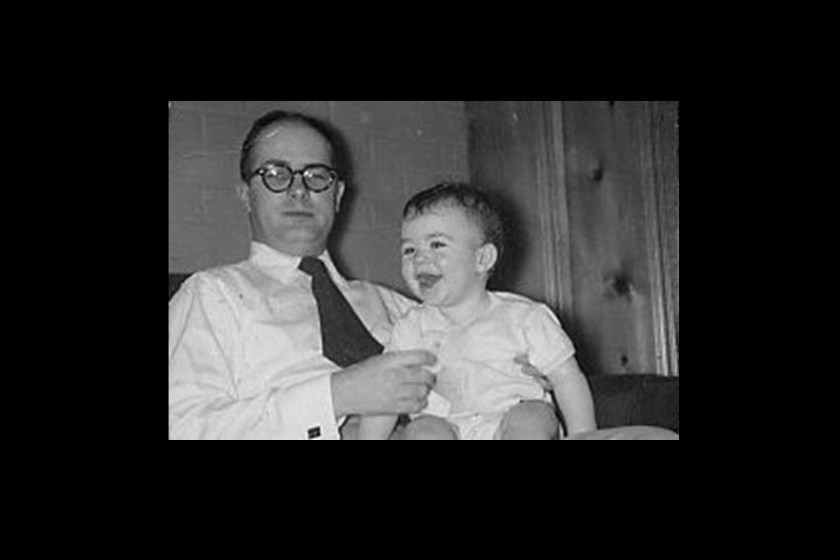
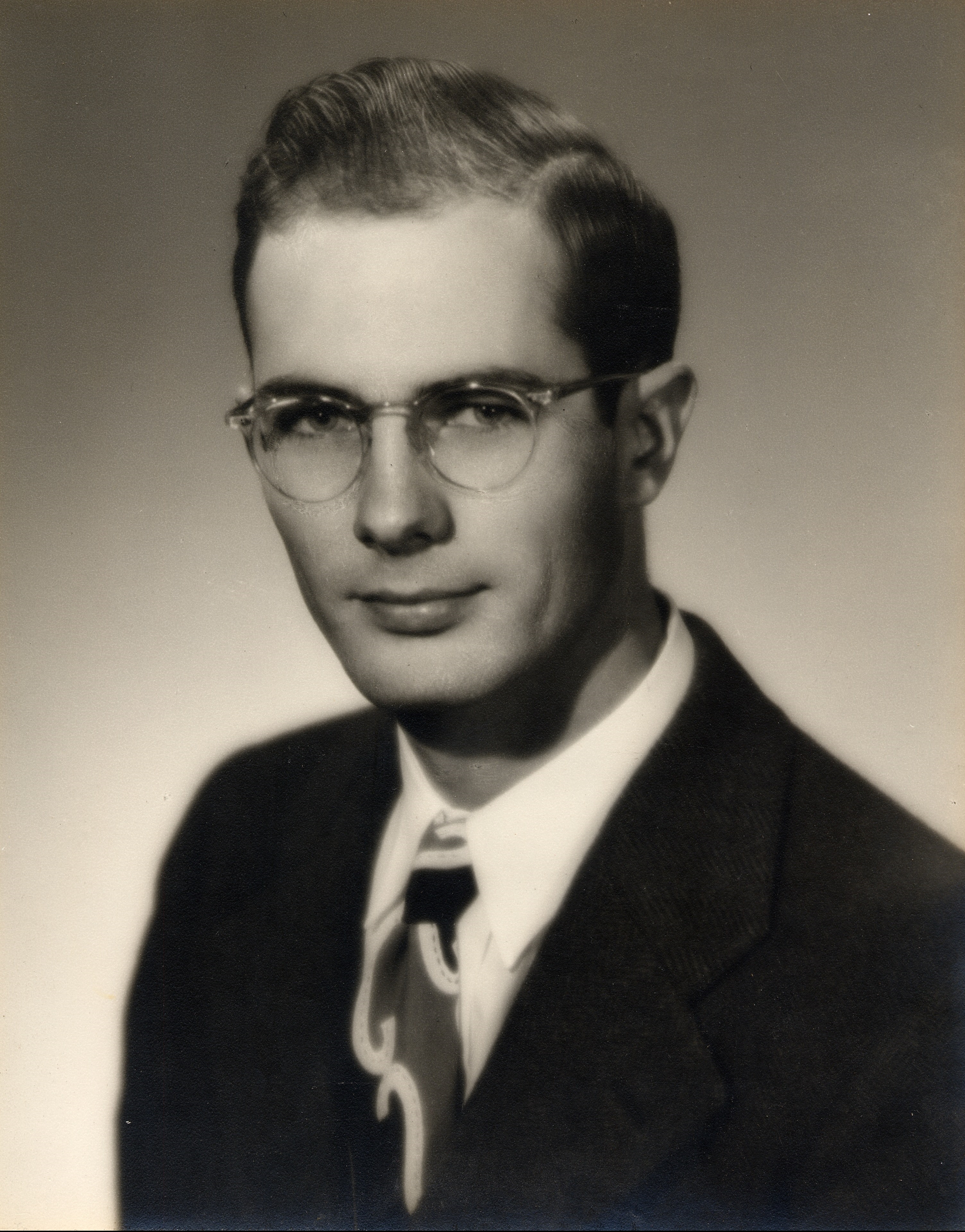
Tom Brown, 1948
7. I have become my father. I repeat many of the same stories. (Did you know that I paid more for my last car than for my first house?) I read funny articles from the newspaper out loud at the dining room table, sometimes to the consternation of my wife and children. I cackle when I laugh. I am a dyed-in-the-wool Southern liberal who believes that government can make our life better, and I have TVA to prove it. I have good-looking legs, even at age 60. I can’t see worth a damn without my glasses and – if you ask Candice – my hearing is suspect. I think Molly Ivins (God rest her soul) and Gail Collins tell more truth in one short newspaper column than any politician tells in a book-length campaign bio. I love to read. Body and Soul and the St. Louis Blues – the only two songs my father could play on the piano – are still among my top 10 favorite songs of all time. I wish I had more of my father’s faith and compassion, but I still have 30 years to work on that and catch up with him. I think it is pretty neat, at age 60, to have a father who turns 90 this year – especially when that father is Tom Brown.
8. I will cry at the movies, so I need to bring a handkerchief.
9. Neckties are a highly overrated – and in my case an increasingly irrelevant – piece of clothing.
10. All things considered, I’d rather live in a community full of old buildings.
Downtown Staunton, VA
11. The movie Selma was not – in my opinion – the “Best Picture” of the year in 2015, but it was the most important. Everyone (and especially Southerners) should see it. We forget too quickly how difficult it was to attain rights for all, and how much pressure there is, even today, to restrict or even take away those rights. We are nowhere near a post-racial society. I grew up in the South in the 1960s. I remember those images on the television. I saw how blacks were treated then. It was terrible. In some ways, it is still terrible. After seeing Selma, Southerners should also visit the High Church of Doing the Right Thing – otherwise known as the National Center for Civil and Human Rights in Atlanta. We can do better.
12. A colleague gave me this big, 1950s-style ashtray for my office with a quote attributed to Amelia Earhart that says, “The most effective way to do it, is to do it.” He thought it sounded like me, and I couldn’t agree more.
13. Stephen Carter, in his book Civility, captured much that is wrong in America today when he said, “The language of the marketplace, the language of wanting, of winning, of simply taking – the language of self – (has supplanted) the language of community, of sharing, of fairness, of riding politely alongside our fellow citizens.” The best description I’ve read of Libertarians – who epitomize the language of self – is that they’ve politicized the protests of children who scream through tears, “You’re not the boss of me.”
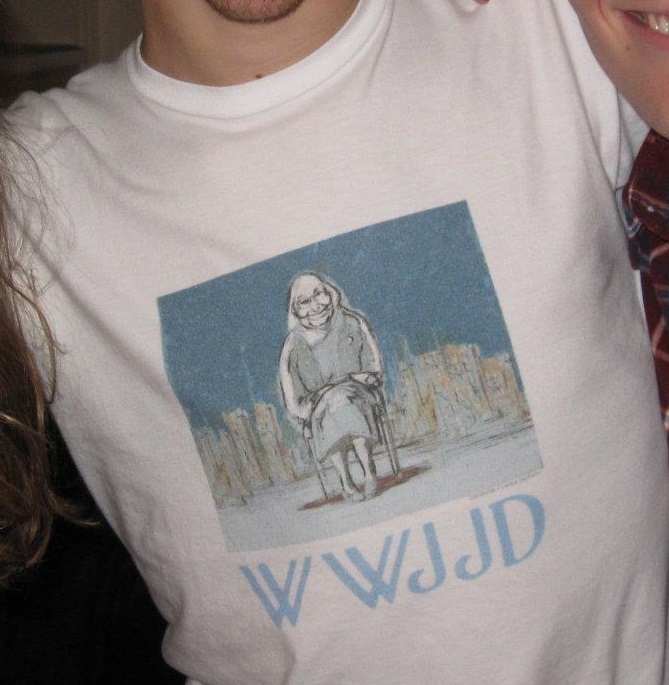
14. “Cities need old buildings so badly it is probably impossible for vigorous streets and districts to grow without them.” (Jane Jacobs) I love old buildings. I always have. We grew up in an early 20th century house on Main Street in Murfreesboro, and I loved visiting my Grandmother’s Victorian-era house on Second Avenue in Franklin. Candice and I renovated two old houses in Staunton, where we spent the first half of our married life. Old houses are especially nice for putting you in a physical and spiritual continuum – there were people in that house before you, and you realize you are just a steward of this place for the next generation. You can connect with the joys and hardships of those who came before, and you can prepare the house for those who come after. The best places I’ve been in life have a real connection to the past, and yet feel remarkably livable for the modern world.
Andrew’s WWJJD (What Would Jane Jacobs Do?) t-shirt
15. Education, experiences, and travel trump “things” hands down. When you have a limited amount of money to spend, go for the things that feed the soul and widen your perspective, not the things that will collect dust in your house or take up more space in your garage (or, God forbid, a storage bin).
16. “Baseball is like church; many attend but few understand.” (Wes Westrum)
17. Take the train whenever possible. It is civilized and, short of walking and riding a bike, it is the most environmentally friendly way to travel. I am writing this right now on a train home from New York City. In a few minutes I’ll wander back to the cafe car. I ride a train to work every day. Even with Amtrak working as a second-class citizen when it comes to transportation systems and the Washington Metro suffering breakdowns from lack of funding and maintenance, train travel still beats the alternatives. Unfortunately, American mass transit is dying. Imagine how well our transportation system could run if people demanded, and politicians funded, train travel.
18. Try to see yourself as others see you. In more than half of my career, I’ve worked with an executive assistant. The good ones – who are perceptive and honest – see you in a myriad of situations and understand you in ways that few people do. One of the best I had the privilege of working with wrote what I took to calling a “Users Guide to DJB” when she left. It was rather eye-opening to read.
19. When you buy something you plan to keep for a while (shoes, cars, a home), buy the best quality (not necessarily quantity) you can afford, without overextending your budget. This approach is why Candice and I tend to keep our (one) car for a decade or more, and why we raised two children in a house with about 1800 square feet. Oh, and you need much less “stuff” than you have.
20. Those who accept life and their own limitations are likely to find more in life.
21. The 9th inning of the 5th game of the 2012 NLDS never happened.
22. If YouTube had existed when I was young, I don’t know if I would be a better guitar player, but I know I would have saved myself a lot of trouble picking up the needle and putting it back (and back, and back) in the grove to try to learn that special lick.
23. “Make yourself useful, as well as ornamental” is good advice I learned from my Grandmother. (Mary Dixie Bearden Brown.) My Grandmother worked hard her entire life, but as you can see in the picture below, my Grandmother was very pretty as a young bride. Naturally, I inherited my big ears from the Brown side of the family.
Mary Dixie Bearden Brown and George Alma Brown – my Grandmother and Grandfather
24. Fear isn’t a solid foundation for any healthy relationship. So why is so much right-wing fundamentalism based on a fear of God’s wrath? In my experience, She cares for all her children, not just the ones who have drunk the Kool-Aid.
25. Speaking of fear, Kris Kristofferson hit the nail on the head about hatred of things we don’t understand in Jesus Was a Capricorn. Truer words than “Reckon we’d just nail him up if he came down again” were never spoken. Thanks to Darrell Scott for resurrecting this song (pun intended) on his wonderful Modern Hymns CD.
26. Don’t you just love it that 2015’s Super Bowl (#49) was hailed by many (I’m looking at you Sally Jenkins) as the “best Super Bowl ever.” What did it feature? One confirmed concussion, and one probable concussion that the Patriots covered up. (The Onion had a telling headline: “Super Bowl Confetti Made Entirely From Shredded Concussion Studies.”) A horrendous arm injury by one player. Oh, and a fight in the end zone on the next to last play. Yep, that about sums up the NFL these days.
27. I think Wondrous Love is just about the best hymn ever – in either version (traditional as heard below from Blue Highway, or reworked for the Episcopal hymnal). I hope my family remembers – when I’ve gone to my reward – that I want it sung at any service/celebration in my memory. And remember to sing the last verse (in the Episcopal hymnal) a cappella. “And when from death I’m free, I’ll sing on” sounds incredible when unaccompanied.
28. The intelligent mind is able to live with paradox. Such as the paradox of why I’m proud to be a Southerner. (Read this piece from The Bitter Southerner, as it sums up my views on the subject pretty well.) Yes, we have this awful racial history that continues to this day, which I wish our region could overcome. And yes, we have bourbon.
(Photo Credit: The Adventures of Sarah and Derrick)
29. Women who seek to be equal to men lack ambition.
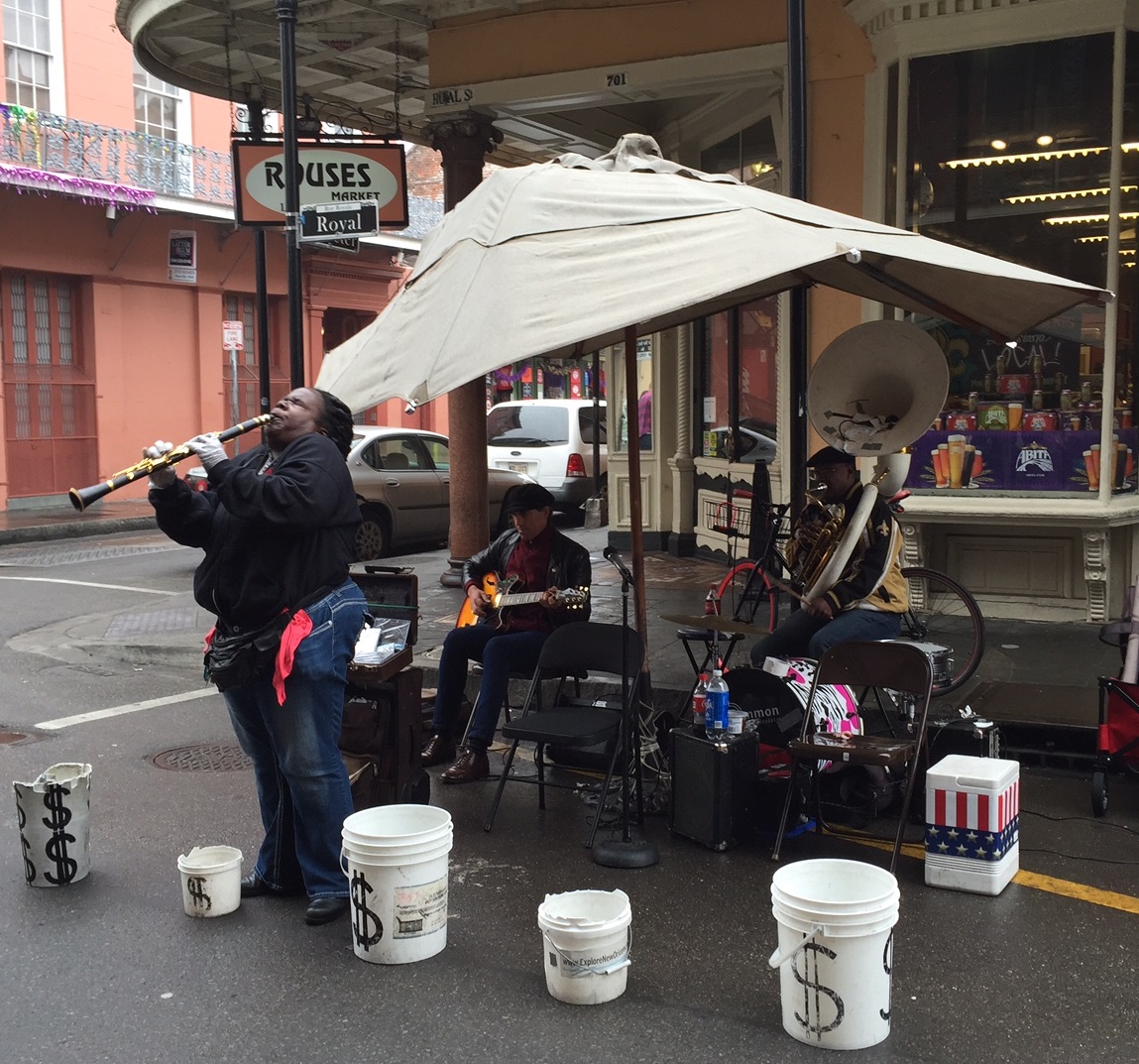
30. When you are paying the bill at a restaurant out of your own pocket, tip at the high-end of the scale – 20% – unless the service is awful and the server is rude. If the service is great, consider giving a bit more. This is especially true at breakfast. Many people don’t understand this idea, and it is generally because they have never waited tables. Waiting tables is very hard work, when done right. I did it for a year almost 40 years ago, and I still remember the long hours on my feet, the late nights, the times when you do a terrific job and the diners still stiff you. It never hurts to thank someone, and tipping a bit more than expected is a way of saying thanks. (The tip up to the norm is payment for service.) This lesson doesn’t apply in places like Copenhagen, where they pay service staff a living wage. But I think I’ll go to my grave in the U.S. with service staff just scraping by. Many waiters and waitresses are working two jobs (or more) just to cover basic costs of living. Tipping at the high-end of the scale is one way I can help them out. (And while it is a little different, I also recommend tipping street musicians – or buskers – when they are good.)
A New Orleans Jazz Trio
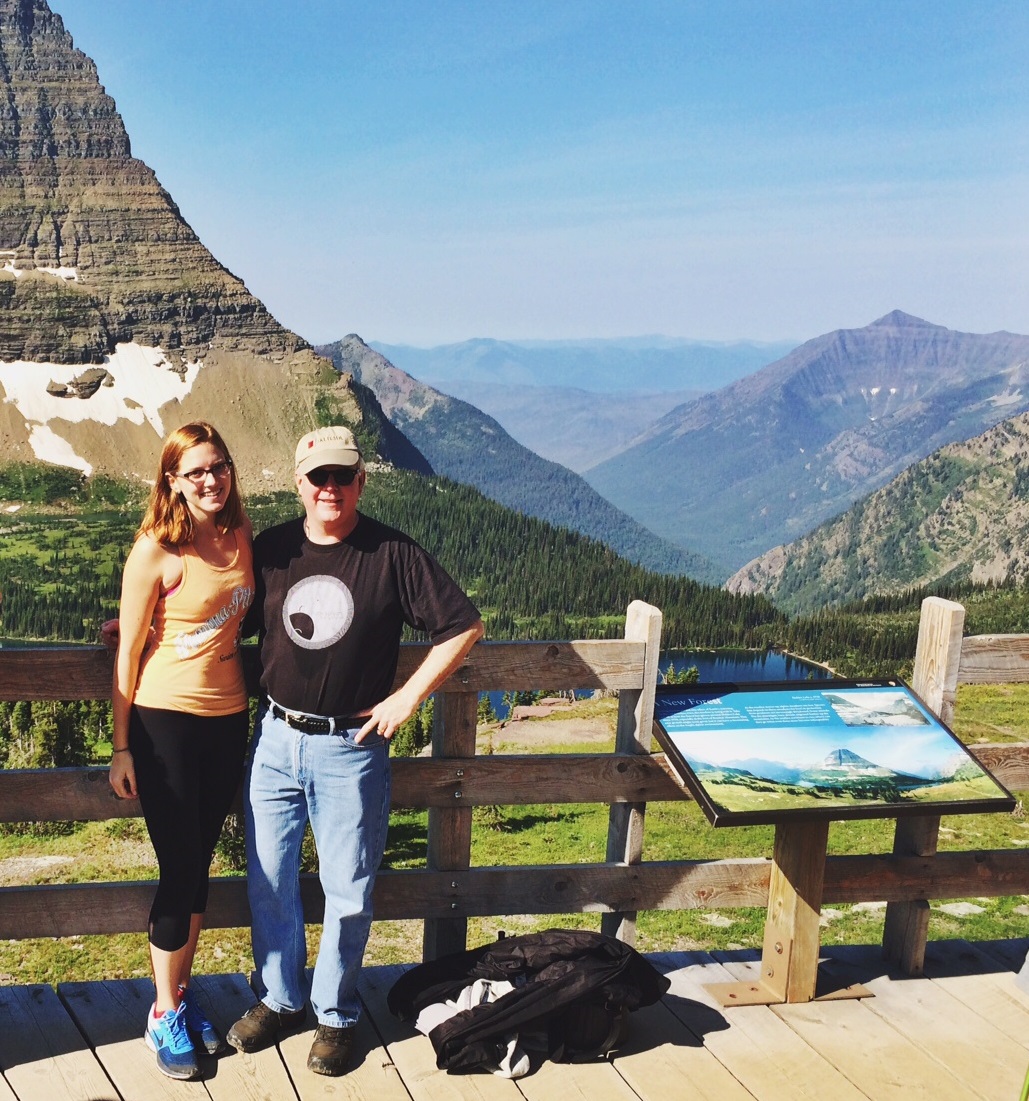
31. If you are going to share a car with someone for more than two weeks, it would be hard to beat Claire as a traveling companion.
Hiking in Glacier National Park with Claire as part of our two-week cross-country trip in 2014
32. “I believe that ignorance is the root of all evil. And that no one knows the truth.” (Molly Ivins)
33. Chris Thile is from another world. There is no other explanation.
Chris Thile with the Punch Brothers at Merlefest 2012
34. The Christian Right is neither.
35. I definitely “married up.” Candice is very intentional about our life together, as a couple and as a family. I would probably miss half (or more) of the wonders of our time together, but she has helped me see the little grace notes that make up our life. Almost thirty-three years later, I would do it all again.
With Candice, on our 32nd anniversary, in Copenhagen (March 2014)
36. Visiting all the Major League Baseball stadiums is a worthy bucket list goal for any red-blooded American. I’m proud to say I am more than halfway there.
37. Everyone should have the chance to be surrounded by – and learn from – passionate and talented people at least once in their lifetime. My entire work career has been one when I’ve been surrounded by such individuals. However, on the personal side, I was lucky in my “earlier life” to sing as part of the Shenandoah Valley musical group Canticum Novum. I’ve seldom heard such a pure soprano as Custer LaRue, who was one of our eight-to-twelve singers (depending on the gig). Among other highlights in her career, Custer was the “singing voice” of Reese Witherspoon in the movie Vanity Fair. (I should probably add that she sang a solo at Claire and Andrew’s baptismal service!) I count myself very fortunate to have had the opportunity to sing with Custer, and with Debbie, Lucy, Kay, Peter, John, and Dick, (plus others) under Carol Taylor’s direction.
38. We have an “almost unlimited ability to ignore our ignorance.” (Daniel Kahneman)
39. “Bad trades are part of baseball – now who can forget Frank Robinson for Milt Pappas, for God’s sake?” You should watch the movie Bull Durham twice a year – in February/March, to get your juices going, and in November, to put the season you’ve just lived through in perspective. Best. Baseball. Movie. Ever.
40. I still miss my mother every day.
41. Barbecue is a gift from the gods. One of the wonderful things about my job is that I get to travel to cities all across the U.S. When I can, I eat at great barbecue places, such as Arthur Bryant’s in Kansas City and The Rendezvous in Memphis.
42. My father (as he nears age 90) likes to say that growing old is not for wimps. I’m beginning to worry that I understand what he means.
43. Nineteen years out of twenty, the lowliest man on a World Series-winning baseball team can give better quotes than the Super Bowl-winning coach. Baseball players and managers speak with eloquence and intelligence (even if it is Yogi Berra-type eloquence). Football players and coaches either talk gibberish (“We used the cover 2 and flex”) or just grunt.
44. One thing I have not figured out in life is how I happened to have such wonderful, talented, and thoughtful children. It is a mystery. Andrew and Claire taught me so much before they turned 21, and I continue to learn life lessons from them. I feel blessed and humbled every day.
Andrew and Claire’s 21st Birthday
45. There are many things said in churches that I find hard to believe. What I do believe is that love is more important than doctrine.
46. World War II was shorter than the NBA playoffs.
47. I was fortunate to grow up in a town where I could walk or bike to school, church, the grocery store, and my job. It was a great way to live as a child. I have since lived in three towns that were compact, walkable (or had great transit), and human-scaled. My children can get around major cities all over the world because they learned to walk, bike or take the bus and train here in Washington. I feel we have given them a great perspective on how to live in community.
48. When someone needs help – a word, a card, a lift, a meal, a changed tire – try to be there for them. I’ve been on the giving and receiving end of each of these things, and I can tell you how much they mean to both the giver and the receiver.
49. “Cowardice is easy. Courage is hard.” (Ron Johnson, Missouri Highway Patrol, after his work in Ferguson)
50. “There is no substitute for excellence – not even success.” (Thomas Boswell)
51. There is no crying in baseball. Oh, and there should never be a pitch clock.
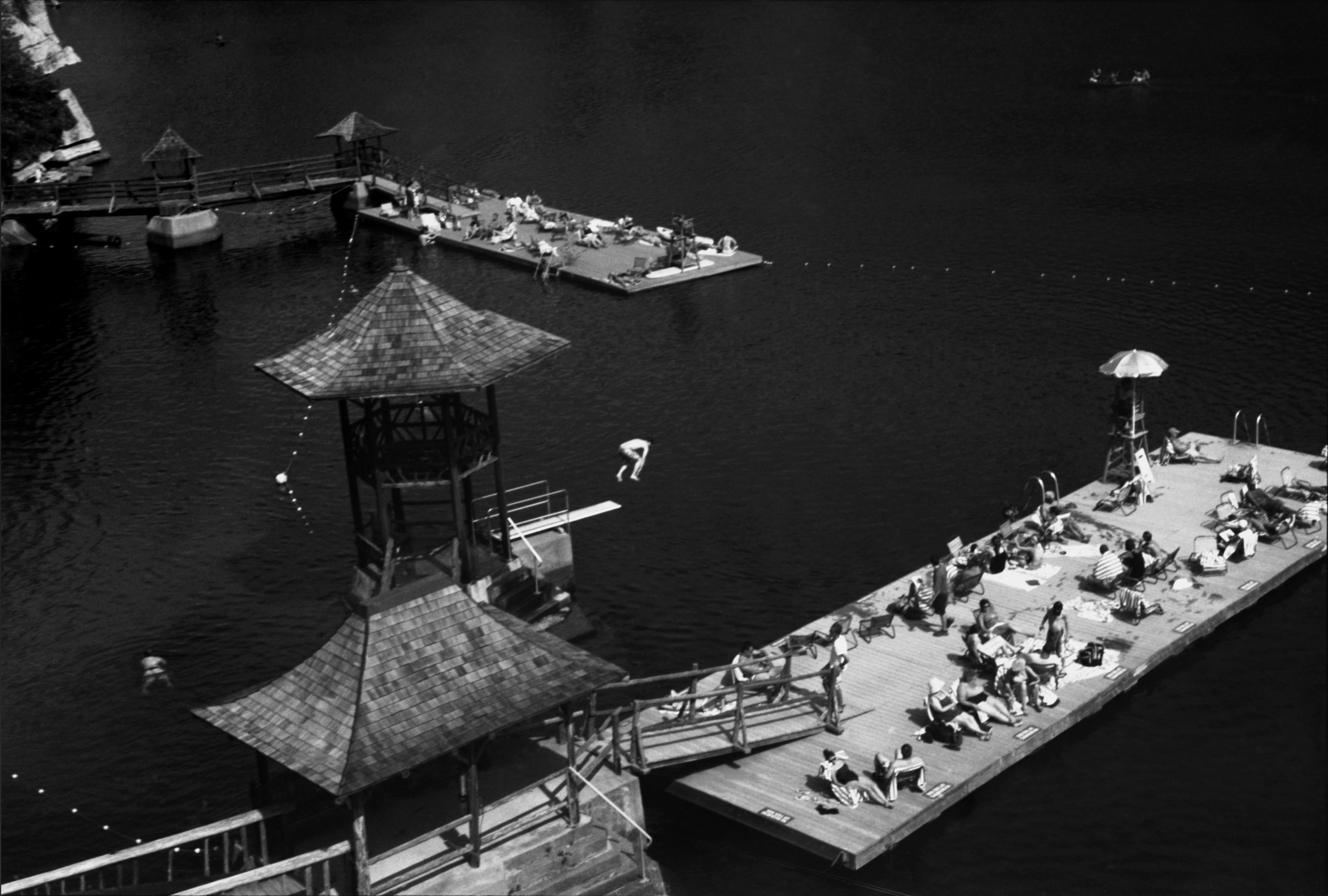
52. It is wonderful when your children take up your interests. I have always loved photography and music. So I was thrilled when Claire showed a real talent for photography (especially black and white) and Andrew likewise showed a talent for music. We do our job as parents when we open up the world’s possibilities to our children. I simply count myself lucky that among their many talents are two that I can understand and appreciate.
The Lake at Mohonk Mountain House (Photo credit: Claire Brown)
53. I have been loved by some wonderful people. All I can say is thank you.
54. Never underestimate the impact one person can have on the world. Dean Smith, the famous basketball coach for the North Carolina Tarheels, died last month. One of the most amazing things I heard about Coach Smith through the many tributes that poured out in early February is that the Baptist Church where he worshiped and that shaped his advocacy for minorities was booted out of the Southern Baptist Convention in 1992 for licensing a gay man to minister. (Being booted out of today’s SBC wins “bonus points” from me, and I grew up a Southern Baptist.) His former pastor said of Smith, “He was willing to take controversial stands on a number of things as a member of our church – being against the death penalty, affirming gays and lesbians, protesting nuclear proliferation.” I also read a great appreciation in the Washington Post by John Feinstein. After asking Smith to provide more details about his helping to desegregate lunch counters in North Carolina in the 1950s, Feinstein recounted that Smith asked him who told him the story. Told that it was his pastor, Smith responded that he “wished he hadn’t done that.” Feinstein replied that Smith should be proud of that work. And here was the kicker: Feinstein wrote, “He looked me in the eye and said, ‘John, you should never be proud of doing the right thing. You should just do the right thing.’”
55. There have been times when I did not get something I thought I really wanted. But in most cases, I found something better. (Or, in the immortal words of Mick Jagger & Keith Richards, “You can’t always get what you want…but you just might find, you get what you need.”)
56. I have always enjoyed a wide variety of music. I’ve been privileged to play bluegrass and to sing Josquin des Prez…and lots of things in-between. I subscribe to the words of the immortal Duke Ellington: “There are two kinds of music. Good music and the other kind.”
57. I am fine with the fact that not everyone wants to hear my opinion and is eager to know what’s on my mind. Opinions are like noses…everyone has them.
58. I believe in the Church of Baseball.
59. A few years ago I became intentional about saying “thank you” to someone every day. It is one of the smartest things I ever did. Thank you.
I don’t often mix my work into More to Come…. But then again, I don’t often hear the President speak so eloquently about the work with which I’m engaged. Last Thursday was one of those days.
After 24 hours in my own house, I was on the road once again to Chicago last week. Cold. Frigid. Windy. Chicago. It wasn’t a destination I would have sought out in February, except for the fact that President Barack Obama was going to designate Pullman a National Monument. At the National Trust, we were part of a coalition working for this designation, and I was proud to join our team at the celebration.
These types of events with government and political leaders are often perfunctory – at least from the politician’s standpoint. Last Thursday – with the President on his home turf – was anything but. You knew we were in for a treat when his opening remarks began with this ode to Chicago’s winter: “It’s always been a dream of mine to be the first President to designate a national monument in subzero conditions.”
Pullman, if you do not know the history, is a remarkably intact industrial town of historic buildings and landscapes. Located 13 miles south of downtown Chicago, it was built by industrialist George Pullman and through all the change that has taken place in this small community, it stands today as representative of the heart of the American Labor movement. Strikes that began in Pullman in 1893 and spread across the country led – in the long arc of history – to the establishment of Labor Day, a 40-hour work week, the weekend, overtime pay, safe workplace conditions, and the right to organize for higher wages and better opportunities. The first African-American Union – the Brotherhood of Sleeping Car Porters – had ties to Pullman. The men and women who worked and labored in Pullman – white and black – helped create the American middle class.
Pullman (Photo Credit: Cynthia Lynn via National Trust for Historic Preservation)
President Obama told the story of Pullman in deeply personal terms, as they related to his life, the life of his family, and to the life of all Americans.
“I want this younger generation, I want future generations to come learn about their past. Because I guarantee you there are a lot of young people right here in Chicago, just a few blocks away, living in this neighborhood who may not know that history.
I want future generations to know that while the Pullman porters helped push forward our rights to vote, and to work, and to live as equals, their legacy goes beyond even that. These men and women without rank, without wealth or title, became the bedrock of a new middle class. These men and women gave their children and grandchildren opportunities they never had.
Here in Chicago, one of those porter’s great-granddaughter had the chance to go to a great college and a great law school, and had the chance to work for the mayor, and had the chance to climb the ladder of success and serve as a leader in some of our cities’ most important institutions. And I know that because today she’s the First Lady of the United States of America, Michelle Obama.”
Then he continued, and the White House transcript includes the reaction from the crowd:
So without this place, Michelle wouldn’t be where she was. There’s a reason why I’ve got one of the original copies of the program for the March on Washington, a march for jobs and justice, with A. Philip Randolph’s name right there as the first speaker, framed in my office. Because without Pullman, I might not be there. Of course without Michelle, I’d definitely not be there. (Laughter.) Whoever she married would be there. (Laughter and applause.)
Then — in contrasting the great national parks of natural beauty with a place like Pullman — the President spoke directly to the students who filled the bleachers in the high school gymnasium, saying:
…To the young people here today, that’s what I hope you take away from this place. It is right that we think of our national monuments as these amazing vistas, and mountains, and rivers. But part of what we’re preserving here is also history. It’s also understanding that places that look ordinary are nothing but extraordinary. The places you live are extraordinary, which means you can be extraordinary. You can make something happen, the same way these workers here at Pullman made something happen.
That’s not to tell you that life is always going to be fair, or even that America will always live up to its ideals. But it is to teach us that no matter who you are, you stand on the shoulders of giants. You stand on the site of great historic movements. And that means you can initiate great historic movements by your own actions.
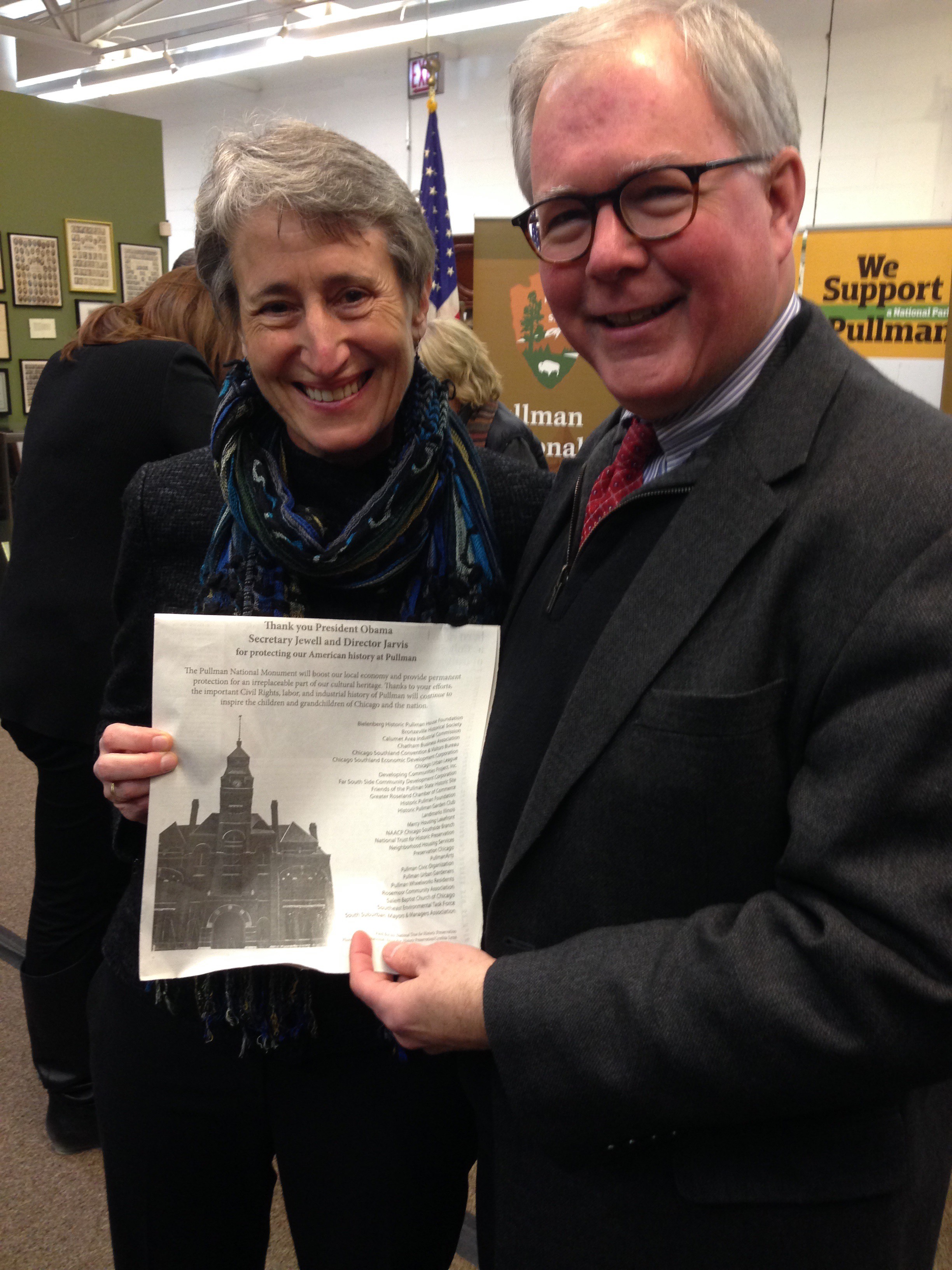
Secretary of the Interior Sally Jewell with DJB at the community celebration in Pullman
It was a day of great celebration. It was a day when one of the country’s most eloquent presidential speakers was able – because of what Pullman meant to him as a man, a husband, a father, a worker, and an American – to explain to all Americans why Pullman matters today, and tomorrow, and to future generations. Secretary of the Interior Sally Jewell and National Park Service Director Jon Jarvis were on hand, and I shared with them an ad we placed in that morning’s Chicago Tribune thanking the President, Secretary, and Director for their leadership in saving Pullman. And there were more than 500 people from the neighborhood – people who have been saving Pullman and recognizing its relevance for decades – who were there as well.
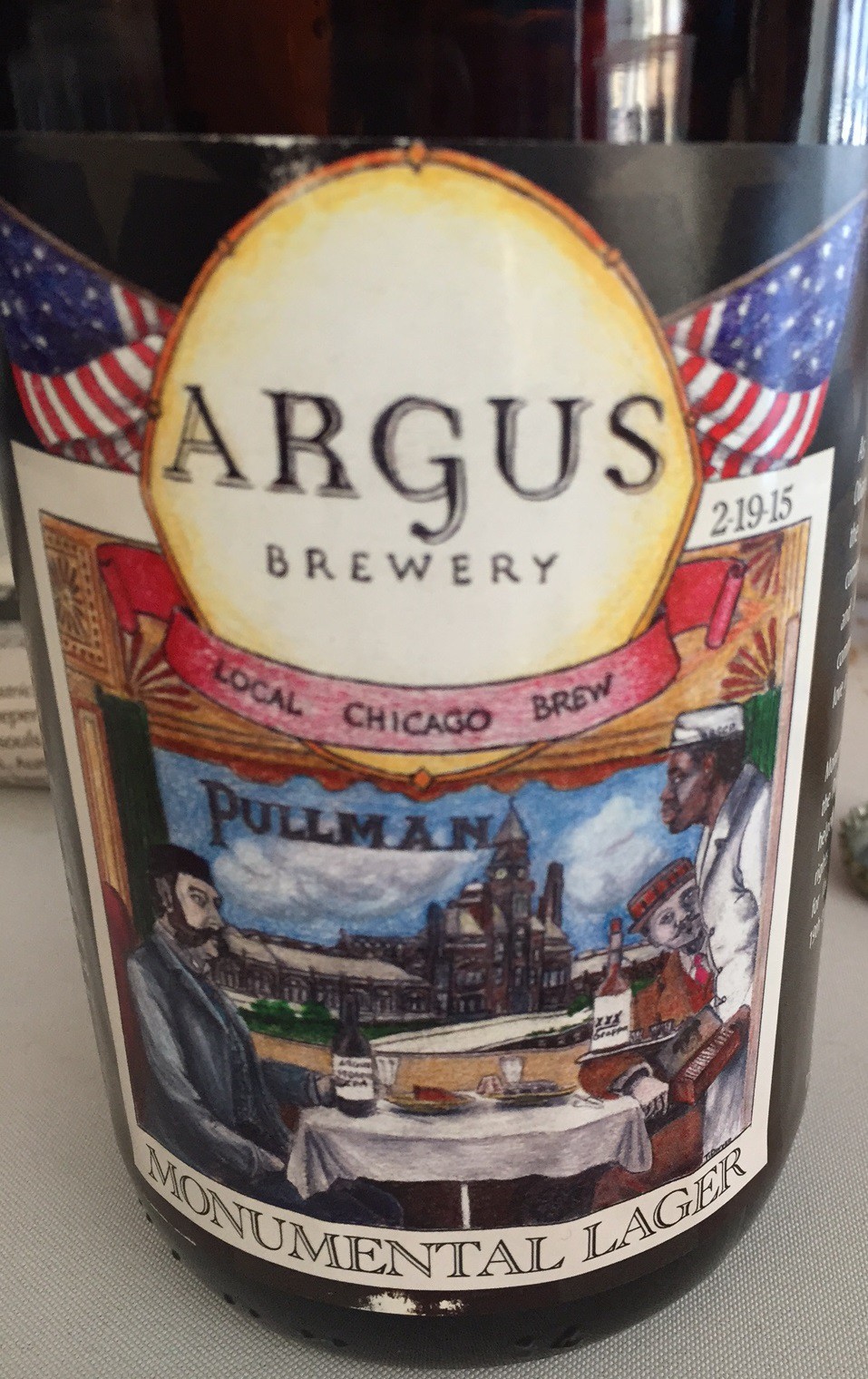
And I did say it was a celebration for the entire neighborhood. Argus Brewery makes fine craft beer in a former Schlitz distribution center in Pullman. To celebrate the monument designation, they produced a one-day only brew – Pullman Monumental Lager. My colleagues in our Chicago office got a case, and we shared one beer after the party. Even the President had four cases delivered to Air Force One. Unfortunately, I was flying United and couldn’t take mine with me through airport security…something that isn’t a problem for the President!
Pullman Monumental Lager from Argus Brewery
Description of the Pullman Monumental Lager
What a way to celebrate! Congratulations to all the folks in Pullman and the organizations such as the National Parks and Conservation Association who worked so hard to make this happen.
And if you have about 25 or 30 minutes, do yourself a favor and listen to the President’s remarks about Pullman. It is a great history lesson. The President’s comments begin after the 32 minute mark.
More to come…
DJB
Image: President Obama Designates Pullman as a National Monument by DJB
Swimming Coach Jean-Paul Gowdy with Claire following a Family Weekend practice
Not even ten hours – TEN HOURS – stuck in the Phoenix Airport on Thursday was going to ruin our last Family Weekend at Pomona College with Claire. (Phoenix Airport motto: “And you think our city has sprawl – just wait until you have to go from concourse-to-concourse in our lovely airport. We’ll show you world-class sprawl!”)
Yes, the time has come for the last of our family weekends during the college years. We’ve made 7 of 8 over the course of the four years between our twins and their two schools.
Some parents poo-poo the Family Weekend, saying they are only for freshmen parents who miss their children. But we love them. Why?
Well, beyond the obvious of getting to spend time with Claire and Andrew, we get to meet and hear great professors talk about fun things. In the fall at Brown, our favorite was Fundamentals of Healthy Aging. This year’s topic of choice at Pomona from Professor Joti Rockwell was entitled Sympathy for the Devil: The Meanings of Fiddle and Guitar Music which addressed fiddle and guitar-oriented music from historical, theoretical, cultural and analytical perspectives. Topics included “Greek mathematical and cosmological foundations for understanding stringed instruments, and the fiddle as a morally questionable instrument!” The Devil’s Box!! Right up my alley.
We get to spend time with our children’s suite-mates and friends. What a sharp group of young adults.
We get to hear talented professors and students perform in various ensembles in some beautiful spaces. Comedy, poetry, jazz and dance ensembles, and improv. Two years ago at Pomona we had a chance to hear fiddler extraordinaire Richard Greene play with Professor Rockwell.
We go to a breakfast where we hear of the work of Pomona’s professors and students, who are having an impact worldwide in so many fields. People such as Poet and Professor Claudia Rankine with her most recent work Citizen;Noah Simon, an alum who was named to Forbes 30 under 30: Young Scientists Who Are Changing the World for his algorithms which are being used to characterize the biology behind Crohn’s disease, rheumatoid arthritis, and various cancers; and Assistant Professor Amanda Hollis-Brusky with her work studying the Federalist Society. At that same breakfast, we engage in a discussion with parents and staff about the importance of standing up and speaking out for the liberal arts, in the face of STEM-only education and the push in some quarters to turn institutes of higher learning into trade schools.
We get to meet and thank adults like swimming coach Jean-Paul Gowdy who have had such a profound influence on our children as they grow into adulthood.
And, because our children go to school on opposite coasts, we go to New England during the height of the fall color season…and we go to Southern California in February!
Haldeman Pool
Did I mention that we hung out around the pool today watching Claire and her teammates train for next weekend’s conference championship? And we were in short sleeves? And shorts? And did I mention that while we were there – in 82º weather – Andrew texted and said it was -14º wind chill in Providence?
Yes, just about the time Candice and I think we are going to pull our hair out because of the weather at home, this little oasis of a trip comes up. And we do love it!
James Terrell art work at Pomona
As we walk through the bucolic campus at Pomona, we keep getting whiffs of the flowers that are all in bloom, and we wonder which plant is calling us over for a closer inspection. The quadrangles, trails, buildings, fountains, art, and plantings work together to form a place of incredible beauty.
Today we have a jazz brunch in a beautiful dining hall that could have come out of a Harry Potter movie. Then we’ll go to the farmers market in the village of Claremont. (Village motto: One of the most wonderful places on earth.) Candice and I will hang out in the 83º sunshine for as long as possible before having an early dinner with Claire and getting ready for our flight home.
I think we’re going to have to come up with some excuse to return next February!