Latest Posts

The work remains the work

In recent days Joy is a fine initial act of insurrection was trending again on MORE TO COME. That 2017 post examined three collections of essays written by historian and activist Rebecca Solnit as a trilogy for our times. Hope in the Dark, the first of the series, finds Solnit writing about the demands of hope before noting that joy is a way to support the work which hope demands.

“Joy doesn’t betray but sustains activism.  And when you face a politics that aspires to make you fearful, alienated, and isolated, joy is a fine initial act of insurrection.”

Solnit has long been a favorite for her clear-headed analysis, pragmatic takes, and hopeful outlook on the crises of our times. I was thrilled to discover that she recently launched a newsletter, and even though I have been intentional in pulling back from some of the worst of the newsfeeds, it only took a minute to decide to subscribe.


Do not surrender to morally and imaginatively impoverished billionaires

Meditations in an Emergency is Solnit’s response to the authoritarian “attack on the long emergence of a new society.” Solnit is writing out of the belief “that there are possibilities in the face of this would-be dictatorship. There always are. I’m here to explore them and act on them with you.”

Time does not run backward. And Solnit reminds us that we do not have to surrender to “morally and imaginatively impoverished billionaires” who do not expect or imagine or understand consequences.

“In 2018, Michelle Alexander wrote a powerful essay that’s stayed with me as a touchstone. She wrote that we are not the resistance, they are. She used the metaphor of rivers and dams, to say we are not trying to dam the river of change they are: ‘Donald Trump’s election represents a surge of resistance to this rapidly swelling river, an effort to build not just a wall but a dam. A new nation is struggling to be born, a multiracial, multiethnic, multifaith, egalitarian democracy in which every life and every voice truly matters.’ . . . I’m with [Alexander]. You can dismantle the institutions, violate the law, attack the vulnerable. But you can’t convince most of us we don’t deserve our rights or our democracy; you can’t convince us to forget what we know.”

I want to quickly share two of her recent essays and encourage you to take a deeper dive into her newsletter.


The misery of those who have a lot and can never have enough

Solnit asserts that “No One Knows How This Will End (But I Do Not Think It Will End Well for Them)” (February 16th). She begins with the “sulky arrogance of [JD] Vance’s performance” at the Munich Security Conference, perfectly nailing the reality of that sad spectacle.

“Only a few days after being rebuked by the pope himself for getting his theology wrong during a week in which he also got rebuked by legal scholars for a tweet in which he got his Constitutional law wrong, he was reveling in the power to be an asshole while getting his facts about European politics wrong and weakening his own and his country’s actual power.”

Then Solnit turns her gaze to the false belief that underpins the actions of these men who would be our oligarch masters.

“These three horsemen of the MAGA-tech-bro apocalypse are in the position of penthouse dwellers who think their top floor apartment doesn’t rest on all the floors underneath, or so it looks to me as they rush about wrecking things with an apparent conviction that they’re immune to the impact . . . that they have defeated everything including cause and effect . . .

I don’t know where Trump, Musk, and Vance’s story ends, but I know it doesn’t end with them in power, and I don’t think it will end particularly well for them, though my main concern—and yours, I presume—is trying to prevent damage along the way. And I’m convinced that if we take action, we get to write some of the chapters and maybe revise or erase some of what they’re trying to impose.”


Destruction at the intersection of hideous and heartbreaking

Solnit is the first to admit that this is a very hard time, but people are comforting others, in the best sense of the word.

“Everywhere I went it felt like people were trying harder than usual to show up, to connect, to be their best selves. This is emergency behavior. This is how people behave when their city is bombed or flooded or burning down, this extra care, this extra presentness, this best self connecting with other best selves. Then, online, an actual pastor I knew reminded me that the word comfort means to fortify (com– as in with; fort as in fortress, fortitude, and fortify), maybe to fortify with kindness.  We were fortifying each other with what we had to offer, which was ourselves, by really being with each other.”  


Do the work

Sadness is certainly not going to stop Solnit. Not with her long history of activism. To say she’s sad is to describe how she feels, not what she thinks.

“The job isn’t to be happy, sad, angry, unfeeling, or anything else; it’s to do the work to oppose this destruction. But taking care of yourself so you don’t fall apart or wear out or aggravate you allies too much is how you stay capable of doing it. One thing I find useful is the distinction between feelings and commitments—you can feel despair or grief or exhaustion and not let go of your commitments or principles. Emotions are the weather that swirls around and changes and changes again. Commitments, principles, are the mountain on which the sun and the rainstorm fall, and it remains a mountain. Pay attention to your storms and rays of light and pay attention to the mountain on which all those things fall.”

I believe we are seeing signs and pushback, suggesting that the “inevitability” of American authoritarianism isn’t all there is to the story. To that end, I came across this reminder from another author which focuses on the work we will be facing today . . . and always.
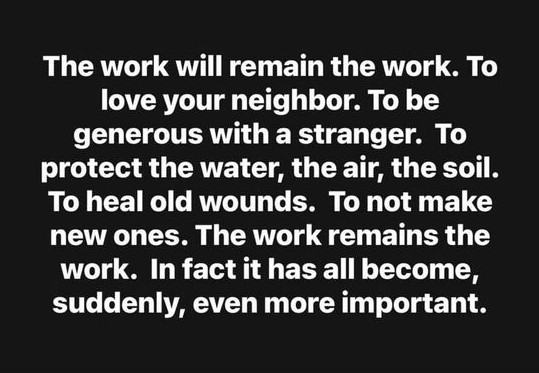
This is work that our oligarchs, who have it all backwards, do not understand. As Solnit asserts, they confuse coercion with power and cooperation with weakness. The opposite is actually where the truth lies.

“Kindness is seen as a weakness, but it’s a strength, both in its ability to care for others and in its recognition of the ways we’re all connected. I wish you the fortress in comfort, the kinship in kindness, and the courage in encouragement, in both what you give and what you receive.”

More to come . . .

DJB

Photo by Kenny Eliason on Unsplash

What seems impossible can be possible

Trailblazers play a unique role in the world. They walk on paths where no one else has traveled, often bringing light and possibility to places that have previously known only darkness and despair.

For those who were moved by the first female Episcopal Bishop of Washington speaking truth to power from the Washington National Cathedral’s Canterbury Pulpit at last month’s National Prayer Service, Bishop Mariann Budde‘s trailblazing presence in that role follows another pioneer, one whose life and ministry was honored and celebrated at a Choral Evensong this past Wednesday. This year marks two significant milestones in the life of the man who was the first African American Episcopal Bishop of Washington, The Right Reverend John T. Walker, sixth bishop of the Episcopal Diocese of Washington and former dean of Washington National Cathedral. The 100th anniversary of Bishop Walker’s birth and the 70th anniversary of his ordination on February 19, 1955, are being celebrated this year. The readings, music, and prayers for the service were drawn from and influenced by the liturgies of Bishop Walker’s consecration as suffragan bishop on June 29, 1971, and his funeral on October 5, 1989.

Bishop John Thomas Walker was born in 1925 to sharecropping parents in Barnesville, Georgia. He grew up in Detroit, his family part of the Great Migration of African Americans from southern states. Both his grandfather and great-grandfather were ministers in the African Methodist Episcopal (AME) Church. Walker joined the Episcopal Church after college and discerned a call to priesthood, becoming the first African American to attend Virginia Theological Seminary in 1951. After parish ministry in Detroit, he accepted a call to teach at St. Paul’s School in Concord, New Hampshire. 

In a moving remembrance from 2019, Bishop Mariann outlined his story, noting that he came to the Cathedral in the mid-1960s as the first Canon Missioner.

“As an African American whose life bridged the worst of Jim Crow and the struggles of the Civil Rights Movement, he knew the pernicious evil of racism and yet refused to be defined by it. He integrated nearly every institution he attended, joined and led, and he helped others walk proudly through the doors of church and society that had previously been closed to them.

The Diocese of Washington elected John Walker as bishop twice, first as Bishop Suffragan in 1971, and then as Diocesan in 1977. As bishop, Walker realized that the completion of Washington National Cathedral fell to him. In a move that takes my breath away, he named himself both bishop and dean of the Cathedral. He then poured himself into the hard work of fundraising for the Cathedral, while at the same time leading the diocese and providing moral leadership during one of the most volatile periods of our society. He was, in the eyes of some, a moderate, yet he never shied away from the pressing issues of his day.” 

Sadly, Bishop Walker’s death came on September 29, 1989, the very day chosen to mark the beginning of a full year’s celebration of the Cathedral’s completion. As Bishop Mariann wrote, “Reading the accounts of that day, you can feel grief rising from the page—the stunned sense of loss and immediate resolve to carry his light forward.”

The full service honoring the life, ministry, and legacy of Bishop John T. Walker can be seen on the Cathedral’s website.

After an organ prelude, the service began with the choir singing Moses Hogan’s arrangement of the spiritual Give Me Jesus (at the 8:50 mark). I was also very moved by the Matthew Glandorf arrangement (at the 22:00 mark) of the Phos hilaron, an ancient lamp-lighting hymn that is used for evening prayer and seemed especially appropriate given Bishop Walker’s legacy of lighting the spaces where he moved. Eugene Sutton’s remembrance of John Walker at Evensong reflects this legacy, as Sutton—the Retired Bishop of Maryland—spoke to how as a young African American he could see possibilities because of the life of Bishop Walker.


I’ve included two additional videos, reflecting different approaches to those two musical experiences. The first is of Kenneth Hanson in concert at Convent Avenue Baptist Church in New York City singing the Hogan arrangement of Give Me Jesus. Mr. Hanson sings with the Harlem Jubilee Singers.

And although it is a different arrangement, I also appreciate The Gesualdo Six‘s Phos hilaron. As the program note states:

“Among the earliest known Christian hymns, Phos hilaron (‘Gladdening light’) can be dated to at least the fourth century on account of its inclusion in the Apostolic Constitutions—prescriptive texts compiled in the Syrian region in the 370s AD. Contemplating the dying light of the evening, the hymn has traditionally been associated with the ritual lighting of candles, and Owain Park’s 2017 setting, which features a solo line accompanied by soft-grained chords, evokes both the literal and spiritual contrast between darkness and illumination.”

One of the readings at the Evensong came from the words of Bishop Walker, and I’ll close with his remarks.

“We are preparing our children for a life in a complex, pluralistic society. My friends, I am convinced that we can begin here a process of openness to new ideas, to bring about change in society. We can offer as the chief option of life—inclusiveness opposed to exclusiveness; trust as opposed to distrust; love of each other; we can help them to make caring responses to each other; we can help to raise them up when they fall and set them on a course that may make this a better world for them and for their posterity.”

With gladness for the life, ministry, and legacy of The Right Reverand John Thomas Walker. May he rest in peace.

More to come . . .

DJB

Photo by CHIRAG K on Unsplash

A marvel of design, function, and livability

Malaysian architect Laurence Loh writes that historic sites convey a spirit of place. A cultural essence. And he suggests that the concept is best understood if one alludes to the notion of “body and soul.” For Loh, the body is “the physical fabric of the heritage site. The soul is the sum of the site’s history, traditions, memories, myths, associations, and continuity of meaning connected with people and use over time.”

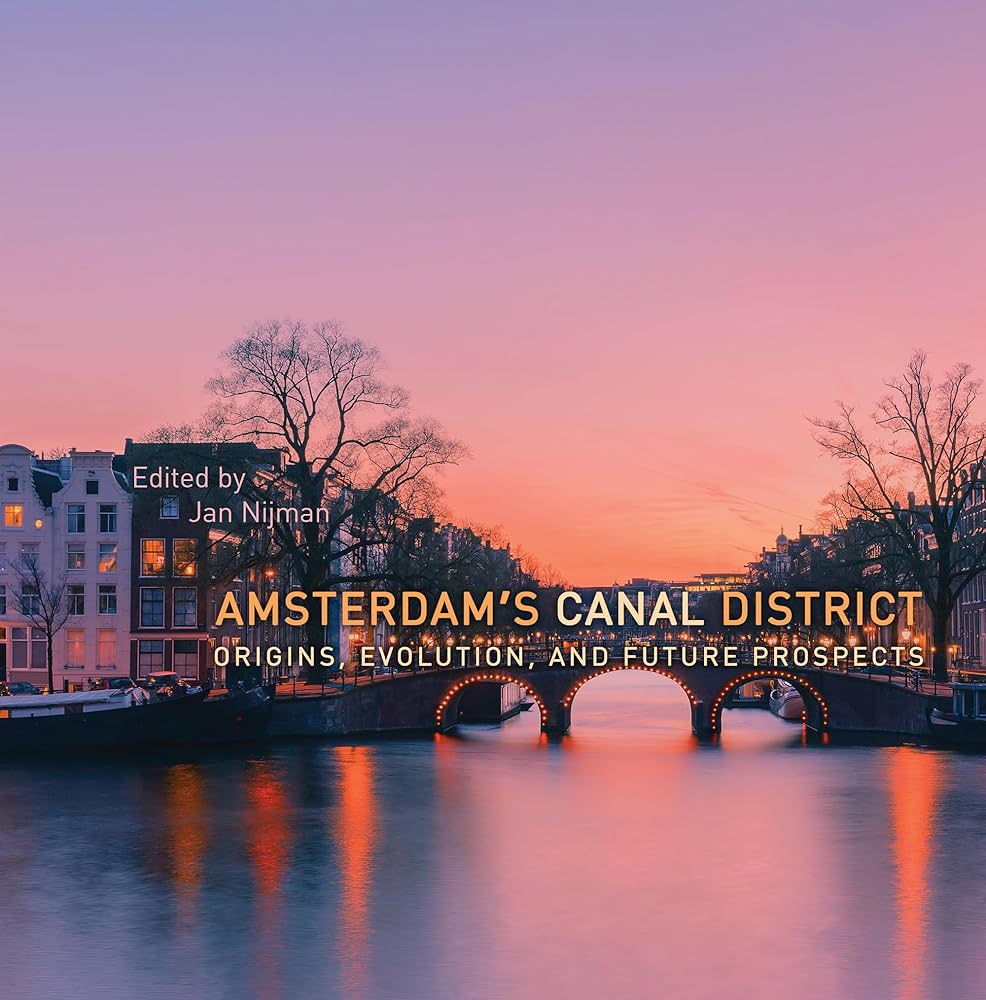
I was thinking of Loh’s framing when reading a thoughtfully written and beautifully illustrated book on Amsterdam’s historic canal district. The editor notes early in this work that “understanding the city can be as complex as studying the biography of a human being: true identity lies in development, growth, and change.”

Body and soul, in other words.

Amsterdam’s Canal District: Origins, Evolution, and Future Prospects (2020) edited by Jan Nijman moves beyond the typical focus on the iconic district’s creation in the country’s 17th century Golden Age to bring together an impressive list of scholars to highlight lessons learned from the district’s evolution. Working from a variety of disciplines, these scholars also bring varied perspectives to the study of contemporary debates facing this world class city. There is no interest among these writers in seeing the city become a memorial to a lost culture. Instead, this work is a call for “the outward appearance of its architecture to be linked with the identity of the people who created, used, and maintained it, and still inhabit it.” People are at the heart of this important work.

After Nijman’s wide-ranging introduction, he breaks the work into three parts: historical origins, evolution, and 21st century challenges. Russell Shorto’s probe of the “early modern-capitalist mindset” in Designing the World’s Most Liberal City is an especially enlightening chapter in the opening section. The roots of the city are in the water, as Shorto demonstrates in describing “an urban development project designed for the city’s residents, and designed in particular to enable those residents to do nothing less than exploit the world.” The merchants of Amsterdam could conceivably travel around the world to bring the riches of the globe home without having to set foot on dry land. And because they turned the problem of water into an advantage, the Dutch thrived on a “particular combination of individualism and communalism that helps define ‘Dutchness.'” Nobility did not own Amsterdam; it was a company town owned by merchants and early capitalists.

This combination of individualism and communalism comes back in Freek Schmidt’s contribution to the second section, where he speaks to the importance of the “multilayered evolution and multiple architectural idiosyncrasies” of the Canal District. These were buildings, neighborhoods, and landscapes that reflected both the individual tastes of the owners and builders but also the ever-present concerns of the city’s fathers over aesthetics and especially function.

Finally, each of the three essays in the section on 21st century challenges explores critical issues facing Amsterdam today: economic and housing pressures, recognition of contested history, and over-tourism. In many ways this section gets to the work’s key questions. Whose city is it? Which histories are celebrated or slighted?

Amsterdam Canal Ring UNESCO World Heritage Site

This very readable and insightful overview of Amsterdam is filled with explanatory charts and beautiful illustrations. It is a book of interest to those who care about the future of this most intriguing of cities, but it also has much to add for those concerned with broader questions of urban planning, historic preservation, and sustainability in today’s world.

More to come . . .

DJB

Photos from UNESCO and Unsplash.

Navigating the “and” of life

Even in retirement, I generally wake up between 5 and 6 a.m. Living with two people whose internal clocks are set to function later in the day means the house is dark and quiet, allowing me to savor the calm that comes before the morning sun. I make my way to my fourth floor studio, but before I stretch and settle in to write I try and begin the day with some moments of quiet contemplation.

One of the resources I’ve called upon for this practice is the daily meditation from the Center for Action and Contemplation (CAC). Contemplation is a way of listening with the heart while not relying entirely on the head. I was not raised in a contemplative religious tradition, but I saw it modeled every day.

My father clearly understood the value of quiet time to begin the day. I have not lived out my father’s deep faith and compassion, but I try to follow his model. At the very least I have inherited his get-out-of-bed-early genes. Each morning, before waking up his five children, cooking our breakfast, and then riding his bike to arrive at work by 7 a.m. (!) he spent time at the dining room table reading, praying, writing . . . listening with his heart. Then he lived what he heard in actions large and small throughout the day.

Franciscan Richard Rohr founded the CAC in 1987 because he saw a deep need for the integration of both contemplation and action. The two are inseparable. Father Richard says that the most important word in the Center’s name “is the word and.”

Contemplation and action.

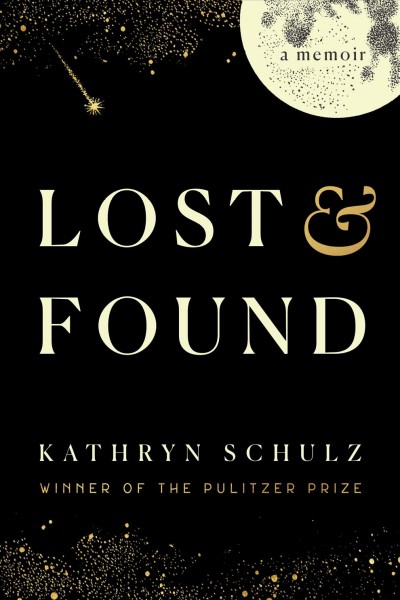
I came to appreciate the importance of the word “and” when I first read a meditation on loss, love, and cherishing life. In her memoir, Kathryn Schulz devotes the final portion of the book to the word “and” as she considers the passage of time that takes place around the liminal transitions of losing a parent and finding a life partner’s love. In our deepest grief, life goes on. As we experience the initial joys of love, life goes on. I returned to reread the book this week.

Lost & Found: A Memoir (2022) by Kathryn Schulz is a tender, searching meditation on love and loss and what it means to be human. Schulz, an exquisite writer, knows that there is both a wonder and fragility to life. While many feel small and powerless in the face of that reality, it is also easy to feel amazed and fortunate to be here. Schulz is clearheaded in her exploration of the mixed experiences and motives we encounter. As she moves through life, Schulz notes that her days are exceptional even when they are ordinary. “We live remarkable lives,” she writes, “because life itself is remarkable.”

The world is full of beauty and grandeur and also wretchedness and suffering; we know that people are kind and funny and brilliant and brave and also petty and irritating and horrifically cruel…. As Philip Roth once put it, ‘Life is and.’”

Many grieve at the seeming loss of values—freedom, honesty, truth, empathy—that we thought the majority in our country held dear. Schulz notes that grief of any kind will age you, “partly from exhaustion but chiefly from the confrontation with mortality.” In times like these we can feel “at a loss—a strange turn of phrase, as if loss were a place in the physical world, a kind of reverse oasis or Bermuda Triangle where the spirit fails and the compass needle spins.”

For many, the compass needle is spinning. We are seeking transformation of our personal bodies and spirit as well as our body politic and the communal spirit of civility.

Rohr has named transformation as the fruit of an authentic spiritual path. If we are truly focused on listening from the heart we will—over time—be transformed. And Rohr asserts that we see that transformation through action.

“Through service toward the depths, the margins, toward people suffering or considered outsiders. Little by little we allow our politics, economics, classism, sexism, racism, homophobia, and all superiority games to lose their former rationale. Our motivation foundationally changes from security, status, and control to generosity, humility, and cooperation.”

The transformed mind lets us see how we process reality. It allows us to step back from our personal perceptions so we can be more honest about what is really happening. Transformation isn’t merely a change of morals, group affiliation, or belief system—although it might lead to that—but a change at the very heart of the way we receive and pass on each moment.

But we need the “and” to transform attention and contemplation towards action and service. We can’t reach our full potential only through contemplation or only through action.

This is a difficult time. But almost all times are difficult. If we are honest with ourselves, we don’t only want to live long lives, but we seek happy and useful lives. The secret to living a long life is pure luck. We may work at our diet and exercise but then be hit by an inattentive driver the next time we cross a street.

But . . . the secret to living a happy and useful life is entirely within our control. How we respond is important. That’s the core of response-ability: the ability to respond.

Recognizing that we have the potential to live and respond with opposites—contemplation and action—helps us navigate the paradox at the heart of life. That recognition helps us respond to these times which—like all the days of our lives—contain both strife and harmony. Concern and contentment. Fragility and wonder. Suffering and beauty. Darkness and light. Shock and amazement. Cruelty and braveness. Tears and laughter.

Grief and gratitude. Loss and love.

Death and life.

Schulz ends her generous and perceptive work by noting that disappearance reminds us to notice, transience to cherish, fragility to defend. “We are here to keep watch, not to keep.” Those words have become something of a mantra for me as I navigate the “and” of life.

More to come . . .

DJB

Photo by Denise Johnson on Unsplash
When Death goes on strike

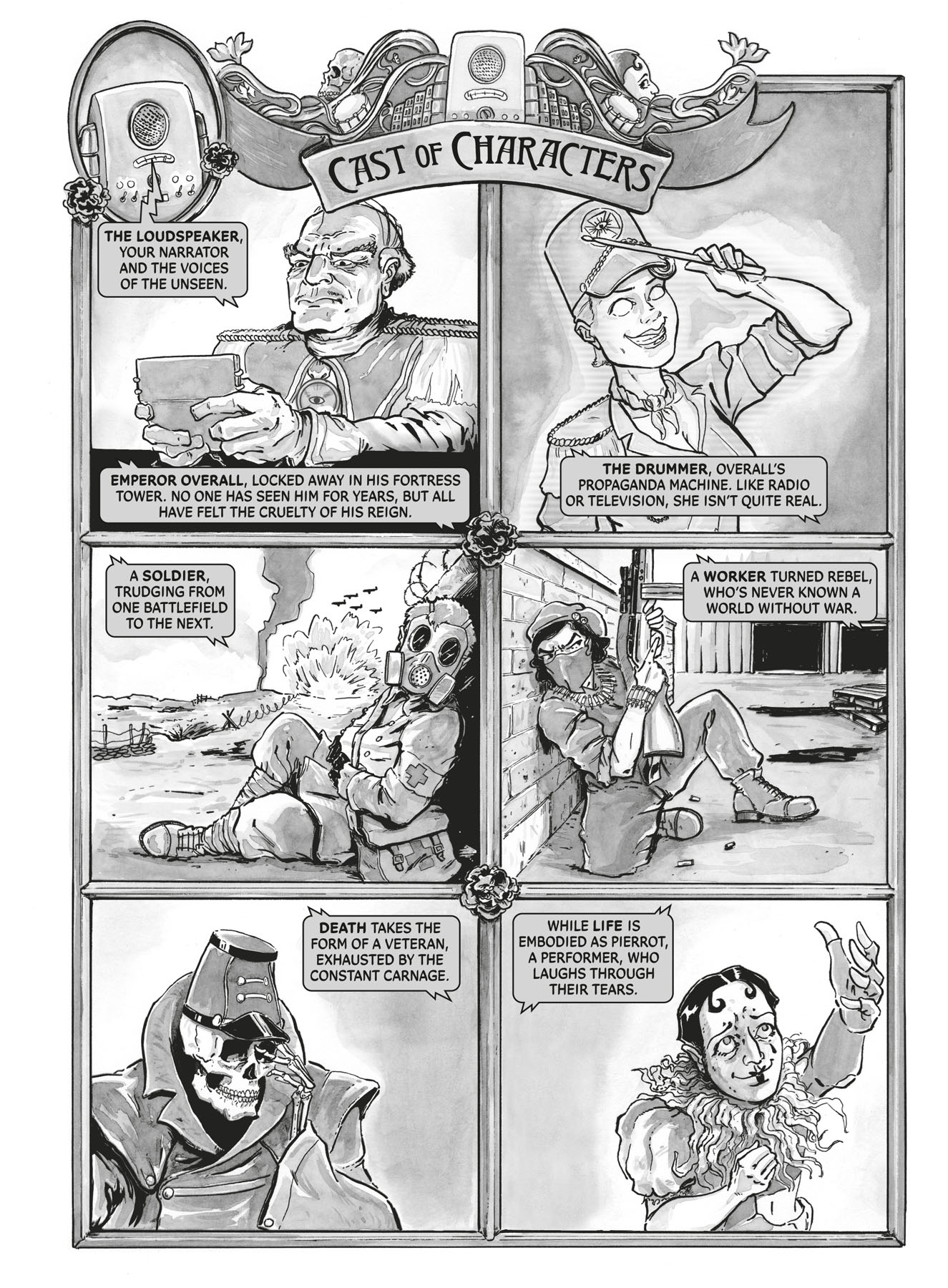
Imagine a scenario where a ruthless dictator kills so many people that the Grim Reaper gets fed up and goes on strike. That is the basis of a remarkable opera as well as a new graphic novel which opens the story to new audiences and new generations.

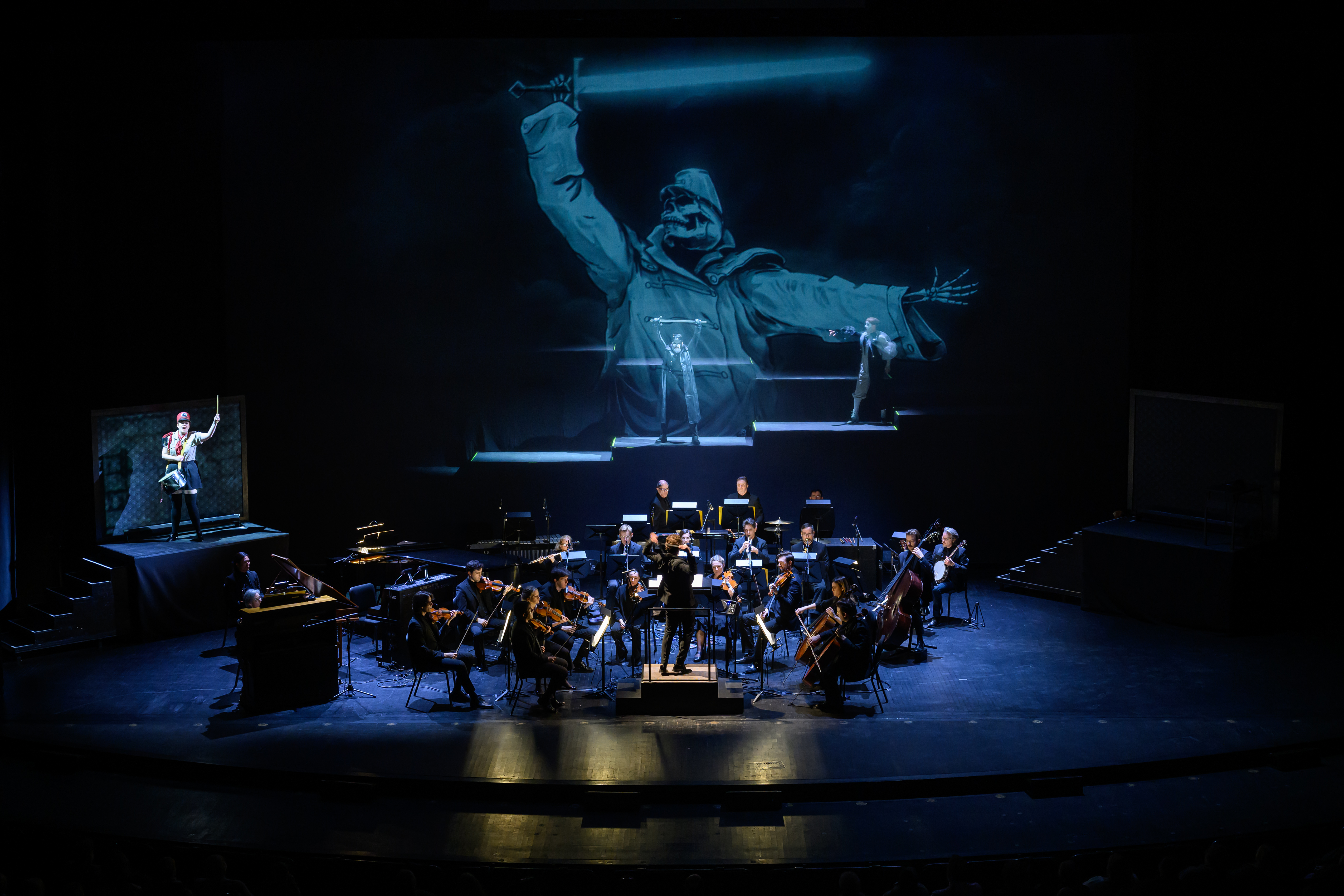
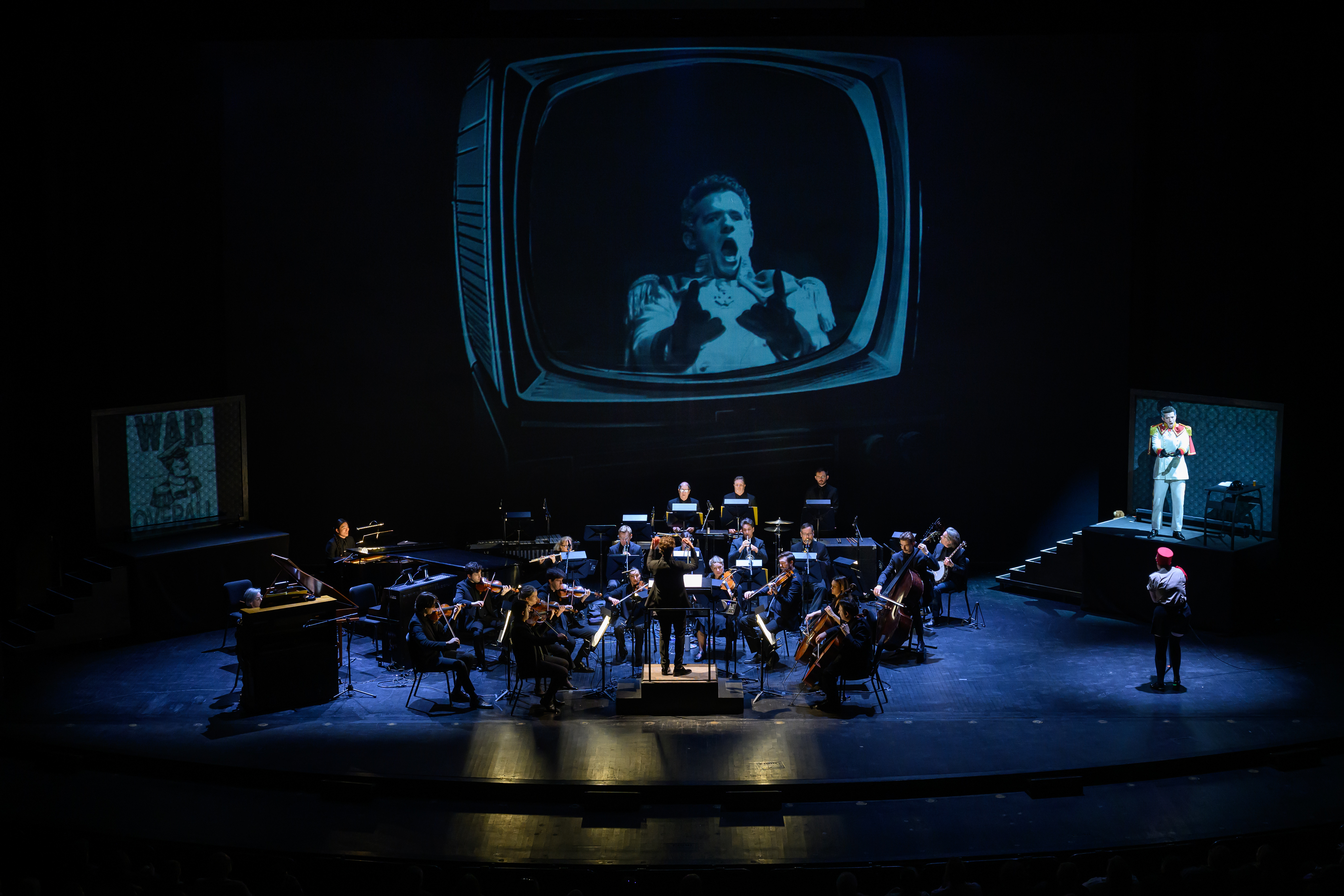
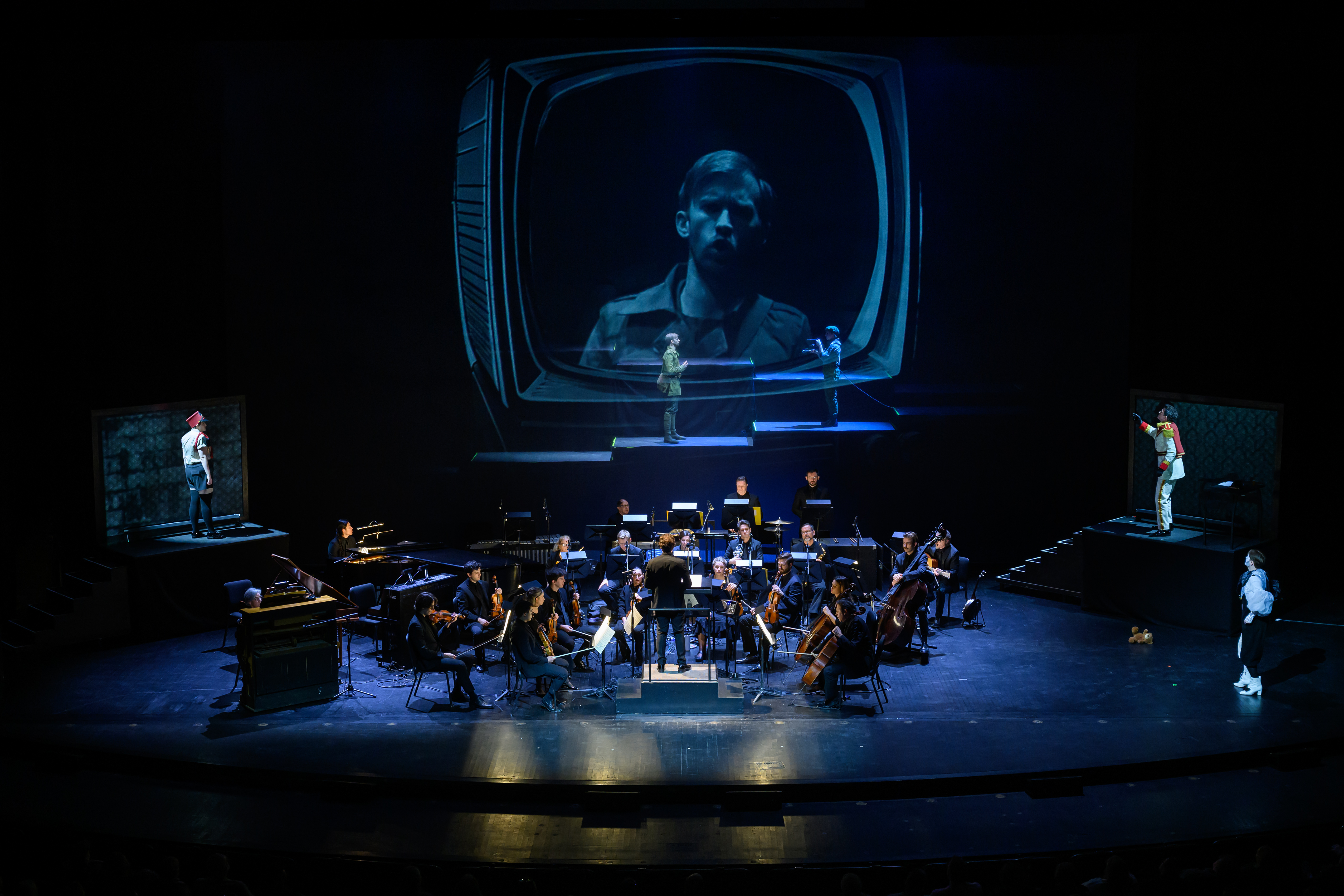
Der Kaiser von Atlantis, Louisville Orchestra production. Photo credit: O’Neil Arnold.

“Faced by the mechanized death on an industrial scale presided over by Emperor Overall of Atlantis, Harlequin and Death—‘life that can no longer laugh and death that can no longer cry’—are reduced to observers of a world ‘which has forgotten how to delight in life and die of death.’ When Overall declares a war of everyone against everyone, Death feels that he has been robbed of all dignity and refuses to serve the Emperor any longer.”

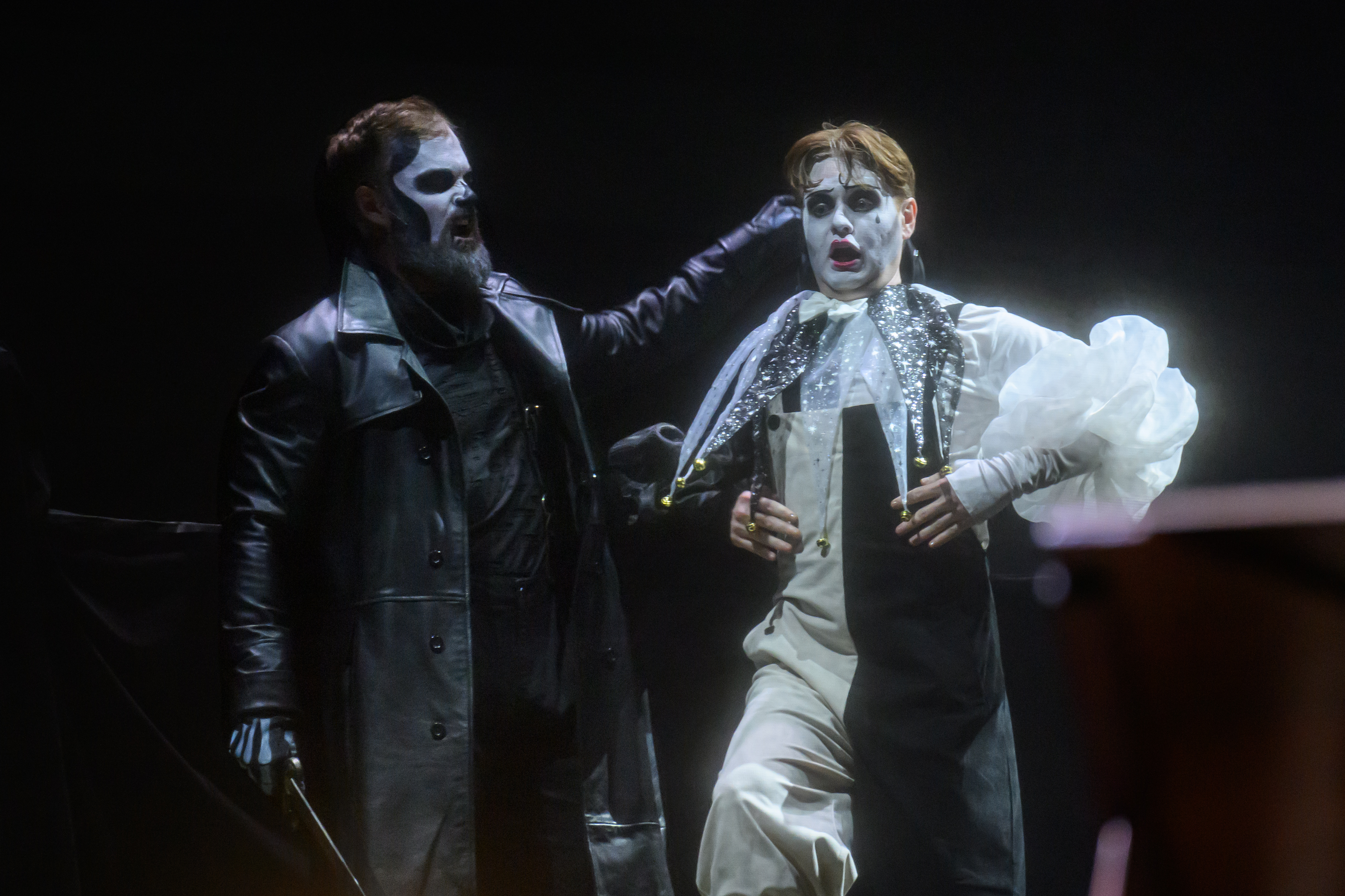
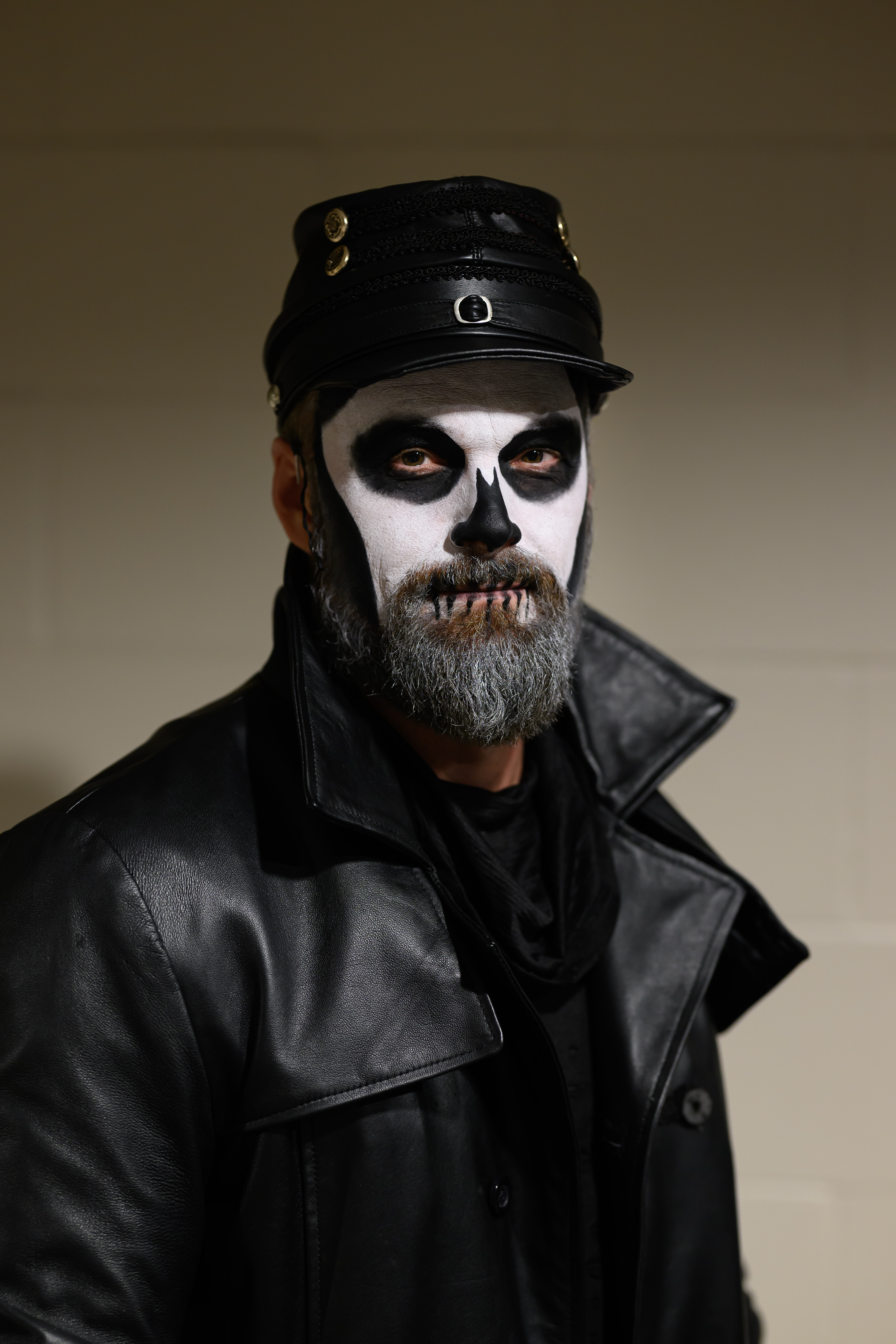
Death and Harlequin in the Louisville Orchestra production of Der Kaiser von Atlantis. Photo credit: O’Neil Arnold.

Der Kaiser von Atlantis is both a tragic and uplifting story.

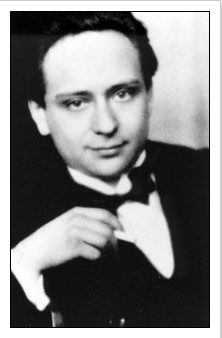
Viktor Ullmann

Viktor Ullmann was a respected Jewish composer in 1930s Austria. Educated in Vienna, he made “important contributions to both Czech and German cultural life as a composer, conductor, pianist and music critic.” As a young man Ullmann enlisted in the military and was decorated for bravery in World War I. He returned to university, where he became deeply influenced by composer Arnold Schoenberg and later, philosopher Rudolf Steiner. Their work helped him understand the role of art “as central to human spiritual and ethical development.”  

In 1942, Ullmann was imprisoned in the Nazi internment camp Terezin (Theresienstadt in German) in the Czech Republic but was still permitted to compose and stage his self-penned dramas. Terezin was erected as a “model camp” meant to dupe the International Red Cross into thinking the interned were privy to an exceptional quality of life enriched with music, art and a full schedule of relaxed activities, but that was not the case.

“At Theresienstadt, under the auspices of the Freizeitgestaltung (the Administration of Leisure Activities), a cultural organ of the Jewish self–administration in the camp and officially sanctioned by the SS, Ullmann composed twenty–three works. These included three piano sonatas, a string quartet, arrangements of Jewish songs for chorus, incidental music for dramatic productions, his one–act opera Der Kaiser von Atlantis, as well as his final work, a melodrama based on Rilke’s Die Weise von Liebe und Tod des Cornets Christoph Rilke, which he completed in 1944.”

Ullmann’s String Quartet No. 3, a piece included on the Dover Quartet’s Voices of Defiance CD, was composed at the camp in 1943.

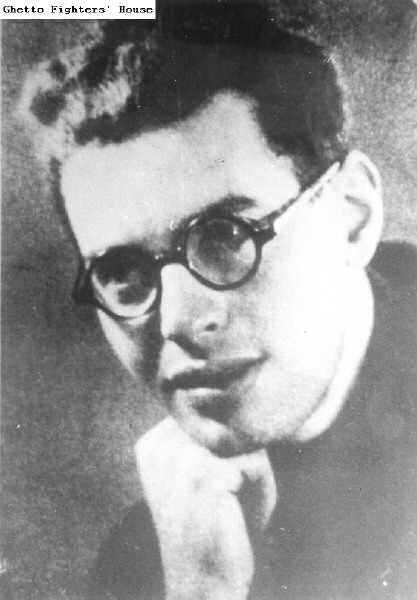
Franz Peter Kien

While at Terezin, Ullmann met Peter Kien, a young Czech poet and painter, who was also active in the cultural life in the camp. They worked together to produce Der Kaiser von Atlantis, a profound meditation on death that stages a dramatic confrontation between the Emperor of Atlantis and the character of Death. As the story unfolds, the Emperor declares a holy war against evil elements in his empire and seeks “to conscript Death to his cause.”

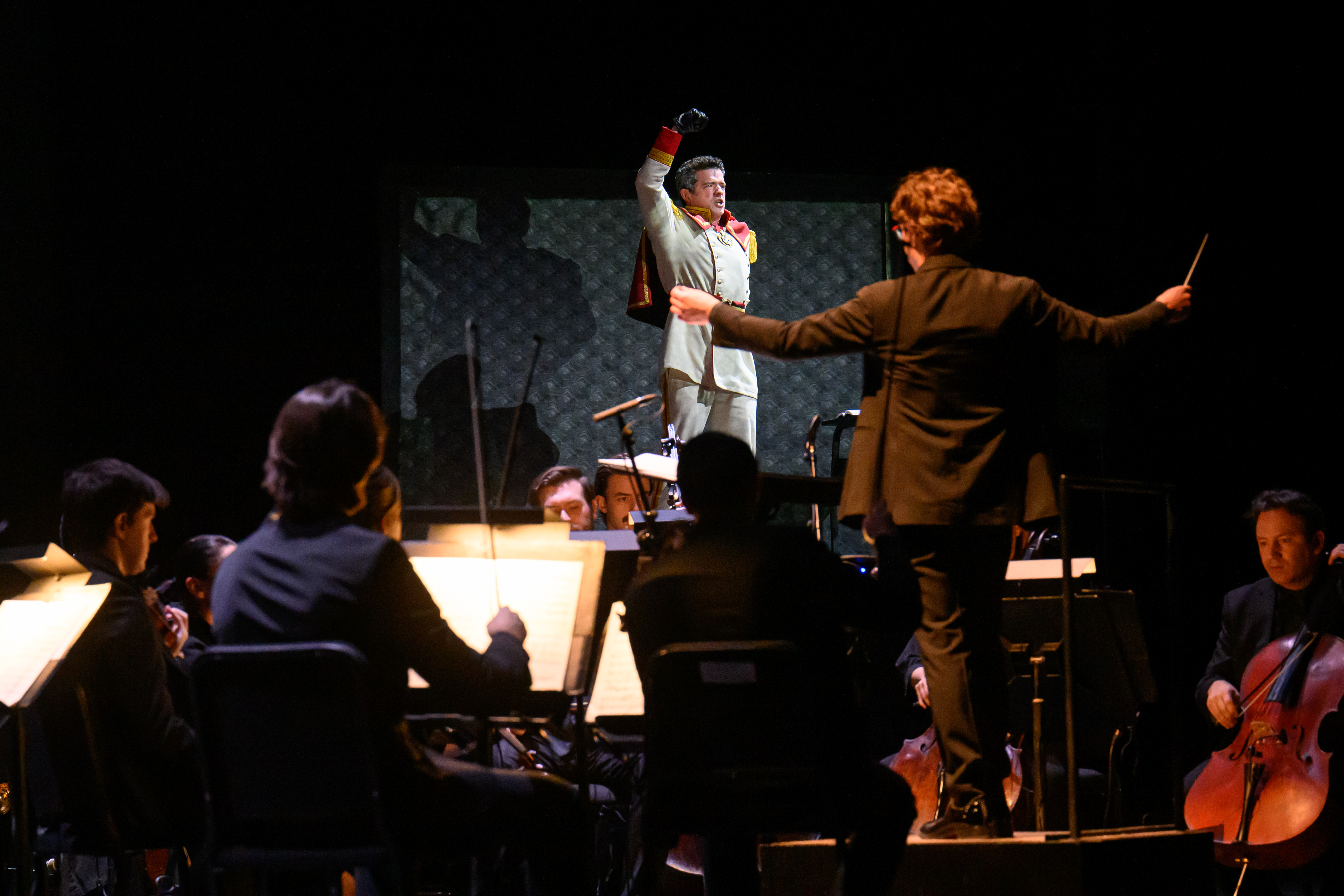
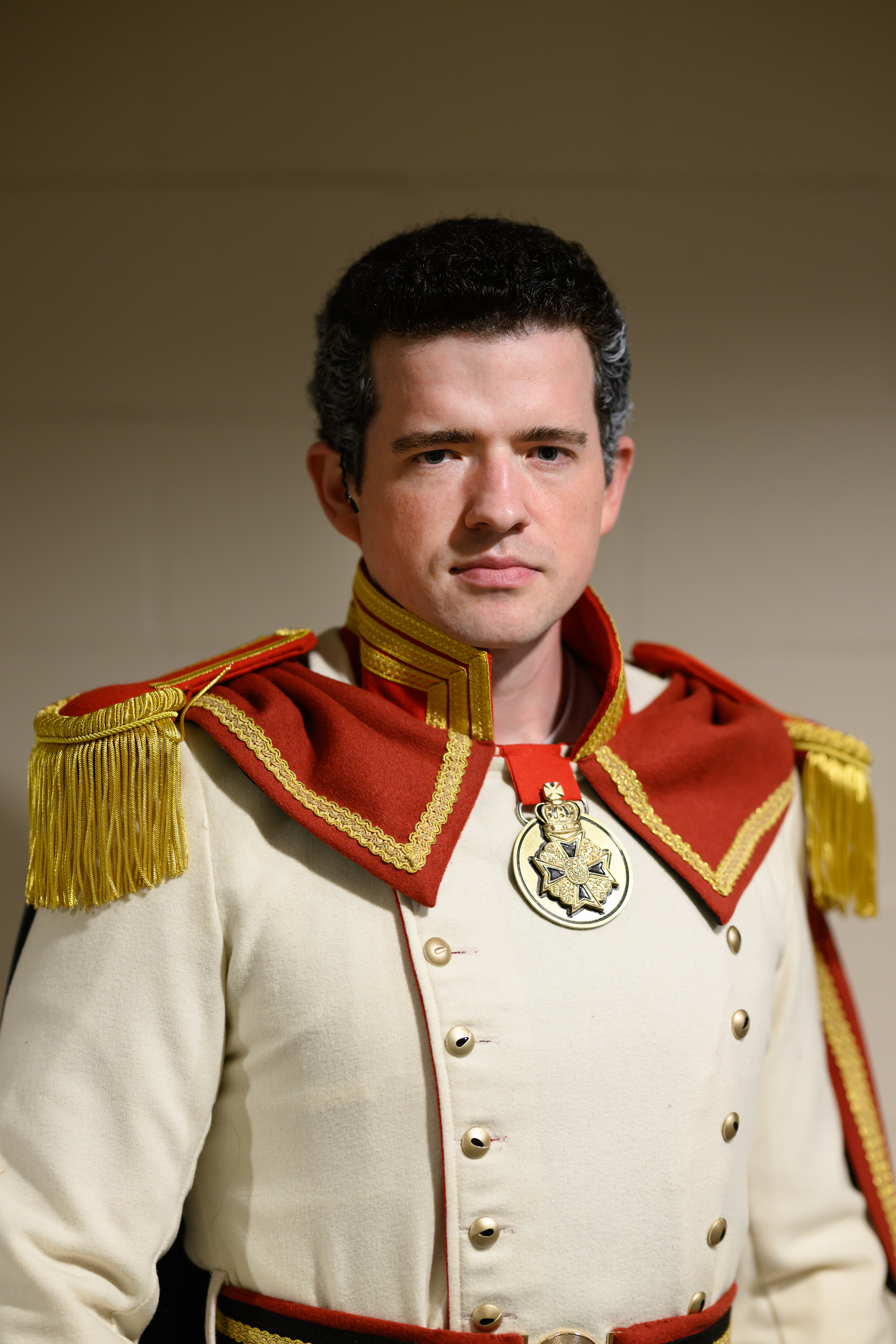
The Emperor in the Louisville Orchestra production (Teddy Abrams musical director and conductor) of Der Kaiser von Atlantis. Photo credit O’Neil Arnold.

Insulted by the Emperor’s effort to involve him in his modernized military campaign, Death—who is already offended by the ‘mechanization of modern life and dying’—refuses to cooperate.  Instead, he decides to teach the Emperor and humanity a lesson that will demonstrate his centrality in regulating existence by making it impossible for anyone to die.” 

One evening during a dress rehearsal of the opera in Terezin, the SS officers in view made the connection between the flamboyant Emperor and Hitler. They halted the production and quickly deported Ullmann and Kien and their families to Auschwitz. There they were murdered two days later, on October 18, 1944.  

When Ullmann was deported to Auschwitz, he left his works in the safekeeping of the philosopher Emil Utitz, who gave them to H. G. Adler in 1945. Adler brought the scores to England in 1947. Prior to his deportation, Kien entrusted a suitcase containing close to 500 artworks and many of his letters to his assistant at the camp, Helga Wolfenstein. “He suggested that Helga hide the suitcase in the ward for infectious diseases where her mother worked, assuming that the Germans wouldn’t conduct searches there for fear of infection. Through her efforts, despite the danger involved, Helga managed to safeguard the artworks until liberation.”


Der Kaiser von Atlantis, Louisville Orchestra production. Photo credit: O’Neil Arnold.

I came to know Der Kaiser Von Atlantis because our son, the tenor Andrew Bearden Brown, sang the role of the Soldier in the recent Louisville Orchestra production of the opera.

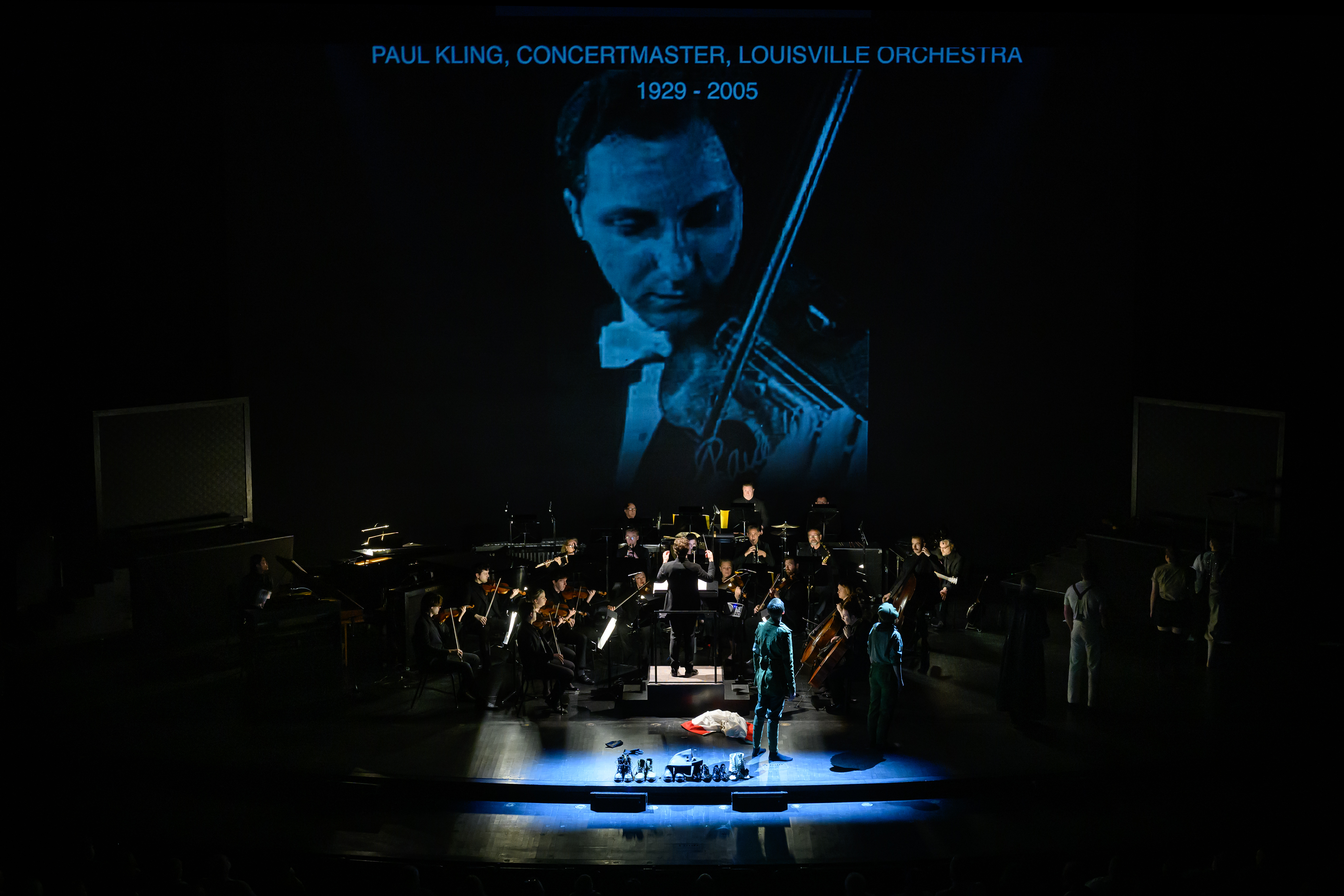
What follows is a short video featuring the orchestra’s musical director, Teddy Abrams, who discusses the career of Paul Kling, a Czechoslovakian violin prodigy who was deported to Terezin at just 14 years of age. There he participated in the rehearsals for Der Kaiser von Atlantis. Kling was transported to Auschwitz but managed to escape during a death march in early 1945, rebuilt his career, and eventually found his way to Louisville, where he was the long-time orchestra concertmaster.

The January 25th production honored Paul Kling and took place two days before the commemoration of International Holocaust Remembrance Day, marking the 80th anniversary of the liberation of Auschwitz-Birkenau on January 27, 1945.

The Louisville Orchestra honors Paul Kling with their January 25, 2025, performance of Der Kaiser von Atlantis. Photo credit: O’Neil Arnold.
The Emperor declares all-out war in the Louisville Orchestra production of Der Kaiser von Atlantis. Photo credit O’Neil Arnold.
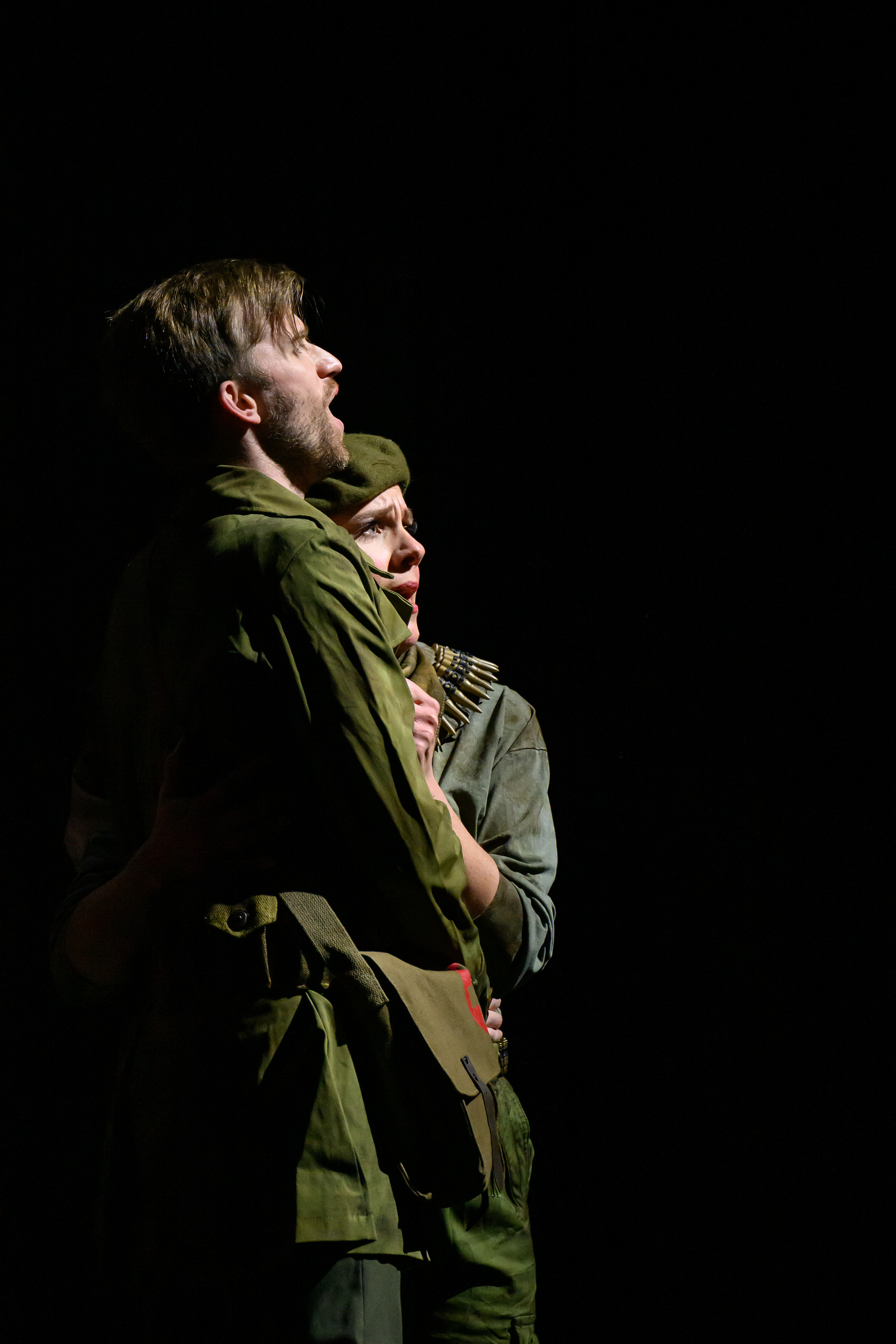
The Soldier and Bubikopf in the Louisville Orchestra production of Der Kaiser von Atlantis. Photo credit O’Neil Arnold.
Andrew Bearden Brown as The Soldier in the Louisville Orchestra production of Der Kaiser von Atlantis. Photo credit O’Neil Arnold.
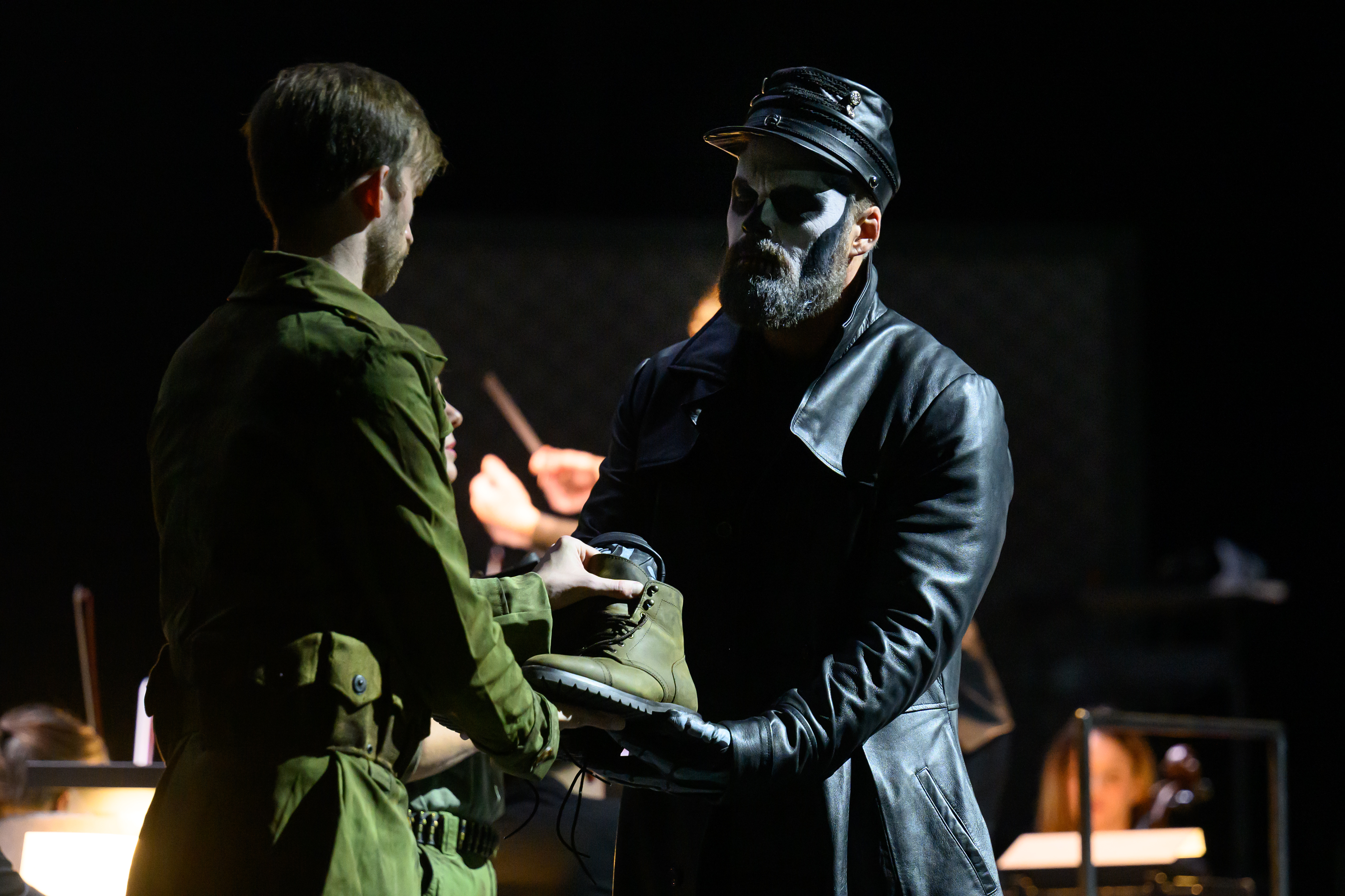
Death comes for The Soldier and takes his shoes in the Louisville Orchestra production of Der Kaiser von Atlantis. Photo credit O’Neil Arnold.

This trailer for the BBC’s Holocaust—A Musical Memorial Film includes The Emperor’s Farewell from the opera.


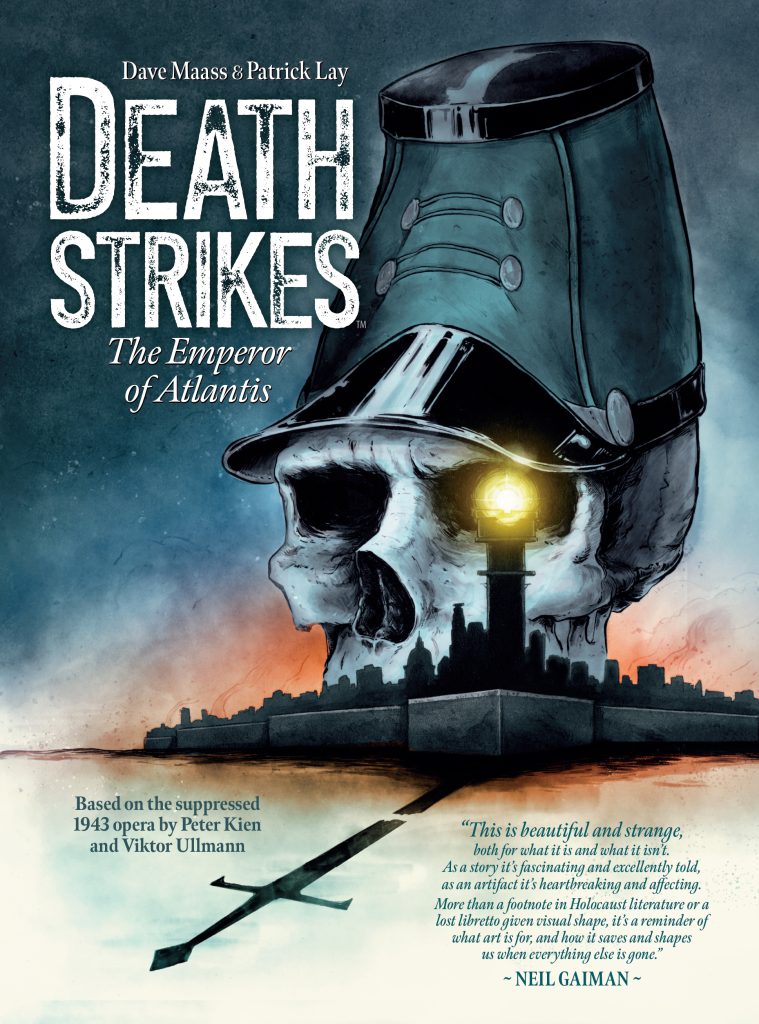
Death Strikes: The Emperor of Atlantis (2024) by Dave Maass and Patrick Lay is a new graphic novel that mixes “dystopian sci-fi, mythic fantasy, and zombie horror.” Atlantis did not sink in this alternative universe but instead became a technologically advanced tyranny. The “power-mad buffoonish Emperor declares all-out war—everyone against everyone.” Death, however, has other plans and goes on a labor strike, “creating a hellscape where everyone fights, but no one dies.”

The novel’s illustrations by Patrick Lay are powerful and biting. Lay and Maass participated in the production of the opera in Louisville, and some of the illustrations were used as backdrops. The graphic novel includes drawings of Kien’s designs from the original opera, historical essays (unfortunately, set in the smallest of type), photographs from the prison camp, and more.

John Mangum has written that Ullmann “found words to live by” in the Goethe aphorism, “Live within the moment, live in eternity” as it “revealed the enigmatic meaning of art.” Ullmann wrote those words in one of his reviews from Terezin. “Der Kaiser von Atlantis is very much a work of the moment,” Mangum adds, “one that cannot be separated from its circumstances. Since its premiere in 1975, it has gradually been finding its way to life in eternity as well.”

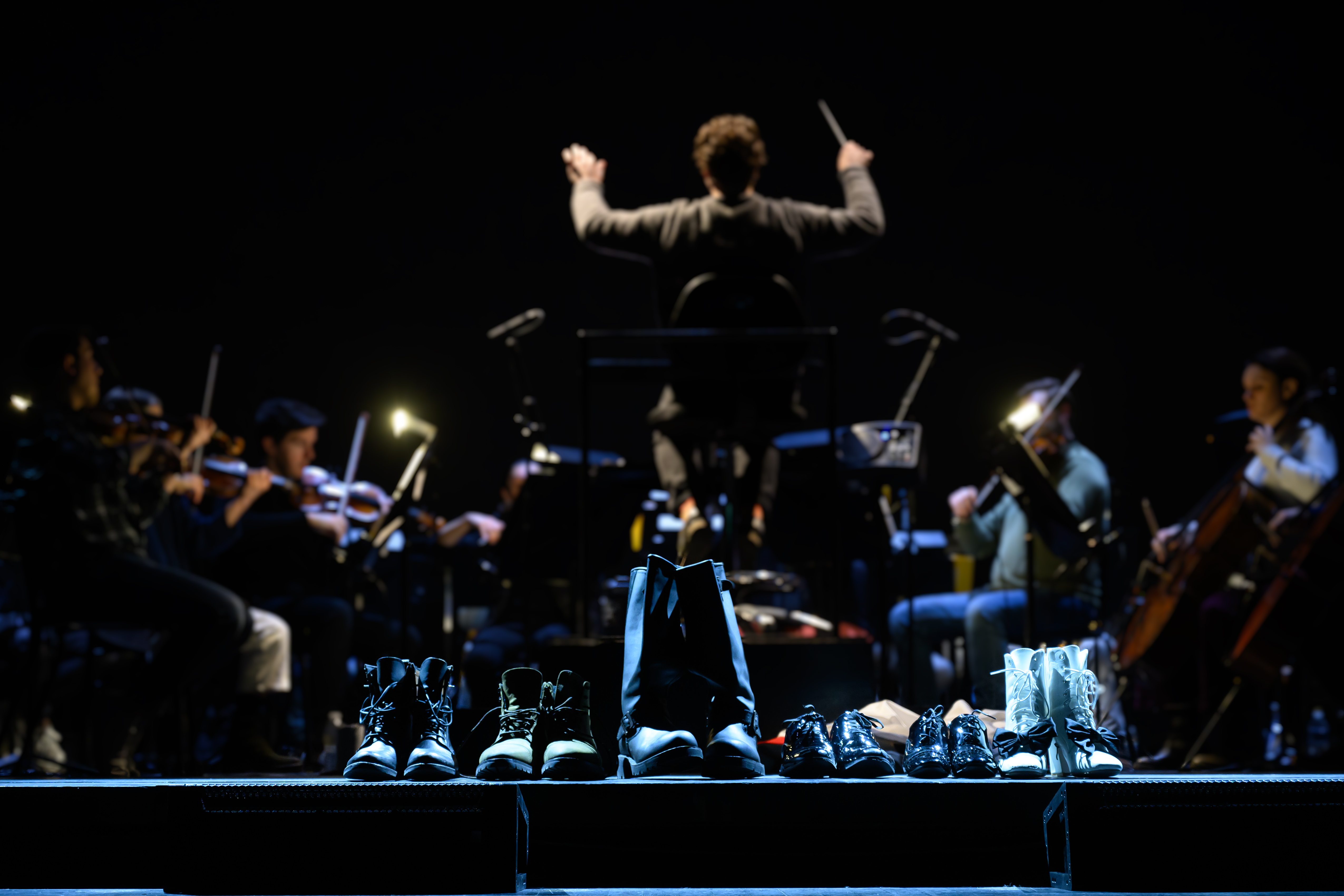
As the opera ends, the shoes of the characters—who have all left with Death—are all that remain on the stage. From the Louisville Orchestra production of Der Kaiser von Atlantis. Photo credit O’Neil Arnold.

Professor Herbert Thomas Mandl, in words shared on the Viktor Ullmann Foundation website, had this to say about the timeliness, and timelessness, of this work.

The Emperor is—like a number of works of art created in Theresienstadt—proof of the human mind’s ability to remain free under the conditions of perfect slavery. Thus, all the mind’s capacities are concentrated into one focal point and lasting values are created even while the artist is facing annihilation.”

More to come . . .

DJB

Lead image: Peter Kien, watercolor of Terezin, 1944, a place where art and music was made against the dark rise of the Holocaust. All photos from the Louisville Orchestra January 25, 2025, production of Der Kaiser von Atlantis by O’Neil Arnold.

The next four years will be filled with upheaval and uncertainty . . . just look at our history

With all the recent talk about “canals, Manifest Destiny, and tariffs, you can be forgiven for wondering what century we are in,” note the writers at the online history site Bunk. There are, they suggest, historical roots to Trump’s aggressive nationalism.

Past and present often seem to come together as one in today’s world, as author Ryan Holiday wrote.

“I can’t predict the future, but I feel pretty confident in predicting that the next 4 years are going to be crazy.

For political reasons, sure, but we don’t need to agree about that. I know I am right because you can’t find a four-year period in history that wasn’t filled with chaos, upheaval, and uncertainty. Never forget, Seneca reminds us, Fortune has a habit of behaving exactly as she pleases. Why would the next four years be an exception to this rule? There is no normal in this life…except disruption, change, and surprise.”

Holiday provides examples and follows by noting the critical question facing us is “not how we can avoid these challenges, but how we can prepare for them.”

These essays led me to consider disruptive and history-changing events in the first fifteen years of my life. Would Holiday’s hypothesis of near constant upheaval ring true?


Setting the stage

Photo of Griffith Observatory in LA by Thomas Aeschleman on Unsplash

The Chinese have a saying: “Most of what we see is behind our eyes.” We see what we expect to see, not necessarily what is really there. That’s as true for history as it is for politics, religion, or our taste in friends. We force the world into our preconceptions and because of that we miss a lot.

Given that caveat, I would suggest that one of the most consequential actions of the past 70 years took place less than a year before I was born. When the Supreme Court delivered the unanimous 1954 ruling in the landmark civil rights case Brown v. Board of Education of Topeka, Kansas—finding that state-sanctioned segregation of public schools was a violation of the 14th amendment and was therefore unconstitutional—it was a turning point in American history. Protests, riots, and attempts to overturn the constitution followed with repercussions that are still being felt. Some actions to change this decision continue until today.

What follows is my very superficial sampling of representative events that impacted me, my family, my community, and the nation at large when I was still a child growing into adulthood. The list barely counts as the tip of the iceberg.


1955-1969

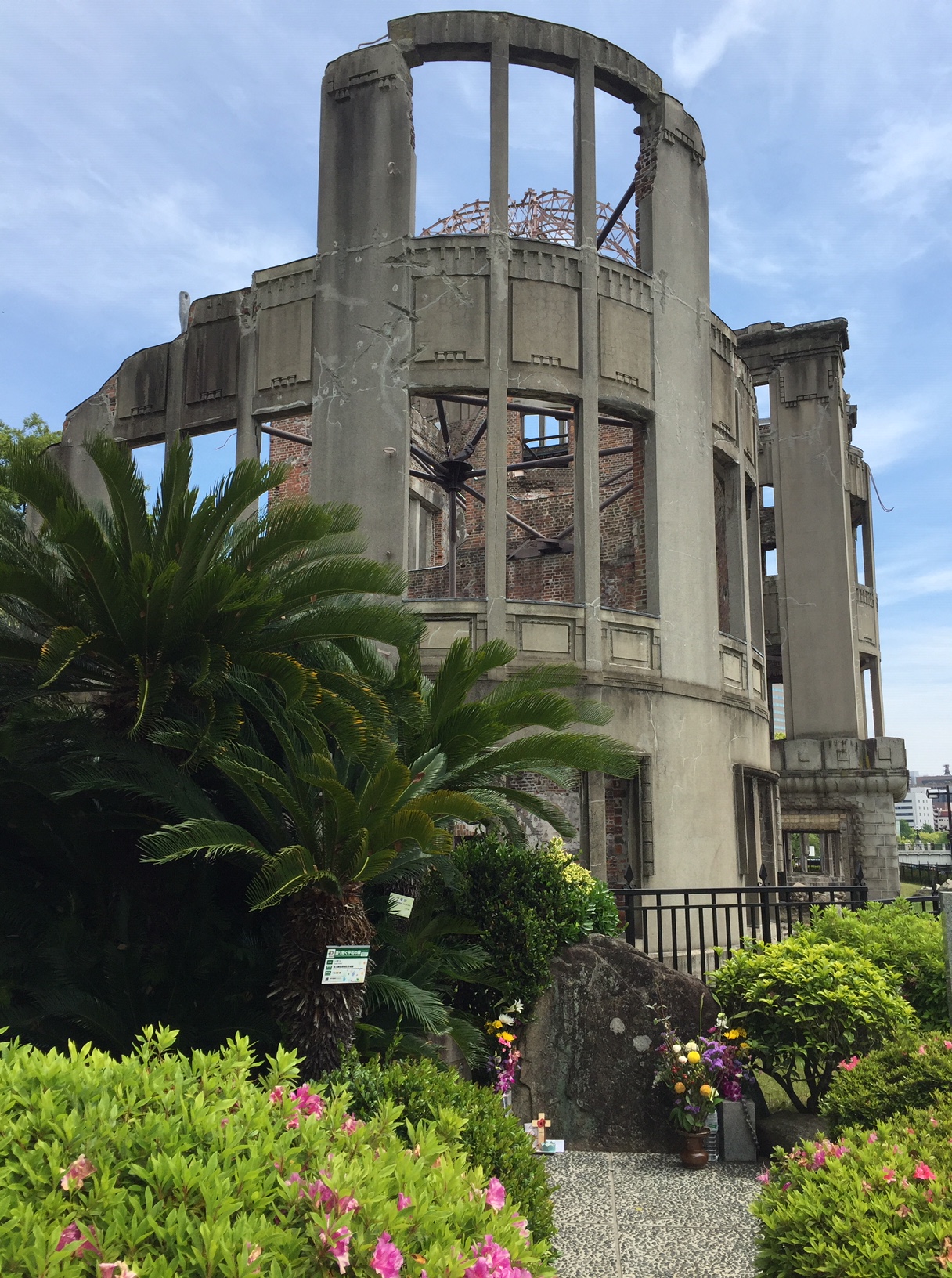
A-bomb Dome
A-Bomb Dome at Hiroshima, Japan

I was born in 1955.

  • The Cold War was in full swing and concerns about nuclear annihilation led 52 Nobel laureates to sign the Mainau Declaration against nuclear weapons.
  • Racial tensions were escalating at home, as Rosa Parks was arrested for taking a seat in the “whites only” section of the bus. Her resistance set in motion one of the largest social movements in history, the Montgomery Bus Boycott, and scared many white southerners.
  • The following year tensions were high in Egypt, as the Suez Canal crisis escalated and alliances in the always volatile Middle East shifted.
  • While many couldn’t comprehend the impact, my engineer father understood that IBM’s introduction in 1956 of the first commercial computer was going to change the world in ways good and bad.
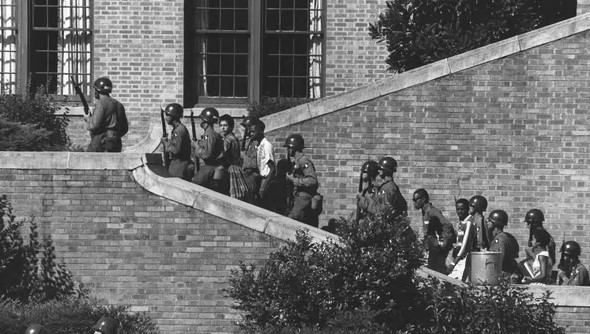
Troops protect Black students at Litte Rock Central High School
  • In September of 1957, the Governor of Arkansas, Orval Faubus, called out the National Guard to prevent Black students from entering Little Rock Central High School. President Dwight D. Eisenhower responded by ordering US troops to support the integration of those nine Black students at Central High. While a large portion of the country was elated, a similarly large faction saw their world crumbling around them.
  • Later that year, the Soviet Union launched Sputnik I, the first artificial Earth satellite, into an elliptical low Earth orbit, setting off panic in the U.S. that we were losing the “space race” to the communists.
  • On December 31, 1958, Cuban dictator Fulgencio Batista fled the country, leading to Fidel Castro’s takeover of the island’s government, 90 miles from U.S. shores, in February of 1959. That action would have major impacts on U.S., Cuba, and Soviet relations for generations and lead to the Bay of Pigs fiasco (April 1961) and the Cuban Missile Crisis (October 1962). I’m old enough to remember hiding under my desk at school as we waited for the atomic bombs to fall.
  • Birth control pills were introduced in 1960, setting off both a feminist revolution around bodily autonomy and a backlash from the patriarchy.
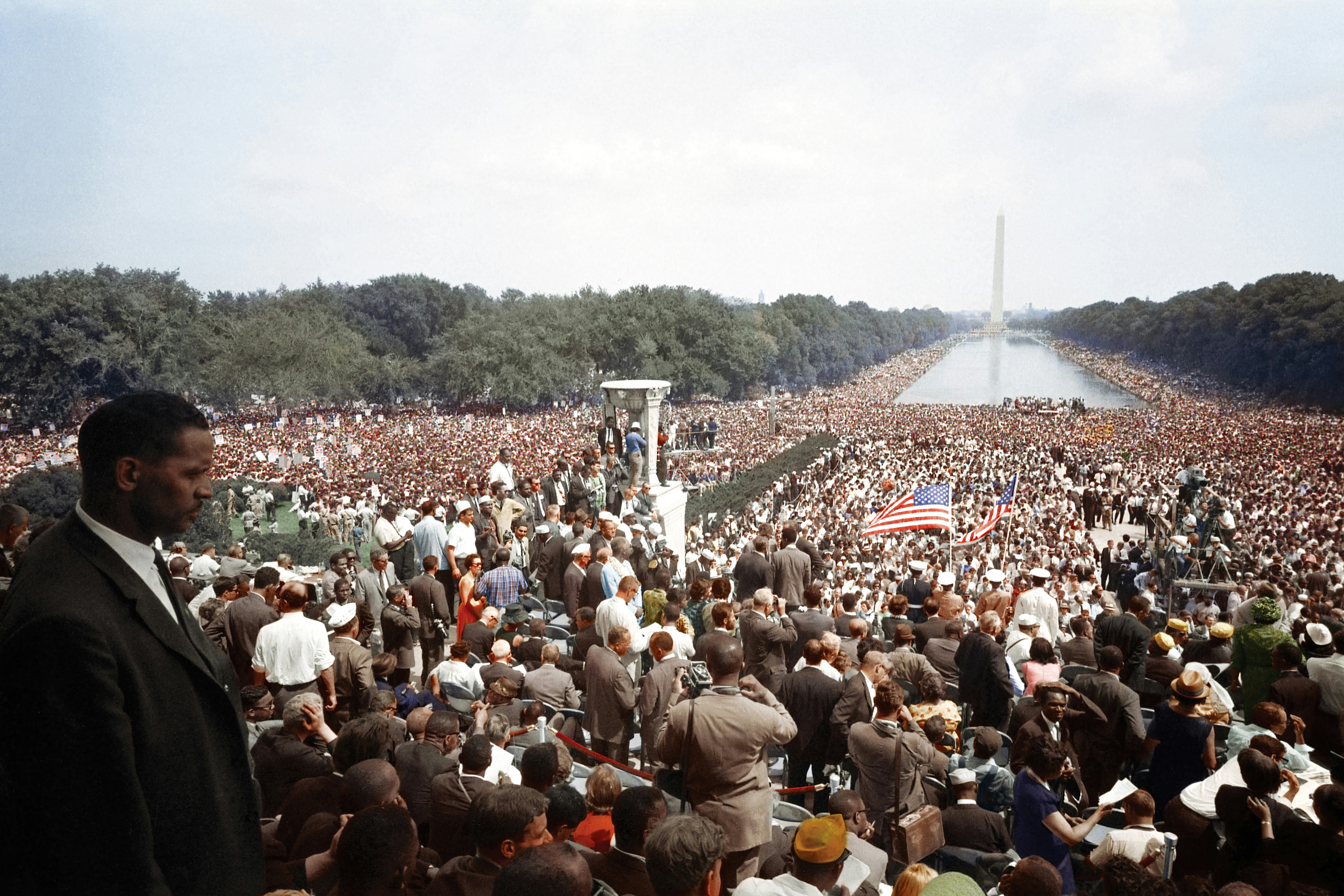
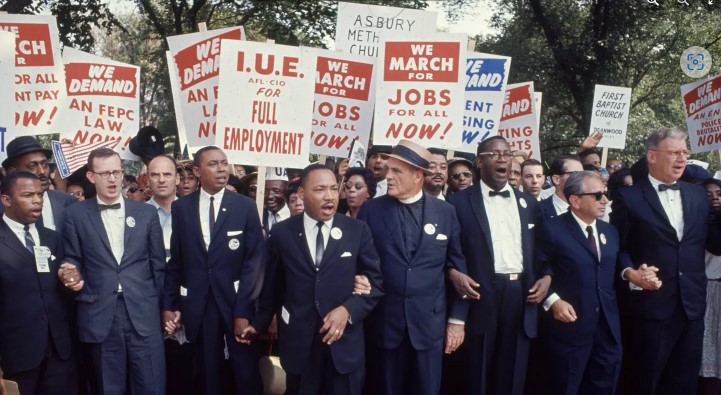
March on Washington, 1963
Capshaw Elementary School, Cookeville, TN (credit: The Living New Deal)
  • Capshaw Elementary School in Cookeville, Tennessee, where I was a rising third grader in the fall of 1963, was integrated some nine years after Brown v. Board of Education. Mother was the head of the PTA. Years later she would reflect that it was one of the most difficult years of her life. “We never had a problem with the children,” Mom noted. It was always the parents—the alleged adults in the situation—who made her job miserable.
Old City Hall in Dallas, at the spot where Lee Harvey Oswald was shot by Jack Ruby
  • The November 1963 assassination of President John F. Kennedy and the subsequent killing of assassin Lee Harvey Oswald led to fear, sadness, angst, and turmoil across the nation. For my generation, everyone remembers where they were when they heard the news, much as my parents’ generation could remember where they were when Pearl Harbor was bombed and my children’s generation would never forget the location where they first heard about the attacks of 9/11. All three were turning points in American history that brought upheaval and uncertainty.
  • 1965 saw the first large-scale US Army ground units arrive in South Vietnam. Their number would soon swell.
  • The Soviets beat the U.S. to the moon in 1966, with the first soft landing by the spacecraft Luna 9. Concerns over the impacts of a Soviet presence in space that could attack the U.S. led to an increase in spending on the military-industrial complex that has been as much as 28% of our national budget (1987) and changed our politics forever.
  • Large-scale protests against the U.S. role in Vietnam broke out in 1966, as fights over the war and civil rights began to tear the country apart.
  • The Six-Day War began in June of 1967 between Israel and the neighboring Arab states of Egypt, Jordan and Syria, reminding us once again of the fragility of peace in the Middle East.
  • Executions and assassinations took center stage in 1968, leading many to wonder if the world was going mad. On February 1st, Saigon police chief Nguyễn Ngọc Loan executed Viet Cong officer Nguyễn Văn Lém with a pistol shot to the head. The execution was captured by photographer Eddie Adams and became an anti-war icon. April 4th saw the assassination of Dr. Martin Luther King Jr. by James Earl Ray at the Lorraine Hotel in Memphis, Tennessee. Riots followed in over 100 U.S. cities, devastating many historically black neighborhoods for decades. Close on the heels of that murder, Palestinian Sirhan Sirhan assassinated presidential candidate Robert F. Kennedy on June 5th just moments after he had won the Democratic primary in California.
  • In August of that year, 250,000 Soviet and Warsaw Pact troops invaded Czechoslovakia to put down the Prague Spring.
  • And in November, Richard Nixon—who used a “Southern Strategy” to bring disaffected white Southerners into the Republican Party with promises of limitations on civil rights—was elected president by a slim margin and began a rightward shift of the party that is now playing out to its logical conclusion with the return of white supremacy, Christian nationalism, and threats of mass deportations.
  • In October of 1969, millions took to the streets to protest during Vietnam Moratorium Day as Nixon quietly escalated the war he promised to end during his campaign. It would not be the last time he lied to the American public.

Thus it has always been

Some will say that the 1950s and 1960s were especially turbulent times in the American story, but they don’t know their history.

  • In the 1770s and 1780s, we fought against the world’s strongest imperial power to gain independence and establish a new nation based on the rule of law and not the power of kings. That democratic ideal is now being tested, but not for the first time.
Mass hanging of Dakota Indians in Mankato, MN
  • Consider the more than 500-year perspective of Native Americans, who saw settlers move westward, taking over their land by force and pushing them into smaller and smaller reservations.
During the Tulsa race riots in 1921, more than 1,200 black businesses and homes were destroyed at the hands of white residents
  • African Americans came here involuntarily in 1619 and have been seeking the American Dream ever since. It appears that each step forward is met with resistance, and they are forced to take two steps back.
  • Think of the decades from 1820 until 1860, as slavery and the power of slave-holding oligarchs drove us into a deadly Civil War from 1861-1865. We’re still fighting the meaning and legacy of that war today, as seen in the battle over Confederate monuments.
  • Massive financial panics, the era of the robber barons and the great inequality of wealth, immigration scares, the Spanish flu pandemic, World War I, the Great Depression, World War II, the overthrow of European colonialism in the global South, and more recently the Covid 19 pandemic, Russia’s unprovoked attack on a sovereign nation in Ukraine, and the attempted insurrection and overthrow of a legitimately elected government on January 6, 2021, are just other examples of disruptions from history.

The point is not to deny the many achievements of the past 70 years. Rather, this summary can remind us that we have been here before. Speaking soon after 9/11, the eminent historian David McCullough reminded us:

“We think we live in difficult uncertain times. We think we have worries. We think our leaders face difficult decisions. But so it has nearly always been….It is said that everything has changed. But everything has not changed….We have resources beyond imagining, and the greatest of these is our brainpower….And we have a further, all-important, inexhaustible source of strength.  And that source of strength is our story, our history, who we are, how we got to be where we are, and all we have been through, what we have achieved.”

Abraham Lincoln—whose birthday we honored yesterday—delivered his annual message to Congress in December of 1862. He stated that we must rise with the occasion. “As our case is new, so we must think anew, and act anew.

In the coming years, we are each going to need to stay rooted to our values but stay open and creative about what forward movement might actually look like. In each of these situations above, brave, creative individuals often let go of what they thought they knew in order to entertain new avenues and creative solutions to old problems.

We all need to decide how we are going to respond in this current crisis. But please don’t say this is unprecedented. History tells us otherwise. It also tells us we can do hard things.

More to come . . .

DJB

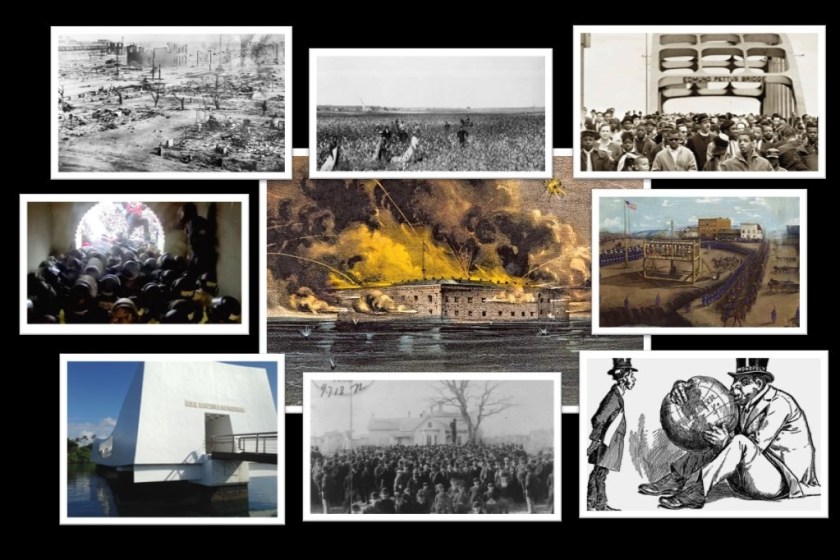
Photo collage by DJB: From top left clockwise: Tulsa Race Riots, Cotton fields, protestors at Edmund Pettus Bridge, hanging of Dakota Native Americans, Monopoly cartoon, lynching of Black American, Pearl Harbor memorial, January 6th insurrection, attack on Ft. Sumter (center)

Just when I thought it was safe to watch the Super Bowl again . . . *

Long-time readers will know there was a period when if it was the first Sunday in February, it must be time for my annual Super Bowl rant. The last one of these rants actually came in 2018 and I called it Rant IV, given that Rants III, and III had already played out on the virtual pages of MORE TO COME . . .

Over the course of those years, I gave readers 14 reasons I wouldn’t be watching the Super Bowl. (And yes, reason #10 is these stupid and pretentious Roman numerals.) 

But reason #11, which I posted two years in a row, related to a certain team in New England, and their intolerable head coach and quarterback. Remember, this was back in 2018.

“11.  It’s the damn Patriots. Again. Is there anyone more insufferable in sports than Bill Belichick/Tom Brady? (Wait, I’ll answer that. Maybe Coach K. But that’s another post. And I know that Belichick and Brady are actually two people, but I’ve grouped them as one because they synch their grating to perfection.) They push rules up to the line and over, and then act like their sainthood has been challenged when they are caught.” 

In recent years I’ve slowly dipped my toe back into the water to watch an occasional NFL game, especially those featuring Patrick Mahomes and the Kansas City Chiefs. Their last-second “pull it out of the hat” endings are just so exciting. And since Mahomes and the Chiefs were going for the threepeat in this year’s Super Bowl, I thought I’d venture a look.

Oh. My. God. No one told me the insufferable Tom Brady was the “analyst” on the game . . . for the unwatchable Fox network. (See reasons #4, #8, and #12 from the earlier posts. I’ve been calling out Fox’s sins for years.) On Sunday I watched the first half and was thankful it was a blowout, because I felt perfectly fine leaving Tom Brady to simply say out loud what everybody already saw.**

Joe Posnanski, as I expected, had a wonderful take on the boredom that is Tom Brady and he also did a good job of explaining why the game itself was a blowout. Brady, he noted, offered up occasional dry insider terms (“We call that a ‘rub route’”) and would dive into the collection of cliches that were “so useful to him in postgame press conferences (winning the Super Bowl is the ‘highest of highs,’ but losing the Super Bowl, alas, is the ‘lowest of lows'”).

“This is simply who Tom Brady is and has always been. I imagine that while Fox Sports might prefer a few more insights here and there, they had to know that this was more or less what they would be getting. Brady has worked hard at improving—working hard to get better is a defining Brady trait—and he did progress in his first year from an unlistenable sound machine to relatively odorless and harmless background noise.”

I’ll have to take Joe’s word for that. I haven’t been following Brady’s broadcasting career. Per the dozens of comments on Joe’s post, many others feel the same way I do about Tom Brady.

Joe also had a spot-on rant about how “pretty much every Super Bowl commercial this year was basically little more than a star cameo.” For guys my age, the Hellmann’s Mayonnaise commercial—with an aging Harry and Sally—brought a bit of a laugh but also a cringe. As Joe said,

I remember when Super Bowl commercials were just frogs croaking ‘Bud-weis-er.’”

This serves me right, I suppose. The real reason I don’t really enjoy watching NFL football comes back to concussions. As someone whose spouse fell and suffered a serious concussion in 2011, an injury which took a full year for recovery, I’ve seen firsthand the very real effects of impacts to the head.  I worry a great deal more these days about spills, trips, crashes, and other mishaps that could lead to concussions. So why do I want to watch—and support—a sport where hitting someone as hard as you possibly can is considered great play? And when I read about the stars of my youth—players such as the remarkable Tony Dorsett—having signs of chronic traumatic encephalopathy (CTE), a degenerative condition many scientists say is caused by head trauma and linked to depression and dementia, I wonder if I can continue to support a sport that leads to such injuries. I know that concussions occur in all sports, baseball included. But no other sport outside of boxing comes to mind where the play itself puts players in such risky situation on such a regular basis.

So I scratched an old itch and got pretty much what I deserved. Please send me this post next year if I mention that I’m thinking about tuning into the game.

Spring Training
Credit: SpringTrainingCountdown.com

And guess what?! Spring Training Countdown was revised for this year to reflect the Cubs’ announcement of pitchers and catchers reporting on February 9, 2025 (the day OF the Super Bowl and notably earlier than most other teams due to their unique situation of opening the regular season in Tokyo against the Los Angeles Dodgers on March 18.)

Let’s play ball!

More to come . . .

DJB


*This is your official Super Bowl Rant V!


**UPDATE: Another commentator phrased it all this way: “The most insufferable team played against the team with the most insufferable fans in front of the most insufferable person.” I pretty much agree on all points.

I love the pithy proverb — Volume 10

Five years ago I created a feature on MORE TO COME to capture some of my favorite sayings without having to write an entire post. I labeled it More to Consider. 

I’ve long been a fan of the pithy proverb—a quote or bit of advice that contains truth in 20 words or less. “Social media is an aphorism machine,” notes the New York Times in Your best advice of 2024. “Any bit of marginally useful wisdom has been reproduced in a paintbrush font and shared a million times on Instagram or TikTok.” 

This was news to me as I’m not on platforms like Instagram. My love for the short and to-the-point adage is much more old school, coming from my Grandmother Brown, who was known to say things such as,

“The graveyard is full of people who thought the world couldn’t get along without them.”

Mary Dixie Bearden Brown (among others).
Mary Dixie Bearden Brown and George A. Brown—my grandparents as young newlyweds

I admit I might have heard that particular one when she thought I was getting too big for my britches. Grandmother, who passed away in January of 1981, was definitely not a social media influencer, although her life had a great impact on mine.

After posting these pithy proverbs on MTC and collecting them in summaries every six months, I decided to use 2024 to reprise some of my favorites from the first five years. * So, as one of those favorites instructs us . . .

“Pay attention. Be astonished. Tell about it.”

Mary Oliver

BE USEFUL AS WELL AS ORNAMENTAL

Unsplash

Grandmother admonished me to get up off the couch and get to work with what became, in later life, one of my favorite bits of advice.

“Make yourself useful as well as ornamental.”

Mary Dixie Bearden Brown

Getting there may be difficult, but I find myself drawn to these calls to reach for your potential, as the effort is worth it.

“Our potential is one thing, what we do with it is quite another.”

Angela Duckworth, from “Grit”

“Difficulty is always a school, though learning is optional.”

Rebecca Solnit

“Hope is hearing the music of the future; belief is dancing to it.”

The Rev. Dr. Francis Wade

“On occasion we write a sentence that isn’t, in fact, correct, but it sings. And the question is: Would you rather be the ornithologist or the bird?”

Colum McCann

“The reason why we have two ears and only one mouth is so we might listen more and talk less.”

Zeno

LOVE YOUR NEIGHBOR. NO EXCEPTIONS.

Following the simple Biblical admonition to love your neighbor has never been easy, but our retreat into tribes and social media rabbit holes seems to have made it worse in recent decades. Several of my favorite adages speak to this challenge, from finding loveliness in the world around us, to watching what you say about others.

“To live with ugliness, we must hallow loveliness / the more, remembering that it often springs / from mud into light-filled air.”

Judith Farr from “What Lies Beyond”

“Nobody’s free until everybody’s free.”

Fannie Lou Hamer

“If you tell the truth you don’t have to remember anything.”

Mark Twain

“I distrust those people who know so well what God wants them to do because I notice it always coincides with their own desires.”

Susan B. Anthony

FIGHT FOR DEMOCRACY

U.S. Capitol, Washington D.C. Photograph by Carol Highsmith.

It is clear that America is in a fight to save democracy. Some of my favorite aphorisms from the past five years speak to this time of trial.

“If you are neutral in situations of injustice, you have chosen the side of the oppressor.”

Desmund Tutu

“Power doesn’t corrupt, it reveals.”

Robert Caro

“To be led by a coward is to be controlled by all that the coward fears. To be led by a fool is to be led by the opportunists who control the fool.”

Octavia Butler

“A sense of history is an antidote to self-pity and self-importance.”

David McCullough

The assault on 2024 is a crock-pot coup, simmering low and slow, under cover, breaking down the fibers of our electoral system, until one day democracy itself is cooked.

Anand Giridharadas

“It is difficult to get a man to understand something, when his salary depends on his not understanding it.”

Upton Sinclair

“America has many problems. Reading too many books is not one of them.”

Ryan Holiday

REMEMBER WHAT MATTERS

Two of my favorites from the first five years have at least a tangential relationship to sports, the first from an article about robo-umpires in baseball, and the second a classic quote from Buffalo Bills coach Marv Levy about what’s really important.

“The strike zone is a fretless bass. Historically, a certain discretion has been appreciated.”

Zach Helfand in a New Yorker article on robo-umpires

“No game is a must-win. World War II was a must-win.”

Marv Levy

WHATEVER ELSE STRIKES MY FANCY

The final set of favorites cover a grab bag of topics and truth.

“The edge of things is a liminal space—a holy place or, as the Celts called it, ‘a thin place.’ Most of us have to be taught how to live there.”

Richard Rohr

“Expectations are resentments under construction.”

Anne Lamott

“Nothing is more desirable than to be released from an affliction, but nothing is more frightening than to be divested of a crutch.”

James Baldwin

“I find television very educating. Every time somebody turns on the set, I go into the other room and read a book.”

Groucho Marx

“The kindest person in the room is often the smartest.”

J.B. Pritzker

“Attention is the beginning of devotion.”

Mary Oliver

We can all do much worse than to follow the “instructions for life” by Mary Oliver.

More to come . . .

DJB


* After the initial More to Consider post pulling together the first group highlighted, I brought out Volume 2: A plethora of pithy proverbs followed with Volume 3: A profusion of pithy proverbs and Volume 4: A plentitude of pithy proverbs. I finally turned to the Super Bowl system (minus the pretentious Roman numerals) with I love the pithy proverb — Volume 5Volume 6Volume 7Volume 8, and Volume 9. For this 10th volume, I highlighted some personal favorites from the first nine editions. This post was originally titled “Best of five years of More to Consider” but then I decided to keep the numbered editions going.


Photo of pithy proverbs from Pixabay

What Did the Blackbird Say to the Crow

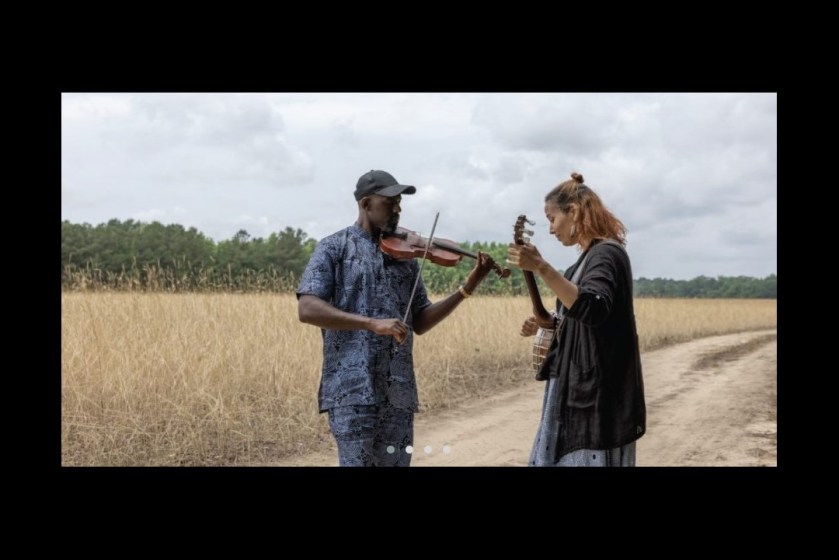
Rhiannon Giddens and Justin Robinson are two of the world’s preeminent experts on Black contributions to folk, old-time, and string band traditions. They have announced they are reuniting on a new album in April, What Did the Blackbird Say to the Crow, that will feature 18 traditional North Carolina fiddle and banjo tunes tracked live and in remarkably simple settings, “captured entirely outdoors and accompanied only by the wind, the rustle of the foliage, and the singing of nearby birds.” The Bluegrass Situation picks up the story:

“With the announcement, the pair have released a live performance video of ‘Hook and Line’ (watch below) that was recorded at the home of Joe Thompson, their late mentor and a vital roots music forebear in the Black string band tradition’s modern iteration. What Did the Blackbird Say to the Crow was tracked in meaningful locations such as this, tying this body of music directly back to the land, the locales, and the people that birthed it.”

Giddens is a MacArthur “Genius” and two-time GRAMMY Award winner and 11-time nominee. Robinson is also a fellow GRAMMY winner, thought leader, botanist, and ethnomusicologist. Both were founding members of the incredibly important supergroup the Carolina Chocolate Drops. “The string band would end up defining the early 2000s era of old-time music, making a huge mark in Americana circles and spawning multiple generations of Black roots-and-folk musicians after them.”

Here’s an old video of the Chocolate Drops singing and playing Cornbread and Butterbeans, followed by a video from 2007 of the group playing on the UNC-Chapel Hill campus.

Giddens & Robinson will be on tour with Dirk Powell and more beginning in April 2025. And for friends in the Carolinas, make plans now to attend Giddens’ inaugural Biscuits & Banjos festival to be held in Durham, North Carolina, at the end of April.

More to come . . .

DJB

From the bookshelf: January 2025

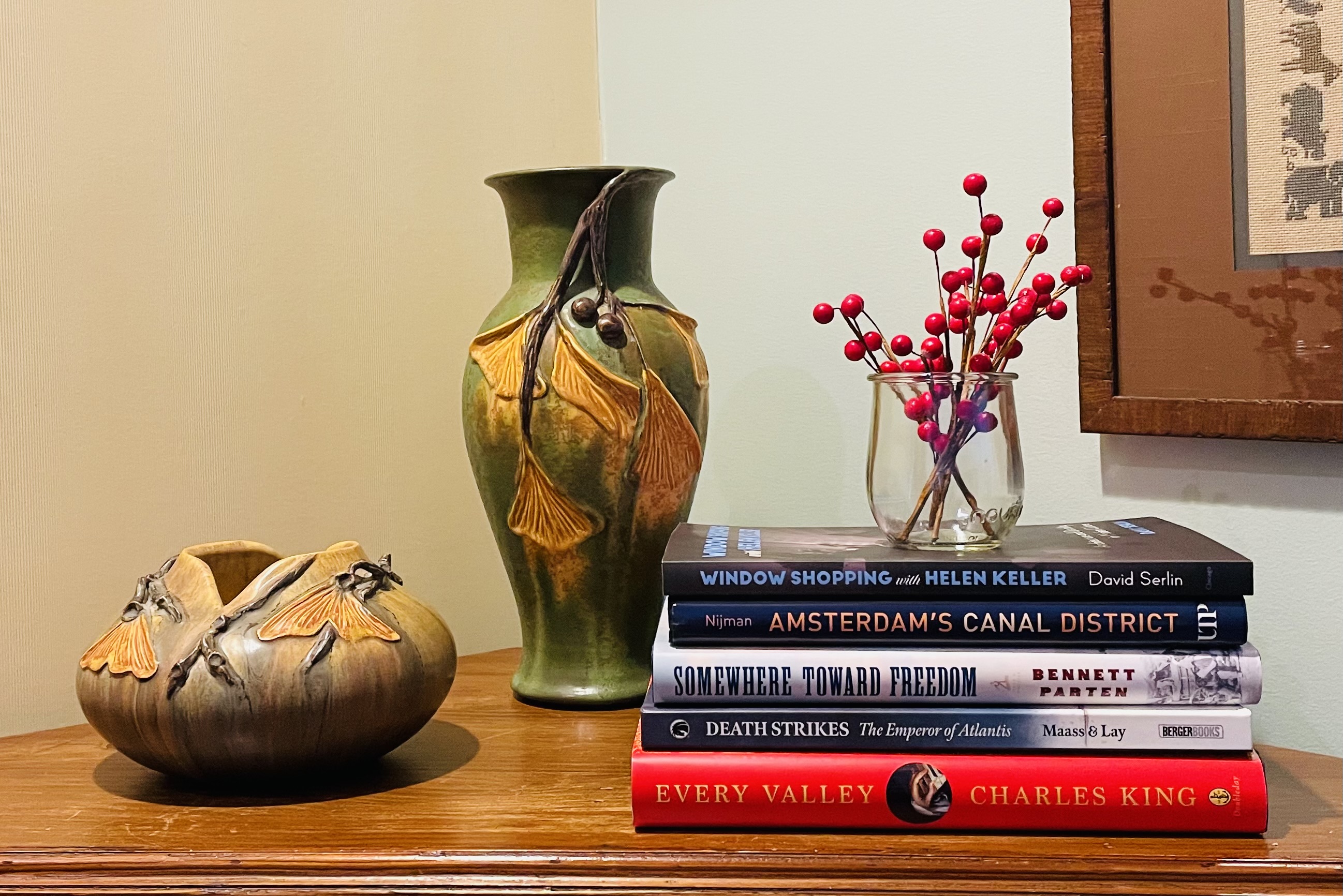
Each month my goal is to read a minimum of five books on a variety of topics from different genres. Here are the books I read in January 2025. If you click on the title, you’ll go to the longer post on MORE TO COME. Enjoy.


A Psalm for the Wild-Built (2021) by Becky Chambers takes place on a small moon called Panga, centuries after the Awakening at the end of the Factory Age, when the robots “employed” by humans decided they wanted to depart for the wilderness to observe “that which has no design.” They had long ago faded into myth and legend until Sibling Dex takes a turn off the paved road, heads into the wilderness, and meets Mosscap, a 7-foot tall, metal-plated, boxy-headed, wild-built robot who is on their own mission. This lovely story is for anyone who could use a break.


In the Beginning was the Spirit: Science, Religion, and Indigenous Spirituality (2012) by Diarmuid O’Murchu takes a broad look at what many know as the third member of the Christian Trinity. In place of anthropocentric traditional approaches to Christianity which tend to place the spirit in a type of little brother relationship to the creator (God) and savior (Jesus), O’Murchu wants us to look at the creative act described in Genesis and recognize the Spirit as that which breathed over the formless void. The Spirit, in O’Murchu’s telling, “is the force behind the recurring words ‘Let there be . . .’”


The Tech Coup: How to Save Democracy from Silicon Valley (2024) by Marietje Schaake is an extraordinarily frightening and important new work on how the tech giants of Silicon Valley have become “too big to fail and thus too big to regulate, causing harm to all of us.” With a subject that is large and technically complex, Schaake has written a book that is both engaging and readable, even for the non-expert. Which is a good thing, because what she describes affects each one of us. The ultimate result of this coup is “the fundamental erosion of personal freedom and democratic norms” all for the benefit of American oligarchs.


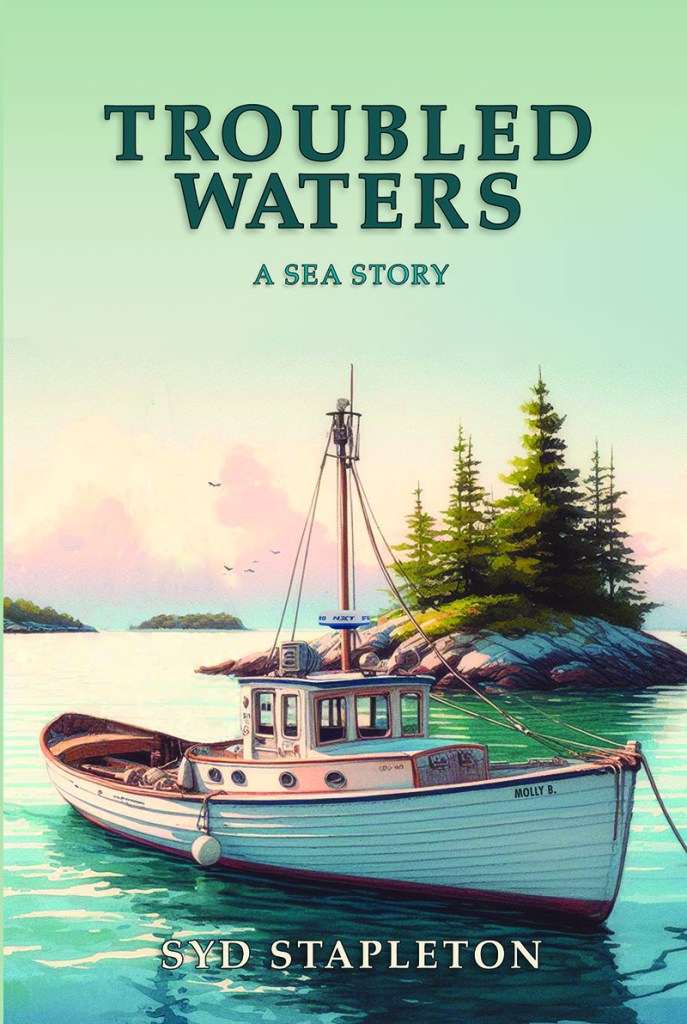
Troubled Waters: A Sea Story (2024) by Syd Stapleton is a tale about an environmental disaster and cover-up wrapped in a whodunit. Our hero, Frank Tomasini, is a 47-year-old marine surveyor who lives comfortably on the Molly B, a 1937 salmon troller, which has been lovingly refurbished by its former owner who also happens to be Frank’s best friend. Frank is asked to unofficially survey the damage to an abandoned and adrift boat that belongs to Arthur Middleton, a “rich and holier-than-thou environmental warrior.” It turns out very few people, including Arthur’s brother, a high-powered Seattle business shark, seem too eager for Frank to find out what happened. I discuss the work with Stapleton in my most recent Author Q&A.


Jesus and the Disinherited (1949) by Howard Thurman is the work that inspired The Rev. Dr. Martin Luther King, Jr. and countless other advocates for peace and justice. Rev. Otis Moss, III highlighted the uniqueness of Thurman’s book when he wrote, “No other publication in the twentieth century has upended antiquated theological notions, truncated political ideas, and socially constructed racial fallacies like Jesus and the Disinherited.” In this seminal work, Thurman stresses that Jesus “recognized fully that out of the heart are the issues of life and that no external force, however great and overwhelming, can at long last destroy a people if it does not first win that victory of the spirit against them.”


What’s on the nightstand for February (subject to change at the whims of the reader)

Keep reading!

More to come…

DJB


NOTE: Click to see the books I read in December of 2024 and to see the books I read in 2024. Also check out Ten tips for reading five books a month.


Photo from Pixabay.