Latest Posts

David Grier at IMT

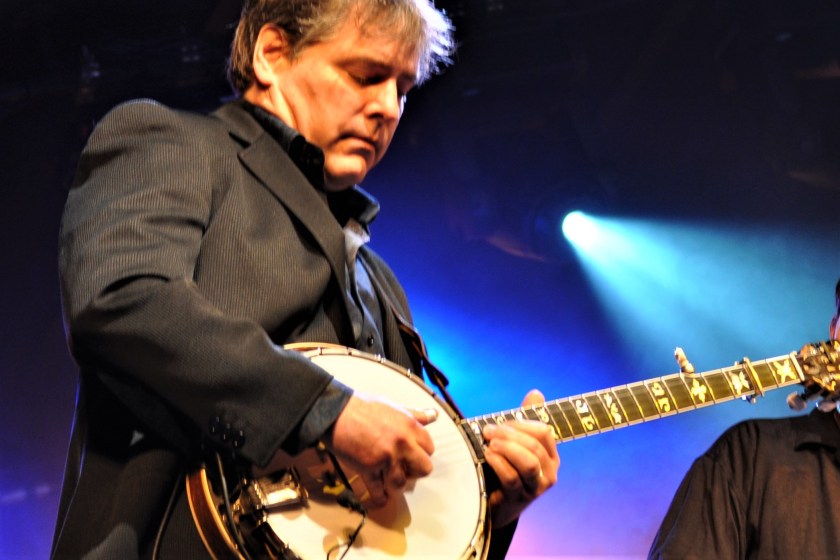
All of David Grier’s guitar skills were on display tonight at the Monday evening concert of the Institute of Musical Tradition in Rockville.  Greir opened with a spirited version of Durham’s Bull, an old fiddle tune (and afterwards opined that all fiddle tunes are described as “old”), and then put on a two-hour tour de force of flatpicked guitar and bad jokes.

It is a tall order to keep an audience’s interest with two hours of solo flatpicked guitar, but Grier made it look easy.  With equal measures original tunes and flatpicking chestnuts – with the occasional popular tune such as Yesterday thrown in as well – Grier showed why he’s one of the best flatpickers on the planet. 

This was an evening of highlights:  the beautiful intro for Red Haired Boy, the original waltz High Atop Princess Cove, and the Stephen Foster tune Angeline the Baker among themOne of Grier’s best recorded efforts is the Bill Monroe tune Old Ebenezer Scrooge, which he worked as a duet with bassist Todd Phillips on the Grammy award winning True Life Blues:  The Songs of Bill MonroeTonight he played it as a powerful solo piece which fared much better than the “stupid fast” (Grier’s description) version of the other Monroe tune Roanoke that ended the show.

However, any complaints are nitpicking, and the numerous guitarists in the audience were there for a different type of picking.  Suffice it to say that Grier satisfied.

In poking around on You Tube, I found the following video that features a young Grier with other winners of the International Bluegrass Music Association (IBMA) instrumentalists of the year awards.  Enjoy Shenandoah Breakdown by Grier (displaying a fun use of time on his guitar break) with Sam Bush on mandolin, Jerry Douglas on dobro, Stuart Duncan on fiddle, Tom Adams on banjo, and the late Roy Huskey, Jr. on bass.

More to come…

DJB

Slow Blogging

The Sunday New York Times included a story on “Slow Blogging.”  I had never heard of the term (although I am aware of the slow food movement), but I found myself agreeing with the rejection of immediacy, the thought of blogging as meditation, and the precept that not all things worth reading are written quickly. 

This approach is a deliberate smack at the popular group blogs like Huffington Post, the Daily Beast, Valleywag and boing-bong, which can crank out as many as 50 items a day.  On those sites, readers flood in and advertisers sign on.  Spin and snark abound.  Earnest descriptions of the first frost of the season are nowhere to be found.

In between the slow bloggers and the rapid-fire ones, there is a vast middle, hundreds of thousands of writers who are not trying to attract advertising or buzz but do want to reach like-minded colleagues and friends.  These people have been the bedrock of the genre since its start, yet recently there has been a sea change in their output:  They are increasingly turning to slow blogging, in practice if not in name.

The blogger profiled in the Times story is Barbara Ganley, and she has a lovely post in response to her new-found fame.  As is my habit, I searched through her blog and found several wonderful pieces, including this reflective piece on the morning after the election.  If you like thoughtful writing, Vermont, beautiful photographs and more, you may want to explore bgblogging as well.

As regular readers know, More to Come…is quirky and certainly isn’t tied to either the news cycle or my professional life.  Perhaps Ms Ganley and other slow bloggers have given me a context for what I’ve called my therapy.  That gives me something to ponder.

More to come…

DJB

Great Acoustic Guitar in Washington

There are few things in life I like better than the sound of an acoustic guitar.  So I’m looking forward to two upcoming concerts in the Washington, DC area by three terrific players.

On Monday night, one of the best guitar flatpickers on the planet will be playing at the Institute of Musical Traditions series at Saint Mark’s Presbyterian Church in Rockville.  David Grier is well-known to flatpicking aficionados and along with a busy session schedule handles the guitar duties in the supergroup Psychograss.  Watch the video below of Grier and Wyatt Rice – younger brother of guitar superstar Tony Rice – and you’ll see why we flatpicker wanna-be’s will be in attendance on Monday, flatpicks clutched in our right hand taking in every lick.

For those of you who prefer your acoustic guitar fingerstyle (which I also love), you only have to wait two weeks to December 8th for the IMT concert featuring Al Petteway, Amy White, and Robin Bullock.  Petteway and Bullock both have inventive minds and beautiful tones.  Their holiday-flavored concert, which features the silver-throated White on a variety of instruments, is always a favorite.  Make your plans now. 

I bought some new strings today in anticipation of the playing to come after I’m inspired by these terrific musicians.  Join me in supporting live music and your local music store! 

More to come…

DJB

Searching the Internet and Finding…The Edge of the American West

In yet another of my posts on very interesting web sites found while searching the Internet, I bring you today The Edge of the American WestThis is a site that contains writings by historians and philosophers, leading the site to suggest that “History is Philosophy teaching by examples. ”

The interests of these men and women run the gamut, if recent posts are any example.  They do a regular This Day in History type of post, one of the most recent being about the day that Richard Nixon declared he wasn’t a crook.  To give  you a sense of the politics here, the post is entitled Yes You Are.  And Also a Liar.”   There are posts on camel metaphors (having to do with choosing cabinet members), and the day in 1972 when the Dow Jones Industrial Average first closed above 1,000.  (We may be headed back there!)

But I knew this was a website worth checking when I read Aw, that could have been MY headHere the writer tells the story of how he “taught the future professional wrestler – and now Heavyweight Ultimate Fighting Champion – Brock Lesnar.”  It is a very funny post, where the writer notes that he, “was less than impressed with Lesnar’s academic potential; his essay on Kant’s anthropology of race was likely not his finest work.”

After noting that Lesnar had wrestled in college, the writer goes on to say  that:

Lesnar parlayed his amateur glory into a three-year run with World Wrestling Entertainment, during which time he evidently vaulted to the top of his profession, wrestling the likes of Hulk Hogan and The Rock on his way to becoming the youngest WWE champion in history. As I understand it, he was known for such moves as the “spinebuster,” the “scoop powerslam,” the “rear naked choke,” and something mysteriously known as “repeated turnbuckle thrusts.” His signature line, Wikipedia tells me, was “Here comes the pain!” — a phrase that I suppose I could have utilized whenever returning Mr. Lesnar’s written work.

You just can’t make this stuff up.  Check out The Edge of the American West.  You’ll probably find more than a few things of interest.

More to come…

DJB

The Lincoln Memorial

A case of the slows

With two sophomores in Pre-Calculus, Spanish, Honors Chemistry, and the like, there’s not much I can do to help with homework these days.  So when Claire asked me to come over to her chair tonight to look over a review sheet, I went with some trepidation.  She must have seen my fear, so she added, “It is for history.”

Whew.  That I can handle.

Her note sheet had some smudges, obscuring some of the answers.  So she asked “Why did President Lincoln fire McClellan?” 

“The first or second time?”  My response surprised her, but she re-read the question and realized it was referring to the second time.  So I said, “because he refused to attack Lee’s retreating army after Antietam.”  She looked at her sheet, figured out the missing words around the smudge, and decided I was right.  One for the old man.

“How did President Lincoln describe General McClellan?” Claire asked.  “That’s easy,” I replied, “Lincoln said McClellan, ‘had a bad case of the slows.'”  

Now I had her!  “How did you know that?!” she exclaimed.  I smiled.  It isn’t often I get to bask in the glow of admiration from my teenagers’ when it comes to questions of homework.

Finally!  All those years of devouring Civil War histories paid off in the self-satisfied feeling you get when you come across as something less than clueless to your teenagers.  You’ll never know when you have to pull a quote about “The Little Napoleon” out of the air.  So study up!

More to come…

DJB

Fired Up and Ready to Go

A friend recently pointed me to a blog posting entitled In Defense of Raising Money:  A Manifesto for NonProfit CEOs written by a man by the name of Sasha Dichter.  Now you may think that sounds like a very boring topic, but if you care about any cause – be it eradicating poverty, health care reform, the arts, AIDS, historic preservation, you name it – read this manifesto.  It is a powerful piece that talks about how your dream and passion has to be bigger than your ego.  Just a sampling…

Spending your time talking to powerful, influential people about the change you hope to see in the world is a pretty far cry from having fundraising as a “necessary evil.” 

Do you really believe that the “real work” is JUST the “programs” you operate?  (the school you run; the meals you serve; the vaccines you develop; the patients you treat?)   Do you really believe that it ends there?  Do you really believe that in today’s world, where change can come from anyone and anywhere, that convincing people and building momentum and excitement and a movement really doesn’t matter? 

Of course your programs or investments are real work.  But so is evangelizing, communicating, sharing, convincing, cajoling, and arm-twisting.  So are videos and images and stories and ideas.

If your ideas and programs and people and vision are so great, shouldn’t people be willing to reach into their pockets and fund them?   If it’s worth spending your life doing this work, shouldn’t you or someone in your organization be able to convince someone else that the work is worth supporting?

In the for-profit world, nothing happens if you don’t have a compelling product with a compelling story that wins out in the marketplace of ideas and gets people to act.  People get so excited about Apple’s products that they blog about the next release, scour the Internet for registered patents, spread ideas and rumors about what is coming next, and convince the people around them that Apple = cool.  Do you think this would happen without Steve Jobs living and breathing the brand each and every day?

So how is it that in the nonprofit sector we create this illusion that growth and change and impact can happen absent this kind of energy and engagement? 

There’s this unspoken idea floating around that “fundraisers” can go about their work in a vacuum, having quiet, unimportant conversations with nameless, faceless rich people, while all the while the people who do the real work (the program folks) can go about their business, separate from and unconnected to this conversation. 

What a waste. 

Don’t you think that creating a tribe of connected, engaged, passionate evangelists for your cause will create a positive feedback loop that will amplify the change you hope to see in the world?  It doesn’t matter if that tribe is 300 powerful, smart, wealthy people or 3 million regular folks who believe in you and the change you hope to make.  If they are passionate and engaged and you give them a way to help, you will amplify your impact.   

Sasha Dichter writes that storytelling is a skill, and all good nonprofit CEOs have to be storytellers.  I read this on the same night I was reminded of the story-telling skills of our President Elect.  Watch this great video – made at Obama’s final pre-election rally held about an hour from our house in Prince William County, Virginia.  It is a great story, but more importantly it shows the power of one person filled with passion and zeal.

More to come…

DJB

Wrap-Up from Vienna

As promised, I’m posting a few additional photos from my travels to Vienna, Austria last week.  The top two photos are a detail from Hofburg Palace and a view of St. Peter’s Church in the rain.

Hofburg PalacePeterskirche


The next is a detail from St. Peter’s.

Peterskirche Detail


Finally, the last two are shots from St. Stephansdom:  the organ on the left and a detail of the pulpit and nave on the right.

More to come…

DJB

Organ at St. Stephansdom

St. Stephansdom

The Best Places to Raise Your Children…Murfreesboro Edition

Murfreesboro Courthouse

(NOTE: See my 2020 update to this post here.)

Business Week magazine just included Murfreesboro, Tennessee as one of the best places to raise your children.  Well, if they’d just asked me I could have told them that a long time ago.

For years now, I’ve been using a little vignette about growing up in Murfreesboro as a part of a talk I give about the livability of towns and cities.  While Business Week focuses on Murfreesboro as a recession-proof college town, I believe there’s a lot more to it.

When I think of home, I remember 407 East Main Street in Murfreesboro.  I grew up in Murfreesboro when it was a city of 35,000 people.  My parents bought a simple 1880s-era home on Main Street because it had an apartment where my grandmother could live with us.  Over the course of twenty years, four generations of our family lived under this roof.

Murfreesboro has a history that was very real and very present to me as a child.  I could walk four blocks to the town square, where the 1850s courthouse (see photo above) served as a reminder of Nathan Bedford Forrest’s 1862 raid on the city.  In a time before Murfreesboro’s streets were given over completely to cars, I often bicycled out to the Stones River National Battlefield on the edge of town, because I was fascinated by the story of that terrible battle around New Year’s Day in 1863.  As I grew older I could walk to my job at Martin’s Drug Store on the square, or stop in for lunch at the City Café – both located in buildings that had a history.

My high school was two blocks away in the opposite direction.  This 1960s building was located on the site of the Tennessee School for Women, an early educational institution in a town where education was important.

The core of Murfreesboro – what today has been identified as its “historic district” – was very livable.  We were one block from our neighborhood grocery store, where the bag boys like my younger brother Joe could often be seen carrying groceries home for the older residents in our neighborhood.  Mr. Clardy, who ran that grocery store, also managed what was then called a “guest home” three doors down from our house on Main Street.  This fabulous Queen Anne style mansion was a home-away-from-home for businessmen traveling to the city.

I was three blocks away from the Baptist Church and its early 20th century building, where I spent a good deal of time, but I could have been just about any denomination and still walked from my house to the local congregation’s home.  The public library, where my mother was the children’s librarian for many years, was five blocks away in a renovated post office building.  Today we call this adaptive reuse.

“Main Street” sounds like the fashionable residential location for most communities, and it was true that we had our share of large Victorian mansions as neighbors.  But next door to our house was an apartment building – which was not the only one on the street.  We lived one block from what today would be called “affordable or workforce housing” and our neighborhood was mixed both racially and economically.  Until I stopped growing, I was a baseball and basketball junkie, and spare hours were spent on the school fields and courts with kids of all races and economic groups.  Our banker lived in our neighborhood.  But so did college fraternity boys, shopkeepers, housekeepers, and the wide range of people who made up Murfreesboro at that time.

We all went to school together, and the public schools in Murfreesboro were the pride of the state.  The community cared about its children, from providing good schools to providing an environment where my grandmother – and others of her generation like Mrs. Roberts and Mrs. Todd – could nurture us, help us feel safe, and receive care and love in return.

You may think that I am painting an idealistic picture of my childhood in Murfreesboro.  I will admit that we had our share of problems to address.  However, Murfreesboro at that time was designed in such a way that we had to work out our problems and we had built-in support structures that made such communication possible. 

And the Murfreesboro that I knew was not so much different from other communities in America built prior to World War II.

My father grew up on Second Avenue in Franklin, Tennessee, in a wonderful Victorian-era cottage.  I remember the house fondly from visits I made to my grandparents.  Like me, my father could walk to school, church, the grocery store, and the town square.  As a college student at Vanderbilt, he caught the Inter-urban bus from Franklin to Nashville daily – a transportation system that had evolved from an earlier streetcar line where my grandfather served a stint as a conductor.  As a young boy I would walk to the store one block from my grandmother’s house and pick up her groceries, which were kept on a tab until she stopped in to pay it later in the week.  That grocery store was in a converted church building, for once a building had moved beyond its original use it didn’t necessarily have to be torn down to remain productive.  My older brother Steve and I would be visiting my grandparents and hear the train whistle at the depot, which was at the end of the block.  We would both tear out the front door and make it down in time to look at the long trains moving through the town.  If we were lucky, the train stopped and we would talk with the engineers and conductors and hear about life on the railroad.  As a young boy, I loved exploring Franklin as much as I enjoyed exploring Murfreesboro.

Why is all of this important?  Because we have now raised an entire generation of citizens who have no idea what a wonderful and enriching place a city or town can be, especially for a child.  We are not building “communities” that connect our past and future anymore and many citizens no longer feel they have a “home.”

The way of life lived in my father’s generation – and I was lucky enough to get much of the same type of life – was inexpensive and fostered a sense of community.  Elderly people like my grandmother served as neighborhood watchdogs.  Children like me could be independent – riding our bikes or walking throughout the neighborhood – while still being observed by adults who knew our parents.  The middle class, poor, working class, and upper class patronized the same schools, stores, and public places.  We knew each other and everyone had a stake in maintaining public order.  And though my father no longer owns 407 East Main Street, it is still the house that I think of when I hear the word “home.”

So Business Week got it right…but they don’t know the half of it.  Children need community – places like Murfreesboro and Franklin and Staunton, Virginia – all places I’ve lived and loved.  But there are great communities in cities, like in Silver Spring, Maryland where we currently live, where great neighborhoods are within walking distance of a revitalizing downtown and beautiful Sligo Creek and a short metro ride away from downtown Washington (which has its own share of great neighborhoods).  So even if you don’t have children, look for real communities.  They’re the best places to live!

More to come…

DJB

Watching the U.S. Election from Vienna

As noted earlier in the week on More to Come…, I spent election night on a plane over the Atlantic.  So I was so happy to see the video below.  No matter  your political persuasion, the historic nature of last Tuesday’s decision by the American people has to touch you.  Sitting here in the lobby of a hotel in Austria, I got emotional watching this 10 minute video summary of election night and wanted to share it with you.

More to come…

DJB

A fitting day for a Viennese funeral

Today was cold, gray, and rainy in Vienna.  But since it was also the only day I had to tour the city, I hit the streets early bundled in my winter coat and sheltered (somewhat) by my travel umbrella.  It turned out to be a fitting day for a (Viennese) funeral.

For someone interested in history, architecture, and cities, being in Vienna for only one day on your first visit can be as frustrating as being a kid in a candy store with a very strict parent.  There are only so many things you can choose.  Luckily, my friends Jim and Janet (they of the great Western trip itinerary) had steered me to a wonderful (and relatively inexpensive) little family hotel that sits astride the St. Stephansdom and Hofburg districts of the city.  These are the names for the medieval city and the imperial city respectively.  So I could jump back and forth with ease and, in the course of a day, see 4 of the best churches in the city while also spending an hour with Mozart and another long stretch in the State Room of the National Library – a truly magnificent space.  Plus I got to walk (and walk) lots of streets.

Peterskirch Vienna

I began by heading over to St. Stephansdom (see picture above), the cathedral that is in the heart of the city and anchors the medieval town.  It is an impressive building, both inside and out, but I noticed police lines outside the church and limited access on the inside.  To cut to the chase, today was a state funeral at St. Stephansdom for Dr. Helmut Zilk, a former mayor of Vienna.  I got to watch some of the changing of the honor guards and even walked through with the mourners in the morning to get a better view of the altar.  But it meant that access to the cathedral was limited all day.  I’m heading back over later tonight to see if I can get in for another look, but I saw enough today to whet my appetite for that return visit.

I had hoped to climb the south tower and get the famous view of the Vienna rooftops, but I quickly shifted plans.  I went through an open door into a small street and suddently found myself face-to-face with the apartment building where Mozart lived for four of his most productive years and wrote the Marriage of Figaro among other works.  In 2006 this museum had a major make-over and now has a very lively interpretive program in spite of the fact that it has very sparse furnishings.  It was moving to think of being in the same space where Mozart’s musical genius did some of his greatest work, and I wish that my son Andrew could have joined me.   (He loves the movie Amadeus, which does get some mention here – mostly to correct the story.)

Afterwards, I made a stop at Peterskirch (or St. Peter’s Church) which sits directly in front of my hotel.  It dates from the early 18th century and it contains (from the description in my guidebook) an “eye-catching pulpit by the sculptor Matthias Steindl.”  I included the photograph as the second one in this post.  I was challenged all day on photographs, due to the very dark weather and the less than perfect light that made indoors.  Nonetheless, I hope you’ll see some of the richness of the detail.  (And speaking of photographs, I want to come back here with my daughter Claire.  I took about 150 photos today, but everyone I took I tried to think about how Claire would look at the composition.  She would love this city – as much for the fashionable shopping district as for the photography opportunities! If you want to see some of Claire’s work, check out A Few Classic Photos from our western trip.)

By now, it was time for lunch.  So I walked a bit and found a nice little cafe where I could have some risotto and wine while resting my weary legs.  Candice and I share a love for good food and often talk about great little cafes.  She would have loved this one.  (Can you tell I enjoy traveling with my family?!) 

Hofburg Palace Vienna

Suitably fortified, I ventured forth to check out the imperial side of Viennese history and toured the Hofburg palaces.  I loved the statuary (doesn’t this guy above look like he’s ready to belt it out of the park!) but the real highlight was the Pruksaal, or State Hall

State Hall, Vienna

What a magnificent space!  My poor photos won’t do it justice, because they didn’t allow flash photography and I was working off our little inexpensive digital camera.  Nonetheless, you’ll get a sense of this space, which is filled with statuary and lined with books.  (Check on the link above to see a photograph of the State Hall taken by a real photographer!)  I wanted to stay there for hours, but knew I had to press on.

My plan was to get back to St. Stephansdom by 4 p.m., when the sign said it would re-open to visitors.  But as I walked by I saw that the funeral was still going on (more about that in a minute), so I headed down to see another fantastic church, Jesuitenkirche, and visit my first Viennese catacomb.  This church (pictured below) was built in the 1600s and my guidebook says that the Jesuits – leaders of the Counter Reformation – were “not afraid of making a statement.”  I’ll say!  Even in the very dark light (which lightened somewhat as the eyes adjusted), it was easy to see that this was a stunner.  I also took a trip down into the tunnels below the church into the crypt.  Because the light was so poor, I’ve included this rather ethereal photo of the organ – one of several beautiful instruments I saw during the day.

Jesuitenkirche Organ

Finally, I headed back to St. Stephansdom Cathedral to wait out the funeral.  Given Andrew’s experience as a cathedral chorister, I knew all about the security at state funerals and also knew they could run long.  But this one turned interesting.

Funeral Service Video

On the side of the cathedral they installed a big screen TV.  So I joined thousands of Viennese to watch the end of the funeral.  And what a treat.  The former mayor of Vienna (who lost a hand in a 1993 letter bombing) was taken out to the strains of the Vienna Philharmonic playing Strauss waltzes.  What a way to go!  The sound was great, and as the waltzes ended the big bell in the North Tower (pictured on the big screen as well) began to toll.  So those of us in the street got to hear the bell live AND on video at the same time.  It was great, and I got to hear some Viennese music that was “almost live” on my first visit.

I still have some time tonight to tour.  (In case you’re wondering, I posted this now to 1) get it on while I still had my 24-hour window available on the T-Mobil Hot Spot and 2) to rest my weary bones for a while.)  I’ll probably put up a few final pictures sometime over the next couple of days, but I hope you enjoy these in the meantime.

More to come…

DJB