Each month my goal is to read a minimum of five books on a variety of topics from different genres. Here are the books I read in October 2024. If you click on the title, you’ll go to the longer post on MORE TO COME. Enjoy.
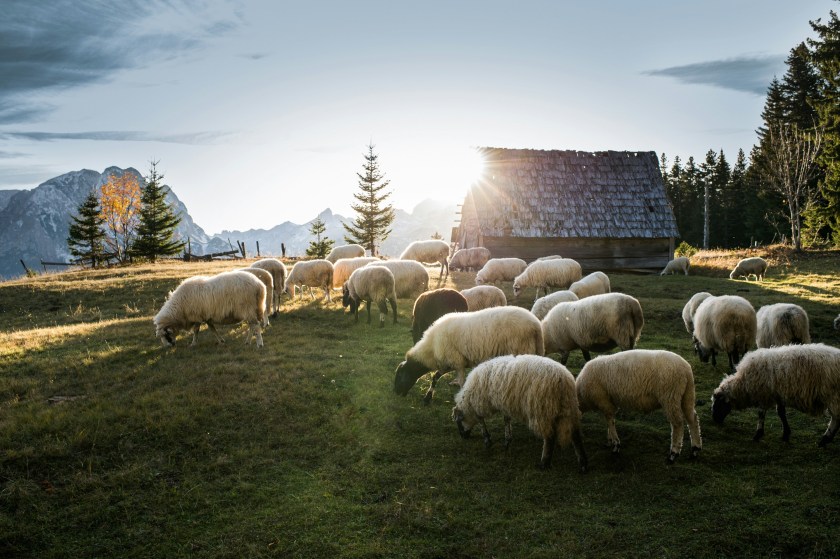
Follow the Flock: How Sheep Shaped Human Civilization (2021) by Sally Coulthard weaves the rich and fascinating story of sheep into a vivid and colorful tapestry. Being an ideal animal to domesticate, sheep have been with us almost since farming began to the point that there are now around a billion on the planet. While there are at least a thousand breeds and crossbreeds, Coulthard makes the point that these unique animals have changed us as much as we have changed them.
To Fall in Love, Drink This: A Wine Writer’s Memoir (2022) by Alice Feiring is a self-described “love letter to wine and a lifelong coming of age story.” Feiring believes that the best wine writing is about life, and in a series of eleven personal essays she explores her own life’s story while sharing her love of natural wine. She doesn’t want to be seen as a wine critic, but instead wants readers to share her fascination for wine’s spiritual underpinnings.
The Greek Way (originally published 1930, reprinted in 2017) by Edith Hamilton is a well-known survey of Greek literature and art that is definitely a product of its time. “Probably no other single person has had such an impact in shaping the perceptions of classical literature and mythology in the United States for almost a century” writes Emily Wilson in The Nation. Hamilton was a powerhouse of her age, with influences that still exist. There is much to admire in this slim work, but also much is required to place this book and Hamilton’s worldview into its proper context.
Magpie Murders (2016) by Anthony Horowitz is the talented writer’s tale of intrigue involving editor Susan Ryeland, her crime-writing author Alan Conway, and Conway’s detective, Atticus Pünd, “who solves mysteries disturbing sleepy English villages.” As someone who follows the path of those classic mystery writers, Conway has been very successful, even as he has alienated family, friends, and, yes, his editor. Yet Ryeland knows she must put up with his troubling behavior in order to keep the successful works flowing. An international bestseller upon its release and then the subject of a Masterpiece Mystery series on PBS, Magpie Murders is a delightful whodunit within a whodunit.
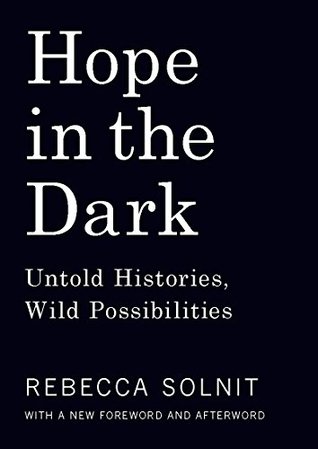
Hope in the Dark: Untold Histories, Wild Possibilities(2016, originally published in 2004), by Rebecca Solnit begins with a discussion around the demands of hope. They are real, but she pivots to note that joy is an especially good way to support the work which hope demands. This political season seems as good a time as any to consider Solnit’s thoughts on hope and joy in the face of despair, and to take the long view which she favors.
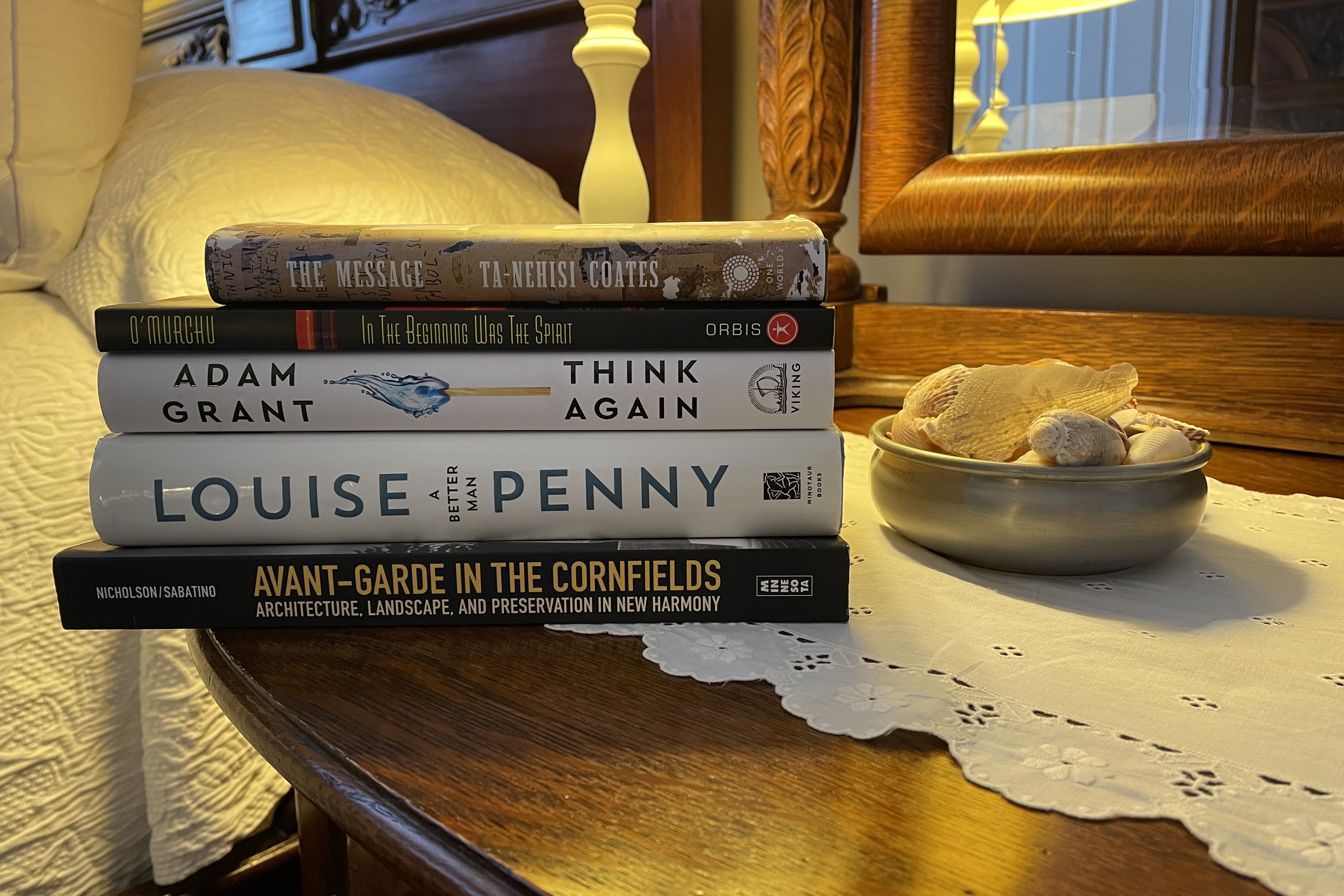
What’s on the nightstand for November (subject to change at the whims of the reader)
We now face a decision, in the words of Vice President Kamala Harris, that is “more just than a choice between two parties and two different candidates. It is a choice about whether we have a country rooted in freedom for every American or ruled by chaos and division.”
“We think we live in difficult uncertain times. We think we have worries. We think our leaders face difficult decisions. But so it has nearly always been . . . It is said that everything has changed. But everything has not changed . . . We have resources beyond imagining, and the greatest of these is our brainpower . . . And we have a further, all-important, inexhaustible source of strength. And that source of strength is our story, our history, who we are, how we got to be where we are, and all we have been through, what we have achieved.”
The Vice President laid out a strong closing argument after a whirlwind 100-day campaign that has provided the country with a clear choice: to go back to a past that never existed except in the romanticized version conjured by its advocates but that promises chaos and heartbreak ahead; or to move forward in a way that understands that we are all connected, a way that embraces humanity through solidarity with our fellow humans.
“Nearly 250 years ago, America was born when we wrested freedom from a petty tyrant. Across the generations, Americans have preserved that freedom, expanded it, and in so doing, proved to the world that a government of, by, and for the people is strong and can endure. And those who came before us—the patriots at Normandy and Selma, Seneca Falls and Stonewall, on farmlands and factory floors—they did not struggle, sacrifice, and lay down their lives only to see us cede our fundamental freedoms…only to see us submit to the will of another petty tyrant.
These United States of America: we are not a vessel for the schemes of wannabe dictators. The United States of America is the greatest idea humanity ever devised: a nation big enough to encompass all our dreams, strong enough to withstand any fracture or fissure between us, and fearless enough to imagine a future of possibilities.”
I love that last line: big enough to encompass all our dreams, strong enough to withstand any fracture or fissure between us, and fearless enough to imagine a future of possibilities.
But we can only fully realize such a future when we work together.
“If you choose solidarity, instead of pulling away from those you once suspected, avoided, vilified, or rejected, you see them as neighbors. You smile. You talk. You try to collaborate for the common good in whatever ways you can. When you disagree, as you must, you do so boldly but also graciously, not burning bridges, not breaking solidarity. They may be your opponents for the moment, but you don’t write them off as enemies.
When you embrace solidarity, you embrace humanity, including Muslim, Jewish, Buddhist, Hindu, Sikh, humanist, and atheist humanity, and including the humanity of those Christians whose behavior consistently prompts you to ask if you can stand staying Christian for even one more second.”
We are all connected, woven—as Dr. Martin Luther King, Jr. said in his Letter from a Birmingham Jail—in an inescapable web of mutuality.
“America, let us show each other—and the world—who we are. And what we stand for. Freedom. Opportunity. Compassion. Dignity. Fairness. And endless possibilities.
We are the heirs to the greatest democracy in the history of the world. And on behalf of our children and grandchildren, and all those who sacrificed so dearly for our freedom and liberty, we must be worthy of this moment. It is now our turn to do what generations before us have done. Guided by optimism and faith, to fight for this country we love.”
Let us reach for that future as we remember that the fight for democracy never ends.
Who would have thought that the humble sheep would make for such fascinating social history? Yet beginning with “our Neolithic ancestors’ first forays into sheep-rearing nearly 10,000 years ago, these remarkable animals have fed us, clothed us, changed our diet and languages, helped us to win wars, decorated our homes, and financed the conquest of large swathes of the earth.”
When a long-time friend, colleague, and fellow National Trust Tour lecturer suggested I had to read this book, I followed her advice. When the package arrived, Candice got a puzzled look on her face and said, “who would write a book about sheep?” It turns out that the best-selling author of design and outdoor living books—including The Hedgehog Handbook, The Bee Bible, and The Little Book of Snow, who lives on a Yorkshire farm where she keeps chickens as well as, naturally, sheep—would.
Follow the Flock: How Sheep Shaped Human Civilization (2021) by Sally Coulthard tells how sheep have been central to the human story for millennia. Being an ideal animal to domesticate, sheep have been with us almost since farming began to the point that there are now around a billion on the planet. There are at least a thousand breeds and crossbreeds, yet Coulthard makes the point that these unique animals have changed us as much as we have changed them. Throughout fourteen captivating and informative chapters she weaves the rich and fascinating story of sheep into a vivid and colorful tapestry.
Coulthard begins, as one might suspect, with wool. Even with the advent of modern synthetic materials, there is no other fiber “quite as sublimely adaptable as wool.”
“It’s a chameleon; a material that can both repel moisture and absorb it, keep you toasty warm or refreshingly cool depending on the outside temperature, and be soft as silk and yet tough enough to resist searing flames. The secret of sheep’s wool rests in its hidden structure . . . wool fibres are cloaked with scales—look at a strand of wool under a microscope and the surface bears an uncanny resemblance to a gnarled tree trunk or a pine cone.”
But she moves beyond the obvious subjects of clothing and food to talk about the social history of sheep, such as the way they have changed our language. In this election season we may hear that someone is a “dyed-in-the-wool conservative” or a “wolf in sheep’s clothing.” We want to be careful not to be “fleeced” by scammers and con men. The idea that black sheep stand out from the rest of the flock, “for good or ill, probably explains the phrase ‘black sheep of the family.'” While the last one is a near universal idea that can be found in languages across the globe, it is ironic that the country with the greatest number of sheep—mainland China—doesn’t use the phrase.
Sheep have also influenced architecture in ways obvious and perhaps more obscure. Shepherds’ huts—once an uncomfortable reality for a working shepherd—have become a go-to destination for those looking for a different type of luxury break. Speaking of her native England, Coulthard observes that many farmers, middlemen, and landowners “made rich by the medieval wool trade went on to build some of the country’s finest houses, guildhalls, and public buildings.”
“And some of England’s prettiest, most chocolate-box towns and villages—places such as Hadleigh, Lavenham, Long Melford, Bury St. Edmunds and Clare in Suffolk, and Chipping Camden, Burford, Stow-on-the-Wold and Bibury in Gloucestershire—owe their embarrassment of architectural riches to the wool trade.”
The World War I Memorial, covered with poppies for the D-Day Anniversary, in Chipping Camden
In many of these same communities, those who made their money in the wool trade lavished their wealth on the local house of worship, resulting in parishes which came to be known as “wool churches.” These are some of the most celebrated examples of “medieval craftsmanship and architecture” in England. “There are literally hundreds of them. The county of Norfolk, for example, has 635 alone.”
One of the more fascinating chapters covers the history of sheep in armed conflict. Coulthard points to the animosity between the English crown and the American colonies as one example. In 1699 William III issued the Wool Act which was designed to force the colonies to only import British wool, to ban the exporting of wool out of America, and to tax any sales of wool. The colonists responded by making and wearing “homespun” which “became a mark of defiance and symbol of patriotism.” In fact, Coulthard asserts that “it was the Wool Act of 1699 that sewed the first stitches of rebellion and anger in the colonies that led, ultimately, to America’s Revolutionary War.” But by World War I, England and the US—along with Australia—were all engaged in a “Knit for Victory” campaign to help soldiers survive the cold in the trenches at the front. President Wilson allowed sheep to graze on the grass in front of the White House in a show of solidarity with the knitters, and in just a year and a half, “US citizens knitted over 24 million items of clothing for soldiers.” It had an emotional impact on soldiers as well as those on the home front making their contribution to the war effort.
Sheep and wool are so ubiquitous and beloved that Coulthard devotes a chapter to the “invention of tradition” where Irish sweaters and Scottish kilts are provided with manufactured stories that speak of home, heart, and heritage. Spinning yarns to manufacture myths— just one more example of how sheep continue, here in the 21st century, to shape human civilization.
A summary of the October posts from the MORE TO COME newsletter.
October found us roaming from the banks of the Potomac to the island harbors of the Aegean Sea. We sent postcards to voters in Georgia and stood in line to vote on the first day possible in Maryland. I listened to the comforting grooves of two blues cats in Takoma Park and read books that took me out of my comfort zone.
It was—to put it mildly—a busy few weeks. Let’s jump in and see what caught my eye or tickled my fancy this month in MORE TO COME.
TOP READER FAVORITES
Two posts topped the list of reader favorites in October. They couldn’t be more different.
Creating ethical, resilient, and thriving communities is the latest of my conversations with authors of recently published books. Sara Bronin’s Key to the City examines how zoning can help create delightful and meaningful places in which to live. I was delighted when Sara agreed to chat with me about her new book, and apparently my readers were as well, as this post topped the list of favorites in October.
I also had a number of readers turn to my appreciation for Kris Kristofferson, who passed away in October. The gold standard of being a dude: Kris Kristofferson, R.I.P. featured my thoughts on this modern-day Renaissance man. Thanks to internet search engines hundreds of new readers also found a post from several years ago that featured Here Comes That Rainbow Again, a song that Kris joked he wrote with John Steinbeck . . . “only he was dead at the time.” Together they made for quite the MTC celebration of Kristofferson’s life and work.
DEMOCRACY DIES . . . WHEN OLIGARCHS RUN AMOK
October was not a good month for those who say that the elite among us should rule without regard for the will of the people. *
Media fails are nothing new in American history, and I tackled this problem in Finding better ways to talk to the American people. I use the work of historians to point to what other generations have done when facing similar challenges.
Before leaving for our trip, I read Edith Hamilton’s The Greek Way. Hamilton engaged the reading public with unfeigned enthusiasm and devotion, “with which she told and retold the story of her love for her own imagined, idealized version of antiquity.” Storytelling, context, and the glory of ancient Greece is a reminder that both storytelling and context are so very important in understanding history.
BOOKS, BLUES, AND BASEBALL
The other posts this month tended to be focused on books I read, music I enjoyed, and baseball I watched. I’d say that’s a good life!
Let’s begin with the books.
Credit: Carol Highsmith
Perceptions and perspectives examines Ned Blackhawk’s groundbreaking book—The Rediscovery of America: Native Peoples and the Unmaking of U.S. History—to reimagine our history “outside the tropes of discovery.”
An ingenious whodunit within a whodunit looks at Anthony Horowitz’s tale of intrigue involving an editor, her crime-writing author, and his detective, Atticus Pünd.
Brilliant reader Nick Kalogeresis—a former colleague and long-time MORE TO COME reader who writes at The Places of Sense Chronicles—made the following comment about my Q&A with Sara Bronin:
David—you get to interview interesting folks. This was a wonderful discussion and I look forward to reading Sara’s new book.
Nick is right. I started featuring conversations with writers early last year, and the October 1st interview with Sara is the 12th in the series. I highlight them near the top of the home page as Author Q&A’s: Conversations with writers, and the topics, in typical MTC fashion, are wide-ranging. Click on the link and check them out!
CONCLUSION
Thanks, as always, for reading. Your support and feedback mean more than I can ever express.
As you travel life’s highways be open to love; thirst for wonder; undertake some mindful, transformative walking every day. Recognize the incredible privilege that most of us have and think about how to put that privilege to use for good. Women, people of color, LGBTQ+ individuals, immigrants, and others can feel especially vulnerable . . . because they are. Work hard for justice and democracy as the fight never ends.
When times get rough, let your memories wander back to some wonderful place with remembrances of family and friends. But don’t be too hard on yourself if a few of the facts slip. Just get the poetry right.
Remember that “we are here to keep watch, not to keep.” Pay attention. Be astonished. Tell about it. And bash into some joy along the way.
Finally, try to be nice. Always be kind.
More to come . . .
DJB
*For those who are interested, Brian Klaas has a great essay on why so many billionaires—who are too often mediocre, overconfident men—are convinced that they are God’s gift to everything they touch. I recommend it.
You can follow MORE TO COME by going to the small “Follow” box that is on the right-hand column of the site (on the desktop version) or at the bottom right on your mobile device. It is great to hear from readers, and if you like them feel free to share these posts on your own social media platforms.
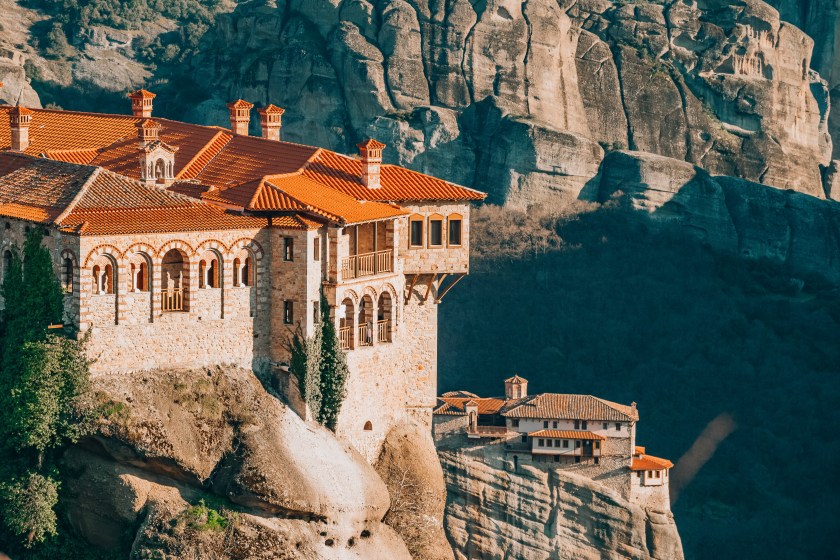
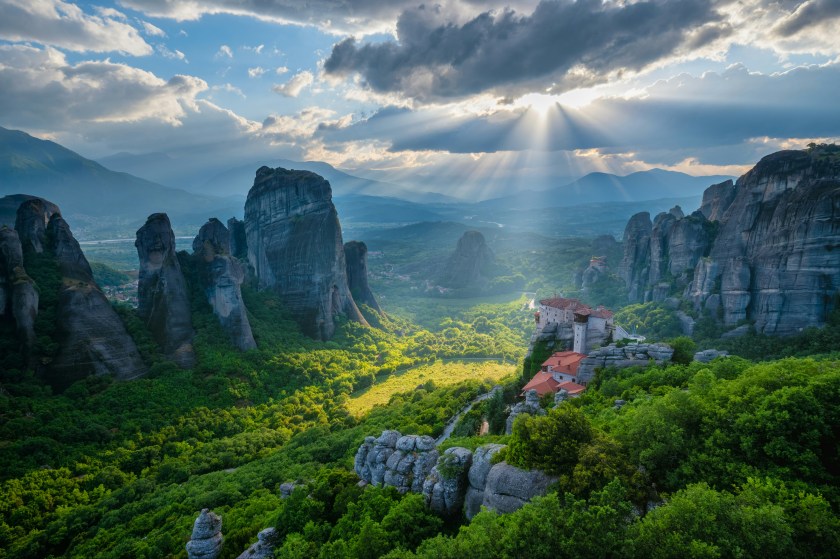
Photo: Monastery at Meteora in Greece by Getty Images via Unsplash.
NOTE: This is Part 2 of a two-part “Observations from . . .” post in which I capture scenes from our recent National Trust Tours trip to the Greek Isles and Ephesus. Click here for Part 1 with my thoughts on Meteora, Ephesus, Pátmos, and Rhodes.
Twenty-four hours in Athens
We arrived in Athens 24 hours before joining our fellow travelers, taking advantage of the time to get an overview tour, eat a wonderful dinner, see a small bit of the city, and begin to catch up on the sleep we’d lost on the flight.
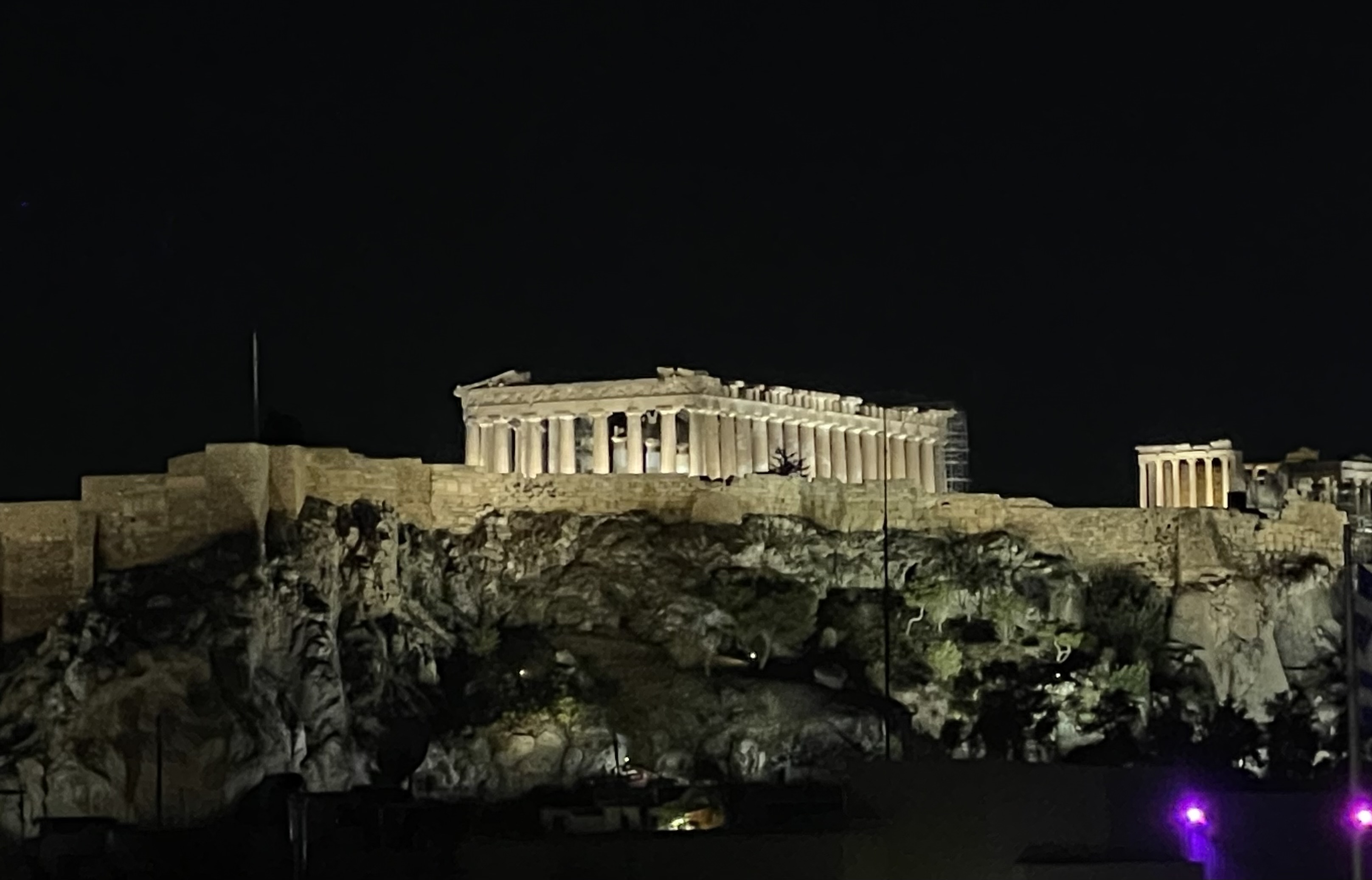
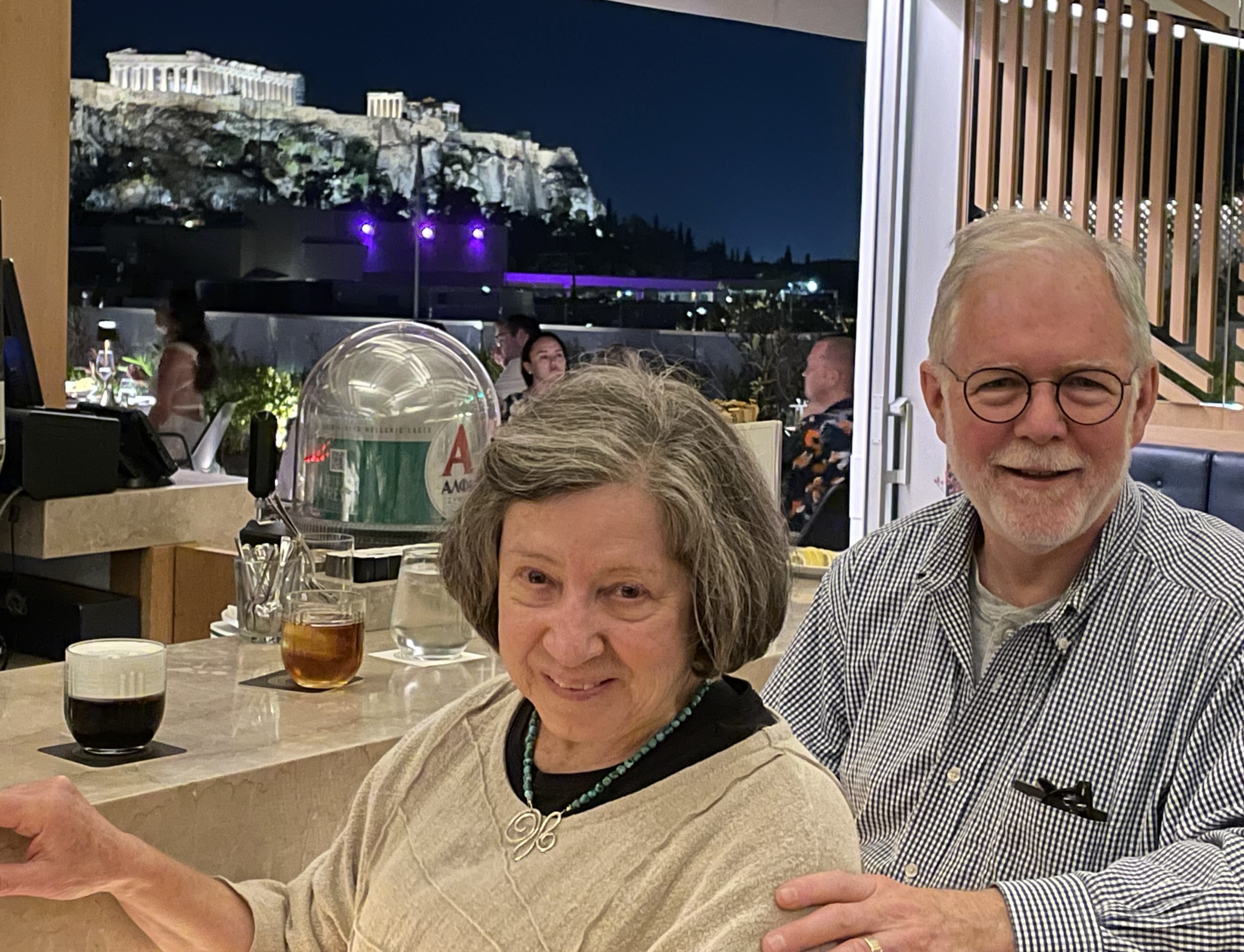
The Parthenon at night, as seen from the rooftop of our Athens hotel
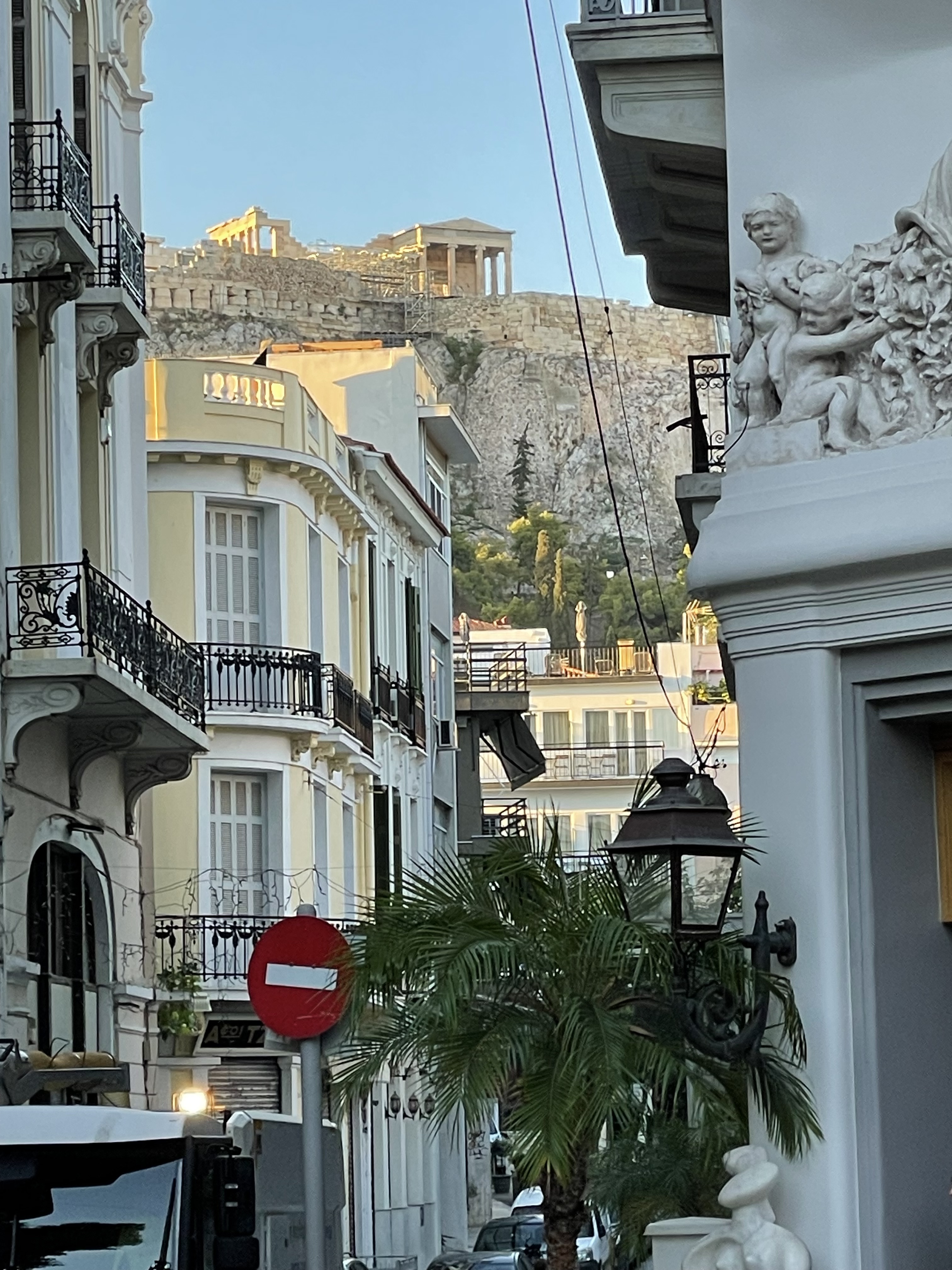
Exploring the Plaka historic district and surrounding neighborhoods of Athens on foot, with the Acropolis in the distance
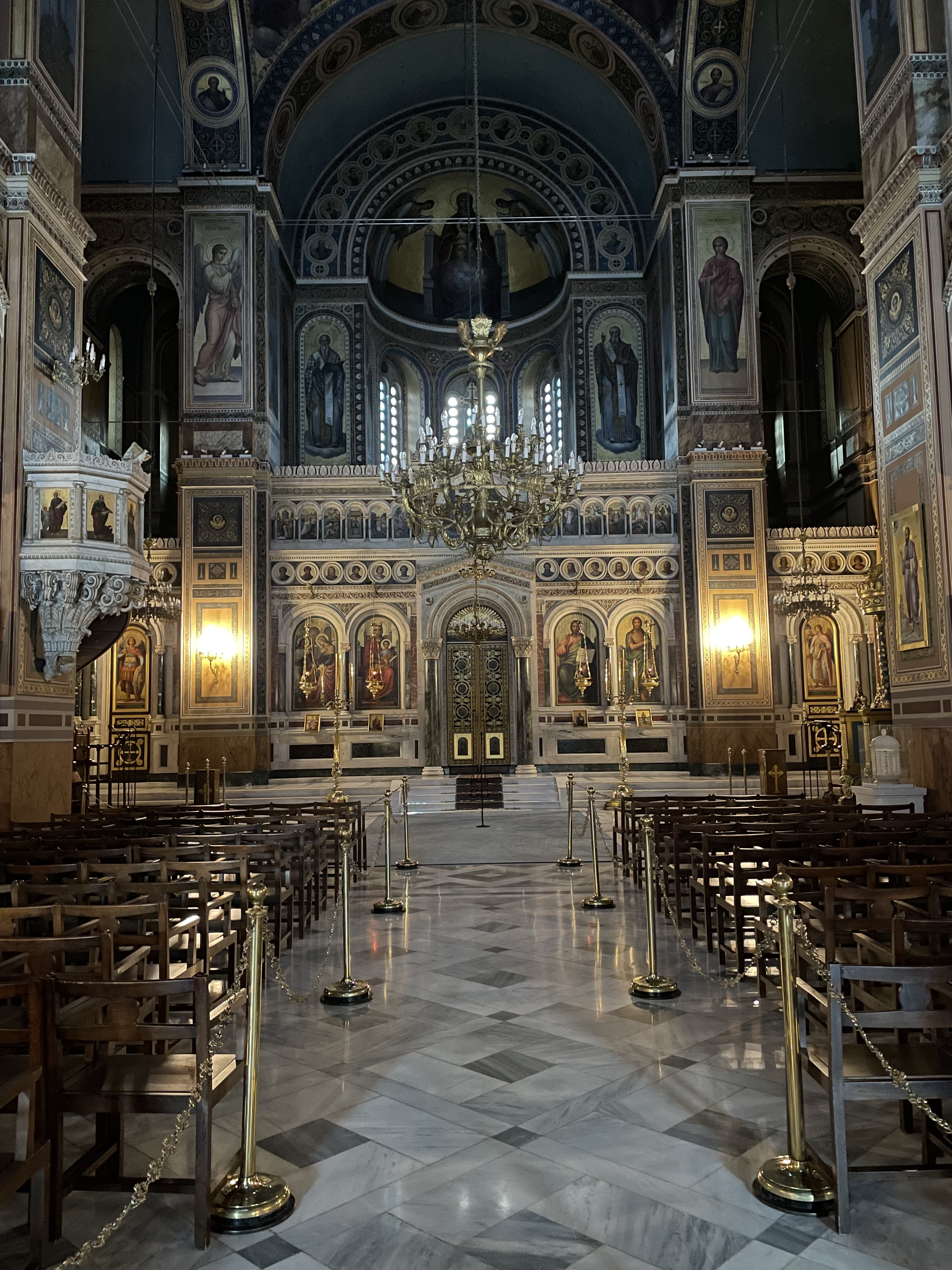
Interior of the Metropolitan Cathedral of the Annunciation, popularly known as the Metropolis or Mitropoli, the cathedral church of the Greek Orthodox Archbishopric of Athens and all of Greece
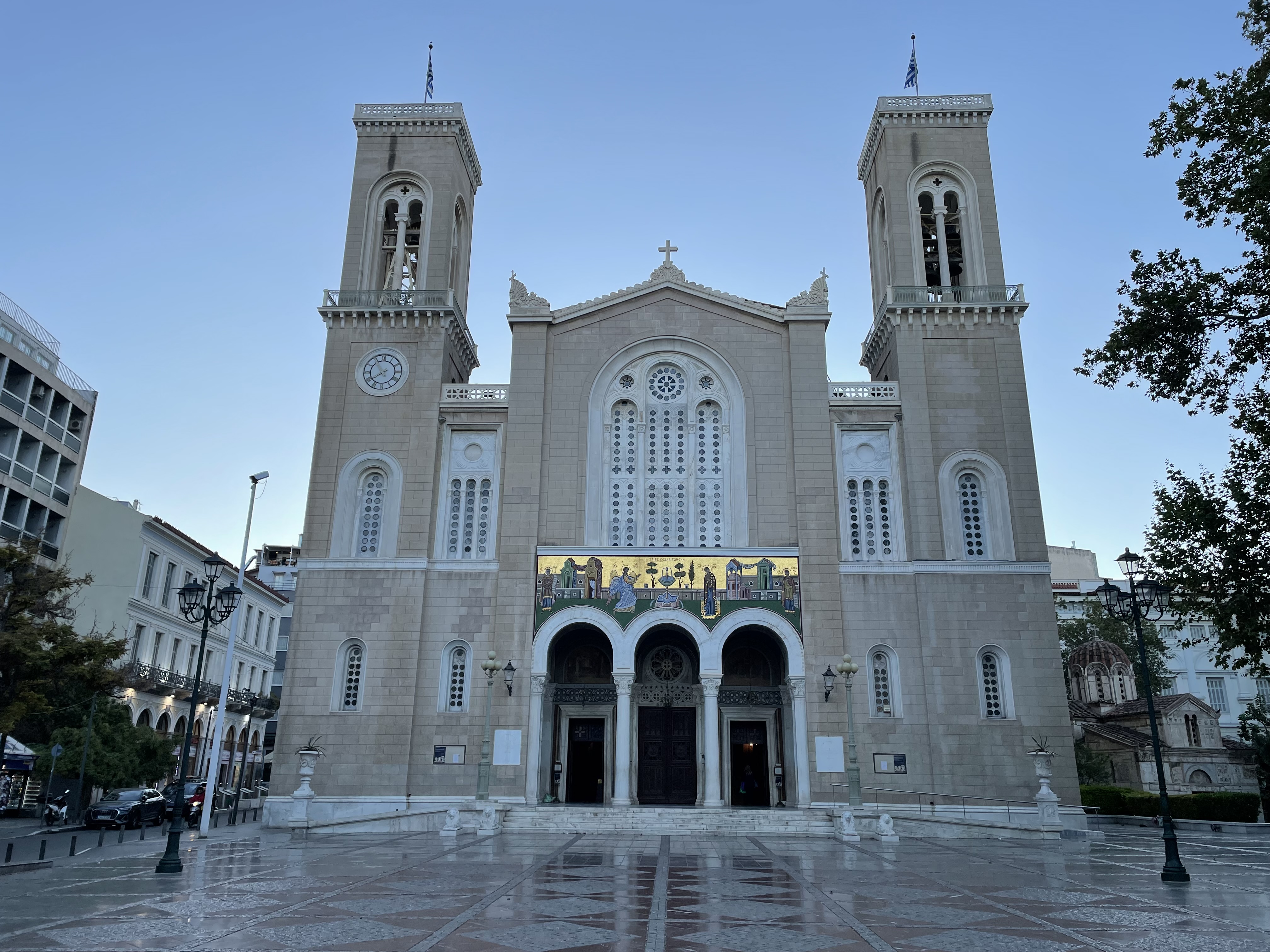
Exterior of the Metropolitan Cathedral of the Annunciation
Parliament building early in the morning, before the foot traffic overwhelms the plaza
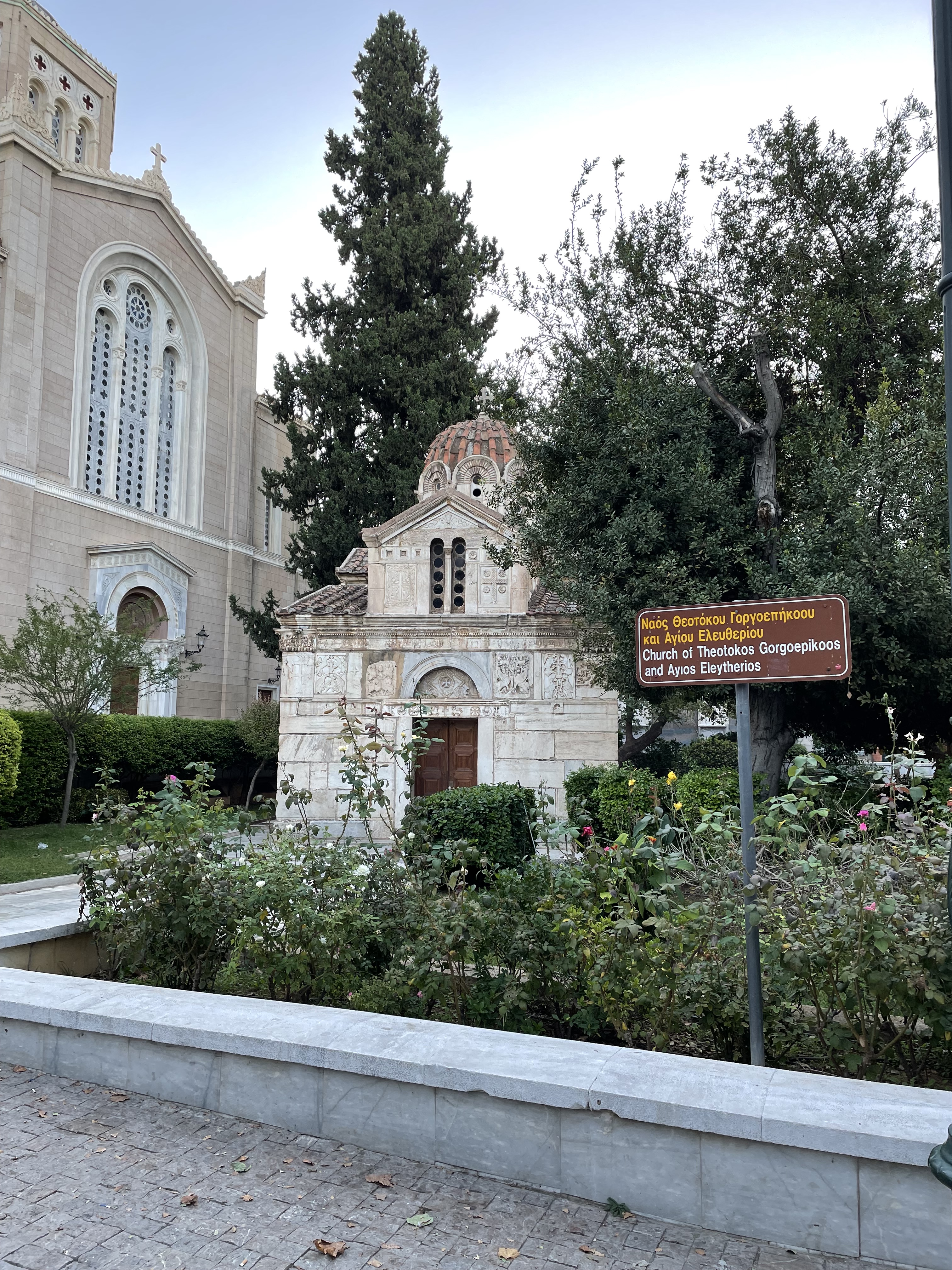
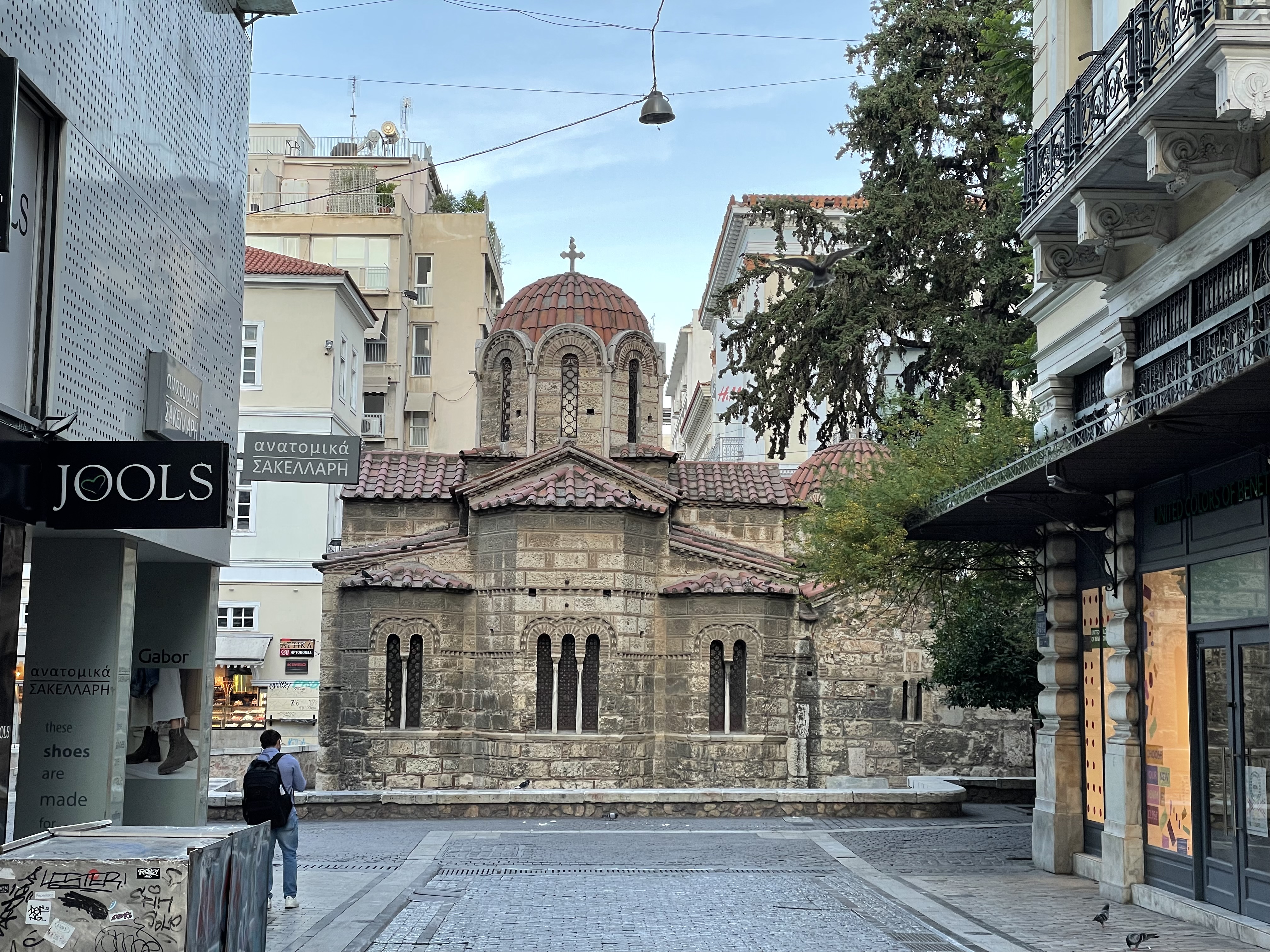
A small chapel set in the center of an intersection along Ermou Street
Legendary stories
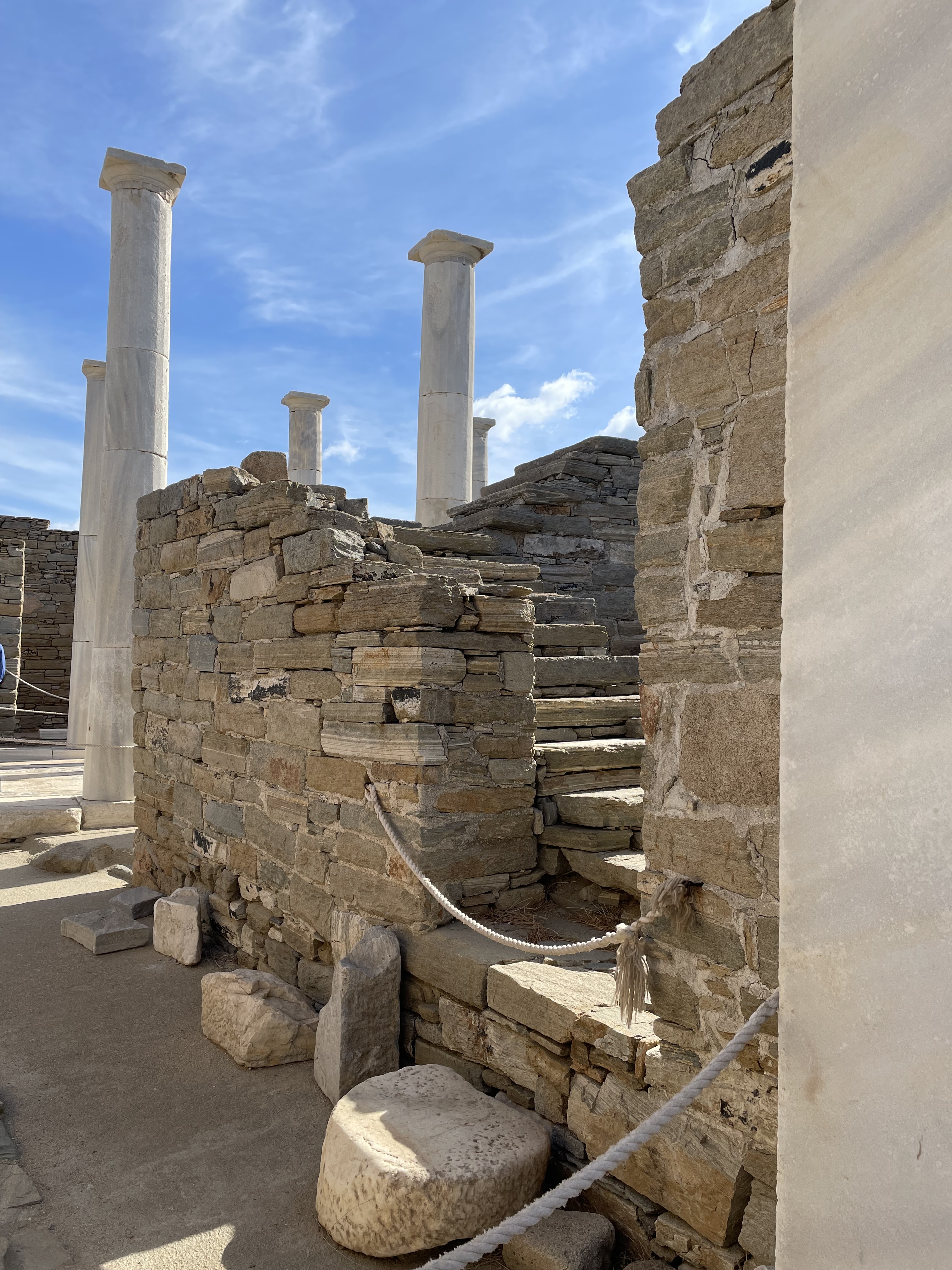
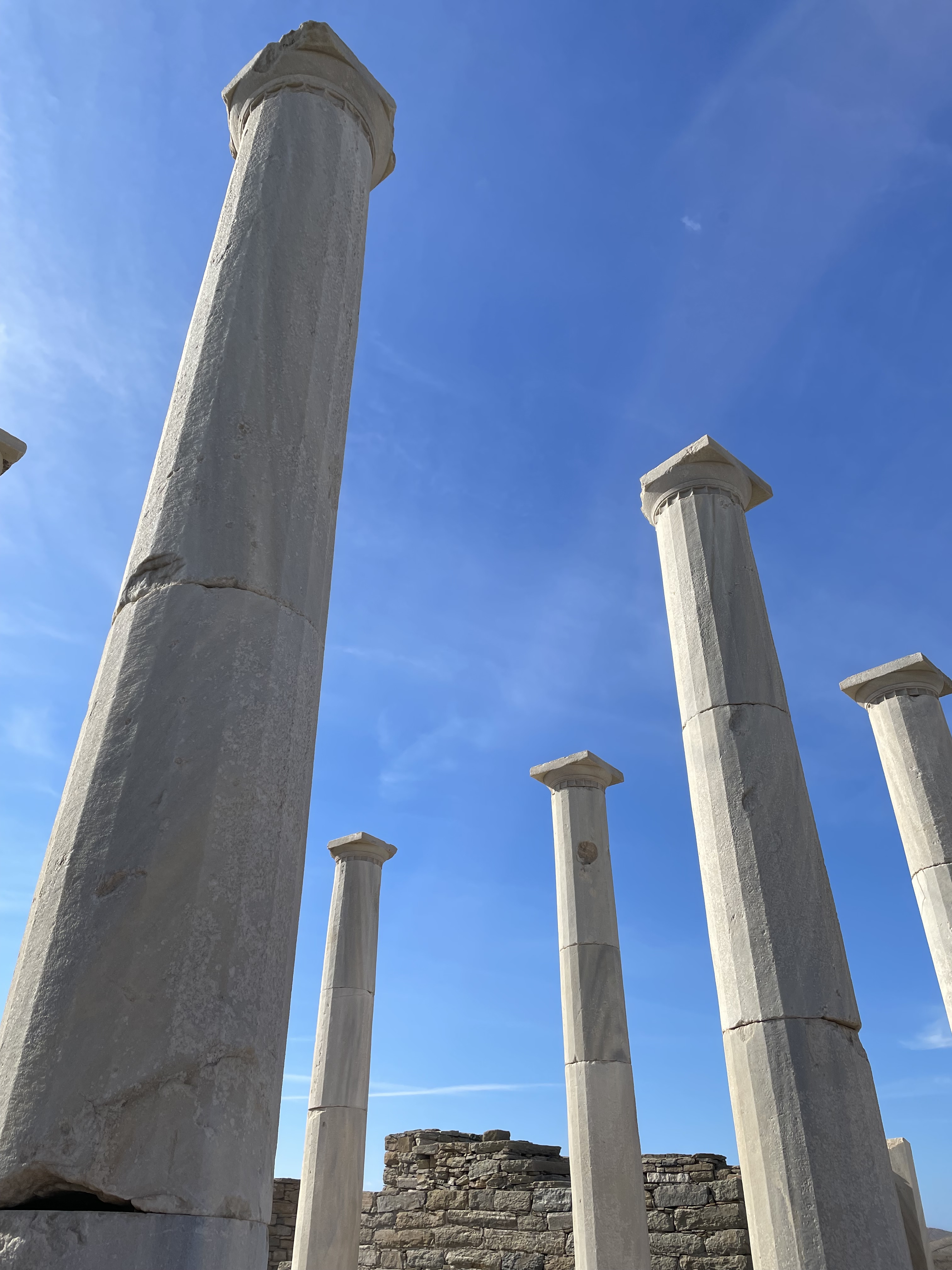
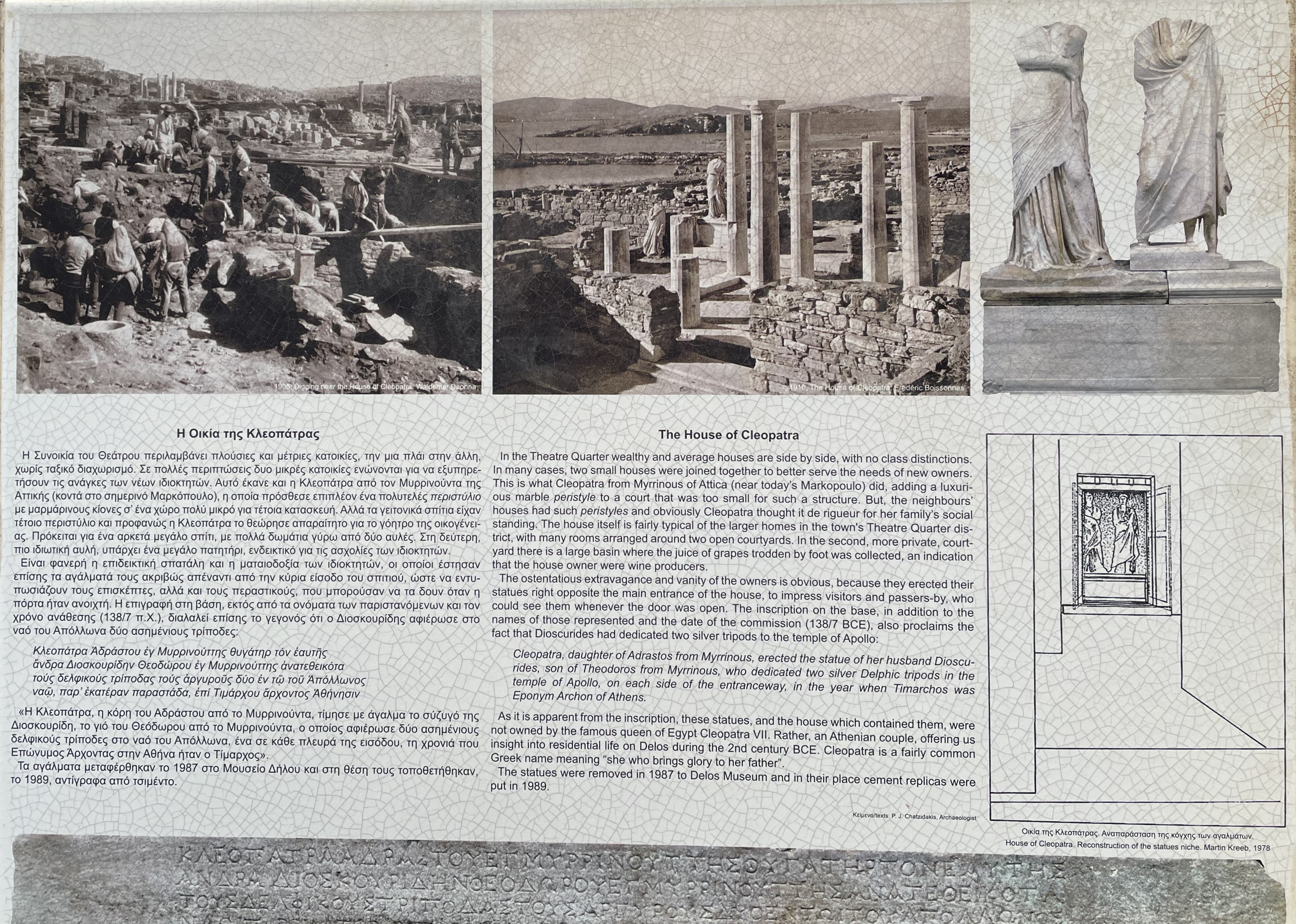
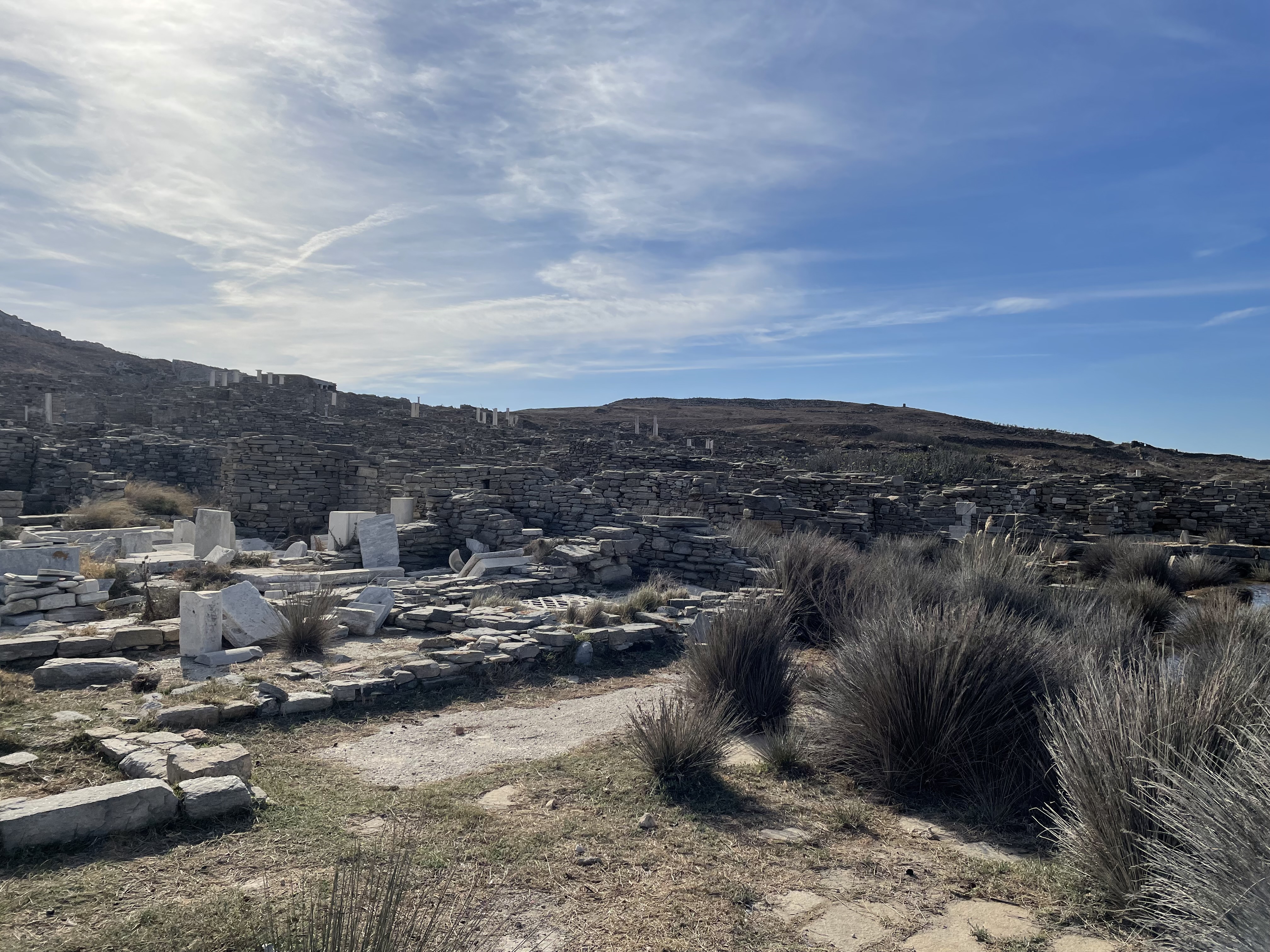
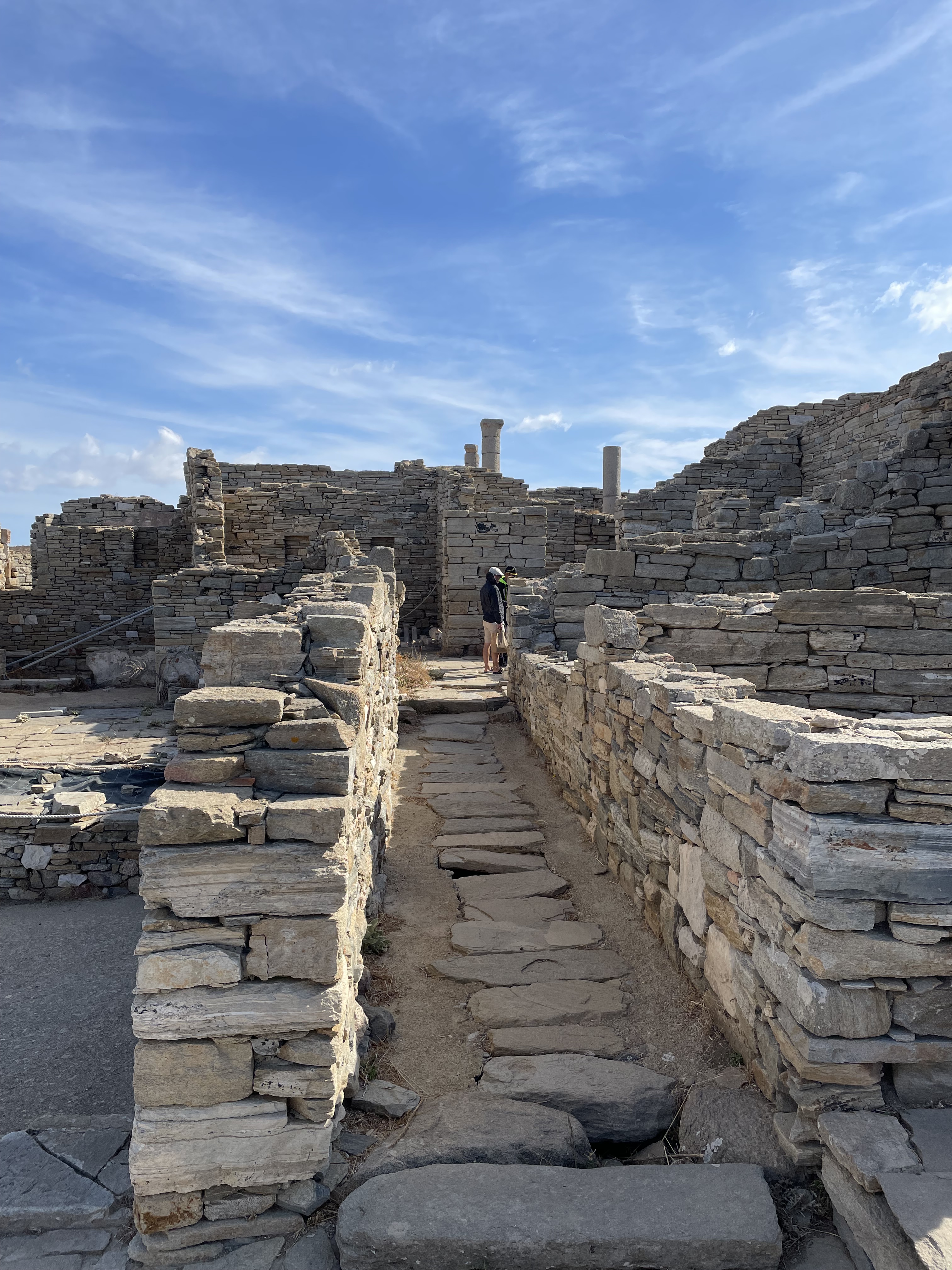
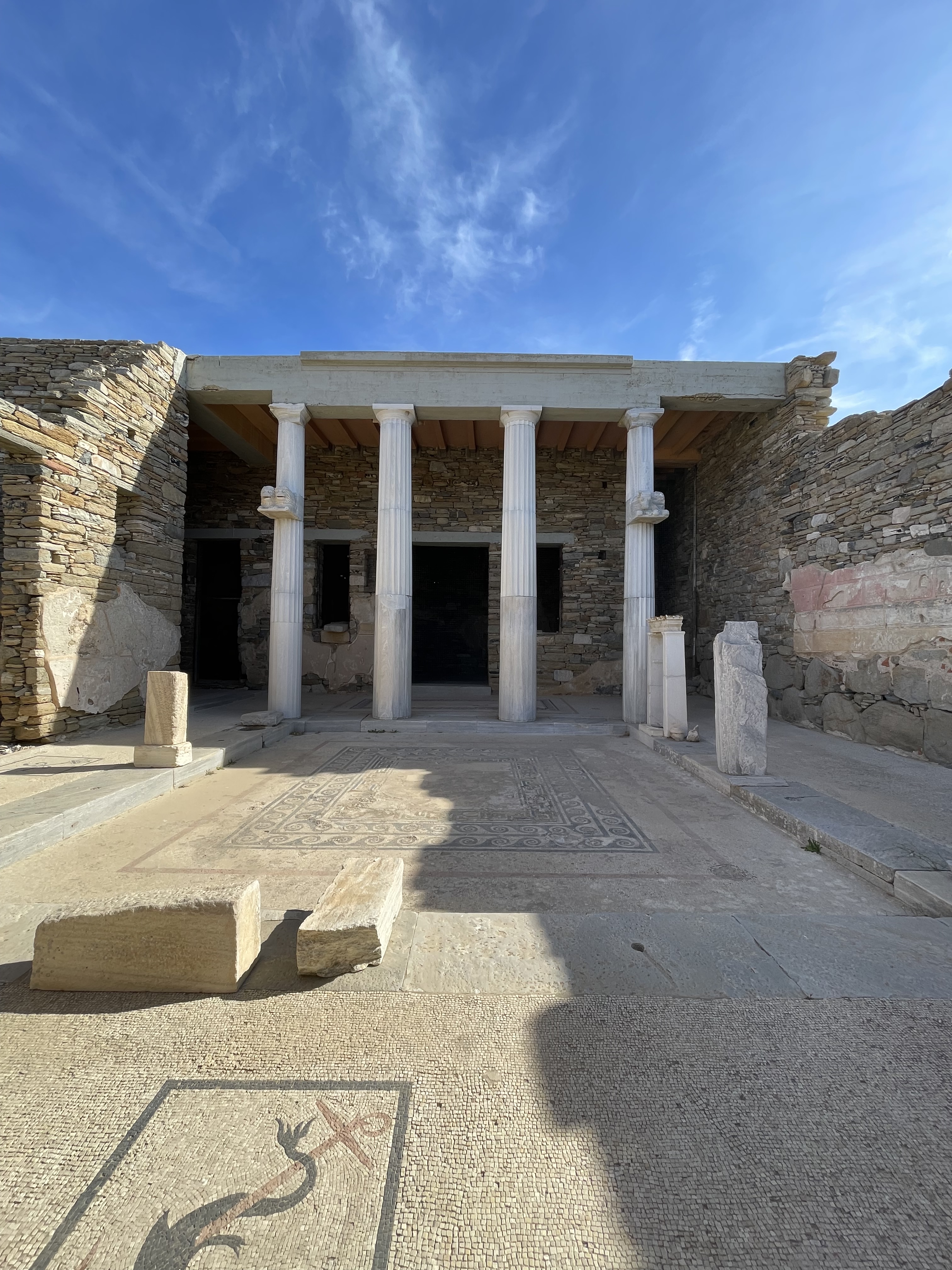
Many of the places we saw along the way used archaeology to convey parts of their story. The island of Delos—the legendary birthplace of Artemis and Apollo and now uninhabited—is a major site that has been excavated for decades, with much more left to learn.
Delos
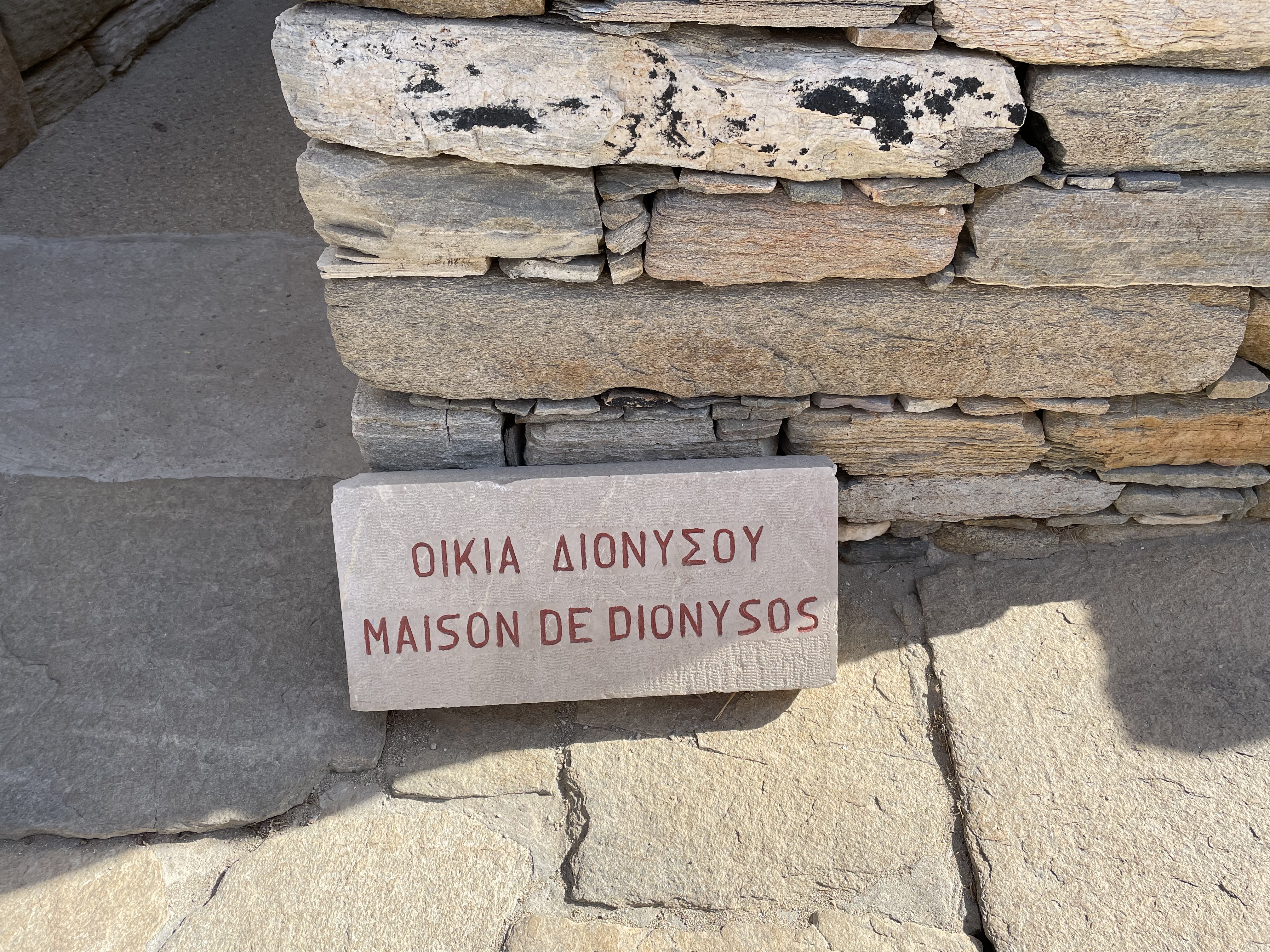
Columns in the Maison de Dionysus, Delos
The House of Cleopatra, Delos
Only a portion of the extensive excavations at Delos
The archaeological work at Delos continues to uncover early Greek masterpieces
An ancient Delos building that functioned much like a bank, complete with teller window and holes for the iron bars
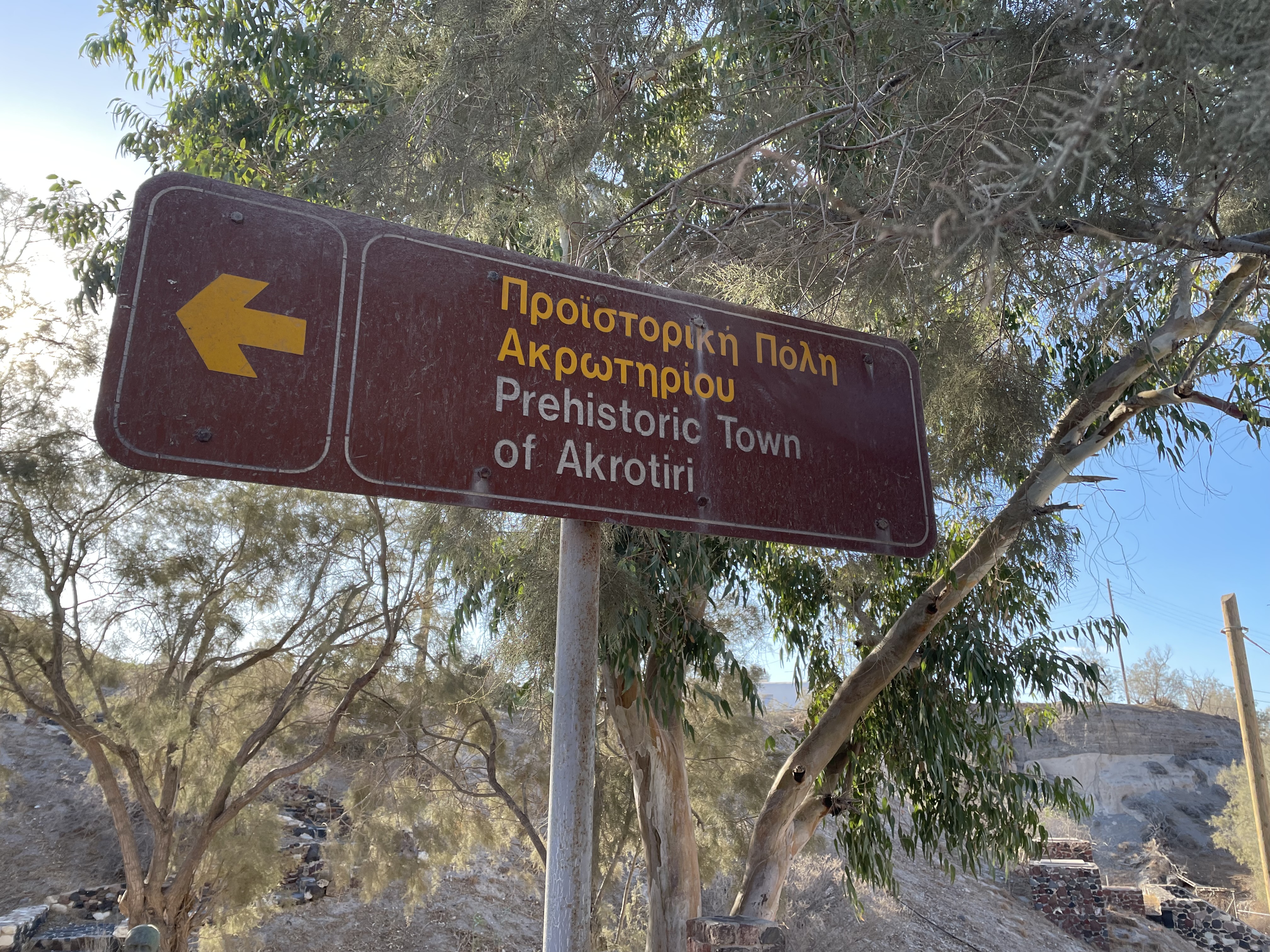
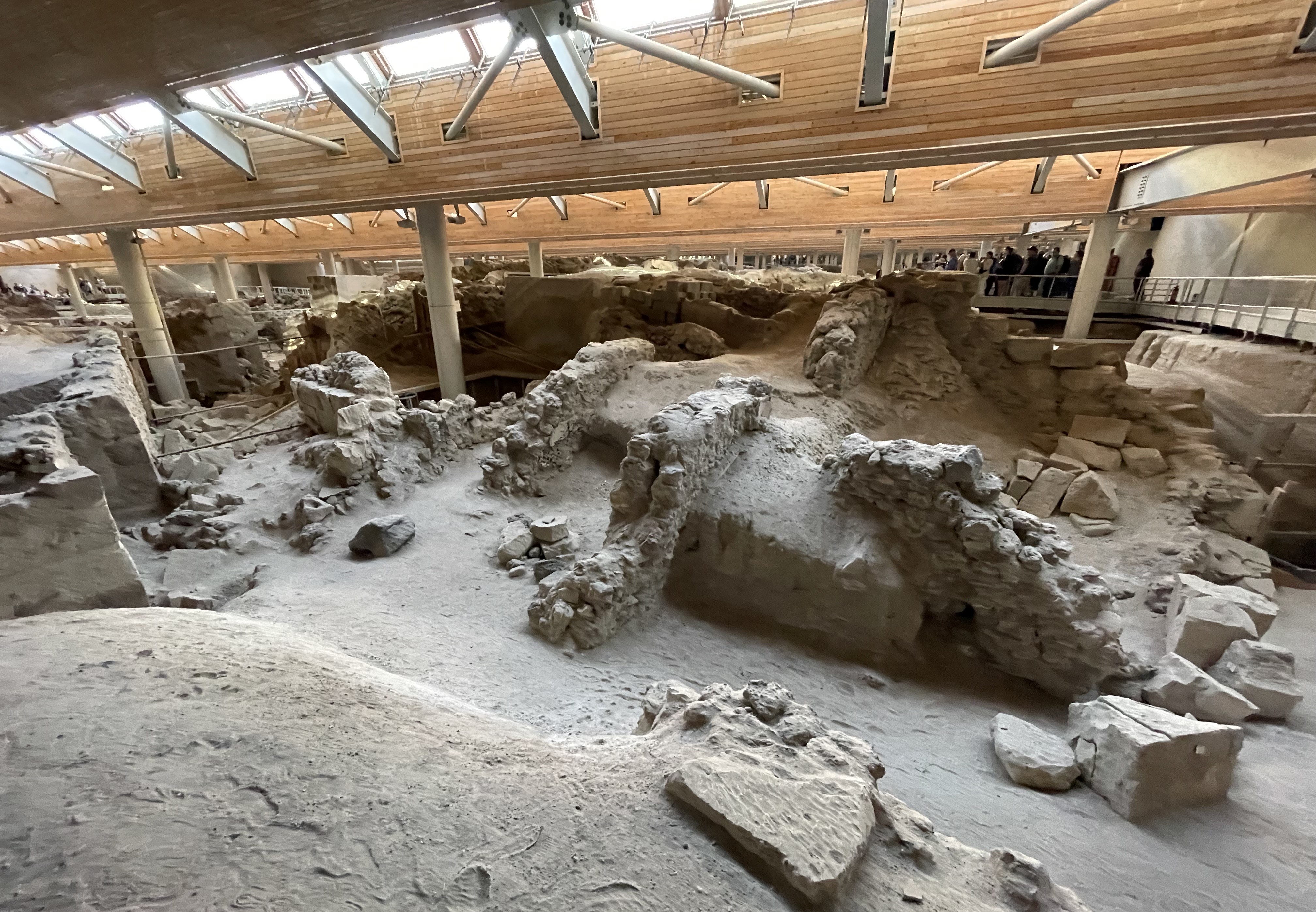
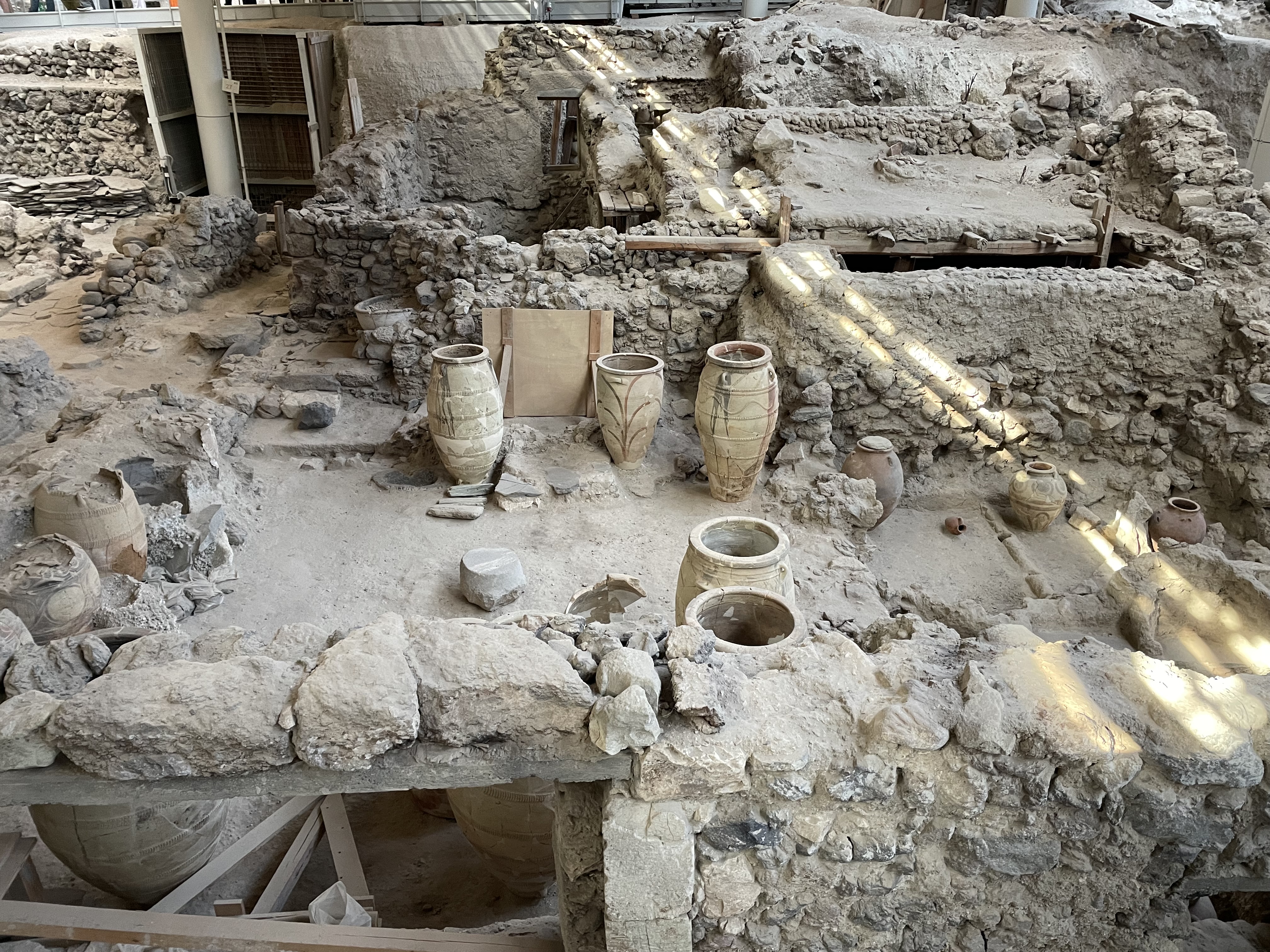
On our last day in Greece we visited the recently reopened excavations of Akrotiri on Santorini, a site that dates to prehistoric times. Like the Terrace Houses at Ephesus that I discussed in yesterday’s post, this dig was entirely under cover.
Akrotiri
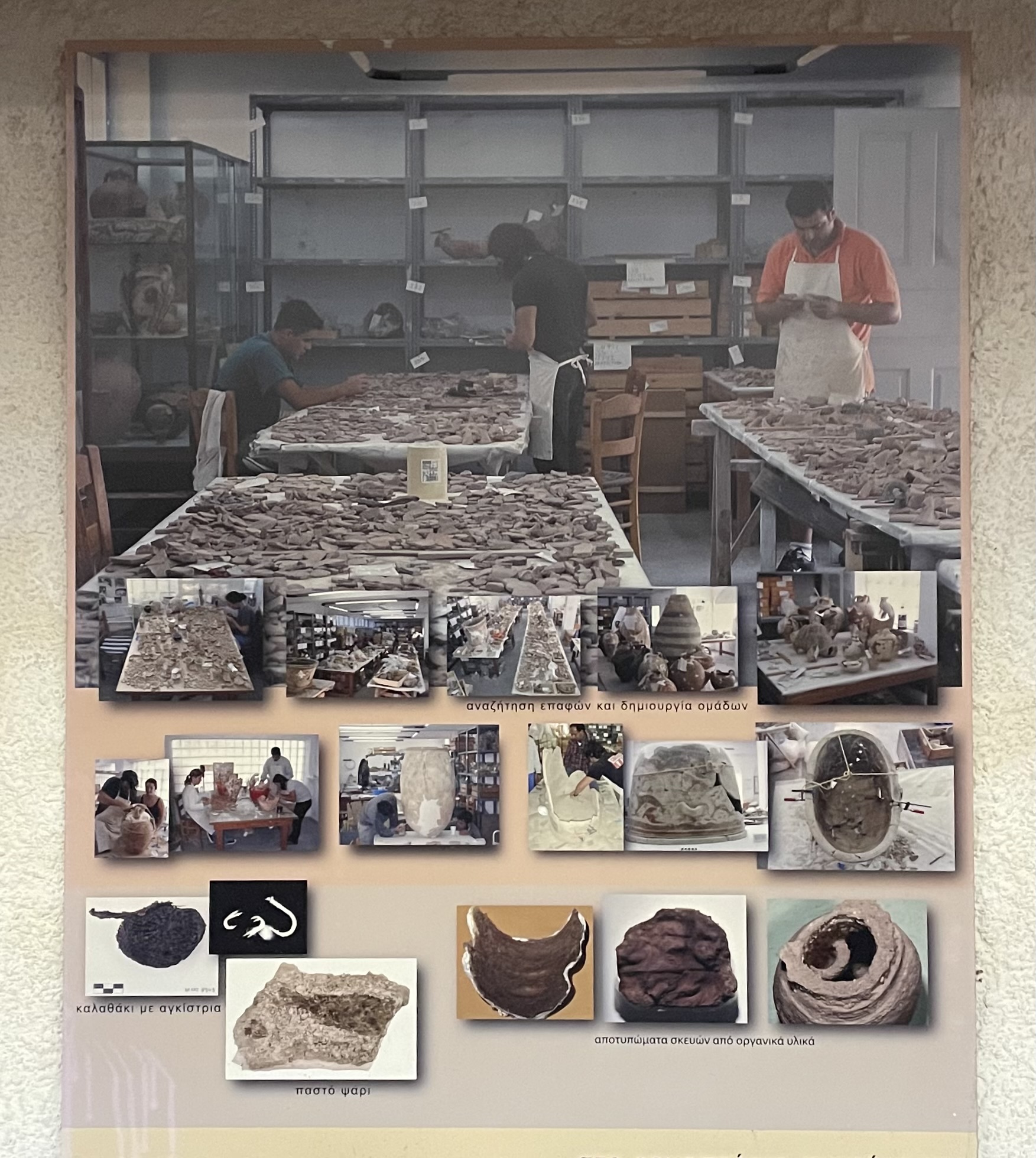
Photos of the archaeological lab work at Akrotiri
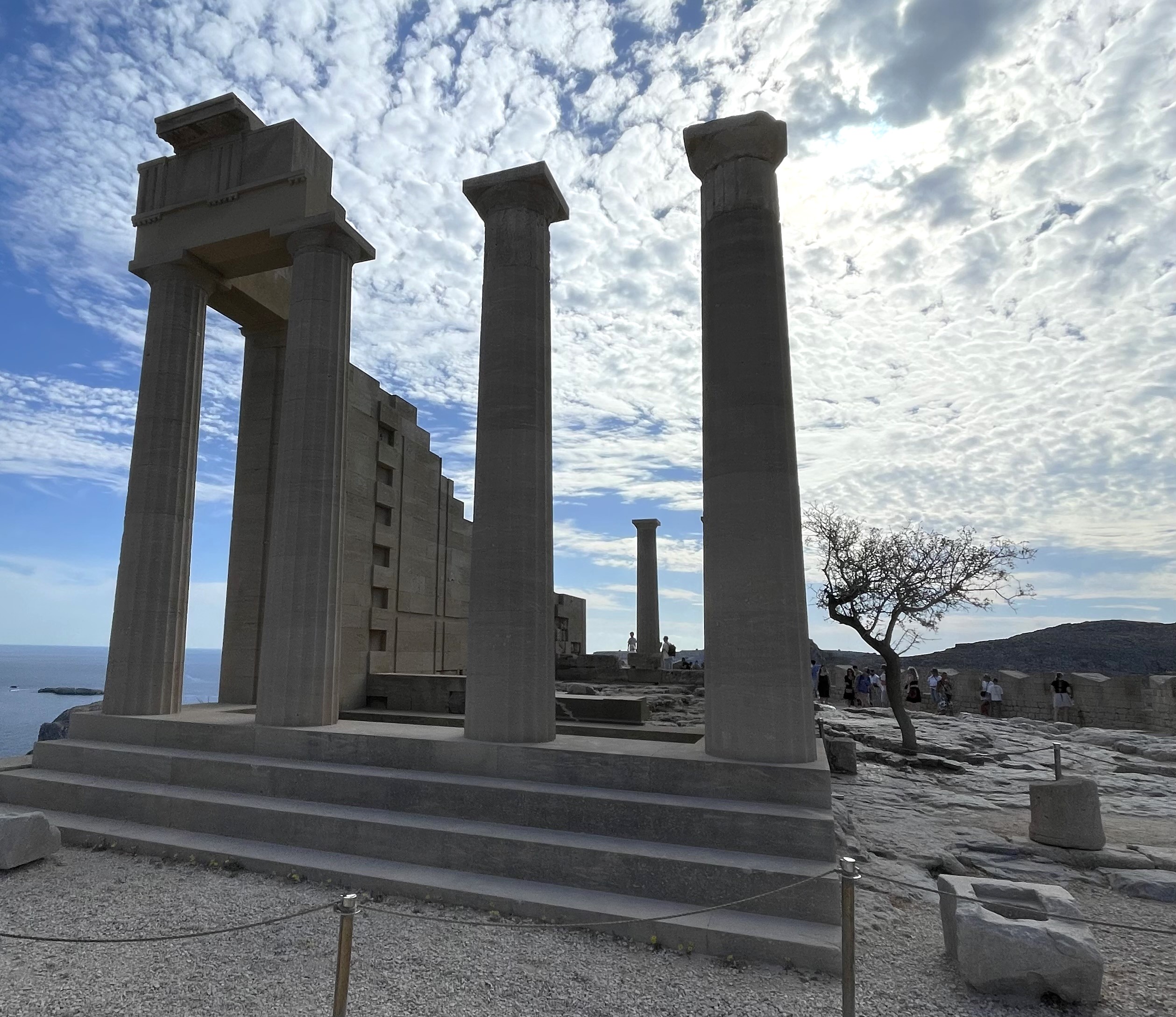
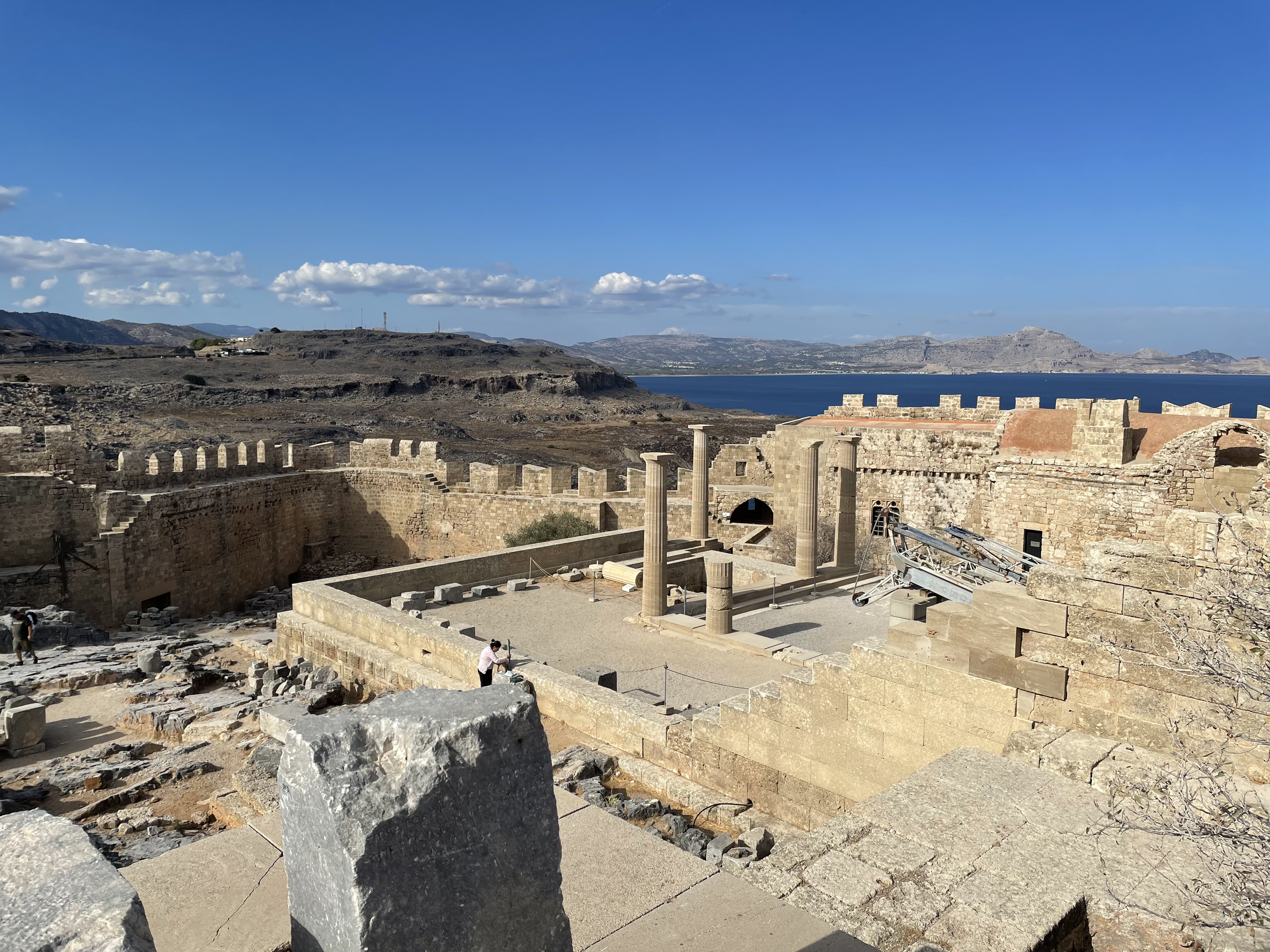
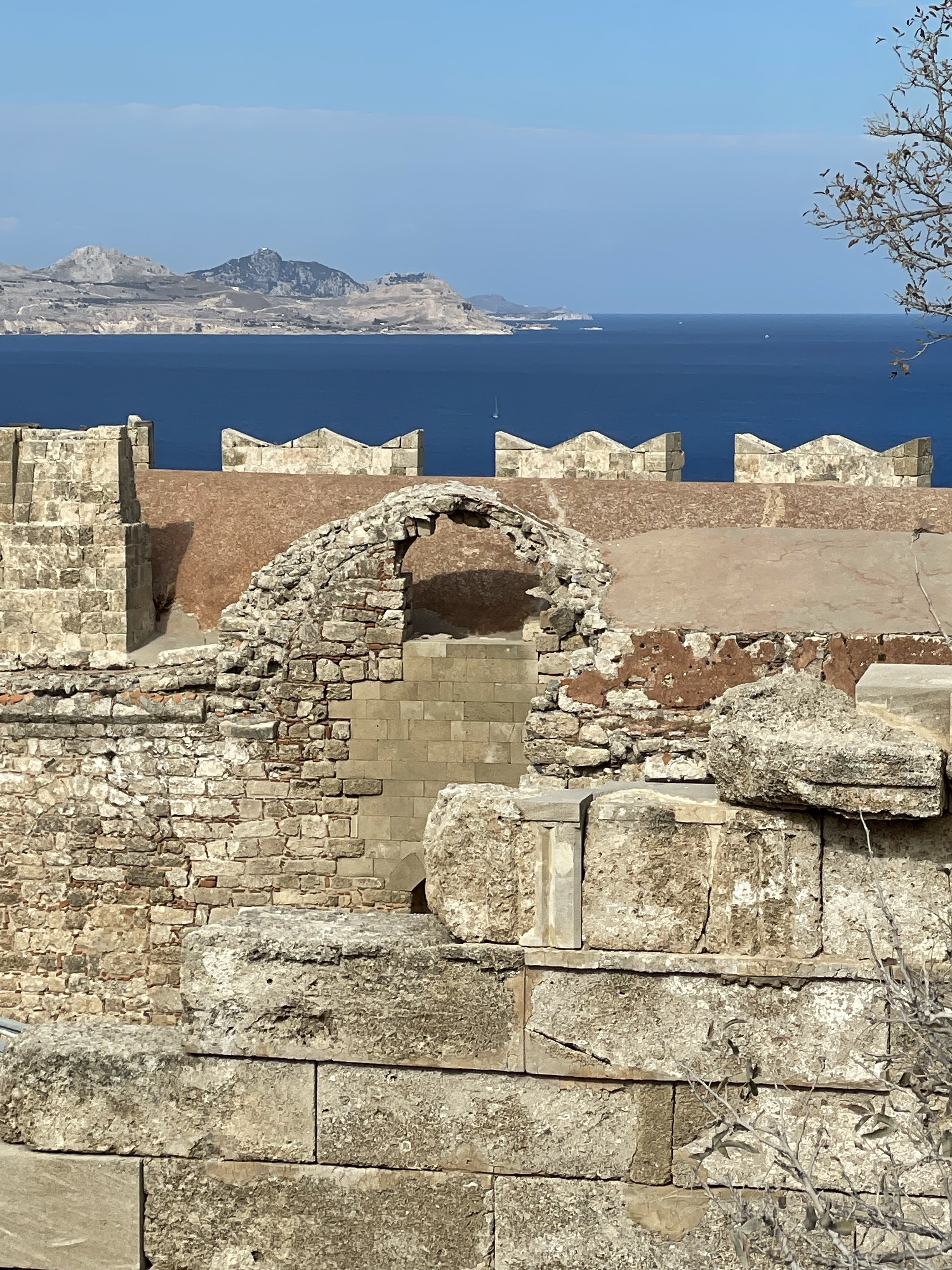
Acropolis in Lindos
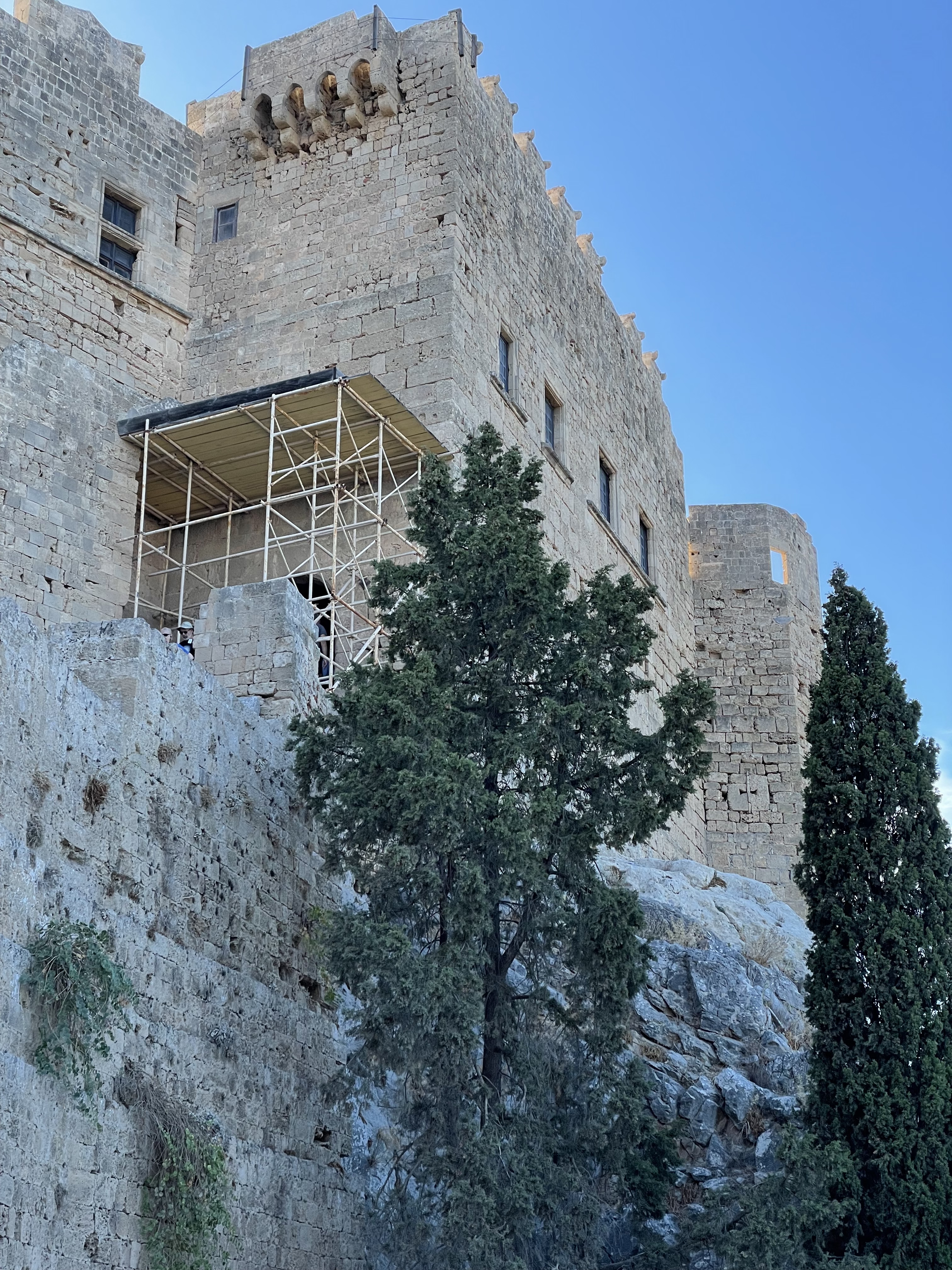
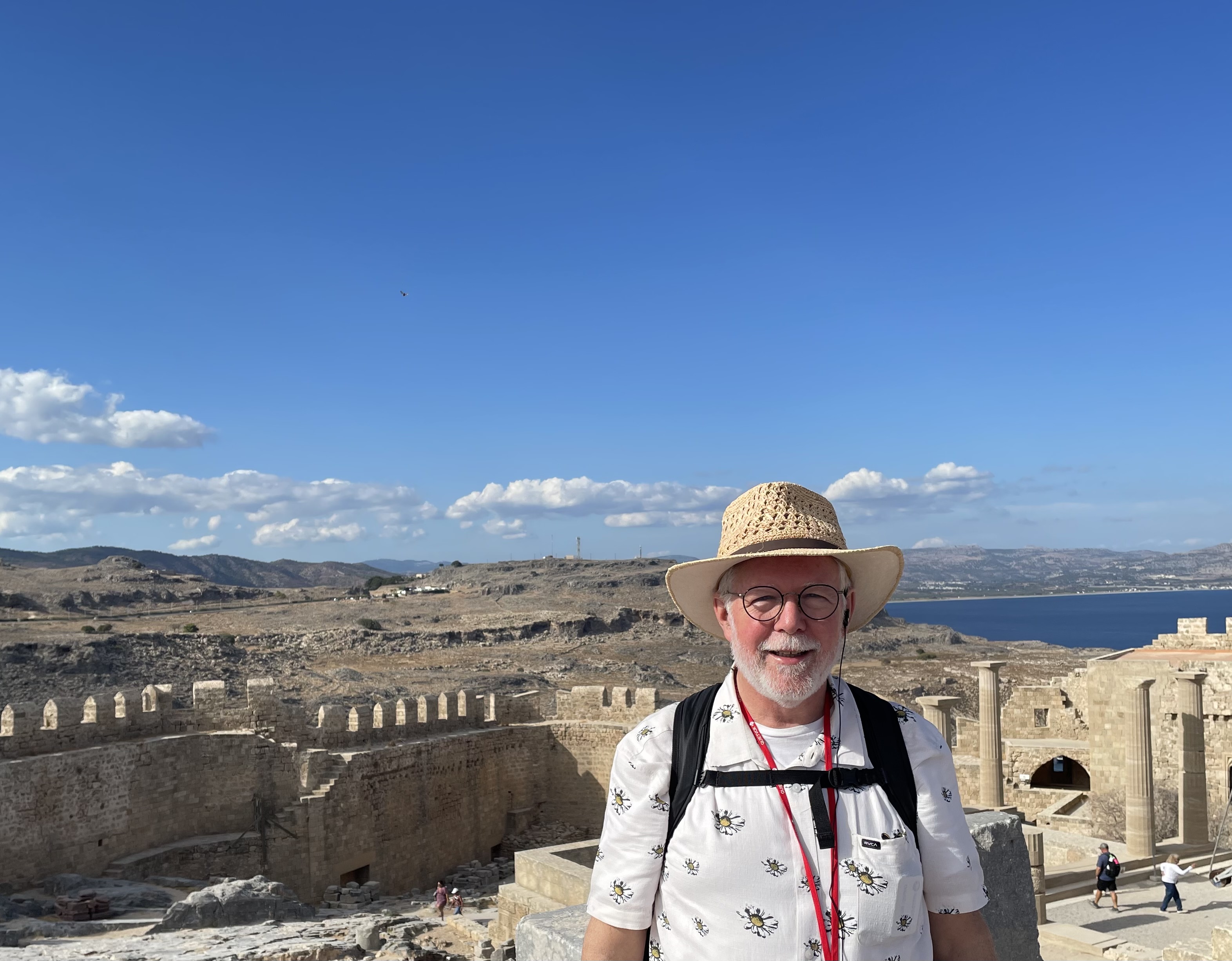
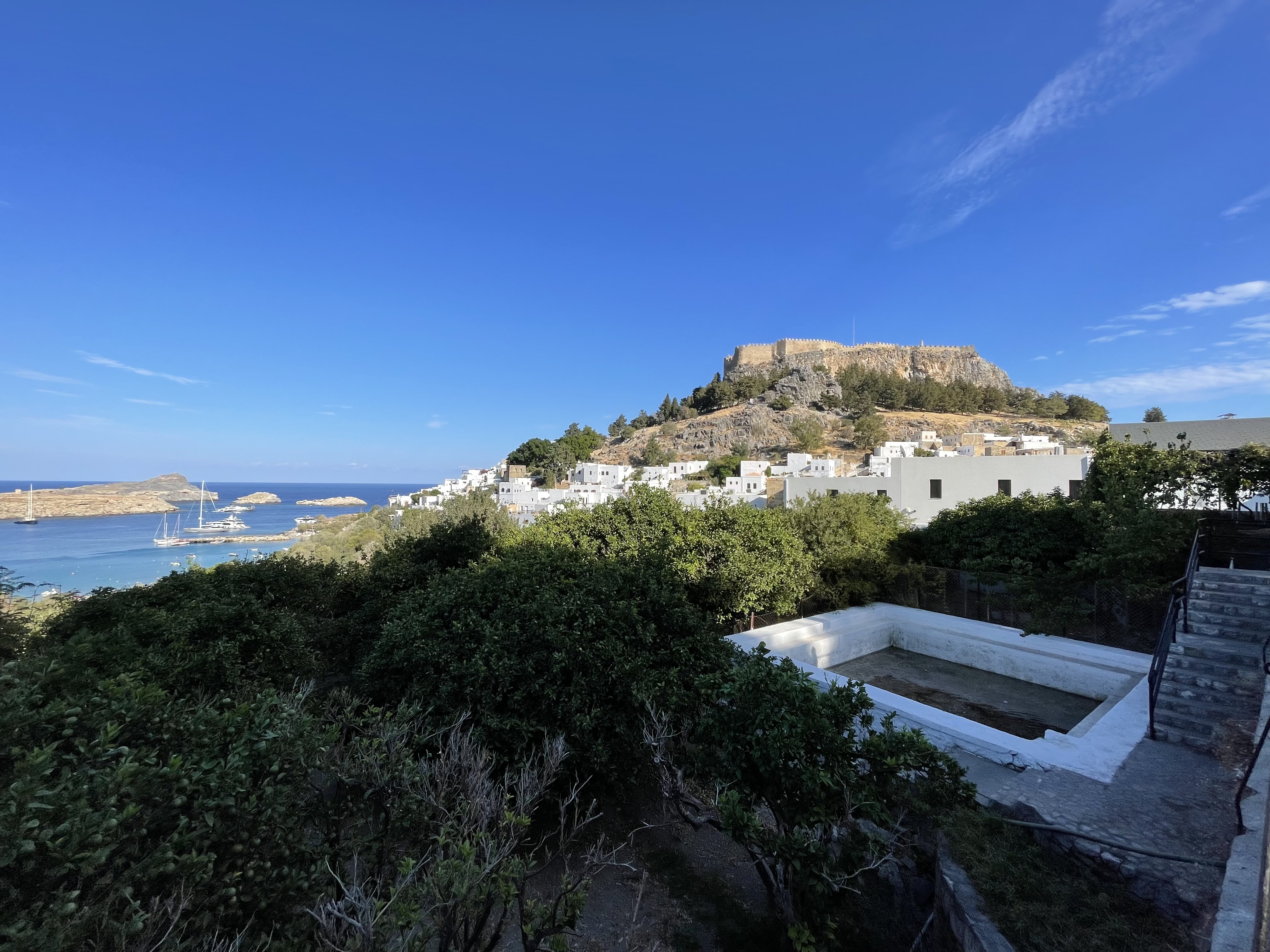
The ancient village of Lindos features a clifftop Acropolis which is only accessible by climbing some 300 steps. I have the pictures to prove I made it!
Lindos
Nearing the fortifications of the Lindos Acropolis
Views of the temples from inside the fortifications:
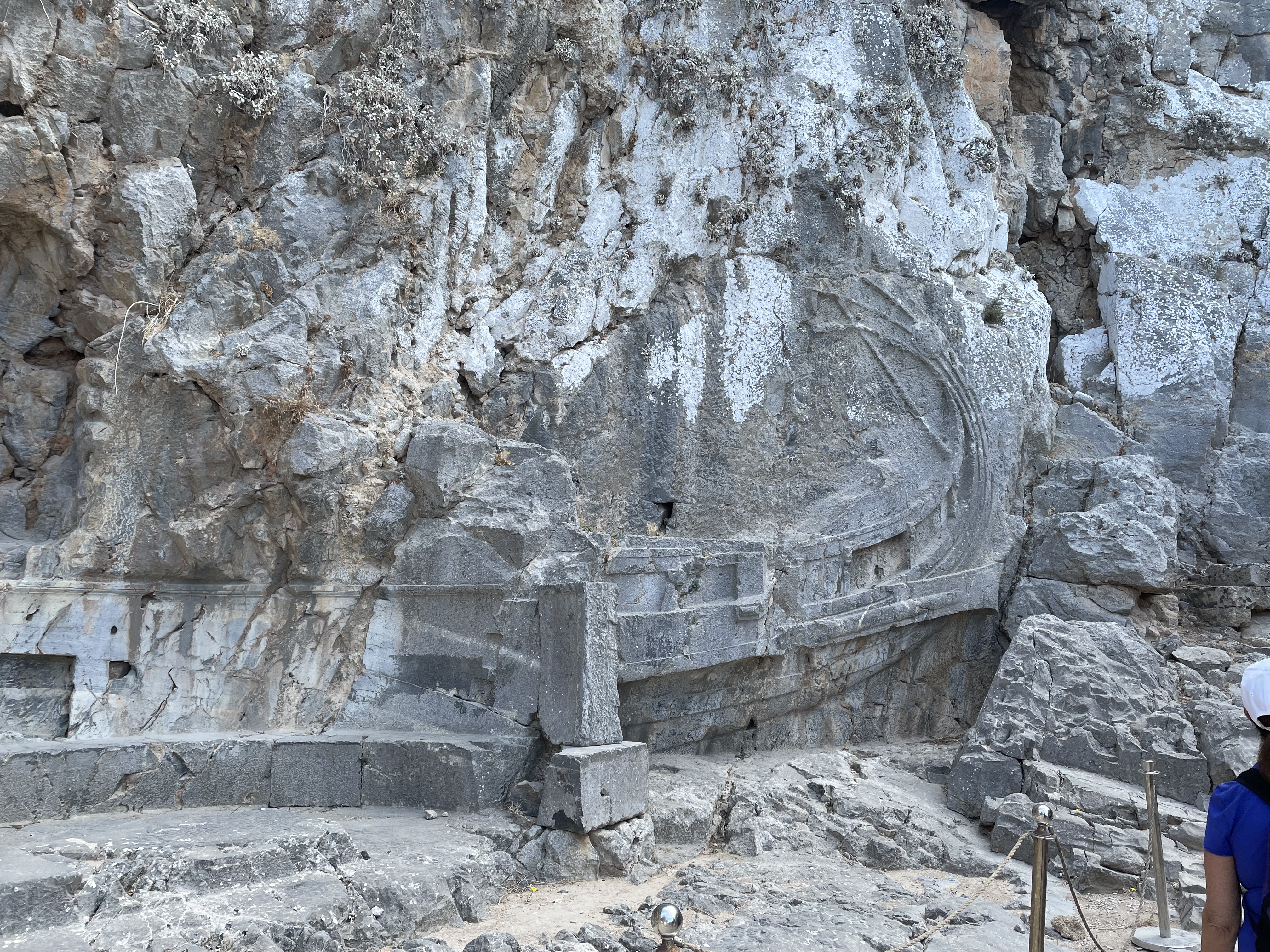
Carving of an ancient ship in the cliffside on the pathway to the Acropolis
The treasures of sun kissed islands
Each island we visited had its own delightful charms and fascinating histories.
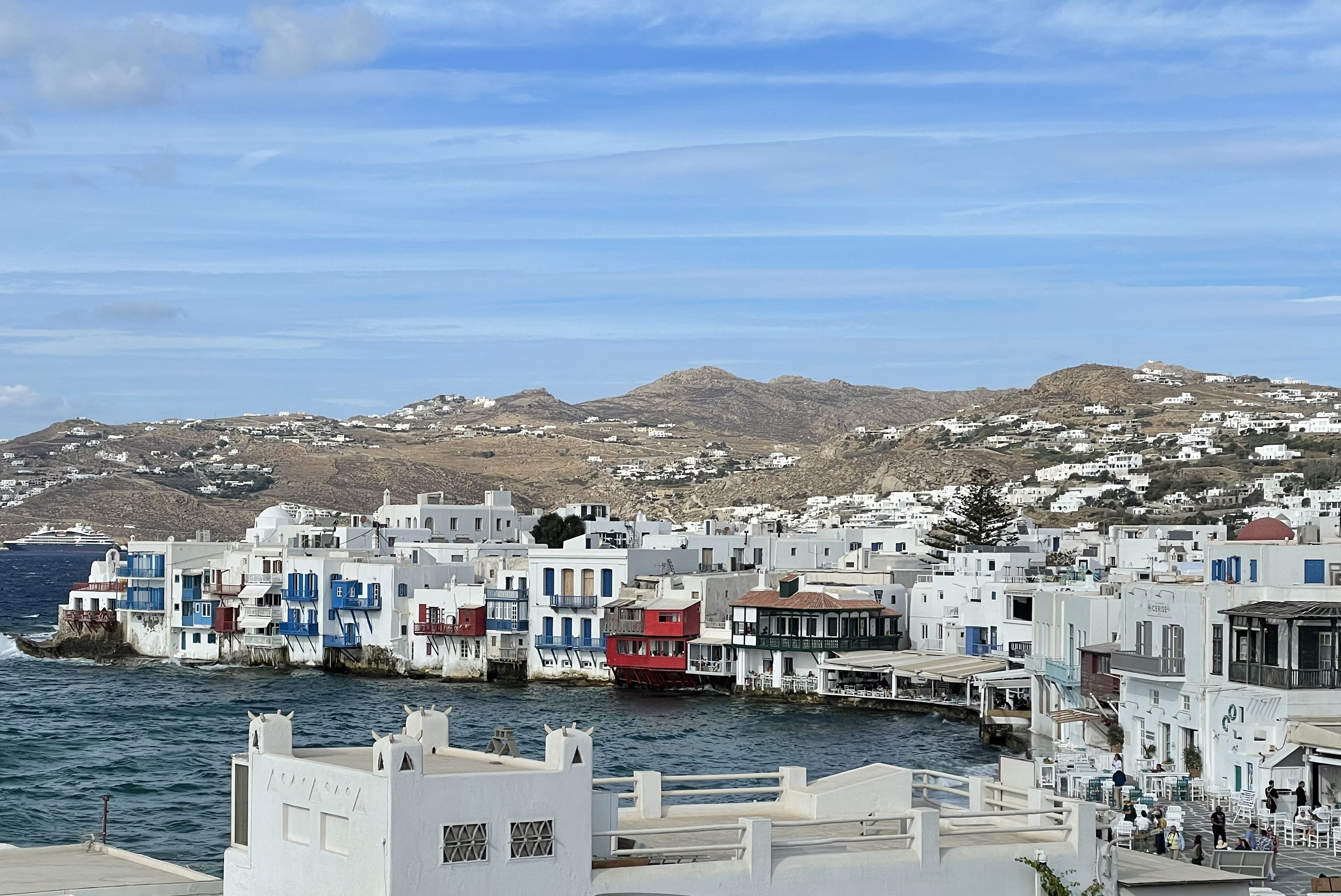
The harbor at Mykonos
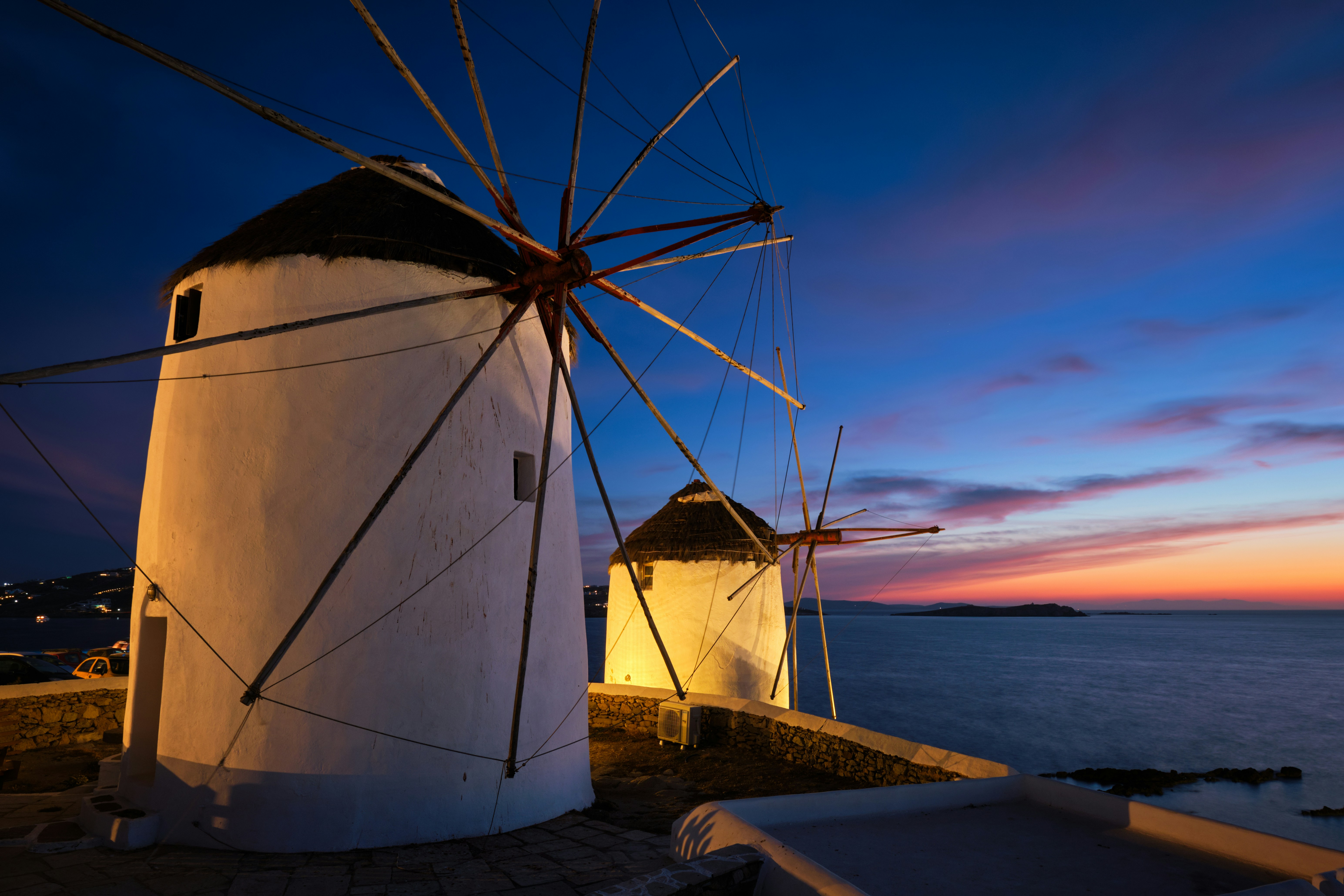
Windmills at Mykonos. Most of them were built by the Venetians in the 16th century, but their construction continued into the early 20th century. They were primarily used to mill wheat.
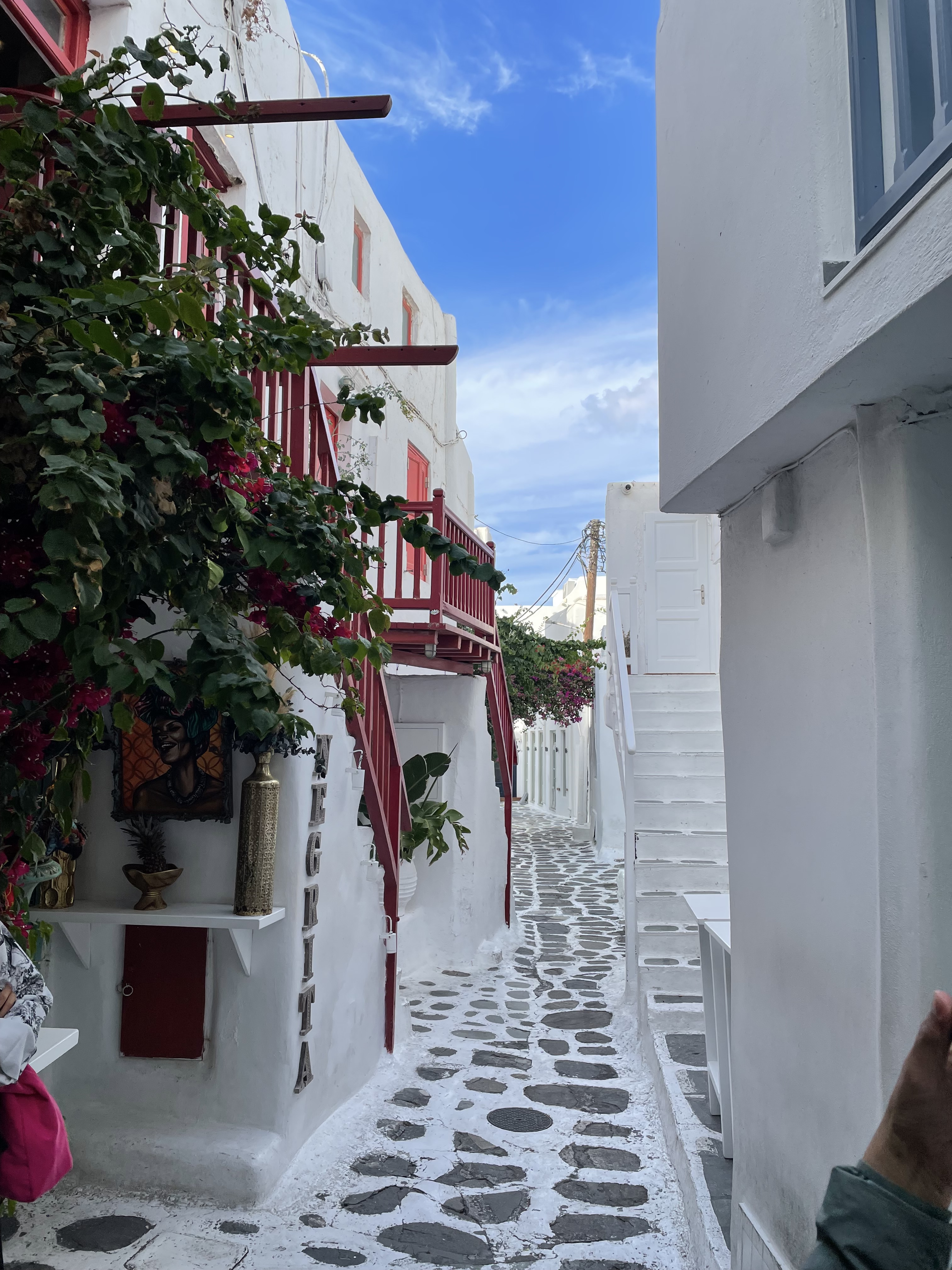
Narrow streets in Mykonos, where land is at a premium, lead to residences . . .
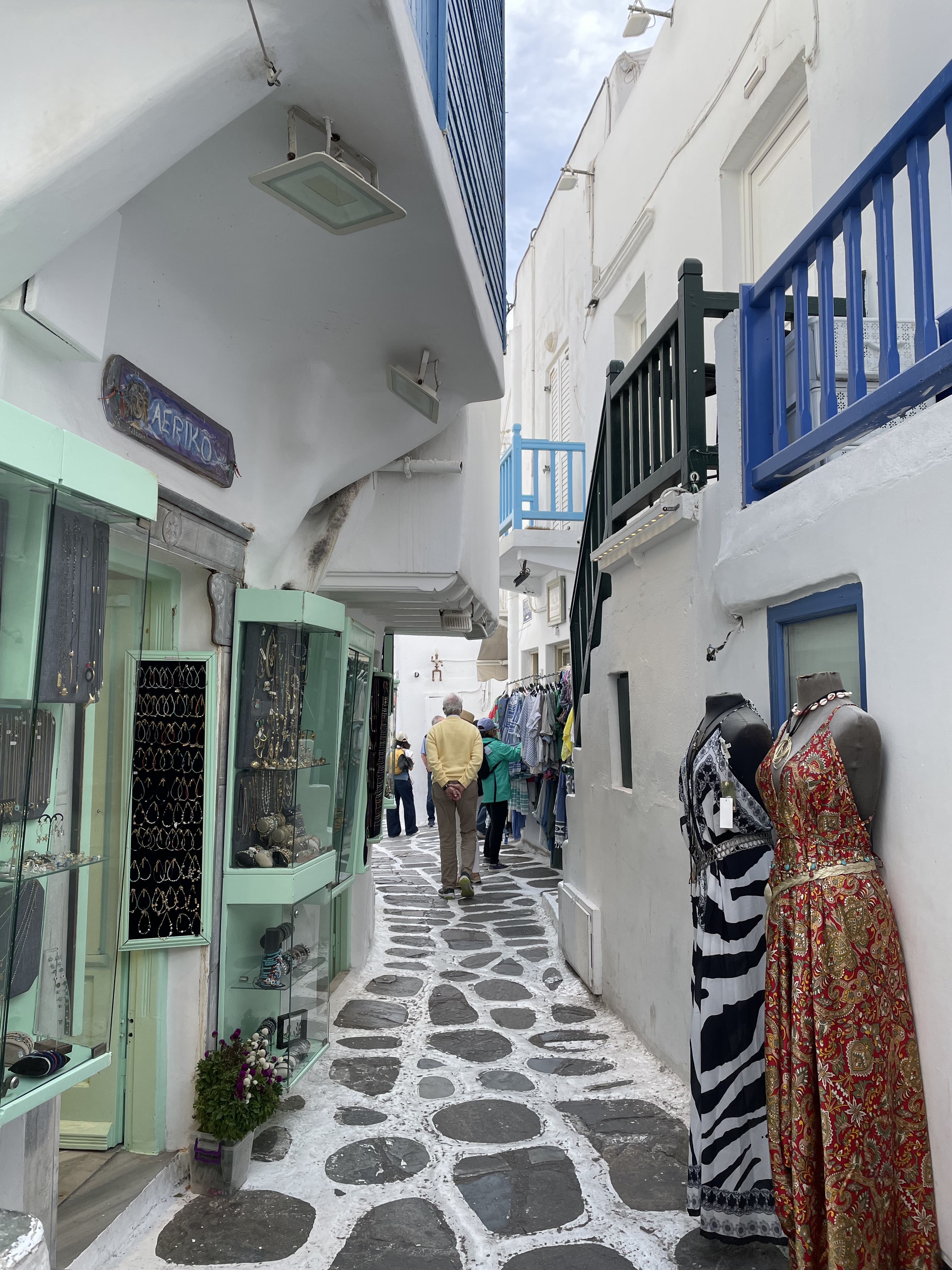
. . . and tiny shops
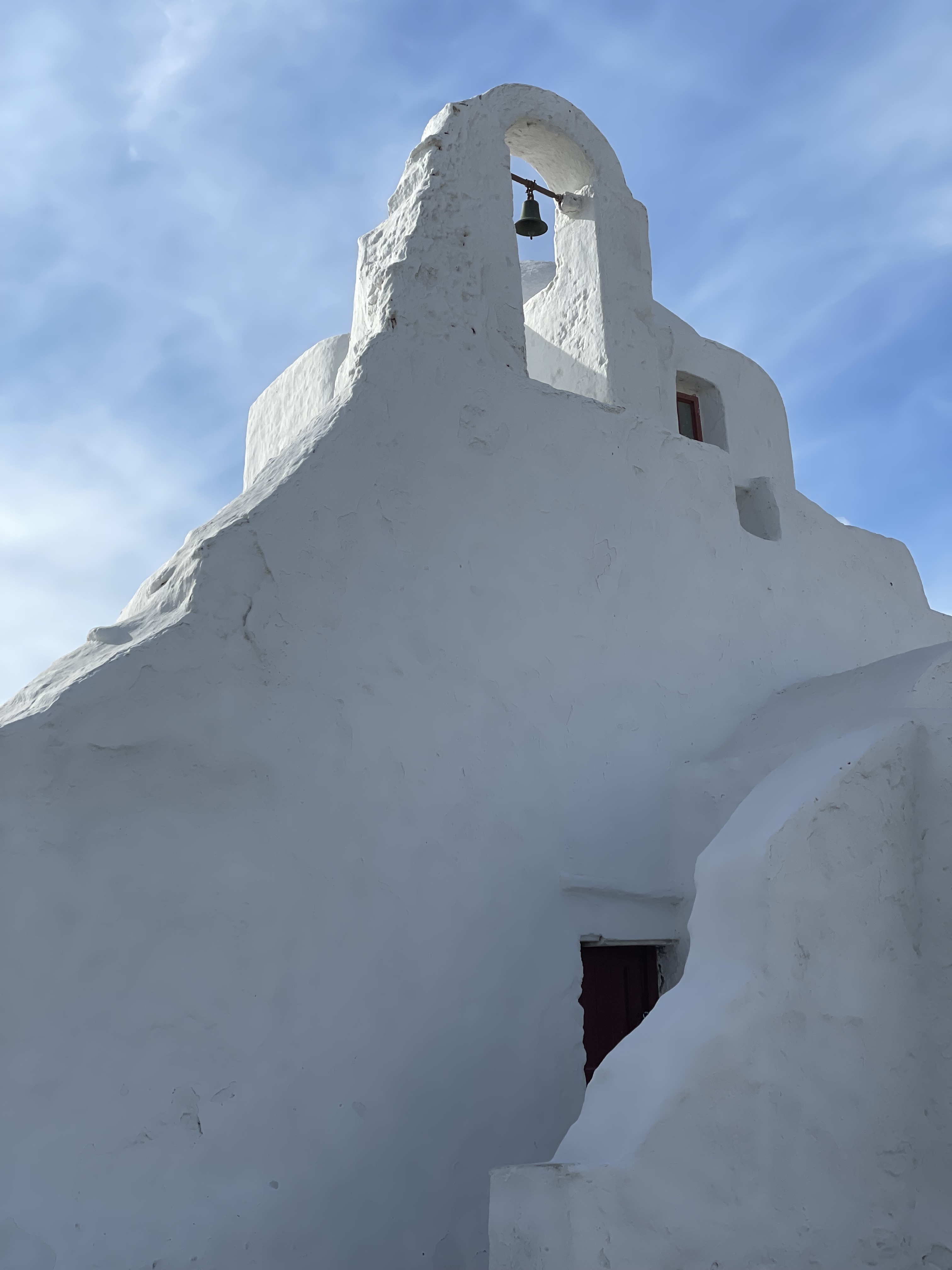
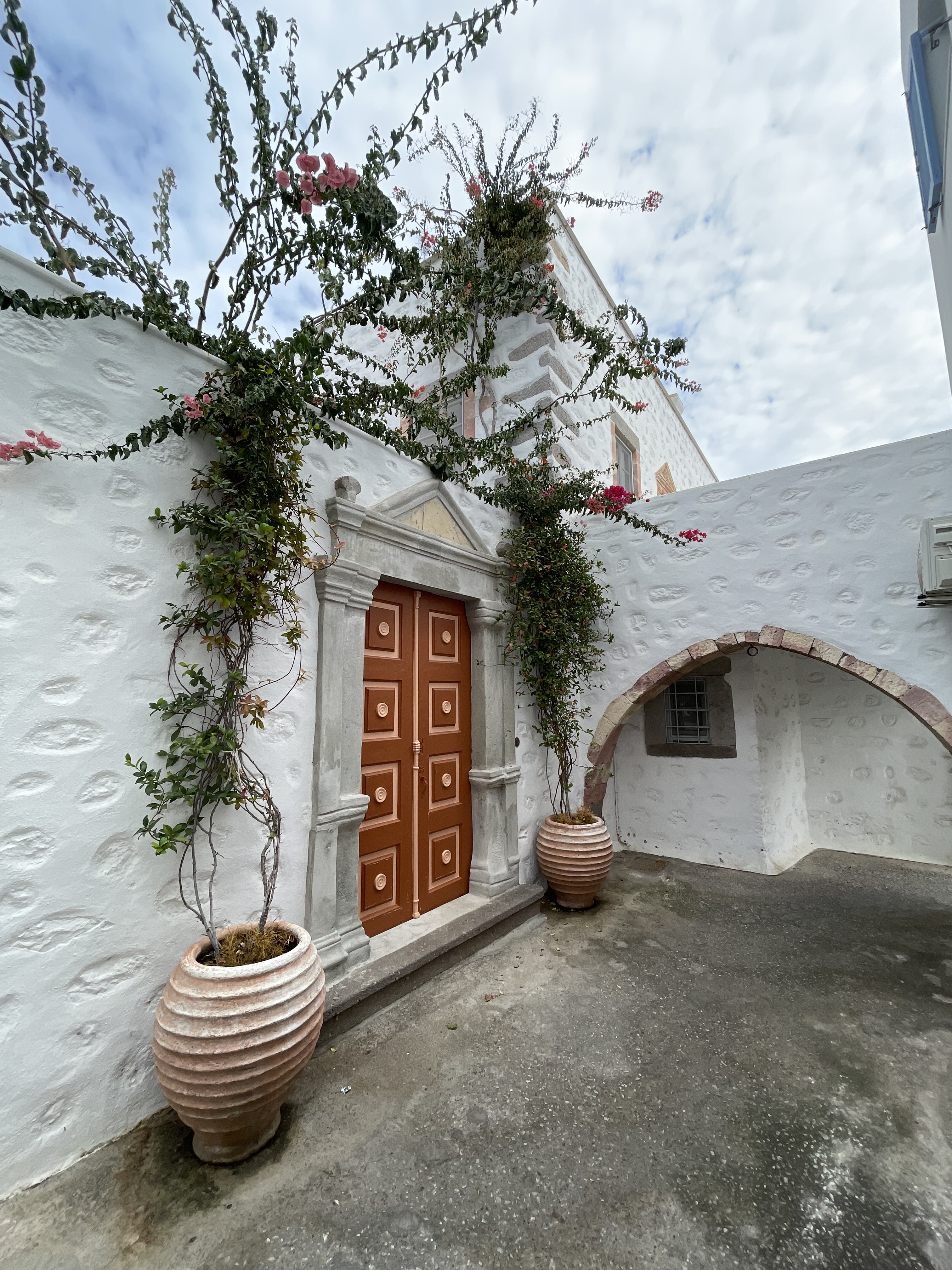
A small, almost hidden chapel in Mykonos
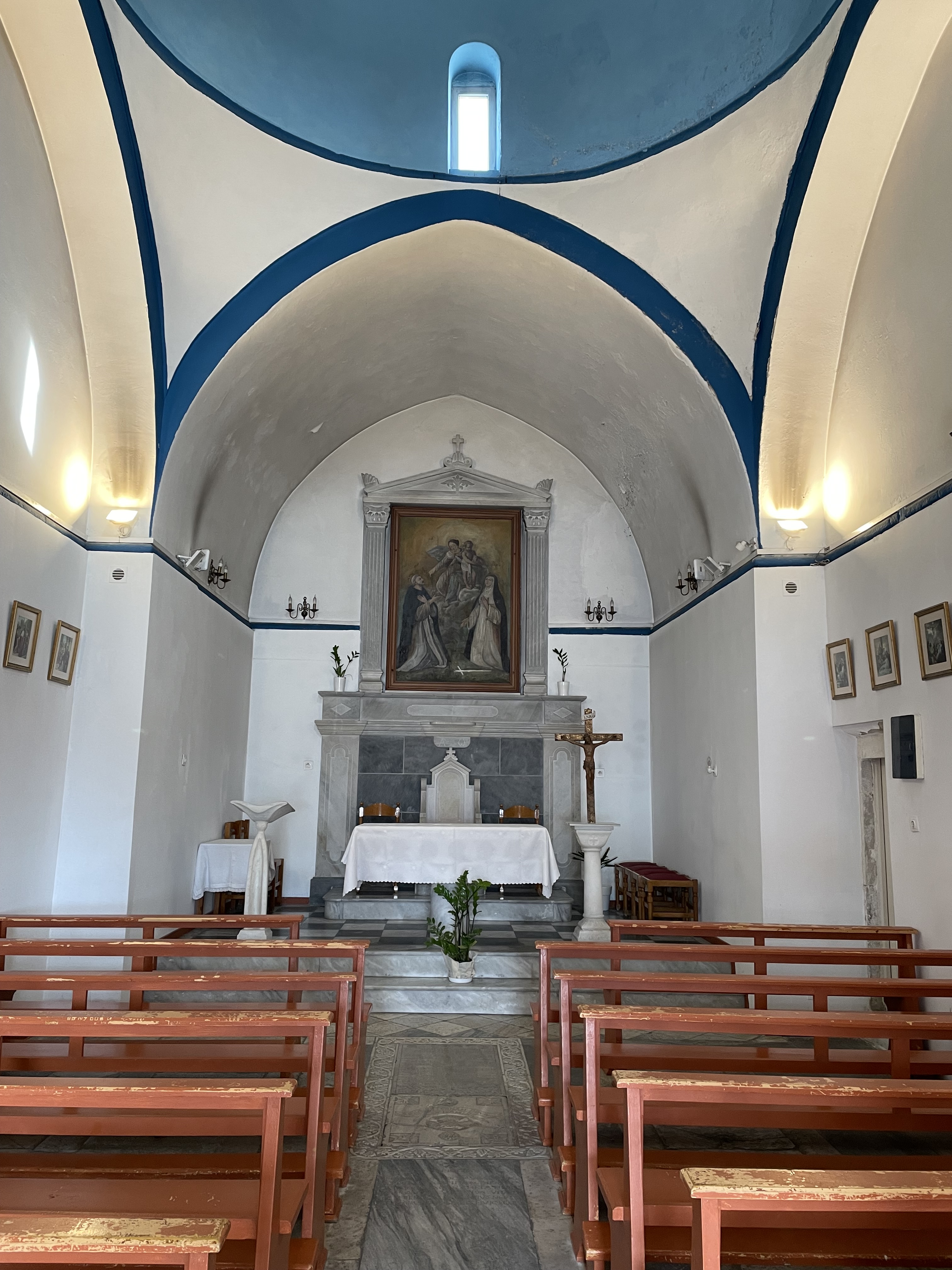
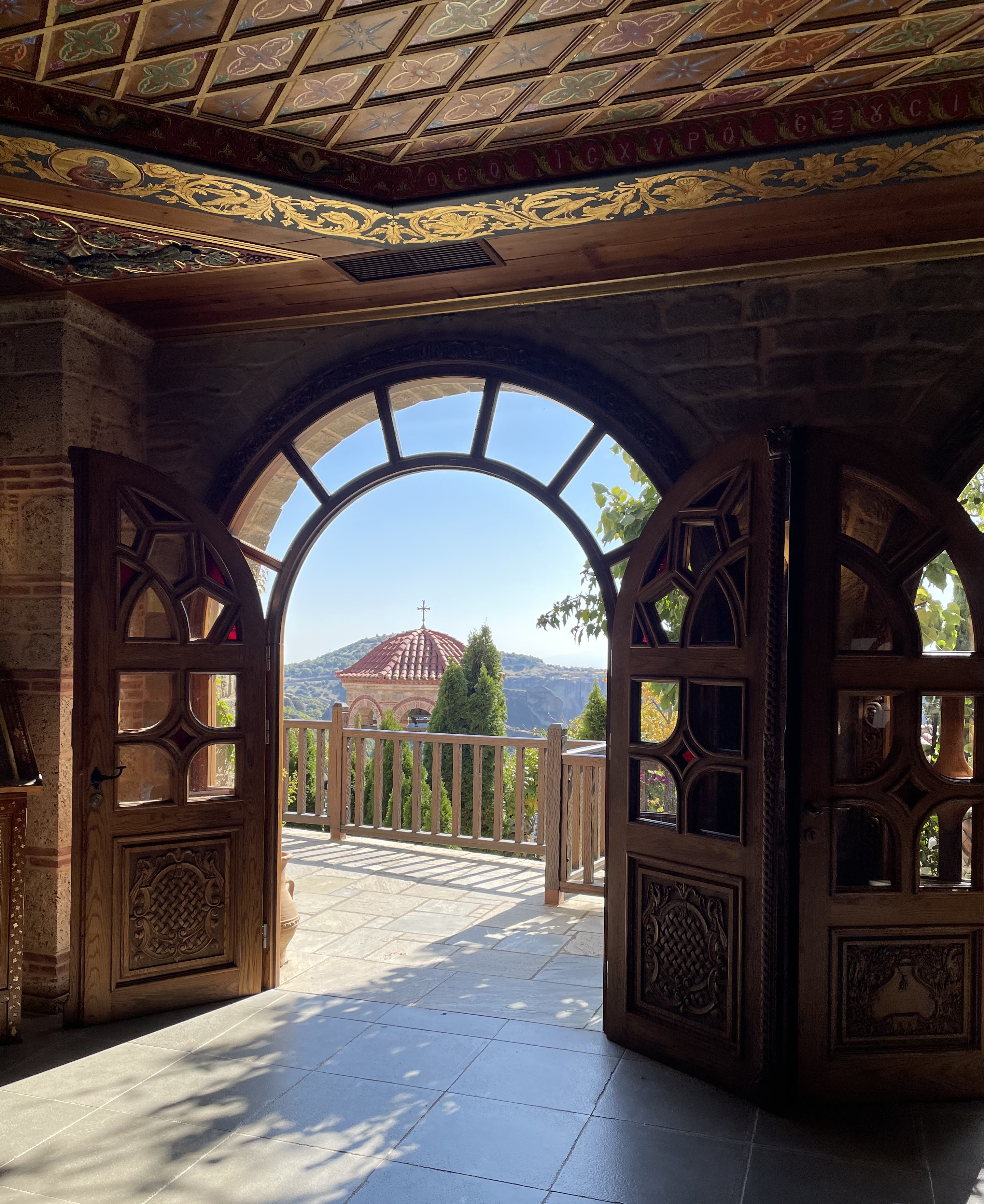
Interior of one of the small chapels in Mykonos. Similar chapels—often constructed as personal chapels by the wealthy—can be found throughout the islands.
We saw why Santorini is one of the most popular islands in the Aegean.
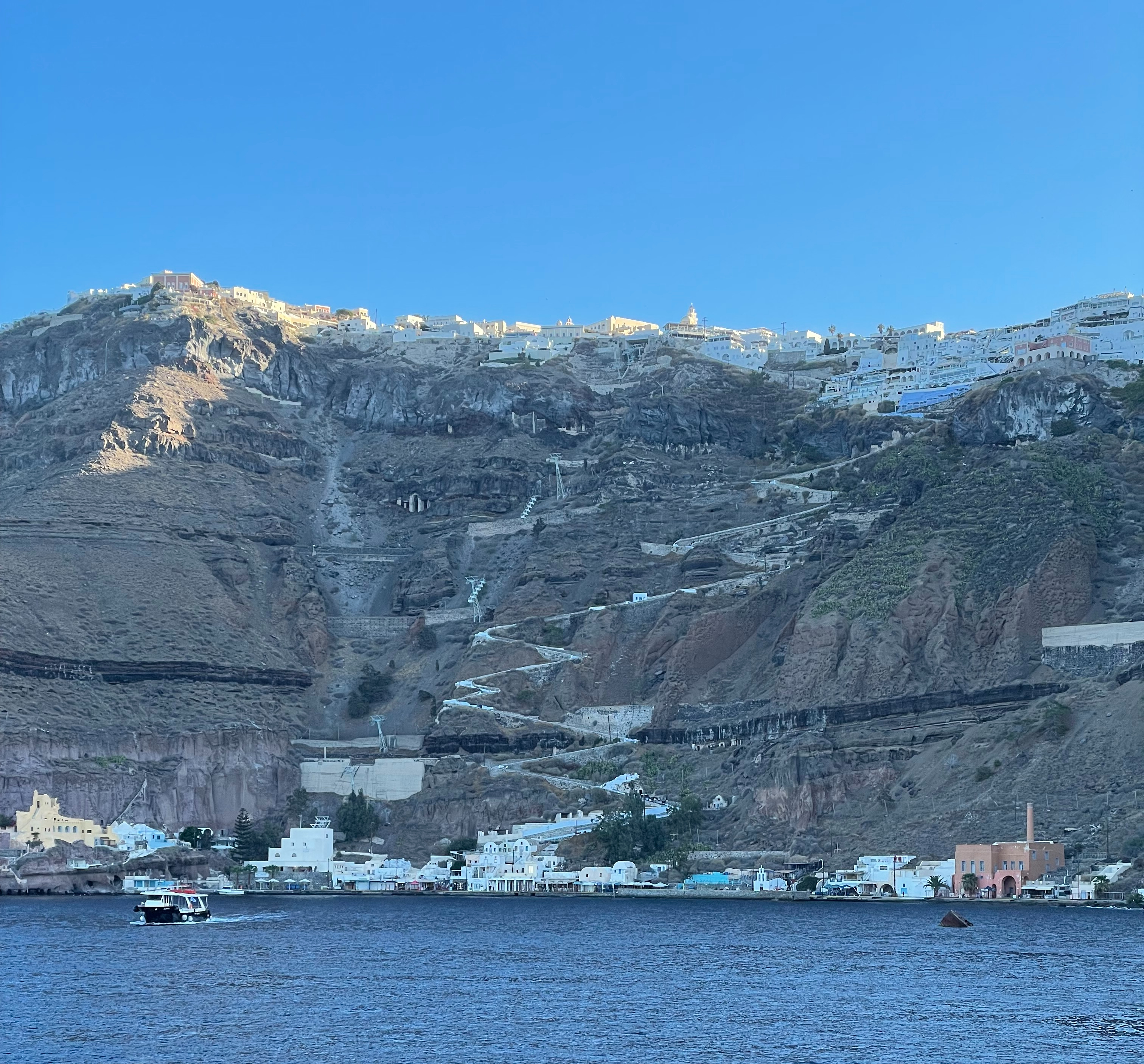
The historic port town of Fira is at the bottom of steep cliffs, and while there is a lift, it is primarily accessible to the top of Santorini by the winding foot and donkey path
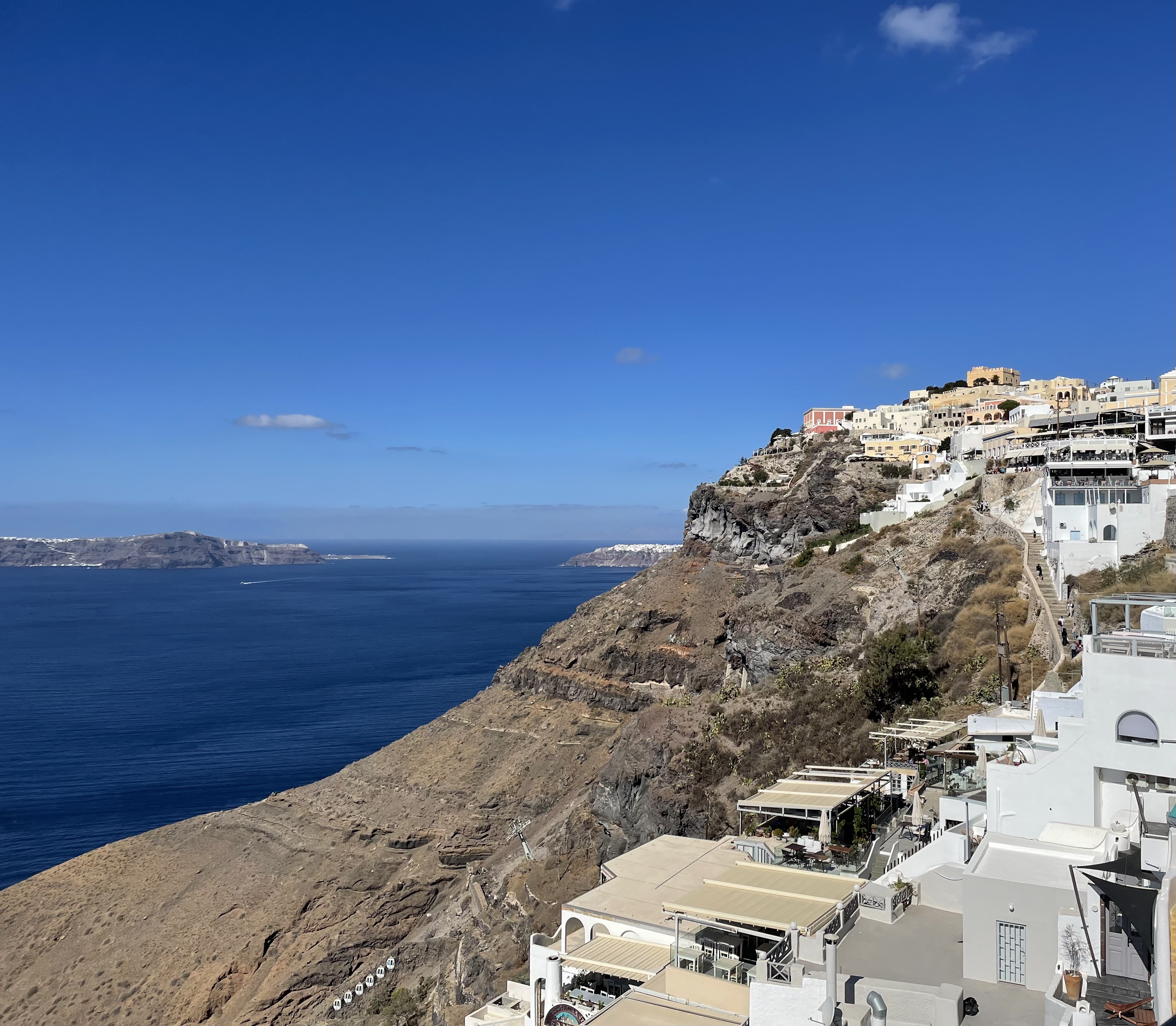
View back down to the sea from the steep cliffs of Santorini
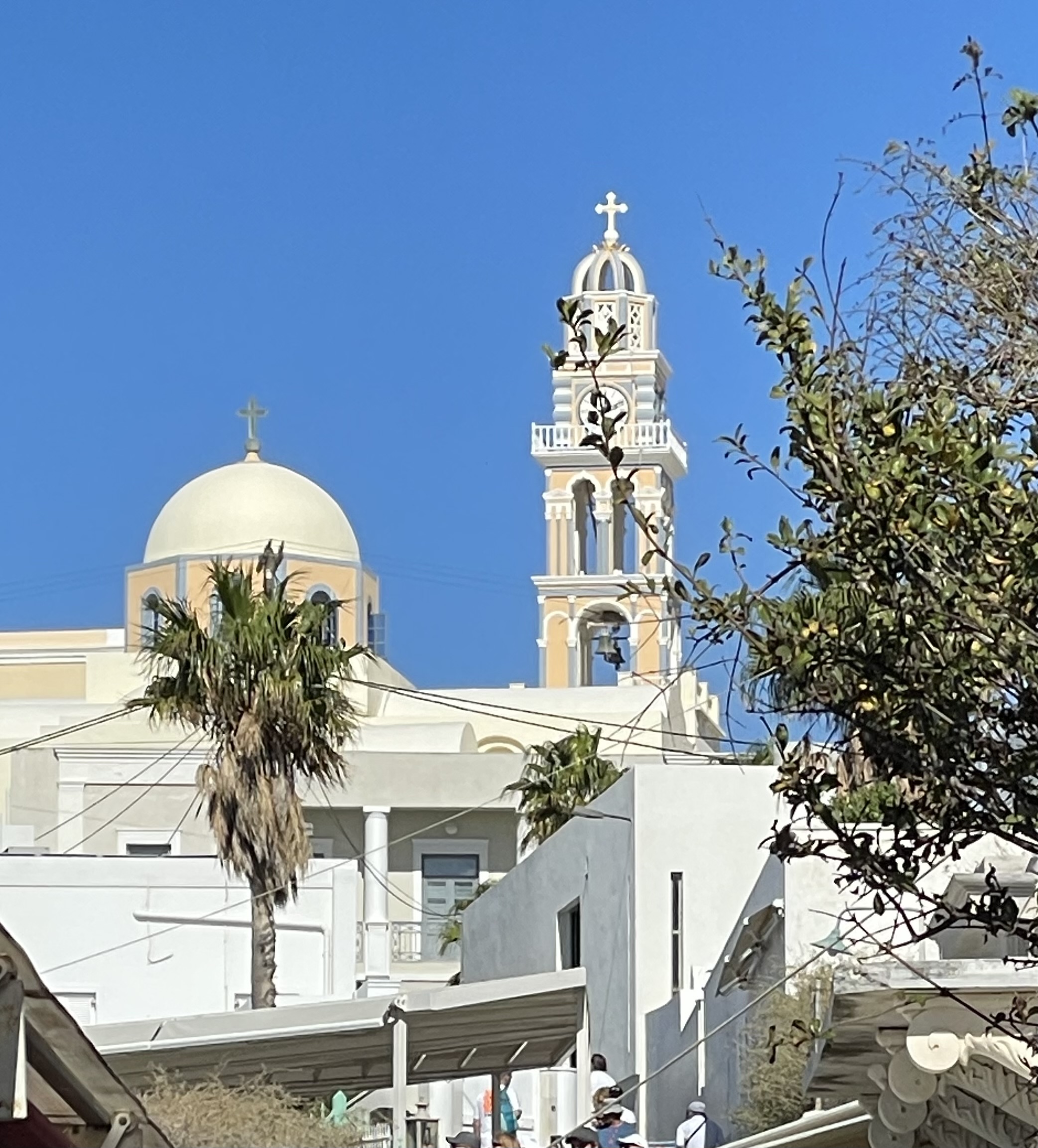
Religious structures of various faiths can be found throughout the city
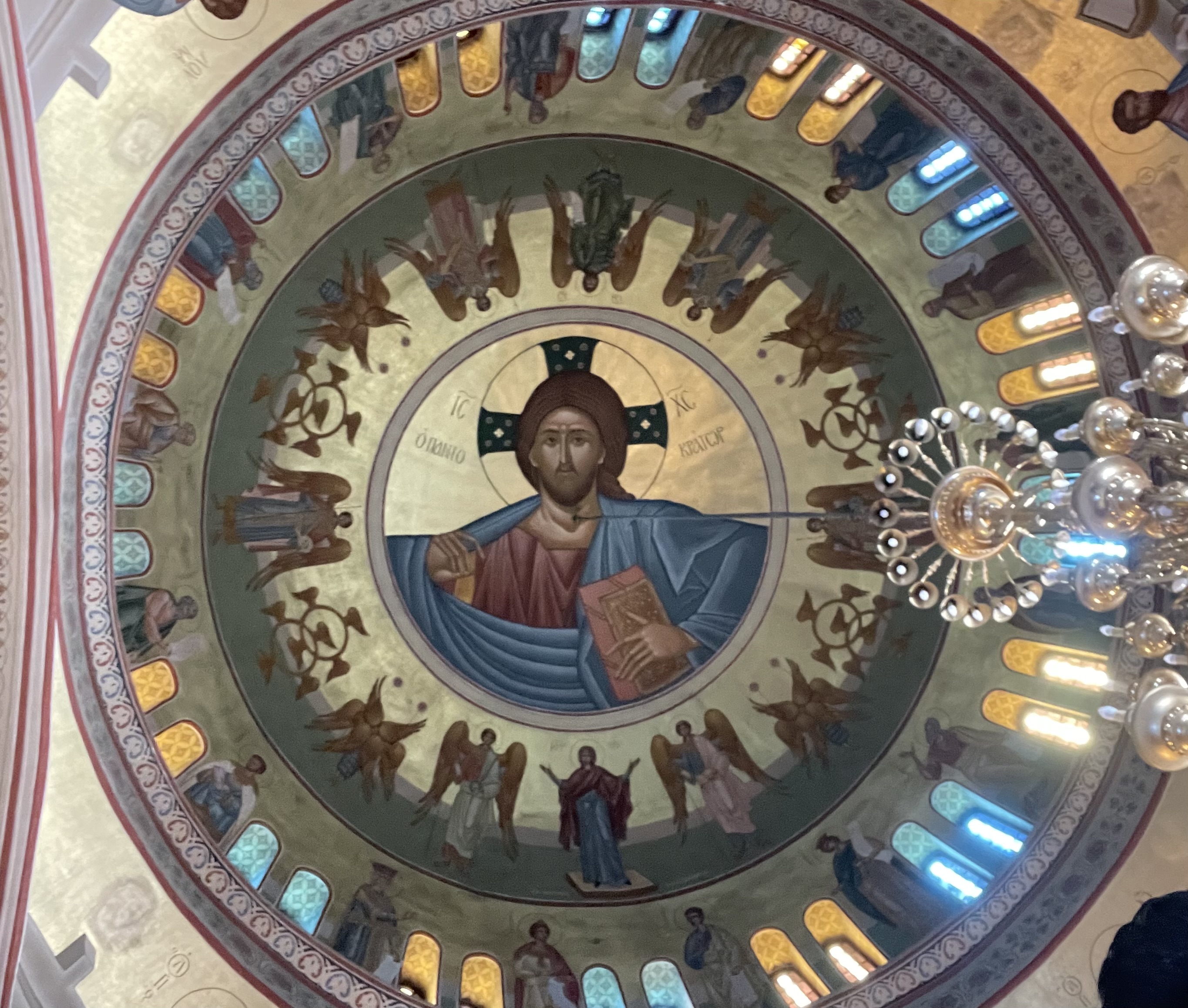
Interior dome in the Greek Orthodox Cathedral in Santorini
Signs of the times
Signs that caught my eye.
Isn’t this an oxymoron?
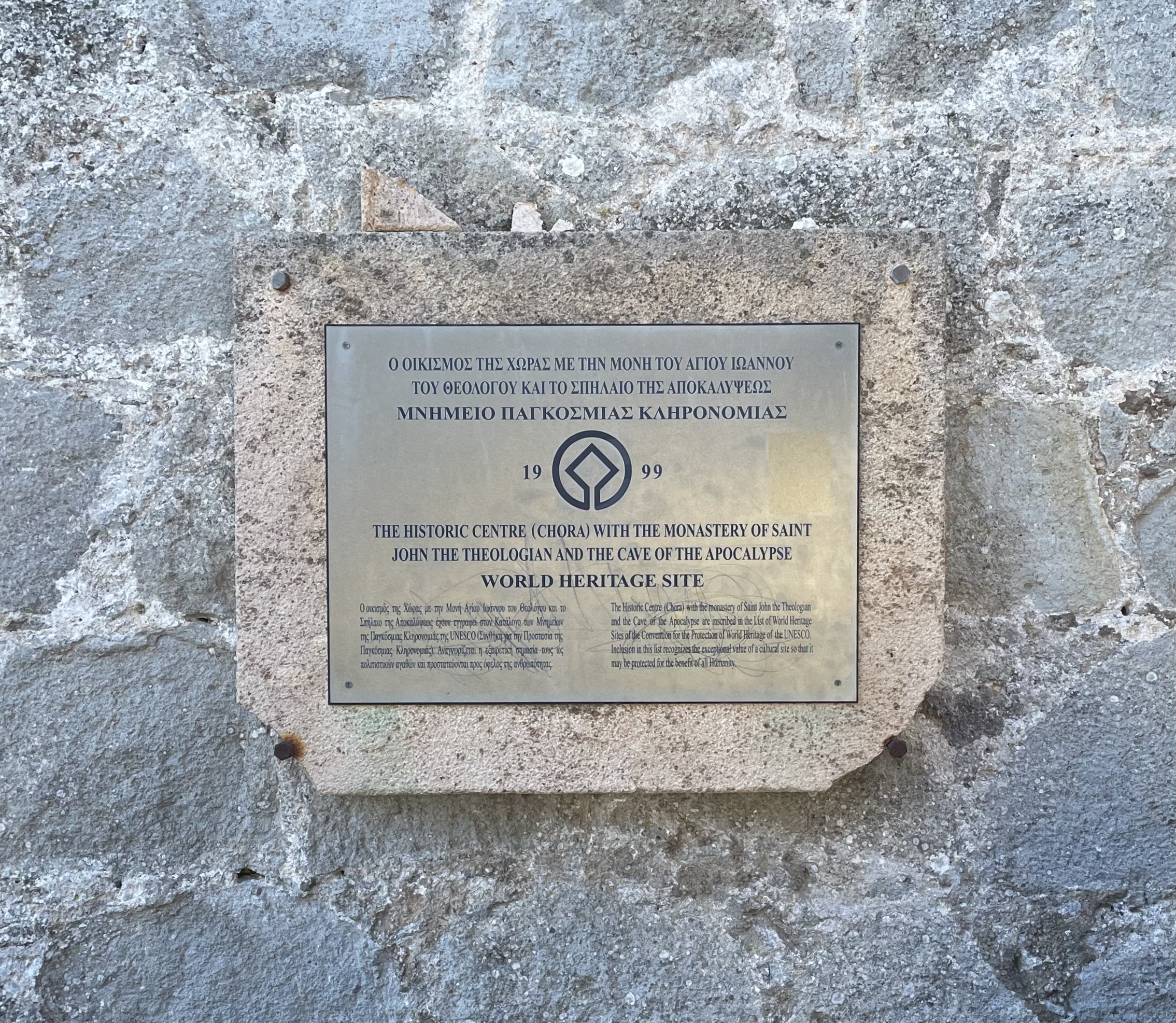
The UNESCO plaque designating Patmos a World Heritage Site
I loved this sign down a side street in Patmos, bringing back memories of an old-style razor blade like my father used for many years
A modest sign for a magnificent home in Delos
Fellow travelers
One of the best things about lecturing on National Trust Tours is the people we meet. We share conversations, memories, and good food. Out of the experiences we have built a number of long-lasting friendships.
Weary travelers catching a late-night drink in the rooftop bar in our Athens hotel before catching up on the sleep lost during the flight. That backdrop is worth staying awake for.
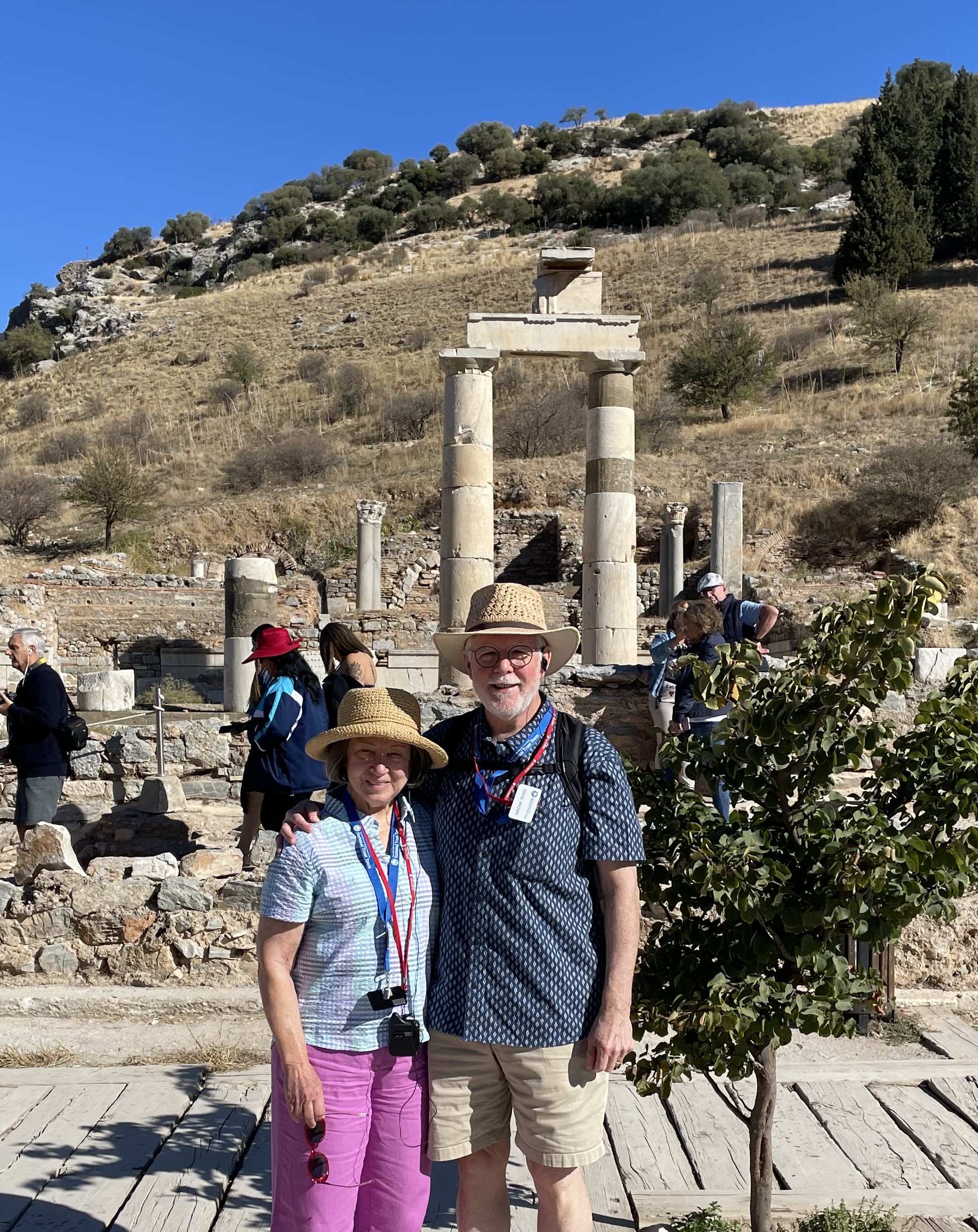
Pausing for a photograph in Ephesus, which was one of Candice’s favorite stops on our trip
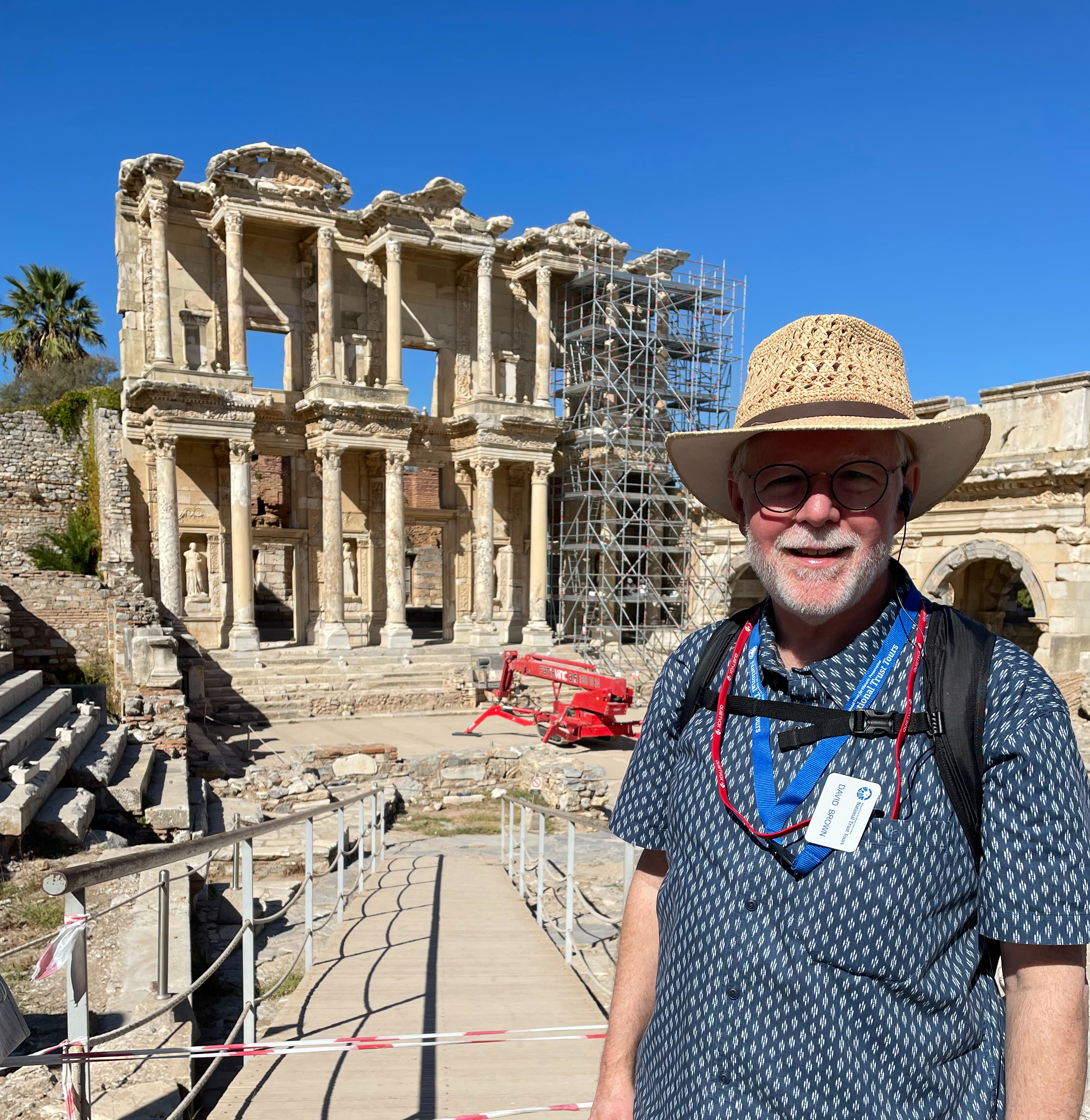
It seemed appropriate for the son and brother of a librarian to have a photo taken at the Library of Celsus in Ephesus
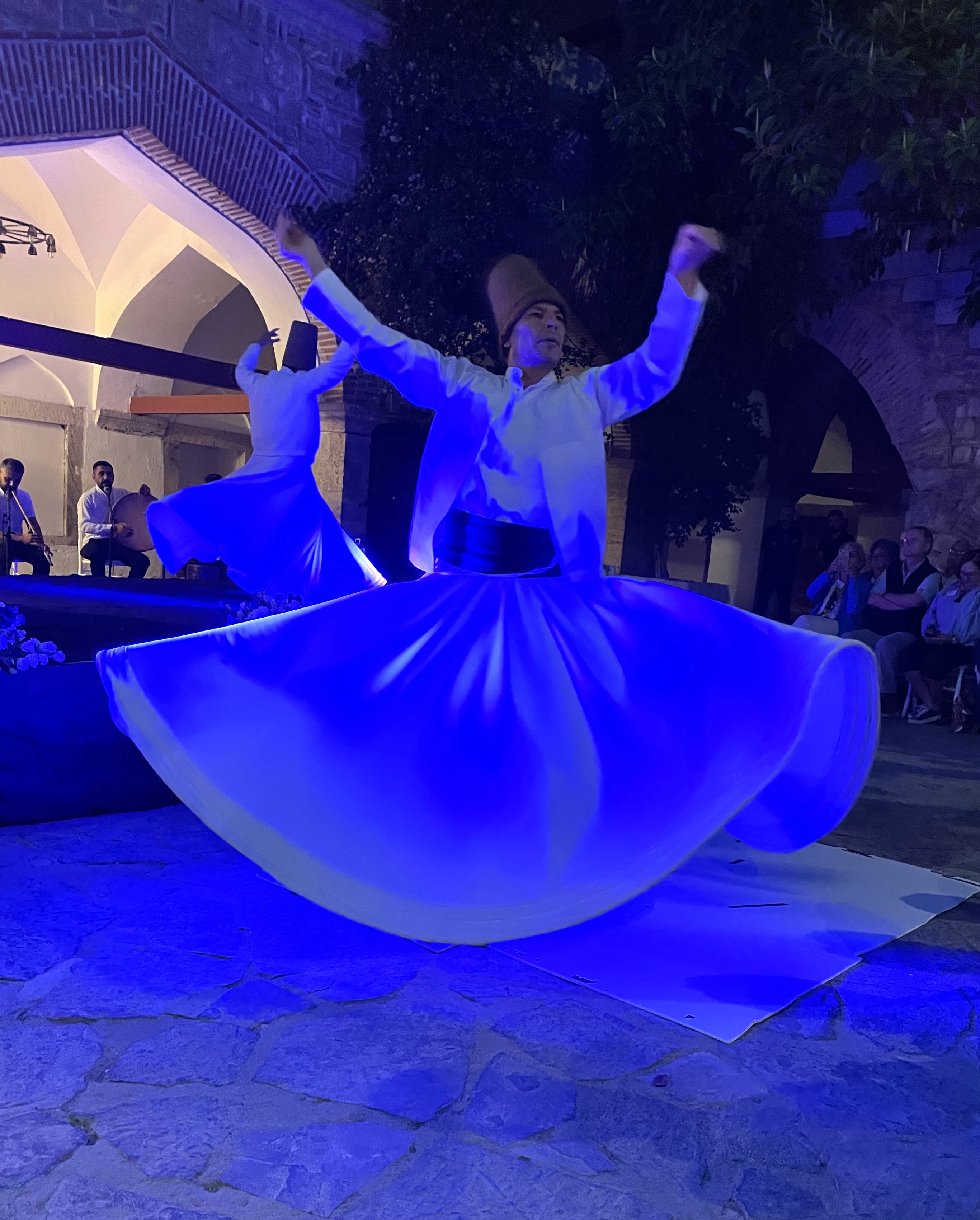
A whirling dervish, Kusadasi, Turkey
Enjoying one of many great meals with fellow National Trust Tour travelers aboard Le Bougainville
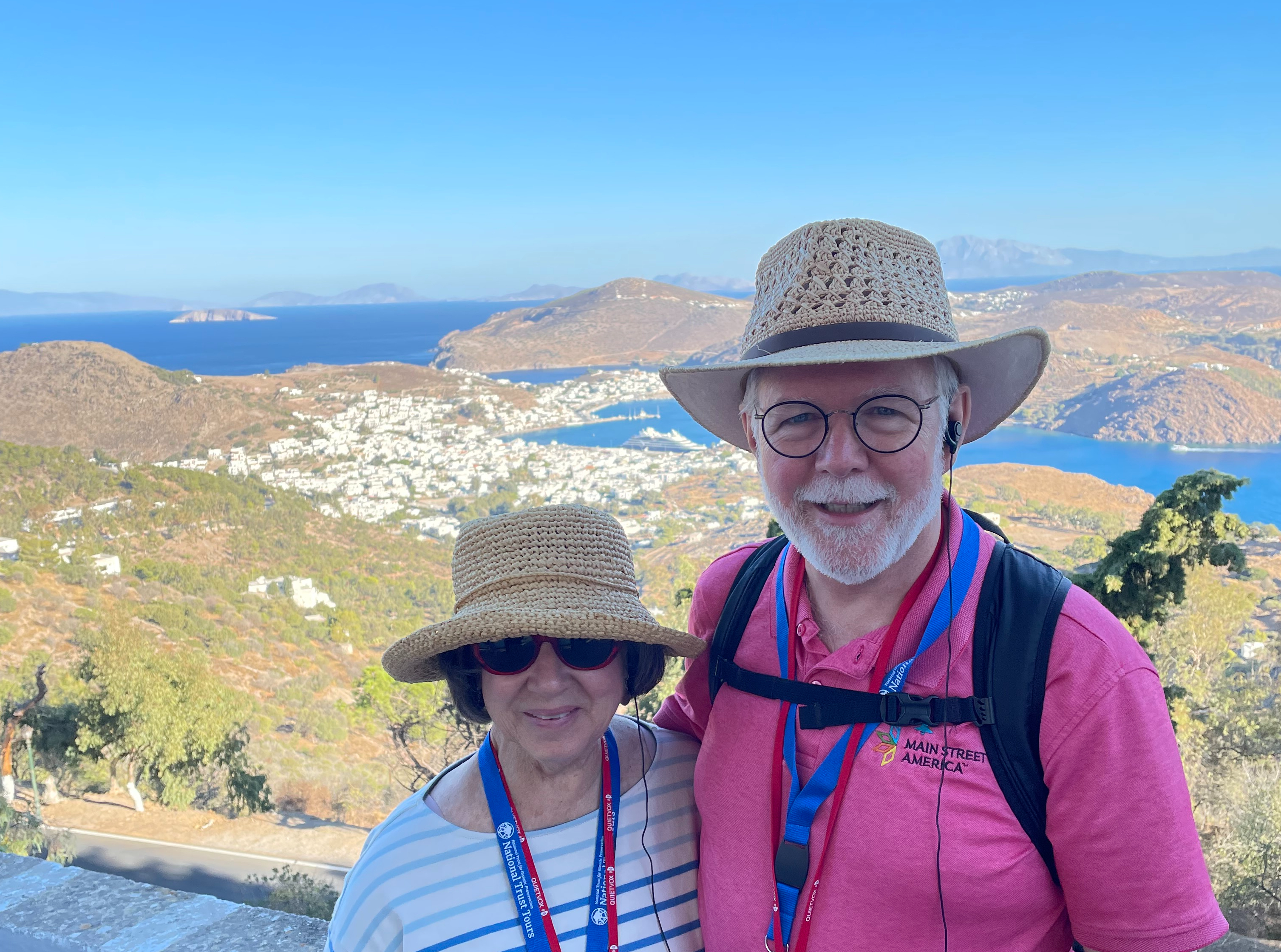
DJB and Candice high above the Pátmos harbor
A gathering of most (but not all) of fellow National Trust Tours travelers. We welcomed those who had traveled with us before, several long-time NTT enthusiasts, and a number of first-time NTT travelers and new friends.
NOTE: This is Part 1 of a two-part “Observations from . . .” review of our recent trip to the Greek Isles. Part 2, which will be primarily pictures, will follow on Tuesday or Wednesday.
Last week I was wrapping up another magical National Trust Tours trip with a lecture focused on saving historic places in a changing world. It was the final day of our visit to the Greek islands, the Meteora monasteries, and Ephesus.
We had certainly seen places where, as the philosopher Heraclitus of Ephesus (535-475 BCE) phrased it, “the only constant in life is change.” The question I posed to our travelers was this: If old places help ground our memories, define our identity, and place us in a larger continuum of time—providing the backdrop for the narrative each of us creates out of our own lives to make them meaningful and coherent—how might constant change influence our perception of history, the places we remember, and those narratives?
There was also a subtext of “we need better myths” in my remarks. I’d been thinking about myths since Dartmouth professor Aine Donovan’s lecture earlier in the trip on the relevance of Greek philosophy in 2024. So much of history is built on myths and perspectives that can and do change over time. I learned a great deal about history from my beloved grandmother, but as I grew older and studied the facts I had to unlearn the myth of the “Lost Cause” she taught me. My narrative had to change.
Throughout the week we saw beautiful and unique places where history continues to unfold while myths are both strengthened and challenged. Here are a few.
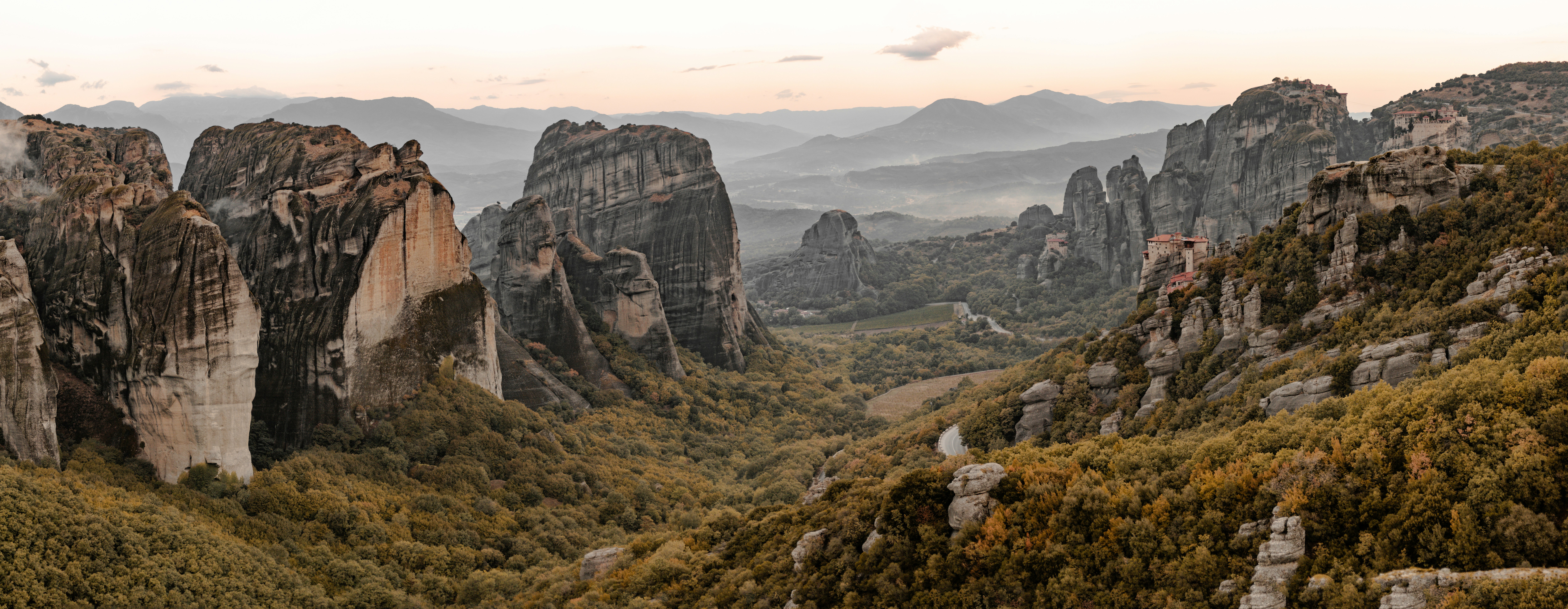
Meteora
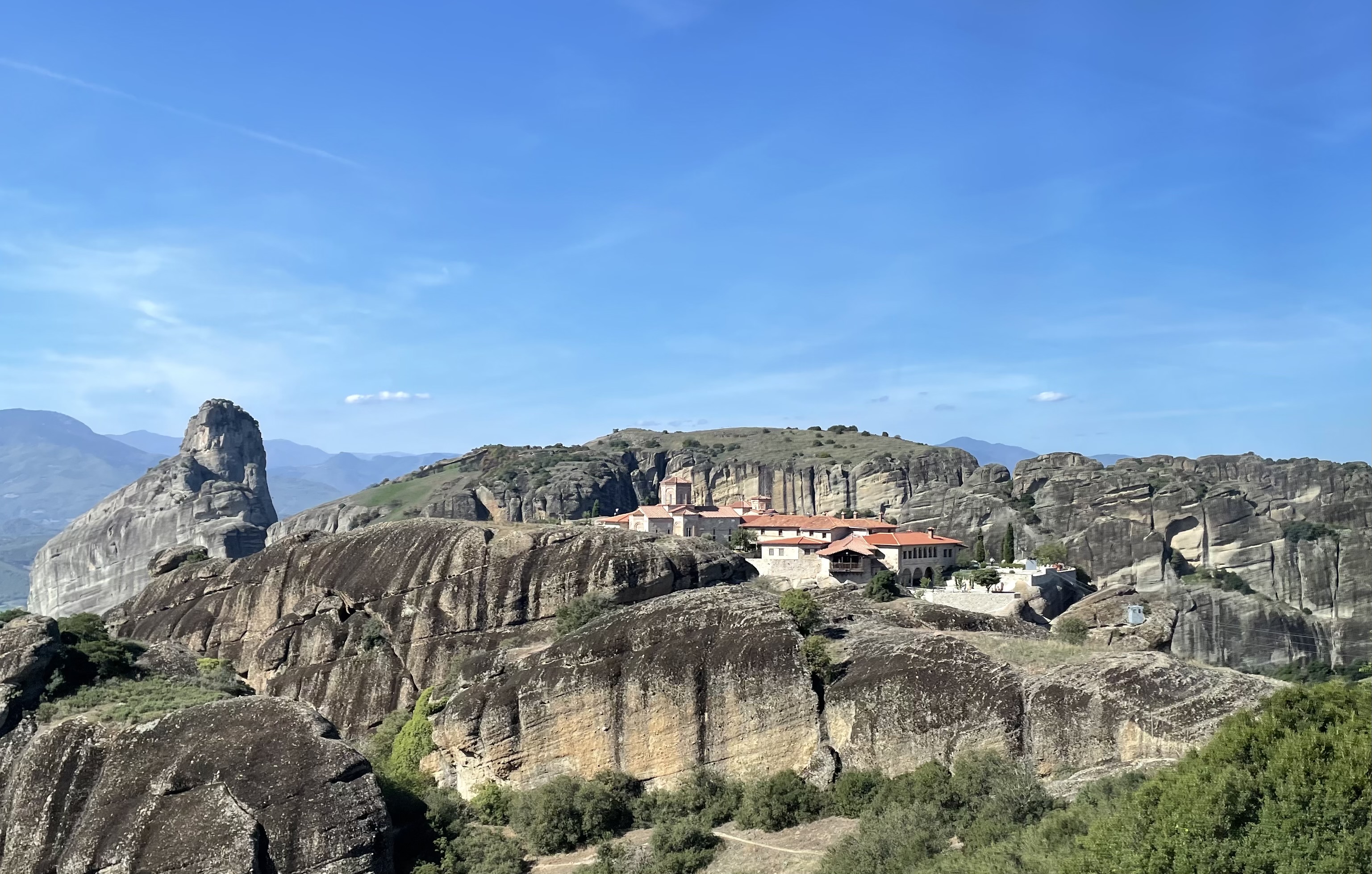
Meteora (credit: Unsplash)
A few miles northwest of the town of Kalabaka, the impressive rocks of Meteora rise from the plains of Thessaly, creating one of the most breathtakingly beautiful landscapes in Greece. Centuries ago one of the country’s most important monastic communities formed on these gigantic rocks. The Greek word Meteora means “suspended in the air” and this phrase aptly describes these remarkable Greek Orthodox monasteries.
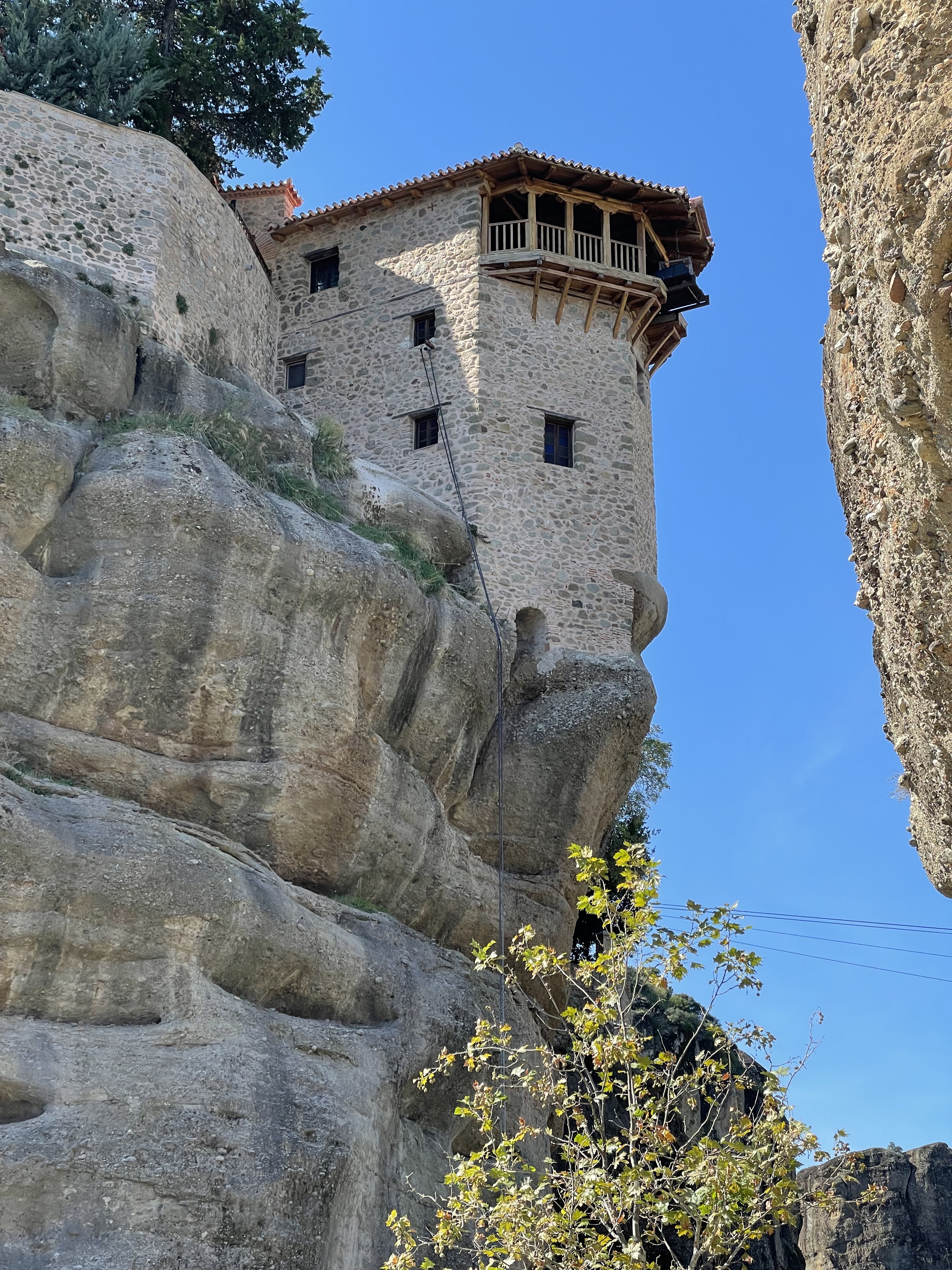
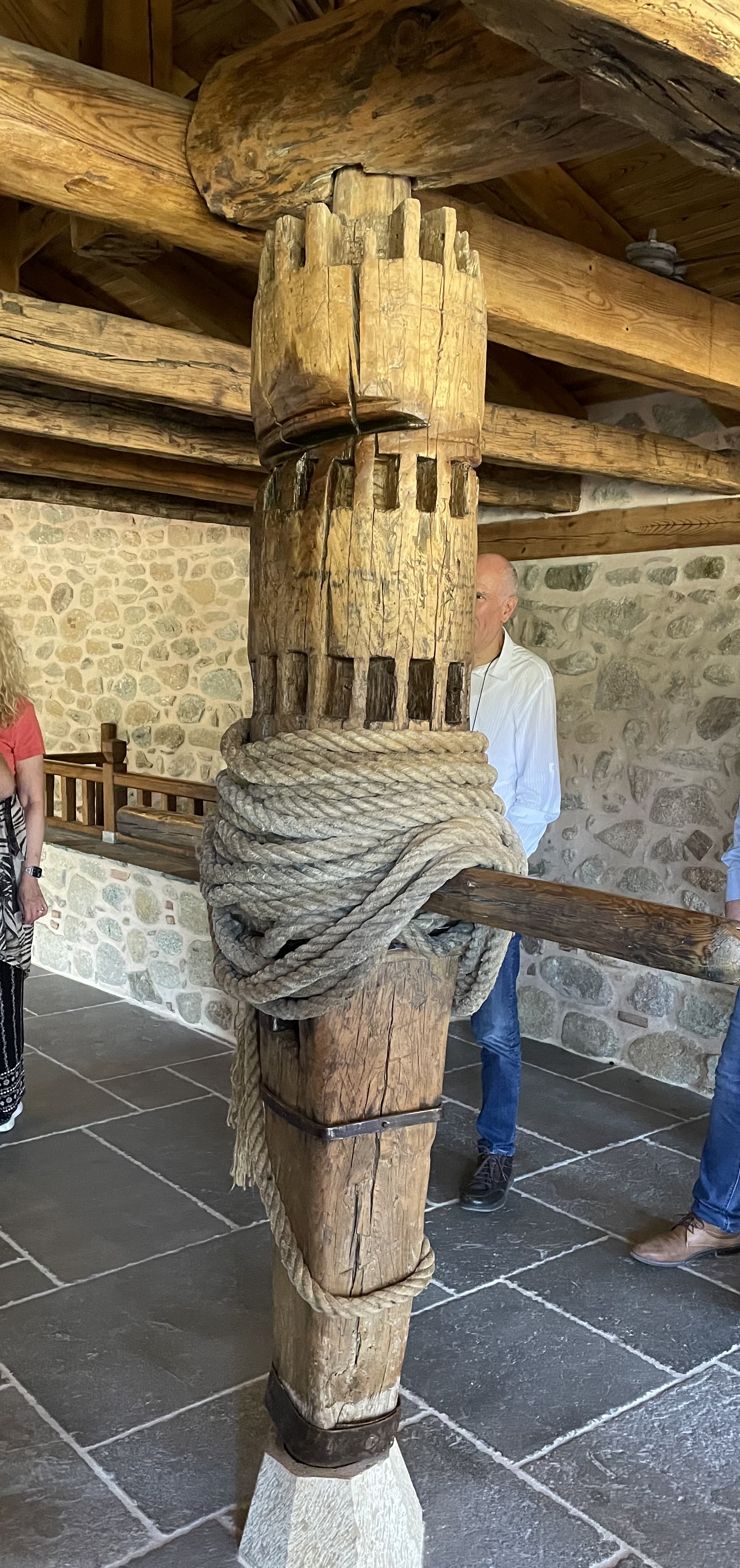
We visited this UNESCO World Heritage Site on the first day of our tour. Monks began settling on these “heavenly columns” from the 11th century onwards where they eventually built as many as twenty-six monasteries despite facing unimaginable difficulties during construction. For hundreds of years, most of these monasteries were accessible only by a system of wooden ladders, ropes, and buckets. While they continued to flourish until the 17th century, only four still house religious communities today.
Part of the historic system of ropes used by monks to access the monasteries
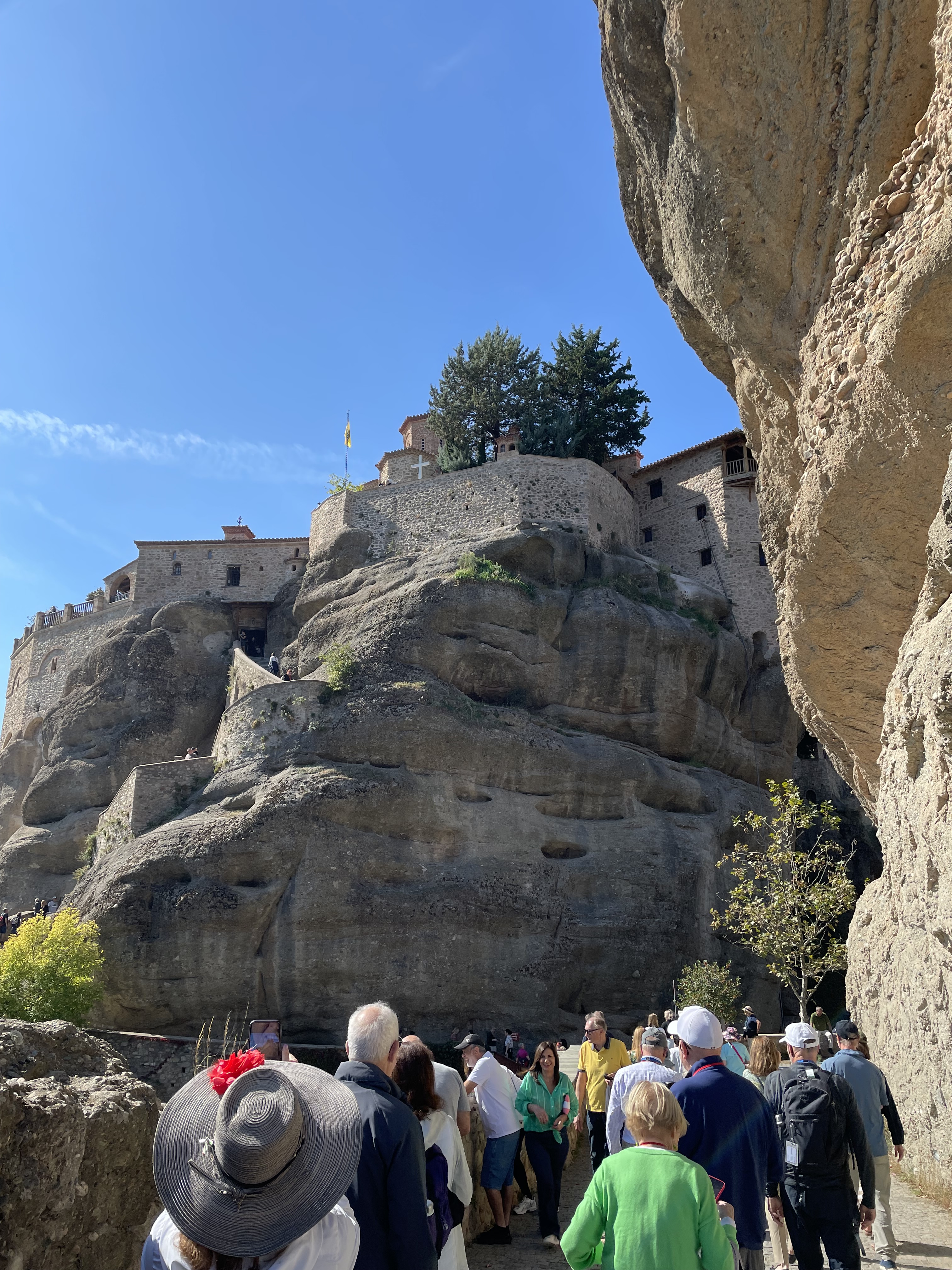
Thankfully today’s visitor generally has solid roads and steps . . . hundreds of steps . . . to access these world treasures.
Visitors on the trail to climb to the monastery
The protection of Greece’s cultural heritage became a government responsibility early on in the creation of the modern Greek state under the supervision of the General Directorate of Antiquities and Cultural Heritage. We saw that work firsthand, as the government was the funder and driver of the remarkable conservation of the monasteries.
Meteora is a spiritual place, where one engages with nature, God, and man. If we think of heritage conservation at historic sites as focused on both the body (the physical fabric) and soul (the sum of the history, traditions, memories, myths, associations, and continuity of meaning connected with people and use over time), Meteora is “body and soul” in the extreme.
Credit: UNESCO
I think the UNESCO nomination gets it right:
“Meteora is one of those places where natural and cultural elements come together in perfect harmony to create a natural work of art on a monumental, yet human scale.”
Ephesus
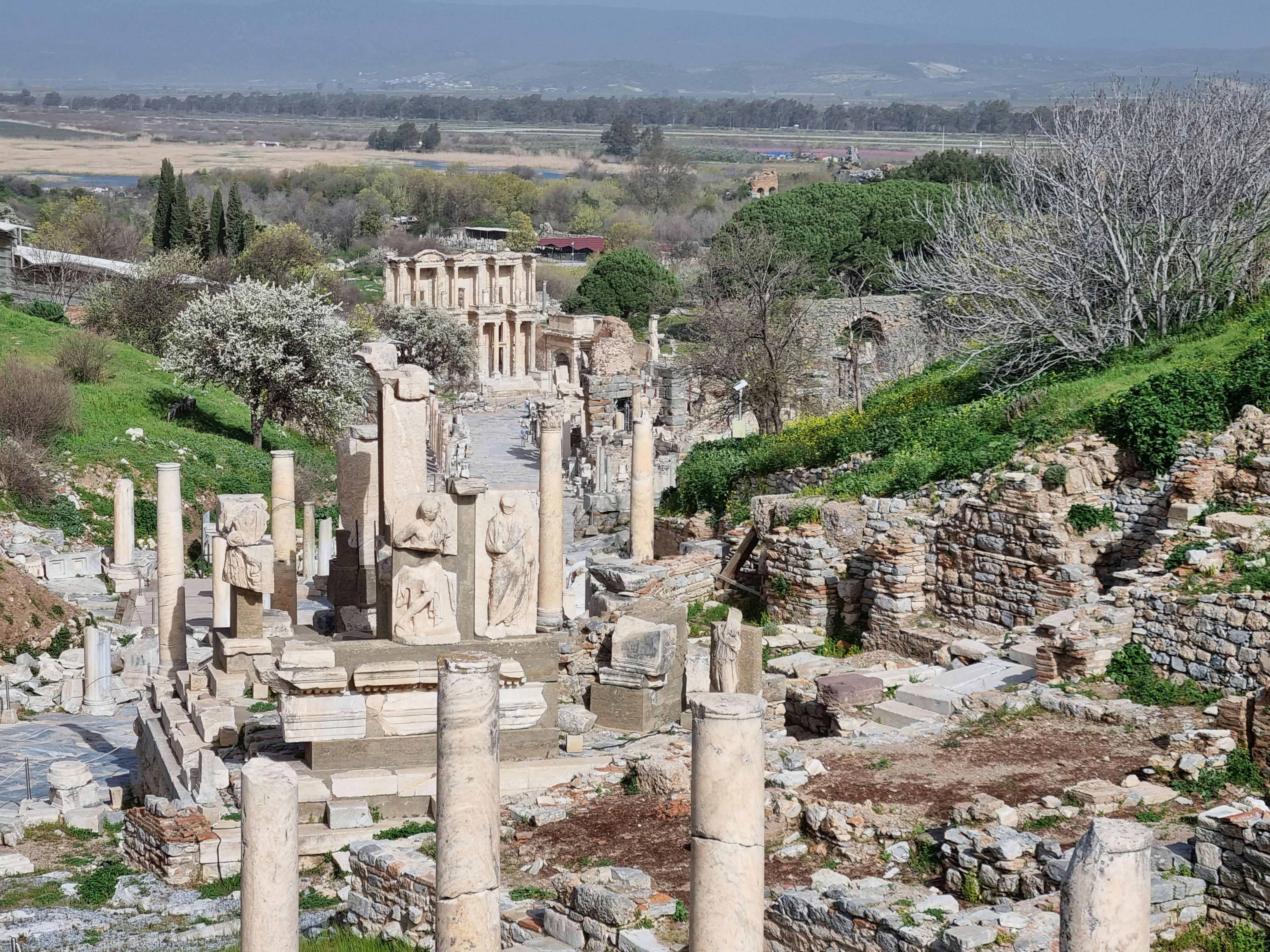
Library of Celsus at Ephesus (credit: Getty Images via Unsplash)
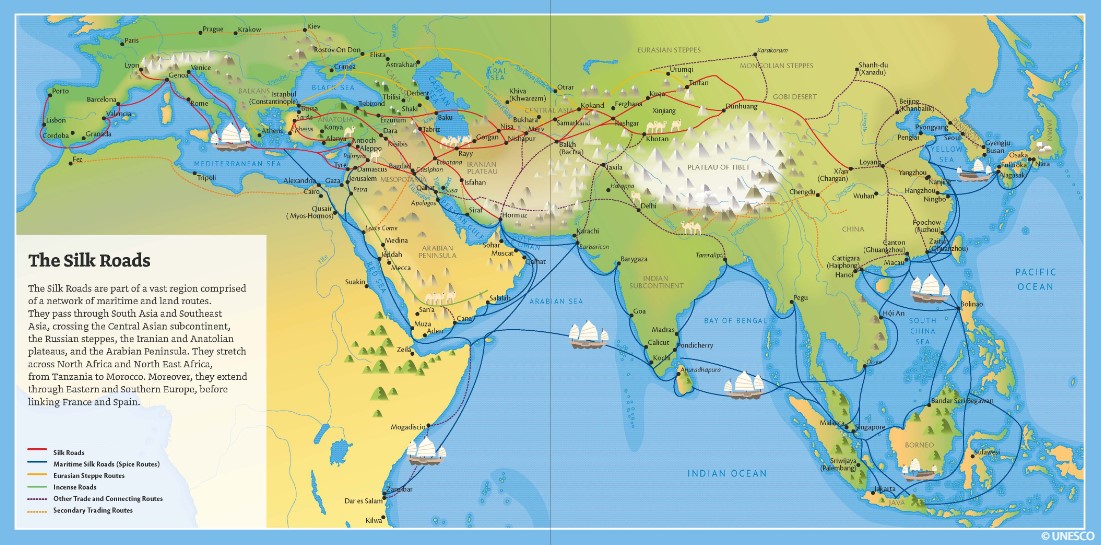
We’ve all heard about the vast trade networks of the Silk Roads. The constant movement and mixing of populations brought about the widespread transmission of knowledge, ideas, cultures and beliefs in addition to carrying merchandise and precious commodities.
The Silk Roads (credit UNESCO)
We slipped out of Greece into Turkey to visit Ephesus, one of the network’s termination points where ships then carried goods via the Maritime Silk Road—an extension that continued their distribution to further locations around Europe and Asia. And we also saw an incredible mixture of cultures—Asian, Turkish, Greek, and Roman among others.
Tiled walkway in Ephesus
Science, arts and literature, as well as crafts and technologies were shared and disseminated into societies along the lengths of these routes, and in this way, languages, religions, and cultures developed and influenced one another. The Greeks had a strong influence along the East and West trade route, leading to their engagement and settlement throughout Central Asia. They were also strongly influenced by other cultures.
View of the primary road in Ephesus, taken on a much quieter day than on our visit (credit: Tony Hanks on Unsplash)
“Located within what was once the estuary of the River Kaystros, Ephesus comprises successive Hellenistic and Roman settlements founded on new locations, which followed the coastline as it retreated westward. Excavations have revealed grand monuments of the Roman Imperial period including the Library of Celsus and the Great Theatre. Little remains of the famous Temple of Artemis, one of the “Seven Wonders of the World,” which drew pilgrims from all around the Mediterranean. Since the 5th century, the House of the Virgin Mary, a domed cruciform chapel seven kilometres from Ephesus, became a major place of Christian pilgrimage.“
UNESCO World Heritage Site nomination
Model of the Temple of Artemis in the Ephesus Museum
The Great Theatre
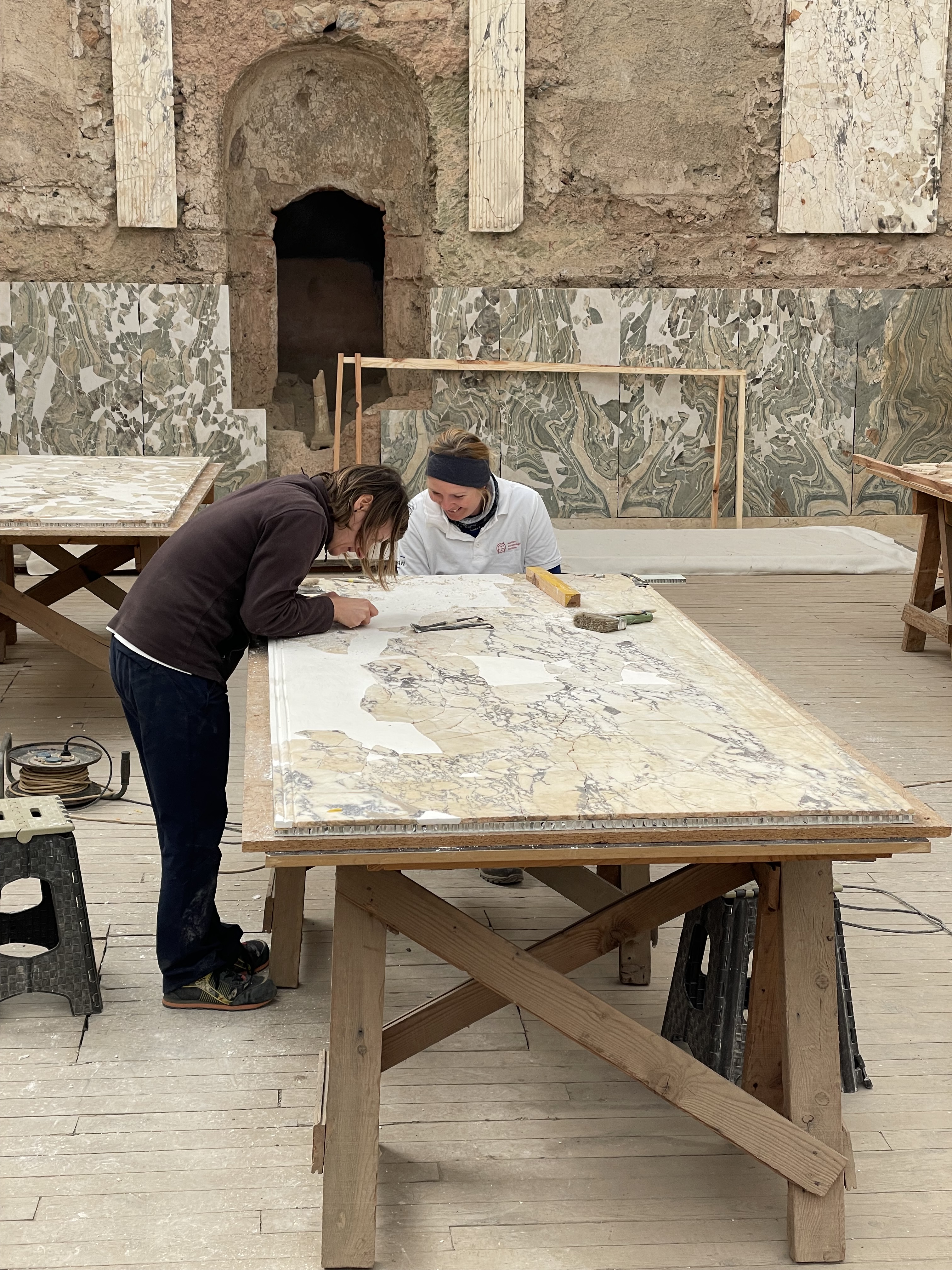
The extensive archaeological excavations at the Terrace Houses—luxury Roman Villas located on a slope opposite the Hadrian Temple, with the earliest dating from 1 BCE—were among the most impressive I’ve visited anywhere on my travels.
Excavations at the Terrace Houses, Ephesus
Archaeologists piecing together fragments of the wall coverings
Paul Goldberger notes that “Successful preservation makes time a continuum, not a series of disjointed, disconnected eras.” In a world that is constantly changing, old places—including large archaeological sites of changing communities that have attracted residents, visitors and pilgrims for millennia—provide people with a sense of being part of a continuum, which is necessary to be psychologically and emotionally healthy.
Ephesus was one of those special historic places for us.
Rhodes
Rhodes (Credit: UNESCO)
Rhodes has incredible layers of history that are key to memories of Christians, Jews, and Muslims. A UNESCO World Heritage Site and the largest of a group of regional islands, it was occupied by the Knights of St John of Jerusalem who had lost their last stronghold in Palestine in 1291. They transformed the island capital into a fortified city able to withstand sieges and to continue their work to care for the sick, but it finally fell to the Ottomans in 1522.
Walls of the medieval city of Rhodes
One of the many gates into Rhodes
The medieval city—like many of this period—is located within a long wall and is divided with the high town to the north and the lower town south-southwest. Originally separated from the lower town by a fortified wall, the high town was entirely built by the Knights. The famous Street of the Knights is one of Europe’s finest testimonies to Gothic urbanism.
View at the foot of the Street of the Knights
Street of the Knights
View off of the Street of the Knights
The palace of the Grand Master of the Knights is a restored showpiece that speaks to the power of the Knights of St. John.
Palace of the Grand Master (credit: UNESCO)
Palace courtyard
Stairway to palace (credit: UNESCO)
One of several palace fixtures made of Murano Glass
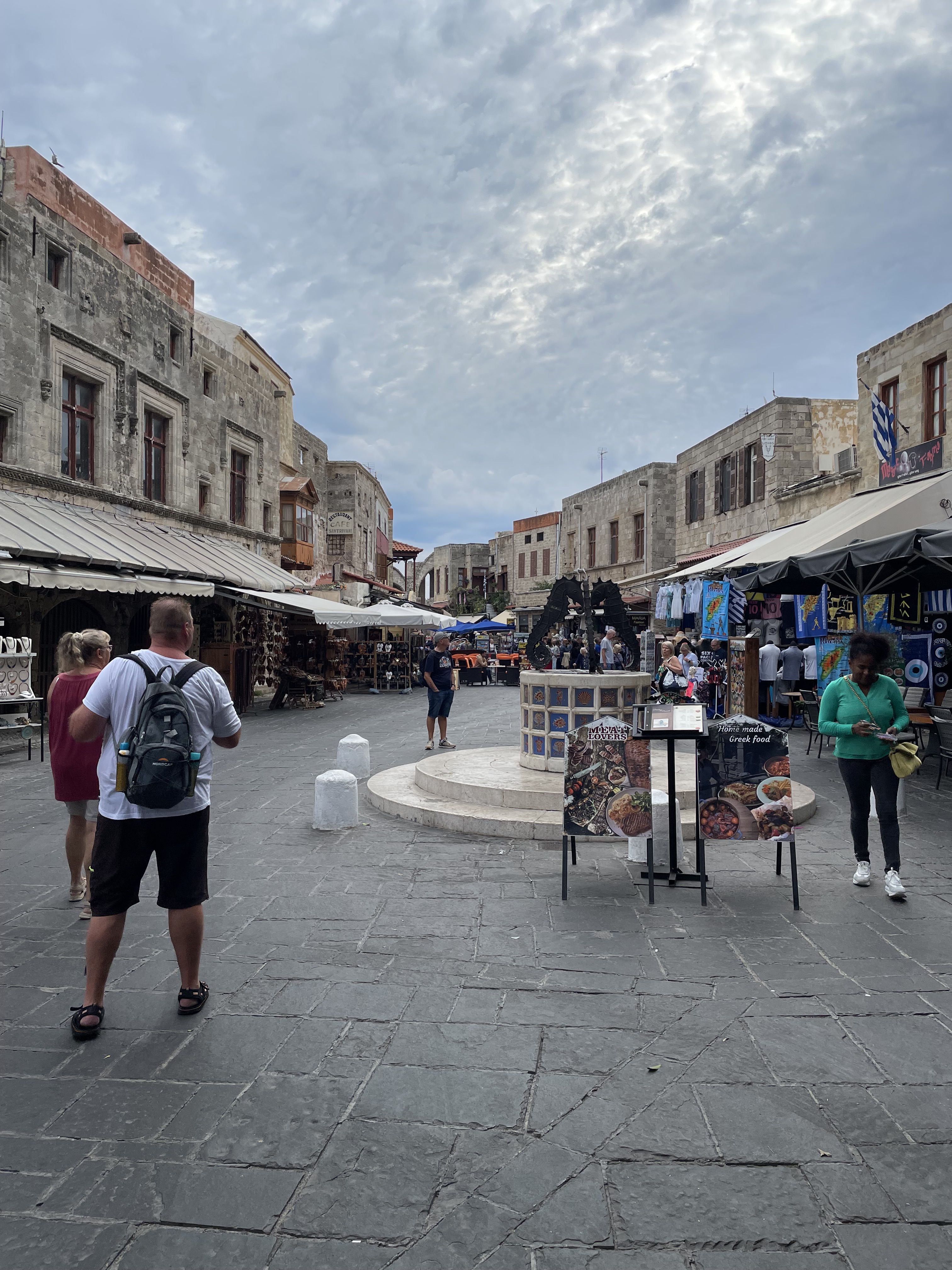
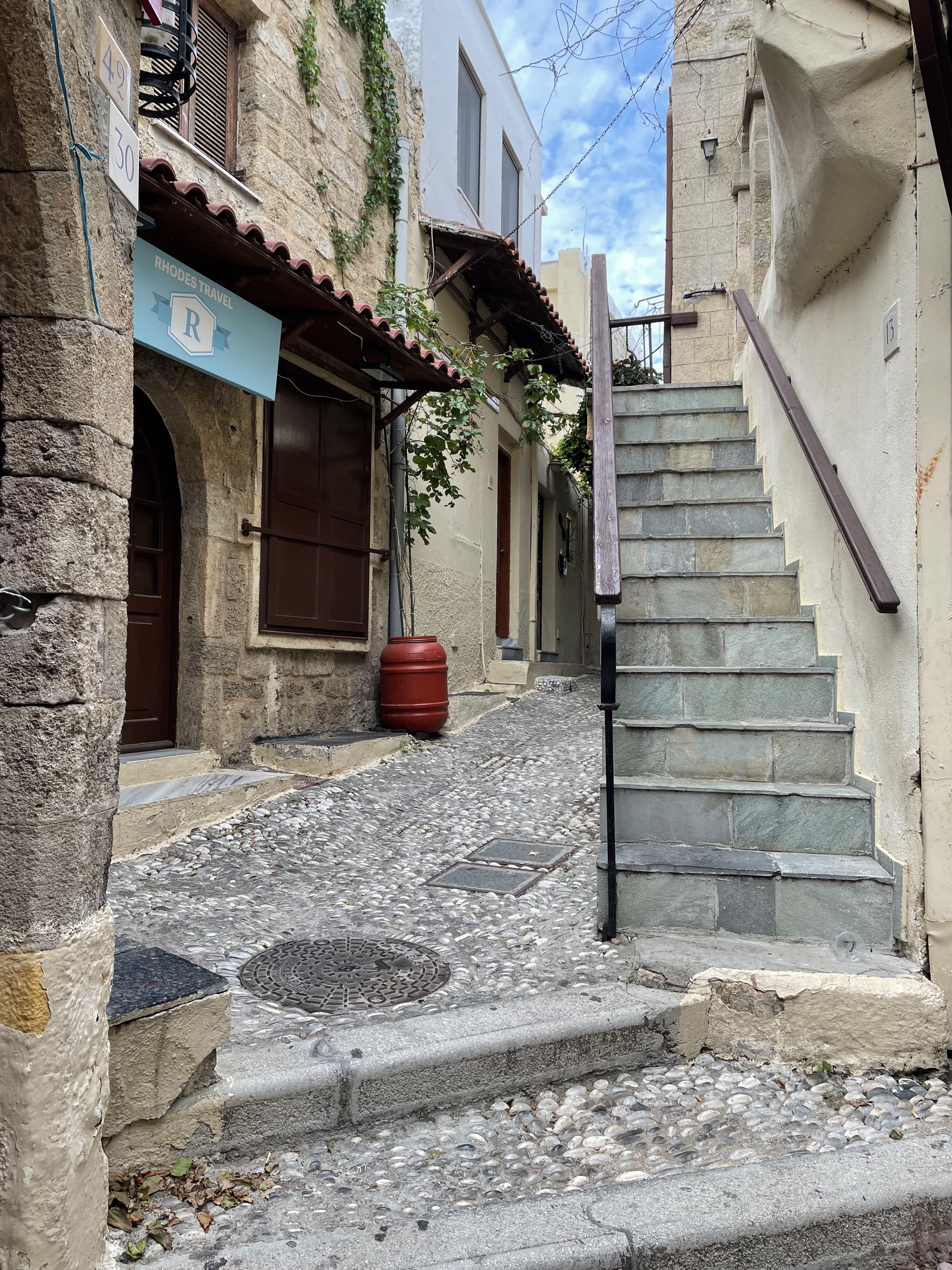
The lower town is bustling with shops, houses, and more—all set within the context of the ever-present walls and impressive stonework.
It is important to recognize the layers of history and development in Rhodes that up to 1912 resulted in the addition of valuable Islamic monuments, such as mosques, baths and houses. Old-style renovation projects often sought to erase the destructive evidence of time and circumstances in favor of fidelity to the original place. But to confront and understand our history, it is best if our restorations and renovations leave parts of our past visible—even parts that we may not want to see. We gain knowledge and greater understanding of our world with a multi-layered look at the past. That type of approach was evident in Rhodes.
One of the many small Orthodox churches found in Rhodes
Jewish Memorial in Rhodes erected in 2002. The memorial has six sides each one has in a different language the words: IN ETERNAL MEMORY OF THE 1604 JEWISH MARTYRS OF RHODES AND COS WHO WERE MURDERED IN NAZI DEATH CAMPS. JULY 23, 1944.
Mosque in Rhodes (credit: UNESCO)
Pátmos
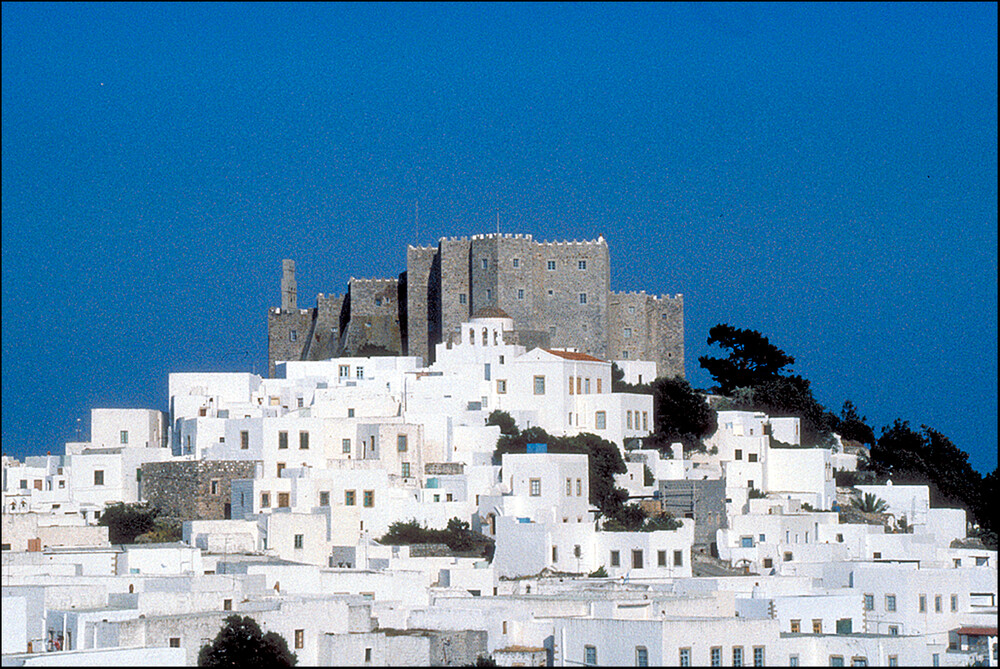
Monastery of St. John in Pátmos (UNESCO)
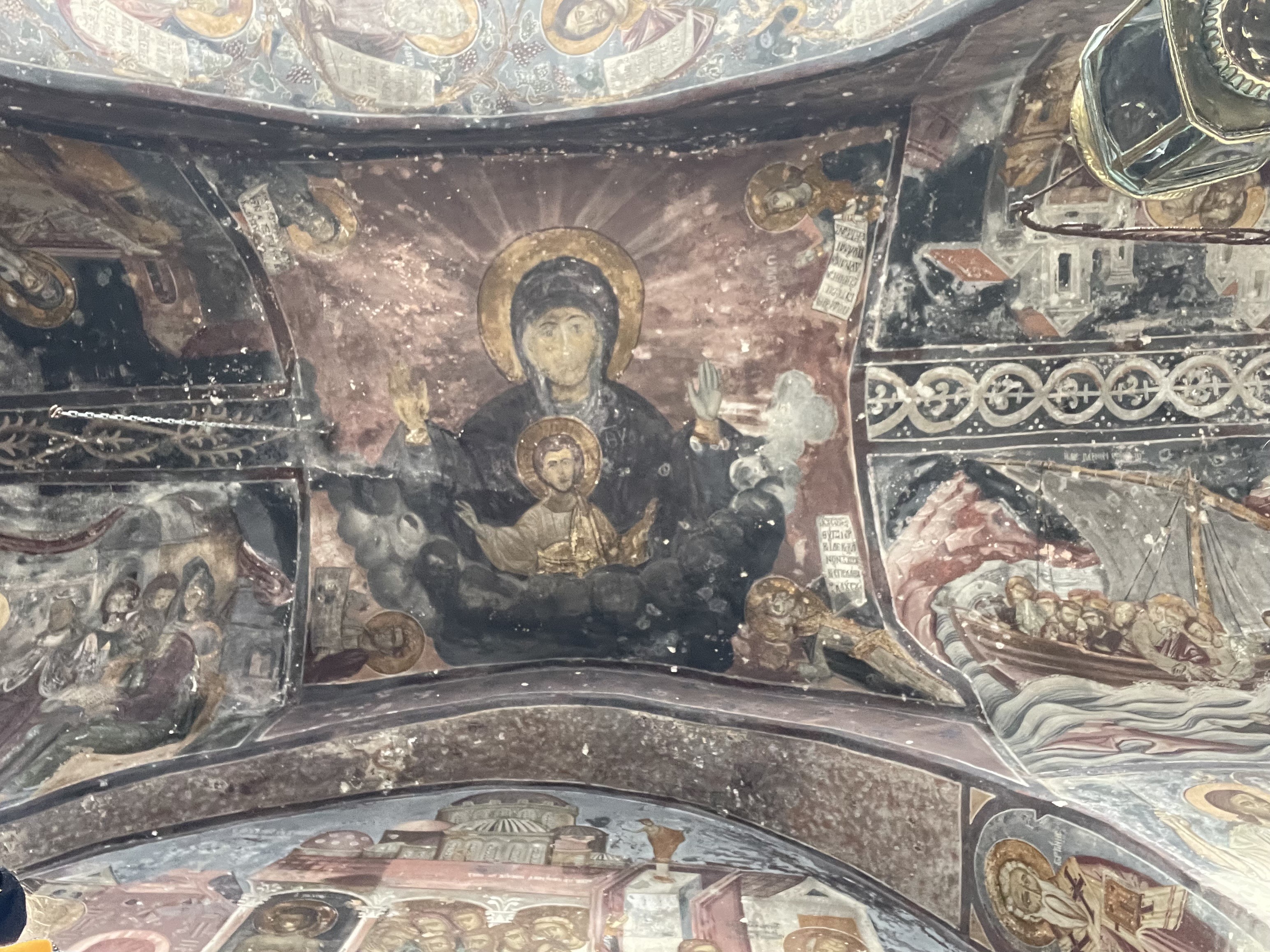
Perhaps no Greek island is more famous than Pátmos, where we toured the Greek Orthodox Monastery of St. John, a UNESCO World Heritage Site, and the Cave of the Apocalypse, where St. John the Apostle most likely wrote the Book of Revelation in 95 A.D.
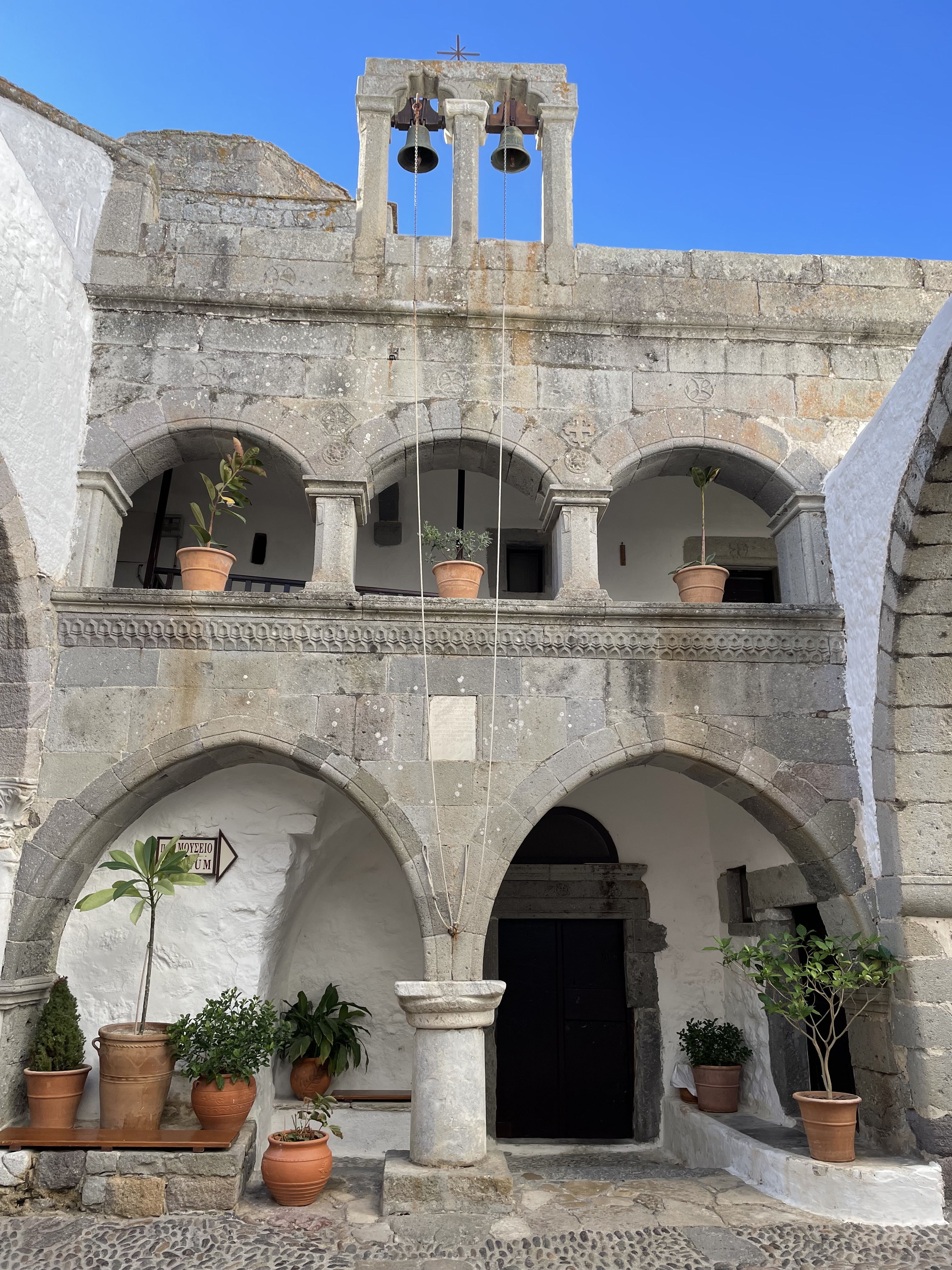
The monastery is a unique creation, integrating monastic values within a fortified enclosure, which has evolved in response to changing political and economic circumstances for over 900 years. It has the external appearance of a castle, with towers and crenellations. It is also home to a remarkable collection of manuscripts, icons, and liturgical artwork and objects.
On the walk up to the Monastery of St. John
Monastery courtyard
Historic refectory for the monks
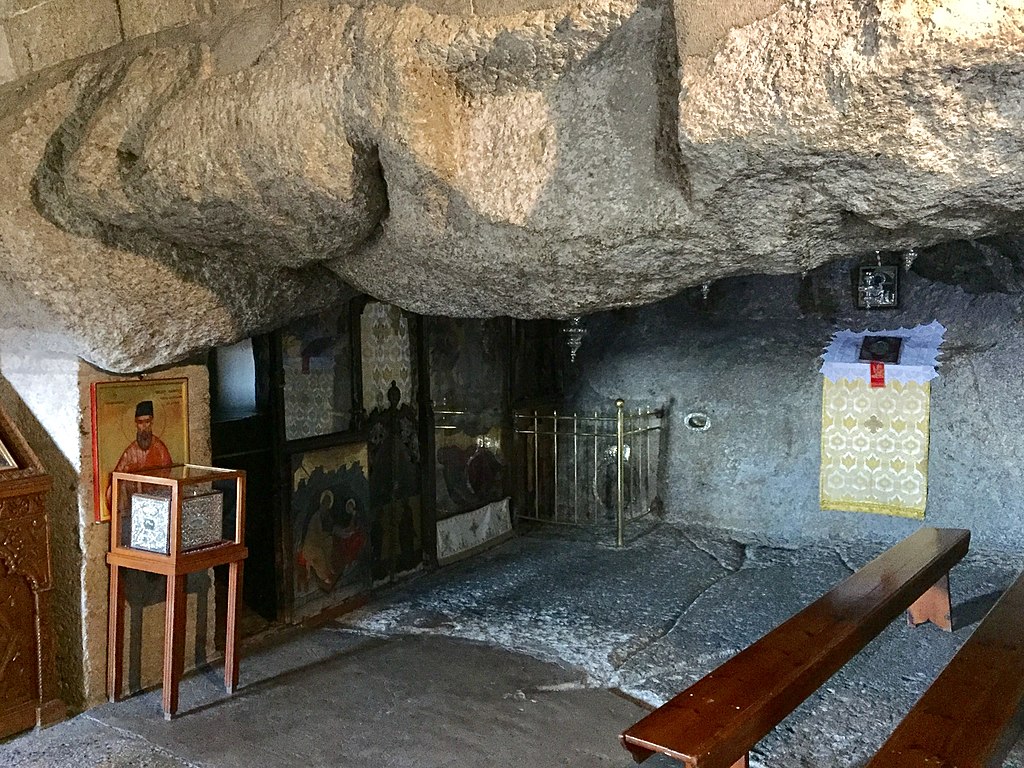
The Cave of the Apocalypse attracted a number of small churches, chapels, and monastic cells through the centuries, creating an interesting architectural ensemble as well as a place of pilgrimage which we saw firsthand while on site.
Cave of the Apocalypse (Wikimedia Commons)
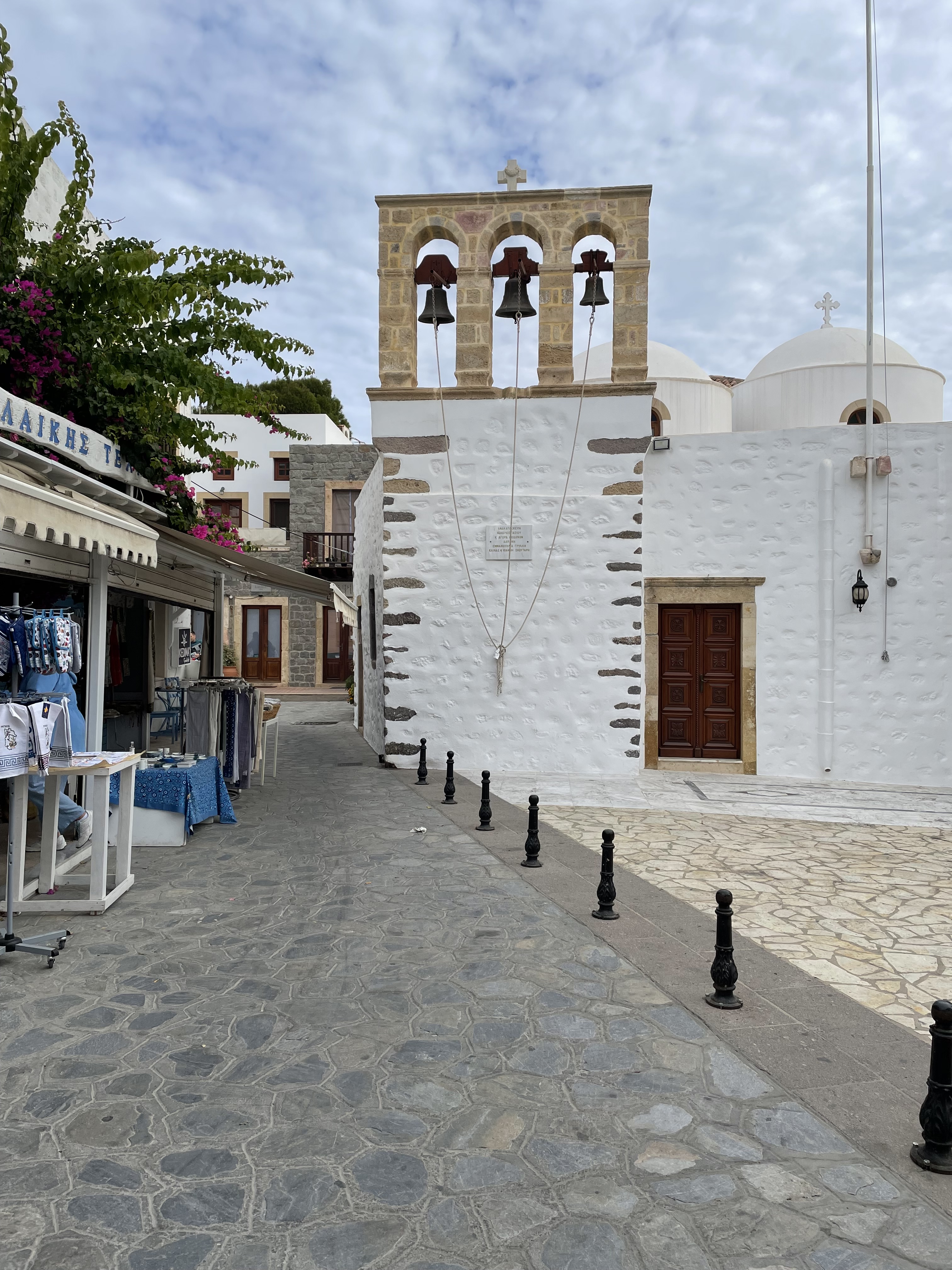
The old settlement of Chóra on the island, which surrounds the Monastery of St. John, is also important as one of the best preserved and oldest of the Aegean settlements. Beginning in the 13th century, the town was expanded by new quarters for refugees as political fortunes changed. Interestingly, Pátmos thrived as a trading center under Ottoman occupation, reflected by fine merchants’ houses of the late 16th and 17th centuries.
Harbor in Pátmos
The elements of the site are unique in several ways, considered both as an ensemble and individually. Pátmos is the only example of an Orthodox monastery that integrated a supporting community from its origins, a community built around the hill-top fortifications.
Credit: Unsplash
Authenticity is critical to any historic site. Here the active monastic community of Pátmos, apart from safeguarding the artistic and intellectual treasures of the monastery, continues to rescue old traditions and rituals. And there is cooperation between secular and ecclesiastical authorities in Pátmos, efforts we saw that have ensured that many of the tourism abuses found in other parts of the Aegean have been largely avoided here. This was the one site that was not overwhelmed by over-tourism during our visit. The engagement of a variety of local, state, national, and international actors seeks to maintain the tranquility appropriate to the sacred values of Pátmos in a changing world.
Credit: Unsplash
A trip ripe with memories, identity, and continuity
Pico Iyer says that “you don’t travel in order to move around—you’re traveling in order to be moved. And really what you’re seeing is not just the Grand Canyon or the Great Wall but some moods or intimations or places inside yourself that you never ordinarily see.”
Iyer’s quote about why we travel is useful in thinking about changing perspectives and how the places we’re seeing relate to the communities we’ve now returned to after the tour is complete.
More to come . . .
DJB
Top photo of Meteora by Getty Images from Unsplash. All other photos by DJB unless otherwise credited.
UPDATE: Well, I seemed to have gotten the lede right yesterday! Freddie Freeman hits the first grand slam walkoff in World Series history, a two-out, tenth inning no doubter that cemented the game’s status as an instant classic. All played crisply (except for a few defensive miscues) in front of a packed and raucous Dodger Stadium crowd. I’ll be back tonight for more!
Tonight begins what could be a classic World Series. With the New York Yankees and Los Angeles Dodgers we have two of the game’s most storied and successful franchises. In Aaron Judge and Shohei Ohtani, we have the two presumptive league MVPs facing each other for the first time in the World Series since 2012, when Buster Posey’s Giants beat Miguel Cabrera’s Tigers.
“(O)ne year after the least irresistible World Series matchup ever, baseball got the ultimate television matchup. Here you go, America—it’s the Dodgers and the Yankees, it’s Shohei and Aaron Judge, it’s Juan Soto and Mookie Betts, it’s baseball royalty against baseball royalty, it’s probably the two most beloved and most despised teams in the sport going at it in the World Series for the first time since 1981, when the Yanks had Reggie and the Dodgers had Fernando and the Yankees had Winfield and the Dodgers had Garvey, and half of all television watchers in the U.S. tuned in.”
Joe’s mention of Fernando and 1981 is an especially poignant reminder this week that time marches on.
Fernando Valenzuela, R.I.P.
Fernando is, of course, Fernando Valenzuela, the great Mexican pitcher with the unhittable screwball and everyman physique who died on Tuesday at the age of 63. Few players had a better start to a big-league career than Fernando’s 8-0 winning streak to begin 1981, a stretch of complete games that included five shutouts. In his first eight starts that year, Valenzuela went 8-0 with a 0.50 E.R.A.
More importantly, he pitched with joy and he brought that joy to millions of fans.
By Tony Barnard, Los Angeles Times from Wikimedia Commons
When Valenzuela took the mound, Fernandomania took over Dodger stadium. His chubby midsection, cherubic face, and long hair gave him a look that non-athletes could appreciate. Frankly, was anyone better suited than Fernando for John Kruk’s famous quip?
“It was spring training, and John Kruk was significantly overweight.
He was also drinking beer and smoking cigarettes. A woman recognized him, and she approached him. ‘You should be ashamed of yourself. You’re an athlete,’ she said.
Kruk responded, ‘I ain’t an athlete, lady. I’m a baseball player.’”
Fernando didn’t look like an athlete, but he was a helluva baseball player. Not only could he pitch, but he could hit, and his spot in the batting order was never a sure out.
Oh, and women loved him.
No player reshaped his franchise’s fanbase in quite the way that the 20-year-old Valenzuela did when it seems the entire Mexican population of Southern California became Dodger fans. And that was a hard sell, because Dodger Stadium had been built on top of a thriving Mexican-American neighborhood, Chávez Ravine. Ry Cooder captured the demise of their hometown in the song 3rd Base, Dodger Stadium.
“Back around the 76 ball, Johnny Greeneyes had his shoeshine stall | In the middle of the 1st base line, got my first kiss, Florencia was kind | Now, if the dozer hadn’t taken my yard, you’d see the tree with our initials carved | So many moments in my memory. Sure was fun, ’cause the game was free | It was free”
But in those pre-internet days, it took only a few games for Fernandomania to take hold. Posnanski writes about the shift as seen by the Dodgers’ Spanish-language announcer.
“Jaime Jarrín, who had been calling Dodgers games in Spanish since 1959, thought the crowd looked fundamentally different from any he’d ever seen at a big-league game. This was a crowd filled with women, a crowd filled with Latino fans, so many of them Mexican.
‘People from Mexico,’ he said, ‘people from other Latin American countries like Ecuador, where I’m from, we didn’t have many baseball idols.… He opened up the sport for us. People who had spent all their lives thinking only about fútbol, Fernando gave them a reason to care about the greatest game, to care about baseball.’”
Fernando was a phenomenon, and I was lucky enough to see him pitch in that magical year of 1981. Surprisingly, he actually lost that game in May at Atlanta-Fulton County Stadium to an aging Gaylord Perry. It was only his second loss of the year. As the wire reports from that game noted,
“Valenzuela (8-2) lasted only 3 2/3 innings and was charged with seven earned runs, lifting his earned run average from 1.24 to 1.88. It was the first time this season that Valenzuela failed to pitch at least seven innings and was his second straight defeat.”
Braves fan that I was at the time, I was glad to see Atlanta come through. But I was more excited to have had the chance to see Fernando, even if it was a rare off night in a magical season. He righted the ship, of course, and helped lead Los Angeles to that iconic 1981 World Championship. He won the National League’s Rookie of the Year and Cy Young Awards that year. To this day, no one else in the majors has won those honors in the same season.
Posnanski, as he often does, says it best for the fan in all of us:
“I honestly believe that Fernando Valenzuela, inning for inning, brought more glee, more laughter, more euphoria, more bliss and more happy feelings than any player in baseball history. To watch him pitch was to smile. The watch him hit was to feel a little more alive. To see him unwind his body as only he did—always pausing for an instant to look up to the sky as if he were asking God: ‘Are you watching this?’—and then uncork that magnificent screwball that had a mind of its own and to watch hitters helpless against its power, all of it took all of us one step closer to heaven.”
Rest in peace, Fernando, and thanks for the great memories.
MLB.com
As for the World Series, I don’t really have a dog in this hunt, but I’m excited to see the stars involved nonetheless. As a longtime Willie Mays and Giants fan, I really don’t like the Dodgers. And like any normal baseball fan who doesn’t live within two hours of New York City, I really don’t like the Yankees. But I adore Juan Soto and Freddie Freeman. I think Aaron Judge is unreal and Shohei is from another baseball planet and I love watching both of them play. As if we didn’t need any more excitement, Chelsea James, writing in the Washington Post, has teased us with the prospect of Shohei pitching to Judge in Game 7. I don’t think it will happen, and Dave Roberts has said it absolutely will not happen, but if anyone could do it, he could. *
So I have no predictions. I just want tight, well-played games where the stars shine and some obscure player makes us all shake our head and remember why we love baseball so much.
And since it is almost Saturday, let’s listen to some great songs about baseball . . . something you’ll never get with football and basketball.
We’ll begin with Les Brown and His Orchestra’s Joltin’ Joe DiMaggio. “They don’t make ditties like they used to,” writes Andy McCullough. “This right here is a ditty.” The lyrics tell the tale of Joe DiMaggio’s famous 56-game hitting streak.
Rusin Dodd, in the New York Times, wrote, “I once saw a Springsteen concert in Phoenix during spring training and ended up sitting about 10 feet from a veteran major leaguer. He was there with family and stayed rather reserved the whole night, but when ‘The Boss’ started playing ‘Glory Days,’ they all went nuts.”
I loved Steve Goodman, as he was an everyman folksinger. When the Cubbies came back to stay alive in the 2016 World Series by winning Game 5, Wrigley Field burst into communal singing with his Go Cubs Go. It pairs nicely with Goodman playing A Dying Cubs Fan’s Last Request.
McCullough noted that “(t)here is something soothing about hearing Claude and Cliff Trenier opine about ‘The Say Hey Kid’ running the bases like a choo-choo train and making the turn around second like an aeroplane. I couldn’t agree more. I miss Willie Mays.
I think John Fogerty’s Centerfield belongs on any list of great baseball songs. All you have to do is be at a ballpark and watch people sing along when it is played to know how much it connects. “Put me in coach” indeed!
And finally, there’s the classic Take Me Out to the Ballgame, sung here—as it will be tonight—by a packed Dodger stadium crowd.
Play ball!
More to come . . .
DJB
*I haven’t been to either Dodger Stadium or Yankee Stadium in my quest to visit all MLB ballparks . . . but Claire has! Here she is almost 10 years ago, with friends enjoying a game a Chávez Ravine. Maybe it is time that Claire and I go on a baseball road trip next summer!
Claire (center) at a Dodgers game…she knows how to pick ’em
World Series Commissioners trophy image from Britannica
Candice and I cast our votes today, the very first day for early voting in Maryland. We walked three blocks to our local polling place. As we came in, a woman walked out wearing a stylish “I’m a Multi Issue Voter” t-shirt, with “democracy, women’s rights, climate solutions, equality” and more listed on the back. All of our county election officials were competent and courteous. There was a line, but the whole process took only 30 minutes. Our next-door neighbors arrived less than five minutes after we checked in. All in all, it was “just the democratic process at work.”
We even got to choose from among three different “I voted” sticker designs. Candice went with one that included the American and Maryland flags. I chose one with the state symbols.
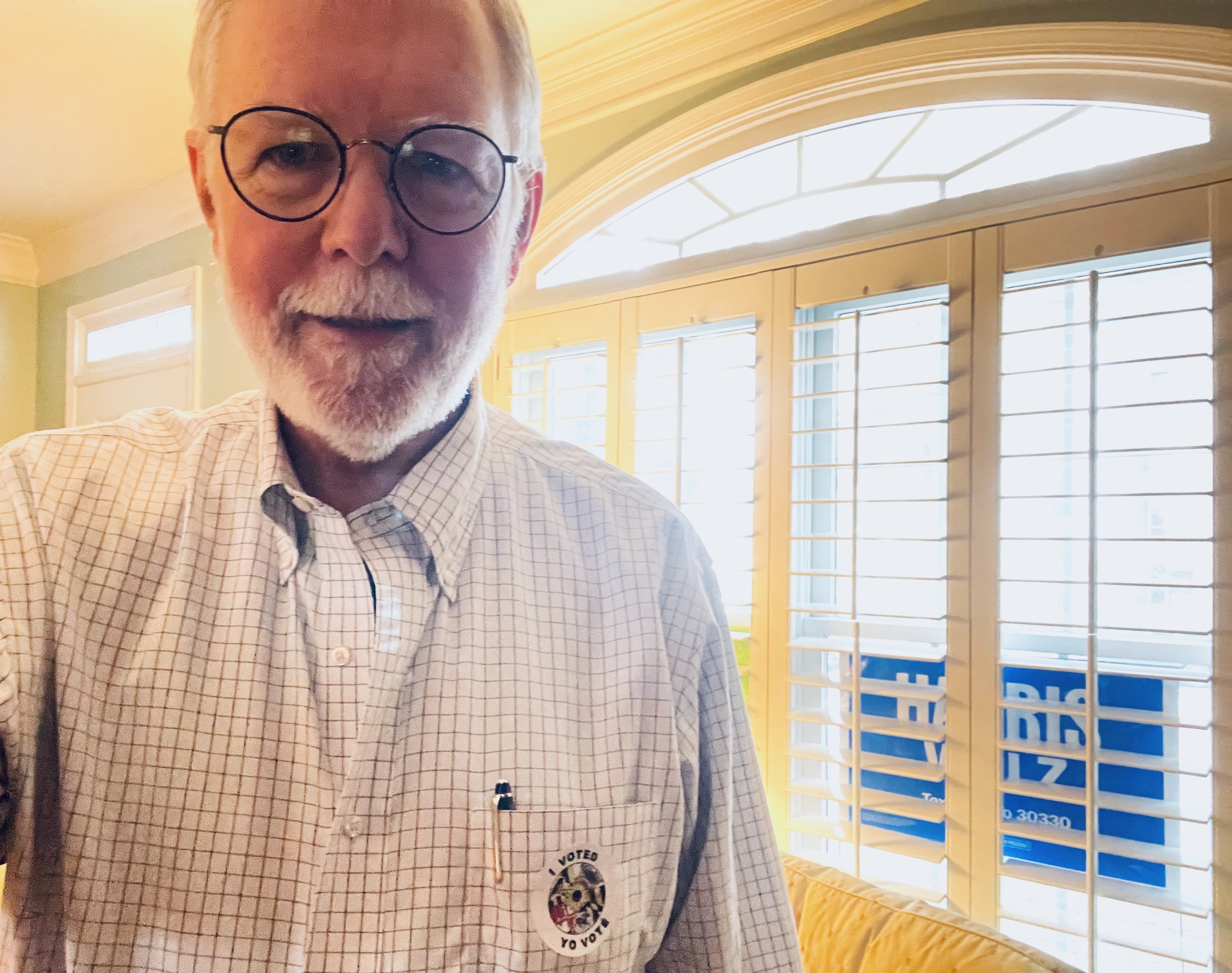
Sporting my “I voted” sticker
My parents believed in democracy and the power of voting. Their votes occasionally offset each other (as they also believed that each individual had the right to make up their own mind), but they always voted. And I heard more than once that if you don’t vote, you don’t get to complain.
I want to quote from Lindsay’s October essay, as I couldn’t have said it better. She begins with Abigail Adams, who wrote her most famous letter on March 31, 1776, to her husband, John.
“In the new Code of Laws which I suppose it will be necessary for you to make I desire you would Remember the Ladies, and be more generous and favourable to them than your ancestors. Do not put such unlimited power into the hands of the Husbands. Remember all Men would be tyrants if they could.”
Chervinsky goes on to say why this last part was so critical to the future First Lady.
“She wasn’t talking about personal or emotional tyranny per se, but rather the legal system that categorized women as property to be controlled by their husbands or fathers. Few women were allowed to own property or conduct financial transactions.
These limitations drove Abigail crazy. John spent years in Philadelphia on congressional business, and then years abroad as a diplomat for the new nation. He left their estate and all financial business in Abigail’s care—and he was wise to do so. She was a savvy investor and expanded their nest egg through creative speculation and property acquisitions.”
But there were times, Chervinsky notes, that “Abigail could not make these purchases herself. Instead, she had to rely on male family members to make transactions on her behalf.”
“In other words, Abigail was arguing that if women had no role as citizens in the new nation, their rights would not be protected. Without the vote, they would be controlled by men and subject to their good will. And we know how well that often turned out.
Abigail was just one of many women who would have loved to vote. So too would generations of people of color, immigrants, servants, and more. They longed for full political participation, argued for it, fought for it, and in some cases, died for it.”
It wouldn’t be the last time that a woman wrote to a man in her family to encourage voting rights for women. In fact, it was a woman’s letter—from Febb Burn to her son Harry, a first-term legislator from East Tennessee—that pushed him to make the decisive vote that ensured the ratification of 19th Amendment, giving women the right to vote. As he noted in justifying his vote amid the outcries that followed, “I knew that a mother’s advice is always safest for a boy to follow and my mother wanted me to vote for ratification.”
Voting is so easy for people like me. But as Lindsay points out in her essay, “for some Americans, it is a much bigger lift. They have to take off work, arrange childcare, wait in line for hours, and risk intimidation.”
She ends Why I Vote—which I encourage you to read in its entirety—with this bit of sage advice.
“You are not choosing a spouse. You are not choosing a soul mate. You are choosing between two options. I agree it would be nice to have a multi-candidate system or maybe even different parties. But that’s not the world we live in. So I encourage you to go touch grass, get connected with this lived reality, and make a choice.
Voting is a civic duty. I wish election day was a national holiday, but there is little I can do about that right now. Instead, I can do my part. If you need assistance figuring out your registration or early voting, I encourage you to visit vote.org.”
Classic British mystery writers like Agatha Christie and Dorothy Sayers have delighted millions of fans and inspired countless writers. I’ve come late to the genre but have made up for lost time, diving in with enthusiasm. When a friend and brilliant reader recommended Anthony Horowitz as someone who draws from those British classics but with a modern twist, I immediately signed on.
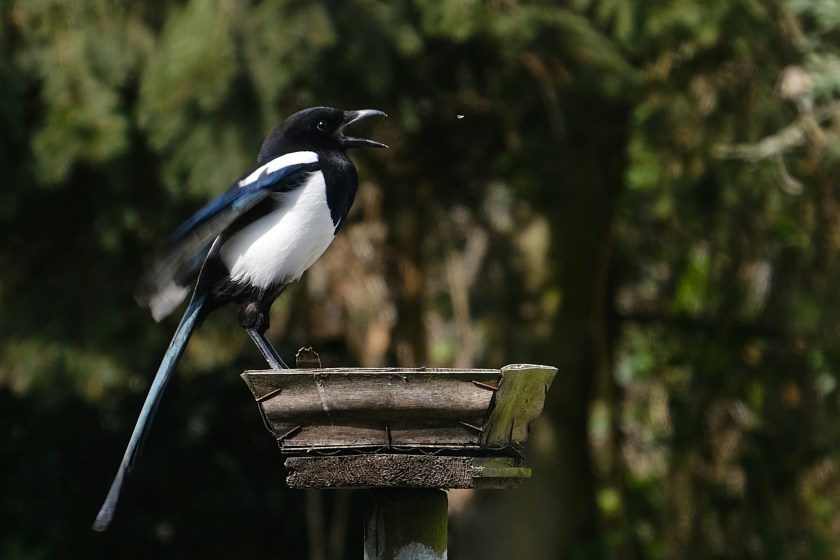
Magpie Murders (2016) by Anthony Horowitz is the talented writer’s tale of intrigue involving editor Susan Ryeland, her crime-writing author Alan Conway, and Conway’s detective, Atticus Pünd, “who solves mysteries disturbing sleepy English villages.” As someone who follows the path of those classic mystery writers, Conway has been very successful, even as he has alienated family, friends, and, yes, his editor. Yet Ryeland knows she must put up with his troubling behavior in order to keep the successful works flowing.
Magpie Murders is number nine in the much-loved and bestselling Atticus Pünd series, so Ryeland is excited to get the manuscript from Charles—the owner of Cloverleaf Books and her boss—for a weekend review. As she reads through the pages she finds the famous detective in the small, fictitious English village of Saxby-on-Avon working to solve at least two deaths that have occurred at Pye Hall, the ancestral home of Sir Magnus Pye. Sir Magnus, whose head was lopped off, was clearly murdered. But the death of his housekeeper a couple of weeks before in what the police have ruled an accident is more ambiguous. And there is a long-ago tragedy that may also fit into this plot.
Like Ryeland, we are pulled along in reading Conway’s manuscript until she turns the page and discovers that the final chapter is missing. What good is a whodunit without an ending? And then she learns on Sunday evening that Alan Conway has died. Ryeland arrives at the office on Monday morning hoping to find the final chapter. Instead, she discovers many more twists and turns—questions that have her wondering if the final chapter can also help her understand how Alan died. She heads to Conway’s home in Suffolk in search of the final chapter of Magpie Murders. And the truth.
An international bestseller upon its release and then the subject of a Masterpiece Mystery series on PBS, Magpie Murders is a delightful whodunit within a whodunit. Many already know the work, the plot, and the answers that Horowitz has us searching for along two separate timeframes. In the book’s first chapter, Horowitz has Susan bemoaning the fact that she was pulled on this journey. “It was all down to that bastard Alan Conway. I hadn’t liked him the day I’d met him although the strange thing is that I’d always loved his books.”
She was expecting a classic whodunit. “But Magpie Murders wasn’t like that. It wasn’t like that at all.”
At a time in our nation’s life when we are talking about joy as a response to hate and despair, I returned to the first of a three-book trilogy of essays published by Haymarket and written by one of my favorite authors.
“Joy doesn’t betray but sustains activism. And when you face a politics that aspires to make you fearful, alienated, and isolated, joy is a fine initial act of insurrection.”
Though initially written during the Iraq war of 2004, I thought of how much more her words apply during our politics of hatred and alienation as manifested by Donald Trump. Hope and joy are definitely needed in response.
Solnit begins the foreword to the third edition of this trilogy with the following observation:
“Your opponents would love you to believe that it’s hopeless, that you have no power, that there’s no reason to act, that you can’t win. Hope is a gift you don’t have to surrender, a power you don’t have to throw away. And though hope can be an act of defiance, defiance isn’t just enough reason to hope. But there are good reasons.”
Hope, as Solnit makes clear, is not naive optimism. Instead, it “locates itself in the premises that we don’t know what will happen and that in the spaciousness of uncertainty is room to act . . . Hope is an embrace of the unknown.” In twenty-one insightful essays, she touches on topics as wide-ranging as “False Hope and Easy Despair,” the “Indirectness of Direct Action,” and “Getting the Hell out of Paradise.” This last one is a call to let go of perfection and to look instead to the possible. And it contains this wonderful quote from Eduardo Galeano,
“Utopia is on the horizon. When I walk two steps, it takes two steps back. I walk ten steps and it is ten steps further away. What is utopia for? It is for this, for walking.”
I’ve recently lived through a period with one individual whose suffering spreads to those around them. We also experienced an act of political vandalism when someone stole our “Angela Alsobrooks for Senate” sign, along with those of several of our neighbors. * As Solnit writes in another book of the trilogy, we are “all weird, all in this together.” She suggests “that addressing our own suffering while learning not to inflict it on others is part of the work we’re all here to do. So is love, which comes in so many forms and can be directed at so many things.”
This is a perspective we all need to grasp to live together successfully. At a time when so many in our political world are trying to push us apart, this trilogy of almost two decades of writing—which I originally reviewed in 2017 under the title Joy is a fine initial act of insurrection—is worth our time.
“Rejoice in possibility and keep lifting one another up,” as poet, songwriter, and singer Carrie Newcomer writes. “These are times of miracle and wonder.”
Let’s find joy. Let’s be the joy in America. Let’s vote, joyfully!
More to come . . .
DJB
*Our next-door neighbor quickly went to the Alsobrooks headquarters (conveniently located one block from our house) and picked up two new signs, one for us. Ours is now safely ensconced in our window.










































 MORE TO COME...