Latest Posts

Deep in our Age of Folly

America lost one of its most lucid, thoughtful, and challenging commentators when Lewis H. Lapham passed away at age 89 in June of this year. The recent election led me to return to his tour-de-force from 2016 to try and make some sense of what just happened here in 2024.

Age of Folly: America Abandons Its Democracy (2016) by Lewis H. Lapham surveys the period from 1990 to 2015 to make the strong case that America’s imperial impulses have shaken our democratic principles. The observations in the first half of the book are presented chronologically from monthly commentaries Lapham produced as the editor of Harper’s Magazine. The essays in the second half, written as backstory to various issues of Lapham’s Quarterly, seek to make the case for history as folly’s antidote. Lapham wants to teach us that “we have less reason to fear what might happen tomorrow than to beware what happened yesterday.” A nation denied knowledge of its past, he asserts, “cannot make sense of its present or imagine its future.”

Through a well-orchestrated and decades-long program of disinformation alongside the strategic disinvestment in public education as plutocrats sought to steal our public assets, America has lost knowledge of its past, fears for its future, and has a sizable minority that embraces the comfort of the authoritarian’s lie. Lapham shows how misadventures such as our invasion of Iraq during the Bush II administration led to ongoing turmoil, downgraded the country’s standing abroad, and did extensive damage to American democracy at home. He speaks to that damage in his preface, where he calls out example after example.

“. . . the bulk of the nation’s wealth amassed by 10 percent of its population, class warfare waged by the increasingly selfish and frightened rich against the increasingly debt-burdened and angry poor, the democratic electing of an American president overruled by the Supreme Court, a national security apparatus herding the American citizenry into the shelters of heavy law enforcement and harmless speech, the 2008-09 devastation of the nation’s wealth and credit, the public good systematically shuffled into the private purse, occupants of the White House pleased to hold themselves above the law, futile but unending foreign war, both houses of Congress reduced to a state of impotent paralysis, a political discourse made by a celebrity-besotted news media posing demagogues on selfie sticks.”

He continued by looking ahead to the 2016 election.

“An age of folly worthy of the name, its consequence the presence of Donald J. Trump, prosperous fool and braggart moth, on November’s presidential ballot.”

We all know how that—and the last eight years—turned out.

The book’s first essay, written in 1990, is especially prescient for its time.

“If the American system of government at present seems so patently at odds with its constitutional hopes and purposes, it is not because the practice of democracy no longer serves the interests of the presiding oligarchy (which it never did), but because the promise of democracy no longer inspires or exalts the citizenry lucky enough to have been born under its star.  It isn’t so much that liberty stands at bay but, rather, that it has fallen into disuse, regarded as insufficient by both its enemies and its nominal friends.  What is the use of free expression to people so frightened of the future that they prefer the comforts of the authoritative lie?”

Lapham also explores the change in our concepts of public and private and its effect on our society, noting that “the familiar story (democracy smothered by oligarchy) has often been told” but that . . .

“…it is nowhere better illustrated than by the reversal over the past half century of the meaning within the words ‘public’ and ‘private.’  In the 1950s the word ‘public’ connoted an inherent good (public health, public school, public service, public spirit); ‘private’ was a synonym for selfishness and greed (plutocrats in top hats, pigs at troughs).  The connotations traded places in the 1980s. ‘Private’ now implies all things bright and beautiful (private trainer, private school, private plane), ‘public’ becomes a synonym for all things ugly and dangerous (public housing, public welfare, public toilet).”

In the final interview before his death, Lapham spoke eloquently about the desperate need for history in our country.

“Edward Gibbon had said somewhere that history is nothing more than the record of mankind’s folly, misfortune and crime. It’s the past living in the present, and the present living in the past. The voices in time are an immense resource—the founders of the American Republic were all passionate students and readers of history. History doesn’t repeat itself if you learn from it: it’s an immense storehouse of human consciousness . . .

In colleges, they teach history as if it’s gateway marble, but it’s not: it’s alive. The reason I started Lapham’s Quarterly was to teach history as alive—as the past living in the present and the present living in the past, not museum-quality marble; living, not dead. It’s the same thing that Faulkner said: the past is never dead. It’s not even past.”

Lapham then talks about our country’s history and how it has played out over the last 400 years.

John Winthrop, the first governor of Massachusetts Bay Colony arrived in 1630 on the ship Arabella, and before the ship dropped anchor in Salem harbor the governor preached the sermon to the Puritan faithful on board the ship and told them there was no such thing as democracy; that in God’s will some will be high in dignity, some low and in submission. That was the way the world worked, and always will. The great argument that is going on and has been going on in America for four hundred years is the story of rich and poor, in one way or another.”

In the book’s final essay, Lapham looks at the writings of Thomas Paine, which speak not to the rich and privileged, but to the common man. 

Lapham eloquently called us to put the wisdom of the past at the service of the present. And to recognize, as Paine so memorably wrote, that “Those who expect to reap the blessings of freedom must, like men, undergo the fatigues of supporting it.”

More to come . . .

DJB

Photo by Giorgio Trovato on Unsplash

History as a touchstone for transformation

The postwar era of the mid-twentieth century—the atomic age and its corollary the Cold War—was a time of great change and widespread anxiety not unlike our current period of global unrest. In one small town along the Wabash River, a group of architects and artists—whose supporters included a philanthropist with family ties to an earlier utopian period in this place—produced site-specific contemporary works that not only went against the grain of generic modernist architecture but more importantly explored the realm of the spiritual against the political backdrop of the time.

If one understands history to be alive, with the past living in the present and the present living in the past, then this story of using history as a touchstone for community and spiritual transformation speaks in profound ways to our present moment.

Avant-Garde in the Cornfields: Architecture, Landscape, and Preservation in New Harmony (2019) edited by Ben Nicholson and Michelangelo Sabatino is an in-depth, scholarly exploration of an iconic small town in Indiana that provides insights and new perspective into architecture, landscape, preservation, spirituality, and philanthropy. The winner of the Allen G. Noble Book Award from the International Society for Landscape, Place, and Material Culture, Avant-Garde in the Cornfields traces how nineteenth century utopian aspirations based on the renewal of society through faith and later science became the touchstone for a transformation through preservation and reinvention of New Harmony’s traditions. During the Cold War years of the twentieth century, New Harmony became a spiritual “living community” and attracted a wide variety of creative artists and architects who left behind landmarks that are now world famous. 

Written from the perspective of a rural town that has never numbered more than 1,000 residents, Avant-Garde in the Cornfields considers how history is interpreted through design and historic preservation. Founded in 1814 as one of three Harmonists communities led by Georg (George) Rapp, a German Pietist prophet who had broken with the Evangelical state church of Württemberg, New Harmony was shaped from the beginning “by an intermingling of faith- and science-based worldviews.” In the 1820s, the Harmonists were replaced by another group of idealistic settlers led by Robert Owen and William Maclure, and the town’s overarching idea shifted from religion to science. Michelangelo Sabatino’s accessible and thoughtful introduction provides the backdrop for this story, continuing through the inevitable decline of these utopian schemes to the town’s sleepy existence as a small Midwestern farm center and the initial efforts at historic preservation supported by private individuals and the State of Indiana.

In 1941, Jane Blaffer Owen—newly married to Kenneth Dale Owen, the great-great-grandson of Robert Owen—visited New Harmony on the way home to Houston from her honeymoon. Blaffer Owen was the well-educated and well-traveled daughter of a Texas oil tycoon and his art-collecting, philanthropic wife. Something about the buildings, landscape, and especially the story and “historical depth” of New Harmony captured her imagination.

Jane and Kenneth Owen began their support of New Harmony as traditional preservationists, focusing on restoration of buildings related to the Owen period of history. A lifelong Episcopalian who read widely and was greatly influenced by the writings and teachings of theologian Paul Tillich, Jane Blaffer Owen soon broadened the scope of her interest and philanthropy to “bring the religious devotion of the Harmonist era into dialogue with the scientific and pedagogical legacy of the Owen/Maclure era” in a way that would reinvigorate New Harmony’s built and natural environments, creating a new living tradition of faith and science.

Seven chapters from contributing authors provide—in detail that exceeds fifty pages in three instances—a comprehensive examination of a unique place where utopian ideals of the 19th century mix with mid-20th century values and design. Following a roughly chronological order, the chapters consider:

  • the Blaffer and Owen family histories;
  • the role of patronage in support of modernist architecture (with illuminating context around the work of J. Irwin Miller of nearby Columbus, Indiana);
  • the commitment by Blaffer Owen and others to living memorials amidst the historic townscape;
  • the challenging commission by Blaffer Owen that resulted in Philip Johnson’s iconic Roofless Church;
  • the troubled history and ultimately unrealized project of Frederick Kiesler’s Cave of the New Being / Grotto for Meditation;
  • the landscape of New Harmony which includes a memorial garden for Paul Tillich; and
  • the design, construction, and history of Richard Meier’s famous New Harmony Atheneum, including preservation and reuse issues around a modernist icon that no longer serves its original purpose.
Richard Meier’s New Harmony Atheneum
The Cathedral Labyrinth, dedicated in 1997, is a reproduction of the medieval Chartres Labryinth in France. The labyrinth is situated near the Harmonist Cemetery. This view shows Meier’s Atheneum in the background.

Nancy Mangum McCaslin’s chapter on the family portrait of Jane Blaffer and Kenneth Owen opens the work and provides important context for Blaffer Owen’s unique role as philanthropist and visionary. She was drawn to the spiritual and intellectual chapters in the community’s history, believing “that both attributes were compatible rather than mutually exclusive.” Understanding this component of Jane Blaffer Owen’s worldview is a key to unlocking the development of the new path for preservation that she led at New Harmony.

Another chapter that captured my attention, in spite of its length, is Cammie McAtee’s examination of “The Rib Cage of the Human Heart: Philip Johnson’s Roofless Church.” McAtee notes that Blaffer Owen came to understand “that New Harmony’s strength lay in its potential to become a laboratory for ideas. She did not want it to be frozen in time, irrelevant to and disengaged from the present.” This revelation led her to work closely over a number of years with Johnson on a space that would serve as a spiritual focal point for the community and ultimately became her “dream of the perfect church for all sorts and for all faiths: a cathedral of earth and sky.” Johnson’s signature dome, which protects Jacques Lipchitz’s sculpture Descent of the Holy Spirit, began with an angularity of design. But Blaffer Owen’s rejection of that concept displays her vision for New Harmony, as she admonished the architect by saying: “You do not worship God with your elbows, you worship Him with your rounded arms.” By encouraging Johnson to relate the dome’s shape to the “gentle contours of the Indiana landscape,” she helped lead him to the final result, which she called “the rib cage of the human heart.”

Avant-Garde in the Cornfields is an expansive vision of this third “utopian” chapter in New Harmony’s history which the editors have brought together in one eclectic, in-depth, and ultimately satisfying volume. The story of how the extraordinary past and present of New Harmony continue to thrive today is worthy of consideration in our own troubled times.

More to come . . .

DJB

All photos of New Harmony by Carol M. Highsmith from the Highsmith Collection in the Library of Congress.

A guitar that sounds “the way bacon smells”

The incomparable Bonnie Raitt is getting the recognition she so richly deserves when she’ll be among the five-member Kennedy Center Honors class of 2024. Tomorrow evening’s ceremony will take place in the Center’s Opera House and will be broadcast nationally on December 23rd on CBS.

I first saw Raitt live sometime in the 1970s, and I’ve always been taken by her ability to select songs by other writers and make them her own, a voice that she has “hammered into submission” until it fits her music to a T, an ability to work with musicians from a wide range of genres, and a unique guitar sound that has been described as “the way bacon smells.”

Oh, she more than hits that mark.

Karen Heller’s thoughtful profile of Raitt in The Washington Post describes how important her parents were in shaping her worldview.

“Her late father, musical theater luminary John Raitt (‘Carousel,’ ‘Oklahoma,’ ‘The Pajama Game’), remains her Polaris. ‘My dad didn’t care if he had another Broadway show. He just wanted to take his music to the people,’ she says. ‘He knew that he would last a long time if every show was opening night. I grew up with that ethos and knew how much fun he had.’ He toured until his mid-80s, until his body would no longer let him.” 

Raitt family on front porch (circa 1960) from BonnieRaitt.com

Raitt is loyal to old friends, many of whom show up on her albums and in live shows; progressive in her politics*; frugal (“I’m Quaker and Scottish”); and “mum about her love life, invoking the Sippie Wallace mantra, ‘women be wise, keep your mouth shut, don’t advertise your man’.”

While the studio version of Women Be Wise that Raitt cut for her self-titled debut album in 1971 is a great interpretation of the Wallace classic, she also performed the song live in a wonderful version with the songwriter where they are clearly having too much fun.

To my mind, however, it is hard to beat Raitt’s performance from the 2009 New Orleans JazzFest, where she literally calls up the horn section in the middle of the tune and turns it over to these cats.

Raitt began by learning and playing the blues, but she’s always had a wide range of musical interests. I Can’t Make You Love Me, which Heller notes routinely leaves fans in tears, perfectly captures the excruciating pain of a broken heart.

Used to Rule the World, which opens her Grammy Award-winning album Slipstream, has a funky grove that fits the song and showcases her killer band.

Raitt is one of the great collaborators in music today, beginning back in the 1970s with her blues heroes.

Muddy Waters and Bonnie, Backstage at The Gusman Theatre, Miami, FL (1977) (Photo by David Jacobs from BonnieRaitt.com)

Her 1990 duet with John Lee Hooker on the bluesman’s I’m In the Mood for Love won a Grammy Award.

For more contemporary duets, listen to Raitt go from the bluesiest Tennessee Waltz you’ll ever hear with the beautiful and talented Norah Jones to good ole gospel rock in Turn Me Around with the one and only Mavis Staples.

Raitt is best known for interpreting songs rather than writing her own. But many times, her interpretation becomes the definitive version. Thing Called Love is a great John Hiatt tune, but Raitt took it to another level, something Hiatt certainly appreciated, as seen in their live version together from 1990’s Farm Aid concert. B.B. King, one of Raitt’s many collaborators, “dubbed her ‘the best damn slide player working.’” Listen to her solo at the 2:35 mark, if you want to see her in action.

One of her most recent Grammy awards came in 2022 for the simple yet subtle story song Just Like That. As one observer said, this shows that there’s still a space for genuine music in an industry obsessed with pitch correction and over production. As Heller noted, this is one song that Raitt wrote herself.

“’Just Like That’ tells the story of a woman who causes a car accident that kills her son, then meets the transplant victim who received his heart, the latter inspired by a news story. Even after singing the song a few hundred times, Raitt cries recalling its genesis.

Songs like ‘Just Like That’ don’t come along very often,” Crow says. ‘It’s a perfect song, and if she never wrote a song before or after it, it wouldn’t matter. It is deep and meaningful, and I feel like it’s who she truly is. A thinker, an intellect. She shows up for the cause.’”

Somehow grace finds us.

The one tune that has become her signature—closing every show—is the John Prine classic Angel from Montgomery. The song is a master class in songwriting. Prine, as a 23-year-old man, inhabits this character of a tired middle-age Southern housewife in a broken-down marriage. He ends with ‘To believe in this living is just a hard way to go”—the line that Tim Bousquet in the Halifax Examiner described as the best single lyrical line describing existential despair. It all makes Angel from Montgomery 3 minutes and 43 seconds of astonishing songcraft. And Bonnie Raitt nails it.

I love her interpretation so much that I couldn’t choose just one to share. Ruthie Foster joins Raitt in a live performance complete with strings that is as wonderful as it is spontaneous (as Foster never practiced the tune before walking on stage).

I’ll end with Bonnie and Jackson Browne—a longtime Raitt friend and collaborator—in a 2022 performance. I first saw Raitt live in the 1970s when she was opening for a young Jackson Browne in Nashville. It was magical then, and this performance, some fifty years later, brings all that magic back, only leavened and deepened with the voices of experience.

Bonnie Raitt: a national treasure.

More to come . . .

DJB


*A note on her social justice work:

Bonnie’s Quaker roots and family ties to the American Friends Service Committee inspire her commitment to social justice, equality, compassion for the suffering and protection of the air we breathe and the water we drink. She has participated in hundreds of benefit concerts and continues to use her voice to raise awareness and support for a myriad of causes she holds dear.

BonnieRaitt.com

Slipstream publicity photo of Bonnie Raitt by Marina Chavez (from BonnieRaitt.com)

From the bookshelf: November 2024

Each month my goal is to read a minimum of five books on a variety of topics from different genres. Here are the books I read in November 2024. If you click on the title, you’ll go to the longer post on MORE TO COME. Enjoy.

After the election, I chose a different set of books to read from those I had originally placed on my nightstand. Each was a deliberate choice to focus on one or more aspects of what we are facing as a nation.


Think Again: The Power of Knowing What You Don’t Know (2021) by Adam Grant makes the strong case that to have real intelligence, we need to rethink and unlearn what we believe and assume. Because we favor the comfort of conviction over the discomfort of doubt, we cling to old beliefs. But in everyday life, and certainly in politics, we need to let go of knowledge and opinions that “are no longer serving us well” and anchor our sense of self in flexibility rather than consistency. “If knowledge is power, knowing what we don’t know is wisdom.”


Small Things Like These (2021) by Claire Keegan is a short yet deeply moving novel (recently made into a movie) set in small-town Ireland during the Christmas season of 1985. Bill Furlong is a coal and timber merchant who, while delivering a load of coal to the local convent, makes a discovery that forces him to consider his past and the choices he must make. This little gem of a book brings us face-to-face, in a simple yet memorable fashion, with how we confront our past and with the evils of a community’s complicit, self-interested silence. It is also a deeply moving story of “hope, quiet heroism, and empathy.”


On Disinformation: How to Fight for Truth and Protect Democracy (2024) by Lee McIntyre is a powerful punch for truth packed in a pocket-sized guide. McIntyre shows how the effort “to destroy facts and make America ungovernable didn’t come out of nowhere.” It is the culmination of decades of strategic denialism. Political parties learned about denialism from some of the best: the tobacco lobby which sprang into action following the first scientific report in 1953 linking smoking to lung cancer. McIntyre, who published this slim book before the election, makes the point that January 6th was “the inevitable result of seventy years of lies about tobacco, evolution, global warming, and vaccines.” These “truth killers” on the science side provided the blueprint for how to deny facts that “clashed with their financial or ideological interests.” 


Attitudes of Gratitude: How to Give and Receive Joy Every Day of Your Life (1999) by M.J. Ryan begins with thoughts on gifts—what happens in our lives when we begin to practice gratitude. Then, Ryan’s essays on attitudes—those underpinnings of action—consider the outlook or stance we need to take in cultivating gratefulness. Finally, she moves to practices, suggesting practical ways we can develop and maintain thankfulness in our daily lives. In this series of brief motivational essays, Ryan reaches back to timeless wisdom to teach us how to unlock the fullness of life—no matter the current circumstances—through the simple joy of living from a grateful heart.


The Power of Reconciliation (2022) by Justin Welby was published for the 2022 Lambeth Conference, when Anglican bishops who share a common faith but have sharp disagreements assembled from around the world in Canterbury. The book addresses the issues of peacemaking for facilitators of community and societal, rather than religious, issues. It is challenging in its message and, at times, in its applicability to issues more relatable to the common reader. However, in tackling an issue that is front-and-center in today’s fractured world, it is also vitally important. As I was reading the book, Welby resigned in the wake of an independent report that he had taken insufficient action in response to a longtime sexual abuse scandal in the church. Why consider this difficult message about an intractable subject delivered by a flawed man? Because, as Welby and others note, we have no viable alternative.


What’s on the nightstand for December (subject to change at the whims of the reader)

Let’s end with something from the great Tom Gauld to make you laugh.

Keep reading!

More to come…

DJB


NOTE: Click to see the books I read in October of 2024 and to see the books I read in 2023. Also check out Ten tips for reading five books a month.


Photo from Getty Images on Unsplash

We are the ones we have been waiting for

Adam Grant, the author of the book Think Again, had a recent op-ed in the New York Times entitled If You’re Sure How the Next Four Years Will Play Out, I Promise: You’re Wrong.

“Humans may be the only species that can imagine an unknown future,” Grant begins. “But that doesn’t mean we’re any good at it.”

“In a landmark study, the psychologist Philip Tetlock evaluated several decades of predictions about political and economic events. He found that “the average expert was roughly as accurate as a dart-throwing chimpanzee.” Although skilled forecasters were much better, they couldn’t see around corners. No one could foresee that a driver’s wrong turn would put Archduke Franz Ferdinand in an assassin’s path, precipitating World War I.”

And it isn’t only predictions where we fall into a confirmation bias and come up woefully short. So many of the hot takes by the media and political experts in the weeks after the election are also very much like that dart-throwing chimpanzee: all over the place.

Democrats may be determined to learn the wrong lessons (hey, we’re not part of an organized party, we’re Democrats), but it helps if we look at what actually happened here in 2024. I’ve been reading and listening to varied voices since the election and a few compelling stories come through that to me at least, are worthy of further consideration. But as Grant would caution, it is too early to reach definitive, much less correct, conclusions.


Lingering economic anxiety

Photo: Getty Images from Unsplash

We’ve been told this election was unprecedented. The reality? Not true. Due to lingering inflation and uncertainty following the pandemic, every incumbent party in every developed democracy lost elections this year—the first time that’s happened since measuring began in 1905. And the incumbent Democratic ticket in the U.S. lost by the SMALLEST margin in any of those countries.

We’ve been told that the ideological bent and policies of the Democrats are toxic and must change. Again, the facts don’t support this thesis. When you look at ballot initiatives for abortion and the fate of Democratic senate candidates in swing states, the “Democrats are toxic” message falls flat. As Paul Waldman notes, “The far more compelling explanation is simply that, just like voters in every country that had national elections this year, they essentially said ‘Ugh, inflation sucked’ and voted for the opposition party.”


The fatal error

Kamala Harris made the fatal mistake of being a woman. And of being a woman of color. Especially a smart woman of color. Someone I know well said they were “not voting for the black woman.” This individual was simply being more forthright than many who find other excuses to cover their bias. I know that some have said that this really wasn’t the case because as a woman she nonetheless made up much of the ground Biden had lost when he pulled out of the race. But as a historian and a son of the South, I am fully aware of the role that racism and sexism plays in America. As the satirist Andy Borowitz perceptively wrote, that “fatal mistake” is “no small data point in a nation that has yet to choose a female head of state—something that 88 other countries have somehow managed to do. Even macho Mexico just elected a woman, and—eek!—a Jewish one at that.”


The cruelty is the point

Photo by Dan Burton on Unsplash

Let’s also be aware, as Roxane Gay stated in a New York Times op-ed entitled Enough that, “Clearly, Mr. Trump is successful because of his faults, not despite them, because we do not live in a just world.”

But to suggest we should “yield even a little to Mr. Trump’s odious politics”—compromising on issues we care about—“is shameful and cowardly. We cannot abandon the most vulnerable communities to assuage the most powerful. Even if we did, it would never be enough. The goal posts would keep moving until progressive politics became indistinguishable from conservative politics.”

Besides the world economic angst, misogyny, racism, and cruelty, there is one other key factor that I’ve been considering in recent weeks. It is summed up by the writer who said, “Trump didn’t defeat Harris in this election. He defeated reality.”


Disinformation

We’ve been told by Trump and the legacy media that this election was a landslide, resulting in a mandate. The reality? Not even close. Trump got less than 50% of the popular vote and he had the smallest margin of victory since Richard Nixon in 1968. More people voted against Trump than voted for him. Approximately 10,000 votes kept the Democrats from gaining control of the House. He’s already trying to claim this gave him a mandate, but it is simply more disinformation.

On Disinformation: How to Fight for Truth and Protect Democracy (2024) by Lee McIntyre is a powerful punch for truth packed in a pocket-sized guide. In it, he shows how the effort “to destroy facts and make America ungovernable didn’t come out of nowhere.” It is the culmination of decades of strategic denialism. Political parties learned about denialism from some of the best: the tobacco lobby which sprang into action following the first scientific report in 1953 linking smoking to lung cancer. McIntyre, who published this slim book before the election, makes the point that January 6th was “the inevitable result of seventy years of lies about tobacco, evolution, global warming, and vaccines.” These “truth killers” on the science side provided the blueprint for how to deny facts that “clashed with their financial or ideological interests.” Karl Rove, Rubert Murdoch, Mitch McConnell, Rush Limbaugh, and Donald Trump only had to take a small step to move these tactics into our political life.

McIntyre reminds us that “truth isn’t dying, it is being killed.” Disinformation is a “coordinated campaign being run by nameable individuals and organizations whose goal is to spread disinformation out to the masses—in order to foment doubt, division, and distrust—and create an army of deniers. He identifies these truth killers, provides a short history of their work, calls out the various creators and amplifiers who spread the word to the “believers” who have been taught to think that “the distinction between fact and fiction . . . true and false . . . no longer exists.” As Gay notes, many of Mr. Trump’s voters “believe the most ludicrous things . . . even though these things simply do not happen.” Unfortunately, we act as if they are “sharing the same reality as ours, as if they are making informed decisions about legitimate issues.”

Monika Bauerlein, CEO of Mother Jones takes it a step further, noting that it isn’t “just Fox News, Twitter trolls, and Facebook grifters anymore. The right has moved from creating a parallel news ecosystem to integrating itself into all the places where people scroll, click, and stream. And their power to do that is only growing as media owners make their accommodations with the incoming administration.”

McIntyre ends with a chapter on how to win the war on truth. He calls on the reality-based world to “increase the number of messengers for truth” and focus on matching the messengers to the people we are trying to reach. So what might ordinary citizens do to fight back against disinformation? McIntyre has suggestions ranging from resisting polarization to recognizing that in some sense deniers are victims to stopping the search for facile solutions. If this were easy, we would have solved it by now.

Disinformation is a choice, and it is a choice to believe anything that affirms a worldview. Yes, this is a dark moment in American history. But as George Lakoff and Gil Duran write in the FrameLab newsletter:

“[W]e must not give in—because giving in to despair is a form of obedience. Authoritarianism threatens everything we hold dear, but we still have tremendous power . . .

Remember: Persistence is the best resistance.”

I’ll end with the final verse of June Jordan’s powerful Poem for South African Women, referenced in the FrameLab newsletter, as a reminder of what’s at stake.

And who will join this standing up
and the ones who stood without sweet company
will sing and sing
back into the mountains and
if necessary
even under the sea

we are the ones we have been waiting for

More to come . . .

DJB


NOTE: For an earlier take on the subject see the 2021 MTC post Disinformation and Democracy


Photomontage Image by Gerd Altmann from Pixabay

Music you won’t hear at the mall

UPDATE: The Windborne IMT show last evening was magical. Held in the Saint Mark’s sanctuary due to boiler issues in the regular hall, the acoustics were amazing and the house was full. This particular show will be livestreamed on Sunday evening, so check out their website for more details.

Windborne live for the Institute of Musical Traditions on December 6, 2024 (photo by DJB)

Windborne has been called “The most exciting vocal group in a generation.” Their captivating show, which I saw for the first time in 2022 and then again last December, “draws on the singers’ deep roots in traditions of vocal harmony, while the absolute uniqueness of their artistic approach brings old songs into the present. Known for the innovation of their arrangements, their harmonies are bold and anything but predictable.”

The group returns to the Institute of Musical Traditions stage next week and they will surely showcase their newest project, To Warm the Winter Hearth, an album and book for midwinter celebration. This trailer highlights the lush vocal harmony, guest musicians, and full-color illustrations from the project.

I have always loved the acapella quartet. Four voices blending, chasing each other, coming together for a special moment of unity only to quickly depart to go their separate ways, and then to find their way back together to a special chord modulation that you just know has the singers silently smiling inside.

Singers Lauren BreunigJeremy Carter-GordonLynn Rowan, and Will Rowan hail from Vermont and Massachusetts, and they have honed their craft over many years of singing together. Each grew up in musical families, “going to Shape Note singing parties, taking classical voice and instrumental lessons, and seeking out folk music in their communities and schools.” They clearly found their passion.

Since I’ve written two other posts highlighting the group’s IMT performances in 2022 and 2023, I’ll keep this simple, with just a few videos to help brighten the midwinter season.

Here are two examples of their work: the short video of E Muntagne d’Orezza sung in Durham Cathedral, followed by their arrangement of the Phil Ochs song When I’m Gone.

Windborne sings a powerful traditional setting of the Stabat Mater in this video from the village of Nebbiu in southern Corsica. Listen to the bells ringing at the 3:00 mark at the end, as if building is adding an appropriate coda.

Some oldtimers know the Ewan MacColl tune The Terror Time from the Tannahill Weavers. Windborne’s arrangement is both traditional and refreshingly new, filmed in the refectory of Mont-Saint-Michel in France. As one commentator noted, check out the gorgeous vocal slides by Lynn at 2:47 and 2:51.

As I have done the past two years, with the approach of winter’s solstice I’ll end this post with Windborne’s arrangement of John Renbourn’s Traveller’s Prayer.

Praise to the moon, bright queen of the skies, | Jewel of the black night, the light of our eyes, | Brighter than starlight, whiter than snow, | Look down on us in the darkness below.

The group performs Friday, December 6th at IMT presents Windborne. The concert will be held at Saint Mark Presbyterian Church, 10701 Old Georgetown Rd in Rockville, MD, beginning at 7:30 p.m.

Enjoy!

More to come…

DJB

Photo of Windborne credit Windbornesingers.com

Observations from . . . November 2024

A summary of the November posts from the MORE TO COME newsletter.

Charles Dickens keeps popping up in my brain.

“It was the best of times, it was the worst of times, it was the age of wisdom, it was the age of foolishness, it was the epoch of belief, it was the epoch of incredulity, it was the season of light, it was the season of darkness, it was the spring of hope, it was the winter of despair.”

Come along to explore the month’s wisdom and foolishness on MORE TO COME.


TOP READER FAVORITE

As is true every November, the top post this month in terms of reader views is Our year in photos – 2024. This practice began in 2008, but now that our children are adults they help in the photo essay’s curation. It can be skimmed or savored, but I hope it gives a flavor of how grateful I am for all the joy given by family, friends, and those I meet along life’s path.


STARING AT OUR COUNTRY WITH INCREDULITY

Yes, we had an election. And instead of being able to Imagine a future of possibilities, as I wrote on election eve, our country decided that it would continue to live in an Age of Folly as my day-after post—A narrative of grievance carries the day—suggests. Lewis Lapham wrote the following in 1990, and it came to fruition on November 5th:

“If the American system of government at present seems so patently at odds with its constitutional hopes and purposes, it is not because the practice of democracy no longer serves the interests of the presiding oligarchy (which it never did), but because the promise of democracy no longer inspires or exalts the citizenry lucky enough to have been born under its star.  It isn’t so much that liberty stands at bay but, rather, that it has fallen into disuse, regarded as insufficient by both its enemies and its nominal friends.  What is the use of free expression to people so frightened of the future that they prefer the comforts of the authoritative lie?”

My post-election essay History doesn’t repeat, but it does rhyme goes back into time—17th century Sweden to be exact—to see what happens when no one is willing to tell the king (or president), “No.” My suggestion that we all—myself included—Step away from the exhausting digital chatter, rang true for a number of readers.


FINDING MEANING AND MENTORS

After the election, I selected a different set of books to read from those that had been on my nightstand. Each was a deliberate choice to focus on one or more aspects of what we are facing as a nation. In addition to Adam Grant’s work referenced above, I considered:

  • M.J. Lang’s book on gratitude, which I reviewed in The practice of gratitude. It may help the reader step back from the daily craziness and put this moment in perspective.
  • Disagreement without hatred is based on a book by Justin Welby, which has helped me consider how to structure and have conversations that can lead to reconciliation, even with big, seemingly intractable issues.
  • Even small challenges have impact took me back to Claire Keegan’s short novel that was a reminder that confrontations against complicit silence come in all sizes. And even the small challenges can have tremendous impact.
  • Apropos of nothing to do with the election, Weaving together the fascinating story of sheep is based on an intriguing book by Sally Coulthard describing how sheep have been central to the human story for millennia. Yes, you’d be surprised.

MUSIC AS A BALM FOR THE TROUBLED SOUL

Molly Tuttle and Golden Highway live at The Fillmore in Silver Spring

Two posts considered music’s role in helping us through difficult times.

  • In Down the rabbit hole, I turn to a weekend of live music—from marching bands to bluegrass to choral evensong—to provide some solace in troubled times.

FEATURED COMMENTS

Photo by Josh Appel on Unsplash

In response to my post Step away from the exhausting digital clutter, Brilliant Reader (and damn good writer) Janet Hulstrand told a touching story in the comments that made me smile. I wanted to share it more widely.

“One of the many things I love about Paris is the pianos they have in several of the train stations that anyone who wants to can play. (A vous de jouer is the invitation). Whenever I have the time (and the piano in Gare de l’Est is not already being played) I sit down and play a little tune or two that I can play from memory.

Yesterday, as I was feeling particularly unsettled by a variety of both small and insignifcant, and larger, more significant things, I was happy to see that the piano was available. I sat down and played first the Ashokan Farewell; and then Danny Boy. Two rather elegiacal tunes that nonetheless helped me to feel recentered, and even a little bit happier.

My mom told me that when I was a child she could always tell when I had had a challenging day at school because I headed straight for the piano when I got home. Turns out that it works the same magic for me now, well into my adulthood.

I will never stop being grateful to my parents for giving me that gift.”


CONCLUSION

Thanks, as always, for reading. Your support and feedback mean more than I can ever express.

As you travel life’s highways be open to love; thirst for wonder; undertake some mindful, transformative walking every day. Recognize the incredible privilege that most of us have and think about how to put that privilege to use for good. Women, people of color, LGBTQ+ individuals, immigrants, and others can feel especially vulnerable . . . because they are. Work hard for justice and democracy as the fight never ends.

When times get rough, let your memories wander back to some wonderful place with remembrances of family and friends. But don’t be too hard on yourself if a few of the facts slip. Just get the poetry right.

Remember that “we are here to keep watch, not to keep.” Pay attention. Be astonished. Tell about it. And bash into some joy along the way.

Finally, try to be nice. Always be kind.

More to come . . .

DJB


For the October 2024 summary, click here.


You can follow MORE TO COME by going to the small “Follow” box that is on the right-hand column of the site (on the desktop version) or at the bottom right on your mobile device. It is great to hear from readers, and if you like them feel free to share these posts on your own social media platforms.


Photo of pumpkins and hay bales by Joseph Gonzalez on Unsplash

Our year in photos – 2024

During this season of gratitude and thanksgiving, I continue my annual tradition of posting family photographs on MORE TO COME. This practice began in 2008* but has grown through the years so that the entire family participates in the curation of this particular entry.

NOVEMBER — DECEMBER 2023

We begin with gatherings and celebrations at the end of last year.

Celebrating Andrew and Claire’s birthday at Cranes Restaurant in DC
The life of the late-December birthday baby.
Andrew’s view of Boston Symphony Hall during a rehearsal of a holiday performance of Messiah
Table set for Christmas breakfast
Our dear friend Ella Taranto stops by to visit with Claire and Andrew over the holiday break . . . and we made sure she once again makes our “Year in Photos” collection (for the fourth year in a row!).

JANUARY — FEBRUARY 2024

The New Year brought busy months of exploration, music, and connection. From Andrew’s singing in the professional choir at Church of the Advent in Boston, to Claire’s full life as a parishioner and vestry member at Christ Church in Alameda, to our decades-long involvement at St. Alban’s Parish in Washington, we all sought spiritual grounding and growth in a time of deep divisiveness.

Candice leads a Godly Play class at St. Alban’s Parish

Claire helped Christ Church celebrate Ireland’s second-most beloved saint on February 1st, St. Brigid Day. Brigid is associated with many miracles related to healing, and it’s fitting that her saint day is also the traditional first day of spring in Ireland.

Claire as St. Brigid
David seldom wears a tie except when he ushers at church. We used this opportunity to showcase one of the beautiful boutonnieres that the Flower Guild creates for the ushers each week.

Late in January, Candice and David traveled to New York City to hear Andrew sing at Carnegie Hall as part of the Boston University School of Music Spotlight. Andrew also participated—along with fellow graduate student Valentina Pulido Pardo—in a BU College of Fine Arts video about their preparations to perform at the world-renown venue.

With friends Sarah Norvell and Maks Adach after the Boston University Spotlight at Carnegie Hall
Andrew was active throughout the winter months, here as Le Prince Charmant (Prince Charming) in the production of Cendrillon (Cinderella) at Boston University

While we dealt with cold weather in Boston and Washington, we also opted to explore warmer climates when the opportunity arose.

Checking out a new winter hat to add to David’s growing collection
Claire spent a week in January at a resort in Costa Rica . . . and she sent these photos so we’d know she was thriving.

In late February, Candice and David took the first of three 2024 National Trust Tours where David served as a lecturer, this time for an exploration of Panama and Costa Rica. We were able to fulfill a bucket list goal of traveling through the Panama Canal.

On the boat to the indigenous village of Embera
Our good friend Ed Quattlebaum from Boston joined us on the Panama and Costa Rica trip.
Old Panama UNESCO World Heritage Site
Sailing through the Panama Canal with National Trust Tours
National Trust Tour travelers in Panama and Costa Rica—February 2024

MARCH — APRIL

Soon after returning from Panama, David and fellow committee members hosted noted Jewish New Testament Scholar Dr. Amy-Jill Levine for the annual St. Alban’s Memorial Lecture Series. We had a full house for her main presentation.

Memorial Lecture Series at St. Alban’s Parish with Amy-Jill (AJ) Levine

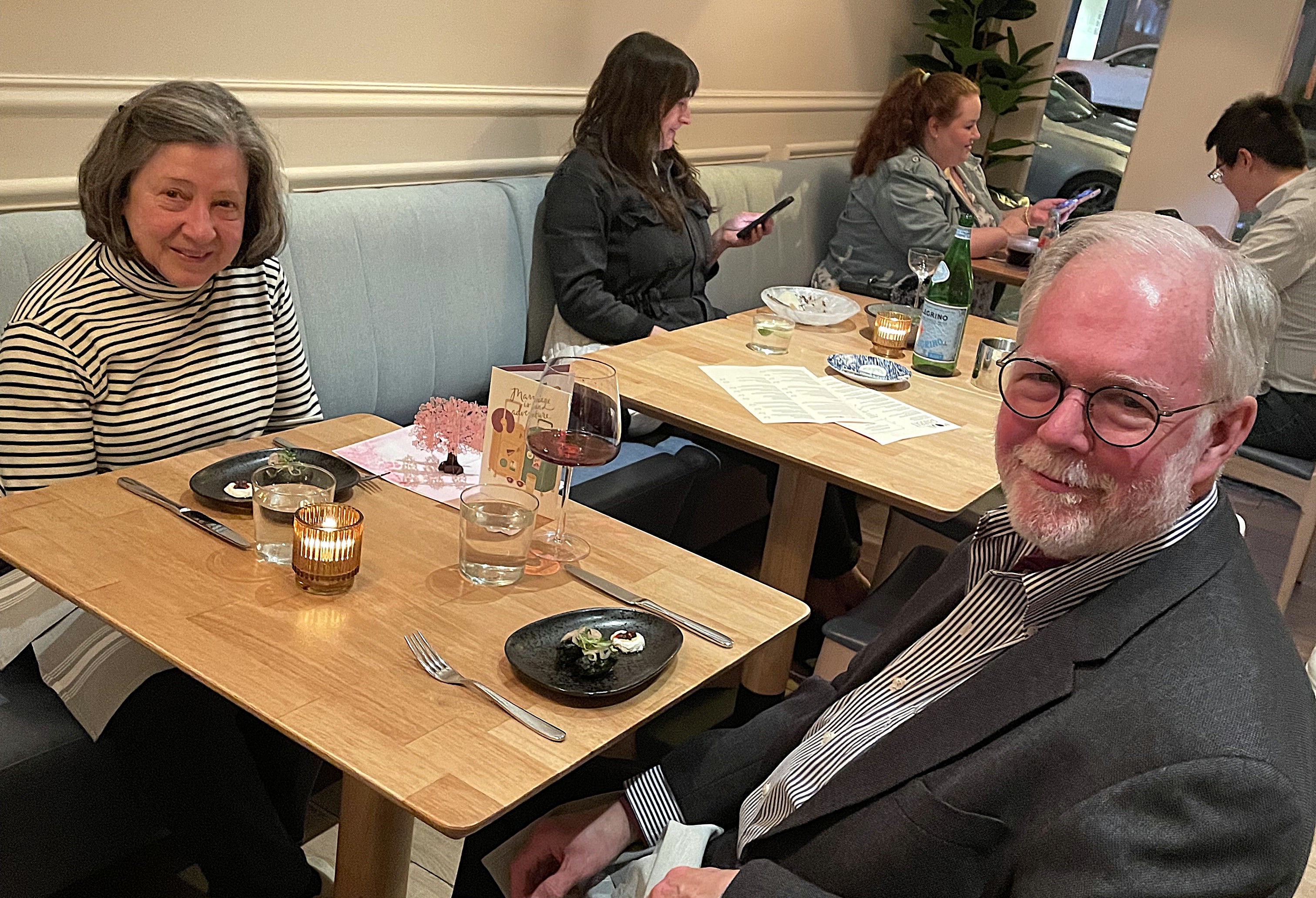
March started a three-month journey for David with cataract surgery. Naturally he wrote about it on MORE TO COME, here, here, and here in what he dubbed the “Cataract Trilogy.” March is also our anniversary month, which we celebrated with dinner and jazz at Bistro Lepic.

David tests out a new look for him—no glasses! (Spoiler alert . . . it didn’t last). Candice had cataract surgery last year to get new, multi-focal lenses and now never wears glasses!
Anniversary dinner at Bistro Lepic
Claire came to the East Coast in March to see friends from her Episcopal Urban Intern Program team: Caroline, Edgar, Graycie, and Baby Nayeli (top right, clockwise)

Spring brought Easter, a solar eclipse, another trip to Carnegie Hall, and Andrew’s final BU performance.

At St. Luke’s Alexandria with Sara and Bill Overby for Easter Vigil and their confirmations into the Episcopal Church
Andrew sings the Exultant at the Easter Vigil at Church of the Advent, Beacon Hill, in Boston
Claire enjoys springtime in New York with her dear friend Jackie Tran
In Boston, waiting for the solar eclipse

Andrew participated in the 2024 finals of the Oratorio Society of New York’s Lyndon Woodside Oratorio Solo Competition at Carnegie Hall in April. He sang Handel’s “Thou Shalt Break Them” from Messiah and Craig Hella Johnson’s “In Need of Breath” from Considering Matthew Shepard. The Matthew Shepard piece is incredibly powerful, and as the final notes lingered in the wonderful acoustic setting you could hear a pin drop for at least five seconds before the applause begin.

Andrew won third place from among an amazing group of talented singers. The following week all three of us went to Boston to hear him sing the role of Tito in Mozart’s La clemenza di Tito.

A family celebration at Prairie Fire restaurant in Brookline, MA
Andrew (as Tito) with David, Candice, and Claire
Andrew (as Tito) with BU Opera Institute colleagues and his voice teacher Lynn Eustis (front)

MAY — JUNE

In May, we sponsored a quote on the marquee at the Arcadia Project in downtown Staunton. The group raises money for rehabilitation through individuals who sponsor a quote each month from a creator on the historic theatre marquee. We chose the “instructions for life” by one of our favorite poets, Mary Oliver.

Thom Wagner posts our quote to the Arcadia Theatre marquee

We returned to Carnegie Hall and New York City in early May to hear Andrew perform Brahms with Ensemble Altera and the Orchestra of St. Luke’s in the Isaac Stern Auditorium. It was a stunning performance in a magnificent setting.

The orchestra joins the audience in recognizing Andrew and the other members of Ensemble Altera

In June we traveled to Alameda for a few days with Claire before heading out to Lake Tahoe, Nevada, where David was visiting his 50th state. He now has the certificate and t-shirt to prove it!

Catching up with family over a meal in Oakland with cousin Chris Palma
David steps into Nevada . . . his 50th state!
David displays the 50th state certificate in Nevada, with Candice and Claire
Claire, Candice, and David take in the beauty of the California portion of Lake Tahoe

JULY — AUGUST

July brought baseball for David and a second National Trust Tour—this time to Scandinavia and the Baltic Sea—for Candice and David. Andrew spent the summer singing at the Des Moines Metro Opera, covering the role of John Singer Sargent in the premiere of American Apollo. (The entire season received a great review in the New Yorker.) Claire and Andrew then took their own Scandinavian tour to Sweden and Denmark.

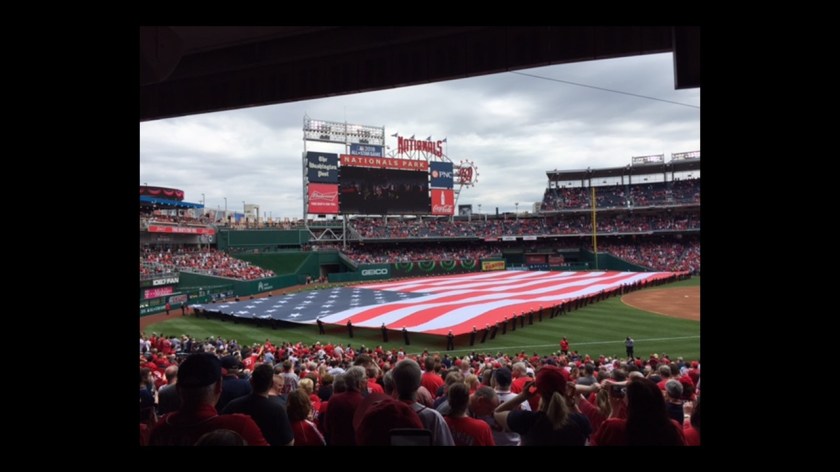
Enjoying a Nats game with friend and former colleague Tricia Kane
Ready for summer with a new haircut

We were happy to find some cooler temperatures—not to mention extraordinary historic places—as we sailed the Baltic Sea in July.

Our dear friend Frank Wade—the long-time rector at St. Alban’s Parish in DC—and his wife Kerry joined us on this trip, as seen in this photo from Tjolöholm Castle.
With our NTT friend Jan Moriarity in Sweden’s Tjolöholm Castle.

Given that we were traveling by ship to these various countries, we explored historic harbor cities—none more delightful than Copenhagen and Tallinn.

At sunset, heading to Copenhagen
Many of our National Trust Tours travelers on the Scandinavia and the Baltic Sea Tour gathered for this group photo
Enjoying some tea with NTT friends in the beautiful city of Tallinn, Estonia

Finland was a special treat, as we toured Helsinki’s amazing central library, saw beautiful monuments, and—in Candice’s case—enjoyed a Finish sauna experience, complete with a dip in the Baltic Sea!

At the Sebelius monument in Helsinki, Finland
Candice takes a dip in the sea after her Finnish sauna experience

Upon our return, Candice and David took a day trip by train to Philadelphia to view the Mary Cassat exhibit.

Finding an old friend at the Philadelphia Museum of Art’s Mary Cassatt exhibition
Walking the river trail in Philadelphia
Andrew with the other Apprentice Artists and coaches at the Des Moines Metro Opera, after the cover run (where all the covers sing their roles) for American Apollo.
Enjoying bluegrass at Strathmore on a cool summer evening with Bob and Judy Van Namen
Claire and Andrew enjoy a cocktail before a family dinner at La Piquette in Washington—the rare time all four of us were together that isn’t a holiday
Andrew in Gothenburg, Sweden
In Haga, the old neighborhood of Gothenburg
Claire comes across her namesake cafe on a bike tour through Copenhagen
Claire photographs a beautiful food market in Copenhagen
Pausing for a photo along a Copenhagen canal

Claire and Andrew topped off their trip to Copenhagen with a wonderful dinner at RADIO. Our children know how to find good places to eat!

SEPTEMBER — NOVEMBER

As the year turned to fall, we continued to read, travel, and focus on those we love.

There are several banned books on that bookshelf

In early September, Candice and Francoise LeGall helped the children of St. Alban’s parish celebrate the Godly Play ministry of The Rev. Emily Griffin at a bittersweet farewell party.

Candice and Francoise thank Rev’d Emily on behalf of the children of the Godly Play ministry

The following week, David and parishioner Kate McNamara helped organize the St. Alban’s Ministry Fair to showcase the many ways the parish reaches out to the community while meeting the spiritual needs of parishioners.

Kate and David in the midst of a busy fair day

In October, Candice and David traveled to Florida to celebrate the 93rd birthday of Candice’s mom, Irene Colando.

Candice with her mom and brother Adam at the birthday celebration
Claire with her new friend Zack

Our third National Trust Tour trip of 2024 took us to the Greek Isles and Ephesus. This was a part of the world we’d both wanted to visit for a long time, and the trip was both memorable and educational. We saw places we’d long read about and we were introduced to new experiences as well.

Having a drink with the Parthenon in the background
At one of the many delicious dinners with National Trust Tour friends
A number of our National Trust Tour travelers gathered together for a group photo
David and Candice high above the Pátmos harbor

Nobody does Halloween quite like Alameda, so Claire and Zack took full advantage, handing out candy with friends and then walking the neighborhood to see the decorations (and hear the five live bands!).

Zack and Claire as Ken and Barbie
Handing out candy with neighborhood friends
Skeleton Dogs Playing Poker—Only in Alameda!

In early November, Candice and David attended the St. Alban’s Parish Weekend at beautiful Shrine Mont in Orkney Springs, Virginia. It was a weekend for spiritual renewal, rest, reading, music, time with friends old and new, and enjoying the wonder of nature—just what we needed before a tumultuous election.

The historic Shrine Mont Retreat Center in Orkney Springs
The woods were too dry for a bonfire, so the singalong with Matt, David, and Rich moved indoors
Deep into our books on a glorious fall weekend at Shrine Mont
Andrew, Candice and David enjoy a scrumptious late fall lunch in DC with Bill and Sara Overby, their son Mike and his husband Casey

As we approach Thanksgiving this week, all four of us remain grateful for each of you and the friendships we share.

Gathering at one of our favorite Washington restaurants: La Piquette

Happy Thanksgiving to all!

More to come…

DJB

*For previous year’s posts, click here for:

The practice of gratitude

With the approach of Thanksgiving, many are asking how we can be thankful in the midst of the deceit, distrust, and discord we see around us. The historian in me responds—to quote David McCullough—that while we “think we live in difficult uncertain times, so it has nearly always been.” The seeker in me looks to establish, as Richard Rohr suggests, a pre-existent attitude of gratitude that is a deliberate choice of love over fear, a desire to be positive instead of negative.


Attitudes of Gratitude: How to Give and Receive Joy Every Day of Your Life (1999) by M.J. Ryan was written some twenty-five years ago and may seem quaint to those struggling with today’s challenges. It is all too easy to give thanks when everything is going well, as seemed to be the case before the turn of the millennium. Paradoxically, it is in the most challenging of times when it is so very important to be open to gratefulness and to remember to be thankful. Thanksgiving itself came from a time of violence. Abraham Lincoln’s famous Thanksgiving proclamation was issued in the midst of some of the worst times of the Civil War. In a series of brief motivational essays, Ryan reaches back to timeless wisdom to teach us how to unlock the fullness of life—no matter the current circumstances—through the simple joy of living from a grateful heart.

Meant to be read an essay or two in a sitting in order to integrate the learnings, Attitudes begins with thoughts on gifts: what happens in our lives when we begin to practice gratitude. Then, her essays on attitudes consider the outlook or stance we need to take in cultivating gratefulness. Finally, Ryan moves to practices, suggesting practical ways we can develop and maintain thankfulness in our daily lives.

Ryan quotes from spiritual masters, writers, mentors, and others who capture the blessings of gratitude with a few choice words.

“Gratitude unlocks the fullness of life. It turns what we have into enough, and more. It turns denial into acceptance, chaos into order, confusion to clarity . . . Gratitude makes sense of our past, brings peace for today, and creates a vision for tomorrow.”

Melody Beattie

In noting how gratitude helps us feel young, Ryan turns to Ralph Waldo Emerson: “The invariable mark of wisdom is to see the miraculous in the common.” When we tap into our sense of gratitude we are like little children, discovering the world for the first time. We don’t have to lose the happiness or “juiciness” of youth just because we’re aging.

In words that fit our times, Ryan notes that while there are plenty of things in life to be justifiably annoyed, angry, or hurt at, “that doesn’t mean that I should completely ignore all that is beautiful, good, and touching.” We’re not perfect, and we shouldn’t strive to be.

A point worth pondering: Upon completing the Universe the Great Creator pronounced it ‘very good.’ Not ‘perfect.'”

Sarah Ban Breathnach

Attitudes are the underpinnings of action, and Ryan has the reader think about how our approach to life affects our gratitude. Thich Nhat Hanh was the Vietnamese Buddhist monk who endured many hardships of war. An orphanage he started was bombed. He had to live years in exile. But through it all, he felt that “the greatest of all miracles is to be alive.” In considering all the sorrow in the world, this simple man who influenced millions writes,

“Suffering is not enough. Life is both dreadful and wonderful. How can I smile when I am filled with so much sorrow? It is natural—you need to smile to your sorrow because you are more than your sorrow.”

Ryan ends this hopeful work with suggestions on the practice of gratitude: how to put our attitudes into action. She begins by reminding us it takes exercise. Every day. Our family started this type of daily practice a number of years ago, when we began our evening meal by stating what we were grateful for that day. Yes, there were times when someone was “grateful the day was over,” but at least there was a recognition that this misery was only temporary in the larger scheme of life.

In one powerful suggestion that is timely today, Ryan pushes us to “do the work of forgiveness.” Nothing blocks feelings of gratitude, she asserts, more than anger and resentment. We victimize people by convincing them they are victims. It may take a while, but “there is a time in the process of emotional resolution for forgiveness.”

Practicing wonderment. Banishing comparisons. Transforming expectations into “no matter whats.” Looking for the hidden blessings of difficult situations. All of these practices can lead to a life of gratitude, that then leads to generosity and kindness to others.

My friends at Kefa Cafe in Silver Spring express their gratitude every day

David Steindl-Rast describes how gratefulness—our full appreciation of something altogether unearned—leads us to thankfulness. “In a moment of gratefulness, you do not discriminate. You fully accept the whole of this given universe, as you are fully one with the whole.”

“[W]hen the fullness of gratitude overflows into thanksgiving, the oneness you were experiencing is breaking up. Now you are beginning to think in terms of giver, gift, and receiver. Gratefulness turns into thankfulness. This is a different fullness. A moment ago you were fully aware; now you are thoughtful. Gratefulness is full awareness; thankfulness is thoughtfulness.”

No one got to where they are by themselves. As we continue to grapple with the violence and division that is all around us, recognizing this basic fact of life is key to a deeper understanding of grace. We all make the choice as to how to respond to hatred and despair. We can respond with gratefulness and love and, in so doing, become the type of person that William Shakespeare described as making “the face of heaven so fine.”

When he shall die,

Take him and cut him out in little stars,

And he will make the face of heaven so fine,

That all the world will be in love with night,

And pay no worship to the garish sun.

Romeo and Juliet (Act 3, Scene 2)

I am thankful for all I have to celebrate this Thanksgiving, for my family and for all the wonder and joy in my life every day. I count myself lucky to have crossed paths with so many people who have loved me into being. You may, or may not, remember what you did to lift me up. But I remember.

Thank you all. Let’s continue the practice of being radically grateful this Thanksgiving and every day. And remember the words of the great Darrell Scott: It’s a great day to be alive. *

“And it’s a great day to be alive
I know the sun’s still shining
When I close my eyes
There’s some hard times in the neighborhood
But why can’t every day be just this good”

More to come…

DJB


For another Thanksgiving essay during challenging time, check out one I wrote for Thanksgiving Day 2020 and then repurposed in 2022


Photo by Silviu Zidaru on Unsplash

Even small challenges have impact

Two friends mentioned they had recently seen a movie that moved them to consider how one responds to authoritarian power. I returned to re-read the novel on which the movie is based, believing that it has an important message for our times. This review is taken largely from my earlier post.

One of the key reasons authoritarians can get away with horrific acts and even murder is because of the complicit silence of “good people” in the community. None is more damning than the silence of the church. In his famous Letter from a Birmingham Jail, the Rev. Dr. Martin Luther King, Jr. wrote of his surprise that the white churches did not support the famous bus boycott against racial segregation on public transit. Some showed outright hostility, he wrote, but “all too many others have been more cautious than courageous and have remained silent behind the anesthetizing security of stained-glass windows.”

Of course, sometime the church is itself the authoritarian power. Ireland’s infamous Magdalene laundries certainly existed—and even thrived—because of complicit silence both inside and outside the church. *

Thankfully, confrontations against complicit silence come in all sizes. And even the small challenges can have tremendous impact.

Small Things Like These (2021) by Claire Keegan is a short yet deeply moving novel set in small-town Ireland during the Christmas season of 1985. Bill Furlong is a coal and timber merchant who works hard supporting his family while running a small business that employs several other men in the community. Well-liked and respected, Furlong “had come from nothing. Less than nothing, some might say.”

His mother became pregnant at the age of sixteen while working as a domestic for Mrs. Wilson, a Protestant widow who lived “in the big house a few miles outside of town.” With no father in sight, Furlong’s mother is disowned by her family; yet her employer takes her in and helps raise young Bill. He goes to school and eventually becomes a local merchant, meets his wife Eileen, and they have four girls who, when we meet them, are doing well at the local Catholic school for young women.

As Christmas approaches, Furlong takes a load of coal to the local convent and makes a discovery that forces him to consider his past and the choices he must make in the face of complicit silence.

The silence hits very close to home when Eileen reminds him that the discovery “Tis not one of ours.” He responds, “Isn’t it a good job Mrs. Wilson didn’t share your ideas?” When he takes his yardmen to the local pub for a Christmas dinner, the owner, Mrs. Kehoe, lets him know that she had heard that Bill “had a run-in with herself above at the convent.”

Her advice? “You want to watch over what you’d say about what’s there. Keep the enemy close, the bad dog with you and the good dog will not bite.” Surely you must know, she adds, “these nuns have a finger in every pie.”

In the end, Furlong follows what he knows, in his heart, is right. And while he could feel a “world of trouble” waiting for him behind the next door . . .

“. . . the worst that could have happened was also already behind him; the thing not done, which could have been—which he would have had to live with for the rest of his life.”

Shortlisted for the 2022 Booker Prize and winner of the Orwell PrizeSmall Things Like These brings us face-to-face, in a simple yet memorable story, with how we confront our past and with the evils of a community’s complicit, self-interested silence. It is also a deeply moving story of “hope, quiet heroism, and empathy.”

Small Things Like These is a little gem of a novel.

More to come . . .

DJB


*What were the Magdalene laundries?

From the foundation of the Irish Free State in 1922 until 1996, at least 10,000 girls and women were imprisoned, forced to carry out unpaid labour and subjected to severe psychological and physical maltreatment in Ireland’s Magdalene Institutions. These were carceral, punitive institutions that ran, commercial and for-profit businesses primarily laundries and needlework. After 1922, the Magdalene Laundries were operated by four religious orders (The Sisters of Mercy, The Sisters of Our Lady of Charity, the Sisters of Charity, and the Good Shepherd Sisters) in ten different locations around Ireland (click here for a map). The last Magdalene Laundry ceased operating on 25th October, 1996. The women and girls who suffered in the Magdalene Laundries included those who were perceived to be ‘promiscuous’, unmarried mothers, the daughters of unmarried mothers, those who were considered a burden on their families or the State, those who had been sexually abused, or had grown up in the care of the Church and State. Confined for decades on end — and isolated from their families and society at large — many of these women became institutionalised over time and therefore became utterly dependent on the relevant convents and unfit to re-enter society unaided.

Justice for Magdalenes Research

Photo of Magdalena cemetery in Donnybrook (credit: Justice for Magdelena’s Research)