Latest Posts

From the bookshelf: December 2024

Each month my goal is to read a minimum of five books on a variety of topics from different genres. Here are the books I read in December 2024. If you click on the title, you’ll go to the longer post on MORE TO COME. Enjoy.


Vermeer’s Hat: The Seventeenth Century and the Dawn of the Global World (2008) by Timothy Brook is a work of history that opens up the world for the reader. Using the paintings of Johannes Vermeer, he encourages us to view certain objects as doors which we can “step through into the teeming social, economic and political context which lies beyond.” Those doors include a beaver hat, Chinese porcelain, a geographer’s map, and more. Once we step into these worlds, Brook then deftly explains how the early years of the seventeenth century took mankind from isolated communities to interconnected worlds. It is, as one reviewer noted, an exhilarating piece of history.


Age of Folly: America Abandons Its Democracy (2016) by Lewis H. Lapham surveys the period from 1990 to 2015 to make the strong case that America’s imperial impulses have shaken our democratic principles. Drawn from monthly commentaries produced as the editor of Harper’s Magazine and essays written as backstory to various issues of Lapham’s Quarterly, Lapham makes the case for history as folly’s antidote. Lapham wants to teach us that “we have less reason to fear what might happen tomorrow than to beware what happened yesterday.” A nation denied knowledge of its past, he asserts, “cannot make sense of its present or imagine its future.”


Don’t think of an elephant: Know your values and frame the debate (2004) by George Lakoff is about framing messages. “Framing is about ideas—ideas that come before policy, ideas that make sense of facts, ideas that are proactive not reactive, positive not negative, ideas that need to be communicated out loud every day in public.” Don’t use the language that the right-wing wants you to use, Lakoff asserts, because their language picks out a frame—and it won’t be the frame we want. Framing is about getting language that fits your worldview—your values. And yet it goes beyond language. Ideas are core. Language simply “carries those ideas, evokes those ideas.”


How to Fight (2017) by Thich Nhat Hanh with illustrations by Jason DeAntonis begins by reminding us that how we respond to unkindness by others is a practiced habit, resulting from well-worn pathways in our brains. We feel slighted and we generally retaliate immediately. However, we can change our minds and develop new habits, new ways of approaching life’s challenges. In these short meditations, Thich Nhat Hanh “instructs us exactly how to transform our craving and confusion.” Paradoxically, we have to learn to take good care of our suffering in order to help others do the same.


Avant-Garde in the Cornfields: Architecture, Landscape, and Preservation in New Harmony (2019) edited by Ben Nicholson and Michelangelo Sabatino is a scholarly exploration of an iconic small town in Indiana that provides insights and new perspective into architecture, landscape, preservation, spirituality, and philanthropy.  Avant-Garde in the Cornfields traces how nineteenth century utopian aspirations based on the renewal of society through faith and later science became the touchstone for a transformation through preservation and reinvention of New Harmony’s traditions. An expansive vision of the third “utopian” chapter in New Harmony’s history which the editors have brought together in one eclectic, in-depth, and ultimately satisfying volume, this story of how the extraordinary past and present of New Harmony continue to thrive today is worthy of consideration in our own troubled times.


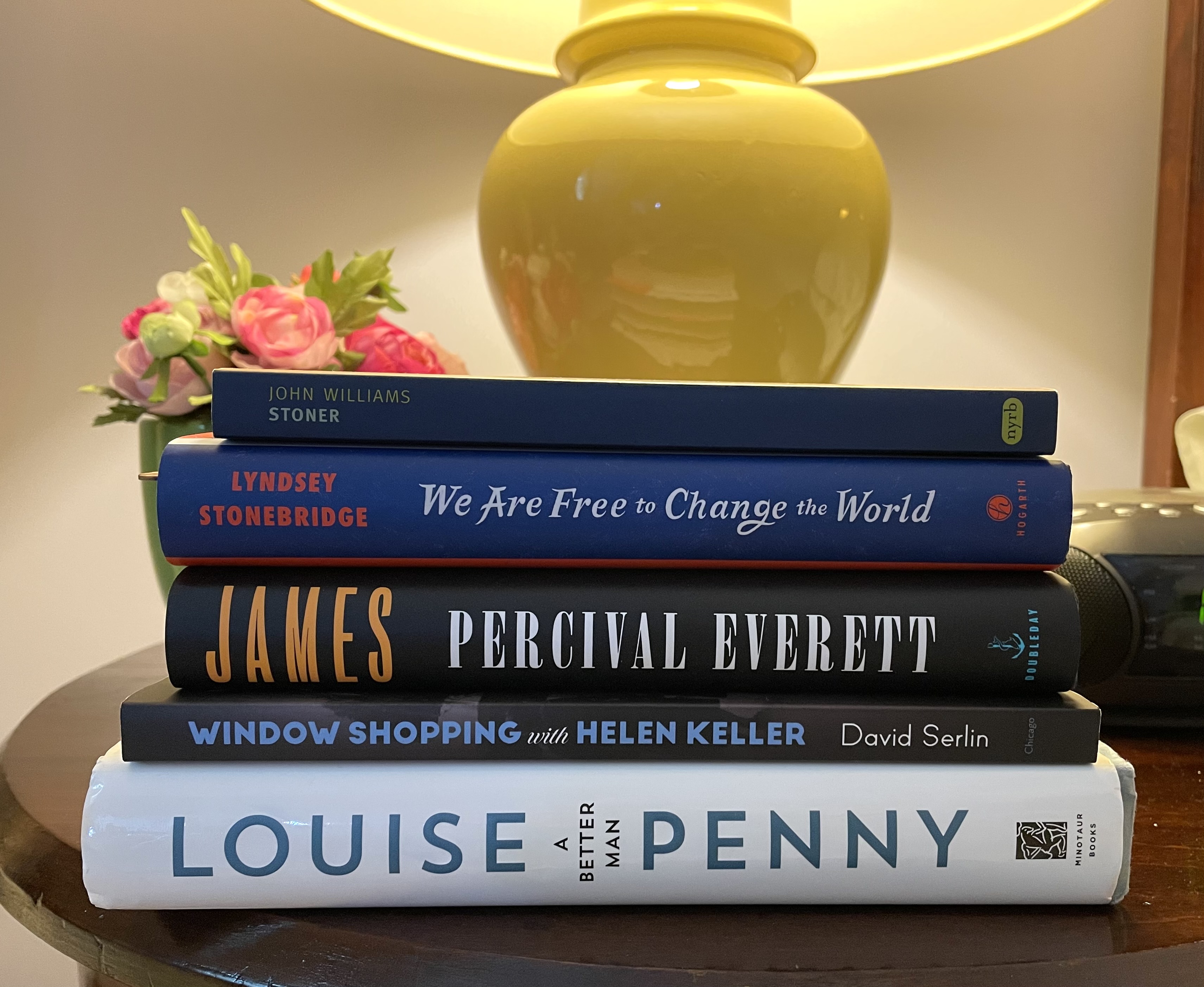
What’s on the nightstand for January (subject to change at the whims of the reader)

Keep reading!

More to come…

DJB


NOTE: Click to see the books I read in November of 2024 and to see the books I read in 2024. Also check out Ten tips for reading five books a month.


Man reading in park from Pixabay

Joy, dreams, faith, honesty, melancholy . . . and riff raff

Last month The Bitter Southerner website* posted Let Her Cook: The Best Southern Albums of 2024, an eclectic list of 20 albums curated by the TBS staff. There are well-known names (Beyoncé, Taylor Swift, Brittany Howard) and everything from folk to pop to rock to rap. Today I’ve focused on six of these artists to highlight names and music that, with one or two exceptions, may be new to you. Each segment quotes from the TBS article and includes one video (except when there are two.)

Enjoy!


Joy Oladokun

Nigerian American singer-songwriter Joy Oladokun was born in Delaware, raised in Arizona, and is now based in Nashville, that hotbed of country and Americana music. In many ways, Oladokun reminds me of the folksingers of my youth, as I wrote in a 2023 post. She has a beautiful and soulful voice, often heard over the delicate sound of her acoustic guitar. Her songs are poetry for today’s America, sung with pain and passion.

“Joy Oladokun’s Observations from a Crowded Room feels like a deep exhale after holding it together for way too long. Blending folk, pop, gospel, and touches of R&B, it’s smooth and meditative but still knows how to groove. Oladokun explores the exhaustion of constantly pushing through—fitting into spaces where you don’t feel welcome, balancing faith, family, substances, and the endless weight of vulnerability. The album opener ‘Letter from a Blackbird’ is written like a reflective contemporary response to the iconic Beatles’ track. ‘Flowers’ and ‘Good Enough’ are gentle, acoustic, and sweet, offering moments of quiet reflection. In contrast, ‘Hollywood’ and ‘Drugs’ hit harder—raw, intense, and emotionally charged, capturing the ache of navigating a life that drains you . . . It’s an album about being tired but honest, creating something beautiful even when you’re at your limit.”

The Bitter Southerner

Here I pair Letter from a Blackbird with Oladokun’s beautiful cover of the Beatles’ original that inspired the new tune.


Sierra Ferrell

One of the brightest young stars in roots music today, Sierra Ferrell brings “a dose of beautifully strange magic to everything she touches.”

“Whimsical, wild and yearning, Sierra Ferrell’s Trail of Flowers is a force. Ferrell pays homage to her roots and those of country, bluegrass and soul genres, weaving it all together with her timeless velvety voice. This album spans decades, creating a mix of sounds and feelings that are both contemporary and classic . . . Somehow hopeful and heartbroken all at once, Sierra Ferrell has mastered the art of loneliness, love and good-old-fashioned country music.” 

The Bitter Southerner

Madi Diaz

Madi Diaz’s Weird Faith feels like cracking open someone’s diary and reading the messiest, most unfiltered pages. The lyrics are blunt, intimate, and shift moods so quickly it’s almost hard to keep up, but that’s what makes it so painfully relatable. Diaz has created an undeniably pretty album, with soft sweet acoustic guitar and stunningly clear vocals throughout. The album hones in on the early stages of a relationship, when you’re spiraling over whether you can trust them yet . . . Tracks like ‘Hurting You’ and the Kacey Musgraves duet ‘Don’t Do Me Good’ are slow and syrupy, while ‘Obsessive Thoughts’ and ‘Worst Case Scenario’ explode with raw, chaotic energy.”

The Bitter Southerner

Maggie Rose

Born in Potomac, Maryland, the Nashville based singer-songwriter Maggie Rose has been making a name for herself in rock-and-roll, soul, folk, funk, and R&B for several years, as I noted in 2021. A gifted vocalist, Rose has worked with some of the top names in the field. 

“Right out of the gate, this album [No One Gets Out Alive] is beautiful and powerful. Its title track opener has so much energy, and its classic emotive soul sound brings the great Carole King to mind. Maggie Rose’s vocals are truly stunning throughout—she has technical skill and vulnerability out the wazoo. This album has a timeless wisdom, celebrating intuition alongside honesty and self worth . . . On the so-dang-funky ‘Underestimate Me,’ Rose’s cup runneth over with swagger and confidence as she literally begs someone to let her prove them wrong. ‘Only Time Around’ is a sweet song about trusting yourself and living in the present, reassuring advice we can all use in these times of transition.”

The Bitter Southerner

We’ll feature that funky Underestimate Me followed by the album’s title track.


Gillian Welch and David Rawlings

I have loved the aching, soulful music of Welch and Rawlings for more than two decades. They have a deceptively simple yet oh so deep style, as I wrote in a 2020 MTC post

“Gillian Welch’s voice is as golden as ever, and David Rawlings’ technical skill on guitar is mesmerizing. This year, the two country and folk legends brought us the smooth, steady and beautiful Woodland . . . With a more orchestral production than older projects, this album stands out most on tracks like ‘What We Had’ and sticks to their timeless folk sound on tunes like ‘Here Stands A Woman.’ The harmonies are effortlessly balanced, showcasing years of intuitive collaboration. No drama, no overpowering. Just pure magic.

This record, released three months before November, leaves us wondering if they’re psychic. How else could they create something so melancholy before we even knew we’d have to be?” 

The Bitter Southerner

Two songs perfectly exemplify this melancholy vibe: Empty Trainload of Sky and What We Had.


Hurray for the Riff Raff

“Old soul lyricism, rich metaphors and even richer vocals shine on The Past Is Still Alive by Hurray For The Riff Raff. This record is smooth and silky on ‘Colossus of Roads’ and ‘Ogallala,’ with a bit of crunch on tracks like ‘Hawkmoon’; and it all flows. Through this project, Alynda Segarra gives sage advice: you can try and outrun the past, but you won’t get far—and maybe that’s not such a bad thing . . . This fall has been painful, and as they told us even before the election, ‘we’re reckoning with our history and thinking about how our country was formed, and also how we might envision a future.’ Like a lightning bug, Segarra has captured a full human experience: rusty trains, midwest sunrises, garbage, Narcan and the beauty of queerness glow in the palm of their hand.” 

The Bitter Southerner

Let’s end with Hawkmoon from Hurray for the Riff Raff’s new album along with their cover of the timeless Townes Van Zandt tune Pancho and Lefty.

More to come . . .

DJB

*From the website: A beacon from the American South and a bellwether for the nation, The Bitter Southerner is an Athens, Ga.-based independent publisher, founded in 2013, that connects an activated and vocal global community working to make the South, and America, a better place. Today, The Bitter Southerner publishes three print magazines annually, books under its BS Publishing imprint, the “Batch” podcast, and offers iconic apparel and home goods in the BS General Store.


Photo of antique equipment on South Georgia farm by cbrennan poole on Unsplash

The questions we ask about the facts of history

Several strands of the history happening in this moment are rolling around in my head. Rather than try and pull together one coherent essay today, I’ll simply capture those strands and encourage you to go to the primary sources. Perhaps later MTC posts will return to these themes.

As you read these pieces, keep this quote from historian Emory Thomas in mind.

“History, defined as ‘facts about the past’ does not change all that much. But we change; the present changes. And so those questions we ask those ‘facts about the past’ change considerably, as does the emphasis we give to some of those facts as opposed to other facts.”

Emory M. Thomas, “The Confederate Nation 1861-1865” (2011 edition)

God did a good thing when he made your dad

President Jimmy Carter lies in state in the capitol rotunda

The eulogies for former president Jimmy Carter at the state funeral on Thursday, January 9th held at the Washington National Cathedral were rich, filled with love, and spoken from the heart. They also helped to correct and update the history around the former president.

Heather Cox Richardson captured many of the best remembrances in her Letters from an American newsletter. As she noted, by virtue of living to be 100 Carter survived many of his contemporaries. But his former vice president, Walter Mondale, as well as the man he defeated for the presidency, Gerald Ford, both left behind eulogies which were read by their sons.

“Mondale recalled Carter’s ‘extraordinary years of principled and decent leadership, [and] his courageous commitment to civil rights and human rights.’ He recalled that toward the end of their time in the White House, in the years immediately after the tumultuous years of President Richard Nixon, with his covert bombing of Cambodia and cover-up of the Watergate break-in, the two men were summing up their administration. The sentence they came up with was: ‘We told the truth, we obeyed the law, and we kept the peace.'”

Ford’s son Steve fulfilled his father’s promise to deliver a eulogy. “Ford . . . noted that the former president ‘pursued brotherhood across boundaries of nationhood, across boundaries of tradition, across boundaries of caste. In America’s urban neighborhoods and in rural villages around the world, he reminded us that Christ had been a carpenter.’”

Steve Ford added his own remembrance when he spoke directly to the Carter children and said, “God did a good thing when he made your dad.”

Perhaps the most moving eulogy came from Carter’s grandson Jason, chair of the Carter Center’s board of trustees and a former Georgia state senator, who emphasized President Carter’s “integrity: his grandfather’s political convictions reflected his private beliefs.”

“’As governor of Georgia half a century ago, he preached an end to racial discrimination and an end to mass incarceration. As president in the 1970s…he protected more land than any other president in history…. He was a climate warrior who pushed for a world where we conserved energy, limited emissions, and traded our reliance on fossil fuels for expanded renewable sources. By the way, he cut the deficit, wanted to decriminalize marijuana, deregulated so many industries that he gave us cheap flights and…craft beer. Basically, all of those years ago, he was the first millennial. And he could make great playlists.’

Jason Carter called his grandfather’s life a “love story, about love for his fellow humans and about living out the commandment to love your neighbor as yourself.”

On a 2007 visit to Savelugu Hospital in Ghana, President Jimmy Carter asks a group of children if they’ve had Guinea worm. A raised hand is a yes. (credit: Louise Gubb/Carter Center)

Carter noted that ‘this disease [Guinea worm] is not eliminated with medicine. It’s eliminated…by neighbors talking to neighbors about how to collect water in the poorest and most marginalized villages in the world. And those neighbors truly were my grandfather’s partners for the past forty years [and have] demonstrated their own power to change their world.’ When Jimmy Carter ‘saw a tiny 600-person village that everybody else thinks of as poor, he recognized it. That’s where he was from. That’s who he was.’ He saw it as ‘a place to find partnership and power and a place to carry out that commandment to love your neighbor as yourself. Essentially, he eradicated a disease with love and respect. He waged peace with love and respect. He led this nation with love and respect.’”

Love and respect.

President Joe Biden focused on what he called Carter’s “enduring attribute: character, character, character.” 

‘At our best,’ Biden said, ‘we share the better parts of ourselves: joy, solidarity, love, commitment. Not for reward, but in reverence for the incredible gift of life we’ve all been granted. To make every minute of our time here on Earth count.’

‘That’s the definition of a good life,’ Biden said. It was the life Jimmy Carter lived for 100 years: a “good life of purpose and meaning, of character driven by destiny and filled with the power of faith, hope, and love.”


The history you didn’t get in school

Bunk is a shared home for the web’s most interesting thinking about American history. By highlighting some of the many points of connection between overlapping stories and interpretations, the editors seek to create a fuller and more honest portrayal of our shared past and “reveal the extent to which every representation is part of a longer conversation.”

On January 9th, the editors published their compilation of the Best Online History Writing of 2024. The entire list of 40 essays is fascinating, but I want to highlight two that caught my eye on first review.


Innocent mayhem that hints at a darker side of things

Credit: RichardScarry.com

This year is the 50th anniversary of Richard Scarry’s 1974 Cars and Trucks and Things That Go, which strikes Chris Ware, writing in the Yale Review with a piece included in Bunk’s Top 40 list in the “Culture” section, as “a commemoration worthy of ballyhoo.”

The entire story is worth your time, as you’ll find insights and plenty of cultural history.

“The Busytown books were enormous successes in America. But Scarry wrote and drew them in Switzerland, where he decided to move in 1967 after a three-week ski vacation with his son,” writes Ware. “What seems to have been an impulsive decision starts to makes sense if you’ve spent a few days immersed in Scarry’s work writing an essay for The Yale Review: a decidedly un-American tone runs through much of it.” Ware continues. “By ‘un-American’ I don’t mean anti-American. Instead, I mean there’s a top-down, citizen-as-responsible-contributor, sense-of-oneself-as-part-of-something-bigger that feels, well, civilized.”

“In Busytown there’s just enough innocent mayhem and tripping and falling to hint at a darker side of things, like failing 1970s marriages and the things on television news that adults were always yelling about.”


History lessons from a horror writer

Horror writer Grady Hendrix, writes The Unspoken Issue Haunting the Whole Election a week before the November election for Slate in a piece chosen by the Bunk editors for the top 40 list in the “Memory” section. Hendrix believes the horror genre has political lessons for us.

“Next week, we face an election in which one campaign declares ‘Let’s turn the page!,’ while the other looks at the country, pronounces it a hellscape, and promises to ‘Make America Great Again!’ In their own ways, both candidates want to bury the past and offer a vision of a brighter future. But if we Make America Great Again, we will create a literal underground of trans people, immigrants, and pregnant women who will have to break the law to survive. If we ‘turn the page,’ there will still be millions of people trapped beneath it who feel that Trump gave them a voice. And those people aren’t going anywhere, even if they lose their political power. We can call Trump the Big Orange Cheeto or the Fascist in Chief, but like it or not, there are millions of Americans who believe in what he has to offer and connect with him in a profound way. Maybe they’re all stupid? Maybe every single one of them is an idiot, and those of us who read (and write for) Slate are smarter and better educated and superior in every way. Maybe all the deaths, the isolation of lockdown, all this struggle to change the country, maybe it’ll all just disappear into the past and never be heard from again. Maybe.

But I’m a horror writer. And the one thing horror has taught me is that you can wish it away, you can lock the doors and draw the curtains, you can even burn it alive—but the past always comes back. Just when you’ve finally relaxed, just when you’ve nailed the last board over the final window and locked dead bolts on all the doors, it’ll come crawling out of its grave and smash through the walls or break through the floor. The past always, always, always returns, looking for its pound of flesh. And horror has one other lesson to teach us: We won’t see how it manifests until it’s far too late.”

More to come . . .

DJB

Photo of historical photographs by Mr Cup / Fabien Barral on Unsplash

The crucible of the life cycle

Winter arrived with a vengeance this week.

We had our first significant snowfall of the season in the region on Monday. With an Arctic vortex bearing down, the temperatures will stay below freezing for the foreseeable future, meaning that the six-ten inches or so of snow that arrived isn’t going anywhere soon. Minnesotans know how to live with this weather and enjoy it. For those of us raised in the South, not so much.

Winter can be difficult. We may feel isolated as friends hunker down in their homes. The cold itself can be a challenge, something I’m finding to be true as I age. To others, the apparent death of life—as nature drops its spring/summer/fall finery and turns within itself for sustenance—can bring on depression.

First snow of the season in Silver Spring. Several more inches arrived on our deck before the day was over.

We’re also facing the existential dread (or so it seems) of another four years of political madness and folly. And it’s not even February, which—I believe—is the longest month of the year.

How do we cope and find hope in difficult and troubled times?

Katherine May writes in Wintering that these months are necessary and a good time to step back. They are also a metaphor for the idea of retreat. Winter, you see, “is not the death of the life cycle, but its crucible.”

Parker Palmer takes on the same theme in Seasons.

“. . . winter has an even greater gift to give. It comes when the sky is clear, the sun brilliant, the trees bare, and the first snow yet to come. It is the gift of utter clarity … Winter clears the landscape, however brutally, giving us a chance to see ourselves and each other more clearly, to see the very ground of our being.”


Clarity and hope

Clarity in troubled times is important. Difficulties require clear thinking. But at the same time it is important that we not give up hope. As Rebecca Solnit reminds us, hope demands things that despair does not. Hopefulness is risky,” writes the historian, author, and activist, “since it is after all a form of trust, trust in the unknown and the possible, even in discontinuity.”

We have to understand that “to be hopeful is to take on a different persona, one that risks disappointment, betrayal…” And still, historians and theologians remind us that hope can carry us forward. Not the greeting card type of hope but the gritty kind “that gets up every morning and chooses to try to make the world just a little kinder (or better) in your own way.” Hope that is clear-eyed and grounded in memory. Historian Howard Zinn spoke of how important hope is in difficult times.

“To be hopeful in bad times is not just foolishly romantic. It is based on the fact that human history is a history not only of cruelty, but also of compassion, sacrifice, courage, kindness. What we choose to emphasize in this complex history will determine our lives. If we see only the worst, it destroys our capacity to do something. If we remember those times and places—and there are so many—where people have behaved magnificently, this gives us the energy to act, and at least the possibility of sending this spinning top of a world in a different direction. And if we do act, in however small a way, we don’t have to wait for some grand utopian future. The future is an infinite succession of presents, and to live now as we think human beings should live, in defiance of all that is bad around us, is itself a marvelous victory.”

Howard Zinn from “A Power Governments Cannot Suppress”

Reenacting creation

The Friends of Silence remind us at this time of year that stillness and reflection are key to our retreat, our replenishment, our renewal.

Photo by Klim Musalimov on Unsplash

Bill Brown was a prolific poet and beloved teacher from Dyersburg, Tennessee. Chapter 16 recently referenced one of his poems that speaks to the possibilities of winter—and hope.
In Praise of Winter Trees

A closed heart can’t greet
a winter sky. Even a rain puddle
is filled by it, and a horse trough,
and the slow current of creeks.

Winter trees, sycamore and oak,
reach for the sky to offer praise –
stark, hard praise, born from all
those rooted years of bearing

the sky’s weight. Some nights
an open heart is filled with vast
spaces between stars the mind
can’t grasp. The thought of heaven

is not so much mammothed by
the sky’s grandeur, but mystified
beyond our silly notions. Winter
trees aren’t arrogant; they praise

no flags, no denominations,
they owe allegiance to the soil.
My sister, when she was younger,
awoke in winter to hold her arms

up to the sky, shiver in the wholeness
of it, let shadows of winter trees
dance sunlight across her face.
Oak, beech, sycamore, maple, and gum,

reenact creation, drop their seeds
from the sky, make their homes
in star dust, and reach back
toward heaven. Trees suffer

drought and freezing rain, accept
the annual tilt toward shorter days.
Some ancient hope, like winter light,
is allied with the gravity of stars.

Bill Brown from the collection “Late Winter” (2008)

Here’s wishing you a period of retreat, clarity of vision, and the sustenance of hope during this time of winter.

More to come . . .

DJB

Winter landscape from Pixabay.

Savor life’s gentle moments

We live in an anger-filled age. After an initial period of community care, the pandemic quickly “blanketed the country in misery and left us at each other’s throats. One of the most revealing data points is that during the pandemic, pedestrian deaths skyrocketed. People were just driving angry.”

I still see this almost every morning on my walk in downtown Silver Spring. Drivers run red lights and ignore stop signs. They honk at the car in front of them a millisecond after the light turns green. Too many drivers speed through heavily traveled pedestrian zones used by the elderly or race through residential neighborhoods filled with children on their way to school.

Since when did stop signs and red lights become suggestions?

At the beginning of 2025 we are halfway through the 2020s and several years out from the worst of the pandemic. Yet we haven’t adjusted our frustrations. We were angry at having to be confined by the pandemic, and we remain frustrated and frightened long after the worst of it has passed. We let our good habits atrophy as we sat in our pajamas at home and several years later we still haven’t moved past those base instincts. Too many of us act like children throwing a temper tantrum. We don’t have the discipline to focus on what’s essential, what matters, what’s around us.

So much of our anger, I’m afraid, comes from trying to control things that are, frankly, uncontrollable.

Letting go of control is hard. Really hard. With all the anxiety and pressure in today’s world, the tendency is to gather all we think we must do and hold on tight. But the fact is that we don’t have that much control. We may act as if we do, but our time will not stretch on indefinitely even though we work, plan, and live as if that’s the case. It is the desire to control, to try and ensure that our efforts will always be successful, that actually restricts us. This desire also keeps us from finding our true nature, our souls.

“Hard work and drawing up plans are helpful, but not always. We do not build our souls as much as we find them along the way. We discover them by accident as much as by intention. There is a time to take our lives in hand, but there is also a time to take our hands off our lives, and to leave what seems apparent and trust ourselves to the hidden.”

Marv and Nancy Hiles, Iona Center of Healdsburg, CA

When we open our eyes to how life really works—when we pay attention, in other words—we come to at least see, if not fully accept, the paradox of limitations. Only when we let go of the need to control do our lives become more productive, meaningful, and joyful. When we let go of the need to control, we can more easily accept—and even rejoice in—the life we are given. We open ourselves to seeing that our days are exceptional even when they are ordinary.

We may even find our souls.

We each have the ability to choose to let go of the anger and anxiety that is pushing us to race through life, acting out in bad ways. We have the ability to make the choice to step through the door. To release the hard grip we have on our lives.

Ryan Holiday quotes the Roman philosopher Seneca who said, “We suffer more in imagination than in reality.” These worst-case scenarios rarely happen, “and yet, the time and energy anxiety steals are gone forever.”

Anxiety comes from within us. We can choose to let it go. Slowing down to savor life’s gentle moments can help.

If we slow down we can take the time and notice all the wonder that is around us. We can think before we react. We can find the good in others. We can choose to put aside our screens and get outside for a walk. We can make the conscious decision to pick up a book and read. And yes, we can find surprising amounts of joy and wonder as we drive.

This often happens to me on 16th Street, NW in Washington.

Part of the city’s original plan, 16th Street was an early location for embassies and churches.  Most of the embassies have left, but one of the charms of the street is the beautiful church and institutional architecture that’s interspersed throughout the neighborhoods. 

St. John the Baptist Russian Orthodox Cathedral, one block off 16th Street in Washington

Rock Creek Park fronts much of the western edge of the street as I head south from Silver Spring. The park is enchanting every time of year, but I especially like the winter, when you can see deeper into the forest and be mesmerized by the sculptural nature of the trees without their leaves.

Rock Creek Park photo by Sara Cottle on Unsplash

The street also features the mansions of the Gold Coast—home for decades to many of Washington’s most affluent and accomplished African Americans. Colorado Avenue is a hidden gem, with a terrific two-block display of Gothic Revival residential architecture. I often take a slow turn down Blagden Terrace, which has a marvelous array of architectural styles in one short block.

Blagden Terrace architecture

As I cross Rock Creek at Pierce Mill, I also slow down and look at the dam, which was constructed in 1904 purely for aesthetic reasons. The visual effect is quite wonderful. On Sunday mornings, when we generally share the road only with joggers, hikers, and cyclists, Candice calls it our moment of Zen.

Historic postcard of the 1904 dam across Rock Creek at Pierce Mill in Washington

Driving the speed limit and following traffic regulations is about caring for others and their safety. It is one way we can live together more peacefully in community. At this slower pace, I am also able to enjoy the beauty—both natural and man-made—that is abundant in Washington.

If you find yourself still angry over the pandemic, or politics, or personal slights, slow down in everything you do. Let go. Loosen the grip you have on your life. Savor the gentle moments. We cannot always be in control.

More to come . . .

DJB

Door photo by Jan Tinneberg on Unsplash.

Rules for the road of life

The New Year is a time when many think of resolutions, perhaps focused on personal ways to respond to our current reality. Unfortunately, too many of us still find ourselves in “an in-between time of rupture and searching and unmourned losses and so many callings yet to heed, so much change to absorb and propel,” as Krista Tippett wrote in 2021.

For more than a decade, I have taken a route away from annual resolutions. In 2013 I established several rules of how I want to live day-to-day. “Life learnings” are what the essayist Maria Popova calls her list.

Designed to help direct me during both good and difficult times, my rules came as the result of a more intentional focus on life’s journey rather than relying on a changing list of resolutions to respond to the challenges of the moment. These personal guidelines are not quite principles but rather serve as reminders of how I want to live over time.

Computer wallpaper with DJB’s life rules

As has been the case in recent years, I highlight each rule followed by a reference to a MORE TO COME essay providing context and examples for these personal rules. They are given to provide hope in the remarkable nature of life, even in the midst of trying times.


Rule #1. Be Grateful. Be Thankful. Be Compassionate. Every Day. 

Gratitude doesn’t always come naturally, which is why this rule leads my list. The practice of gratitude (November 23rd) speaks to the fact that it is all too easy to give thanks when everything is going well, but paradoxically it is in the most challenging of times when it is so very important to be open to gratefulness and to remember to be thankful. Thanksgiving itself came from a time of violence. Thoughtfulness becomes thankfulness. Gratitude leads to generosity and kindness to others.


Rule #2. Exercise six days a week for the rest of your life. 

I like to observe the world at the speed of walking, which makes putting one foot in front of the other my main form of exercise. Committed to transformation (July 21st) considers how we can walk into a state of well-being. Walk into our best thoughts. Walk to be transformed.


Rule #3. Listen more than you talk.

Understanding needs to happen before transformation can take place. Listening, as always, is key. Listening to others. Listening to ourselves. Gentleness is powerful. Stillness is strength. (December 17th) explores the wisdom of Thich Nhat Hanh. “Sometimes,” writes the famous Buddhist monk, activist, and spiritual leader, “when we attempt to listen to another person, we can’t hear them because we haven’t listened to ourselves first.” We have such strong emotions and feelings that they often overshadow what others are saying and what is happening in the world. I still struggle with this life rule.


Rule #4. Spend less than you make. 

In Margareta Magnusson’s witty look at how to age gracefully she encourages us to live within our means . . . always good advice no matter our stage along the journey. Magnusson’s book is full of great suggestions for a happier next third of life, which I explore in Living exuberantly (September 25, 2023). The necessity of winter (January 17th) suggests that fallow times are good periods to consider new practices.


Rule #5. Quit eating crap! Eat less of everything else. 

Laugh. Think. Cry. (January 8th) looks at the many ways our family tries to follow this life rule when it comes to food. The meditations of the compelling four-hour movie Menus-Plaisirs around what matters—a devotion to craft, the beauty of nature, the love of food, and familial bonds—touched me deeply in places too little explored in everyday life.


Rule #6. Play (music), read, write

I actually updated this one on the first day of 2025, after originally posting the essay on MTC. As I thought about this rule, I remembered that for several years I’ve had “Passions” on my daily task list and under that I remind myself to “play, read, write”—which is shorthand for play music, read from a book, and write something useful (at least to me) every day.

I grew up singing at home with my brothers and sisters while mom played the piano.  A kind of alchemy (March 9th) makes the case that America needs more communal singing. Singing for many of us is something we do because we can. Singing together is something we should do because it helps break down the isolation that tears at too many souls, bringing us together into a supportive community and sustaining us during good times and bad. An increase in communal singing would be another small step towards healing the estrangements in our civic life. 

Regular readers know that I come from parents who were voracious readers, and they passed that gene along to me. The 2024 year-end reading list (December 20th) is a good place to see how I did this past year.

And Letter to the world (November 6, 2023), where I discuss “why” this newsletter exists, helps explain my need to write something of value each day.


Rule #7. Connect and commit. 

Conversation and connection are at the heart of living together as humans. “To communicate with someone, we must connect with them.” But I—like millions of others—consistently make a mess of this basic task. “The single biggest problem with communication,” said the playwright George Bernard Shaw, “is the illusion it has taken place.” How we communicate and connect (June 5th) is my reminder of the importance of this life rule.


Visiting my 50th state!

Rule #8. Don’t be a Grumpy Old Man. Enjoy life! 

The purple iris as the antidote to worry and sorrow (April 25th) tells the story of how as I was walking through my Silver Spring neighborhood, I came upon a tiny handmade sign among some flowers. Since it is my custom to always read the plaque, I stopped to investigate.

The little plaque read:

“I have had more than half a century of such happiness. A great deal of worry and sorrow, too, but never a worry or a sorrow that was not offset by a purple iris, a lark, a bluebird, or a dewy morning glory.”

Mary McLeod Bethune, 1875-1955

The sign sat among a stand of beautiful irises in full bloom. I’ve always had a special place in my heart for the old-fashioned iris, my mother’s favorite flower. (Mom died on this day, January 1st, in 1998.) I’m glad to know that I share at least one thing with the great educator and civil rights pioneer Mary McLeod Bethune, and that a simple purple iris can help me follow this final life rule.


As you can see, I’m working to live into Kathryn Schulz’s admonition to treat each day as the exceptional experience it is while doing my best to bash into some joy along the way.

Best wishes for a wonder-filled and remarkable 2025. As you welcome the New Year, consider making gratefulness, thankfulness, and compassion an everyday practice. I can recommend the effort!

More to come . . .

DJB

Observations from . . . December 2024

A summary of the December posts from the MORE TO COME newsletter.

The turning of the year is always a time for reflection. If your life is like mine, the past twelve months provided more than enough challenges and opportunities—personally, as a nation, and as members of the global community—to reflect upon.

One thing that pleased me came last Friday morning, when Andrew—our family puzzlemaster—called out from the dining room table, “Oh Dad, you’re going to love today’s New York Times crossword puzzle.” Sure enough, the clue to #17 Across was “Stay Tuned” which led to a family post from Andrew with the picture and note, “a common phrase for us in the NYT crossword today!”

The December 27, 2024, NYT Crossword Puzzle

Among the normal book reviews and musings readers will find on MORE TO COME, I also posted a couple of year-end reflections in recent weeks. Let’s jump in to see what piqued my interest in December.


TOP READER FAVORITES FOR THE MONTH AND YEAR

One post far outpaced the others in terms of reader views this month. The 2024 year-end reading list is an annual affair where I pull together short summaries of the 60 books I read over the course of the year. After you skim my list, go to the comments to see what books other readers suggested and perhaps add your own.

I also took the time to look back over the books I read to consider what they reveal about the year I’ve just lived through. My state of mind. Stage of life. Shifting interests.  Seeing myself in the books I read: 2024 observations was an interesting exercise which I recommend to other readers.

And yesterday, I highlighted the top reader choices for the entire year. The best of the MTC newsletter: 2024 features a baker’s dozen of your favorites.


HOLIDAY MUSINGS

Three posts this December tied directly to the holiday season.

  • Gifts of music for Yuletide offered up some of my favorite tunes for the season. This post begins with The Duke Chapel Choir and our son Andrew Bearden Brown as the tenor soloist performing the Recitative Comfort Ye, My People followed by the Aria Every Valley for a performance of Messiah earlier this month. You can also go to the link to the full performance (where there are some nice comments about the tenor soloist!).*
  • As we approach New Year’s, I posted songs that focused on The Turning Year, with my wish for you to have “the power to know just what to keep and what let go.”

WRAPPING UP A YEAR OF READING WELL

I finished my year’s worth of reading in December with a number of posts, ranging from reviews to overviews.

  • The late Lewis Lapham eloquently called us to put the wisdom of the past at the service of the present, as I write in Deep in our Age of Folly.
  • New Harmony’s extraordinary past provides an object lesson in how we can use History as a touchstone for transformation, as I discuss in this review of Ben Nicholson and Michelangelo Sabatino’s in-depth, scholarly exploration of an iconic small town in Indiana.

FROM BLUES TO BALM

Bonnie Raitt

In addition to holiday tunes, I had two other musical posts this December that were polar opposites in terms of focus and style.

  • Rest in the grace of the world calls us—when despair for the world grows—to come into the peace of wild things. Here are musical settings of Wendell Berry’s beautiful poem.

JIMMY CARTER, R.I.P.

With the news on Sunday of the passing of former President Carter, I posted Remembering Jimmy Carter, which includes personal memories of the first vote I cast in a presidential election and thoughts on living ten miles from Plains during two years of the Carter presidency.


FEATURED COMMENTS

Few people fall so easily into the “Brilliant Reader” category as my friend Ed Quattlebaum. Ed taught at St. Paul’s School in Concord (where he served with the future Bishop of Washington, the late John Walker, and his wonderful wife Maria) before teaching American and European history for 36 years at Phillips Academy, Andover. He has degrees from Harvard and the University of California, Berkeley, so, as I said, “brilliant.” Plus, he’s a great baseball fan, having raised two sons who are both “in the business.” I met Ed and his equally brilliant wife Ruth on a National Trust Tour cruise of the Black Sea (they were traveling with Andover alums) in 2006, and we’ve stayed close ever sense. Ed’s only blemish is he has nice things to say about Bill Belichick, who he knew during Belichick’s one year at Phillips Academy.

Recently, I received the following email from Ed after he’d read one of my posts about books.

This item made me think of the most eclectic, prolific, and widespread reader that I know in all 49 states.  [Can’t yet speak for Alaska.]

Which makes you a hero.”

Ed was referring to this article entitled The One Hundred Pages Strategy.

“This is exactly what it sounds like: every day, come rain or shine, on religious and secular holidays, when I travel and when I am exceptionally busy, I read at least one hundred printed pages.”

I don’t read anywhere near 100 pages a day, but I do read five books a month which astonishes way too many people. The article is a wonderful read and has inspired me to up my game . . . and cut back even more on scrolling through online junk.


CONCLUSION

Thanks, as always, for reading. Your support and feedback mean more than I can ever express.

As you travel life’s highways be open to love; thirst for wonder; undertake some mindful, transformative walking every day. Recognize the incredible privilege that most of us have and think about how to put that privilege to use for good. Women, people of color, LGBTQ+ individuals, immigrants, and others can feel especially vulnerable . . . because they are. Work hard for justice and democracy as the fight never ends.

When times get rough, let your memories wander back to some wonderful place with remembrances of family and friends. But don’t be too hard on yourself if a few of the facts slip. Just get the poetry right.

Remember that “we are here to keep watch, not to keep.” Pay attention. Be astonished. Tell about it. And bash into some joy along the way.

Finally, try to be nice. Always be kind.

More to come . . .

DJB

*Duke Chapel says it will take this video down after January 12th, so you may want to move quickly to see it. Hopefully Andrew will be able to use his solos on his website.


For the November 2024 summary, click here.


You can follow MORE TO COME by going to the small “Follow” box that is on the right-hand column of the site (on the desktop version) or at the bottom right on your mobile device. It is great to hear from readers, and if you like them feel free to share these posts on your own social media platforms.

Photo by Tim Gouw on Unsplash

The best of the MTC newsletter: 2024

December is when “Best of” and “Top Ten” lists spring up in all sorts of places, including MORE TO COME.

This list is your selection of the top posts for the year of 2024.

Because MTC is not your typical single-focus newsletter, I want to thank you once again for reading this eclectic mix of observations. I am so grateful that readers keep checking in, providing feedback through their choices of what’s of interest.

Here’s a baker’s dozen of the top stories from the past year, as selected by the readers of MORE TO COME. And yes, you have to scroll almost to the bottom to see what’s #1.


THE JOYS OF TRAVEL

Two top posts from this year provided readers with views of my travels as an educational expert on National Trust Tours.

  • While on a visit to Scandinavia and the Baltic Sea, we visited eight harbor cities in seven countries. A tale of two harbor cities was a look at Copenhagen and Tallinn, two of my favorites.
  • I’ve had the opportunity to both lead and learn on visits to some of the world’s most picturesque and historic cities, towns, and landscapes. In what became a reader favorite, I looked ahead at six exceptional upcoming tours in Exploring places that matter.

BOOKS OPEN UP NEW FRONTIERS

Reviews of several of the sixty books I read in 2024 made the list of top reader views.

  • I’m convinced that the catchy title of There is no “Dr. No” caught the interest of some search engine algorithm, for while I found the stories of art thefts to be fascinating, I never expected this review to make the top views list. Shows how much I know.

CHANGES

DJB at Easter in 1958. Hey, I had good-looking legs even then!

Two top posts from this year explored passages in life, in this case cataract surgery and the celebration of yet another trip around the sun.

  • Perhaps it was because of all the cute pictures of the author in his youth, or perhaps it is because so many people who read the newsletter have undergone cataract surgery, but for whatever reason Seeing the world with new eyes was a big favorite. I wrote about the fact that the weirdest part of this seemingly ubiquitous surgery comes when your self-image gets all screwed up along with your eyesight.
  • A lifetime of letting go is my annual birthday post from March 4th (the only day that is a command). This year I’ve been noticing the value of slowing down in order to see the wonder around us, to focus on my place and calling in life, and—simply—to enjoy the ride.

FAMILY

I’ve always included family stories as part of this newsletter. Four of those posts from 2024 made this list.

  • Speaking of music, I include A kind of alchemy here in the family section because I really learned to love communal singing around the piano with my mom, brothers, and sisters. (Daddy was not allowed to sing!)
  • The fifteen years our family lived in Staunton, Virginia, remain among our most important and treasured memories. I wrote about that time, and our support of a great new project in the city, in the post Celebrating the creators. It was near the top of the MTC 2024 list of favorites. And when we returned to Staunton for Thanksgiving, I got to see the poster that Pam and Thom Wagner of the Arcadia project produced that highlighted this very piece. How cool is that!

AUTHORS TELL THEIR STORIES

In a series of questions & answers, five authors graced MORE TO COME this year with their presence. Two of those conversations were among this list of top reader views, including the post which garnered the most views in 2024.

  • Undermining the conventional has been an integral component of the Edith Farnsworth House since Dr. Farnsworth and Mies van der Rohe met at a dinner party one fateful winter evening in 1945. To help expand our understanding of this iconic place, Michelangelo Sabatino and his fellow authors produced a richly illustrated, deeply researched, and well-crafted source of unending pleasure for the eyes, mind, and soul. Michelangelo graciously agreed to answer my questions about this important new book, which made the list of reader favorites in 2024.

AND THE WINNER IS . . .

What happens when one of the most transformative events in human history, the crucifixion of Jesus of Nazareth at the hands of the Roman Empire sometime around the third decade of the Common Era, has to rely on witnesses for transmission across centuries? The transformational power of stories—my Q&A with author Amy-Jill Levine which topped this year’s list of most-read MTC posts—considers the book Witness at the Cross: A Beginner’s Guide to Holy Friday which examines the stories, texts, social contexts, religious background, and perspectives of those who watched Jesus die. Dr. Levine, known as AJ to friends, brings her deep understanding of scripture, insightful commentary, broadness of perspective, and engaging wit to our conversation to help us consider this climatic moment in the Christian story. 


BTW, I WAS RATHER FOND OF THESE AS WELL

These are a few additional pieces that I was fond of but that didn’t get quite so much notice:

Citizenship (April 15th) — We each choose what type of country we want. How we respond to others is part of that choice.

When The New York Times came calling (May 22nd) — Seeing one of my photographs appear in the New York Times left me with mixed feelings.

Willie Mays, R.I.P. (June 20th) — Saying goodbye to a childhood hero.

Memory is a poet . . . the scrapbook edition (July 1st) — Some old memorabilia reminds me that memory is more poetry than history.

The gold standard of being a dude: Kris Kristofferson, R.I.P. (October 5th) — If you look up Renaissance man in the dictionary, you may find Kristofferson’s picture.

Whatever you found to enjoy this year on MTC, Thanks, as always, for reading!

More to come . . .

DJB


Last year’s listing of the top posts on MORE TO COME as selected by reader views can be seen by clicking on the link. You can also check here to find similar lists from:


Photo credits: Windmills on the Greek Island of Mykonos by DJB; Meteora monasteries from Getty Images on Unsplash; Shrouded valley by Pine Watt on Unsplash; Photo of DJB by the “Celebrating the Creators” poster in Staunton by Andrew Brown; View of the Edith Farnsworth House, now a property of the National Trust for Historic Preservation, from the Carol Highsmith Collection, Library of Congress; Crucifixion by a Strasburgian painter, possibly Hermann Schadeberg.

Remembering Jimmy Carter (Updated)

UPDATED on January 8, 2025: As Washington honors former president Jimmy Carter today as he lies in state at the U.S. Capitol and tomorrow with a state funeral at the Washington National Cathedral, I wanted to share a copy of the program from the funeral which Andrew will sing as a member of the Cathedral Choir.

My friend Carol Highsmith, who has photographed America for decades and has shared those images with the American public through her Carol Highsmith Collection at the Library of Congress, shared a photograph today of the Carters taken at the Maranatha Baptist Church in 2017.

Several times each year former U.S. president Jimmy Carter discusses the meaning of biblical passages during his Sunday School lessons at the Maranatha Baptist Church in Carter’s hometown of Plains, Georgia. And following each lesson, he and his wife, former First Lady Rosalynn Carter, also a Plains native, wait to greet each and every parishioner — including this mother and baby — who wished to be photographed with the former First Couple.

Finally, one of the best remembrances of Carter comes from Jim Barger Jr. in the piece “Unwavering” on the Bitter Southerner website. Posted on October 1st in honor of the former president’s 100th birthday, it has the following as its summation:

“You can argue over whether Jimmy Carter was America’s greatest president, but he was undoubtedly one of the greatest Americans to ever become president. He and Rosalynn eliminated fatal diseases, championed human rights, and literally negotiated world peace. He still believes in us.”


UPDATED on December 30th: New links and remembrances.


Jimmy Carter official presidential portrait

With today’s passing of former president Jimmy Carter, we will all discover stories throughout the media—some written several years ago on special occasions such as his 100th birthday—that exemplify the type of man he was.

Such as the time Jimmy Carter risked his life to help save Ottawa by lowering himself into a melting nuclear reactor. In 1952 as a young Naval officer, Carter was in the early stages of his life and career. He had recently been sent to work under Captain Hyman Rickover at the Naval Reactors Branch of the Atomic Energy Commission in Washington, D.C. Carter, who worked closely on the nuclear propulsion system for the Sea Wolf submarine, was one of the few people in the world who had clearance to go into a nuclear power plant.

On December 12, 1952, a 28-year-old Carter was called into action after an accident occurred on a new experimental nuclear reactor at Chalk River, Canada. “Carter and his team were a part of the group of people who needed to clean and fully shut down the reactor. The short amount of time Carter and his team could spend at any stretch meant they needed to be precise.”

The fact that the capital of Canada was not decimated in a nuclear accident attests to their success. Carter exposed himself in 89 seconds “to the same amount of radiation that the general population absorbs in one year. He later said his urine continued to test positive for radioactivity for six months.”


While all the major news outlets have posted obituaries, which detail Carter’s political career, his exemplary post-presidency, his humanitarian and peace-building successes, and more, historian Heather Cox Richardson has an especially wide-ranging and thoughtful assessment of President Carter’s life and legacy. It is worth your time.

Brian Klaas also has an insightful piece on his Substack newsletter today where he writes that “post-presidency legacies are so fascinating, because they reveal true character that is dissociated from the vicious political battles in Washington and the flukes of history.”

“We have lost Jimmy Carter, but Carter’s presence will be felt around the world for decades to come. Now that he has died, consider his hidden legacies—because he has literally saved millions upon millions of people from excruciating pain, debilitating disease, and blindness. That, surely, is a legacy we can all agree is worth celebrating.”


My memories of Jimmy Carter began while I was in college but have lasted a lifetime.

The 1976 campaign, when former Georgia Governor Jimmy Carter took on the incumbent Gerald Ford, was the first time I was eligible to vote for president. A few weeks before Election Day, I was in Philadelphia as a young college student studying history and historic preservation, attending the National Trust Annual Preservation Conference—the first of 41 I attended over my career.

Philadelphia in 1976 moved me. I loved exploring a real city, a gritty city at the time, with my friends and classmates. It was so different than Murfreesboro or Nashville. We ate food that had never before passed my Southern lips and heard strange accents that sounded foreign to my ears. I was able to see and touch Independence Hall and Carpenters Hall, iconic places that I had explored only in books as my interest in the past expanded and deepened. Being in the room where the delegates debated concepts such as the self-evident truths of life, liberty and the pursuit of happiness made it all come alive.

Photo of Jimmy Carter campaigning in Philadelphia. Candice has confirmed my original suspicions that I’m captured in this photograph, just to the left of the hat being waved in the front of the crowd. The long black hair and mustache was my look at the time, and that’s where I remember standing that day in relation to the platform.

And the real-time relevance of history and place exploded in my face during that trip. I was there near the end of the presidential campaign; the first time the people would have a voice after the upheavals of Watergate. Jimmy Carter was scheduled for a massive downtown rally late in the week. Several classmates and I wedged our way into the tens of thousands of people who filled four streets that came together at the intersection where the candidate would speak.

My heart raced as I heard the roars for that now-familiar Southern lilt coming from a man who in a few short days would be president-elect. My mind thrilled as I realized that here I was, in the city where the concept of a government, deriving powers from the consent of the governed, had its most powerful realization. Somehow, I also understood that, in casting my first vote for president, which went to President Carter, I would soon be a part of what Abraham Lincoln noted was the ongoing fight to see if a nation dedicated to the proposition that “all men are created equal” can long endure.


Meeting First Lady Rosalynn Carter in Plains, Georgia, in 1978. I was beginning research on a National Register historic district for the town when Mrs. Carter stopped by.

Two years later I was living in Americus, Georgia, just ten miles from Carter’s hometown of Plains. I was the first historic preservation planner in a joint program between what were then called Area Planning and Development Commissions and the state historic preservation office. I had moved to a place with a complex history, as histories usually are.

I spent two years of the Carter presidency living near Plains. In his book The Outlier, Kai Bird describes South Georgia’s racial inequality, the poverty, the patriarchy, the over-the-top religious piety that was part of the atmosphere but that could also serve up deep hatred towards the interracial Christian Koinonia community. As someone who lived there in the 1970s, it all rang true. Jimmy Carter was shaped by those forces and also reacted against them.

And as we celebrate Jimmy Carter today, let’s remember the many and varied accomplishments of the Carter administration. On the domestic side Carter began the deregulation of American business that brought everything from lower airline prices to the emergence of craft beer. His energy policies saw a decline in foreign oil imports and led to investments in solar, wind, and other renewable energy sources. Consumer regulations from automobiles to pharmaceuticals led to the saving of thousands of American lives each year. We ended his administration with cleaner water and air along with the protection of valuable parts of the country’s wilderness. Inflation was whipped at a steep political cost and the judiciary saw its first large influx of women and minorities. Foreign policy achievements included the ratification of the Panama Canal and SALT II treaties, normalization of relations with China, and the Camp David agreement between Israel and Egypt.


Memories from my 2023 visit to the Carter Presidential Museum in Atlanta

Jimmy Carter was a complex man who lived a very consequential life.

Rest in peace, Mr. President. May your life of service inspire other leaders to follow your pragmatic yet hopeful belief in the ideal of America.

More to come . . .

DJB


For other MORE TO COME posts on President Carter, see:


Jimmy Carter lying in state at the U.S. Capitol on January 8, 2025. Photo in the public domain from the U.S. Military via Wikimedia Commons.

The Turning Year

The coming of the new year is a time for reflection and promise. I’ve always liked the old phrase “turning of the year” to describe this time of change and thought it would be interesting to hear how several musicians have treated this phrase in song.

Jennifer Cutting is “a composer and bandleader by family tradition and a musician and ethnomusicologist by training.” Her grandfathers, “one from England and the other from Ireland, were the inspiration for her natural synthesis of British and Irish musical traditions.”

Cutting’s song The Turning Year (A New Year’s Toast), as performed by the acappela quartet Windborne on her video, begins with this verse:

“Oh, kind companions gathered here, all at the turning of the year,
The hour grows late, our hearts grow fond, in melody shall be our bond.
We live in hope, we pray for peace, we meet with joy the year’s new lease,
The falling snow, the icy moonlight shining clear,
SO LET US SING TO WELCOME IN THE TURNING YEAR.”

I love the sentiment that we take our battle-scarred selves into the new year with a sense that no matter the trouble, we can prevail.

Now Yule is past, the old year fades; time heals all wounds, or so they say.
Though battle-scarred, we will prevail; we hold the pen that writes the tale.
Do not regret the flow of years; for there is naught that disappears;
Our every kindness written large, among the stars;
SO LET US SING TO WELCOME IN THE TURNING YEAR.

And while we’re toasting the turning year, let’s remember to make amends to those we’ve hurt.

From Curated Lifestyles on Unsplash

The tallest trees, the barest boughs, the callow choir of earnest vows.
Whatever boon we ask of life, we ask it here, we ask it now.
So let us toast to absent friends; to those we’ve hurt, let’s make amends;
And those we love, let’s set them free, yet hold them near,
SO LET US SING TO WELCOME IN THE TURNING YEAR.

“The minutes pass, the hour strikes, the mighty flares light up the night
Now let us raise a festive glass, that all we hope may come to pass.
I wish you joy, I wish you peace, I wish you health, but more than these
The power to know, just what to keep and what let go.
SO LET US SING TO WELCOME IN THE TURNING YEAR…
SO LET US SING TO WELCOME IN THE TURNING YEAR.”

Windborne at the 2024 Music of Midwinter concert sponsored by the Institute of Musical Traditions (photo by DJB)

Jimmy Aldridge & Sid Goldsmith emerged onto the British folk and acoustic scene in the 2010s. Their website bio suggests it is the combination of outstanding vocal work, sensitive instrumentation, and powerful social conscience that has brought them critical acclaim.

Their tune Turning of the Year has a chorus that speaks to how we see this time as one where we can clear away the challenges of the past year.

In a rolling storm that clears a year away | A rolling storm that clears our year away


On Jennifer Cutting’s Song of Solstice album, which included The Turning Year, she also has this poignant piece that reminds us that not all are as fortunate as we are in these difficult months of winter. Time to Remember the Poor is performed here by Cutting’s Ocean Orchestra along with acoustic guitar master Al Petteway.

For a slightly different take, Windborne also included a version of this song on their 2024 album To Warm the Winter Hearth.


Finally, I will end with Roger Eno, a British composer and musician, whose “distinctive style as a recording artist has attracted a cult following.”

In this video for the album The Turning Year’s title track, “Eno’s melodic solo piano is underscored by a beautiful string orchestration.” This was recorded at Berlin’s Teldex Studio.

Let’s all sing (and play) to welcome in the turning year.

More to come . . .

DJB

Photo of stars by Phil Botha on Unsplash