Alaska joined the Union as the 49th state on January 3, 1959. Hawaii followed later that year to give us our present constellation of 50 stars on the old stars and stripes. Yes, we had that disagreement from 1861-1865 when eleven states thought it was best to break away from the Union and keep enslaving other human beings, but that question of succession without a fight ended when Abraham Lincoln and millions of courageous Americans decided that our Union was worth fighting — and dying — for.
On Friday, July 14, 2023, I crossed over the Canadian border into Alaska officially making it my 49th state to visit, drawing ever closer to that elusive bucket-list goal of visiting each of our 50 states. The opportunity came with a National Trust Tour of Alaskan Glaciers and the Inside Passage, where I was privileged to serve as a study leader lecturer.
Detail of a historic house totem pole from the Wrangell Museum
Waterfall from a glacier in Endicott Arm
Petroglyphs Beach in Wrangell, Alaska
Petroglyphs Beach details
Detail from a modern totem pole in Ketchikan
Glacier and waterfall in Endicott Arm
Some of our National Trust Tour travelers in Alaska
I’ll have a lot more to say (and show) about our tour but wanted to note the milestone passed and the one now on the near horizon. At the same time, I also want to use this post to touch on the value of seeing other places and hearing different perspectives.
One of the great things about traveling with National Trust Tours is that you meet such fascinating, curious, and smart fellow travelers. One of those individuals on this tour is a retired military historian. Over dinner one evening with Paul and Donna, the subject of Gettysburg and Normandy came up. Paul — the West Point graduate, retired infantry officer, and long-time military historian — mentioned that he thought all Americans should visit two places: Gettysburg, to understand how our nation was shaped and Normandy to see us at our best when presented to the rest of the world. I couldn’t agree more.
Gettysburg is not just about the three days of fighting on July 1-3, 1863. Paul mentioned that when he takes military groups on tours of the battlefield, he always ends it at the cemetery, so that he can talk about the Gettysburg Address. Tears immediately came to my eyes, because I grasped his point. It was at Gettysburg on a fall November day that Abraham Lincoln reshaped the story — and in fact the history — of our nation.
Doris Kearns Goodwin wrote eloquently about Lincoln’s ability to shape the master story of America in a way that was “deeper and simpler throughout his life. It was the narrative of our country, the birth of our democracy, and the development of freedom within our Union.”
“At Gettysburg, he challenged the living to finish ‘the unfinished work’ for which so many soldiers had given their lives — that ‘government of the people, by the people, for the people shall not perish from the earth.’ At the Second Inaugural, Lincoln asked his countrymen ‘to strive on to finish the work we are in, to bind up the nation’s wounds.’ These same words nourished Franklin Roosevelt. He drew upon them, he said, because Abraham Lincoln had set goals for the future ‘ in terms of which the human mind cannot improve.’”
And, of course, Franklin Roosevelt was president in 1944 when, on the beaches of Normandy, the U.S. showed what can happen when the world comes together to fight bigotry and hatred.
Saving the places where history happened has been my life’s work, and it is among the reasons I continue to explore this fascinating world with all its complexity and wonder.
The 50th state on my bucket list? Nevada. I’ve been at the Las Vegas airport several times, but that doesn’t count under my rules. We’ll pick up Claire in Alameda at some point in the coming months and drive over to Lake Tahoe to take in more of the beauty and grandeur of this amazing country that, even with all its many flaws, remains one of the true hopes for the world.
Each month my goal is to read a minimum of five books on a variety of topics and from different genres. Here are the books I read in June 2023. If you click on the title, you’ll go to the longer post on More to Come. Enjoy.
The Sense of Wonder: A Celebration of Nature for Parents and Children (1965) by Rachel Carson may seem slight upon first examination but looks can deceive. In these few pages about the introduction of children to nature there is much that is inspiring, spiritual, and timeless. Carson’s story begins as she takes her twenty-month-old nephew Roger down to the beach on a rainy night. “Together we laughed for pure joy — he a baby meeting for the first time the wild tumult of Oceanus, I with the salt of half a lifetime of sea love in me.” It was clearly, she notes, “a time and place where great and elemental things prevailed.” It is in both their reactions that Carson draws the inspiration for her call to contemplate the awe and beauty of nature, bringing a “spiritual renewal, inner healing, and a new depth to the adventure of humanity.”
A Fever in the Heartland: The Ku Klux Klan’s Plot to Take Over America, and the Woman Who Stopped Them (2023) by Timothy Egan is a page-turning true-life historical thriller of the rise and fall of the powerful Indiana chapter of Ku Klux Klan and D.C. Stephenson, the charismatic, ethically unmoored con man at its helm. This is not the KKK of the post-Civil War South but a retooled all-purpose hate and special interest group. The Klan succeeds in gaining control over much of the state and local governments in Indiana, Colorado, and Oregon, and they came close to infiltrating the nation’s government. The book turns on Stephenson’s conviction for the brutal kidnapping, beating, drugging, rape, and murder of Madge Oberholtzer, a twenty-eight-year-old unmarried educator. “Democracy was a fragile thing,” writes Egan, “stable and steady until it was broken and trampled. A man who didn’t care about shattering every convention, and then found new ways to vandalize the contract that allowed free people to govern themselves, could do unthinkable damage.”
Thinning Blood: A Memoir of Family, Myth, and Identity (2023) by Leah Myers is one young Native American’s fierce piece of personal history. Myers, who may be the last member of the Jamestown S’Klallam Tribe in her family line due to her tribe’s strict blood quantum laws, is searching for ways to ensure that her identity, her family’s story, and the tribe’s history in the Pacific Northwest’s Olympic Peninsula is not lost forever. Hers is a young Native American voice fearful that her culture is being “bleached out.” She is searching for a personal as well as a tribal identity and is writing to stake her claim as “Native enough” to tell these stories and take her place alongside the ancestors.
The Difficult Words of Jesus: A Beginner’s Guide to His Most Perplexing Teachings (2021) by Amy-Jill Levine is full of challenging questions and problematic sayings. Levine, the first Jew to teach New Testament at Rome’s Pontifical Biblical Institute, is well suited to the task. Levine describes herself as “an unorthodox member of an Orthodox synagogue and a Yankee Jewish feminist who until 2021 taught New Testament in a Christian divinity school in the buckle of the Bible Belt.” Levine notes that “if we look at the Bible as a book that helps us ask the right questions rather than an answer sheet, we honor both the Bible and the traditions that hold it sacred.” In this helpful book for seekers everywhere, she looks at the questions that we should be asking ourselves today.
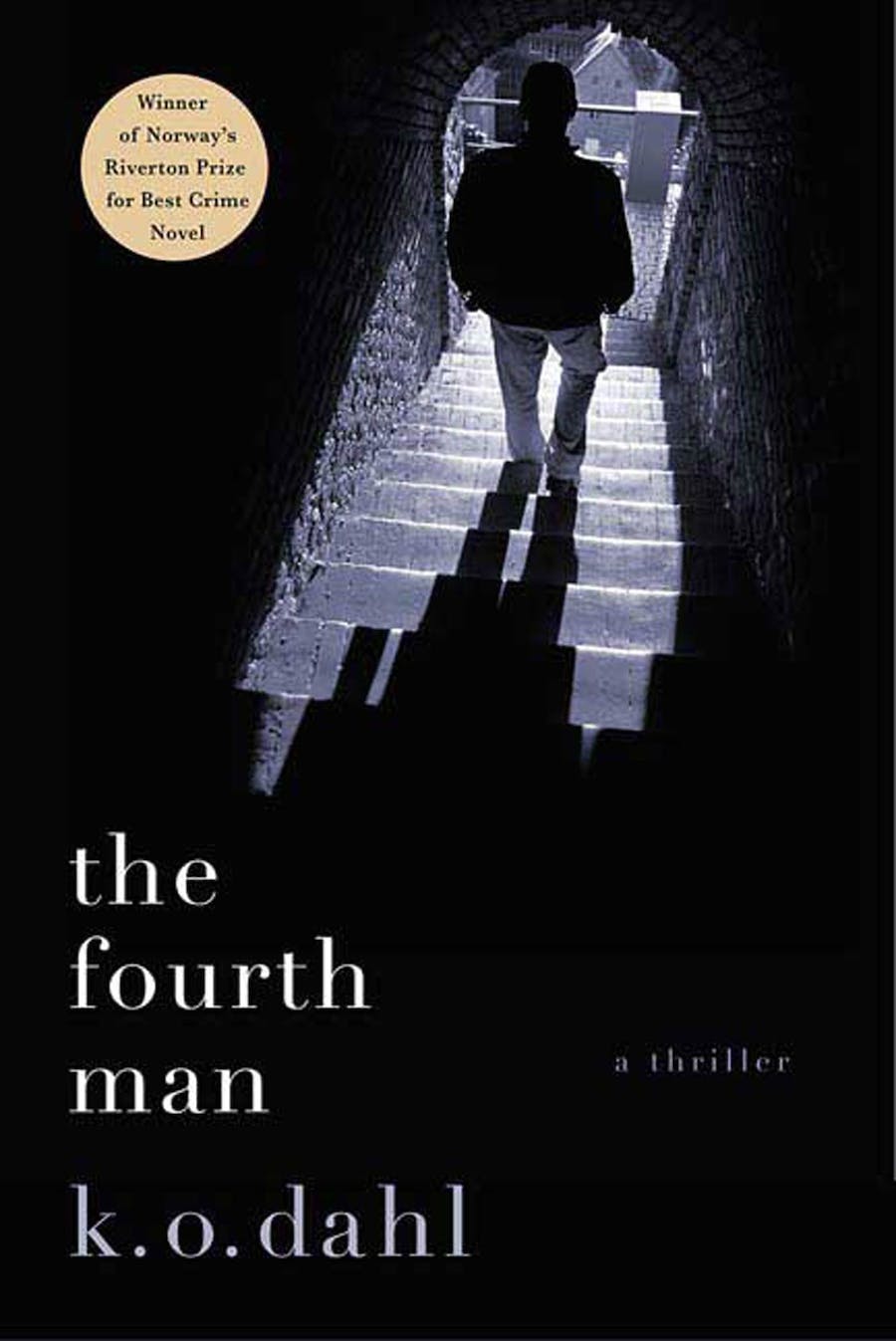
The Fourth Man (2005) by the Norwegian writer K.O. Dahl is a smart, dark, complex, and ultimately very satisfying crime novel. We meet Detective Inspector Frank Frølich of the Oslo Police in the third sentence, as an unexpected woman inadvertently endangers both his police stakeout and her own life. As bullets begin to fly, Frølich lays on top of her. The inspector and the dark-haired beauty with mysterious eyes and a unique tattoo meet by chance a few weeks later and their affair begins. It is only after Frølich is hopelessly in love that he learns that Elisabeth Faremo is the sister of a hardened and wanted member of a local crime gang. Through a fast-paced and compelling story, Dahl has Frølich explore the seamier sides of Norwegian life and his very conflicting emotions about Elisabeth. His gruff, firm, yet sympathetic colleague — with his own challenges in love — helps do the tough police work that gets us to the unexpected ending that is as complex and satisfying as the rest of the book.
Rethink: The Surprising History of New Ideas (2016) by Steven Poole is an insightful work around the story of how many of our new and seemingly innovative ideas are actually based on old ideas that were mocked or ignored for decades if not centuries. Justice Oliver Wendell Holmes said, “Many ideas grow better when transplanted into another mind than in the one where they sprang up.” All those electric vehicles you see on the road today, for instance, are based on technology that came from the first electric car . . . which was built in 1837.
What’s on the nightstand for July (subject to change at the whims of the reader):
Historic preservation has, from its very beginnings, been tailored to serve present-day purposes and shape how the future views the past. As histories of the movement show, the selection of what we save changes as we come to understand the importance of less celebrated histories, the contributions of marginalized communities, and the value of wider perspectives.
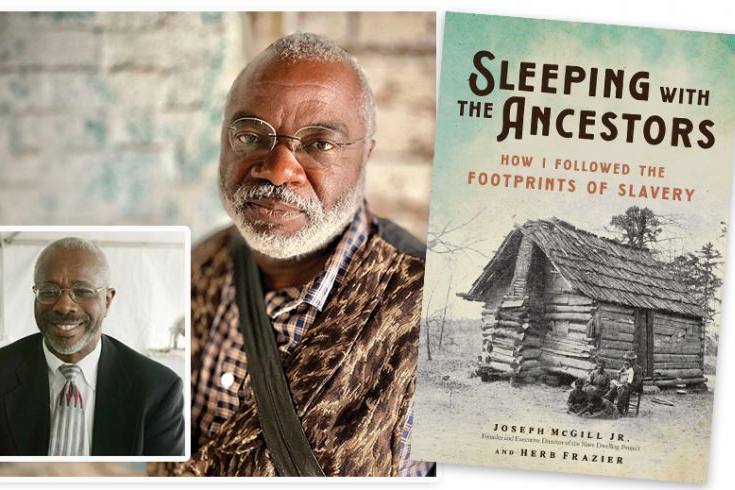
Sleeping With the Ancestors: How I Followed the Footprints of Slavery (2023) by Joseph McGill, Jr. and Herb Frazier is a compelling work about a crusading effort to draw attention to the preservation of dwellings where enslaved people lived, worked, and raised their families. A former colleague of mine at the National Trust who founded and leads The Slave Dwelling Project, Joe and his co-author Herb Frazier have compiled a captivating account of his years working to “change the narrative, one slave dwelling at a time.” In it, the authors recount the broadening of a modest regional effort into a national force. Joe graciously agreed to chat with me about the book and his work.
DJB: Joe, were there particular places that led you to begin sleeping in slave dwellings and that helped shape the project?
JM: Several factors came together in making this decision. While in college I accepted a summer job as a park ranger at Fort Sumter National Monument. In undertaking research on the Civil War, I came across flaws in the history that I was taught: the indigenous people were not the enemy, enslaved people were not happy with their lot in life, and the people enslaving them were not benevolent.
As a park ranger, I would interact with Confederate Civil War reenactors whose knowledge was of the Lost Cause variety. My ongoing research and the 1989 movie Glory inspired me to become a reenactor of the 54th Massachusetts Volunteer Infantry to honor the 200,000 Black men who served for the Union during the Civil War. Participating in reenactments where we camped overnight provided me with access to historic sites after hours. That was another step in the process.
Later I became director of history and culture at the Historic Landmark District of Penn Center on St. Helena Island, South Carolina, where the buildings pertained to the history of African Americans. As a program officer for the National Trust, I became even more attuned to the knowledge of preserving buildings while working to convince the public that slave dwellings matter.
My epiphany for loving historic spaces predates my professional career. While in the Air Force I visited the home in Amsterdam where Anne Frank hid from the Germans during World War II. The physical space made my limited knowledge of Anne Frank come alive, just as the physical space of the Lorraine Motel in Memphis, where Dr. Martin Luther King, Jr. was assassinated, brought tears and a desire for militancy.
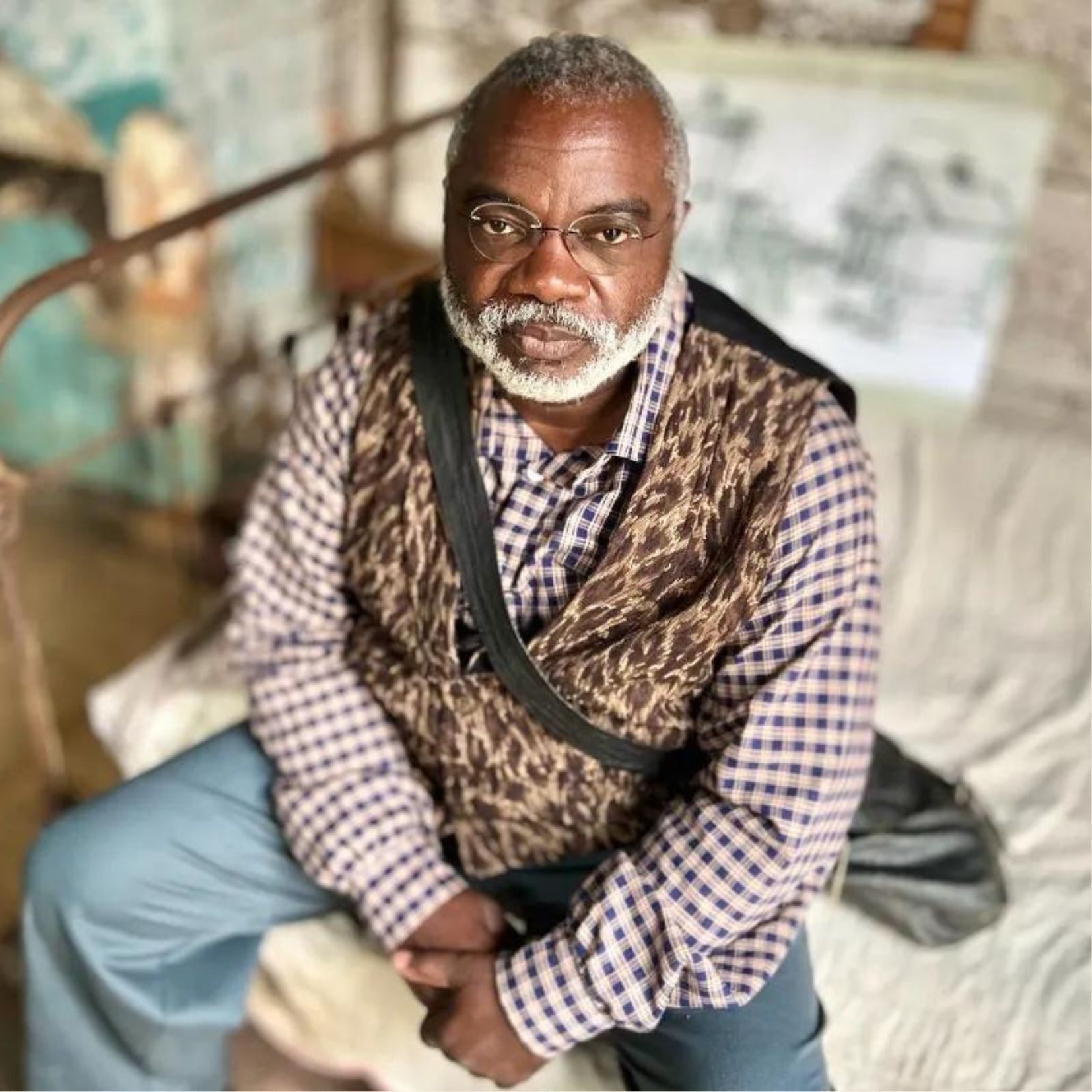
Joseph McGill, Jr., Founder and Executive Director of The Slave Dwelling Project
Where were some of the most surprising places you found that housed slaves?
In my history books and Hollywood, the happy enslaved people and their benevolent enslavers lived on plantations. Slave cabins are on plantations, so I initially called my work The Slave Cabin Project. But on a sleepover at Old Alabama Town I immersed myself in what urban slavery was like. Most importantly, I stayed in a two story, four compartment, brick building. This was certainly not a slave cabin.
What was clear from the project’s onset was that the word slave was essential for the name of the project but changing “cabin” to “dwelling” made the project more inclusive.
What was most devasting to learn was that slavery was not just a southern thing. After the American Revolution, northern states abolished slavery legislatively yet they remained complicit because the banks, insurance companies, slave ships, and factories adding value to cotton were all north of the Mason Dixon line.
My first northern sleepover in a slave dwelling was Cliveden in Philadelphia, Pennsylvania. At Fort Snelling in St Paul, Minnesota, I slept in the place where Dred Scott slept. It is those places where I’ve stayed in states like Wisconsin, New York, New Jersey, Delaware, Massachusetts and Rhode Island that are most rewarding to me.
What places have been resistant to the idea of a sleepover, and why?
Several institutions of higher learning owe their existence to the institution of slavery. Sweet Briar College in Sweet Briar, Virginia, was my first sleepover on a college campus, and I’ve had many since. While Clemson University and the University of Virginia are on the list of the places stayed, some obvious ones missing from the list are two in South Carolina — the University of South Carolina and Francis Marion University — as well as The University of Alabama.
It took me five years to get a sleepover at Mt. Vernon, as it was not their intent to interpret George Washington as one of 12 slave-owning presidents. Natchez, Mississippi, was also a very tough nut to crack because of its love for celebrating hoop skirts and mint juleps at their annual pilgrimage. The local garden club has control of how history is interpreted in Natchez.
Many sites do not want to engage for fear of reparations. Despite that fact there are great examples of places that are working diligently with the descendant communities including James Madison’s Montpelier in Virginia; Middleton Plantation and Historic Brattonsville in South Carolina; and Sommerset Plantation and Stagville in North Carolina.
How has the Slave Dwelling Project changed the way historic sites, museums, and preservation organizations present the narrative around slavery?
Ten-to-twenty years ago, one would be hard pressed to encounter a historic site that interpreted slavery in a researched and respectful manner. Now historic sites are ridiculed if they don’t include the narratives of the people once enslaved at their sites. In my thirteen years of leading the Slave Dwelling Project, I’ve witnessed and influenced the changing of the narrative.
Some sites that said no to my request initially have since allowed me to conduct sleepovers, once I had established a track record. Sites are now calling me, and more are engaging with their descendant communities. The words “enslaved” and “enslaver” are now permanently embedded in the lexicon. We are working on using the term “freedom seeker” instead of “run away.” Some encourage using the term “forced labor camp” instead of “plantation,” but I’m not there yet.
By that same token, some are still afraid of the word plantation. That is why one can visit Monticello, Montpelier, the Hermitage, Mount Vernon, Drayton Hall, Middleton Place all in an effort to minimize what those places really are. They are all plantations.
Joe, what books and authors influenced your work that you would recommend for readers who want to know more?
Slaves in the Family where Edward Ball researched and published the findings on his slave owning ancestors is also a good read.
They are hard reads, but the Slave Narratives are necessary for anyone doing serious research about slavery in the United States. One must be careful in using them because most of the interviewers were white and this was during a period in history when Blacks were more intimidated. Despite that reality, Slave Narratives is still a good resource for researching chattel slavery.
Seth Godin is a teacher and bestselling author who blogs on marketing, tribes and respect. Unlike those you’ll find here on More to Come, Godin’s posts are short. Very short. And to the point.
Our job as professionals is to show up and do the work. Not simply respond to incoming or do the chores, but to create and innovate.
And yet, some days feel more conducive than others. There are moments when it simply flows.
When the surf’s up, cancel everything else. Don’t waste it.
Postpone the dentist, outsource the grocery shopping and leave your email for now.
Make hay.
Indeed!
More to come…
DJB
NOTE: Because the sun is shining this month (you’ll see more in the coming days) I’m going to make some hay while I set aside the Saturday Soundtrack posts during July. That feature will return in August.
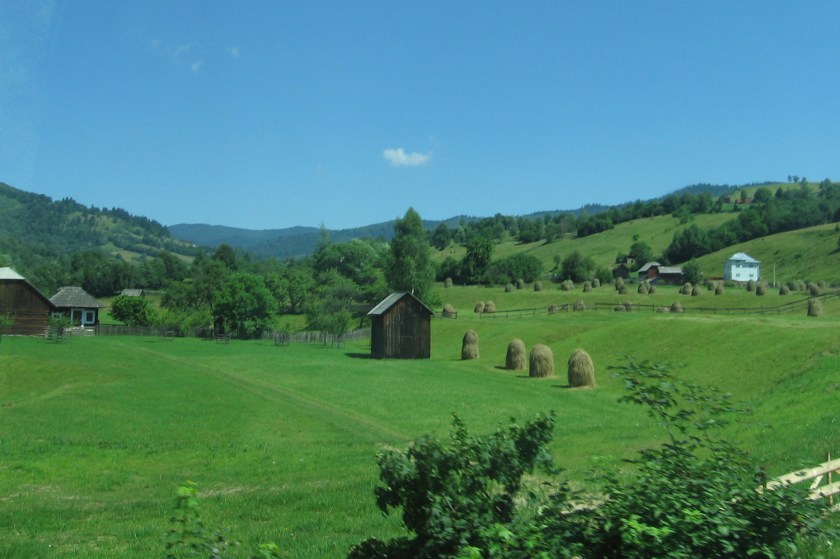
Photo of hay bales in Romania in July 2006 from a National Trust Tour of the Black Sea (credit: DJB)
The Chief Justice is clearly worried about the Supreme Court’s legacy.
In last week’s majority 6-3 opinion that declared the administration’s student loan forgiveness program unconstitutional, Chief Justice John Roberts urged those who disagreed with the decision not to disparage the Court because “such misperception would be harmful to this institution and our country.”
I’m afraid that horse is already out of the barn.
As multiple observers noted, Roberts and his five conservative colleagues decided in two recent cases that fake plaintiffs are good plaintiffs, substituting their beliefs for the law. That blame lies with the Court. Respected political scientist Norman Ornstein made it clear that the conservatives “have unilaterally blown up the legitimacy of the Court.”
America can accept this Supreme Court as legitimate and its rulings as the final word — or it can have true democracy and a functioning state. But not both.
Today’s extremist Supreme Court is no surprise. It is a decades-long project of corrupt sponsors that is right on schedule.
Supreme Inequality: The Supreme Court’s Fifty-Year Battle for a More Unjust America (2020) by Adam Cohen is a devastating and damning argument against today’s Supreme Court and the Republican party’s fifty-year plan to circumvent the Constitution, overturn the gains of the New Deal and Civil Rights eras, and cement inequality into American law and life. Cohen surveys Supreme Court rulings on a variety of topics from poverty, education, and campaign finance to labor, corporations, criminal justice, and democracy itself to expose how little the Court does to protect the rights of the poor and disadvantaged. In fact, since the Nixon era “the Court has, with striking regularity, sided with the rich and powerful against the poor and weak, in virtually every area of the law.”
Cohen shows how President Johnson and the liberal lions of the Court under Chief Justice Earl Warren — a group that was an outlier in the nation’s long history — made a number of tactical mistakes concerning retirement and appointments. That allowed a go-for-the jugular Richard Nixon — with support of complicit Republicans * — to ruthlessly push a justice with lifetime tenure out the door and make four strongly conservative appointments to the high court. He was stopped only when forced to resign in disgrace. Similarly, Senate Majority Leader Mitch McConnell and the Republicans built the current 6-3 constellation as the result “of several questionable – to use a wonderfully euphemistic term — actions” to quote Zimmer again, so that the corrupt, twice impeached, twice indicted Donald Trump could make three appointments that have sealed the Court’s supermajority before he was voted out of office and his coup attempt failed.
Cohen carefully reviews the decisions that case-by-case have undermined America’s rule of law, handing control over to an extremist minority. Even conservatives like Reagan administration Solicitor General Charles Fried are appalled.
[I]t has undermined or overturned precedents that embodied long-standing and difficult compromise settlements of sharply opposed interests and principals. These decisions are not the work of a conservative Court.
The Court’s tilt towards extremism only got worse since the book’s publication. A group of decisions this June made a mockery of settled law, precedent, standing, and the balance-of-power to hand extreme ideologues wins in striking down affirmative action, limiting the rights of LGBTQ+ citizens, allowing minority lawmakers to choose their voters, and curtailing the powers of Congress and the president while introducing power for the Court that is not in the Constitution.
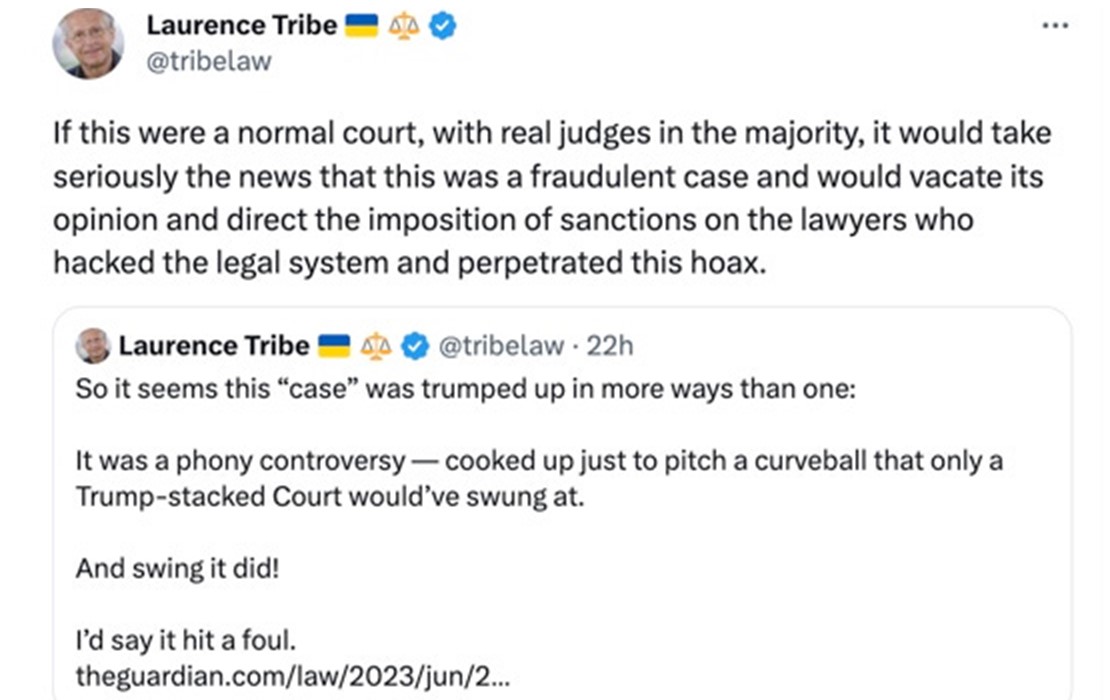
In the Colorado case where the decision discriminates against LGBTQ+ individuals, reporting came out just before the ruling which indicates that the facts of the case were not — how shall we say this — facts. The gay man named Stewart who the plaintiff said contacted her business about a website for a gay marriage turned out to be happily married to a woman for 15 years, had never contacted the website designer, and had no idea he was named by the plaintiff in the suit. Esteemed constitutional scholar Laurence Tribe suggested what should have happened next.
Coupled with last year’s decisions to take away rights from women in the Dobbs decision, put a stranglehold on states’ and cities’ efforts to keep guns off the streets, and further tighten religion’s grip on civil society — not to mention Pro Publica’srecently reported corruption of sitting justices by rich benefactors with business before the Court — we see a stunning set of moves that may finally wake Americans to the devastating harm perpetrated by Roberts and his two most recent predecessors, Warren Burger and William Rehnquist, along with their conservative colleagues.
What happened at the court [long-time Court watcher Linda Greenhouse reiterated] was a power grab of a different sort, driving the law far to the right in service of an agenda that most Americans don’t share.
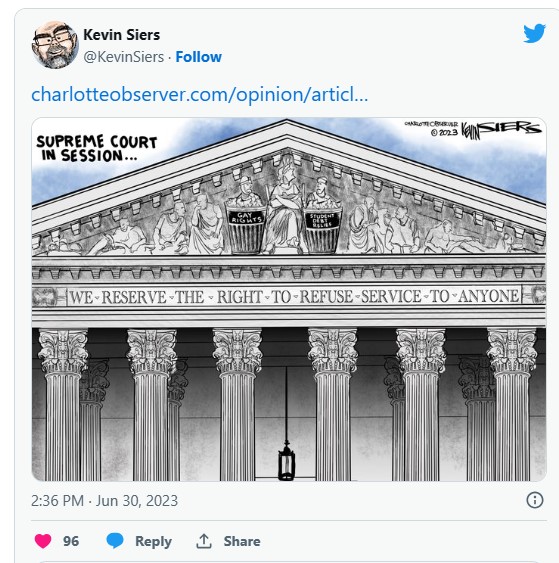
Cohen reported that a mean-spiritedness towards the poor began to appear with the rulings of the Nixon judges. Legal commentators have noted that same callow spirit now permeates the Roberts Court. It goes hand-in-hand with the arrogant and blatant corruption by justices that refuse to allow any ethics rules to grace their hallowed halls, making them a target-rich environment for the nation’s editorial cartoonists.
The three liberal justices on the current Court — all women — are following the path of Justice Thurgood Marshall in writing stinging dissents that point out this head-in-the-sand perspective.
Justice Sonia Sotomayor wrote in dissent to the Colorado LGBTQ+ case that the First Amendment right to free speech has never before been used to issue a license to discriminate.
Justice Ketanji Brown Jackson turned back a personal attack from Clarence Thomas by writing that “Justice Thomas’s prolonged attack…responds to a dissent I did not write in order to assail an admissions program that is not the one UNC has crafted.” Then she put the whole mess in clear terms that everyone can understand.
With let-them-eat-cake obliviousness, today, the majority pulls the ripcord and announces ‘colorblindness for all’ by legal fiat. But deeming race irrelevant in law does not make it so in life.
Justice Elena Kagan may have put it most succinctly in her dissent to Biden.
“…the Court, by deciding this case, exercises authority it does not have. It violates the Constitution.”
The entire enterprise under the leadership of John Roberts is violating major parts of the Constitution.
America just celebrated its independence as a nation where “all men are created equal.” Heather Cox Richardson reminds us that “just as in the 1850s, we are now, once again, facing a rebellion against our founding principle, as a few people seek to reshape America into a nation in which certain people are better than others.”
The men who signed the Declaration of Independence on July 4, 1776, pledged their “Lives, [their] Fortunes and [their] sacred Honor” to defend the idea of human equality. Ever since then, Americans have sacrificed their own fortunes, honor, and even their lives, for that principle. Lincoln reminded Civil War Americans of those sacrifices when he urged the people of his era to “take increased devotion to that cause for which they gave the last full measure of devotion — that we here highly resolve that these dead shall not have died in vain — that this nation, under God, shall have a new birth of freedom—and that government of the people, by the people, for the people, shall not perish from the earth.”
Keeping a democracy is a constant fight. We have to fight and vote again and again like our lives depend upon it. Because they do.
More to come…
DJB
UPDATE: Not to pile on (well, yes, I am piling on) two more respected observers have written about the legitimacy of the Supreme Court, and I wanted to capture their thoughts for future readers. First, respected fighter for democracy Marc Elias wrote for Democracy Docket that John Robert’s Last Word is Not the Final Say in which he points out that Robert’s has been known to disparage his colleagues in dissents when it suits his purpose. And Rebecca Solnit, writing for The Guardian has a call to arms entitled The US supreme court has dismantled our rights but we still believe in them. Now we must fight which — like most Solnit work — is a must-read.
*FBI Director Hoover wiretapped Justice William O. Douglas‘s telephone while House Minority Leader Gerald Ford tried to start impeachment proceedings against Douglas. Ford’s home-state paper said it would take his claims more seriously if it “had greater faith in his objectivity.”
The Weekly Reader links to written works I’ve enjoyed. I hope you find something that makes you laugh, think, or cry.
Earlier today we celebrated the diversity, inclusion, and just plain weirdness of the 2023 Takoma Park July 4th parade. We were there because, as historian Heather Cox Richardson reminds us, it was on July 4th, 1776, that . . .
[T]he Second Continental Congress adopted the Declaration of Independence, declaring: “We hold these truths to be self-evident, that all men are created equal, that they are endowed by their Creator with certain unalienable rights, that among these are Life, Liberty and the Pursuit of Happiness.”
For all the fact that the congressmen got around the sticky little problem of Black and Indigenous slavery by defining “men” as “white men,” and for all that it never crossed their minds that women might also have rights, the Declaration of Independence was an astonishingly radical document. In a world that had been dominated by a small class of rich men for so long that most people simply accepted that they should be forever tied to their status at birth, a group of upstart legislators on the edges of a continent declared that no man was born better than any other.
America was founded on the radical idea that all men are created equal.
Residents of small-town Takoma Park in the DC Metro area await the start of one of the best July 4th parades in the region.
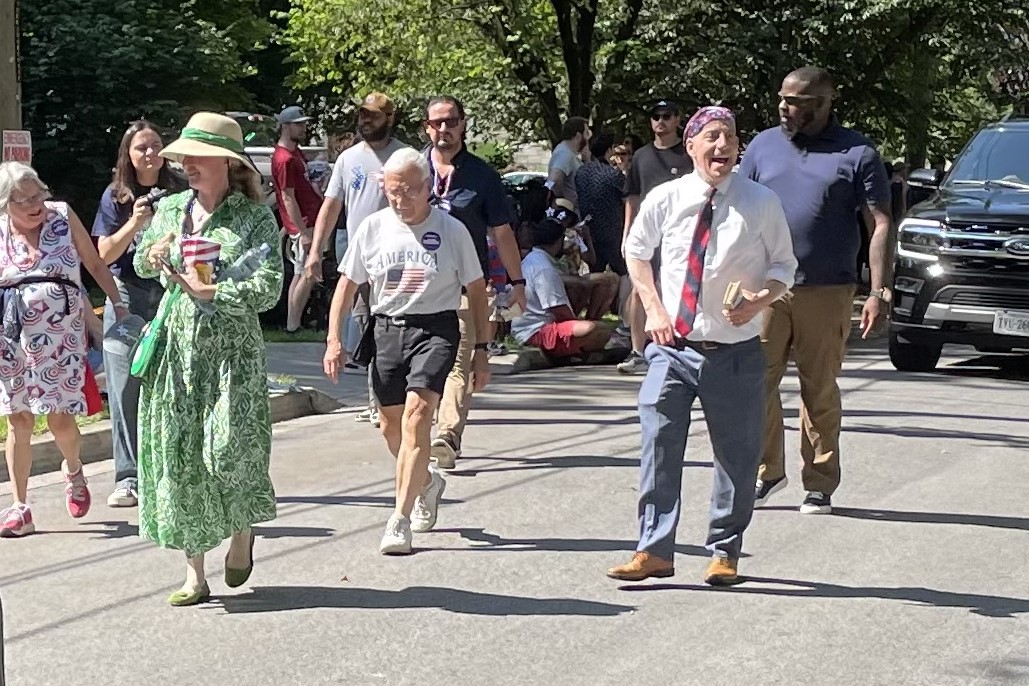
One of the great present-day defenders of that founding principle, the courageous and highly effective Jamie Raskin, served as the Grand Marshal for his hometown parade. Sporting one of his stylish Stevie Van Zandt bandanas as he continues his recovery from treatment for diffuse large B-cell lymphoma, Raskin could not be bound by the car provided for his use, once again walking the route and working the crowd like the pro he is.
Grand Marshal, Congressman Jamie Raskin (right front) sporting his great-looking bandana from musician Stevie Van Zandt
Along with seeing Congressman Raskin, we got to hear musicians of all stripes salute America with Caribbean pan drumming, old 60s rockers, patriotic hymns, and tunes from Scottish bagpipes.
The panquility steel drum band is always one of my parade favorites
The band on the aptly named Party Barge
Bringing our Scottish heritage to Takoma Park
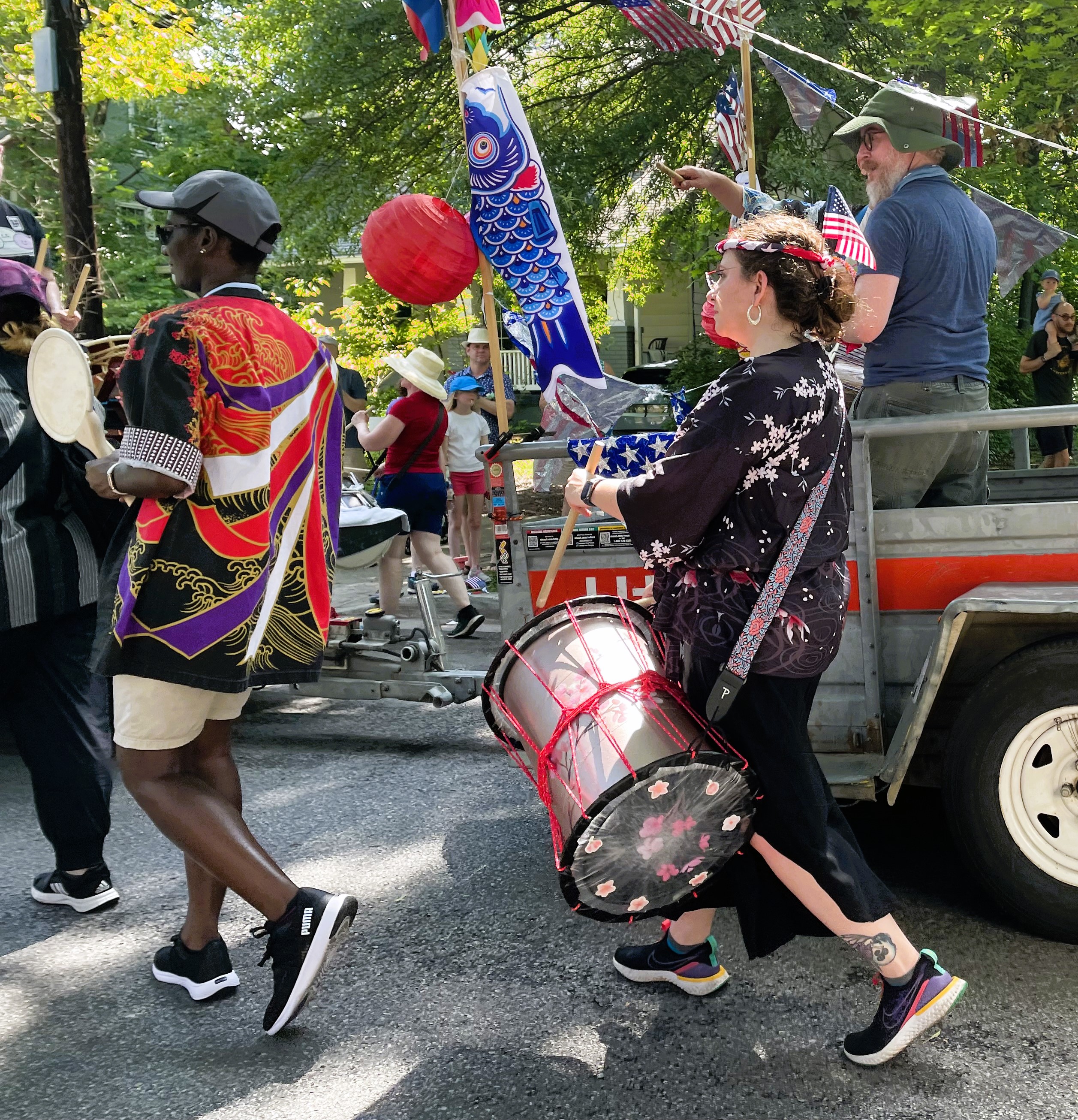
It was the Mark H. Taiko School — bringing a Japanese musical tradition to Maryland — that won first prize in the parade’s performing arts category.
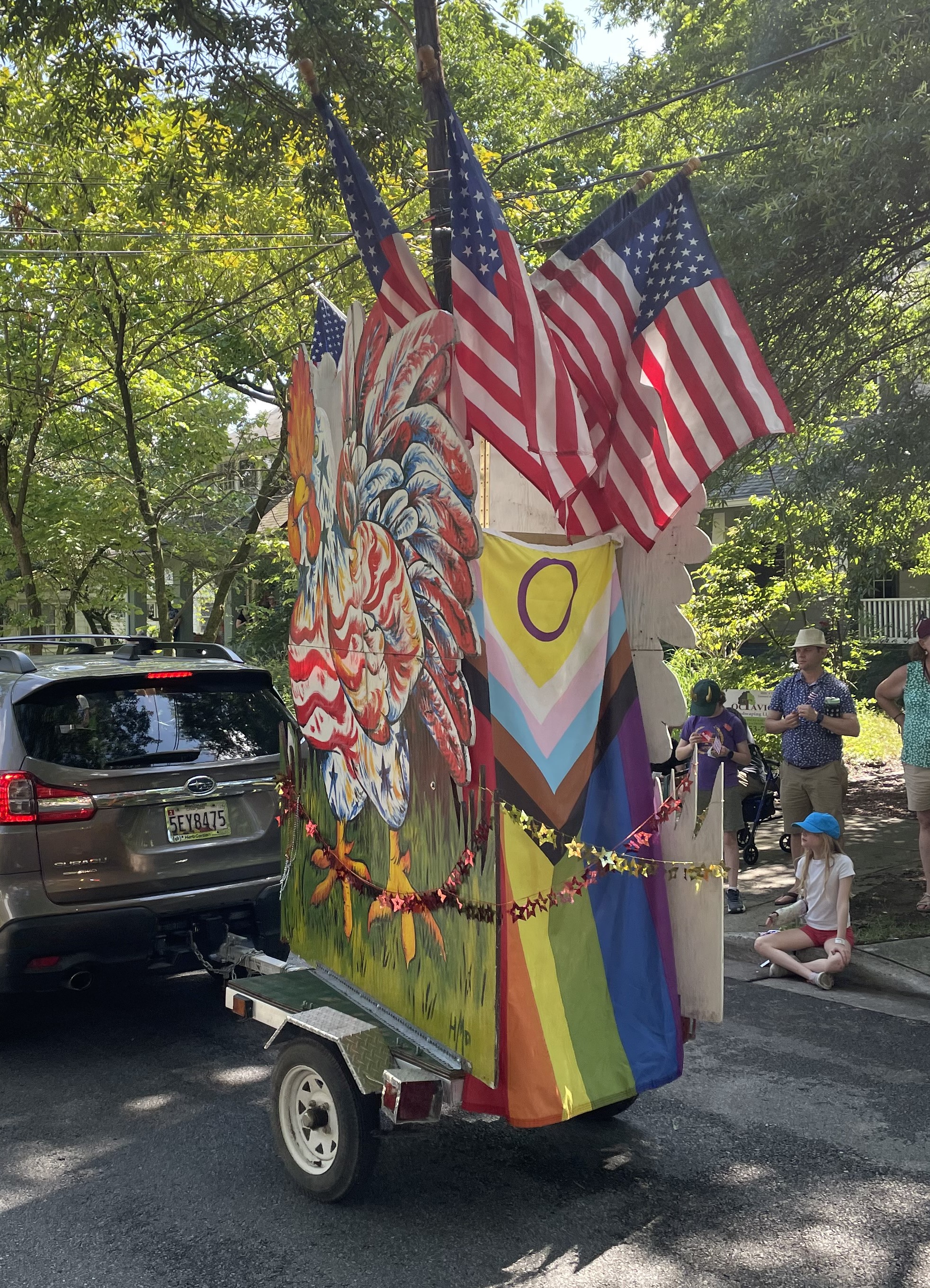
This year’s parade featured dancers, strange automobiles, beauty queens, other types of queens, the always-popular Revelers, and . . . the local chapter of midwives!
A Reveler joins the fun
Call the midwives!
But it was the Happy Campers who took away one of the top two Wacky Tacky Takoma Awards.
The City of Takoma Park is always eager to salute and thank their public works department and workers. Once again, the guy driving the mower had waaaay too much fun making circles along the parade route.
When you put it all together — even the inclusion of the supporters of the anti-vaxxer, conspiracy theorist, and all-round nut RFK, Jr. because in this parade they give just about everyone a platform — this is the messiness that is democracy. And it is wonderful and worth fighting for.
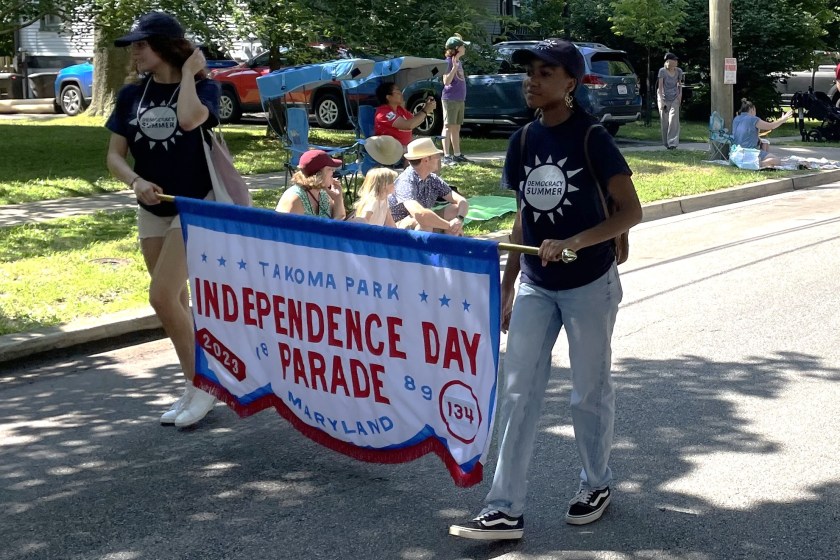
The Democracy Summer Fellows
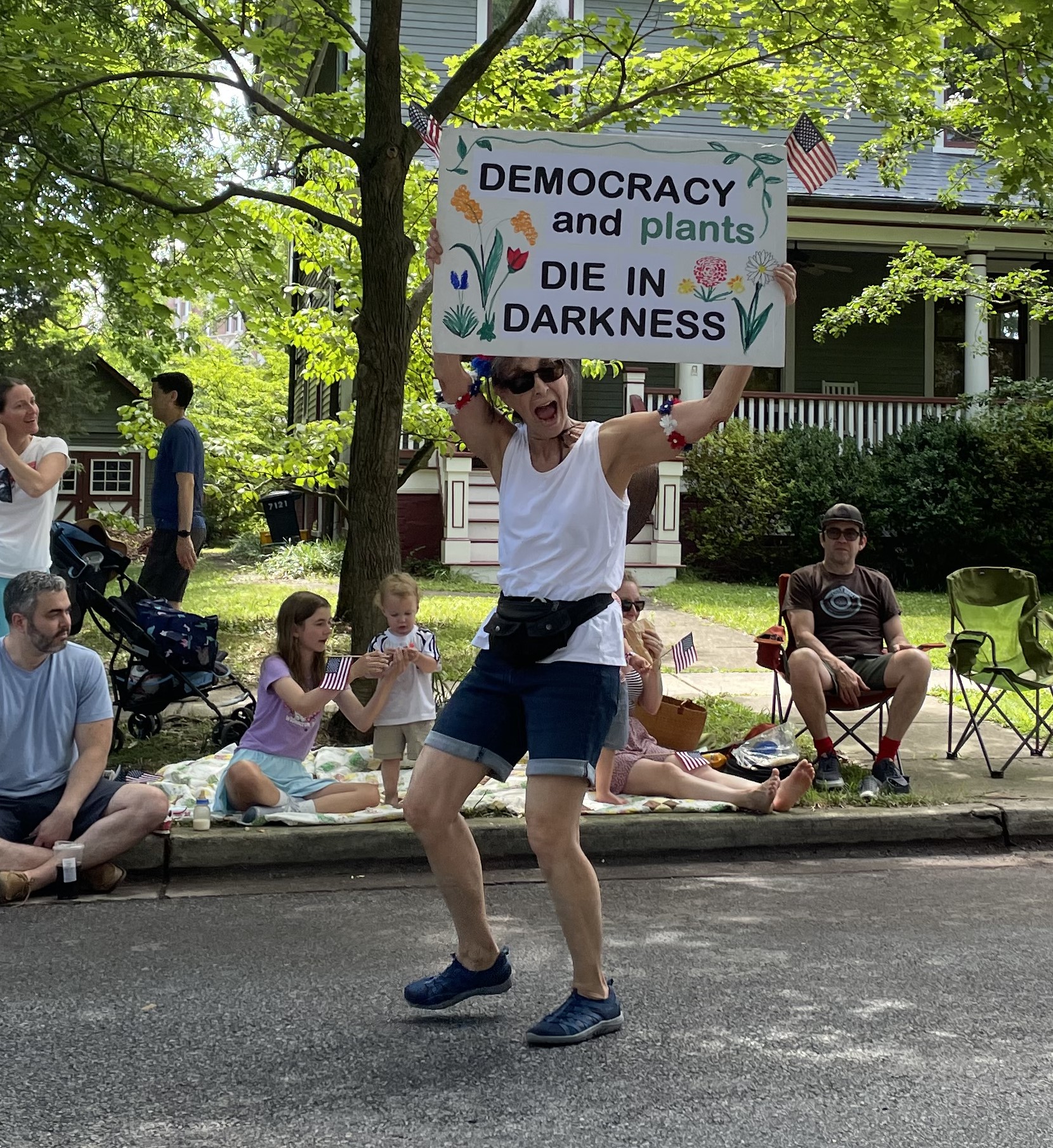
A member of the Takoma Horticulture Club — winners of the “Parade Theme” award — show why they won with this timely message
The day before we celebrate America’s independence is a useful time to remember that as a country we have many birthdays. Imani Perry notes that even though we broke away from Great Britain, teachers and historians in the U.S. have inherited a British inclination to tell history in a linear, forward sequence. But that won’t work, she notes, for the story of the nation.
There are so many birth dates: 1492, 1520, 1619, 1776, 1804, 1865, 1954, 1964, 1965. After centuries, we are children of the colonized, colonizers, enslaved, marginal, poor, wealthy, exploitative, White, Black, shades of brown, citizens, and fugitives running from the law. People with jobs but no papers, people with papers but no door or mattress.
It is impossible to tell our story in a linear fashion.
As I prepare to leave for a trip to Alaska — a part of our country that could add a birth date to that list that is more than 11,000 years old — I wanted to make sure I was hearing Indigenous perspectives among those voices telling our history.
The Alaska Native Reader: History, Culture, Politics (2009) edited by Maria Sháa Tláa Williams is a good place to seek understanding of the Indigenous perspective in our 49th state. Home to more than 200 federally recognized tribes, the voices and history of these Native Alaskans are nonetheless often overlooked or silenced. Too often Alaska’s history is told through the stories of “Russian fur hunters and American gold miners, of salmon canneries and oil pipelines.” However, Native Alaskans have been here much longer and have stories, histories, landscapes, ways-of-living, and cultural perspectives worth knowing and preserving.
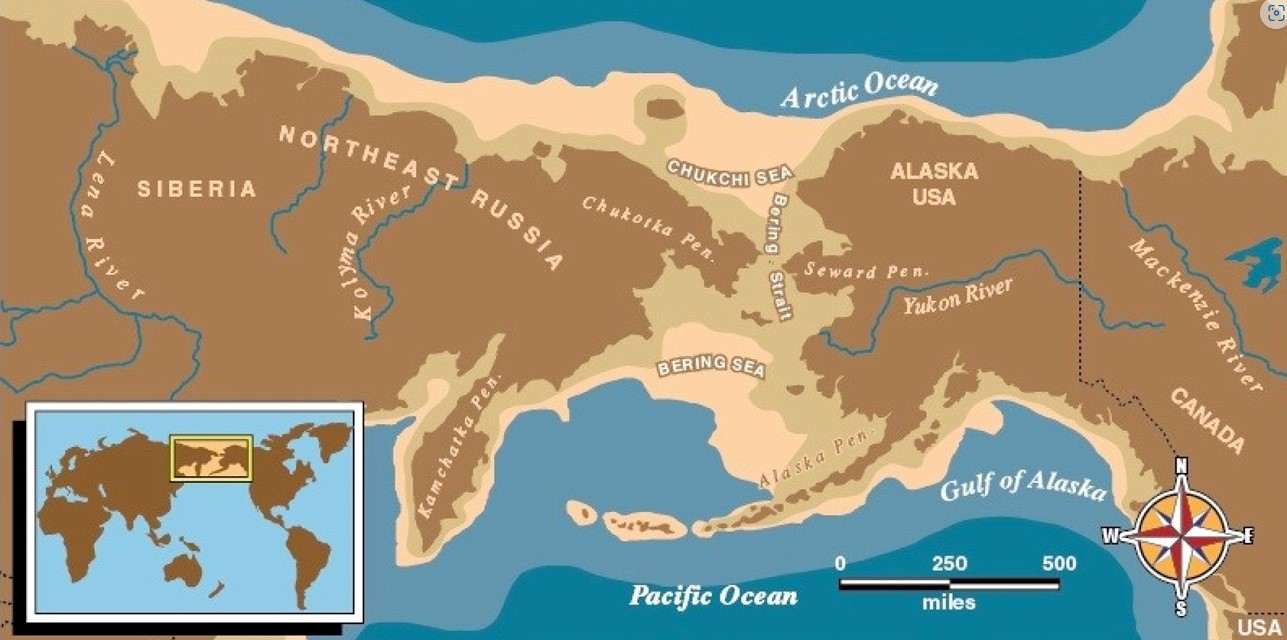
As seen at the National Historic Landmark Dry Creek, the claim of the Indigenous peoples in Alaska is much older than Russians or European Americans. When archaeologists first discovered the Dry Creek site in the early 1970s, its 11,000-year-old archaeological artifacts were the first pieces of evidence to confirm that people migrated across the Bering Land Bridge and hunted Pleistocene megafauna in Alaska.
Bering Land Bridge (Credit: National Park Service)
The site validates a long-standing cultural connection between Asia and Alaska, and informs us on the earliest trade, communication, and migrations between Alaska and the rest of the Americas. The Dry Creek site is significant to our understanding of the earliest Americans and our ties to Asia.
Williams notes that she uses the term “perspective” purposefully in speaking of the voice she provides Indigenous peoples. “Perspective is how something is portrayed from a particular point of view; in this case, it is an indigenous point of view.” The perspectives she has included are often “counter” stories or histories that “relay new ideas and concepts that have not been included in most history books on Alaska.”
Early in the work, she deftly displays this use of perspective with two stories about the Russian “discovery” of Alaska in the middle of the eighteenth century: one from the Russian perspective and the other from the point of view of the Native Alaskans who were being “discovered.” She also gives voice to the Dena’ina peoples, on whose land about 80 percent of the Alaskan population now reside. This alternative history of Anchorage, Alaska’s largest city, points to how the long and continuing Dena’ina presence is often obscured. The Dena’ina historian Alberta Stephan wrote, “It is important to the Athabascan Indian people that their history of a well organized life style be known by everyone.”
Ted Mayac, Sr. has a short but telling piece on How It Feels to Have Your History Stolen as he writes about the oratorio King Island Christmas. Yup’ik writer Harold Napoleon shares a heartrending description of the long shadow of The Great Death — the 1900 flu outbreak. It was a time-marker for the Yup’ik people and it was caused by a disease from non-Natives.
Cultural worldviews in Indigenous communities evolve over thousands and thousands of years and time is important in that development. Williams includes a work by Professor Greg Cajete of the Santa Clara Pueblo about the relationship of the Alaskan Native societies and the stars, how they are linked to origin stories, and their placement in the larger cosmos.
And Cajete explains that the reading of the land, sky, and waters over thousands of years has helped Yup’ik hunters and their families survive in some of the harshest environments on earth. They do so through a deep observational understanding of the relationship between the movements of the sun in a directional circuit of time and the space of the Arctic tundra landscape and the night time movement of the Big Dipper through the year. They use this knowledge to know — even during a winter night — what “time” it is and the direction of the home base on an almost featureless landscape.
Alaska Natives use a relational understanding which combines sky knowledge with knowledge of weather, land, and ocean. This relational understanding is embedded in mythical as well as real stories handed down through the oral tradition. In this way, stories of celestial cycles formed the basis for real integration of traditional environmental knowledge with mythical and historical traditions of Alaska Natives.
As Williams notes, too often what we read about Indigenous peoples in Alaska comes from non-Native voices, “and although there are some impressive contributions in this arena, by definition they lack the ideas, voice, or perspective of the indigenous experience.”
The selections in this fascinating work “shed light on who Alaska Native people are, what their history has been, and the impacts of colonialism, in part by including a new cadre of indigenous leadership that has emerged in the twenty-first century.” Worldviews from the Indigenous perspective “provide new models for viewing knowledge and the indigenous perspective on math, science, astronomy, and the cosmos.”
We are all the richer for hearing these voices and seeking to understand their perspective.
When I walked to the front gate of Nationals Park earlier this month only to find that the game had been postponed due to the hazardous air conditions from Canadian wildfires, the impact of all the terrible things we’re doing to our planet once again became very real. Silver Spring’s own Rachel Carson, perhaps the finest nature writer of the twentieth century, told us that humans could not obtain complete mastery over nature but should approach great and elemental things with mindfulness and awe.
She made that point in The Sense of Wonder which grew out of summertime visits to the Maine coast with her young nephew. My review of this little gem of a book — Becoming receptive to what lies all around us— was the top reader choice on MORE TO COME… for this month.
June is also the anniversary of one of the most important dates in history. D-Day and the ongoing fight against government by the few and for the few— the other top reader choice — was a timely reminder that we once fought and defeated fascism on the beaches of Normandy. In a pamphlet distributed to troops during WWII, those men and women fighting against bigotry, racism, and hatred learned that “the fundamental principle of democracy — faith in the common sense of the common people — was the direct opposite of the fascist principle of rule by the elite few.” That’s why the fascists fought so hard against democracy. It is why we have to fight so hard today against those who would overturn our rule of law and government by the people.
Let’s see what else made it to MTC this month.
BOOKS ARE EDUCATIONAL
Groucho Marx once said, “I find television very educating. Every time somebody turns on the set, I go into the other room and read a book.” Sometimes when asked how I read at least five books each month, I’ll reply that I don’t watch much television. In addition to the Carson book noted above, I reviewed these works in June:
When fear and resentment take poweris my look at Timothy Egan’s newest work Fever in the Heartland about the rise of the Ku Klux Klan in the 1920s. Understanding the full scope of our past helps us combat those who are spewing hatred and banning books today.
Amy-Jill Levine is a self-described “unorthodox member of an Orthodox synagogue and a Yankee Jewish feminist who until 2021 taught New Testament in a Christian divinity school in the buckle of the Bible Belt.” In Acknowledging the difficulties, I discuss her book The Difficult Words of Jesus: A Beginner’s Guide to His Most Perplexing Teachings.
Family, myth, and identityis my look at Thinning Blood, the recent memoir of Leah Myers, a young Native American who makes a powerful push against the feeling of extinction in this fierce piece of personal history.
The latest crime novel in my year of reading dangerously is The Fourth Man by the Norwegian writer K.O. Dahl, which I review in The dark underworld of the soul.
I also returned to Rethink by Steven Poole this month, as it helped me consider The tyranny of binary choicethat we’ve succumbed to in recent years.
During June, I wrote about a rock ‘n roll legend, a Harvard-educated banjo innovator, a folk pianist, and a songstress and writer with pure country sensibilities. Go figure.
Stranger in a strange land led a couple of Leon Russell fans among my readers to self-identify. In his long career, Leon played with everyone ― a “preposterously impressive roll call.”
On Banjo with Alison Brownlooks at the latest by the best banjo player (and independent record label co-founder) to ever grace the halls of that Ivy League institution in Cambridge.
My appreciation for the late folk pianist who passed away on June 4th can be found at George Winston, R.I.P.
Hail to the Redswas my quick homage to the Cincinnati Reds, the team currently having the most fun in baseball. They promptly dropped two games to the Braves but did take a series from the Orioles.
The Browns celebrated Father’s Day late this year, but I recognized the holiday with Father’s Day, baseball, and dad jokes. Yes, I got a few groans from the family.
Continue to celebrate the good news!is this month’s reminder that things we want to go up (jobs) are rising while things we want to go down (inflation and murder rates) are falling. But since you won’t read about it in the New York Times someone has to fill the void.
Thanks, as always, for reading. As you travel life’s highways be open to love, undertake some mindful walking every day, recognize the incredible privilege that most of us have and think about how to put that privilege to use for good. Women, people of color, LGBTQ+ individuals, immigrants, and others can feel especially vulnerable…because they are. Work hard for justice and democracy because the fight never ends.
Bash into some joy along the way.
And finally, try to be nice. Always be kind.
More to come…
DJB
You can follow More to Come by going to the small “Follow” box that is on the right hand column of the site (on the desktop version) or at the bottom right on your mobile device. It is great to hear from readers, and if you like them feel free to share these posts on your own social media platforms.
It seems we are creating a “thumbs up or thumbs down” world. Tribes, which often drive this type of thinking, give the illusion of helping us know our standing in the chaos of modern life. But when everything is presented as an either/or decision, we often look at our choices and feel hopeless.
In his Garden of Forking Paths newsletter, Brian Klaas wrote on this tyranny of binary choice in an essay entitled The Lost Art of the Ideal and the Cycle of Futility. Klaas suggests that our daily despair and feelings of hopelessness result, in part, from the loss of expansive, creative, pie-in-the-sky thinking. To make his point, Klaas asks a simple question.
When did you last consider what utopia looks like?
I have been thinking about utopia in recent months but through much of my life I was pragmatic. Too pragmatic, I suspect. What’s possible in a narrow sense is often the first — and perhaps only — question I’d ask in any given situation. While often appropriate it can also become a crutch.
Millions, I fear, have decided that simply navigating what is given to us is easier than considering the type of lives and society we want. We become afflicted by the curse of knowingness as we see the challenges involved with moving toward our ideals.
By giving in to simply knowing that things are difficult and perhaps impossible, we succumb, in Klaas’s words, to the self-fulfilling delusion of powerlessness.
It strikes me that one way out of the curse of knowingness is to embrace life’s mystery and become more comfortable with uncertainty. At the very least we can banish the thought that everything is either/or and up-or-down. What if, by assuming that we are not all-wise in the ways the world works, we first consider the kind of ideal outcome we want and then ask ourselves what is needed to move toward that goal, given the constraints we face?
On Sunday, June 11, an 8,500-gallon tanker truck on an off-ramp in Philadelphia flipped onto its side and crashed into a wall at a curve. The crash ignited the gasoline in the tank; the driver died and a stretch of I-95 over which an average of 160,000 vehicles a day travel collapsed.
Most immediately began to think about the hardships resulting from the months or years needed for the highway to be repaired.
Yet setting aside the world’s assessment of how difficult it would be, Pennsylvania Governor Josh Shapiro immediately announced what in this situation was an ideal outcome: that six lanes of road, three in each direction, would reopen less than two weeks after the crash.
Imagine being in the meeting where the talk is focused on theideal of reopening the road in two weeks. That pie-in-the-sky scenario then leads the engineers to come up with an unpredictable and perhaps unprecedented solution. All of a sudden, everyone comes together and says, “let’s do this!”
Crews working around the clock “constructed a temporary road resting on a bed of aggregate made of recycled glass bottles. The fix will stay in place until a full reconstruction is complete. The governor had a camera set up to livestream the construction and has turned it into a source of pride.”
And they continued with innovative solutions to ensure that they would beat the deadline.
To rebuild I-95 on time, we need 12 hours of dry weather to complete the paving and striping process,” Pennsylvania’s Democratic governor Josh Shapiro tweeted. “With rain in the forecast, we reached out [to Pocono Raceway] for help — and they’re bringing their jet dryer to Philly to help dry this section of I-95 and keep us on schedule.”
President Joe Biden’s administration played a key role in funding and coordinating the federal response. The President announced after the highway reopened, “We are proving that when we work together, there is nothing we cannot do.”
Klaas suggests that binary choice it is like “following Google Maps without thinking about where you want to go . . . We drive forward, but always toward a flawed destination that nobody really wants.” In thinking this through, I returned to a book I read when it was first published.
Rethink: The Surprising History of New Ideas (2016) by Steven Poole is an insightful work that tells the story of how many of our new and seemingly innovative ideas are actually based on old ideas that were mocked or ignored for decades if not centuries. Pie-in-the-sky stuff, in other words. Justice Oliver Wendell Holmes said that “many ideas grow better when transplanted into another mind than in the one where they sprang up.” For instance, all those electric vehicles you see on the road these days are based on technology that came from the first electric car . . . which was built in 1837.
Poole writes there are many ways of thinking about ideas, but all depend on “maintaining the suspension of belief” — doing away with the “curse of knowingness.” This gives us time to look at an idea from other, potentially more fruitful angles.
Many innovative ideas come from rediscovering old ideas or reviving them in a different context. Want that road open in two weeks? Call on recycled glass that’s been around for decades along with jet dryers designed to keep racetracks safe and then use them in different ways.
Suspension of belief is living into a life of awe and wonder where we can move beyond the sense of powerlessness that comes from seeing everything as black-and-white. Nature and life are full of complexity and possibilities. Our world is not either/or. We live with many things at once.
We know in our bones that things are harder than they have to be. But let’s push back against the delusion of powerlessness and think expansively about the type of world we want instead of just bickering over the directions.
More to come…
DJB
The Weekly Reader links to written works I’ve enjoyed. I hope you find something that makes you laugh, think, or cry.
My love for the short and to-the-point adage comes from my grandmother. Known to favor sayings such as “Don’t believe what you hear and only half of what you read,” Grandmother Brown had a big influence on my life as well as my love for words.
Late in 2019, a series of pithy proverbs — those bursts of truth in 20 words or so — debuted on the blog. After six months they came together in a post entitled More to Consider.* Four years later I’m still at it. Let’s look at I love the pithy proverb — Volume 8 to see what made it to the More to Consider segment over the past six months.
Living with the unpredictability of life
I’ve been focused a great deal this year on living with the limitations and unpredictability that come our way every day. Several of the pithy proverbs speak to this idea/ideal, beginning with one from poet John O’Donohue, followed by a second from poet Mary Oliver.
I would love to live like a river flows, carried by the surprise of its own unfolding.
John O’Donohue
Pay attention. Be astonished. Tell about it.
Mary Oliver
Books are a gateway to wonder and awe
It will come as no surprise to regular readers that I latch onto pithy proverbs about books at every chance I get. I was delighted to read a quote from President Dwight Eisenhower delivered to the graduates at Dartmouth University in a commencement address in June 1953. In fact, over the past six months I’ve featured book-related quotes and proverbs from two U.S. presidents, one founding father … and Groucho. That would make quite a Mount Rushmore tableau!
Don’t join the book burners. Don’t think you are going to conceal faults by concealing evidence that they ever existed.
Dwight D. Eisenhower
Books serve to show a man that those original thoughts of his aren’t very new after all.
Abraham Lincoln
The person who deserves most pity is a lonesome one on a rainy day who doesn’t know how to read.
Benjamin Franklin
I find television very educating. Every time somebody turns on the set, I go into the other room and read a book.
Groucho Marx
Kindness is so very important in life
My long-time partner in morning ritual
I’ve loved this saying by the writer Robyn Ryle the very first moment I saw it.
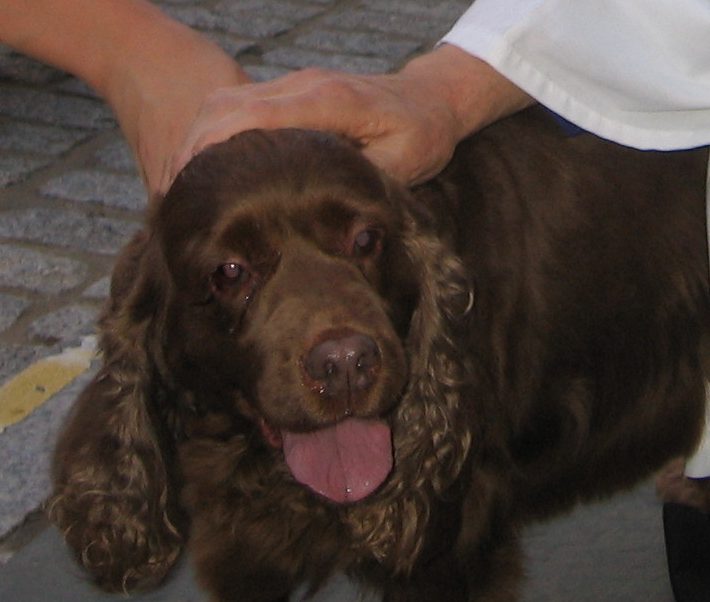
What more do you need to know about a person than how they treat their dog when they believe no one else is watching?
Robyn Ryle
And this quote has become something of a mantra for me in my third stage of life.
Try to be nice, always be kind.
Dr. Who (written by Steven Moffat)
Thinking about what matters
Section from a wall of inspirational quotes at the Black History Museum & Cultural Center in Richmond (photo by DJB)
Our goal in life is not to become more spiritual, but to become human.
Richard Rohr
I wrote a full essay on More to Come around this simple quote:
Sin is simply the failure to bother to love.
James F. Keenan, S.J.
Sometimes our spiritual goals are skewed, as Father Richard Rohr suggests.
We prefer heavenly transactions to our own transformation.
Richard Rohr
By our love, the divine may be reached and held; by our thinking, never.
Your rights end at the end of your nose; that’s where somebody else’s nose begins.
Anonymous
Those who say one thing and do another are at least acknowledging that right and wrong exist, as noted in the following:
Hypocrisy is the tribute vice pays to virtue.
Francois de La Rochefoucauld
Everything can be taken from a man but one thing: the last of the human freedoms — to choose one’s attitude in any given set of circumstances, to choose one’s own way.
Viktor Frankl
This one goes well with Grandmother’s saying at the top of this post:
Don’t believe everything you think.
Scott McGill, Ecotone Ine.
I’ll leave you with my personal pithy proverb, which is life rule #1:
Be grateful. Be thankful. Be compassionate. Every day.
































 MORE TO COME...