Latest Posts

Bully of the Town

After a week when childish yet dangerous tantrums from a group of bullies dominated the news, I couldn’t get the classic Bully of the Town out of my head.

When I walk this levee round and round
Everyday I may be found
When I walk this levee round
I’m looking for that bully of the town

Bully of the Town is an old tune with somewhat unknown origins. It may have been a folk song known along the Mississippi River before it became a pop hit. The Traditional Tune Archive suggests that the song was originally written by Charles E. Trevathan in 1895 for the stage show “The Widow Jones.” It was sung in the production by Trevathan’s girlfriend, May Irwin. Bully of the Town was frequently heard at old-time fiddlers’ contests in the early 20th century and the Skillet Lickers (led by fiddlers Gid Tanner and Clayton McMichen, with Riley Pucket on guitar and vocals, and Fate Norris on banjo) recorded the song in Atlanta in April 1926, one of eight sides for Columbia records. Blues researchers suggest the song was developed from an earlier blues ballad based on a real-life incident in New Orleans.

Whatever the origin, one of my favorite instrumental versions was performed by guitar legend Norman Blake on his Back Home in Sulphur Springs album. The cross-picking is pure Norman.

Norman Blake

Blake also joined Nashville guitarist extraordinaire Bryan Sutton on Sutton’s wonderful Not Too Far from the Tree album (which he recorded with his guitar heroes) where they play the tune as a duet.

The incomparable folk guitarist Etta Baker recorded Bully of the Town as a finger-picked instrumental.

A rather raucous version by the Memphis Jug Band gives a flavor of how the tune may have sounded when it was played in the blues and old-time music venues of the American South.

The lyrics have been altered many times depending on the artist, genre, or venue but the many bluegrass groups that recorded the tune through the years usually played it as an instrumental. Allen Shelton (one of Jim & Jesse’s Virginia Boys) included it on his Shelton Special album from the 1970s as a banjo tune.

Levi Lowrey, who handles the vocals and second fiddle in this version with the modern Skillet Lickers, is the great grandson of Gid Tanner, who headed up the original band.

So why all the focus on bullies? Well, Tuesday was, as Joyce Vance wrote,

. . . a day for sad firsts, further evidence of the damage Donald Trump has done and continues to do to our country. Today was the first time a (thankfully former) American president behaved in such an outrageous manner as a defendant in a civil lawsuit that a judge entered a gag order against him. And it was the first time a Speaker of the House was removed by a motion to vacate.

And bullying was very much in evidence everywhere.

Let’s begin with Trump, that life-long insecure bully whose public pronouncements in recent weeks have become increasingly violent and morally depraved. Vance’s description is both accurate and entertaining.

With little fanfare (and none of the warning federal Judge Tanya Chutkan has provided Trump with in the District of Columbia case), New York state Judge Arthur Engoron slapped Donald Trump with a gag order this afternoon. The Judge entered the order after Trump posted on Truth Social about the Judge’s law clerk. The Judge said, “consider this statement a gag order forbidding all parties from posting, emailing or speaking publicly about any of my staff.”

Trump had posted a picture of Judge Engoron’s law clerk standing with New York Senator Chuck Schumer — the type of picture people and politicians take all the time — and salaciously suggested she was his girlfriend. Surprise . . . that is not true.

Judge Engoron, in a no-nonsense fashion, ensured the post was removed. He admonished everyone . . . that “personal attacks on members of my court staff are unacceptable, inappropriate, and I will not tolerate them in any circumstances.” In case that wasn’t clear enough, he put it down where the hogs could get it, saying, “Failure to abide by this order will result in serious sanctions.”

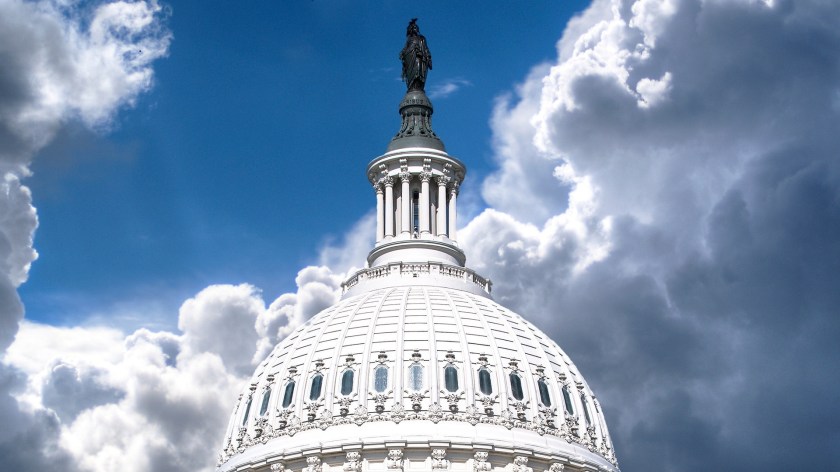
The ouster of former Speaker of the House Kevin McCarthy is another example of the bullying traits of today’s Republican party.

Rep. Matt Gaetz essentially bullied McCarthy from the day he took over as Speaker, pressing buttons to get a rise out of the spineless leader. He finally filed the motion to vacate the chair, which passed with eight Republicans voting with all the Democrats. (Hey, it isn’t the job of the opposition party to protect the Speaker, especially one that has tried to bully them and has lied to them repeatedly over the years.)

In the Democratic caucus meeting, to decide how to vote, Rep. Adam Schiff quoted The Big Lebowski, when telling colleagues he agreed with Matt Gaetz that you couldn’t trust McCarthy. Gaetz “isn’t wrong, he’s just an a**hole,” Schiff said.

And then, as Heather Cox Richardson reported, Representative Patrick McHenry pulled another classless, bullying stunt when one of his first official acts as temporary speaker was to order former speaker Nancy Pelosi (D-CA) to vacate her private Capitol office, announcing he was having the room rekeyed (and probably going beyond his authority).

What a bunch of rude, angry, bullying, and petty jerks.

Joyce Vance again:

All of that comes to a head in this moment — the effort to destroy versus the effort to sustain and nourish. The outcome is not certain, but to be an American means to have hope in the aspirational, to believe that we can persevere and move past difficulties . . . the burden is for all of us to carry, not just the judges who must hold Trump to account or the Democratic legislators who refused to support a politician who wanted the Speaker’s title so much that he debased the office. All of us have a solemn duty to stay informed, to prepare for the upcoming elections, to get engaged in local and national politics. Democracy hangs, quite literally, in the balance, and we continue to have important work to do.

More to come . . .

DJB


Image by John Hain from Pixabay

A prescription for sick cities

What happens . . . when we throw out thousands of years of knowledge about how cities function? When local governments become addicted to growth? When our cities obsess over out-of-towners? When we lower standards?

When that happens, we have big problems.

Your City is Sick (2023) by Jeff Siegler is a deep dive into how the various causes of community malaise — poor planning decisions, neglect, disregard for current residents, and more — have led to the dysfunction we see today. Cities are like people, Siegler argues, and when humans forget all we’ve learned about health care, skip the vegetables that sustain us, eat a diet of attractive desserts, and stop exercising we get sick. Cities face the same challenges.

Like a blunt yet perceptive doctor, Siegler first helps us understand the disease. Then in straightforward, no-holds-barred language he prescribes treatments to push his readers to transform their cities through relentless, incremental improvements. Jeff, a long-time friend and colleague, recently chatted with me about his hard-hitting yet essential new work.


DJB: Jeff, you write that we are all in a civic relationship, whether we know it or not. What does that mean, and why is it important for the average citizen?

JS: The civic relationship is the one we pay so little attention to, yet it is always shaping us and affecting us. Those in great cities or neighborhoods they love are well aware of this relationship. They experience the streets, businesses, and buildings making their lives better on a daily basis. They get a sense of identity and pride from the decisions their civic leaders make and how their collective community behaves. Their life is enhanced by the place they call home. I think about the fact that ancient Romans were fiercely loyal to their neighborhoods and would insist they were listed on their graves. This is the type of allegiance a community should foster! Ideally, the communities we call home should lift us up and make us feel better about ourselves, but sadly, so many people have a relationship with their city or town that, at best, doesn’t provide them with anything, at worst, actually makes their lives much harder.

Jeff Siegler

You suggest that most Chambers of Commerce and Tourism Bureaus have lost their reason for existing. Why . . . and what should take their place?

I have worked with so many incredible people in the tourism and chamber industries, and I sympathize with their struggles. These organizations were created during a time when communities needed their services, but times have changed and the nature of the local economy is completely different today. These industries did not adjust and they are struggling to remain relevant. Successful organizations have to periodically look at their mission and ask themselves if they are as effective as they could be. Chambers would be better served to focus on entrepreneurship and real estate development to retain local wealth. I would love to see the same energy and attention the tourism bureau extends toward visitors being directed to residents and making sure they feel like they matter to the community. 

What is civic health and how will that help heal our sick communities?

Being a member of a community used to play a much larger role in people’s lives and we are seeing how this shift from connectedness to isolation is having devastating social impacts. For 70 years we have been building human habitats that aren’t fit for humans. A sick city is going to have sick residents and our places are making people physically, socially, mentally, and fiscally unwell. A healthy city will foster dignity, pride, connectedness, joy, companionship, and physical activity just to name a few. The concept of civic health is pretty simple, cities should be designed and managed with residents’ health and well-being as the primary concern. When this occurs, communities will heal, and as communities heal, so will the people that inhabit them. 

What is Silverbulletitis? How do you spot it? What measures are necessary to cure that disease? 

Silverbulletitis is the ever-pervasive belief that all community ailments can be solved with one big-ticket project. You can easily spot it when you visit a community with a downtown mostly comprised of empty surface lots with a smattering of crusty mega-projects, like the parking deck, the arena, the civic center, and so on. Someone in these communities keeps buying the same old failed magic revitalization pill. Community improvement, just like self-improvement doesn’t work like that. There are no shortcuts to getting better. There are no secrets to success. The fact of the matter is, community revitalization is a long, slow process that consists of a million small improvements, and these add up over time to something amazing. We have to give up on the idea that someone from somewhere else has a solution, or that something that took 50 years to break can be repaired in one year. The cure is in empowering locals, rebuilding the same way the community was built the first time, trusting residents to rise to the occasion when given the opportunity, and understanding that a community already has every single thing it needs to be successful. 

Jeff, what books on cities can you recommend for our readers?

The one that really opened my eyes was Happy City by Charles Montgomery. This book first introduced me to the idea of how the design of our infrastructure is constantly shaping our lives. I think of it this way: we intentionally design different rooms in our houses for different purposes because we understand the experience we want them to foster. A city is no different, we must be intentional in how we design the space between the homes and the buildings to foster the type of feelings and behavior we want residents to experience. Diving deeper into this concept has led me more recently to read Cognitive Architecture by Ann Sussman and Justin Hollander as well as Welcome to Your World by Sarah Williams Goldhagen. Once you realize how the design of your city is shaping your life, it becomes impossible to unsee, but it’s not a choice to take lightly. 

Thank you, Jeff.

Thanks for asking me to be a part of this David.

More to come . . .

DJB
Photo from Unsplash

A brilliant love letter to baseball

Baseball is boring. Until it isn’t. Even with the new pitch clock working its magic, there’s still a lot of standing around. There’s time between each half-inning to chat. Before the bottom of the seventh, the entire crowd stands up and sings Take Me Out to the Ballgame — a wonderfully anachronistic moment of civic harmony.

America needs more communal singing.

Unlike basketball and football, baseball is a game of perspective. It moves at a leisurely pace. Players, umpires, and fans have time to talk, get to know each other, and tell stories.

Nobody tells a better baseball story than Joe Posnanski.

Why We Love Baseball: A History in 50 Moments (2023) by Joe Posnanski may not be the most important book you’ll read this year, but if you care at all about the game this will be the book you’ll cherish. This is a love letter of the best kind, bringing together the long history of the game with the uniqueness of the moment when someone — player, umpire, coach, fan, sportswriter, or even you — fell in love with baseball, all told with Posnanski’s “trademark wit, encyclopedic knowledge, and acute observations.” These forever moments are magical or, to use Posnanski’s “favorite definition of magical: ‘beautiful or delightful in such a way as to seem removed from everyday life.'”

I hate it when George Will is right, but he perfectly captures the essence of the author when he says, “Posnanski must have already lived more than two hundred years . . . how else could he have acquired such a stock of illuminating facts and entertaining stories.”

The book title promises 50 special moments in the game’s history, but Posnanski admits that there’s more. He occasionally interrupts his countdown to the top moment in baseball history to insert five bonus memories so he can highlight trick plays, meltdowns, memories that are absolutely guaranteed to bring a tear to your eye, and more.

In all, there are 108 moments and memories. Even that number is magical. There are 108 stitches on one side of a baseball. The Cubs’ World Series drought lasted 108 years. Some physicists did a study and determined that Nolan Ryan threw the fastest pitch ever recorded at 108 mph. The Big Red Machine — the 1975 Reds — is, I believe, the greatest team of them all. They won 108 games.

Why We Love Baseball includes fictional moments from film, moments from the dead ball era before Babe Ruth forever changed the game, moments from players in the Negro and Japanese Leagues, and moments from our childhood. In fact, the book begins with Posnanski as a 10-year-old, when Cleveland’s Duane Kuiper is his favorite player. The Indians’ second baseman hit one home run in his career, but he was Posnanski’s hero because he always played the game with “verve and love.” The description of listening to that home run call on the radio is priceless. And there’s a beautiful postscript where Kuip, by then a beloved broadcaster for the San Francisco Giants, sends Posnanski an authentic game-used Duane Kuiper bat and cap out of the blue. That’s why we love baseball.

Posnanski finds Joe Niekro teaching the eight-year-old Chelsea Baker how to throw a knuckleball, which at age thirteen made her the best Little League pitcher in the country. You’ll discover why Mariners fans suffer endlessly “in exchange for the mere possibility of sublime rapture,” as with “The Double” in the 1995 ALDS versus the Yankees. “Sometimes we even get it.”

Joe helps us relive the “exuberant, carefree, exhilarating” Javy Baez no-look tag on Nelson Cruz in the 2017 World Baseball Classic. We read of old Sid Bream chugging home to score for Atlanta in the 1992 NLCS, a memory where in real time I ran screaming around the house as Skip Carey yelled BRAVES WIN! BRAVES WIN! There’s the marvelous set-up, telling, and then coda to George Brett’s epic pine tar home run meltdown. Most don’t remember that the call was overturned, the Yankees took the case to court where they were represented by the infamous Roy Cohn, the judge threw out their case with a two-word decision — “Play Ball” — and the Royals eventually won the game.

Those who have crafted the words that feed our memories also come in for praise. Vin Scully’s call of the final inning of Sandy Koufax’s 1965 perfect game is included, with the perfect line, “[T]here’s 29,000 people in the ballpark and a million butterflies.” John Updike, writing “Hub Fans Bid Kid Adieu” in the New Yorker about Ted Williams’ failure to take a curtain call after a final home run, comes up with the classic, “Gods do not answer letters.”

Every moment you remember (and then some) are included: Giambi fails to slide. Galarraga’s imperfect game and his grace afterwards. Don Larsen, who may have had too much to drink the night before the day when “The imperfect man pitched a perfect game.” The ball conks off Jose Canseco’s head for a home run (and I’m still doubled over in laughter).

My personal favorite: Howie Kendrick’s go-ahead home run for the Nationals in Game 7 of the 2019 World Series.

I don’t have any quibbles with Joe’s top 5 moments, but I’ll only mention one so as not to spoil the ending. I’ve written about it before. It is “The Catch” — Willie Mays’ incredible catch and throw in the 1954 World Series. The catch itself was amazing, but Mays stops in full stride, “whirled and threw ‘like some olden statue of a Greek javelin hurler,’ the novelist Arnold Hano would write.”

Baseball is all about perspective. We love it, and yet it also breaks our heart. A. Bartlett Giamatti said it best.

It breaks your heart.  It is designed to break your heart.  The game begins in the spring, when everything else begins again, and it blossoms in the summer, filling the afternoons and evenings, and then as soon as the chill rains come, it stops and leaves you to face the fall alone.

Spring Training
Credit: SpringTrainingCountdown.com

Why We Love Baseball — which I’ll pick up again and again — may help postpone that heartbreak this winter.

More to come . . .

DJB

Photo by Clay Brown on Unsplash

Observations from . . . September 2023

A summary of posts included on MORE TO COME in September 2023.

This year I began to feature Q&As with authors of new books in the MORE TO COME newsletter. It has been a big hit with readers, and I’ve enjoyed connecting with both long-time and new friends who have put their thoughts into words and shared those with the reading public.

Two of those authors have had recent accolades that deserve special mention.

First, my former National Trust colleague Joseph McGill, Jr. had his book Sleeping With the Ancestors mentioned in the New York Times. You can read my July Q&A with Joe here. And then just last week, long-time friend and author Janet Hulstrand was featured in a Politics & Prose book talk around her memoir A Long Way From Iowa. You can read my February Q&A with Janet here. Congratulations to both Joe and Janet!

Look for the sixth of my author Q&As next month. But for now let’s jump in and see what was on my mind in September.


BACKUP CATCHERS AND SERVANT LEADERSHIP

The post with the most views in September is one where I actually missed the lede. Go figure. In Ode to the backup catcher, I tied thoughts on retirement (Stephen Strasburg’s and others) together with a review of The Tao of the Backup Catcher: Playing Baseball for the Love of the Game. This little gem of a book starts slow but becomes a powerful take on servant leadership. That may not be abundantly clear from my review, but the post is still worth reading.


OTHER WORKS FROM THE BOOKSHELF

In addition to backup catchers, I read about exuberant aging, bathtub murders, flatboat expeditions, and biodiversity. Just another typical month.

  • Living exuberantly is my look at the latest from Margareta Magnusson. Her take on aging exuberantly gave me the opportunity to opine about Bach cantatas and beautiful fall gardens (on a visit to the Duke chapel to hear Andrew sing), ballparks full of pyrotechnics and cities with flying pigs (on a recent trip to Cincinnati), and the bending of the elbow with former colleagues and good friends. 
  • In my year of reading dangerously™, I turned to Dorothy Sayers and her book Whose Body?, which is reviewed in A classic of detective fiction turns 100. This is where you’ll find the bathtub murder.
  • Luxuriating in the stream of time is my review of the fascinating and informative account of writer Rinker Buck (who names these guys?!) and his trip down the Ohio and Mississippi rivers from Pittsburgh to New Orleans on a wooden flatboat.

WE LIVE IN INTERESTING TIMES

Interesting doesn’t always equate with normal or easy. But these are the times we have, so here are my takes from September.

  • When U.S. District Judge Tanya Chutkan set the start date for former president Trump’s trial on four criminal counts for his efforts to overturn the results of the 2020 presidential election, multiple bells went off in my brain, resulting in A date with history. March 4th, until 1936, was when presidential inaugurations were held. Lawmakers chose that date because it was the one on which, in 1789, the Constitution went into effect. Priceless. It is also the only date that is a command. Oh, and it is my birthday.
  • Being alert to media framing ― as I discuss in Bad and broken frames ― helps us understand the challenges we face to shift our national conversations toward support for democracy.

IF YOU DON’T LIKE MY MUSIC CHOICE THIS SATURDAY, JUST WAIT A WEEK

My Saturday Soundtrack pieces in September covered an even broader range than is normally the case. Thus the meaning behind the title. I don’t expect everyone to like each featured artist or genre, but chances are I’ll get around to your favorites in a few weeks. In the meantime, check out:

  • A terrific new album by Rhiannon Giddens as featured in You’re the One. Giddens, the two-time GRAMMY Award and Pulitzer Prize-winning singer and instrumentalist, is more than willing to explore the past and future together.
  • And then take a stroll down Rock & Roll memory lane with That’ll Be the Day and find out why it had worldwide impact . . . in unexpected ways.

WHATEVER ELSE TICKLED MY FANCY

  • At the break of day is a reminder of the beauty of sunrises and sunsets I’ve seen ― from Alaska to Asheville, Cambodia to DC, Dublin to the Dutch Caribbean, the Grand Canyon to Mohonk, and more.
  • I’ve never liked the sound of the word “blog.” It just grates on my ear. Searching for the right word is a short piece where I banish it from MORE TO COME. One of my editors thinks I can still find a better word. *

CONCLUSION

Thanks, as always, for reading. Your support and feedback mean more than I can ever express.

As you travel life’s highways be open to love, thirst for wonder, undertake some mindful walking every day, recognize the incredible privilege that most of us have, and think about how to put that privilege to use for good. Women, people of color, LGBTQ+ individuals, immigrants, and others can feel especially vulnerable . . . because they are. Work hard for justice and democracy as the fight never ends.

Bash into some joy along the way.

And finally, try to be nice. Always be kind.

More to come . . .

DJB

For the August 2023 summary, click here.


*What . . . this thing has “editors”?!?


You can follow MORE TO COME by going to the small “Follow” box that is on the right-hand column of the site (on the desktop version) or at the bottom right on your mobile device. It is great to hear from readers, and if you like them feel free to share these posts on your own social media platforms.


Photo of creek by Pexels from Pixabay

The earth is our home

In considering why anyone should give a second thought about a plant moving toward extinction with the name of the hairy beardtongue, one author — writing in the 1990s — asks us to first consider periwinkles. There are six species of periwinkles growing on the island of Madagascar, he notes. Halfway around the world, they might seem just as inconsequential as our hairy beardtongue. Yet one of those species, the rosy periwinkle (Catharanthus roseus) . . .

. . . is the source of alkaloid chemicals vinblastine and vincristine, used to cure two of the most deadly forms of cancer: Hodgkin’s disease, especially dangerous to young adults, and acute lymphocytic leukemia, which, before the periwinkle alkaloids, was a virtual death sentence for young children . . . Ironically, the other five periwinkle species remain largely unexamined for their medical potential. One of them is near extinction due to the destruction of its habitat.

On a global scale, one out of ten plant species has been found to contain “anti-cancer substances of some degree of potency.” And we simply don’t know what we’re losing.

The Hairy Beardtongue

What we do know is that we lose them at our peril.

Biological Diversity: The Oldest Human Heritage (1999) by Edward O. Wilson is a short introductory book designed to make the case that no species should be allowed to go extinct, if possible. Originally written after a keynote address at the first New York Natural History Conference in 1990, Wilson — by that time a highly decorated and somewhat controversial natural scientist who had already won one Pulitzer Prize for his book On Human Nature and was soon to receive a second for The Ants — wrote this work to educate young people about the importance of biodiversity, the threats to it, and our response.

With original natural history illustrations by Patricia Kernan the book was designed to not only be helpful to high school biology students but to anyone “interested in preserving the integrity of earth’s delicate ecosystems through awareness and education.” I happened to find the pamphlet tucked away in our bookcase at home (speaking of habitats with many undiscovered elements), and despite its occasionally dated text and data the basic premise still strikes me as inordinately valuable in today’s world.

We don’t have much time to waste if we want to reverse the trends of loss in biodiversity. Human-induced changes to the habitat come with “such a velocity that it is too great for life to handle.” We are inducing change at such a rapid pace — merely a tick in geological time — that species do not have time to adjust.

Wilson makes the pronouncement early in the book that “Simple prudence dictates that no species, however humble, should ever be allowed to go extinct if it is within the power of humanity to save it.” Later the book provides an example of a species that we saw on our recent trip to Alaska, the musk oxen, that was near extinction.

Small populations of Musk Oxen live in Arctic regions, in some areas due to reintroduction. They huddle together when threatened, an effective defense against predators such as wolves, but one that allowed easy slaughter of whole herds by humans in the 18th and 19th centuries.

The Musk Ox

I’m not a scientist and have never had much of a bent toward the natural sciences. But I’m working hard to catch up on some of the basics. In travels around the world as well as in our hometown, I can see how habitats are being destroyed, to the detriment of the planet and life.

In the preservation and planning field we talk about the gobbling up of land that was once in a more natural state. A colleague recently wrote that by the year 2020, Peoria, Illinois — that town known in our culture as representative of middle-America — had more than doubled in size geographically since 1920 yet the population had stayed relatively the same. Now the same number of people are taking up twice the space as was true 100 years ago, for no real reason other than bad planning decisions and greed. You can repeat this scenario of open-space loss in town-after-town across America. I suspect that no matter our personal lenses, we can all see the problem easily enough if we try.

I am a fan of the printing of lectures and other short presentations by museums, nonprofits, and other educational institutions as an easy-to-access introduction. This one gave more context to some of the recent works I’ve been reading, and enourages me to explore more.

Science is just one of many tools we use to understand the world. But curiosity and wonder help expand our knowledge. Reading widely about topics in which we are not expert helps us accept change more readily as we broaden our worldview. This is another small step along my path.

More to come . . .

DJB


Related posts on MORE TO COME:


The Weekly Reader links to the works of other writers I’ve enjoyed. I hope you find something that makes you laugh, think, or cry. 


Image by Adina Voicu from Pixabay

Thank you, Sean Doolittle

This will be short. I just wanted to say how much I love Sean Doolittle, who retired on Friday after 11 years in the majors, six of them with the Washington Nationals. As he wrote in his farewell message, he was retiring “with gratitude and a full heart.”

Many Nats fans have the exact same feelings.

No Nationals player between the amazing 2012-2019 run of success for the club was more a Washington-type person than Sean Doolittle. Not Bryce Harper who couldn’t wait to get out of town for the bigger money in Philly. Not Tony “Two-Bags” Rendon who really didn’t feel at home here even though he was indispensable during the 2019 championship run but then decided to accept a big offer from the Angels, the team where dreams go to die. Not even those players who really didn’t want to be traded and loved it here, the Max Scherzers, Trea Turners, and — the deepest cut of all, Juan Soto. Not even Ryan “Employee 11” Zimmerman who always felt more like a Northern Virginia-type to me than a District guy.

Doolittle and his wife Eireann Dolan, who is beloved by Washingtonians in her own right, made this city their “forever home.” As Chelsea Janes wrote in a beautiful piece for the Washington Post, Doolittle “felt like someone (Nationals fans) knew, the guy down the street who worked for the environmental nonprofit and sat in independent bookstores wearing Birkenstocks in his free time.”

For Doolittle, his appreciation for the opportunity to be a major league pitcher is real. He thanked the A’s, the team that originally drafted him. He thanked the Cincinnati Reds and Seattle Mariners for hosting him for a “gap year” in 2021, before he could return to the Nats. He thanked the union, which provided the working conditions and labor contracts where he could work through his numerous injuries and still be able to close out the wild and wacky Game 6 of the 2019 World Series, and which expanded to include minor leaguers under their bargaining umbrella. He said that 2019 was the highlight of his career, just as the year was the highlight of a lifetime of watching baseball for so many of us in Washington.

As Joe Posnanski posted today, Doolittle’s wife Eireann “wrote the most beautiful of summations of Sean’s wonderful and unlikely career.”

“Watching Sean’s career for the past decade,” she wrote, “has always felt a bit like seeing a Subaru Forester in the Daytona 500. Part of you is like, ‘Who the hell let that thing in there?’ And the other part kind of just wants to see how far it can go. Turns out farther than you’d think.”

Cleats Sean Doolittle decorated in 2019 for trans and gay rights during Pride Month. (Photo by Sean Doolittle via the Washington Blade)

Doolittle and Dolan used his platform to speak out for marginalized communities including LGBTQ citizens, and to promote causes such as literacy. He had an “ability to earn respect as the nerdiest guy in almost every classically macho clubhouse he entered,” Janes wrote. And Washington just loves nerds, especially those who are thoughtful, grateful, and somehow still relatable. It doesn’t hurt to be able to throw high heat past hitters.

So, I guess this was a little longer than I expected. But that’s okay. Sean Doolittle deserves it.

I can’t wait to see what he and Eireann do next in DC.

More to come . . .

DJB


Image of Sean Doolittle set to host a Storytime event in 2022 at Central Library in Arlington (via Arlington Public Library)

Living exuberantly

You have to love a book where the first chapter is an exhortation to have a gin and tonic with a friend, followed by another encouraging the reader to eat chocolate daily. These seemingly glib indulgences led me to think about Bach, ballparks, and the bending of the old elbow. Stick with me here, it’s a fun ride.

The Swedish Art of Aging Exuberantly (2022) by Margareta Magnusson is a witty look at how to live and age gracefully well into your final third of life. Magnusson was introduced to the world through her bestseller The Gentle Art of Swedish Death Cleaning (or the clearing out of your unnecessary belongings so others don’t have to do it for you). This follow-up work — which is a short 140 pages because “old people don’t want to read 400 pages” — is a humorous yet useful look at how to approach life when more of it is behind you than ahead. It is simple and pragmatic advice.

Part memoir and part acquired wisdom from more than eight decades on earth, Magnusson encourages us not to fear death but to focus on what’s important now: beauty, friends and loved ones, those less fortunate, leaving a better place for your children and grandchildren. Along the way her advice includes admonitions to wear stripes (she likes them), live within your means, don’t resist new technology, let go of what doesn’t matter, keep an open mind, spend more time with young people, and have that gin and tonic with a friend on a regular basis. As one reviewer noted, these suggestions allow Magnusson to “philosophize on life’s greater meanings.”

The chocolate she recommends is a thumb in the nose of diet culture. The gin, instead of encouraging alcoholism, is a reminder to stop and smell the juniper berries while catching up with those who have known you the longest.


I finished reading this book between two weekend trips that were my own little effort to live exuberantly. The first was a trip to Durham to hear our son, Andrew Bearden Brown, perform as the tenor soloist in Cantatas BWV 60 and 95 as part of the Bach Cantata Series of the Duke Chapel music series. Andrew was superb, singing before a close-to-full house of appreciative patrons and his delighted parents. The weekend gave us the opportunity to live exuberantly in the midst of the beauty of the music, the extraordinary architecture of the chapel, and the glory of nature’s offerings in the Sarah P. Duke Gardens.

Morning sun on the Duke Chapel
Duke Gardens on a picture-perfect day

Then, for something completely different in the exuberance department, I flew to Cincinnati this past weekend to meet up with a former colleague and watch a Reds game. Yes, per Magnusson’s suggestion, adult beverages were consumed along the way.

This has been a great year for meeting friends over a baseball game.

With my dear friend Ed Quattlebaum for a chilly April game at historic Fenway Park in Boston
Catching up with long-time friend and former colleague John Hildreth at Nats Park in July
Taking in my annual game at Nats Park with “Two-Dollar Tom” Cassidy in August … over an adult beverage*
With my former colleague Lisa Thompson last Friday at Cincinnati’s Great American Ballpark

As readers and friends know, I am on a bucket-list quest to visit all 30 Major League ballparks.** Because the Reds are so much fun this year, I made the decision to take advantage of frequent flyer miles and check another park off the list.

Ballpark as seen from across the Ohio River
On the streetcar to the game

Cincinnati was once the nation’s predominant port processing site, earning it the nickname “Porkopolis.” Today that’s celebrated in art.

Outside the ballpark with one of the city’s many pigs. No comments about the similarity in profiles.

Inside the ballpark: homage to the nation’s first professional baseball team, the Cincinnati Red Stockings, and a view of the field.

The fans love the park’s pyrotechnics — fireworks for a homerun and flames of fire for striking out an opposing player.

Alas, the Reds — in the midst of a race to secure a playoff spot — saw their bullpen implode in a 7-5 loss to the Pirates. As Joe Posnanski wrote, relievers with the “alien-made-up-name” of Buck Farmer and “Irish Poet” Ian Gibaut each had blown saves.***

I took advantage of the trip to see other delights of the city before flying home on Saturday afternoon.

Walking across the Ohio on the historic John Roebling bridge (same engineer as the Brooklyn Bridge)
The Samuel Hannaford-designed City Hall
President Garfield statue
The James Keys Wilson-designed Wise Temple
Downtown architectural details
The Netherland Hotel — my home for the trip and home to the Palm Court bar, where I enjoyed a good Kentucky bourbon . . . just across the river in Ohio.

Here’s to living life large and exuberantly, no matter the age!

More to come …

DJB


*Tom gives two-dollar bills as tips to the staff at the beer stand. They’ve given him the nickname “Two-Dollar Tom.”


**I do have some rules for this quest. First, drive-by viewings don’t count. I have to actually see a game. I use to buy a hat of the local team to prove I’d been there, but it was suggested that I have enough caps — so that’s no longer necessary.

Finally, demolitions have wreaked havoc with these plans. I decided — in a totally arbitrary way since I am the commissioner and umpire for this game — that if I’ve seen a team in their home ballpark that has since been demolished, then it counts against my list.


***It got worse the next day as the Reds blew a 9-0 lead to lose 13-12.


Here is the list of teams/ballparks still to be visited. Let me know if you’d like to join me in seeing one or more of these ballparks.

  • Arizona Diamondbacks – Chase Field
  • Detroit Tigers – Comerica Park 
  • Los Angeles Dodgers – Dodger Stadium 
  • Miami Marlins – Marlins Park 
  • New York Yankees – Yankee Stadium (I know—how can I not have made it to Yankee stadium yet?! Just goes to show I’ve never been a big Yankees fan.)
  • Texas Rangers – Texas Stadium 
  • Toronto Blue Jays – Rogers Centre

Image by Ernest Roy from Pixabay

That’ll Be the Day

Buddy Holly has a special place in the history of Rock & Roll music. A central and pioneering figure of the mid-1950s, Holly was born in Lubbock, Texas, during the Great Depression. A member of a musical family, he learned to play guitar and sing alongside his siblings. Holly’s music was influenced by gospel, country and R&B.

Here’s how his Rock & Roll Hall of Fame essay begins:

Rock & roll as we know it wouldn’t exist without Buddy Holly.

The bespectacled ’50s teen idol roughed up familiar musical influences — rhythm & blues, rockabilly, country & western — with upbeat tempos, a jittery vocal approach, and youthful lyrics filled with edgy declarations of love, lust and heartbreak.

On September 23, 1957 — exactly 66 years ago today — That’ll Be the Day by Buddy Holly and the Crickets reached #1 on the charts in the US.

Despite Buddy Holly’s untimely death at age 22, his influence was felt around the world.

Glasses Sign near the Clear Lake Crash Site by Dsapery at English Wikipedia

Daniel Immerwahr, in his brilliant How to Hide An Empire, describes one of the perhaps unexpected ways Holly had influence on other musicians.

Liverpool England in the 1950s was near one of the largest U.S. bases in the world, Burtonwood, which was the gateway to Europe. The American influence on the area was enormous in all sorts of ways. One we may not immediately identify is entertainment. U.S. soldiers at Burtonwood looked for music that sounded like home (among other pleasures). Four musicians from the city were more than happy to oblige. While the rest of England was stuck in the vaudeville era, Liverpudlians had a special advantage with access to American records — especially from African American artists — and a big financial incentive to master that music. The first song that the Beatles recorded was a Buddy Holly cover. “They cut it in 1958, the same year the antinuclear marchers moved on Aldermaston” (a nearby nuclear facility in England) so that the Beatles and the peace symbol debuted within months of each other and were both side effects of the U.S. system of placing military bases around the globe.

Paul McCartney (left) and John Lennon (right) practicing in the living room of McCartney’s boyhood home (credit Michael McCartney via the British National Trust)

The song they recorded — when they were still known as The Quarrymen — was That’ll Be the Day.

My favorite version of That’ll Be the Day was by Linda Ronstadt. Here’s the Wikipedia entry with just the facts:

Linda Ronstadt recorded “That’ll Be the Day” for her 1976 Grammy Award-winning platinum album Hasten Down the Wind, produced by Peter Asher and issued by Asylum Records. Her version reached number 11 on both the U.S. Billboard Hot 100 and the Cash Box Top 100 and number 27 on the Billboard Country Singles chart . . . This recording is included on the album Linda Ronstadt’s Greatest Hits (1976) and on the 2011 tribute album Listen to Me: Buddy Holly.

But That’ll Be the Day is important for so much more than the facts. It is a look into the heartbeat of 1950s music and the seismic changes that were underway, and Ronstadt nails that vibe in her interpretation. I heard Linda and her knockout band live twice in the 1970s, and this song was always a highlight. Guitarists Waddy Wachtel and Andrew Gold are smoking in this version from a live German concert, and Rondstadt’s powerful voice is unparalleled among rock singers.

Enjoy this special ride down the Rock & Roll memory lane!

More to come …

DJB


Also on MORE TO COME:


A classic of detective fiction turns 100

While standing in the mystery section of the Silver Spring Public Library on a recent summer day, I did a quick Google search on the best crime novelists of all time. Up popped the name of Dorothy L. Sayers, a pioneer in the genre, with the suggestion that I try the first of Sayers’ books to star the amateur detective Lord Peter Wimsey. Thankfully, my library had a copy!

It was only when I returned home that I discovered that this classic of detective fiction tuned 100 years old in 2023, making it the perfect next addition in my “year of reading dangerously.”

Whose Body? (1923) by Dorothy L. Sayers is a delightful period puzzle that turns deadly serious for Lord Peter as he works to find the answer to two mysteries. As the book opens he receives a call from his mother, the Dowager Duchess of Denver, asking for his assistance in helping clear her architect of suspicion of murder. It seems that overnight a body, clad only with a pair of fashionable pince-nez, has appeared in his bathtub. At the same time, a famous London financier vanishes from his bedroom across town, leaving no trace. The body in the bathtub is not that of the financier, so whose body is it? The police do not suspect that the two cases are connected, but Lord Peter has his doubts.

Lord Peter Wimsey is the first in a long line of British gentlemen amateur sleuths to appear in crime novels over the next 100 years. Independently wealthy he is nonetheless without the responsibilities of peerage which passed to his older brother, the Duke. Lord Peter (the title is a courtesy one only as he is not a peer and has no right to sit in the House of Lords) is intelligent and athletic, graduating from Oxford with a first-class degree in history and a reputation as an outstanding cricket player. From a 21st century perspective, it is fair to say that his Wikipedia entry is very impressive for a fictional character in a series of crime novels!

Whose Body? is definitely a period piece, and because the dialogue seeks to be faithful to the backgrounds of the various characters, not always as easy a read as an Agatha Christie novel of roughly the same vintage. However, Sayers constructs a delightful tale with memorable heroes and villains. Thanks to the help and insights of his valet, Bunter, a skilled amateur photographer, Lord Peter becomes convinced that the two cases are linked. He proceeds on that assumption despite the skepticism of the police, including Detective Parker of Scotland Yard who works with him to untangle the two cases.

What begins as something of a simple assignment for Lord Peter turns very serious as he experiences trauma from his service in World War I just before he has to confront the man he is convinced is the murderer. Sayers does us the favor of having the murderer write a rather lengthy confession to Lord Peter, just to make sure we have connected all the various dots.

As Sarah Weinman, who writes the monthly Crime & Mystery column for the New York Times Book Review said in an appreciation of Whose Body?, “the novel is pure pleasure to read, fulfilling a desire for escape — something readers want as much now as they did 100 years ago.” This was also Sayers’ first crime novel, and “(w)hat elevated Sayers’s debut to the upper ranks of the genre was the quality of her prose and the sense that her sleuth had more emotional heft than he displayed.”

At the time, Sayers was one of relatively few women writing detective fiction. Agatha Christie’s “The Mysterious Affair at Styles,” which introduced Hercule Poirot, had appeared three years earlier. While Margery Allingham would go on to publish her debut, “Black’erchief Dick,” not long after “Whose Body?,” she wouldn’t create her own gentleman sleuth, Albert Campion, until 1929 — the same year that Josephine Tey’s first mystery, “The Man in the Queue,” came out. Ngaio Marsh didn’t publish her first novel, “A Man Lay Dead,” until 1934.

Whose Body? takes the reader back, in more ways than one, to so many of the elements of the crime novel that generations of readers have come to enjoy. If you’ve never read it, or if it has been a number of years, now may be a good time to be introduced, or reintroduced, to this classic.

More to come …

DJB


To see reviews of the other books in my year of reading dangerously (i.e., mystery novels), click here for JanuaryFebruaryMarchApril, May, June, July, and August.


Photo by Aleks Marinkovic on Unsplash

Luxuriating in the stream of time

A good story can be a “titillating and very dangerous thing.”

Personal adventures — especially of the monumental variety — can lead to bad history. One well-known example comes from Norwegian ethnologist Thor Heyerdahl, whose 1947 Kon Tiki raft expedition captured the world’s attention and advanced his belief that “long before Columbus, early ocean travelers — tall, fair-skinned, redheaded Vikings much like himself — spread human culture to the most remote corners of the earth by drifting with the currents. Academics scoffed, and the 1976 voyage of the Hōkūleʻa resolved the debate. Micronesian navigator Pius “Mau” Piailug “demonstrated his profound skill for reading the night sky and the ocean swells and safely guided the massive ocean-going canoe from Hawaii to Tahiti.”

With that cautionary tale in mind, I approached the story of a more recent expedition with some apprehension.

Life on the Mississippi: An Epic American Adventure (2022) by Rinker Buck tells of the author’s 2016 quest to take a flatboat from Pittsburgh to New Orleans, recreating the approximate route traveled by a young Abraham Lincoln and millions of other Americans of that day. Buck undertakes this adventure to set the history straight, but in the process, he learned a great deal about himself, our country, and human nature.

When Americans think of pioneers, settlers in wagon trains heading west usually come to mind. Yet the role of the flatboat in our country’s evolution is far more significant than most realize. “Between 1800 and 1840, millions of farmers, merchants, and teenage adventurers embarked from states like Pennsylvania and Virginia on flatboats headed beyond the Appalachians to Kentucky, Mississippi, and Louisiana.” In this case, Buck gets the history right, using the vessel he built to illuminate that story for the many who have only a cursory sense of how our country grew.

The trans-Mississippi flatboat experience that began right after the Revolutionary War led to the expansive and complex American economy. It was built by farmers and others who didn’t have much in the way of book skills, but they nonetheless found the wherewithal to complete their task within themselves. Once they arrived at their destinations,

… settler families repurposed the wood from their boats to build their first cabins in the wilderness; cargo boats were broken apart and sold to build the boomtowns along the water route … In the present day, America’s inland rivers are a superhighway dominated by leviathan barges — carrying $80 billion of cargo annually — all descended from flatboats like Buck’s ramshackle Patience.

When describing the building of Patience, Buck goes into a discourse about the importance of jury-rigging — or what he calls shit-rigging — to life. He grew up on a dairy farm in New Jersey where his father would fix any problem by shit-rigging the solution. Front door-knob broken? No problem. Replace it with vice-grip pliers. It was a skill that Buck would learn and master. “Shit-rigging is life’s golden diploma.”

And when he looked at his completed flatboat, she was “a shit-rigging masterpiece, my hillbilly Pequod, my floating jalopy, my personal Kon-Tiki, a gorgeous code violation that would carry me south to New Orleans.”

Rinker Buck’s flatboat, christened “Patience”

Life on the Mississippi is the tale of the trip by Buck and his misfit crew — another piece of serendipity in that the flatboat captains of the early-to-mid 1800s usually pulled together a crew from whoever was available. As the author states early in the book, “the flatboat was indeed an ideal school for acquiring a knowledge of human nature.”

Besides an enjoyable travelogue, Buck also educates the reader about past histories and present-day challenges. Often they overlap. He has a moving and thoughtful chapter on the “burden of the 19th-century, trans-Mississippi frontier. Our thriving as a people depended on our destruction of the people who were already here and were now considered in America’s way.” Later he examines the forced migration of millions of enslaved Blacks from the Mid-Atlantic states to the deep South, to help expand King Cotton’s grip on our economy and nation. Both are extremely sad chapters in the country’s past. Yet how we remember history, Buck asserts, “is as important as history itself. Authenticity matters.”

The current life and death struggle of river valleys dealing with the transition from coal to other forms of cheaper and more environmentally friendly sources of power also comes in for examination. The topography of the Ohio River valley hides much of this from the American public and many of the locals he meets blame Washington but conveniently miss the point that the coal industry brought much of this downfall upon itself. Buck is a patient educator, who recognizes the different perspectives but focuses on the facts. When viewing the vegetation taking over abandoned docks and rusting plants, he notes: “Along the landscape of the inland rivers, the persistence of man was dramatically yielding to the persistence of nature.”

Buck, a progressive “Yankee” working his way through the deep red South, identifies misinformation at every turn. He was constantly told he was going to die, usually by people who never went on the river. “Misinformation is as American as apple pie,” he notes in another of his apt metaphors for life today.

An easy-to-read companion, Buck references histories written by those who first traveled the Ohio and Mississippi rivers and their tributaries such as the Cumberland and Wabash. These accounts are written by plain folk of the early frontier, giving their voices authenticity. One of the most colorful was the traveling minister and diarist Timothy Flint, who wrote: “Almost every boat, while it lies in the harbor, has one or more fiddles scraping continually aboard, to which you often see the old boatmen dancing.”

“A violin medley that started out as a Scotch-Irish reel from Ulster might be passed on along the river to a German fiddler from Mannheim, or a Bohemian Jew, or even a wayward Brahmin from Boston.” notes Paul Schneider. The inland river country …

… had become quintessentially American — slapdash, colorful, ethnically mixed.

Cumberland Gap is a tune no doubt heard on the river. This version by Notorious Folk includes some nice dancing.

Take a pause — to use a phrase that Buck employs — to luxuriate in the stream of time.

More to come …

DJB