Latest Posts

When we can’t be bothered to love

Conversations and sermons in the Episcopal church rarely mention sin. To many it may feel like an old-fashioned notion and not appropriate for a progressive faith tradition. Or we may simply be too polite. But the topic wasn’t a problem in the Baptist church of my youth. I was up to my eyeballs in sermons that called me to repent of my sins. And they were many. Sins were understood to be personal failings; struggles that arise when one is too weak to stand up to temptation. The outcome is that we are separated from the divine.

We all take personal actions that lead to estrangement. It may come for the nonbeliever in the form of separation from other individuals, or the community, or nature. However, if one is raised in certain religious traditions — such as those that specialize in awarding what Soupergirl co-founder and Orthodox Jew Sara Polon calls a “PhD in guilt” — the introduction of the notion of sin “brings us into contact with what philosophers call ‘existential anxiety.'”

On a recent Saturday morning I found myself in the midst of a strange and perhaps unique confluence of cultures. This four-decade Episcopalian who nonetheless still finds elements of his Baptist upbringing lurking somewhere deep in his soul was sitting in his current church listening to a black Methodist minister speak words from a Jesuit theologian which made so much sense that I couldn’t get them out of my mind.

We were delving into the topic of racism and food injustice. And the speaker stopped me cold when he said,

Sin is the failure to bother to love.

The words came from James F. Keenan, S.J. He is the Catholic theologian being quoted by the Rev. Dr. Christopher Carter (the Methodist minister) at the recent seminar of St. Alban’s Parish (the Episcopal church) on Faith and Food: A Christian Ethical Response to Food Injustice.

As Keenen proposes, and Christopher explained on that Saturday morning, we actually sin out of our strengths, not our weaknesses.

Our sin is usually not in what we did, not in what we could not avoid, not in what we tried not to do. Our sin is usually where you and I are comfortable, where we do not feel the need to bother … where we have found complacency, a complacency not where we rest in being loved, but where we rest in our delusional self-understanding of how much better we are than others. It is at that point of self-satisfaction thatwe usually do not bother to love.

Sinning out of our strengths? Oh my! This was a concept of wrongdoing, of estrangement, of sin that had somehow never permeated my cocooned worldview.

I had to wrestle with that one.

Christopher reminded us that in the parable of the Good Samaritan, Jesus tells how first a priest and then a Levite came along and saw the man who had been beaten and left for dead by robbers. Neither could be bothered to stop, so they crossed to the other side of the road and kept on walking. However, it is the Samaritan — a man from another country, an enemy if you will — who takes pity on the victim, binds his wounds, and carries him to the inn for care.

There are many examples in the scriptures — and even more in our current polarized world too easily prone to fear and hatred — of people who could have done something and did not. They could not bother to stop.

I find myself in that group virtually every day.

If you don’t buy a theological approach to sin, think of the actions we take that willingly separate us from other humans or from all creation. When we think in those terms, seeing that estrangement as coming out of our weaknesses allows us to gloss over our responsibility. It becomes trivial. It also becomes prone to easy manipulation.

But when we see estrangement as coming out of our strength, as love we can and should share but choose not to because we cannot be bothered, then it seems that the true nature and consequences of our separation from the community of our fellow creatures and the divine becomes real.

Photo by Dan DeAlmeida on Unsplash

As Christopher said in his sermon the following day in the context of both the lectionary’s reading about the road to Emmaus and our weekend topic of food, we learn about others, and our frame of reference is changed, when we break bread with those we don’t know. We learn other stories, we learn to empathize with others, and we learn to love when we eat together. So the questions he asks are, “Who do you need to break bread with, and what story do you want your food choices to tell?”

Asking where, in the busyness of our lives, we need to stop and find the time to love is not a question that is easily dismissed. I’m wrestling with it still.

More to come…

DJB

Image of window from Good Samaritan Hospital, New York.

Observations from … April 2023

A summary of posts included on More to Come in April 2023. If you receive my monthly email update, you can skip this one.

During a recent seminar on food injustice, one of our speakers suggested that by clearly articulating our values we can identify ― and hopefully begin to close ― the gap between what we say we believe and how we actually live out those values. For instance, who do we say is of value and who do we actually include at the table when we break bread together? Or more broadly, what do we say we value as a nation and what do our actions show?

In April, More to Come considered these gaps between professions of belief and actions as I explored the intersections of history, community, and current events.


ANOTHER AUTHOR INTERVIEW TOPS THE LIST OF READER FAVORITES

Public libraries tell us a great deal about a community’s civic health, showing the link between what we say we value (children and education) and how we live out that value. In what is becoming a habit, my most recent author interview has topped the list of most-viewed posts. Books for the people is my interview with author Lisa R. Ramsay about her new work — published on the occasion of the 75th anniversary of the public library in my hometown — entitled Books and Our Town: A History of the Rutherford County Library System.

In our conversation we explore civic engagement, strong female leadership, and TVA’s early involvement in getting books to rural communities. My mother was a long-time librarian in Murfreesboro and my sister is the current Linebaugh Branch Librarian, so I am pleased to have a Q&A to get this story to readers of More to Come. If you love libraries and local histories, I think you’ll enjoy this post.


HISTORY HELPS US UNDERSTAND THE PRESENT MOMENT

In the midst of upheaval, we throw out the word “unprecedented” a great deal. Yes, there are things that haven’t happened before. But even those events can be set in a proper context by understanding history. This month, there were four times I turned to the past ― and those who write about the past ― for help in understanding events swirling around us today.

  • The tragic mass shooting in Nashville, the protests that followed, and the expulsion of two black legislators from Tennessee’s House of Representatives in the wake of their support for the protestors was on my mind in A country that was built on a protest. My native state is one of paradox, and these actions made me very sad for how a minority has resorted to authoritarianism to hold on to power. This all played out on Maundy Thursday, and as one Tennessee resident noted it was beyond ironic “that the Republicans produced a trial that felt rigged to give a foregone conclusion on this day of all days.”
  • Aligning the way we eat with our values is a two-part post, the first of which previews the 2023 St. Alban’s Memorial Lecture Series focusing on how the ways we eat could better align with our social and theological values. There is an important historical narrative describing how our present inequitable food system developed, and that story came through during the seminar. After the series was complete, I posted the videos of those talks to the original post.
  • That discussion on food and faith took place on Earth Day, so it seemed appropriate to repost historian Heather Cox Richardson’s look at its history. Earth Day 2023 is her thoughtful and informative reminder of “an earlier era, one in which Americans recognized a crisis that transcended partisanship and came together to fix it.”
  • Finally, when you feel that all the world “is uniformly a disaster-zone, run by malicious idiots,” read Bad events, good trends. The world is not as bad as we think.

ALL BOOKS ALL THE TIME (OR SO IT SEEMS)

In addition to Lisa Ramsay’s history of my hometown library, I read my usual wide range of books in April.

  • James Cone’s The Cross and the Lynching Tree, which I review in Faith, race, and the American experience, will upset your equilibrium in all the best ways. This is a revelation of a book that invites us to see the world through different eyes, those of the world’s marginalized and oppressed. 
  • The networks that sustain and shape us is a review of David George Haskell’s “noisy” 2017 book, The Songs of Trees. This is a book of science, but it is also a book of contemplative studies. And philosophy. And modern cultural studies. And yes, even history. Haskell, in repeated visits to twelve individual trees in different settings all around the world, dives deeply into their biology and evolution, as well as the networks that trees depend on and provide to the wider world, including humans.
  • In preparing for an upcoming trip and lectures in Alaska, I read a classic study of Life beyond the road system. Tom Kizza’s book The Wake of the Unseen Object examines native Alaskans life in the back country.

MUSIC FOR THE SOUL

It really wasn’t planned this way, but the Saturday Soundtrack features for April carried forward similar themes. Folksinger Carrie Newcomer’s music at the intersection of the sacred and the ordinary, which I highlight in Room at the table, is so vital today.

  • An invitation to journey and wonder introduces readers to The Arcadian Wild. The young band from Nashville plays progressive folk and bluegrass in the style of Nickel Creek. Their music is an invitation to find rest, to journey, to wonder.
  • In the midst of the pandemic, I asked my son — Andrew Bearden Brown — to curate a soundtrack of his favorite Music for Holy Week. I reposted it here, three years later, because this is timeless music by amazing artists.

CONCLUSION

Thanks, as always, for reading. As you travel life’s highways, do your best to treat others with kindness, undertake some mindful walking every day, recognize the incredible privilege that most of us have, and think about how to put that privilege to use for good. Women, people of color, LGBTQ individuals, immigrants, and others can feel especially vulnerable…because they are. Work hard for justice and democracy because the fight never ends.

Finally, try to be nice, always be kind.

More to come…

DJB


You can follow More to Come by going to the small “Follow” box that is on the right hand column of the site (on the desktop version) or at the bottom right on your mobile device. It is great to hear from readers, and if you like them feel free to share these posts on your own social media platforms.


For the March 2023 summary, click here.


Image by Jill Wellington from Pixabay

Things are not always what they seem

One of the traditional tools of the trade of the crime novelist is the killer who isn’t what they seem to be. Because these are murder mysteries it usually takes a great detective like Hercule Poirot to uncover the deception, especially when the murder is first announced at the funeral.

The classic with the clever alliterative title was the April choice in my year of reading mystery novels.

Funerals are Fatal (1953) by Agatha Christie was published in the U.K. as After the Funeral. The book opens as Richard Abernethie, the wealthy head of the family fortune dies suddenly in his Victorian mansion. One sister is convinced it was murder. When that same sister, Cora, is savagely murdered with a hatchet the next day in her home, the extraordinary remark she made at her brother’s funeral suddenly takes on a chilling significance.

At the reading of Richard’s will, all those present saw Cora — the family member given to blurting out unpleasant truths — tilt her head on one side “with a bird-like movement” and say: “It’s been hushed up very nicely, hasn’t it … But he was murdered, wasn’t he?”

The attorney handling Abernethie’s estate probes the mystery and uncovers a great deal that was previously unknown. However, this one seems unsolvable, even to a wise and very observant solicitor. In desperation, Mr. Entwhistle turns to his old friend Hercule Poirot to unravel the mystery.

And Poirot has a great deal to unravel.

A bloody hatchet. A piece of poisoned wedding cake. The corpse of an eccentric widow whose face had been smashed beyond recognition. A housekeeper who listened at keyholes. Two nieces greedy for money and men. And a bunch of quarrelsome relatives who needed cash and weren’t fussy about how to get it.

The entire family had come together after the funeral to hear the reading of the will. Richard’s favorite sister-in-law, Helen Abernethie, had this nagging doubt that something was off — wrong — as they sat in a room in Richard’s mansion. Yet she couldn’t place her finger on it. Poirot follows his usual approach of holding conversations with all those involved. He was “a man of curves, like the kind he threw at unwary suspects when they were off guard.”

Classic Agatha Christie themes are evident in Funerals are Fatal: “a healthy inheritance casts suspicion on the family, but as ever, nothing is quite as it seems.” Richard has died and his sister Cora had been brutally murdered. But as he homes in on the killer, he has the family reassemble several weeks later and asks them, “How well did you all know Cora Lansquenet?” When another sister says, sharply, “What did you mean?” we know that Poirot has figured out what was behind Helen’s doubt after the funeral. The journey to get there is one more delightful Agatha Christie tale.

More to come…

DJB


To see reviews of the other books in my year of reading mystery novels, click here for January, February, and March.


The Weekly Reader links to written works I’ve enjoyed. I hope you find something that makes you laugh, think, or cry. 


Image by Dorothée QUENNESSON from Pixabay

The networks that sustain and shape us

What do an Amazonian ceibo tree, a balsam fir in Canada, a Rocky Mountain pine, a Bradford pear in New York City, and an olive tree right out of scripture in Jerusalem have in common? These trees, plus seven others found around the world, share more than just their inherent nature as trees. In the hands of a biologist whose work integrates scientific, literary, and contemplative studies of the natural world, they also serve as learning tools to help us see the biological connections and networks that sustain and shape us.

The Songs of Trees: Stories from Nature’s Great Connectors (2017) by David George Haskell is a fascinating book in its subject matter, scope, and approach. Yes, this is a book of science, but it is also a book of contemplative studies. And philosophy. And modern cultural studies. And yes, even history. Haskell, in repeated visits to twelve individual trees in different settings all around the world, dives deeply into their biology and evolution. But some of the more intriguing perspectives shared by this lyrical writer are centered around the networks that trees depend on and provide to the wider world, including humans.

David Haskell was the writer who drew me into my later-in-life exploration of nature with his absorbing meditation about a small patch of old growth forest in Sewanee, Tennessee. The Forest Unseen — a finalist for the Pulitzer Prize — was his attempt to “put down scientific tools and to listen: to come to nature without a hypothesis, without a scheme for data extraction, with a lesson plan to convey answers to students, without machines and probes.” 

As Caspar Henderson noted in The Guardian,

The Songs of Trees is the equal of [The Forest Unseen] in its scientific depth, lyricism, and imaginative reach . . . Haskell’s intention is nothing less than to explore interconnection in nature across space and time, and to observe how humans can succeed, or fail, in the co-creation of networks of life that are more intelligent, productive, resilient and creative.” 

The insightful observations made throughout this work help the reader understand how nature’s networks connect and support life. Humans thrive due to these networks, but we also have much to learn from a careful study of this system. The author’s networked view of life “enriches our understanding of biology, human nature, and ethics.” One can understand his worldview when he describes one of the few glimmers of hope in a politically polarized Middle East: fair trade associations in which Jews and Arabs cooperate to produce fine quality oil.

Haskell is not only a thoughtful observer, but he is also a remarkable listener who shares his findings with the reader. Listening — paying attention — moves us all past what we know and into the deeper knowledge to be found when we tap into the roots of nature and humanity.

Key to the experience of The Songs of Trees is the noise emitted from the trees. To my ear it is a delightfully noisy book. I don’t usually listen to audio books, preferring to markup hard copies for future reference, but in this case I’m glad I did. Primarily read by Cassandra Campbell with an interlude or two from Haskell, the prose soars, and the sounds, which might seem strange to see on paper, jump out through her interpretation. We hear the roar that comes from the wind through Colorado’s ponderosa pine. More specialized equipment is required to hear sap moving through a green ash. The listening devices attract a crowd in New York, as Haskell’s study of the ubiquitous Bradford pear intrigues even the most urban of fellow humans. At the heart of it all are the “songs” made by the trees.

In many ways, Haskell’s work brings to mind the scientific yet poetic prose of Rachel Carson. I happened to be reading another book at the same time which speaks of her ability to take rock-solid science and write about it in ways to touch — and move — the heart.

In the end, the twelve trees that are the stars of Haskell’s book symbolize the key theme that comes through all his work: “life is about relationships [and} we can find salvation in this view of life as a community.”

More to come…

DJB

Image from Pixabay

Earth Day 2023

Historian Heather Cox Richardson used her daily Substack post last evening to highlight the history of Earth Day. It is a thoughtful and informative reminder of “an earlier era, one in which Americans recognized a crisis that transcended partisanship and came together to fix it.”

I’ll share a few excerpts but will encourage you to read the entire post.

The spark for the first Earth Day was the 1962 publication of Rachel Carson’s Silent Spring. A marine biologist and best-selling author, Carson showed the devastating effects of people on nature by documenting the effect of modern pesticides on the natural world. She focused on the popular pesticide DDT, which had been developed in 1939 and used to clear islands in the South Pacific of malaria-carrying mosquitoes during World War II. Deployed as an insect killer in the U.S. after the war, DDT was poisoning the natural food chain in American waters.

Carson was unable to interest any publishing company in the story of DDT. Finally, frustrated at the popular lack of interest in the reasons for the devastation of birds, she decided to write the story anyway, turning out a highly readable book with 55 pages of footnotes to make her case.

When The New Yorker began to serialize Carson’s book in June 1962, chemical company leaders were scathing. “If man were to faithfully follow the teachings of Miss Carson,” an executive of the American Cyanamid Company said, “we would return to the Dark Ages, and the insects and diseases and vermin would once again inherit the earth.” Officers of Monsanto questioned Carson’s sanity.

But the public was interested.

Democratic president John F. Kennedy asked the President’s Science Advisory Committee to look into Carson’s argument, and the committee vindicated her. Before she died of breast cancer in 1964, Carson noted: “Man’s attitude toward nature is today critically important simply because we have now acquired a fateful power to alter and destroy nature. But man is a part of nature, and his war against nature is inevitably a war against himself? [We are] challenged as mankind has never been challenged before to prove our maturity and our mastery, not of nature, but of ourselves.”  

The wheels toward protection moved forward, but three specific events pushed Americans to pay closer attention to human impacts on the environment.

  • “First, on December 24, 1968, William Anders took a color picture of the Earth rising over the horizon of the moon from outer space during the Apollo 8 mission, powerfully illustrating the beauty and isolation of the globe on which we all live. 
  • Then, over 10 days in January–February 1969, a massive oil spill off the coast of Santa Barbara, California, poured between 80,000 and 100,000 barrels of oil into the Pacific, fouling 35 miles of California beaches and killing seabirds, dolphins, sea lions, and elephant seals. …
  • And then, in June 1969, the chemical contaminants that had been dumped into Cleveland’s Cuyahoga River caught fire.”

It is an amazing story, and this short newsletter is worth the read. Today, we need to know this history more than ever.

Happy Earth Day.

More to come…

DJB

Photo: Earthrise, taken on December 24, 1968, by Apollo 8 astronaut William Anders, NASA, Public Domain.

An invitation to journey and wonder

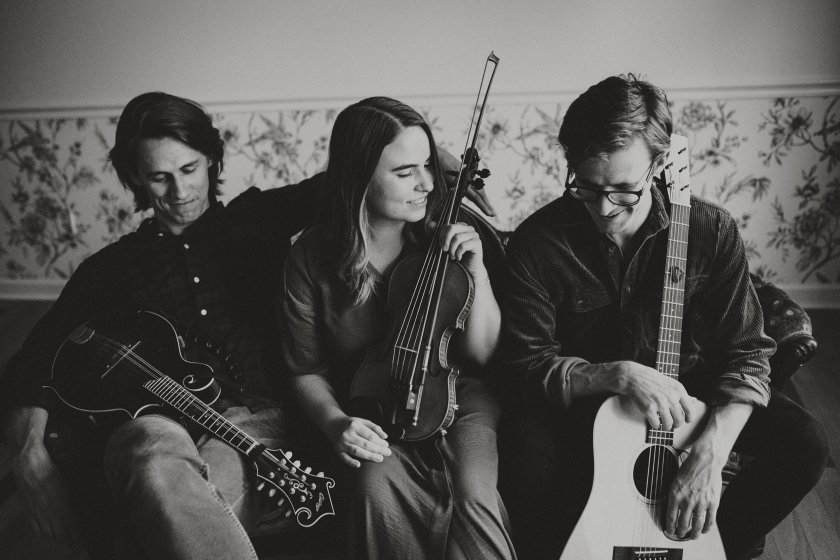
The Arcadian Wild began in the fall of 2013 “when a few choir students from Lipscomb University in Nashville” met up after class to jam for the afternoon. Ten years later the band — Bailey Warren on fiddle, Lincoln Mick on mandolin, and Isaac Horn on guitar — are still at it, set to release a new album and reaching new and larger audiences.

Mick and Horn are the long-time leaders of the group and share the songwriting duties. Much of the music that the band produces “explores an intersection of genre, blending the traditional with the contemporary in order to create a unique acoustic sound that is simultaneously unified and diverse.”

With one foot planted firmly in choral and formal vocal music, and the other in progressive folk and bluegrass, the band offers up songs of invitation: calls to come and see, to find refuge and rest, or to journey and wonder.

Rain Cloud, seen here in a 2022 performance, was the first track on the band’s self-titled 2015 album.

I’m being followed by the rain clouds
My clothes are soaking up the pain that keeps pouring down
Too much more and I may drown

I’m being followed by the night sky
It stole away my sight; it seems I have lost my way
I need someone to be my guide

Listen to my voice
Close your frightened eyes
Hide behind my love for you
‘Cause fear’s only a choice
One that we all must make someday
So know you’re not alone in this

Silence, a Stranger from the band’s 2019 album Finch in the Pantry features fiddler Paige Park, an early member of the group.

Silence is a stranger that I’ve never let inside
I hear him knocking, but I do not dare reply
God knows what he would say if I opened up my door
I’ll keep up this clamor so he can’t tell me the score.

Solitude’s an old friend from the other side of town
When he comes across the river I pretend I’m not around
HIs voice brings me comfort and his counsel’s always wise
But I can’t stand to face the disappointment in his eyes

Quiet, come another time
Isn’t on my side
I need to look alive

The group has finely tuned instrumental chops, as heard in the title tune and Holemabier, both from the 2019 Finch in the Pantry album.

Hey Runner — like so many of their tunes — is about some of the absurdities of the modern world.

Welcome, let me take you to your very own private room.
Whatever you need is on the way, from the absurd to the insane
Remember I’m a volunteer

I know your people have people, and I know this should make my day
There’s none with whom I’d rather spend my afternoon than with an ego that can fill a room
But still, still all I hear:

“You better run fast. Get it done even if it takes all night
I don’t know what else you’ve been told, but I’m above that
And if I change my mind it’ll be alright
It’s not like you’ve got somewhere to be

“Run fast. Don’t for get who I am, and I don’t ask twice
And while you’re at it would you mind to read mine
Cause I needed that last week, but take your time
It’s not like I’ve got somewhere to be”

The band not only does original music, but they also cover the work of other musicians, such as with this version of Everybody Wants to Rule the World by Tears for Fears.

A new album entitled Welcome, to be released in July, continues to “blur the lines between chamber folk and progressive bluegrass, drawing on everything from country and classical to pop and choral music with lush harmonies and dazzling fretwork.” The band has released an audio of the tune Dopamine a work with clear Nickel Creek influences — from the new album. One reviewer described it as “a punchy track that confronts the insidious ways that smartphones and social media have hijacked our brains.”

Credit: Shelby Mick

The Arcadian Wild is touring in 2023, with upcoming shows on June 1st in Charlottesville, on June 2nd at the Hamilton in Washington, and on June 3rd at the Rams Head in Annapolis.

Enjoy!

More to come…

DJB

Photo of The Arcadian Wild via TheArcadianWild.com

Books for the people

Benjamin Franklin‘s founding of America’s first public lending library was just the beginning of our love affair with libraries. Some attack the idea of governments providing access to books, but public libraries remain a surprisingly relevant bellwether institution of a community’s civic health. Each has its own story.

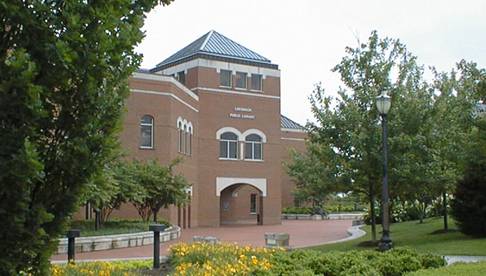
Books and Our Town: The History of the Rutherford County Library System (2023) by Lisa R. Ramsay is a wonderful addition to this treasury of local histories. A 1942 editorial in the Rutherford Courier entitled Books and Our Town encouraged the citizens of Murfreesboro, Tennessee, to create a public library. Henry T. Linebaugh answered the call, although it took several years for the community to respond to his generosity and open its first public library, named after the benefactor’s mother. For its 75th anniversary, Ramsay has gathered a rich array of stories that tell how the library became an essential part of the community. She also tells of the very real people who make it all work, including the “much beloved Helen Brown” — my mother — and current Linebaugh Branch Librarian Carol Brown Ghattas, my sister.

Lisa and I spoke about her work.


DJB: What first drew you to Linebaugh’s history?

Lisa Ramsay: My childhood connection to Linebaugh is what lured me to discover its story. As a pre-teen and teen, I spent many hours in the library when it was housed in the old Post Office building. Part of my early work at Linebaugh was assisting patrons in the Historical Research Room, where I discovered scrapbooks, photos, and early library papers. The more I saw, the more I wanted to combine them into a written history. The research and writing were done over six years, starting as articles for an internal newsletter. That is approximately the same length of time between the benefactor’s financial proposal in 1942 and the library’s opening in 1948.

Old Post Office building

You note the key role the Tennessee Valley Authority (TVA) played in bringing bookmobiles to Tennessee. Why would TVA care about reading?

The TVA’s early work of building a power system had men and their families living in remote areas with little access to news and entertainment sources. Keeping up the morale of those workers necessitated a plan. TVA hired Mary Utopia Rothrock to set up a library in its model company town, Norris, Tennessee. Rothrock developed a book exchange program for the outlying work sites that would later morph into a bookmobile system. Books for the People provides a nice recap of that work.

MGL Branch at Patterson Park

The library had a 1959 parade float with the theme, “Children Today – Citizens Tomorrow.” What can you tell us about Linebaugh’s role in building an engaged and informed citizenry?

From the earliest days, Ms. Parsons, the first librarian, wanted to provide citizens with vast resources to keep them informed. In addition to obtaining thousands of books, she subscribed to numerous newspapers and magazines, helped by local civic-minded groups that donated financially, hosted fundraisers, and contributed books to help foster public engagement. Over the years, the library partnered with organizations like the Rotary Club, the American Association of University Women, Home Demonstration Clubs, the Daughters of the American Revolution, the League of Women Voters, and more. Above all, the library has sought to include resources reflecting its patrons’ diverse interests and ideas. Those parade pictures demonstrate the library’s public engagement.

PJ Day at Linebaugh

Linebaugh has been led by a number of strong women. What’s been their role in shaping the broader community?

Many women connected to the library system have made a lasting impression on our community; some have been publicly recognized for their impact. The video series Leading Ladies of Rutherford County History highlighted the lives of fifteen women, three of whom had links to the library system: Linebaugh’s first librarian Myla Taylor Parsons, Mary Scales (a Linebaugh board member from 1968 to 1985), and Myrtle Glanton Lord, for whom the library at Patterson Park was named. These women made vital contributions as leaders, helping to provide access to educational resources and opportunities.

Under the leadership of former Director Laurel Best, the School Library Journal editorial staff acknowledged the library system with the SLJ Giant Step Award in 2006 when it took over the bookmobile program after the Regional Library discontinued it. Ms. Best was also awarded Nashville Business Journal’s 2008 Impact Award because of her work’s positive effect on the residents of Rutherford County. Current Director Rita Shacklett and the library board led the opening of the state’s first bookless library when the Technology Engagement Center was opened in 2018. That same year, Ms. Shacklett won the Tennessee Library Association’s Honor Award in recognition of her significant role in advancing librarianship in Tennessee. These dedicated women are a few, among many, who have contributed to the library’s work, engaging the community to imagine and explore life’s limitless possibilities.

Linebaugh today

I love to ask librarians, “What books are you reading now?

Lisa Ramsay (credit: Bill Shacklett)

The most recent book I finished was Women Talking by Miriam Toews, from which the movie of the same name was based. As is my custom, I watched the movie first. I know that is counter to most librarians’ preference for films based on books, but I learned long ago that reading the book first almost always brings disappointment when watching the movie. I love movies so I switched my routine. Now, I can watch the movie and get enjoyment from it. Afterward, if I choose to read the book, I often find it even more fulfilling. That’s a win-win for me.

Women Talking is no different. Reading the book added a few other levels to the tale that I felt were interesting but not necessary for the film.

The newest book I’ve checked out is the nonfiction book of essays, Run Towards the Danger, by the screenwriter-director of Women Talking, Sarah Polley.

Thank you, Lisa, for answering my questions and for writing this wonderful book.

Thank you for the opportunity. It has been my pleasure.


More to come…

DJB


The Weekly Reader links to written works I’ve enjoyed. I hope you find something that makes you laugh, think, or cry. 


Photo credits: RCLS.

Bad events, good trends

Are you well-informed about what matters in the world? Or do you turn off the depressing daily news feeds to watch cat videos?

The chances are that even if you consider yourself a news junkie, you are not terribly well informed about long-term trends. On the other hand, it is understandable if you tune out the news on a regular basis. Brian Klaas — Associate Professor of Global Politics at University College London — says both things are more the result of our broken news model rather than your moral failings as a human being.

In Why the world isn’t as bad off as you think, Klaas sets out to show that news coverage is “terrible at capturing the biggest good news stories: the long-term trends that show vast improvements in human living standards across long stretches of time.”

He begins with a quiz: what percentage of the global population currently lives in extreme poverty — defined as earning less than $1.90 per day?

If you are like me, you have no idea. And that’s not because I don’t follow the news. It is just that the news cycle focuses on events. But here’s a hint. When I was born, the number was about 50%. Today, it is lower.

The news we read and hear is mostly an aggregation of “every bad event that happened in the last twenty-four hours, anywhere on Earth.” So you can see why it is easy to get the impression that the world “is uniformly a disaster-zone, run by malicious idiots.

Then, we step away from our screens, go for a walk, and it doesn’t seem so dire.”

It’s important to be well-informed about tragic events, because tragedies cry out for action. If we care about other humans, we need to know when they’re suffering, particularly if we can do something about it. …

But they are events, and because the focus lies squarely on them, we lose sight of the major, gradual shifts in our world that, like slow drips of water, seem insignificant on any given day, but can eventually cause a flood. Drips add up.

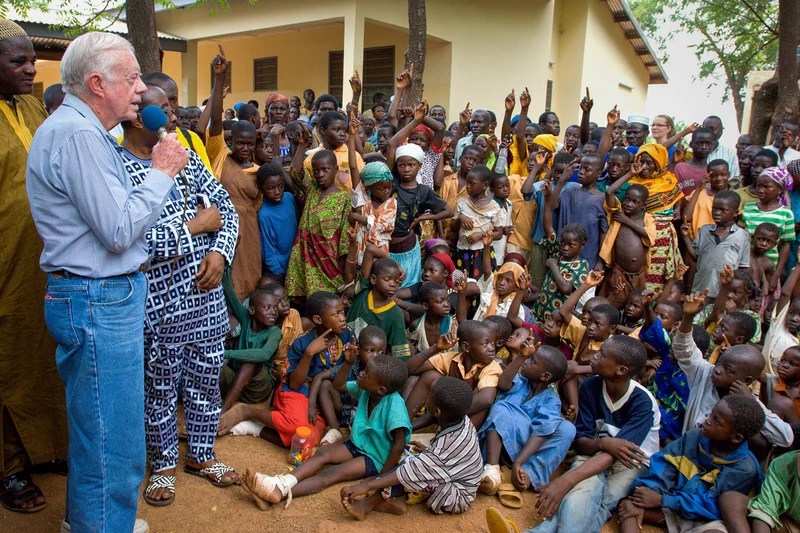
As the world has been celebrating the life of President Jimmy Carter during his time in hospice care, many learned about the long-term good news trend that came as a result of his single-minded focus.

On a 2007 visit to Savelugu Hospital in Ghana, President Jimmy Carter asks a group of children if they’ve had Guinea worm. A raised hand is a yes. (Credit: Louise Gubb/Carter Center)

Jimmy Carter targeted diseases primarily affecting the poor in remote areas — notably Guinea worm disease — and had remarkable success. Because of his commitment, case numbers plummeted from 3.6 million a year to just 13 in 2022.

But we don’t hear that type of news on a daily basis. News has an event bias that comes about for several reasons, including convenience and tradition. This bias is also derived from the fact that events have storylines,

and humans are, to borrow the phrase from Jonathan Gottschall, a “storytelling animal.” That’s why police chases like the infamous one with OJ Simpson were such ratings gold, because it was an event that was overflowing with dramatic tension. We all need to know how the story ends.

Not all trends (i.e., climate change) are good, and we should hear about those as well. But bad events dominate. And even when there is a good trend that relates to the events of the day — such as the holding of the rule of law in spite of right-wing attempts to destroy it — that story gets swallowed up by mainstream media that is an extremely friendly place for conservatism. That isn’t going to change even if the media took the time to reflect on what they’ve done to this country.

Reporting on good, long-term trends can upset the business model for newsrooms. But it doesn’t have to be that way.

Let’s return to the pop quiz. The correct answer, Klaas points out, is 8% or about 1 in 12 people who live in extreme poverty. That sounds — and is — terrible. But the trends are amazingly good.

Two hundred years ago, 80 percent of the world’s population was living in extreme poverty, or four out of every five people. By the 1950s, that figure was about 50 percent, and it didn’t budge for some time. By 1980, not much had changed. 45 percent of the global population was still in extreme poverty. …

By 2000, the proportion had dropped to 26 percent. Two decades later, we’re rapidly heading toward 5 percent. That is astonishing. My parents and I were both born into a world in which roughly 1 out of every 2 people in the world were in extreme poverty, whereas the next generation will be born into a world where that figure is approaching 1 in 20.

Have you ever heard about that on the news?

The news should not just be a passive observer of events. “News should be a conduit for information that helps people make sense of the world.”

So what can we do?

  • First, understand that the world isn’t as bad as you think. News reporting gives you a skewed perspective.
  • Second, push back on bad media coverage. As Oliver Wills notes, “press criticism is a long-held American tradition.” It can be useful in educating others.
  • Third, recognize propaganda for what it is. As Ruth Ben-Ghiat reminds us, “propaganda is never just words, and it goes beyond lying. It is a system of organizing belief so people come to see the world in ways that benefit the leader and his party.”
  • Fourth, don’t give in to a diet of “happy news.” That’s just as dishonest as the aggregation of bad events.
  • Finally, we do need more reporting of “bigger trends and what’s driving them.” Many are invisible, but positive. Look for fact-based news outlets with a point of view designed to help people and protect democracy.

When you think everything is going to hell in a handbasket, Klaas suggests opening up Our World in Data to see some of the incredible progress we’ve achieved.

And then go for a walk.

From Pixabay

More to come…

DJB

Photo by usa from Pixabay.

Room at the table

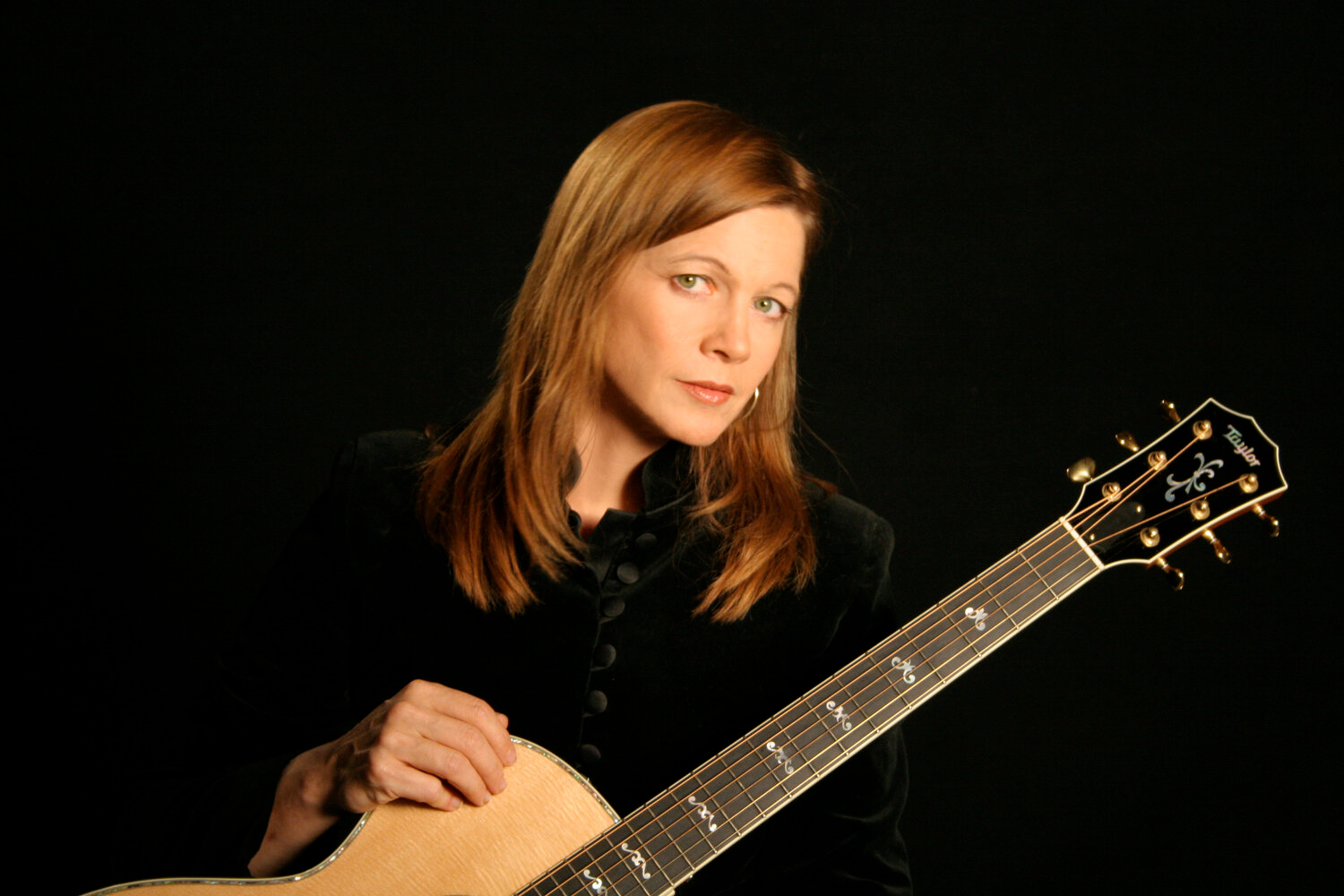
It was the richness of the voice, along with the depth of her spirituality, and the accessibility of her songs, that drew me in when I first heard Carrie Newcomer live in 2014. “We are living moments of grace and wonder, shadow and light,” Newcomer says. These are the moments she captures in her music.

Carrie Newcomer has always explored “the intersection of the spiritual and the daily, the sacred and the ordinary. Over the course of her career she has become a prominent voice for progressive spirituality, social justice and interfaith dialogue.”

It is a voice sorely needed in this day and age.

In her classic I Believe, Newcomer begins by singing,

I believe there are some debts that we never can repay / I believe there are some words that you can never unsay /And I don’t know a single soul who didn’t get lost along the way.

Later, she tells us how she’s sees the ordinary as anything but,

I believe in a good strong cup of ginger tea, / And all these shoots and roots will become a tree / All I know is I can’t help but see, all of this as so very holy.

And near the end, she let’s the listener know that community with people known and unknown — past and present — is here for us to take.

I believe in a good long letter written on real paper and with real pen, / I believe in the ones I love and know I’ll never see again, / I believe in the kindness of strangers and the comfort of old friends, / And when I close my eyes to sleep at night it’s good to say, “Amen”

Newcomer has a side that laughs easily, as on My Dog when singing that she wants to live up to the person her dog thinks she is.

I’m doing the best I can, / At least that’s what I plan. / I’m trying to be the person that / My dog thinks I am.

That tune is from her most recent album, Until Now, which explores the process of unraveling and reweaving the threads of our lives after great disruption, exploring change and transformation with attention to detail and self-compassion.” Yes, it came out during the pandemic.

I Will Sing a New Song, also from Until Now, was inspired by a poem by the same name by the theologian and mystic Dr. Howard Thurman. It is another take on the reweaving necessary after great change.

I will sing a new song. / The old one’s carried me this far and for so long, / But it’s time to walk on, / Lifting up my voice and heart with a new song.

Her ability for sharp observation of the world led the Dallas Morning News to rave, “She’s the kind of artist whose music makes you stop, think and then say, ‘that is so true.'” She has been described as “a soaring songstress” by Billboard, a “prairie mystic” by the Boston Globe and Rolling Stone has declared that Newcomer “asks all the right questions.”

Newcomer often writes about how she has been supported by others, as in this tune from the 2016 album The Beautiful Not Yet. She noted that “Barbara Kingsolver has written about a phrase she uses to encourage her children, ‘You can do hard things.’”

I loved this idea behind this phrase. It absolutely acknowledges the difficulty of the task at hand, and yet, at the same time it completely affirms that the child has everything they need to move forward, and that they have support. I began to think about all the times in my own life that someone has given me that kind of sound advice and encouragement.

When I was writing a post for my most recent birthday, I came across Newcomer’s Leaves Don’t Drop They Just Let Go and was moved by the simple truth of this line:

I’ve traveled through my history.
From certainty to mystery.
God speaks in rhyme in paradox.
This I know is true

There is a wealth of Newcomer music to explore, and I encourage you to do so. But I’ll end with her song and a message from her 2014 album A Permeable Life that is so needed in this time of alienation and hatred.

Let our hearts not be hardened
To those living in the margins,
There is room at the table for everyone.
This is where it all begins,
This is how we gather in,
There is room at the table for everyone.

Author Barbara Kingsolver wrote of Newcomer, “She’s a poet, storyteller, snake-charmer, good neighbor, friend and lover, minister of the wide-eyed gospel of hope and grace.”

That sounds like someone we should all listen to.

Enjoy!

More to come…

DJB

Carrie Newcomer portrait by Jim Krause via carrienewcomer.com

Aligning the way we eat with our values

UPDATE: See below to watch the presentations from these sessions.

The Rev. Dr. Christopher Carter delivers the 2023 Memorial Lecture Series Keynote address at St. Alban’s Episcopal Church in Washington, DC on April 22, 2023

How might you eat in ways that are in alignment with your social and theological values?

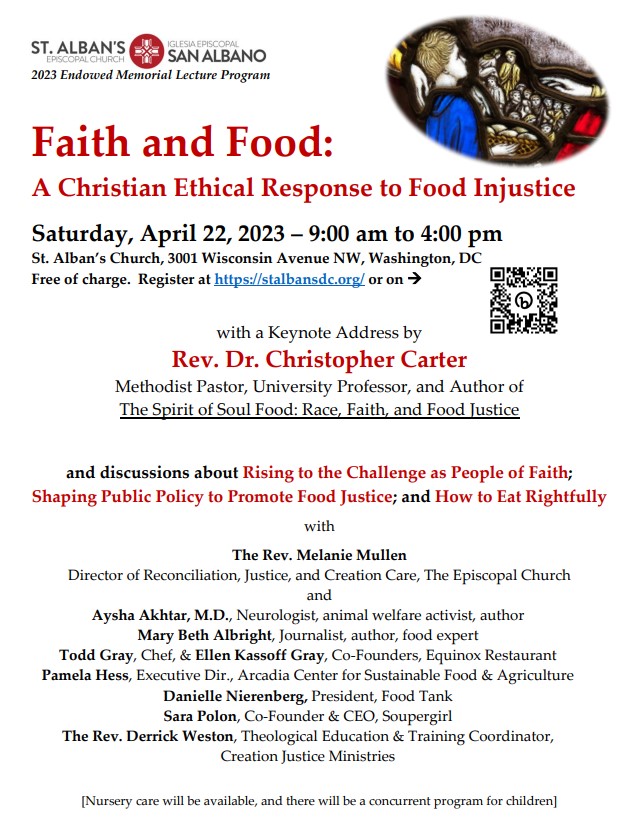
Earth Day 2023 is an especially appropriate time to consider that question with a discussion around ethical responses to food injustice. St. Alban’s Episcopal Church in Washington, DC will be hosting Methodist pastor and theologian the Rev. Dr. Christopher Carter who will keynote a daylong examination of Faith and Food: A Christian Ethical Response to Food Injustice on Saturday, April 22nd.

The event is free and open to all from all faiths (and those with no faith affiliation). You can register by clicking on the QR code in the poster below. If you can’t make it to DC, the event will be livestreamed.

I wrote a review of Christopher’s book The Spirit of Soul Food last fall, and I began by noting that while our food production system has been broken for a long time, many of us have only touched the surface of the problem and seldom in ways that reach across racial and class lines to address systemic issues. Thankfully, my lack of comprehension about an ethical response to food injustice and the impact of our broken production system on communities of color was brought home to me in Christopher’s book.

Christopher gives a short introduction to the program in this St. Alban’s video:

The Spirit of Soul Food: Race, Faith, and Food Justice merges a history of Black American foodways with a Christian ethical response to food injustice. Panelists will address public policy responses to the challenges of food injustice and the very personal issue of how to eat rightfully.

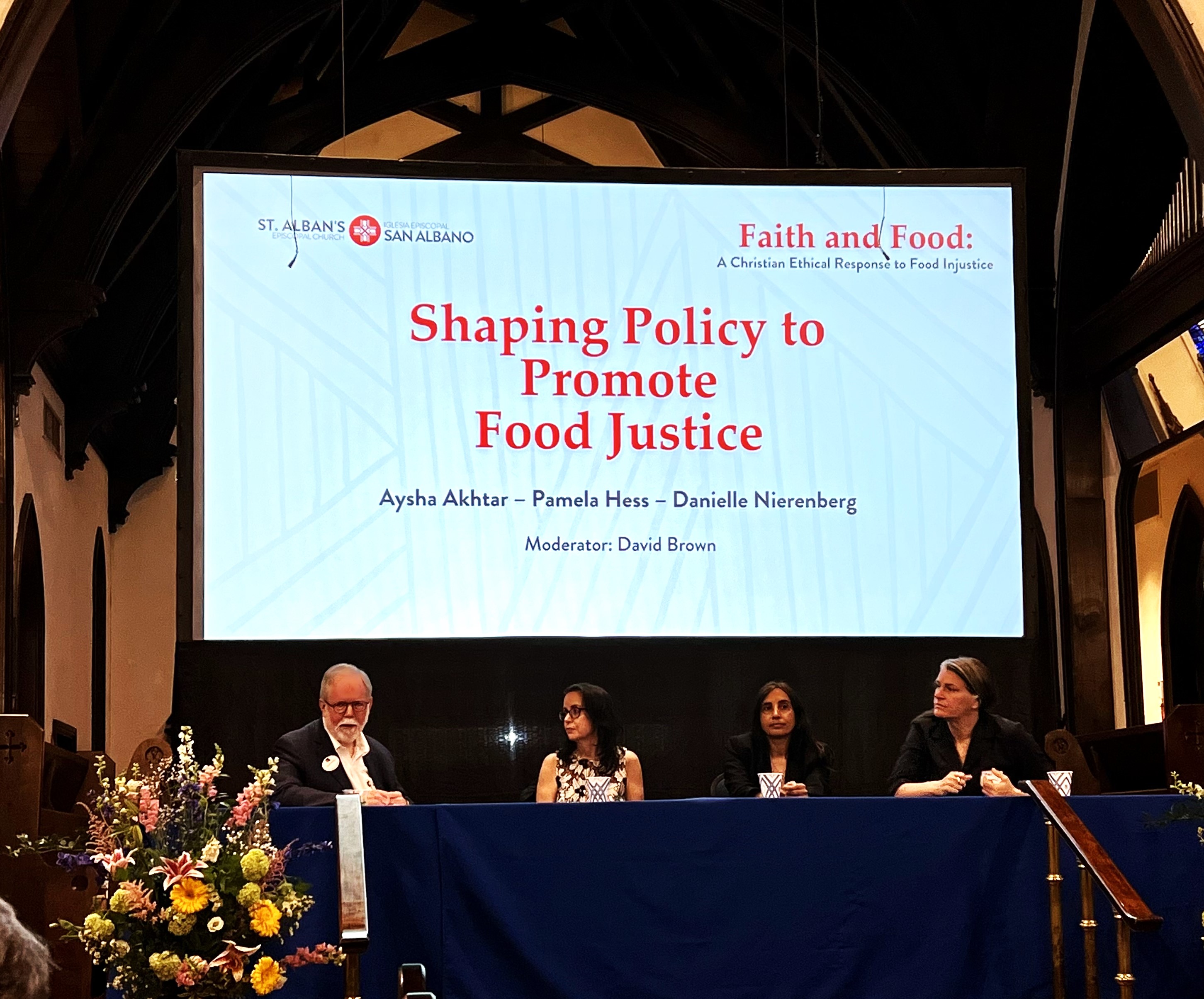
I’m honored to be moderating the “Shaping Public Policy to Promote Food Justice” panel which will feature Aysha Akhtar, MD, MPH, CEO of the Center for Contemporary Sciences; Pamela Hess, Executive Director of the Arcadia Center for Sustainable Food & Agriculture; and Danielle Nierenberg, President of Food Tank. 

As you can see in the poster below, there are a number of other outstanding speakers scheduled for the day.

Full disclosure: I am a member of the Endowed Memorial Lecture Series committee, the group responsible for bringing Christopher Carter to DC and for organizing the day’s events. More important disclosure: I am also very excited about this event!

I hope to see you there!


UPDATE: The morning and afternoon sessions have now been posted on the St. Alban’s parish YouTube channel, and I include them below. The Rev. Dr. Christopher Carter’s keynote address begins the morning session. Our policy panel which I moderated and which featured Dr. Aysha Akhtar, Pamela Hess, and Danielle Nierenberg, opens the afternoon session. These are posted as they were livestreamed.

Morning session featuring keynote address
DJB (left) moderating the Shaping Policy panel at the MLS program with (l to r) Danielle Nierenberg, Dr. Aysha Akhtar, and Pamela Hess
Afternoon sessions with the panels on policy and eating rightfully

More to come…

DJB

Photo by Anya Bell on Unsplash