All posts filed under: Historic Preservation

Citi Field

Ballpark

The latest stop on my quest to visit all 30 Major League ballparks* found me, earlier this week, with a friend at the front gate of Citi Field, home of the New York Mets. It had taken almost an hour by train during the height of the evening commute to get from midtown Manhattan to Flushing. After stepping off the subway, I was disappointed to find the ballpark — home to one of two major league baseball teams in the nation’s largest city — in what was essentially a suburban setting, surrounded by parking lots. The game had just begun so we stopped only briefly to take in the entry rotunda, yet even that short pause made me think of the gateway to Ebbets Field, the famous home of the Brooklyn Dodgers. It was only later that I discovered that the ballpark was in its unfortunate location thanks to that old enemy of urbanism, Robert Moses. And yes, the owners of the Mets had appropriated the Brooklyn Dodgers and the “New York City history of …

The First Baptist Church

Religious freedom and the American experiment

Few things set my father into action more than news of some fellow Baptist or other Evangelical Christian trampling over the doctrine of the separation of church and state in order to advance the views of their personal brand of religion or to persecute a faith community they saw as un-American. That rare breed of liberal Southern Evangelical Christian, my father was a regular on the Letters to the Editor page of the local newspapers, as he worked to tell his neighbors why Baptists—of all denominations—should cherish religious freedom. Just before he died, my father—a proud member of the Religious left—sent in his last letter on the topic, in response to Tennessee’s consideration of naming The Bible the official State Book. As one of his neighbors described the letter to me at his funeral, “It was a good one!” Suffice it to say that Tom Brown would have appreciated Steven Waldman’s new book, Sacred Liberty: America’s Long, Bloody, and Ongoing Struggle for Religious Freedom as a welcome addition to our understanding of this important right. Waldman’s 2019 …

Pullman

Why Labor Day matters

We may hear more about “Back to School” sales this weekend than we do about why we celebrate Labor Day. I’ll do my little part to rectify that problem. Labor Day has been around in one form or another since the 1880s, highlighting the work of trade and labor organizations and their members. However, unions and workers have both taken a beating in recent decades, as financial interests have fought to rollback or restrict the gains made by the working classes over the years. I grew up in the South and saw first-hand the open hostility to unions. The powers that be wanted cheap labor and they used all sorts of tools to ensure that they succeeded. I was reminded of the promise and challenge of Labor Day while reading one of my posts from 2015 on the designation of Pullman, just outside Chicago, as a National Monument. Pullman, if you do not know the history, is a remarkably intact industrial town of historic buildings and landscapes. Located 13 miles south of downtown Chicago, it …

Preserve Cast

History was all around me: PreserveCast podcast of my career in preservation (so far)

“Connection to place is very important to me, and I learned that by walking the streets of Franklin and Murfreesboro, where I grew up.  History was all around me . . . and I’ve always wanted to do something about connecting the past to today.” When PreserveCast host Nick Redding began our recent conversation on the award-winning Preservation Maryland podcast with a question about my path to preservation, my thoughts went to my childhood home, grandmother, and a favorite downtown theatre. That podcast, looking at my work at the National Trust for Historic Preservation and more, can now be found on the PreserveCast website. In a thirty minute interview, Nick and I explore not only how I became a preservationist, but also the various jobs that led to my serving as the Chief Preservation Officer at the National Trust from 2010 until I stepped down from the position at the end of March 2019. “Somebody said that ‘Chief Preservation Officer’ is one of the great titles in the preservation field.  Its not as good as …

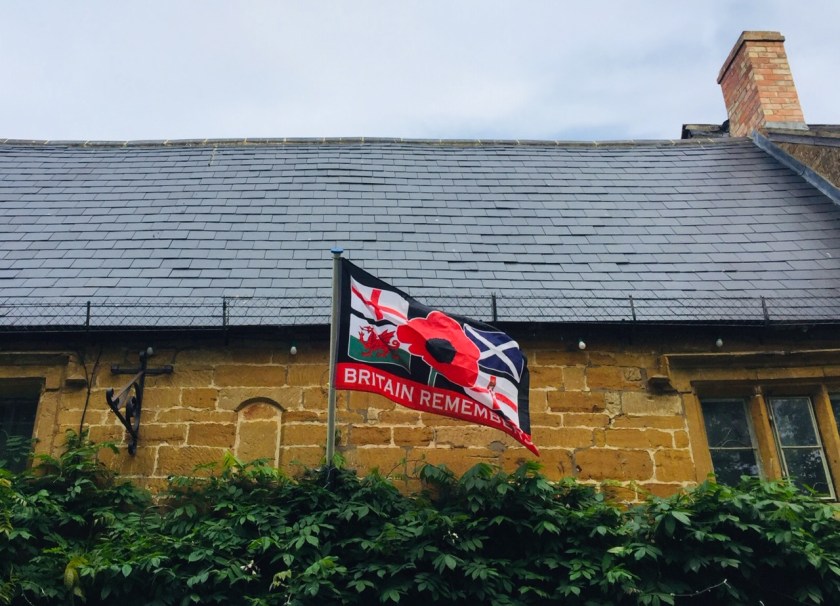
Britain remembers flag

Remembering D-Day

Seventy-five years ago today, almost 160,000 troops from the United Kingdom, Canada, and the United States — including smaller contingents from Australia, Belgium, Czechoslovakia, Denmark, France, Greece, the Netherlands, New Zealand, Norway and Poland — invaded Nazi-occupied Europe on the beaches of Normandy.  Over the next three months of fighting, 209,000 Allied troops would die before the Nazis were pushed back across the Seine. June 6, 1944 — D-Day — should never be forgotten. It was a time when the countries of the world came together to combat bigotry, racism, and hatred.  Many men and women made the ultimate sacrifice in that fight. To be in Britain for the 75th anniversary is a reminder of our better natures.  We began to see the remembrances of the anniversary as we stepped off the bus in the small Cotswald village of Chipping Campden last week.  There, in the center of this beautiful High Street, was a small World War I memorial covered with poppies, the now almost-universal symbol of remembrance for those killed in war. This week, …

Miho Museum entrance

I.M. Pei, Rest in Peace

Eight days before the revered architect I.M. Pei passed away at 102 years of age, I had the opportunity to visit one of his last—and more remote—commissions:  the Miho Museum in Japan. Standing amidst the Shiga mountains in a protected nature preserve, Pei’s Miho Museum, which opened in 1997, fits in well with the other modern yet very accessible works of this master who left an indelible mark on the world before his passing on May 16th of this year. Pulitzer Prize-winning architectural historian and author Paul Goldberger wrote a lovely obituary for Pei in the New York Times, capturing  the architect’s expansive work and spirit.  When thinking of Pei, my mind naturally turns to the beautiful East Building of the National Gallery of Art in Washington, D.C., a museum I’ve visited many times.  One feature that always brings a smile to my face wasn’t exactly designed by Pei.  Etched into the stone is a listing of all those who made the East Building possible—politicians, National Gallery leadership, architects, and more.  At one point the beautiful …