All posts filed under: Historic Preservation

We Shine a Light on the Past to Live more Abundantly Now

This week at the National Trust, we are preparing to host the 2017 PastForward national preservation conference in Chicago.  Long-time colleagues and new friends who care about the past and the places that bring that past into the present will gather from all across the country.  I suspect that we’ll share thoughts that challenge the conventional wisdom, offer support for a broader understanding of the American story, and come away with a new appreciation for the work that takes place by preservationists and by those who don’t (yet) identify as preservationists. Why do these people gathering this week in Chicago care about the past?  And what’s with that name, PastForward? In a recent conversation that included Pulitzer Prize-winning historian Annette Gordon-Reed, (The Hemingses of Monticello: An American Family), journalist and author Krista Tippett summed up the answer to those questions with her opening line:  “In life, in families, we shine a light on the past to live more abundantly now.” I think that’s a great summation of why so many of us will gather this …
Complicity in a Shared Work of the Imagination

Last week I had the privilege of launching the National Trust’s National Treasure campaign for Clayborn Temple, a landmark in the history of the Civil Rights movement.  It was here where Memphis sanitation workers gathered in 1968 and decided to go on strike, marching with their “I Am a Man” signs that became a potent symbol for all that is at stake in the fight for equal justice.  Clayborn Temple was where the leadership of The Rev. Dr. Martin Luther King, Jr. transformed the strike from a local labor dispute into a national issue, effectively tying the sanitation workers’ cause with the national issues of economic justice and racism. It was to Memphis and Clayborn Temple that Dr. King was returning when he was struck down by an assassin’s bullet. To be in that sacred space with more than 150 Memphis residents, young African American poets and musicians, revered spiritual leaders who walked with the sanitation workers, preservationists of all ages, and current members of the workers’ union was an honor and a reminder of …

The Revenge of Analog: Real Things and Why They Matter

I recently finished David Sax’s new book The Revenge of Analog:  Real Things and Why They Matter.  Appropriately, I bought my hard-back copy in that most analog of places—Portland, Oregon’s Powell’s City of Books—the nation’s largest independent bookstore. Sax, a business journalist from Canada, posits that “while digital technology has certainly made life easier, the analog technologies of old can make life more rich and substantial.”  He argues that in today’s digital world, analog is making a surprising comeback.  What are those analog technologies?  Notebooks and paper.  Vinyl records.  Film.  Board games.  (Vintage Game Night at the Woodrow Wilson House, anyone?) He also looks at the comeback of analog “ideas” in areas such as printing, retailing, and education. Some of Sax’s examples strike me as first-world games of the highly educated. However, as I thought about the tactile nature of the pages as I read, I realized that he had an important point about the impact of real things in our lives. About two years ago I stopped purchasing e-books and have returned to buying …

Cooper-Molera Garden

To learn something new (about old places), bring in new partners with different perspectives

At the National Trust for Historic Places, where I work, we believe that historic sites are fundamentally places of intersection. When we allow them to share their stories, historic sites are dynamic spaces where past, present, and future meet in a variety of ways.  One very important way they intersect is with community. About ten days ago, I visited Cooper-Molera, one of our National Trust historic sites where delight and enjoyment are at the heart of our community intersections.  Cooper-Molera is a two and one-half acre property in the heart of downtown Monterey, California’s historic commercial district. There we are implementing a new model that combines commercial uses and interpretation in creative ways.  We will have a bakery, restaurant, and event center in adaptively used historic buildings operating in collaboration with museum uses in one of the adobe residences to reinvigorate the site, sustain it financially and engage audiences that might never visit a historic site or house museum. Those are the people we should all want to meet at this intersection. We call this …

Emotions Flow Through Places – Thoughts After Charlottesville

Last week I referenced Dr. Mindy Fullilove’s book Root Shock with a story that spoke to how emotions flow through places.  I wrote before the events in Charlottesville—and the reactions to that weekend—brought place, memory, and emotion to the forefront of our national conversation. Stephanie Meek’s statement on Confederate memorials and the confronting of difficult history speaks to how emotions that arise from place are not always built upon strong, positive memories.  Of course, Dr. Fullilove understands this all too well.  Root Shock is focused on the difficult history of urban renewal, something seen in Charlottesville’s destruction of the African-American community of Vinegar Hill in the 1960s.  At the Trust, as Stephanie notes, “we believe that historic preservation requires taking our history seriously. We have an obligation to confront the complex and difficult chapters of our past, and to recognize the many ways that our understanding, and characterization, of our shared American story continues to shape our present and future.”  That is especially true of our Civil War history, and the fact that many of …

Ebbets Field

Emotions flow through places

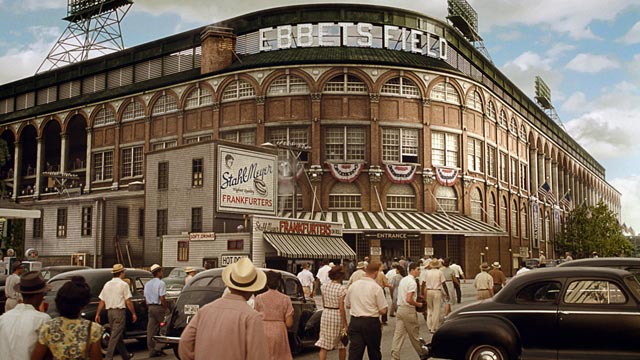
It will surprise no one that I read a couple of baseball books and watched several games while on vacation.  But it may surprise you to know that the best piece of writing I read which included baseball as its subject came from the opening pages of psychiatrist Mindy Fullilove’s 2004 book Root Shock:  How Tearing Up City Neighborhoods Hurts America, and What We Can Do About It.  She begins chapter one with several powerful paragraphs.  I’m going to quote extensively from those two pages. “Every once in a while, in a particular location and at a particular time, people spin the wheel of routine, and they make magic.  One such location was Ebbets Field in the heart of Brooklyn, where, through World War I, the Roaring Twenties, the Great Depression, World War II, and the postwar struggles for equality in America, hard-working people enjoyed baseball.  That small, unpredictable, and intimate ballpark was a gallery for characters to strut their stuff, and the characters in the stands took as much advantage of the opportunity as …

The Bad-Ass Librarians of Timbuktu

Virtually every reviewer of this 2016 work about the race to save some of the world’s most precious ancient manuscripts calls out the “unfortunate” or “inappropriate” title. And they are right. But then, in the comments section, reader after reader says something to the effect of “I wouldn’t have read this book (or your review) except for the title.” And they are right.   So there you have it.  Don’t let the title turn you off of this marvelous little book.  But also, don’t go into the work thinking that the librarians of Timbuktu are a modern-day version of Indiana Jones.  The tale is good enough on its own, but I suspect the author (and his publishers) thought that “The Very Persistent and Dedicated Librarians of Timbuktu” simply wasn’t going to set books flying off the shelf. Joshua Hammer, a former bureau chief for Newsweek who now serves as contributing editor to Smithsonian, is a talented writer who combines a strong journalism sense, travel writing sensibilities, a grasp of the culture and disputes of a …