All posts filed under: Monday Musings

Defining our democracy

“The good things in our nation did not come about by chance, and they will not be preserved by indifference.” The Rev. Dr. Deborah Meister I’ve said it before, and I’ll say it again: Keeping a democracy takes work. Disuse of democracy by a careless majority is cause enough for worry in a world of constant struggle between tyranny and freedom. But when that indifference is coupled with a deliberate effort by a wealthy minority to undermine the public good for private gain, we find ourselves at a point where Americans are in danger of having government by the people smothered by an oligarchy focused on the enrichment of the few and the repression of those who disagree with them. America as an idea is a work in progress, with an eye on the prospects for the future. At our best, we are always growing, always becoming, as we move toward that more perfect union. But we are not always at our best. The history that really happened, as opposed to the history we’ve told …
The struggle between tyranny and freedom

America faces great challenges in 2020. It is even tempting to call these times unprecedented, but they are not. Harry Truman, of course, made this point in very plain language: “It was the same with those old birds in Greece and Rome as it is now. . . . The only thing new in the world is the history you don’t know.” As Samuel W. Rushay, Jr. wrote about Truman’s understanding of history and the threats to democracy in the 1940s, “(H)is understanding of history provided him with a wider perspective on communism, whose assault on democracy was, in the words of historian Elizabeth Edwards Spalding, the ‘current form of a timeless struggle on earth’ between the forces of tyranny and freedom.” We have seen that struggle between tyranny and freedom over and over again here in America. I was reminded of that feature of American life during my summer break, as I read of one particular moment in that struggle as told in Edward Achorn’s fascinating new book Every Drop of Blood: The Momentous …

The long haul

Only a few weeks into the pandemic, Leonard Pitts, Jr. — a Pulitzer Prize-winning columnist with the Miami Herald — noticed a change in the behavior of certain segments of the country. In the response to COVID-19 and the question of when and how the nation’s economy should be reopened, he observed that as a country, “(W)e seem to have tapped the U.S. Strategic Stupid Reserve. The result has been a truly awe-inspiring display of America’s matchless capacity for mental mediocrity.” Leonard Pitts, Jr., Miami Herald, April 24, 2020 This is one strategic reserve where the well never appears to run dry. Heck, in April we were just beginning to draw down on the stupid. I don’t have enough patience to cover even 1% of the calls upon this reserve since then, but one recent examples will suffice. Who would have thought back in April that this administration was going to smear the director of the National Institute of Allergy and Infectious Diseases in the press while the president “was praising the public-health stylings of …

Pathway Free-Photos

The lens is not the landscape

How did you respond when you first discovered the many ways there are to view the world? For some, this isn’t a problem. From an early age they have looked at the world through a particular set of glasses, assuming that their view is the correct one. They learn how to describe what they see in terms that others who wear the same glasses understand. And unless they have some life-changing jolt — perhaps a worldwide pandemic that doesn’t care about their nationality, religion or political ideology; or an especially graphic picture of systemic racism that refuses to be ignored — they never ask questions about the things that are not clear. But for those who see another perspective or choose to try on different pairs of glasses, all of a sudden they realize that their world view is not the only one. They have to choose how to respond. Buddhist monk Thich Nhat Hanh describes this broader existence when he notes, “While living the life of a wave, the wave also lives the life …

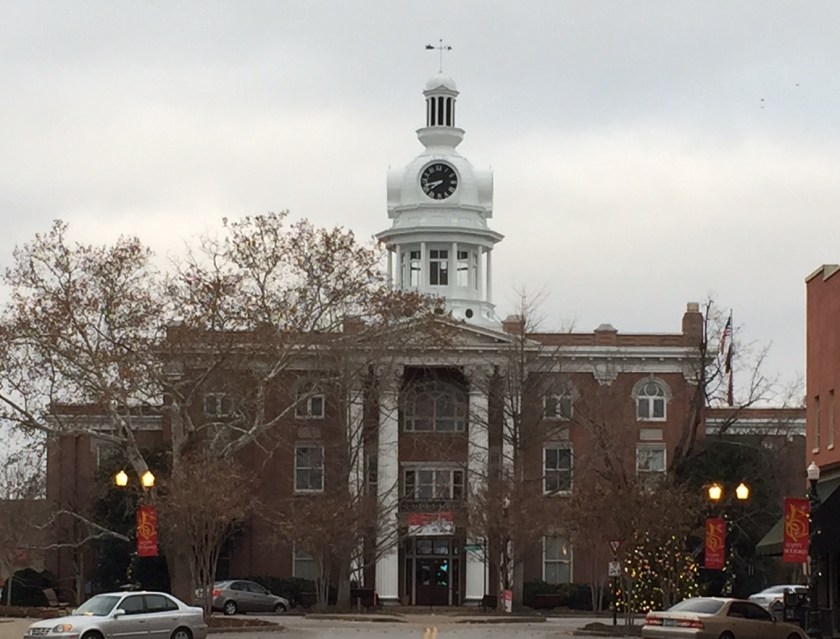
Rutherford County Courthouse

Places and perspectives

Are you afraid? It was an era when those protesting for civil rights had moved from nonviolent techniques to more confrontational stances, and the nightly news carried stories and photos of clashes in cities across the country between the police and protesters. The tribal nature of our communities was coming into focus for everyone to see. While we lived on Main Street, our neighborhood was mixed both economically and racially. And here I was, playing pickup basketball on a local court, when a player on the opposing team asked me that question. He wanted me to acknowledge that I was the only person scuffling around on the asphalt, shooting at hoops with torn nets and battered backboards, who was not African American. The question insinuated that I should feel out of place and uncomfortable and was followed by another: Don’t you feel scared? Playing on the local courts as a young teenager with whatever group of neighborhood kids came along was just what I did. “No,” I replied. I knew most of these guys, and …

Finding your potential: Aging in a time of turmoil

I recently dove into two books on aging. It wasn’t because I felt old, aged, infirmed, or any of those descriptors we often use when talking about the elderly. However, I can read a calendar, and I recognize that I can’t claim to be middle age when no one lives to be 130 years old.* My study began just as the global pandemic struck, with the coronavirus focusing so much of its potency on the vulnerable and those 60 years of age and older. I finished the second book as the nation roiled from both the largest economic downturn since the Great Depression and the injustice that was highlighted in the grotesque and brutal deaths of black men, women, and children at the hands of the police. Whether I liked it or not, I was forced to think about aging in a time of turmoil. Talk about your inauspicious timing. In light of current events, I quipped to some friends that these book choices could be interpreted as: a sign of naiveté, a sign of …