All posts filed under: Monday Musings

Thoughts to start off the work week

Courage

Refuse to be afraid

In anticipation of next Sunday’s Super Bowl game, I’m going to pass along a football story.  However, those who know me well know that I don’t watch much football, so this tale will come via a baseball source, Pittsburgh Pirates manager Clint Hurdle as recounted in the book Big Data Baseball.  (And if you don’t want advice from a sports figure, just jump to the bottom for a little Tolkien.) According to the book’s author, Hurdle recounted the following story for his team after a difficult patch of games: “Tim Wrightman, a former All-American UCLA football player, tells a story about how, as a rookie lineman in the National Football League, he was up against the legendary pass rusher Lawrence Taylor.  Taylor was not only physically powerful and uncommonly quick, but a master at verbal intimidation.  Looking Tim in the eye, [Taylor] said, “Sonny, get ready.  I’m going left and there’s nothing you can do about it.” Wrightman coolly responded, ‘Sir, is that your left or mine?’ The question froze Taylor long enough to allow …

The Healing Powers of Connection

Several years ago Candice was recovering from a severe concussion and was home bound for several months. During that time a friend gave her a small book, thinking she might relate to Elisabeth Tova Bailey’s story of isolated recovery from a mysterious illness. We had not thought about that gift for a long time until I went looking for a short read to pack on a recent trip.  I happened upon Bailey’s The Sound of a Wild Snail Eating and was immediately captivated by this strange yet reassuring tale. To summarize the book might lead friends to question your reading choices. Bailey – an active and curious woman of 34 – contracts a mysterious disease while vacationing in Europe and finds herself bedridden and unsure that she will live.  A wild snail arrives in the bedroom where she is convalescing, brought in by a friend and placed in a pot of field violets. Over twelve months – and 178 pages – Bailey watches the snail explore its terrain, eat, sleep, eventually hatch 118 offspring, and …

Nothing Can be Changed Until it is Faced

Last week, President Obama named the A.G. Gaston Motel (a National Trust National Treasure), the 16th Street Baptist Church (site of a bomb attack in 1963 that killed four young girls), and other places near them as part of the new Birmingham Civil Rights National Monument.  Made on the eve of celebrating the Martin Luther King, Jr. holiday, the president’s designation was a good reminder of the importance of why we protect places that tell difficult stories from our past. A few weeks ago I finished reading a powerful book that harkened back to the work and writings of The Rev. Dr. Martin Luther King, Jr.  Michelle Alexander’s The New Jim Crow:  Mass Incarceration in the Age of Colorblindness is a work that demands a response from the reader and is not easily dismissed. In the book’s foreword, Cornel West alludes to the link between Alexander’s work and Dr. King’s core beliefs.  King called for us to be “lovestruck with each other, not colorblind toward each other. To be lovestruck is to care, to have …

Clarity

John Schuerholz was elected to baseball’s Hall of Fame a few weeks ago.  (For those who don’t care about baseball, stick with me…this really isn’t about baseball.)  Schuerholz, as general manager (GM) of both the Kansas City Royals and the Atlanta Braves, took both teams to World Series titles.  GMs are the puzzle-masters of baseball, hiring the talent both on and off the field while negotiating with the owner to build a successful franchise. Schuerholz began his career as a high school grammar, composition, and geography teacher. It was there – according to writer Joe Posnanski – that Schuerholz learned the importance of clarity. “This was the great gift of John Schuerholz, the commanding instinct that helped make him one of the most successful general managers in baseball history. He sought clarity. He demanded clarity.”  Posnanski notes that great teachers seek clarity.  “There is the well-reasoned answer and the chaotic flood of words meant to obscure the fact that the student didn’t do the work.” Last week I wrote about the wandering mind while today I’m …

Wandering (Think Jar Collective)

I was trying to daydream but my mind kept wandering*

New Years is the time when many of us make resolutions.  We promise ourselves to focus on losing weight, reading more books and watching less television, being mindful in the present.  One of my personal perennial chestnuts in recent years is to avoid becoming a grumpy old man. So with all this attention on focus, why was I so excited to find a book on the wandering mind to read over the winter holidays?  Because “It seems we are programmed to alternate between mind-wandering and paying attention, and our minds are designed to wander whether we like it or not.”  That sure rings true in my life experiences. Are you still with me? In The Wandering Mind:  What the Brain Does When You’re Not Looking, author Michael C. Corballis argues that “Mind wandering has many constructive and adaptive features – indeed, we probably couldn’t do without it.  It includes mental time travel – the wandering back and forth through time, not only to plan our futures based on past experience, but also to generate a …

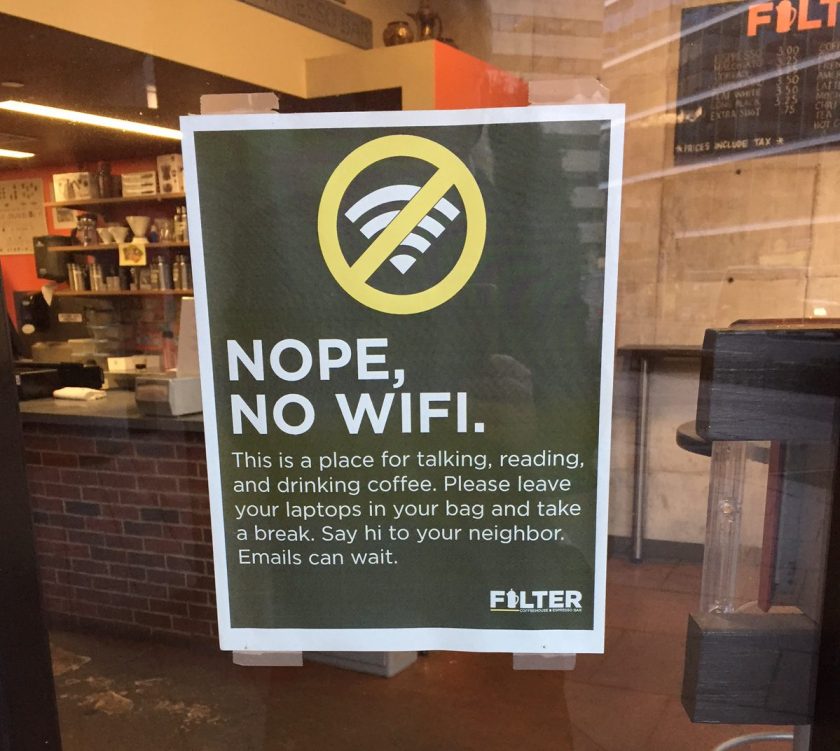
No WiFi

Be civil, be urban

Each morning on my walk to our offices at the Watergate, I stop off at Filter coffeehouse for a coffee to begin the work day.  What first drew me to this particular coffee shop on I Street, NW between 19th and 20th (as opposed to the 15 others I pass in my 25 minute walk) is the sign on the door.  It reads, simply, “Be Civil, Be Urban.” I was intrigued.  My interest was really piqued when I stepped inside and found urban planning books and architectural models on the bookshelf, a prominent “Nope, No WiFi” sign, and a quote on the wall from architectural historian Spiro Kostof that reads, “Civilization, in this strict sense, is the art of living in towns.” Living and working in groups – in towns, cities, and organizations – led us to move toward a civilized society.  But civilization is not guaranteed. How we live and work together is a key to productivity, learning, growth, and happiness.  Civility is — unfortunately — in short supply in much of our national …

Relevance

Nina Simon, the Executive Director of the Santa Cruz Museum of Art and History, gave a powerful TrustLive talk at the recent Houston PastForward conference on place and relevance.  She defines relevance as a key that unlocks meaning, opening doors to experiences that matter to us, surprise us, and bring value into our lives. In her book The Art of Relevance, Nina applies two criteria to all the stories she tells about relevance.  First, how likely new information is to stimulate a positive cognitive effect – to yield new conclusions that matter to you.  Second, how much effort is required to obtain and absorb that new information.  The lower the effort, the higher the relevance.  As those of us who heard her speak know, she frames this work in terms of doors and keys that help different groups access rooms of information.  To understand individuals different from us, we have to go outside our rooms and look – with empathy – at the views of the community outside the door.  We have to learn from …

Pearl Harbor Day

A couple of years ago I wrote a post called Why We Memorialize and Remember Sacred Places on the reasoning behind my decision to cite December 7, 1941, as my top candidate deserving of the descriptor “The day the world changed forever.” I thought it would be a good post to share again – here on Pearl Harbor Day.  Memorials are about memory, which is “an essential part of consciousness” as quoted in my colleague Tom Mayes’ series of essays on Why Do Old Places Matter? In this day and age, we glorify the individual and forget that it is the collective – the community – that holds us together.  Places such as the U.S.S. Arizona memorial – and I would argue the Waikiki Natatorium War Memorial – are indeed “places where moments in personal history become part of the flow of collective history.”  History that transcends individual experiences and lifetimes. It is important to remember that we are judged not just by what we build, but by what we choose to save and remember …

Duffle bag

The real voyage of discovery

I was in college before I took my first airplane ride – a trip from Nashville to Philadelphia for (no surprise here) the 1976 National Trust Preservation Conference.  It was probably another ten-to-fifteen years after that before I traveled outside the U.S. Growing up in a large, middle-class family in Tennessee in the 1950s and 1960s, we didn’t just jump on an airplane when we felt the urge. My children find this difficult to comprehend, since they took their first flight at 6 months of age, and by the time they were in college the number of countries they had visited required both hands to count.  When I tell them that my grandparents probably stayed in Tennessee their entire lifetimes, they begin to recognize the dramatic changes that take place from one generation to the next. I’ve been working to make up for lost time when it comes to travel.  Both personally and professionally, I have the opportunity and privilege to travel to many places both in the U.S. and around the world.  I was thinking …