All posts filed under: Recommended Readings

Beach Reading

Think before you speak. Read before you think

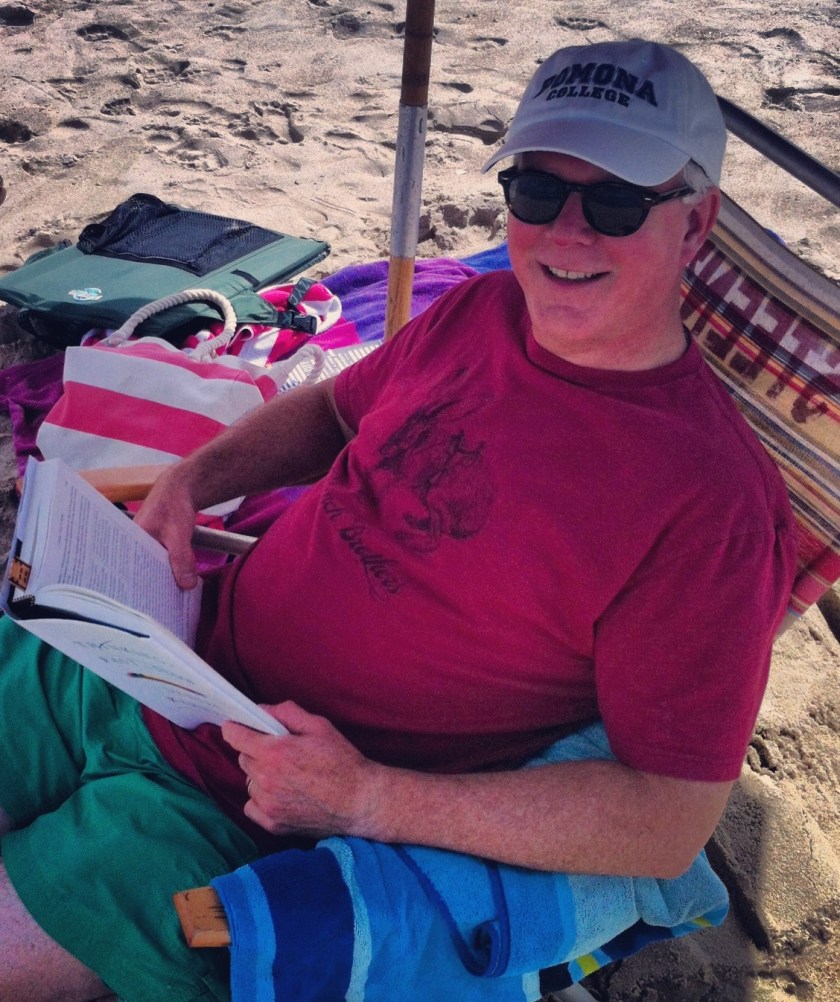
Author Fran Lebowitz once wrote, “Think before you speak.  Read before you think.” I’ve been thinking about reading recently, because I will be out of the office as I complete the final two weeks of my sabbatical and link that with some personal days off. I have the opinion that summer reading lists should be light, but that may simply be an excuse to read another baseball book.  Since this time is tied to my sabbatical, I’m going a bit more serious this August and I thought I’d share a few of the books which will be on night stand. (Regular readers can expect “mini reviews” in the coming weeks.) Bending the Future:  50 Ideas for the Next 50 Years of Historic Preservation in the United States (Edited by Max Page and Marla R. Miller) – This brand new work from the University of Massachusetts Press contains a wonderful introductory essay and then 50 short contributions from practitioners, academicians, journalists, community activists and more. I’m looking forward to digging into this work as one more …
The Age of Wonder

During high school graduation ceremonies for Andrew, one of the speakers built her remarks around a relatively new work at the time that captured the love of knowledge and learning. Five years later, I finally  picked up Richard Holmes’ The Age of Wonder (first published in 2008).  Sometimes it takes a while, but I try never to pass up a good book recommendation. And I’m so glad I did.  The Age of Wonder is a terrific work which looks at the growth of science in the Romantic Age.  Holmes tackles this broad topic with a blend of history, biography, art, science, and philosophy. In 500 pages that seem to fly by, the reader follows the intertwined stories of such historical luminaries as astronomer William Herschel and his sister Caroline, botanist Joseph Banks, chemist Humphry Davy, and writers such as Mary Shelley, Samuel Taylor Coleridge, and John Keats. The book rightly received stellar reviews from the start, which I cannot top.  “Flat-out fascinating,” “groundbreaking,” and “superlative” are just a few of the descriptions applied to this …

Men Explain Things

Letting experience be larger than knowledge

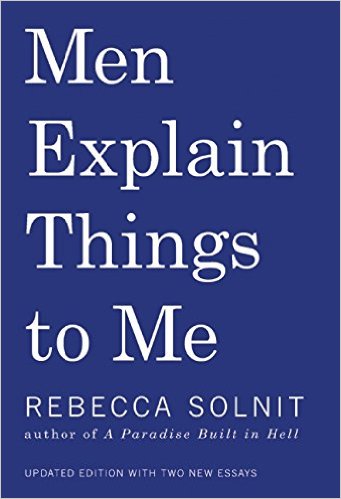
I just completed reading a thoughtful collection of essays by the writer Rebecca Solnit.  Titled after the first in the collection and her best-known essay – Men Explain Things to Me – these nine pieces written between 2008 and 2014 explore multiple topics including the gender wars and male privilege, the use of violence as a way of silencing speech, abuse of power, a new twist on marriage equality, and more.  Through them all, Solnit pushes the reader to consider perspectives that are likely to be outside their  comfort zone. A colleague forwarded the link to the Men Explain Things to Me essay several weeks ago after I referenced Solnit’s book Wanderlust: A History of Walking. (Also highly recommended.) The essay begins with the comic scene of a man explaining Solnit’s most recent book to her – even though he never read anything more than the New York Times book review of her work. But as noted on Solnit’s website, she ends this essay “on a serious note— because the ultimate problem is the silencing …

Basilica di Santa Maria

Observations from the road: Scenes from Holy Week in Rome

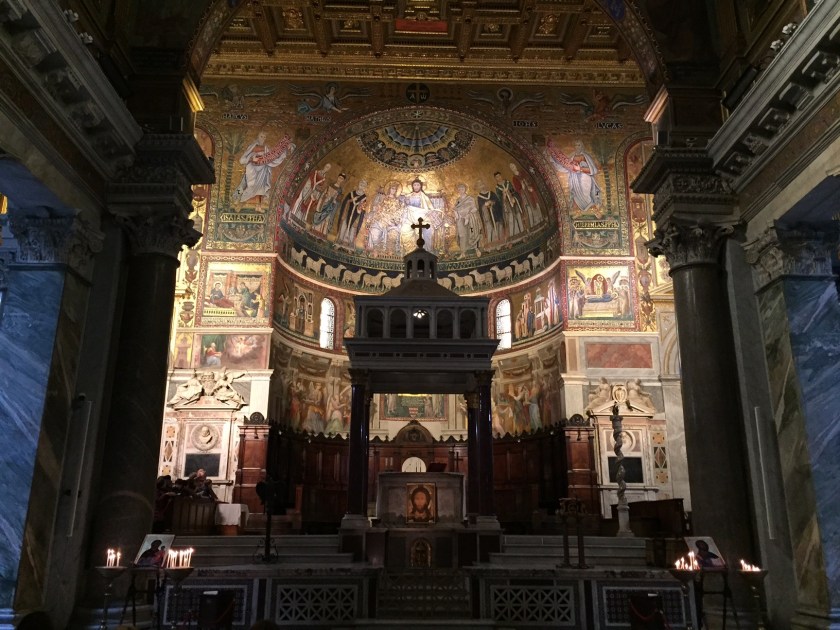
Sorry.  No pope sightings (or even attempts at pope sightings). We have had a relatively low-key Holy Week while in Rome, but that doesn’t mean it hasn’t had its memorable moments. Olive Trees and Palm Sunday:  Our week began last Sunday with a Palm Sunday processional at the neighborhood Basilica di San Pancrazio in Monteverde.  A 6th century basilica that was extensively renovated following Garibaldi’s 1849 attack on Rome, San Pancrazio was a lively place last Sunday. We met about a block away from the basilica and followed priests and musicians through the streets, waving olive branches in place of the palms we see in the United States.  During the service, conducted (of course) entirely in Italian, we only understood the occasional word. But we knew the shape of the liturgy and could follow along without getting lost.  The nave was filled with worshipers, while the aisles were used by parents and nuns to walk or stroll young children throughout the service.  The music was similar to Catholic folk masses in the U.S. these days …

My Own Personal Spring Training

As I post this, the clock on Spring Training Countdown (motto:  Winter Bad. Baseball Good.) reads:  4 days, 7 hours, 37 minutes, 7 seconds.  It is clear I don’t have much time to get in shape for the season! My own personal spring training generally consists of reading a new baseball book and re-watching Bull Durham (best baseball movie ever).  However, our tape/CD player is broken (I know, we’re old school), and so I had to improvise and instead read two baseball books.  It is tough duty, but sometimes you’ve got to do what you’ve got to do to get into shape. I began with 2015’s Big Data Baseball: Math, Miracles, and the End of a 20-year Losing Streak by Pittsburgh writer Travis Sawchik. This is a terrific book about how the 2013 Pittsburgh Pirates, stumbling along in a 20-year losing streak (remember Sid Bream and Barry Bonds and Skip Carey’s classic 1992 “They may have to hospitalize Sid Bream” call) turned around their fortune as a baseball club.  The Pirates did it using big-data …

A Republic, If You Can Keep It

When asked, following the Constitutional Convention, what kind of government had been created, Benjamin Franklin made a now famous reply.  “A republic, if you can keep it.” Those words have been on my mind a great deal in recent weeks.  I wonder why? Could it be the calls from those who want us to seal the borders, shut off all immigration into the U.S., and deport 11 million individuals?  Could it be presidential candidates saying – when a decision is made that recognizes that we are a secular nation and not based on religious law – that we have “criminalized Christianity?” Could it be the calls to register Muslims and to reopen the internment camps of WWII?  When I hear these speeches, I’m reminded of the late great Molly Ivins’ quip about Patrick Buchanan’s famously combative “culture wars” speech at the 1992 Republican National Convention:  It probably sounded better in the original German. But that’s not why I sat down to write. I’ve read three books over the past couple of months that all bring …

Beach reading

Summer reading 2015

This has been a busy summer, full of travel, family changes, work, and good food!  During the past three months, I’ve also had a chance to read a few books – a couple just okay, one interesting, and one terrific.  So here’s a short summary, from mediocre to recommended. The Language of Houses: How Buildings Speak to Us, by Alison Lurie.  I picked up this 2014 book – with its promise to highlight how buildings speak to us in ways simple and complex, formal and informal – with great anticipation.  Written by a Pulitzer Prize winning author, I expected great – or at least good – writing that would pull me along.  Unfortunately, I found it a simplistic and rather bland work that I had trouble finishing.  This is a topic that holds a great deal of promise.  Unfortunately, Lurie’s work doesn’t deliver. The House with Sixteen Handmade Doors:  A Tale of Architectural Choice and Craftsmanship by Henry Petroski.  I bought  this quirky work in Seattle while on my cross-country trip with Claire in 2014.  …