All posts filed under: Recommended Readings

Measure What We Value

We measure a great deal in the modern office environment, and the nonprofit world is no different.  Finding the right measurement to capture what is truly important, however, takes time and thought.  Profit for a business is easy to track, but in the mission-driven world of nonprofits the right outcomes can be hard to quantify. I was thinking of this while wrapping up James Williams’ Stand Out of Our Light:  Freedom and Resistance in the Attention Economy.  In looking for ways to set boundaries for attention-grabbing technology, Williams turns to measurement as one key.  He begins by noting, that “Our goal in advancing measurement should be to measure what we value, rather than valuing what we already measure.” How do we, both as individuals and as staff members of a large organization, do this work?  How do we measure what we value?  Williams has a suggestion on the organizational or corporate scale:  measure the mission.  If we “operationalize in metrics the company’s mission statement or purpose for existing, which is something nearly every company has …


Not Your Summer Reading List

Summer reading lists can be fun. I’ve enjoyed compiling my annual list since I started this blog ten years ago. I also enjoy reading lists developed by others, as you often get insights into both great new books and the thoughts of the individual who passes along recommendations. My criteria for good summer reading lists include:  they must be focused on a short period of time when the compiler is away (e.g., for an August vacation), and the reading can’t be too heavy, as there are 10 other months to read tomes about how the world is going to hell in a handbasket. What follows is not a summer reading list. I’ve fallen so far behind in updating readers about the books I’ve found interesting, challenging, refreshing, and—yes—troublesome that I’ve decided to take a Twitter-like approach and provide two-four sentence summaries of everything I’ve read between Memorial Day and Labor Day this year.  Since I can’t remember the order in which I read them, I’m listing them in alphabetical order (by author).  Let me know …

Lone Cypress

Pacific Grove-by-God

For several years I’ve regularly traveled for work to Monterey, California, a small coastal city some two hours south of San Francisco. So when we went looking for a west coast destination for this year’s family vacation, I suggested we check out the Monterey Peninsula.  Now that we’ve wrapped up a week-long visit to Pacific Grove—next-door neighbor to the city of Monterey—we’re just coming to realize how much we’ve seen and explored in this new (to us) part of the world. Let’s begin with the coastline, the attraction to visitors for thousands of years.  I awoke every day shortly after 6 a.m. and went for walks of as much as two hours along the well-used (and well-loved) Monterey Bay Coastal Trail.  Pacific Grove’s portion of this 18-mile trail, which follows the path of the old Southern Pacific Railroad train tracks, hews close to the water and rock-strewn coastline, while Monterey’s comes inland a bit to incorporate Cannery Row, the Monterey Bay Aquarium, and Fisherman’s Wharf.  My walk often began before sunrise and was shrouded in …

Playing my Running Dog

Think slow

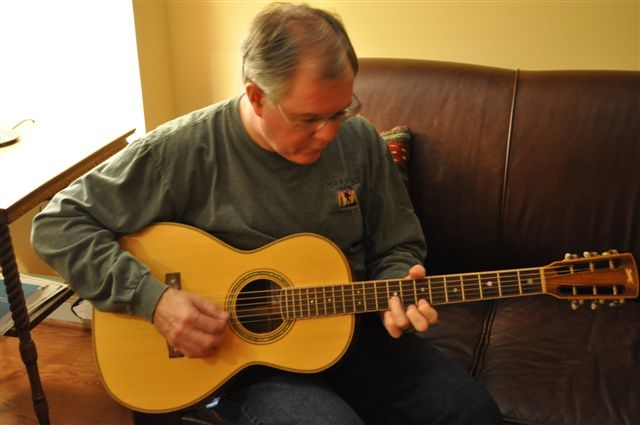
Our 15-year-old nephew — a budding musician — was in town this past weekend, so I took him to the House of Musical Traditions in Takoma Park. There he could see every type of musical instrument known to humankind (plus some) and, frankly, it gave me an excuse to play a few good guitars.  Not that I don’t have good guitars at home.  Later in the day my nephew had a chance to see and play my two prized Running Dog guitars made by luthier Rick Davis. Davis was profiled in Tim Brookes’ 2005 book Guitar:  An American Life, where the author seeks to replace a badly damaged first guitar with a hand-crafted one “for the second half of my life.”  He writes that as he nears 50 years of age, he finds an itch that can only be scratched with a new guitar.  And as Brookes notes, “Guitar makers even have a word for these baby-boomers-who-always-wanted-to-be-great-guitarists-and-now-have-the-money-to-indulge-those-dreams:  dentists.” “Much later, after the guitar is finished, Rick will refer to ‘the eternal and infinite capacity of …

What you know that just ain’t so

In the midst of the disruption and turmoil that can be found around us, I have been reminded of the quote that began with Mark Twain and then was adapted by the great Negro League pitcher and philosopher Satchel Paige: “It’s not what you don’t know that hurts you, it’s what you know that just ain’t so.” We seem to be having an epidemic these days of “what you know that just ain’t so-itis.”  There are many reasons this could be the case, but an important one is that we’re bombarded with information that requires work on our part to filter and understand.  Warren Bennis has written that “adults learn best when they take charge of their own learning.  Taking charge of your own learning is a part of taking charge of your life, which is the sine qua non in becoming an integrated person.”  Consider where we get information today.  In our interconnected yet at times isolated world, we all fall into the trap of letting others tell us how to think.  It is easy …