A fundamental law of human existence
Love your neighbor is not a helpful suggestion; it is a fundamental law of human existence.
Love your neighbor is not a helpful suggestion; it is a fundamental law of human existence.

Alice Randall wants us to recognize and remember the Black roots of Country Music.

A summary of my 2023 discussions with seven different authors about their most recent works.

Dr. Jennifer Eberhardt’s powerful 2019 book Biased has been where I turned over the past week when I had wanted to read more than New Yorker cartoons or internet comment boards. And it has been worth the investment of time. As an African American scientist helping to teach and train groups as disparate as the Oakland Police Department, prisoners in the San Quentin penitentiary, and Silicon Valley tech companies, Dr. Eberhardt is helping us understand the way that prejudice hides below the surface of polite society yet shapes so much of what we see, think, and do. She calls on the latest neuroscience to track how our brains develop, react, and think. Then she lays out stories and studies that establish the pervasiveness of unconscious bias, even in those of us who work to fight tendencies toward prejudice. The widely-hailed book looks at bias against a range of individuals and communities, yet Dr. Eberhardt speaks most often about our prejudice towards African Americans. “In this country,” she writes, “blacks have become a reminder of the racial …

If you are already missing baseball, you have company. To help you through the gloom, I’ve gone back into the More to Come archives to gather my personal “Best Books about Baseball” list. Here you’ll find my top nine books — one for each inning — to help you through this spring. And there might even be some “free” extra-inning baseball at the end! (NOTE: I’ve linked to my reviews, but they may be buried in a longer post containing information on multiple books. Look carefully and you’ll find the book in question.) Okay, let’s play ball! For the 1st and 2nd innings, we’ll have the top hitters from each team coming to the plate. So I’ll begin with some of the best: two baseball books which I included in the 2014 post Twelve Influential Books (And a Few More Thrown in for Fun). How Life Imitates the World Series by Thomas Boswell – The longtime Washington Post sportswriter’s first book of baseball essays, published in 1982, is still his best. How can you not …
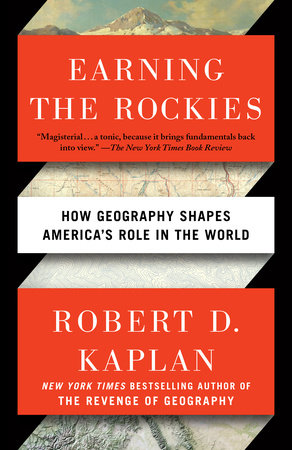
I picked up Robert D. Kaplan’s 2017 book Earning the Rockies: How Geography Shapes America’s Role in the World based on several high profile recommendations. In a short 178 pages, Kaplan — a card-carrying member of the East Coast elite that he proceeds to denigrate throughout the book —describes a cross-country trip taken in 2016 and mixes in his thoughts on how our geography led the U.S. to become a benevolent imperialist power. And calling on his impressive foreign policy experience and credentials, there are parts of this meditation on America’s rise and decline that are skillful and insightful. Kaplan argues that America became a great country not just because of our constitution and values, but because it occupies some of the best, most fertile land on the planet that is connected by a river system (running diagonally) that unites the heartland into a strong political unit. “America’s greatness,” in his words, “ultimately, is based on it being a nation, an empire, and a continent rolled into one.” And in taming the frontier, America — according to Kaplan’s analysis …

The study of history is an ongoing conversation between past and present from which we all have much to learn.

In the coming weeks, if we are able as individuals to stay healthy, we may all be looking at books in our “to be read” pile to fill up this time of coronavirus. For very good reasons sports leagues and tournaments are shutting down. Opera houses and theatres are going dark. Schools are closing. Restaurants may be next on the list. Watching cable news is just too damn depressing (and not always very informative). As I was writing this, Major League Baseball cancelled the rest of spring training and has pushed back opening day at least two weeks. If you are looking for a good sports book to fill up your hours, I wish I could send you to Jane Leavy’s 2018 The Big Fella: Babe Ruth and the World He Created with more enthusiasm. Those who know my reading habits are aware that I always read a baseball book as part of my personal spring training. (The other part of the regimen is watching Bull Durham, the best baseball movie ever.) In 2020, The Big Fella was the …

It is surprising that a field that has focused so much on the preservation of history has an unfortunate blind spot to its own history. Historic preservation is one of the longest-lasting examples of community development, land use reform, and public history in the United States. The stories of the past efforts of our fellow citizens to ensure that parts of our history are with us today and tomorrow are varied and fascinating. Yet many, both inside and outside preservation, tell themselves a simplistic and usually inaccurate story of how we came to value parts of our past in a country that too often only values the new and what’s over the horizon. The recently released second edition of Giving Preservation a History, edited by Randall Mason and Max Page, is a strong attempt to reverse our trend at historical amnesia in the preservation field. Through seven essays retained from the first edition, six new essays prepared for the 2020 book, and two concluding chapters to wrap both works together, the editors have endeavored to put forward …

So many today seem content to settle in the midst of their ignorance and not face life with astonishment, awe, and a sense of wonder. As Margaret Renkl writes, that approach is their loss.
 MORE TO COME...