All posts tagged: Rebecca Solnit

Hope demands things that despair does not

In her essay “False Hope and Easy Despair,” historian and author Rebecca Solnit speaks to how hope requires action. “Hope” she quotes author Ernst Bloch, “is in love with success rather than failure.” That seems obvious, but Solnit drives home her point by noting that failure and marginalization are safe. Despair has many causes and varieties.  Denying one’s power and possibility allows us to “shake off” our sense of obligation. We can make our point too easily when the point becomes “the demonstration of one’s own virtue rather than the realization of results.” On the other hand, “Hopefulness is risky, since it is after all a form of trust, trust in the unknown and the possible, even in discontinuity.  To be hopeful is to take on a different persona, one that risks disappointment, betrayal…” I have spent recent weeks studying strategic plans, business models, trends in nonprofit organizations, and other materials that look backward to history to make sense of what’s ahead. They begin by looking backward because, as I’ve said earlier, hope is grounded …

SE Utah Cliff Dwellings

Places teach us, if we let them

I have just finished reading two books about the American West that were written in 1987 and 1994. As I finished the second one on a rainy Sunday afternoon I thought, “I hope I age as well.”  The older of the two—which I actually read second—was the first book cited by the author of the 1994 work in her “Sources” chapter.  Both are written by women I greatly admire as writers and thinkers. So enough of the cat and mouse games. Rebecca Solnit‘s Savage Dreams:  A Journey Into the Hidden Wars of the American West, was republished in a 20th anniversary edition in 2014, with a new preface by the author. I’ve been on something of a Solnit kick lately, as she is one of the most thoughtful of writers exploring a wide variety of issues across the American landscape. This early work is often hailed as a foundational work of environmental thinking.  However, I saw this more as a book about place and unacknowledged history, and the title of the post comes from her …

The Blessing of Silence, Part II

A few weeks ago I wrote about the blessing of silence, meaning “quietude” as opposed to the “silencing of voices.” Rebecca Solnit, in her most recent collection of essays entitled The Mother of All Questions, notes that silence is crucially different from quietude.  The latter speaks to the absence of noise – which is sought – while the former speaks to the absence of voice, which is too often imposed. Little did I know that the Friday before my last post on this topic, the Harvard Business Review had published an article entitled, “The Busier You Are, the More You Need Quiet Time.”  My colleague Barb Gibson sent along the HBR article which began with a quote from writer Ta-Nehisi Coates who argued that serious thinkers and writers should get off Twitter, in a call to “get beyond the noise.”  It isn’t just writers who suggest that periods of silence are valuable.  Medical researchers have found that “taking time for silence restores the nervous system, helps sustain energy, and conditions our mind to be more …

Hope is grounded in memory

Last Saturday marked my 20th anniversary at the National Trust for Historic Preservation. For the past few days, I’ve been thinking about hope in the context of life’s milestones.  Not a greeting card kind of hope or optimism, but “hope that’s kind of gritty…the kind,” as described by songwriter and author Carrie Newcomer, “that gets up every morning and chooses to try to make the world just a little kinder (or better) in your own way.” The thought that “hope is grounded in memory” has influenced the work of  another writer I admire, Rebecca Solnit. In a recent interview, she notes that “We think of hope as looking forward, but…(if) you study history deeply, you realize that, to quote Patti Smith, ‘people have the power’….(P)eople have often taken on things that seemed hopeless — freeing the slaves, getting women the vote — and achieved those things.”  Knowing history gives me hope. To be fair, hope is hard.  Cynicism – where I have gone on occasion – is easy. But in thinking about 20 years of …

Men Explain Things

Letting experience be larger than knowledge

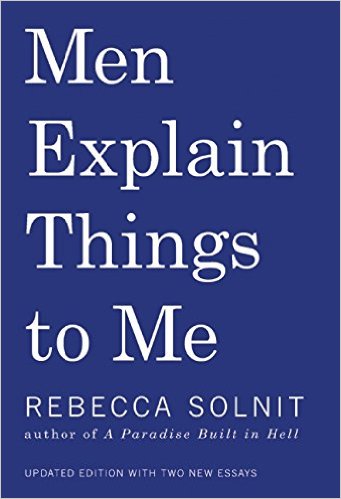
I just completed reading a thoughtful collection of essays by the writer Rebecca Solnit.  Titled after the first in the collection and her best-known essay – Men Explain Things to Me – these nine pieces written between 2008 and 2014 explore multiple topics including the gender wars and male privilege, the use of violence as a way of silencing speech, abuse of power, a new twist on marriage equality, and more.  Through them all, Solnit pushes the reader to consider perspectives that are likely to be outside their  comfort zone. A colleague forwarded the link to the Men Explain Things to Me essay several weeks ago after I referenced Solnit’s book Wanderlust: A History of Walking. (Also highly recommended.) The essay begins with the comic scene of a man explaining Solnit’s most recent book to her – even though he never read anything more than the New York Times book review of her work. But as noted on Solnit’s website, she ends this essay “on a serious note— because the ultimate problem is the silencing …