Perspective
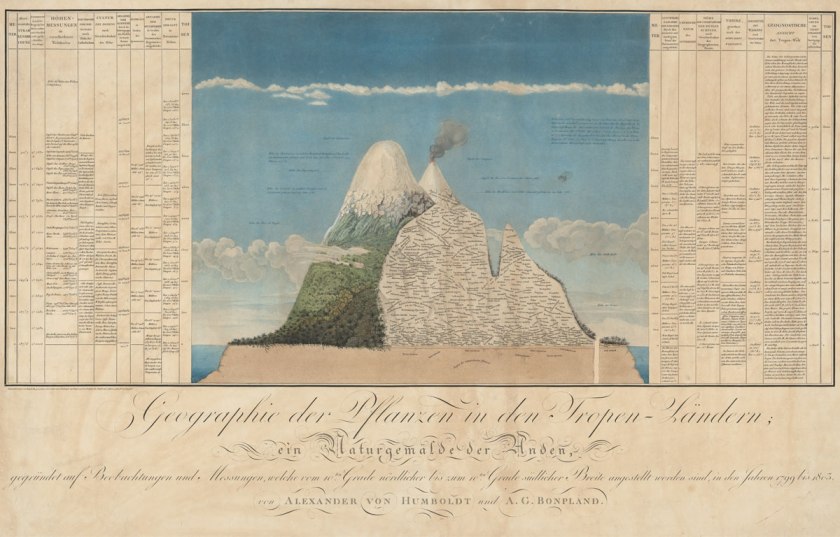
Alexander von Humboldt’s perspective was radically different than his scientific contemporaries of the late 18th and early 19th century because he conceived of nature as a complex and interconnected global force.
Books (along with a smattering of movies and plays) that I have found of interest and want to share
Alexander von Humboldt’s perspective was radically different than his scientific contemporaries of the late 18th and early 19th century because he conceived of nature as a complex and interconnected global force.

For whatever reason, I’ve been plowing through books this fall. Perhaps that is what a great deal of time on planes and trains does for one’s reading habits. In any event, this has been my first chance to stop and reflect on these recent readings for the blog, so I’m seizing the moment. One of the two I’ve included here is a very important work, significantly moving the scholarship forward in its field. The other is a small, family story that nonetheless captures the heart as it tells of a charming, privileged woman who struggled to live as a lesbian in the South of the jazz age. Both, now a couple of years old, are recommended. Edward Baptist’s The Half Has Never Been Told: Slavery and the Making of American Capitalism is a troubling and ultimately persuasive 2014 book by historian Edward E. Baptist. In this ambitious work, Baptist sets out to to demonstrate, in great detail, that slavery was not the pre-modern institution on the verge of extinction with paternalistic slave-owners as claimed by …

Kurt Vonnegut has called him America’s greatest satirist, while others suggest he was born of Mark Twain and H.L. Mencken. Lewis Lapham—editor emeritus of Harper’s Magazine, founding editor of Lapham’s Quarterly, and the object of those accolades—is a writer of great eloquence and “lethal wit.” I was delighted to see that some of the best of Lapham’s essays from the past twenty-five years have now been collected into a new work, Age of Folly: America Abandons Its Democracy. This is both a wonderful and important book. Lapham surveys the past twenty-five years to make the case that America’s imperial impulses have shaken our democratic principles. You can agree or disagree with his premise, but his arguments are lucid, thoughtful, and often challenging. In the very first essay, from 1990, Lapham states his case succinctly and directly. “If the American system of government at present seems so patently at odds with its constitutional hopes and purposes, it is not because the practice of democracy no longer serves the interests of the presiding oligarchy (which it never …
Last week I had the privilege of launching the National Trust’s National Treasure campaign for Clayborn Temple, a landmark in the history of the Civil Rights movement. It was here where Memphis sanitation workers gathered in 1968 and decided to go on strike, marching with their “I Am a Man” signs that became a potent symbol for all that is at stake in the fight for equal justice. Clayborn Temple was where the leadership of The Rev. Dr. Martin Luther King, Jr. transformed the strike from a local labor dispute into a national issue, effectively tying the sanitation workers’ cause with the national issues of economic justice and racism. It was to Memphis and Clayborn Temple that Dr. King was returning when he was struck down by an assassin’s bullet. To be in that sacred space with more than 150 Memphis residents, young African American poets and musicians, revered spiritual leaders who walked with the sanitation workers, preservationists of all ages, and current members of the workers’ union was an honor and a reminder of …
I recently finished David Sax’s new book The Revenge of Analog: Real Things and Why They Matter. Appropriately, I bought my hard-back copy in that most analog of places—Portland, Oregon’s Powell’s City of Books—the nation’s largest independent bookstore. Sax, a business journalist from Canada, posits that “while digital technology has certainly made life easier, the analog technologies of old can make life more rich and substantial.” He argues that in today’s digital world, analog is making a surprising comeback. What are those analog technologies? Notebooks and paper. Vinyl records. Film. Board games. (Vintage Game Night at the Woodrow Wilson House, anyone?) He also looks at the comeback of analog “ideas” in areas such as printing, retailing, and education. Some of Sax’s examples strike me as first-world games of the highly educated. However, as I thought about the tactile nature of the pages as I read, I realized that he had an important point about the impact of real things in our lives. About two years ago I stopped purchasing e-books and have returned to buying …

Summer reading on lying, grace, baseball, and architecture.

It will surprise no one that I read a couple of baseball books and watched several games while on vacation. But it may surprise you to know that the best piece of writing I read which included baseball as its subject came from the opening pages of psychiatrist Mindy Fullilove’s 2004 book Root Shock: How Tearing Up City Neighborhoods Hurts America, and What We Can Do About It. She begins chapter one with several powerful paragraphs. I’m going to quote extensively from those two pages. “Every once in a while, in a particular location and at a particular time, people spin the wheel of routine, and they make magic. One such location was Ebbets Field in the heart of Brooklyn, where, through World War I, the Roaring Twenties, the Great Depression, World War II, and the postwar struggles for equality in America, hard-working people enjoyed baseball. That small, unpredictable, and intimate ballpark was a gallery for characters to strut their stuff, and the characters in the stands took as much advantage of the opportunity as …
Virtually every reviewer of this 2016 work about the race to save some of the world’s most precious ancient manuscripts calls out the “unfortunate” or “inappropriate” title. And they are right. But then, in the comments section, reader after reader says something to the effect of “I wouldn’t have read this book (or your review) except for the title.” And they are right. So there you have it. Don’t let the title turn you off of this marvelous little book. But also, don’t go into the work thinking that the librarians of Timbuktu are a modern-day version of Indiana Jones. The tale is good enough on its own, but I suspect the author (and his publishers) thought that “The Very Persistent and Dedicated Librarians of Timbuktu” simply wasn’t going to set books flying off the shelf. Joshua Hammer, a former bureau chief for Newsweek who now serves as contributing editor to Smithsonian, is a talented writer who combines a strong journalism sense, travel writing sensibilities, a grasp of the culture and disputes of a …

“We are all in this together, and that addressing our own suffering while learning not to inflict it on others is part of the work we’re all here to do. So is love.”
Earlier today, my brother and sisters and I received an email from our older brother Steve. He had just read a book review in the Washington Post concerning a new Library of Congress book entitled The Card Catalog: Books, Cards, and Literary Treasures. It brought back memories, and I’ll let Steve’s note to the four of us take it from here. This story took me back to all those days in libraries…Cookeville and Murfreesboro public, at Tennessee Tech & Western Michigan (where I almost lived while doing my thesis– I even had a private cubicle!), and the 2 church libraries. I spent lots of time at the one in Cookeville where Mom was a one-woman staff for a long time. I would help bind books, glue return card pockets, and watch her type cards for the ubiquitous card catalog. I loved all that. Now I read on my pad and search online, rarely going to an actual library except to find a book old enough to not be available digitally. This article reminded me of …
 MORE TO COME...