
America needs more communal singing.
Singing for many of us is something we do because we can. Singing together is something we should do because it helps break down the isolation that tears at too many souls, bringing us together into a supportive community and sustaining us during good times and bad.
An increase in communal singing would be another small step towards healing the estrangements in our civic life. The makers of Jim Beam bourbon certainly understand the value of singing together in an ad appropriately titled People Are Good for You.
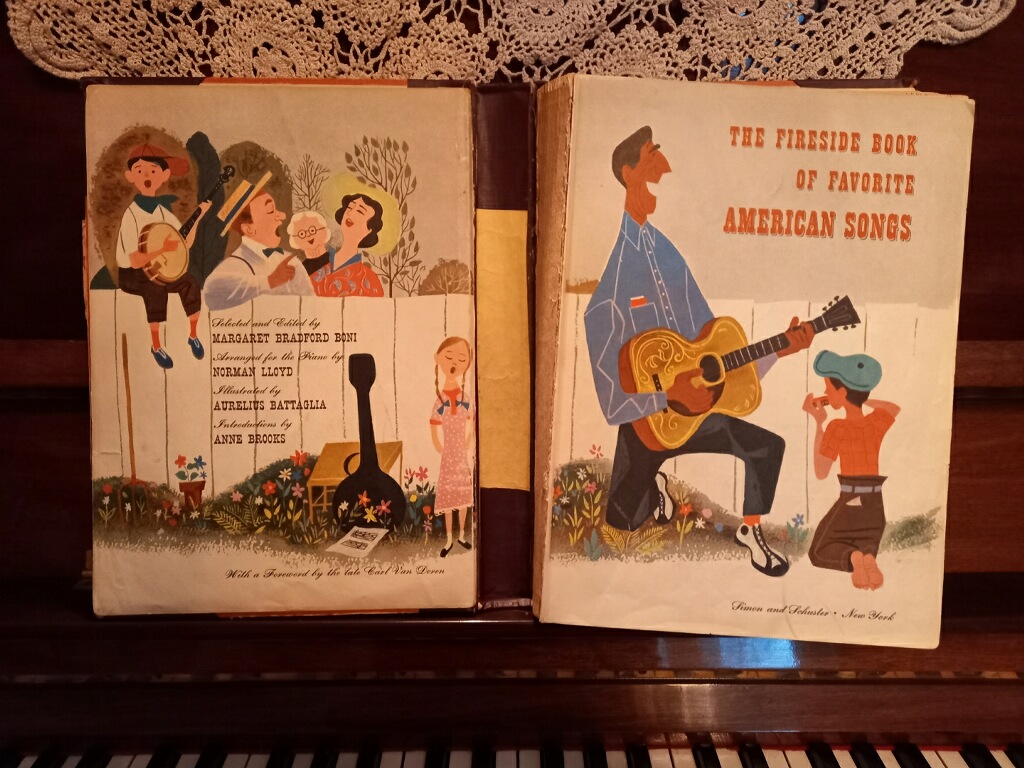
I grew up singing at home with my brothers and sisters while mom played the piano. The Fireside Book of Favorite American Songs* and the sad tale of Springfield Mountain are a big part of my memory bank. My sister Carol still has that songbook, cracked spine and all, and she pulls it out occasionally to bring back memories.
I’ve often felt sorry for people who did not have places where they could sing in public. Even when my faith has been clouded by doubt or in moments of darkest despair, I’ve always found solace in the music at church. There I can sing robustly and without self-consciousness and feel unity with the world and release from the world at the same time. Many’s the time during the recessional at funerals I’ve sung the wonderful O God Our Help in Ages Past—with its incredible tenor line—while tears streamed down my face.
A quote widely, but probably incorrectly, attributed to St. Augustine says it best: “He who sings, prays twice.”
In her book Wintering, the author Katherine May speaks to the importance of robins during our coldest months. First, they seem to be around when other birds disappear. “Only in the far north do they migrate, and their bright plumage and friendly habits make them more visible than other birds.”
And they sing through the darkest months.
Other birds “call in the winter” but they are warding off predators, Robins, on the other hand, “engage in full, complex song during the coldest months when its far too early to consider breeding.” The well-fed robin will sing well in advance “of the time that he expects females to act on his display.”
In evolutionary biology, this is known as costly signaling, a gesture that advertises superior strength and vitality, yet by its very nature is potentially dangerous to the creature. A robin sings in winter because he can, and he wants the world—or at least the female robins—to know it. But he is also in practice for happier times (emphasis added).
May then describes what singing means to her, in a way that resonated deep in my soul.
One of the greatest blows was that I could no longer sing [when I lost my voice]. It’s tempting to glibly write, “Not that singing played a huge part in my life,” but that wouldn’t be true. Singing might not be my profession or my ambition, but it has sustained me for as long as I can remember, from attempting harmonies in the car with my mother to warbling along to the radio while I cook. I sang in choirs at school and at university, my low alto knitting with the other voices. Singing with others is a kind of alchemy, an act of expansive magic in which you lose yourself and become part of a whole. I have long been reliant on the stress release of booming out half-remembered choir parts when I’m driving alone in my car.
In twenty-first-century Britain and America, we’ve linked singing with talent. As the father of a professional tenor, I’m all for having professionals perform so we can enjoy their amazing gifts. I think we should even pay them handsomely for their work.

But as May writes, we’ve got it fundamentally wrong if all singing has to be by talented and gifted professionals. And since Andrew recently served as the tenor soloist in the Reston Chorale’s Messiah Sing-Along, I know he would agree.
The right to sing is an absolute, regardless of how it sounds to the outside world. We sing because we must. We sing because it fills our lungs with nourishing air, and lets our hearts soar with the notes we let out. We sing because it allows us to speak of love and loss, delight and desire, all encoded in lyrics that let us pretend that those feelings are not quite ours. In song, we have permission to rehearse all our heartbreaks, all our lusts. In song, we can console our children while they are still too young to judge our rusty voices, and we can find shortcuts to ecstasy while performing the mundane duty of a daily shower or scrubbing down the kitchen after yet another meal.
Like the robin, we sometimes sing to show how strong we are, and we sometimes sing in hope of better times. We sing either way.
Pete Seeger was one of the great artists of the folk revival, in part because he knew—even at age 94—that music was made to be sung together.
Of course, we’re now so used to hearing such amazing versions of Lift Every Voice and Sing—the Black National Anthem—that we forget how wonderful it sounds when sung in community.
And the first link in this post refers to that great anachronistic American tradition of singing Take Me Out to the Ballgame. While it isn’t a “community” version, let’s begin with the Kansas City Symphony and Chorus having some fun with the tune while the Royals were on a World Series run.
And then, how it is traditionally—and best—heard.
Go find a place to sing in community. It’s good for you . . . just as people are good for you.
More to come . . .
DJB
UPDATE:
The British musician Brian Eno was once asked in an interview what he thought about music education in Britain’s school system. He said, “I believe in singing to such an extent that, if I were asked to redesign the British educational system, I would start by insisting that group singing becomes a central part of the daily routine. Group singing builds character and, more than anything else, encourages a taste for cooperation with others.”
In true community, we learn to sing not only with one another but with our world.
Philip Gulley
*1952 edition by Simon and Schuster, dedicated to the memory of Carl Van Doren, author, critic, and authority on Americana.
Photo by Carol Brown Ghattas
 MORE TO COME...
Absolutely!!
Thank you, David — what a way to start the day. Awake and Sing!!
very best to you and Candice
Thanks, Alice. So glad you enjoyed it (and agree!).
Just beautiful, both in sentiment and in prose. Thank you for this!
Thank you!
Pingback: Observations from . . . March 2024 | MORE TO COME...
Pingback: Baseball joy and sadness | MORE TO COME...
Pingback: Down the rabbit hole | MORE TO COME...
Pingback: The best of the MTC newsletter: 2024 | MORE TO COME...
Pingback: Rules for the road of life | MORE TO COME...
Pingback: Opening Day 2025 | MORE TO COME...
Pingback: Do one thing everyday that scares you | MORE TO COME...
Pingback: Take me out to the ballgame | MORE TO COME...