
Those who watched the Ken Burns film will recall Harlan Howard’s famous line that Country Music is three chords and the truth. One of Nashville’s most successful Black songwriters says that “Country Music is three chords and four very particular truths: life is hard, God is real, whiskey and roads and family provide worthy compensation, and the past is better than the present.”
“The last truth is one of the places where Country experiences a racial split. In the world of white Country, the past that is better than the present exists in a longed for and lost mythical Dixie. In Black Country, the past that is better that the present exists in a longed for and lost Africa before colonization. In my life it was the Detroit past that was better than the Washington, D.C., present.”

My Black Country: A Journey Through Country Music’s Black Past, Present, and Future (2024) by Alice Randall is memoir, history lesson, and manifesto by the first Black woman to cowrite a number one country hit, Trisha Yearwood’s XXX’s and OOO’s.* Randall’s story could not be more different than the stereotypical country songwriter: born of an activist yet difficult mother and a loving and wise father in Detroit in a marriage that didn’t last, raised in the nation’s capital during its Chocolate City days where she attended the prestigious and preppy Georgetown Day School, a graduate of Harvard University where after discovering a connection with British and American metaphysical poetry she was surprisingly propelled towards Country Music, and a decades-long resident of Nashville who writes modern Black fiction and screenplays and has emerged as an innovative food activist committed to reforms that support healthy bodies and healthy communities.
Not exactly the hayseed who fell off the pickup truck.
But the story that upsets the stereotype is what My Black Country is all about. Randall wants us to know the truth behind two statements that she heard from her father: “Black folk invented Country Music” and in a nod to the way the unknown writers of many folk songs are credited, “Traditional is a Black woman!” She is sitting in Quincy Jones’ Los Angeles house when she has the ephinay that gives her life a new and higher ambition: she is to “lay a velvet carpet for my pearls” just as Jones had done when he recorded Miles Davis late in life as a way of ensuring remembrance. Randall’s life goal is to make certain that everyone recognizes and remembers the First Family of Black Country Music: “DeFord Bailey, the father; Lil Hardin, the mother; Ray Charles, their genius child; Charley Pride, DeFord’s side child; and Herb Jeffries, Lil’s stepson.” This book is only one step along that path.
Growing up outside Nashville in the 60s and 70s, I knew three of the five of Randall’s first family: Bailey, Pride, and Charles, although I never considered Ray Charles a country musician. I knew he had recorded the iconic Modern Sounds in Country and Western Music, but Randall sets the record straight for me with multiple links between the “genius” and Country Music. Just listen to the piano solo in Worried Mind beginning at the 1:10 mark and then try and tell me the man’s not country.
On the other hand, DeFord Bailey’s story of being pushed out of the Opry because he was Black was one I knew. Bailey wasn’t merely one of the Opry’s first stars—he was the first musician to perform the Saturday that announcer George D. Hay coined the name of the world’s longest-running radio show—the Grand Ole Opry. He not only helped popularize the harmonica in the United States, he was country’s first big star and the one who was selling the tickets to the shows that others like Roy Acuff benefitted from. “He was the draw that got a lot of folks tuning in to the Opry.”
His train songs were one of the reasons. Trains suggested a future, a way out.
Black folk needed a sound that was an escape, a sound that was a positive possibility, a sound that took them away from where they were to some place better. We needed what “Pan American Blues” provided and DeFord Bailey delivered: reliable escape most Saturday nights for a good long while.
Bailey was also “the first musician to hold a recording session in Nashville, setting the stage for a scene that would change the world.” Given all that, Randall lays down her marker.
“DeFord isn’t just the father of Black Country, DeFord is the Father of Country and was Country’s first superstar. Period exclamation mark. How in the f**k does that get forgotten?”
Charley Pride, who died in 2020, was an undeniable Country Music superstar. He had twenty-nine #1 songs on the country charts during his career and was an important music publisher. He became the Grand Ole Opry’s second Black member and was inducted into the Country Music Hall of Fame in 2000, five years before DeFord Bailey and twenty-one years before Ray Charles. As a Black man in a white world, Pride was dignified, talented, full of rural bona fides, and someone who paved the way into the Hall of Fame for the elders who had paved the way for his musical success.
The other two members of the first family were unfamiliar to me, but Randall makes the strong case for their inclusion. Lil Hardin, who is better known in jazz circles, played piano on one of the most influential Country songs of all time, Jimmie Rodgers Blue Yodel #9. Along with Louis Armstrong, the three of them made musical history. The song—also known as Standin’ on the Corner—was recorded in 1930 at Hollywood Recording Studios, in Los Angeles. Along with the other 12 Blue Yodels Rodgers recorded in his very short life, it made him a national star. And he was accompanied by two Black musicians.
Herb Jeffries was America’s first Black singing cowboy, an important figure in country’s development. Jeffries’s first film, Harlem on the Prairie, appeared in 1937, followed by Two-Gun Man from Harlem, The Bronze Buckaroo, and Harlem Rides the Range.
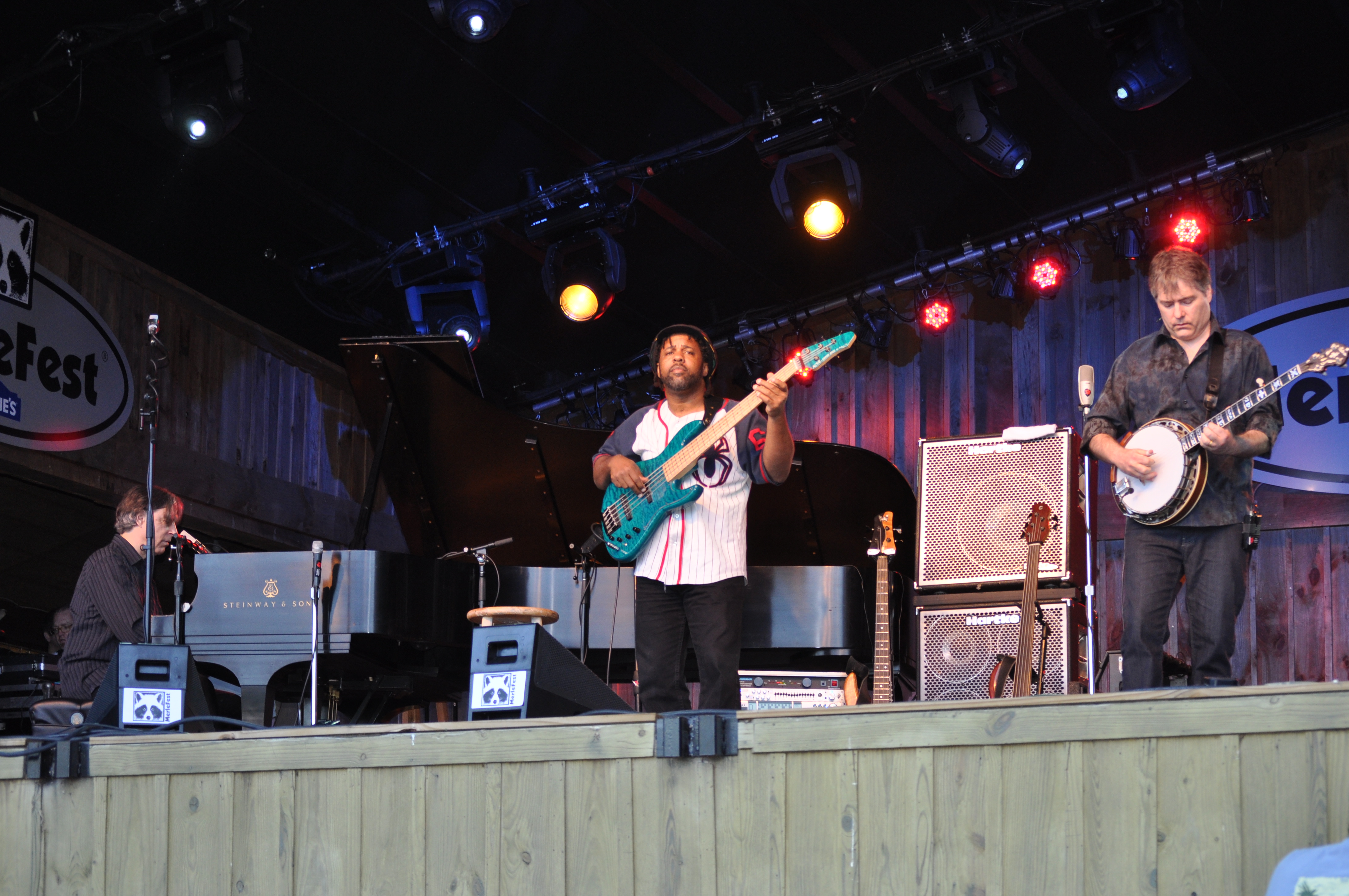
Randall tells mesmerizing stories as one would expect from a talented songwriter. She also drops a song or reference on just about every page that reinforces her thesis that Black people are essential to country’s development. Along the way we meet well-known stars and those, like the Wooten Brothers, who are less well known in country circles. (I first heard them with banjo legend Bela Fleck.)
The other main thrust of this book points to the future, with many of the artists I’ve highlighted through the years making an appearance.** Randall has written songs performed by Glen Campbell, Moe Bandy, Marie Osmond, Jo-El Sonier, Judy Rodman, Radney Foster, and Holly Dunn, as well as Trisha Yearwood. A collaborative album, also called My Black Country featuring young Black female artists playing the Alice Randall songbook, was being conceived and recorded as Randall wrote the book. Enjoy Valerie June, Caroline Randall Williams, Rhiannon Giddens, Adia Victoria, Allison Russell and others sing the works that Alice Randall created.
Randall mentioned that the John Cowan/Mark O’Connor version of The Ballad of Sally Anne—a song about lynching—was her favorite of any of her songs . . . until Rhiannon Giddens reinterpreted it for My Black Country.
I especially love Allison Russell’s feminine reimagination of Many Mansions.
Click here to get videos of the entire playlist.
The album stands as a wonderful set of music while the book is a great revelation. Enjoy them both.
More to come . . .
DJB
*Randall tells the great story of how she once had the opportunity to meet Aretha Franklin backstage at a concert. Franklin was notoriously stingy with passes, but she was welcoming to Randall and mentioned her song XXXs and OOOs. There was one line in there that made it all happen.
“As a Black woman who had once been a colored girl in Detroit, it felt sweeter than sweet to celebrate Aretha in a Country song in such a way that it made her smile. We did it, Matraca [Berg] and me, with eighteen words: ‘She’s got her God and she’s got good wine, Aretha Franklin and Patsy Cline, she’s an American girl.’
Those words opened the Queen’s door for me.“
**For previous MORE TO COME posts on Black Country artists see:
- A creative life (Rhiannon Giddens)—2024
- You’re the One (Rhiannon Giddens)—2023
- You’re Not Alone (Allison Russell)—2023
- A new kind of American troubadour (Joy Oladokun)—2023
- The hero of my own story (Allison Russell)—2023
- Tré Burt follows his songwriting muse (Tré Burt)—2021
- Keeping the faith with The McIntosh County Shouters (The McIntosh County Shouters)—2021
- Adia Victoria is making the blues dangerous again (Adia Victoria)—2021
- Jake Blount’s path through metal and funk to get to the Appalachian music of the Black community (Jake Blount)—2021
- Leyla McCalla’s music from the melting pot (Leyla McCalla)—2020
Photo credit: Trains at Night
 MORE TO COME...
Pingback: Observations from . . . May 2024 | MORE TO COME...
Pingback: Blackbird | MORE TO COME...
Pingback: From the bookshelf: May 2024 | MORE TO COME...
Pingback: The 2024 year-end reading list | MORE TO COME...