
Two weeks ago I received an email from a senior photo editor for The New York Times. He was working on a story that described a moment at a parade in 2022 which involved Maryland Congressman Jamie Raskin. I was there and my photo of Raskin walking the parade route caught the editor’s eye as he searched the internet. He was asking to license this image for one-time use for the Times.
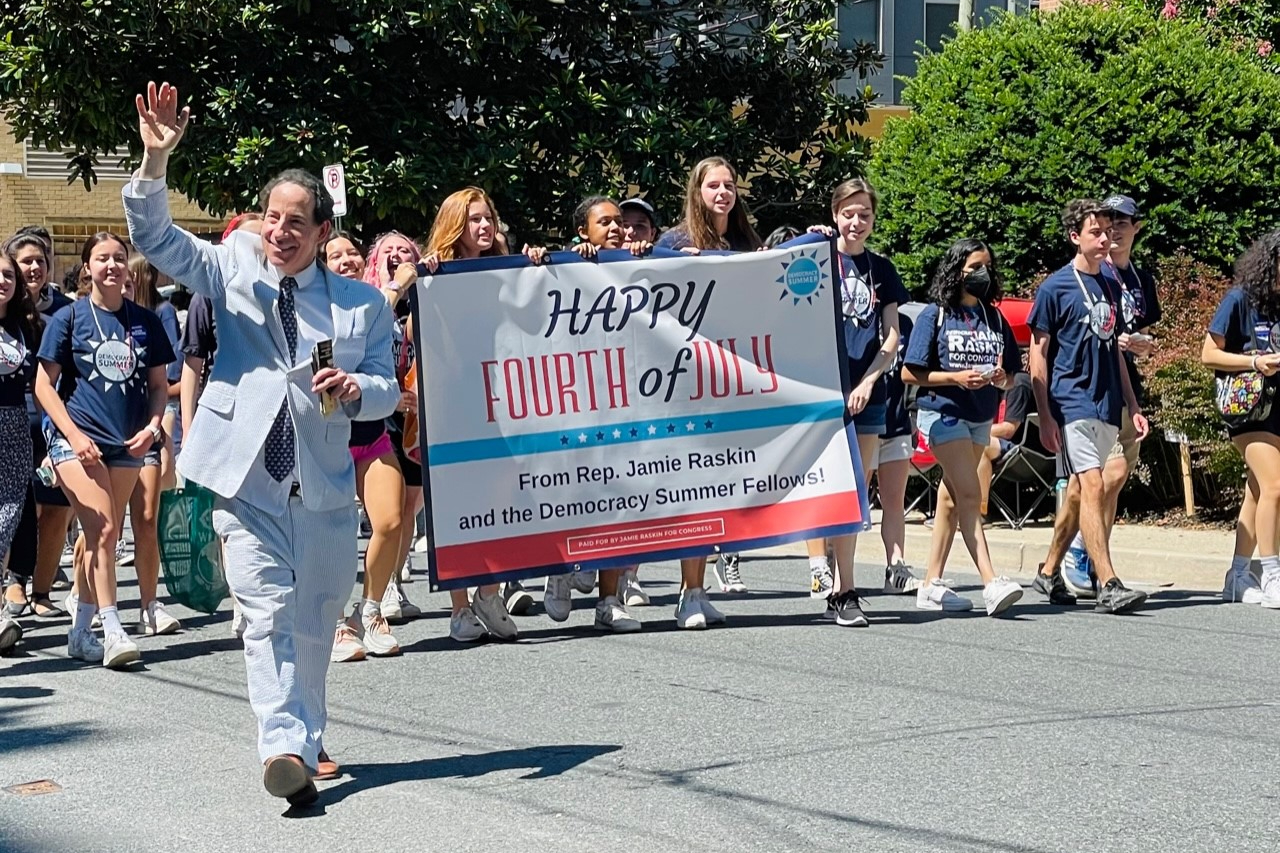
When the photo was not used in the May 19th online edition, I suspected I had been left on the proverbial cutting room floor. However, when our Monday Times was delivered to the house, I saw that the story—“Threats and Fear Are Transforming U.S. Politics”—was front page.

Then I discovered my photo and byline made the spread on the jump to page 14!
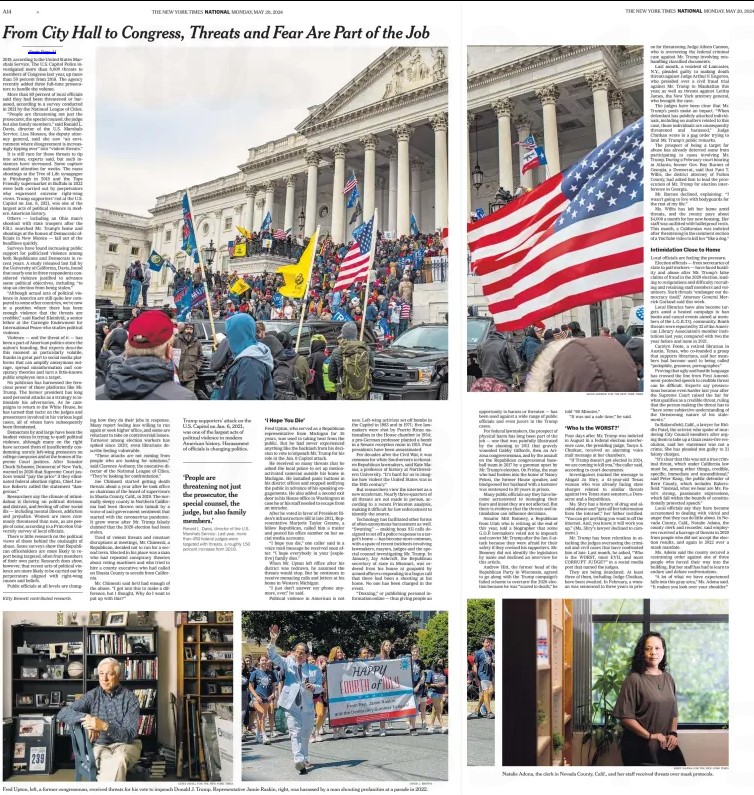

How did I happen to take this picture? Well, Congressman Raskin shows up in several of my parade photos over the years. (Check out 2023, where he’s sporting one of his stylish Stevie Van Zandt bandanas.) At those parades, Raskin arrives and sweeps through the street like a whirlwind, enthusiastically working the crowd, shaking every hand he can reach and waving to the ones he cannot touch. In 2019 I likened him to James Brown: the “hardest working man in politics.”
I am a Jamie Raskin fan, admiring his courage, his politics of inclusion, and his unwavering commitment to democracy. Most importantly, Jamie Raskin has a clear love for people and a zest for life. *
I’ll admit that I was pleased to have made The New York Times for the first time as a photographer. (I have had quotes in a few stories, a short op-ed, and letters to the editor in my former life.) But regular readers know I have a conflicted relationship with the Times. We’ve been subscribers for decades and relish much of the information the paper provides. However, in my estimation they keep downplaying the most important political issue of our lifetime.
Read the story about the political violence—threatened and real—that is tearing apart our country. It is clear and sobering. I thought my Raskin picture was especially appropriate as it showcased where political violence can break out. There’s nothing more American than an Independence Day parade, so it points to the truth of: “If they’ll attack here, they’ll attack anywhere.”
In 2019 I pointed readers to historian Joanne B. Freeman’s Field of Blood, which looks at political violence in the decade before the Civil War. This is a very serious issue that goes back generations, as historians have repeatedly noted.
Today is an especially appropriate day in history to discuss political violence. As historian Heather Cox Richardson reminds us, “on May 22, 1856—exactly 168 years ago today—South Carolina representative Preston Brooks beat Massachusetts senator Charles Sumner nearly to death on the floor of the Senate after Sumner criticized southern enslavers, particularly Brooks’s relative South Carolina senator Andrew Butler.”
I have returned to the problem of political violence and the damage it brings to democracy several times in my newsletter. For instance, I wrote in that 2022 article:
“As he does every year, Congressman Raskin was marching in today’s Takoma Park July 4th parade. He was there in spite of threats made to members of the House Select Committee on January 6th. Why are the members being threatened? Because the January 6 committee has made the work of uncovering truth ‘the lodestar of its public hearings.’”
While they have covered our current outbreak of political violence before, the Times could have been writing a variation of this story on an almost daily basis since 2015 and at least as recently as May 18th of this year when Donald Trump, in a speech to the NRA, alluded to the execution of President Joe Biden.
That’s not normal. It’s not normal when extremist will tolerate no dissent. Yet the Times coverage didn’t mention it.
The newspaper’s editor, Joe Kahn, has said “that democracy-related coverage wasn’t the Times’s most important focus,” even though—as Margaret Sullivan and many others have pointed out—we’re in an incredibly dangerous moment for American democracy. Kahn’s position troubles me.
Sullivan is one of the nation’s most astute media observers, a skill shown once again in a recent Substack post. She states that most sensible people know the difference between, “Shouldn’t The New York Times be vitally interested in preserving democracy and shouldn’t its news coverage reflect that?” and “Why isn’t The New York Times joining forces with the Biden campaign?” That’s not the question, even though Kahn took the interviewer’s opening query in that direction.
Sullivan suggests that audience growth and the lucrative nature of expansive coverage . . .
“. . . is one of many reasons for this emphasis on “independence,” which is both a journalistic virtue and code for Big Tent. But to my mind, that stance can tip over too easily into a kind of performative neutrality in politics coverage in which unequal candidates, parties and positions are equalized. (Trump has been charged with dozens of crimes and is sitting in a courtroom defending himself in a hush money/campaign finance case involving a porn star? Well, let us restate that Joe Biden is old!)“
In its place, Sullivan would like for the top decision-makers in mainstream media “to make it clearer” in coverage, emphasis, framing, and public statements that the “news organization is aware of the threats to democracy on the ballot in November. And that it is a core part of your mission to stand for democratic principles and to have news coverage reflect that consistently.”
Another commentator suggests that if media outlets are tied to the horserace theme, at least stop covering the odds and talk about the stakes.
Sullivan also addresses the issue of framing.
“While you’re at it, you could also stop doing everything possible to put a negative spin on Biden’s legitimate accomplishments, as these two news alerts—one from the Times, one from the Guardian—illustrate. This is one of innumerable examples.“
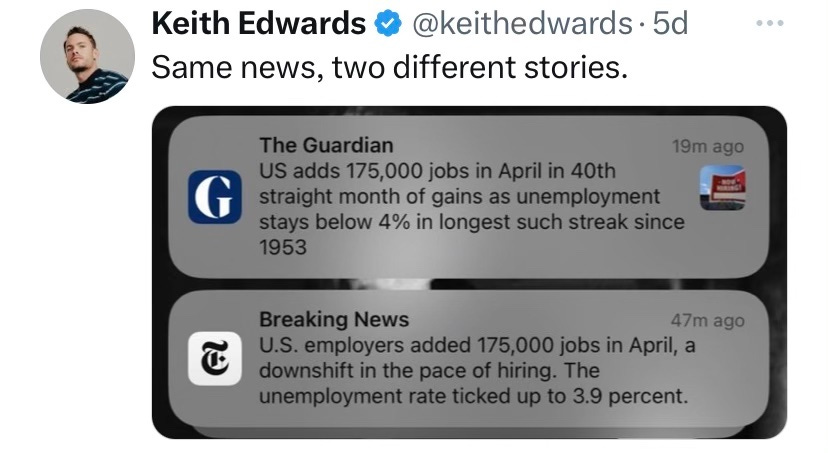
So yes, I’m pleased that The New York Times has used one of my photographs. But I do wish the Times would take its role in protecting our democracy more seriously. When virtually every candidate to be Trump’s vice president refuses to abide by the election results and we hear daily escalation of violent rhetoric, the stakes seem pretty clear.
More to come . . .
DJB
UPDATES AND RELATED STORIES
- After this post went up, commentator Mark Sumner called out the Times for killing stories for Trump, just like another “newspaper” that has been in the news during the former president’s New York trial.
- Brian Klaas in his The Garden of Forking Paths newsletter also went into a deeper dive about the roles the Times and other media play in the inversion of reality. It is worth a read.
* See also Lessons Jamie Raskin learned from his father (2021)
The Weekly Reader links to the works of other writers I’ve enjoyed.
Photo by David Smooke on Unsplash
 MORE TO COME...
I agree with your observations. I read the Times every morning and am consistently struck with the negative take on stories about Biden. For example, instead of talking about the the content of Biden’s speech at Morehouse College, the article highlighted a few protestors.
Thanks for the comment, Sarah. That Morehouse College speech was one of the most powerful of Biden’s presidency yet as you note the Times chose to focus not on the content but on the few protesters in attendance. It isn’t that the protests shouldn’t have been mentioned, but reporting about the “stakes rather than the odds” would have focused more on Biden’s beliefs and agenda, which he clearly outlined in a well-crafted and thoughtful speech. DJB
Pingback: Observations from . . . May 2024 | MORE TO COME...
Pingback: It’s up to us | MORE TO COME...
Pingback: Memory is a poet . . . the scrapbook edition | MORE TO COME...
Pingback: Looking away from a very old threat | MORE TO COME...
Pingback: The best of the MTC newsletter: 2024 | MORE TO COME...
Pingback: 70 lessons from 70 years | MORE TO COME...