
Every time I visit a bookstore or library, I chance upon one or more volumes that haunt me. They seem to say, “Why didn’t you read me twenty, thirty, or fifty years ago?” My excuses are feeble. I may have been too busy reading histories and biographies to devote much time to literature and poetry. Perhaps I was hooked on a small number of well-known Southern authors and missed others I should have explored. Or maybe I was just lazy.
It never fails, however, that when I push myself to read a classic work for the first time, I am reminded of how much we have to learn between our birth day and our last day. Of all the different perspectives that could have enriched my time as an impressionable youth but that are now working their magic on my third stage of life. And that the saying “too many books, too little time” is a cliche for a reason: It is true.
A classic of the Harlem Renaissance that I only recently read for the first time is the latest of those “why didn’t I read this a long time ago” books that call to me from nearly every bookshelf I pass. Better late than never.

Their Eyes Were Watching God (1937) by Zora Neale Hurston is the story of Janie Crawford, a proud independent black woman who finds herself while navigating three marriages and a fair share of sorrow. In recounting her life’s story full of travel to her friend Pheoby, she explains that “you got tuh go there tuh know there.” Janie begins as a young girl, goes through a myriad of experiences in the Jim Crow South, and comes out a much wiser woman of 40. She learns that others—family, friends, lovers, busy-bodies—want to tell her how to live. Her Grandma reminds her that the black woman “is de mule of the world” and both white folks and black men will expect her to tote the heaviest load. But in the end Janie proclaims that she has done “two things everbody’s got tuh do fuh theyselves. They got tuh go tuh God, and they got tuh find out about livin’ fuh theyselves.” Hurston’s vivid writing and empathetic outlook towards Janie’s quest brings this story alive.
We see Hurston’s skill in creating images early in the book, when she describes Janie’s coming of age experience under a blossoming pear tree in West Florida. She was hearing singing that had nothing to do with her ears, and she watches a “dust-bearing bee sink into the sanctum of a bloom.” A passing boy gives her a kiss, and “that was the end of her childhood.”
Hurston grew up in Eatonville, Florida, which is important to the story.
“Established in 1887, the rural community near Orlando was the nation’s first incorporated black township. It was, as Hurston described it, ‘a city of five lakes, three croquet courts, three hundred brown skins, three hundred good swimmers, plenty guavas, two schools, and no jailhouse.’”
She could see the evidence of black achievement all around here, and it is here where the fictional Janie comes for part of her journey. She marries the mayor, has a big house, and seems to be set in life. But her soul remains restless as her husband refuses to let her think, talk, or act in ways that he doesn’t approve. When the mayor dies she is freed, and despite the disapproval of the townsfolk she leaves with a much younger man named Tea Cake. He “engages her heart and spirit in equal measure and gives her the chance to enjoy life without being a man’s mule or adornment.” They move to the Everglades and are loving life when a hurricane hits. Once again, Hurston’s descriptive writing pulls the reader along as Janie, Tea Cake, and their friend Motor Boat sit in a small shack and listen to the wind howl and Lake Okechobee rise.
“The wind came back with triple fury, and put out the light for the last time. They sat in company with the others in other shanties, their eyes straining against the crude walls and their souls asking if He meant to measure their puny might against His. They seemed to be staring at the dark, but their eyes were watching God.”
The ending is not happy but, as commentators note, it does draw to a satisfactory conclusion. Janie lives to tell the tale, a strong black woman able to hold her own and then some. It is a remarkable book that almost fell into obscurity until a young writer named Alice Walker traveled to Fort Pierce in 1973 to place a marker on the grave of the author who had so inspired her own work.
“Walker found the Garden of Heavenly Rest, a segregated cemetery at the dead end of North 17th Street, abandoned and overgrown with yellow-flowered weeds . . . Unable to afford the marker she wanted—a tall, majestic black stone called ‘Ebony Mist’—Walker chose a plain gray headstone instead. Borrowing from a Jean Toomer poem, she dressed the marker up with a fitting epitaph: ‘Zora Neale Hurston: A Genius of the South.’”
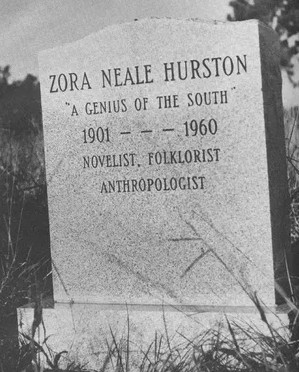
Walker’s acknowledgement of the debt she owed to Zora Neale Hurston led to reassessment, new editions of old works, and a renaissance that continues today.
More to come . . .
DJB
Photo: Images from Eatonville, Florida, from Southern Poverty Law Center


Pingback: From the bookshelf: April 2025 | MORE TO COME...
My friend Sara sent along an email note concerning this post, and I wanted to capture it here:
“Also—just to tell you that you were born 25 years too early—Our school system in Raleigh had ZNH Eyes… on our 11-grade curriculum from early 90s onward. Whenever I taught junior English, it was there. So there’s a 30-year cohort in Wake County North Carolina that has a high-school acquaintance with that book :-)”
Born too early for a book written in 1937 . . . imagine that! Thanks, Sara.
Pingback: Observations from . . . May 2025 | MORE TO COME...
Pingback: The year in books: 2025 | MORE TO COME...