In this latest installment of the Author Q&A series, Nathaniel Popkin talks with me about his new novel and the story of a progressive rabbi trying desperately to hold her interfaith community together. Popkin has created a thoughtful and deeply compassionate examination of the age-old divisions poisoning America’s social contract in the 21st century.
Today’s news is full of stories of deep political divisions that threaten to rip apart bonds and affinities that have connected us—at the personal, community, national, and global levels—for decades if not centuries. As our attention is once again turned to war in the Middle East, a new novel set for publication on May 5th takes us into the life of a Jewish and multifaith community in New Jersey to examine the deep ties, explosive tensions, and inherent contradictions that exist at the core of this and so many relationships.
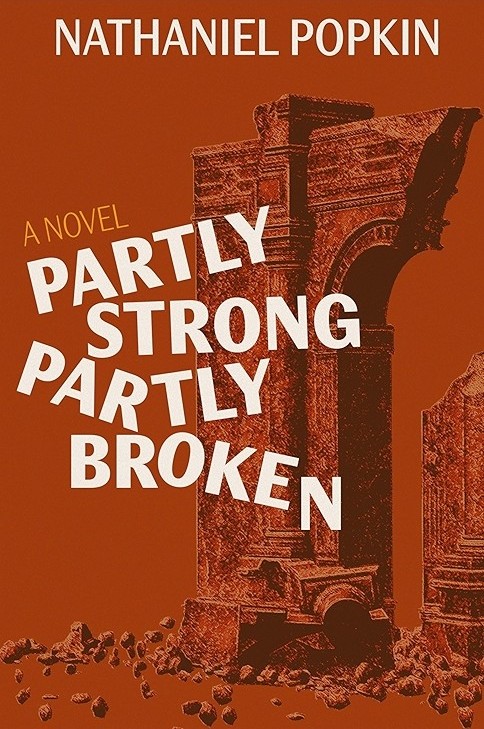
Partly Strong, Partly Broken (2026) by Nathaniel Popkin is a work full of compassion and understanding as it explores the difficult questions around politics and racism that vex us today. The novel, told through the eyes of the passionate, inclusivity-minded Rabbi Adinah, focuses on political divisions poisoning an American Jewish community and a multifaith coalition in New Jersey. Set in the fall of 2023, the story unfolds before the attacks on Israel by Hamas and the subsequent devastation of Gaza in retaliation. Rabbi Adinah returns from a trip to Israel to find both her synagogue and her congregation falling apart. A hurricane has ripped a hole in the roof, and her office, which was always her refuge, is flooded. At the same time, a new conservative member of the congregation has become friends with the synagogue’s president and inserts herself into Adinah’s efforts to build a Hebrew Learning Center. This new congregant’s strong views on Israel disrupts the rabbi’s weekly Torah class and sows divisions while threatening the rabbi’s work of inclusivity and her vision for the Center. To further compound the rabbi’s troubles, a young Syrian refugee she mentors is the victim of a brutal hate crime, and as she lies in a coma the alliances Rabbi Adinah cultivated with leaders of other faiths become increasingly challenged.
Partly Strong, Partly Broken probes the stories, beliefs, and intensions of people who are working to navigate troubled and dangerous times. Many of the guardrails that guided our life together have been broken and refuge is difficult to find. Popkin creates a story for today’s world in which all can relate, and he examines these tensions with honesty and sensitivity. I was delighted when Nathaniel agreed to chat with me about his book in this most recent installment of my Author Q&A series.
DJB: Nathaniel, as I was reading the novel I was reminded of George Packer’s 2013 nonfiction book “The Unwinding” on the demise of the American social contract. Do you see your work as being solely focused on divisions within the American Jewish community or are there broader forces at work and, if so, are there deeper lessons for readers to take away from your book?
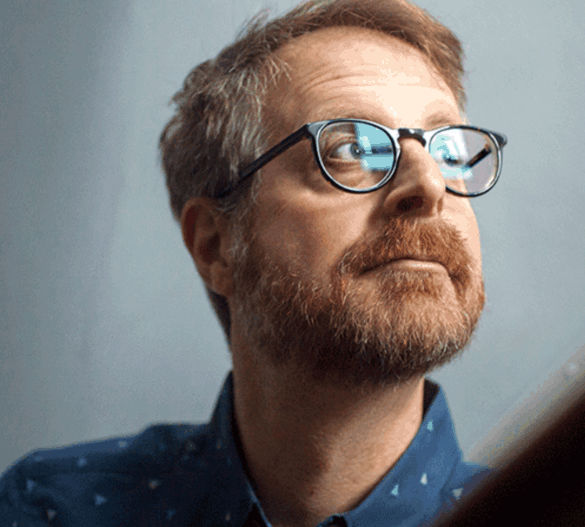
NP: I’m glad you’ve raised this because the novel is deeply engaged in asking how the American social contract might break down. How fragile is it? How resilient, even in the face of what sometimes seem like impossible conflicts? We’ve all seen in the past three years especially how oppositional beliefs about Israel and Palestine have divided people, even those otherwise on the same political side, and how these “tensions boiling over,” as the New Yorker put it, could even sway elections. The novel’s beloved protagonist, Rabbi Adinah, co-leads a multifaith coalition of religious leaders who are a mirror on the demographics of their inner-ring New York suburb and who together are in pursuit of justice—the fulfilment, it seems to me, of the American social contract. The rabbi’s co-leader and confidant is Imam Abdul, Palestinian American, educated in Cairo, and together they respond to a hate crime against a young woman, Fami, a Syrian refugee they’re both invested in (by way of the social contract, in fact). What could disturb this alliance? What kinds of threats? These are some of the questions the novel asks readers to consider. As a work of fiction, Partly Strong, Partly Broken is more of an invitation to ask questions than answer them. An invitation to wonder, to stir intellectually, psychically, rather than a giver of lessons. The only thing the novel teaches, in my view, is how complex and multi-layered all these questions are.
The issue of “going or leaving home” is important to Rabbi Adinah, as she begins to grapple with that question early in the book. What aspects of home―especially for American Jews in the context of belonging and Israel―do you want your readers to explore along with Adinah as the story unfolds?
When the novel opens in early September 2023 Rabbi Adinah is returning from a three-week trip to Israel, where she’s participated in the massive pro-democracy protests. And where she’s been staying (in Haifa) with her ex, Sana, a Palestinian Israeli social worker, someone she’s never been able to let go. Sana, I believe, is “home” for Adinah, as much as the former, somewhat sweeter version of Israel (in memory, at least) of two decades previous, the space and place where they fell in love. As Molly Crabapple suggests in her new book, Here Where We Live Is Our Country, the question of home for Jews is fraught. The multi-generational trauma of displacement colors all questions of belonging and attachment. Which is why Israel has been able to loom so large in the Jewish imagination. If there had been more and different choices, then perhaps this particular attachment would feel different. Rabbi Adinah grew up in California in a placeless-feeling suburb and she found her own way to Jewishness, an evolution that offered her various homes, including Girona, Spain, and the multifaith coalition in her New Jersey town. These are all aspects of home for her. In reflecting on Israel, the diaspora, Yiddish and Hebrew, the novel does ask readers to question Jewish notions of home and belonging. There are many versions of answers here!
There are certainly bad actors in the larger story of Israel and Gaza, but within the focus of your novel the main characters hold passionate beliefs that don’t, in and of themselves, make them bad people. What are we to make of that and how might the reader put that in the context of the communities where they live?
For the novelist there really are no “good” or “bad” actors. The writer must be curious—lovingly curious—about all their characters, about all those characters’ motivations, and try to see them for who they are. None of us are what we wish we were, nor what others wish we were, but we are what we are, as painful as that may be sometimes. In this particular novel, I do want to help the reader see complexity, to feel how hard it is to be certain about anything. To hold possibly oppositional truths and not necessarily to accept them but to acknowledge their simultaneous presence. At the same time, I try somewhat subtly to disturb preconceived notions about who believes what in relation to Israel. And what even Israel means to people in an American context. That is not to say this novel doesn’t have an ethical core or a kind of foundational point-of-view. The rabbi herself, who isn’t strident and isn’t a fundamentalist, counts on two things: her experience in the world and her instinct, which is to distribute gifts. She has an ego, too, and the reader will come to see how it might interfere in all this.
Rabbi Adinah has multiple roles: leader of a Jewish faith community, public face of American Jews in her larger community, important player in the local multifaith coalition, mentor for young people, advocate for a new Hebrew Learning Center. How does the fact that these roles don’t always align speak to larger issues in American life today?
A person can experience a lot of internal resistance, dissonance, even detachment if the various aspects of their life don’t feel aligned. To have integrity means somehow to be so self-organized that all the aspects feel integral, of a piece, and possibly integrated. But is this really possible, even for a thoughtful person like the rabbi? In addition to being a joyful scholar and mentor, Rabbi Adinah is strong willed, and willfulness can be blinding. She’s putting a lot of effort into making these various roles feel integrated. In fact, she’s invented the Hebrew Learning Center to do just that: make everything make sense. But as events take on their own force and meaning around her, can this delicate apparatus hold?
This book revolves around a Jewish community but you have said that this is not a Jewish book. What does the book―and the grappling with questions around myth and justice―hold for non-Jewish readers?
The special power of novels is to make the particular feel universal. You can read Dostoyevsky or Cervantes or Krasznahorkai or Flannery O’Connor and feel like the author is speaking to you, reaching some part or aspect of your life or humanness, a sway of the heart or mind. And so, of course, a novel that centers on a Jewish community in 2023 can relate to readers from anywhere, at any time. To that end I will add that the novel is an invitation to look through a particular lens at this era of American life, as political beliefs have fractured families, social organizations, churches, you name it.
By transposing the experience of fracturing communities to a fictional world, the novel enables us to see our situation more clearly through distance. Our reality becomes mythic and fluid, disrupting even the idea of firm and inflexible positions. Though unity may always be illusory, the novel still wants to say that something special is being lost when we are so divided: the “Kingdom” as the rabbi imagines it, lush with powerful virtue—not just within Jewish communities, but across multifaith and multiethnic America.…
But I think there’s more to it. From my standpoint, as the writer, Partly Strong, Partly Broken is about a turning point, a moment of societal change, in this case the ending to the rabbi’s “Kingdom,” liberal Jewish America’s relative unity and relative comfort with and connection to Israel (public opinion polls since Oct 7 play this out).
As I was conceiving Partly Strong, Partly Broken, I kept coming back to one of my favorite works of fiction, Guiseppe di Lampedusa’s 1958 novel The Leopard, perhaps best known for its film adaptation starring Burt Lancaster. There must be a name for such literature, which observes a key tipping point of a societal balance, in this case the gradual and yet sudden breaking apart of the Sicilian aristocracy in the 1860s. Lampedusa famously reproduces the social and cultural milieu of mid-19th-century Sicily as if he had been there watching, as if the unraveling of landed privilege was going on in front of his eyes.
To a certain extent even a century later it still was, of course, but in addressing the decisive moment of the creation of the Kingdom of Italy, he also benefited by the perspective of time. That wasn’t the case for me. Partly Strong, Partly Broken is a novel of now, and it derives its purpose and meaning from the shared anguish of the present day. At its center, trying to hold together a suddenly fracturing American Jewish community (and that community’s multifaith alliances), is not a towering prince like Lampedusa’s Don Fabrizio, but a cleric with unruly hair and high boots, Rabbi Adinah.
It may be our responsibility as writers to speak to the now, but without perspective, how do we even know what we’re talking about? And isn’t social media producing enough immediate commentary? Why even bother to transform the present into fiction? For me, the answer is simple: it’s a coping mechanism. A novel can suggest the capacity to have some control in a moment when it feels like everything is spinning toward dissolution. For the reader, I hope, it brings a kind of perspective, not of time and distance, but of truth and authenticity. Anyway, I hope Rabbi Adinah will share a bit of the timelessness of Don Fabrizio.
Thank you, Nathaniel.
Thank you for your excellent and engaging questions.
More to come . . .
DJB
Photo of storm on Unsplash


David, thank you for this timely piece. I will share it this morning with our Smithsonian travel group, a blending of Jews, Christians, NONES, as we travel from Krakow to Auschwitz. It’s a special day for all of us. We are in excellent hands with our guides, Stefan, from Romania and Laurie, a Polish American academic who formerly taught at William and Mary. Relentless Blessings! Bob Stephenson
Bob, thank you for this kind note. The journey you are on is vital and important at any time, but especially in these days. Thanks for sharing Nathaniel’s book and Q&A with your group, and thanks for reading and especially for your friendship. All the best, DJB
Pingback: Observations from . . . April 2026 | MORE TO COME...
Pingback: From the bookshelf: April 2026 | MORE TO COME...
Pingback: Observations from . . . May 2026 | MORE TO COME...