
In the third installment of the Inspector Maigret series, Georges Simenon writes of a crime where everything seems false. I found this work—like several other Simenon novels I’ve read—at the venerable Bridge Street Books in Georgetown.
Installment #3 in my series on the region’s independent bookshops.
When I walk into Bridge Street Books, just past the Four Seasons Hotel in Georgetown, I occasionally get no farther than the shelves inside the front door. That’s where the detective fiction is displayed. Once I discovered they had a good selection of Simenon’s Maigret novels I was hooked on this quirky little hole-in-the-wall.
In this third installment * of my year of visiting the DMV’s Independent Bookshops, let me tell you a bit more than what’s just inside the cover, so to speak, before I get to the book at hand.
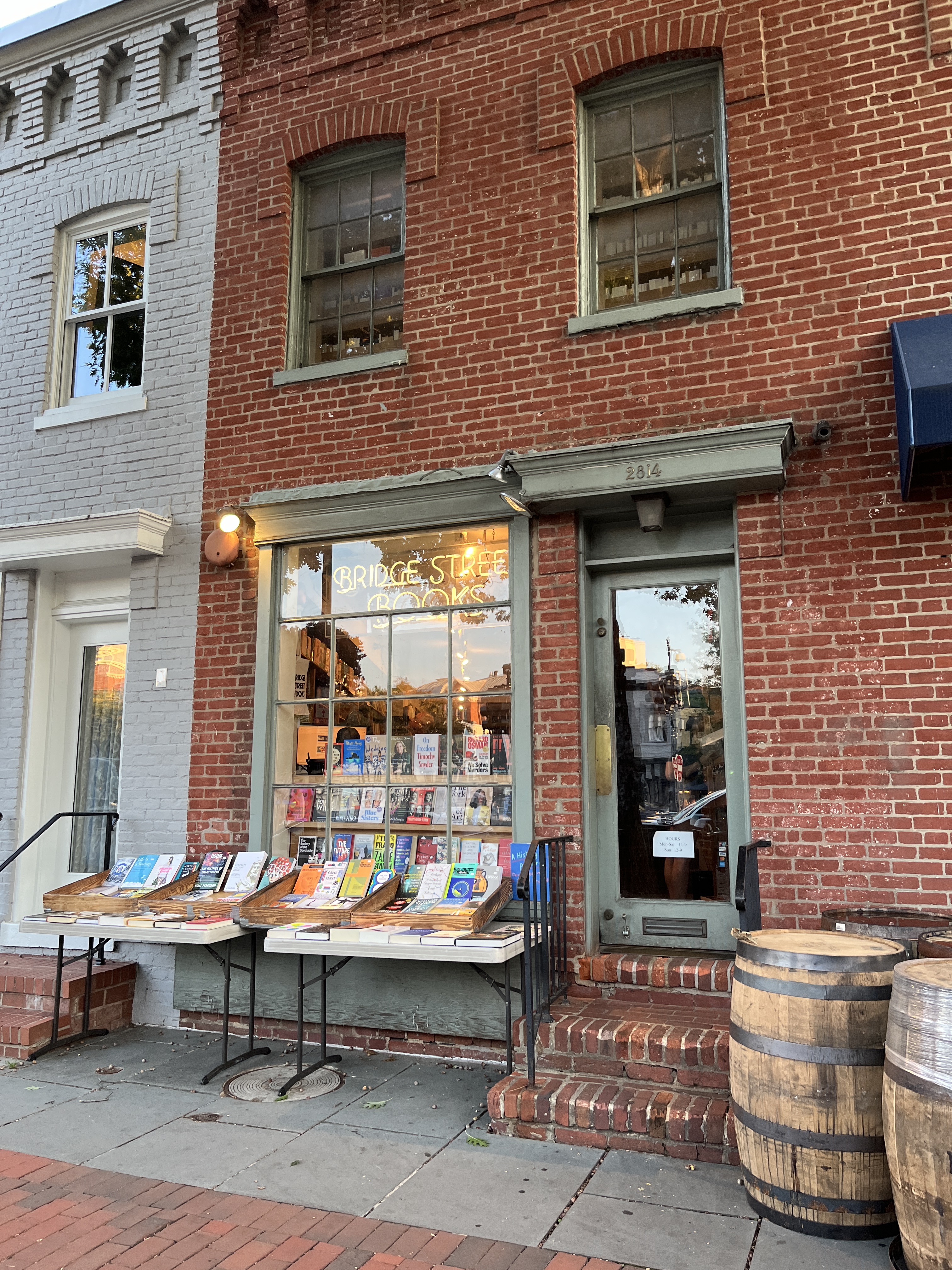
Founded in 1980 by Philip Levy, Bridge Street Books stocks a wide selection of trade, university, and small press publications. Climb the steps into this small two-story shop and one feels like you’ve entered the crowded apartment of a very interesting bibliophile, an individual who stocks works that interests them and displays their passions through the artwork and photos of Virginia’s Chesterfield Nationals baseball team that line the staircase wall.
Levy passed away in 2017, and the shop has since been run by a nonprofit. Regulars and reviewers most often cite the poetry, philosophy, and history selections as being especially diverse and rich. Two tables usually sit outside the front door filled with bargains to entice those walking by to stop and browse. When I’ve moved beyond the detective fiction, I’ve found an eclectic selection that certainly reflects the Georgetown neighborhood’s tastes and interests. And I usually find something that calls out to me to be purchased and read.
Bridge Street Books is a small, individualized gem in a city and an industry that have become depressingly homogenized with chains (the city) and online options (the industry) over time. Do yourself a favor and give them a visit.
Third installments seem to be the theme of this post, as on a recent visit to Bridge Street I picked up the third work in the Maigret Series. One of the first things that struck Chief Inspector Maigret was how strangely indifferent the wife and son behave when he investigates the death of a Monsieur Gallet in a small town outside Paris. Their attitudes just add to the puzzle of a crime where everything seems false.

The Late Monsieur Gallet (1931) by Georges Simenon, an early work in the Inspector Maigret series, is a tale of misdirection, betrayal, and misfortune. Called to the crime scene in a small hotel outside Paris, Maigret is immediately struck by the fact that so much about the case seems fake. The grieving relatives don’t exactly grieve. The dead man used an alias and had not worked at his stated place of business for 18 years. He traveled extensively throughout the country although his health was poor. Monsieur Gallet had been shot in the head, but it was a knife stabbed in the heart, administered almost immediately after the gun wound, that killed him. And was the dead man right or left-handed?
Because the book is an early one in this long-running series, the reader is still learning about the Chief Inspector’s methods, quirks, and history. Madame Maigret makes only a nominal appearance and except for the brilliant and methodical forensic specialist Joseph Moers—who loses part of an ear when he is shot examining the evidence—few of the other officers from the series are included in this story. Maigret delves into the contradictions that are all around him, trying desperately to sort out the facts from fiction. Using all of his skills, the inspector works to uncover the true crime at the heart of this story.
As I have been delving into Simenon’s Maigret canon, I have also become intrigued with the different approaches to portraying the detective on television. A new Masterpiece release on PBS updates the story to modern times, with a somewhat unconventional Maigret (he carries his father’s pipe around, but never smokes it); a striking and smart Madame Maigret, who is very much the inspector’s equal; and a diverse cast of supporting officers. I was familiar with the first story in this new season (The Lazy Burglar) and was able to see that the original story outline is faint but nonetheless provides a useful frame on which the writers and producers can add a variety of subplots.
It generally works. Even with those changes I enjoyed the new adaptation and am eager to see if the producers continue with future seasons. Simenon’s Maigret series is ripe for both reading (and re-reading) of the originals while also adapting the stories and characters for a modern audience.
A hallmark of Maigret as a detective is his empathy and insight into human behavior. At the end of this novel, the inspector no longer had the dead man’s picture, but he has something better: an understanding of what drove his final actions.
“His right cheek was all red . . . blood was flowing. He was standing there staring at the same place, as if he was waiting for something.
Peace, for heaven’s sake, that’s what he was waiting for, growled Maigret . . .”
More to come . . .
DJB
*To see the most recent installment in my year of visiting the DMV’s independent bookshops, click here. Three down, twenty-two to go!


Pingback: Observations from . . . February 2026 | MORE TO COME...
Pingback: From the bookshelf: February 2026 | MORE TO COME...
Pingback: Celebration of Interdependence | MORE TO COME...
Pingback: A celebration of independent bookstores | MORE TO COME...
Pingback: The forgotten life and mysterious death of baseball’s first phenom | MORE TO COME...
Pingback: Need to broaden your horizons? | MORE TO COME...
Pingback: The impossible sister | MORE TO COME...
Pingback: With one foot in fiction and the other in memoir | MORE TO COME...
Pingback: Navigating small town dynamics | MORE TO COME...
Pingback: Reading challenges and independent bookshops: A mid-year update | MORE TO COME...
Pingback: One challenge down, two to go | MORE TO COME...
Pingback: Exploring DC’s independent bookshops: A Labor Day update | MORE TO COME...