Yiyun Li’s memoir of loss is difficult, challenging, and honest. It was one of the treasures I found at Washington’s JF Books.
Installment #10 in my series on the region’s independent bookshops.
One of my hopes in visiting all 30 of Washington’s independent bookshops was to find stories and writers that expanded my worldview, challenged my preconceived notions, and introduced me to authors who had important things to say that I may have been missing.
Washington’s JF Books did all of that and more.
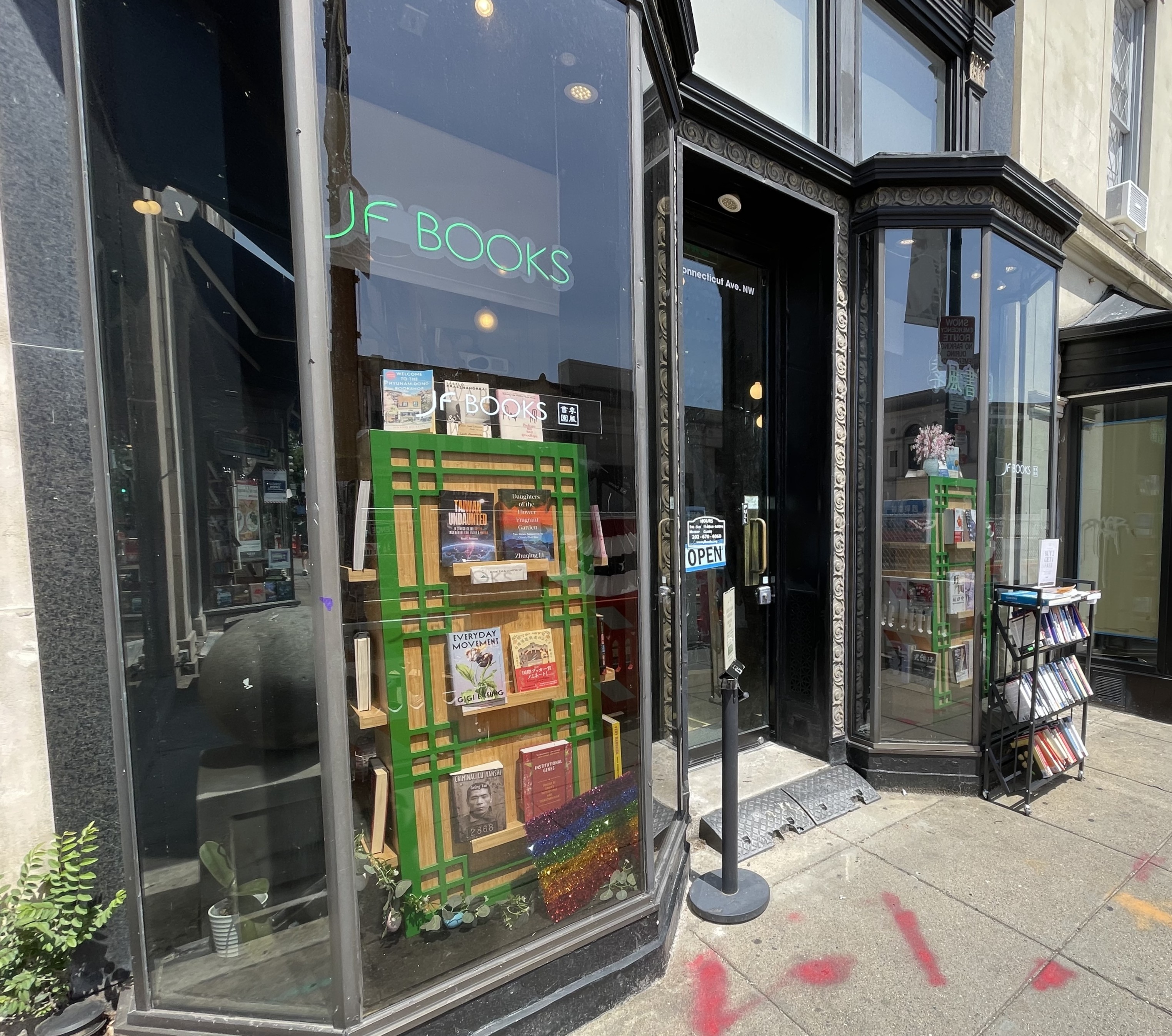
Located in Dupont Circle, this small storefront invites the reader into an independent bilingual bookstore rooted in Shanghai since 1997 and part of the nation’s capitol since opening here in September of 2024. As the only Chinese-English bookstore in the city and as a nonprofit, JF Books . . .
“. . . [is] committed to intellectual freedom, diversity, and critical thought. Our shelves feature a curated selection of Chinese-language books from mainland China, Taiwan, and Hong Kong, as well as English titles focused on China and Asia studies.”
JF Books grew out of Jifeng Bookstore. As the store’s About Us page on the website details, this institution has always been more than just a bookstore.
“For two decades, it was a cornerstone of China’s intellectual landscape. With eight branches at its peak, Jifeng fostered a love of reading and critical thinking through meticulously curated selections in social sciences and humanities, alongside vibrant cultural events. Lectures, forums, readings, and independent documentary screenings pulsed with intellectual energy, drawing in over hundreds of thousands of attendees in its final five years. However, Jifeng’s commitment to open dialogue clashed with a tightening grip on free expression. When told in advance of its fate of having to close on Jan. 31, 2018, it held a 283-day long countdown, accompanied by rich cultural events.”
Jifeng Bookstore found a new home in Washington with its new name, JF Books. It is a continuation of a legacy. Chinese-language social science and humanities books remain a cornerstone of the shop. But as I discovered on my recent visit, JF Books also showcases English-language works exploring China and Asia and celebrating the voices of Asian-Americans.
The very helpful staff directed me to the English language titles on my visit and provided guidance on books that might be of interest. It was a slim memoir that first drew my attention. A finalist for the National Book Award for Nonfiction, the winner of the Andrew Carnegie Medal for Excellence in Nonfiction, and the 2026 winner of the Pulitzer Prize for Memoir or Autobiography, I was taken by the book’s review in the New York Times: “Strange and profound and fiercely determined not to look away.”
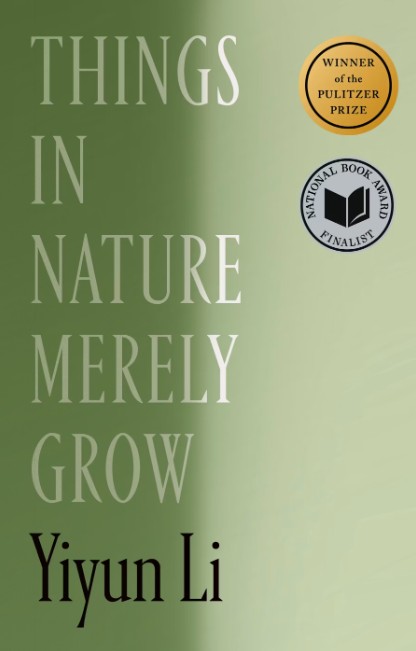
Things in Nature Merely Grow (2025) by Yiyun Li is one of the most difficult, unsettling, and yet moving books I have ever read. “There is no good way to say this,” Yiyun Li writes at the beginning of this book. “There is no good way to state these facts, which must be acknowledged . . . My husband and I had two children and lost them both: Vincent in 2017, at sixteen, James in 2024, at nineteen. Both chose suicide, and both died not far from home.” After that straightforward, painful opening, Li continues in austere and unsparing prose through what one reviewer correctly names a meditation on living and radical acceptance. From the abyss. “The death of a child realigns time and space,” she notes. “If an abyss is where I shall be for the rest of my life, the abyss is my habitat. One should not waste energy fighting one’s habitat.” Yet life grows alongside the scars. Children die and parents go on living.
Li is not looking for an end point to her sorrow. She is not looking to “get over it.” And she is most certainly not interested in thoughts from friends, acquaintances, or even strangers who say they “understand” her pain, those who make themselves the center of the message, remember their own losses, and provide advice on how to overcome grief from their own triumphant experience. She reminds all of us that grief cheapened by cliché is often purely for the consolers themselves.
“I am not a grieving mother,” she writes. “I am the mother who will live, every single day, for the rest of my life, with the pain of losing Vincent and James, and with the memory of bringing them up.”
Throughout this short, powerful work, Yiyun Li is an “astute and unsentimental writer and observer.” She faces the facts, which are “the harshest and the hardest part of life” because unalterable facts bring with them some order and logic. One fact that resurfaces throughout the book is Li’s difficult relationship with her own mother. It certainly impacts how she relates to her own children and with life. When a couple of mothers ask if they could tell their children—Vincent’s peers—that he had died in an accident, she writes that “not calling a fact by its name can be the beginning of cruelty and injustice.” She is speaking from experience.
This book, which she has written for James after producing an earlier, different type of book after Vincent dies, is not designed to “provide the easy satisfaction of fulfillment, inspiration, and transformation.” It is not that type of book. In the past Li has quoted Montaigne: “To philosophize is to learn to die.” Now she knows that there are other variations:
“To philosophize is to learn to live with deaths. | To philosophize is to learn to live with those deaths until one dies. | To philosophize is what one can do while living in an abyss—not lost, but found.”
With a book that has garnered this much acclaim, one can find a wide variety of reviews. One of the most meaningful from my reading was by Siqi Li on the Literary Mama website. Writing as a parent and specifically a mother, Li notes that while she is drawn by the book’s title, she’s also “deeply unsettled by the unimaginable tragedy of Li’s loss.” Every parent who reads this book wants to ask the question that should not be asked. In her beautiful and nuanced review, produced after a trip to Taipei, where she had visited the dormant volcano, Seven Star Mountain, Siqi Li writes,
“But through her words again, I see her presence as a mother, ‘holding on to everything and nothing that is called now and now and now and now,’ and I recognize that her spirit is already in me. It is the spirit of stubborn maternal instincts, of [Hawaiian] goddess Pele’s lava streams, penetrating the vast lands and splitting open every crack, exposing our vulnerabilities with force, heat, light, and truthfulness. This is what I think the title means: nature does not bother waiting for the wound to close before growing again. Like the silver grass in the wind on top of the Seven Star Mountain, life grows alongside the scar, with fear, with suffering—and Li lets us see it: the rustling bamboo, the dancing butterflies and chafer beetles. We fear, we suffer, and still, we live, because things in nature merely grow.”
At the end of this profoundly moving book—difficult, yes, but also deeply meaningful and illuminating—Yiyun Li tells her readers about a note she receives from a colleague who had a student who died from suicide. Her friend had been asked to speak at his service and she shares lines from a German poem that she intends to read.
“There are times in life when the world seems to stand still, and when it turns again, nothing is as before.”
Li’s world, still once before, is stiller now. “Children die, and parents go on living—this, too, is a fact that defies all adjectives.” Li said “I love you” to both of her children many times. And that, too, is a fact.
Yiyun Li’s words are not comforting, but they open a way of approaching life and death and life with honesty. Things in nature merely grow until it’s time for them to die.
More to come . . .
DJB
Photo of darkness and light via Unsplash.


When I shared the link and story with JF Books, I had this delightful response back from Calvin Yu:
Check them out. I suspect you’ll find some unexpected treasures.
Pingback: Observations from . . . July 2026 | MORE TO COME...
Pingback: From the bookshelf: July 2026 | MORE TO COME...
Pingback: Attention is the beginning of devotion | MORE TO COME...
Pingback: Summer reading . . . check! | MORE TO COME...
Pingback: Exploring DC’s independent bookshops: A Labor Day update | MORE TO COME...