
Nafissa Thompson-Spires has produced a debut novel that turns convention about history and mystery writing on its head. A beautiful work full of insight, pathos, and humor. What a combination!
Histories built around racial tensions and Jim Crow era segregation are, rightly, serious works for serious subjects. But what happens when a writer seeks to explore the joy in self-determination? Likewise, murder mysteries are generally constructed as whodunits. Can we have a work where we know from the beginning who committed the murder, and the tale is to find out if they will get away with it?
Convention, in skillful hands, can be turned on its head. To find such craft in a debut novel is unusual, but also exhilarating.
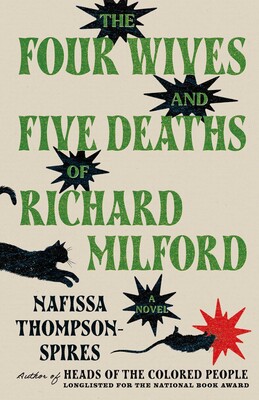
The Four Wives and Five Deaths of Richard Milford (2026) by Nafissa Thompson-Spires is a dark comedy about love, death, self determination, and survival. The story begins at the funeral of Richard Milford who is being buried, but not celebrated, by his four “wives.” That’s not the best description of his female companions who are the mothers of his 13 children, as he legally has only one “wife.” The town has come together in 1927 to gawk at this unusual family that seldom shows its face beyond the Milford mansion which sits high above the free-Black community of Newville, Oklahoma. Townfolk want to see how they will “honor” the man who appears to be something of a cult leader, business mogul, bigamist, and con man. As the book progresses we find that Milford usually begins to seduce his women and friends with charm but when that fails the bootlegger resorts to force. Sophronia—the woman who is the mother to the largest number of Milford children—says, “By my count, there were five Riches, a spectrum from Rich to Not-Rich, any of which could appear on a single day.”
“In the morning” (as one reviewer encapsulates it) “he’s a hard-working rancher and black-market businessman (brisk sales of moonshine), but by the afternoon he might transform into ‘Rich the Enriched, dreamer, peering through his hand-built telescopes.’ At night a lover, during the day he’s Daddy for his 13 children. On occasion, he sheds all recognizable identities and changes into ‘Rich who was not Rich, like a caterpillar and a chrysalis and a butterfly all out of order.’”
Each of the four wives plus Rich’s long-time cook narrate chapters in which they describe their personal attempt to kill the family patriarch. The personalities and peccadillos shine through each story. Alberta, the cook, introduces the reader to folk beliefs around the eclipse and the blood-red moon that appeared just before the fateful day. Lally, the wife with the marriage certificate and no children, describes Rich’s personal philosophy of Stoic Enterprising which involved three principles: wealth accumulation without government interference, the need for a stringent (all white) diet, “and the notion that if we evolved enough on earth, our souls, shrouded in white, would not see final death, but meet again one Great Friday on a celestial plane.” Sophronia, Georgette, and Vivianne—the young woman brought in as teacher for the 13 children and who becomes the last of Rich’s personal harem—all have their own reasons for wanting Rich dead.
Interspersed with these confessions are the thoughts of the townspeople of Newville, the freedom town for Blacks that existed until statehood, the Depression, lynching, and the new highway “disappeared most of us into history.” No matter how they feel about the town’s prospects, no one in Newville, it seems, is sad to see Rich dead.
“Piddling pissant,” says the narrator near the book’s beginning. “Since time for us in Newville moves in the shape of a full moon, we could simultaneously Juba and teach one how to Dougie—and detest Rich Milford beyond the infinite in every parallel reality. Excuse us, then, while we alternately stomp, spit, blow our noses, Cakewalk, C-walk, Charleston, Nae-Nae, Macarena, Wobble, Electric Slide, Cha-Cha Slide, and do the Hustle on Rich’s grave.”
Yes, many of those dances post-date the 1927 setting, but that’s just part of the fun of Thompson-Spires’ book. And the reference to time is captured by a small symbol at the end of each chapter, as we see the work progress from the sliver of a crescent in Chapter One to a full moon by the end of the book.
Rich’s body has been pulled out of the river “swollen and stinking of gangrene, poisoned and bootmarked and missing a foot.” Over the course of this short, page-turning novel we learn how those various attempts at murder took place, the refusal of Rich Milford to die until he did, and the specter of lynching that reminds the residents of this freedom town that they really aren’t free. Their church, stores, sheriff, and newspaper may all be Black, but in 1920s Oklahoma—and especially after the Tulsa race massacre—white supremacy and bigotry are still very much the order of the day.
Thompson-Spires has written an unconventional novel that examines history, human nature, joy, and pain on its own terms. Nana Kwame Adjei-Brenyah—author of Chain-Gang All Stars—calls this work “a beautiful novel that makes you smile even as it hurts.”
That’s a great description for a work full of love, violence, and mercy. I can’t wait to see what Thompson-Spires writes next.
More to come . . .
DJB
This book was purchased at People’s Book. For my description of this Takoma Park bookshop taken from my tour of the DC region’s 30 independent bookstores, see Installment #2.
Photo of a lunar eclipse by Steve Busch on Unsplash

